
Articles & Guides
Tips, ideas and free printables — 303 guides and counting.
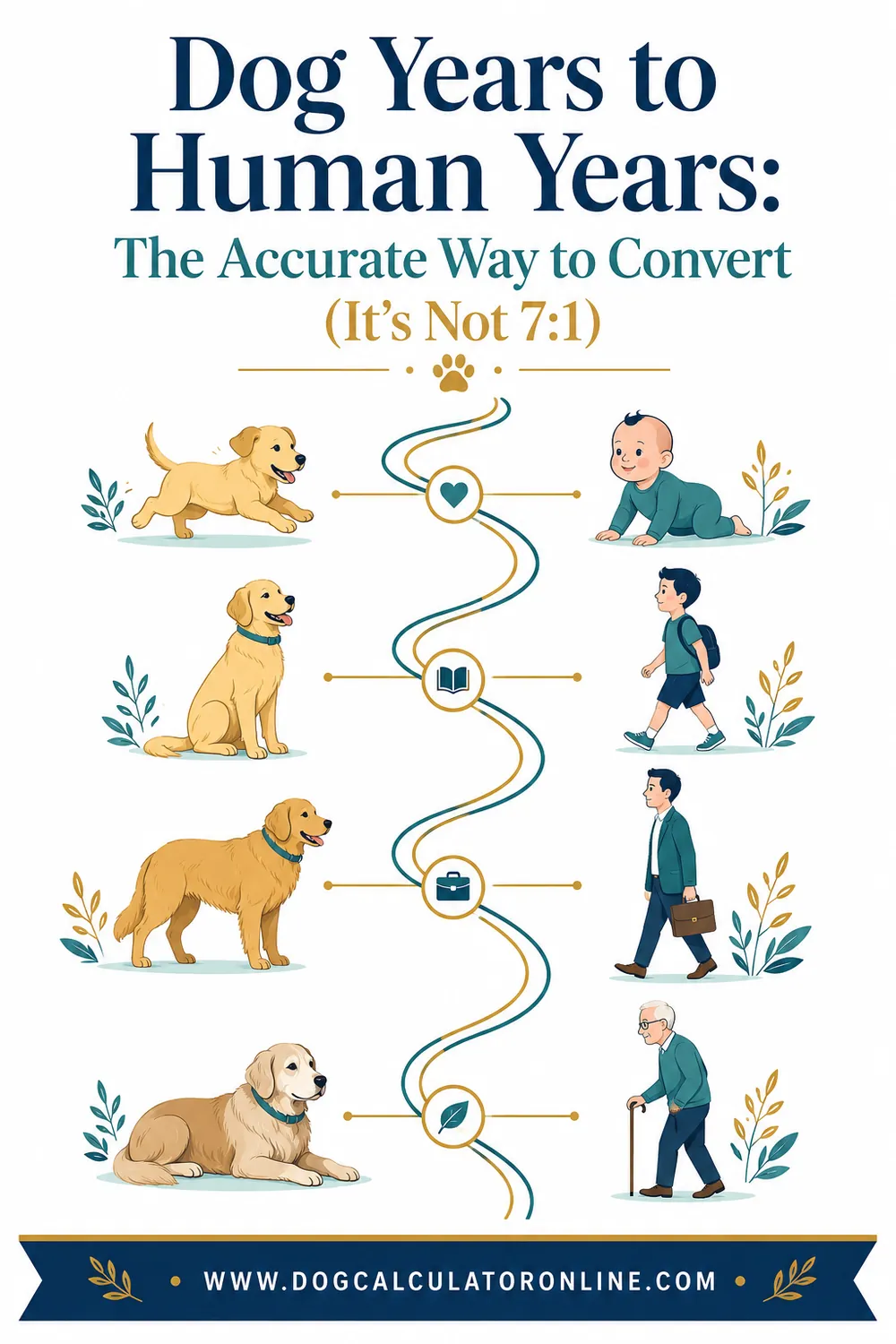
Convert dog years to human years the accurate way. See the vet-backed size-adjusted formula, the 2019 DNA study math, and why the 7-year rule is wrong.
How old is your dog in human years? Use the vet-backed size-adjusted method (not x7) plus the 2019 DNA formula. Free calculator and a full age chart inside.
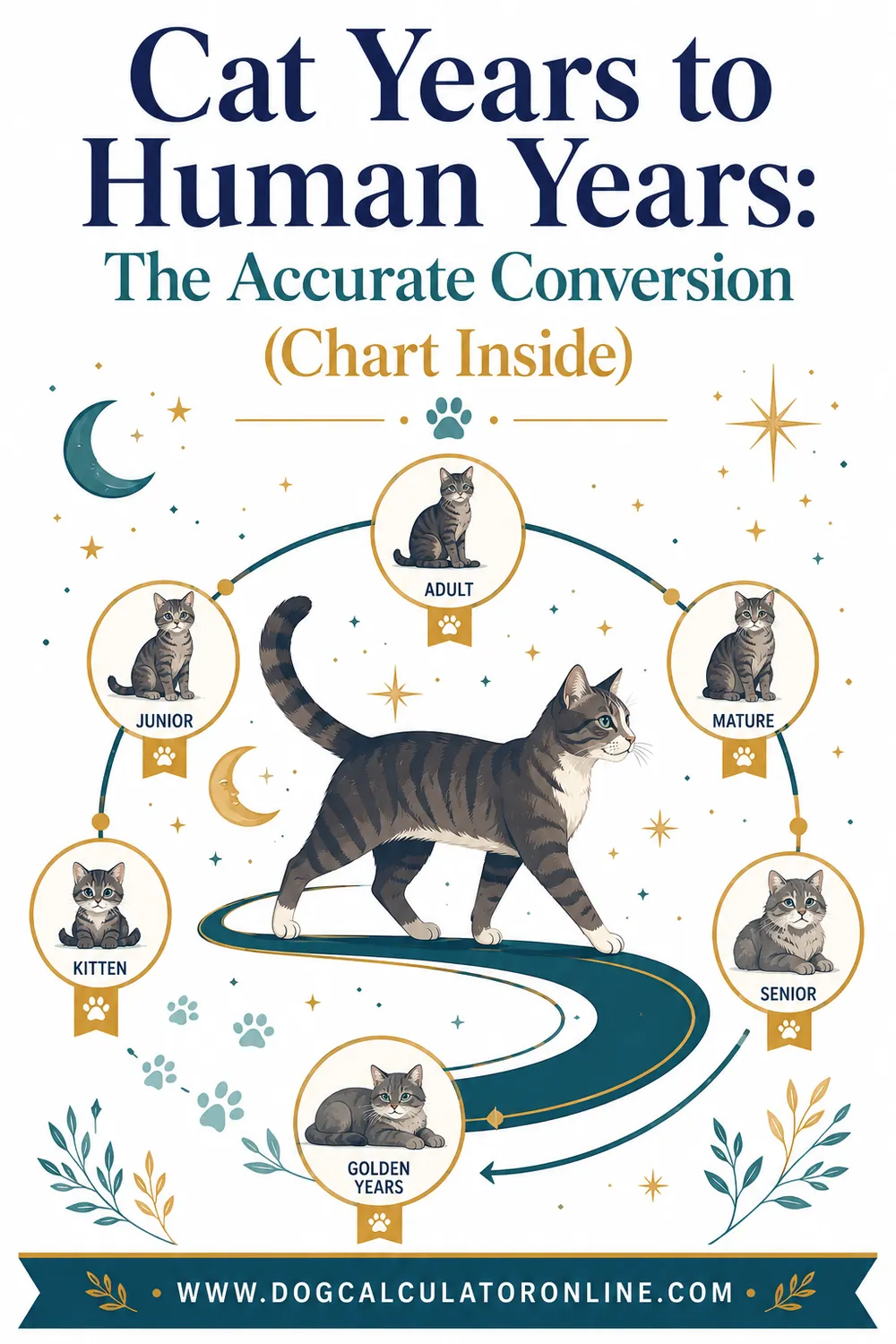
Convert cat years to human years accurately. See the vet-backed method (year 1 = 15, year 2 = 24, then +4/yr), a full chart, and why it differs from dogs.
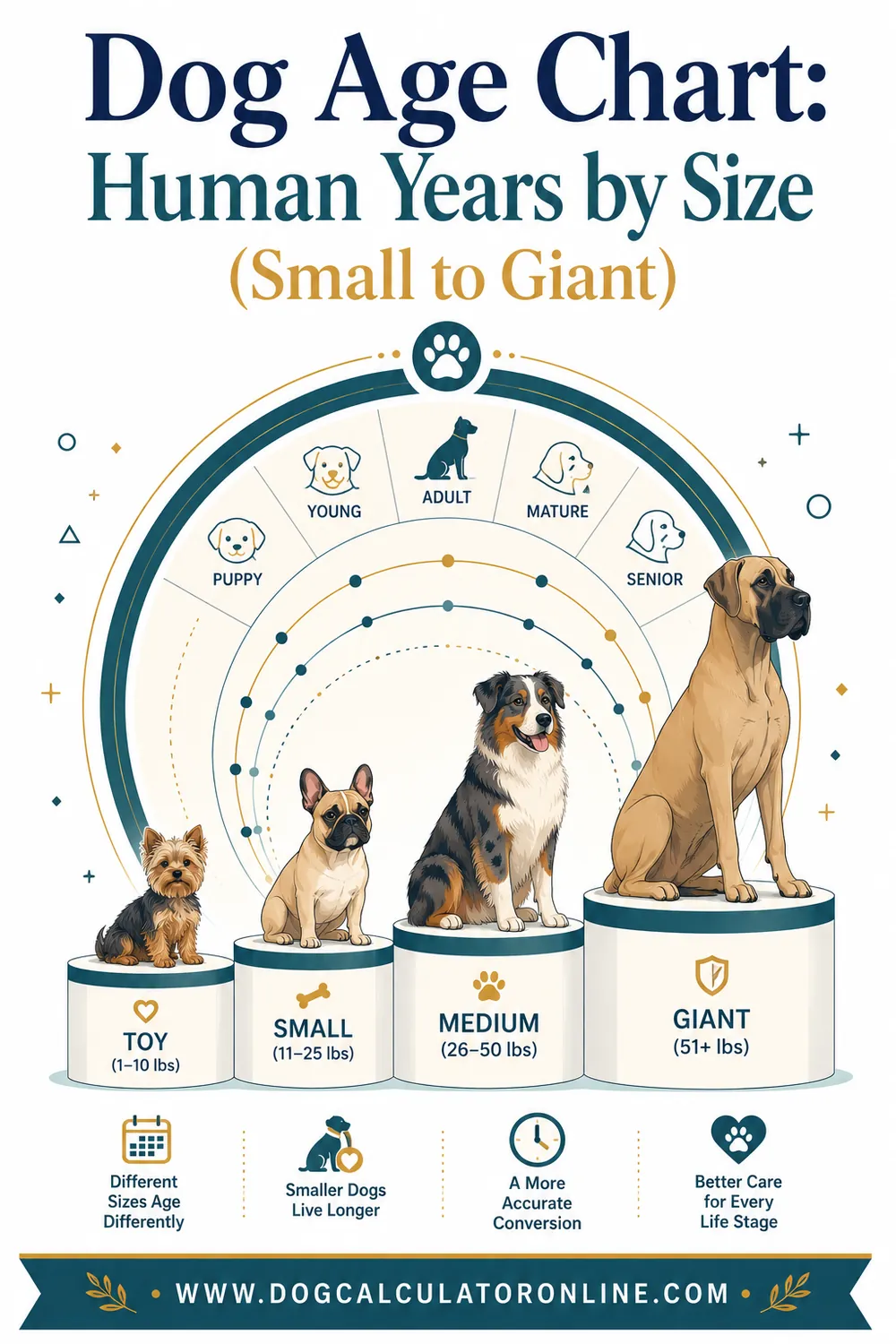
The accurate dog age chart in human years, broken down by size from small to giant. Vet-backed numbers, life stages, and a free calculator for your dog.
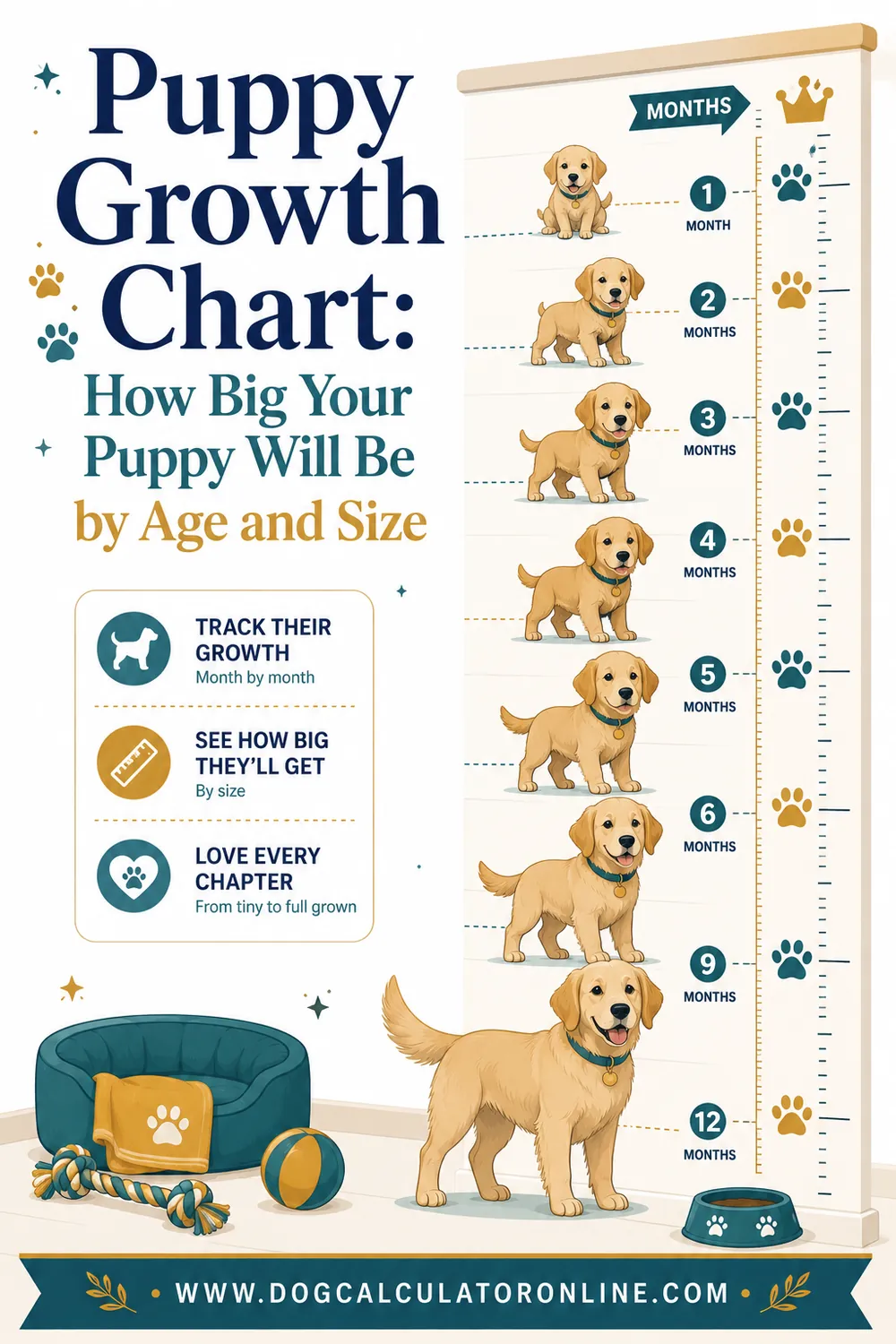
A puppy growth chart by size class — see what percent of adult weight your puppy reaches at each age, plus how to predict their final size. Free calculator inside.

How big will your puppy get? Use the paw test, the double-at-4-months rule, and weight formulas by size class to predict adult size. Free puppy weight predictor.
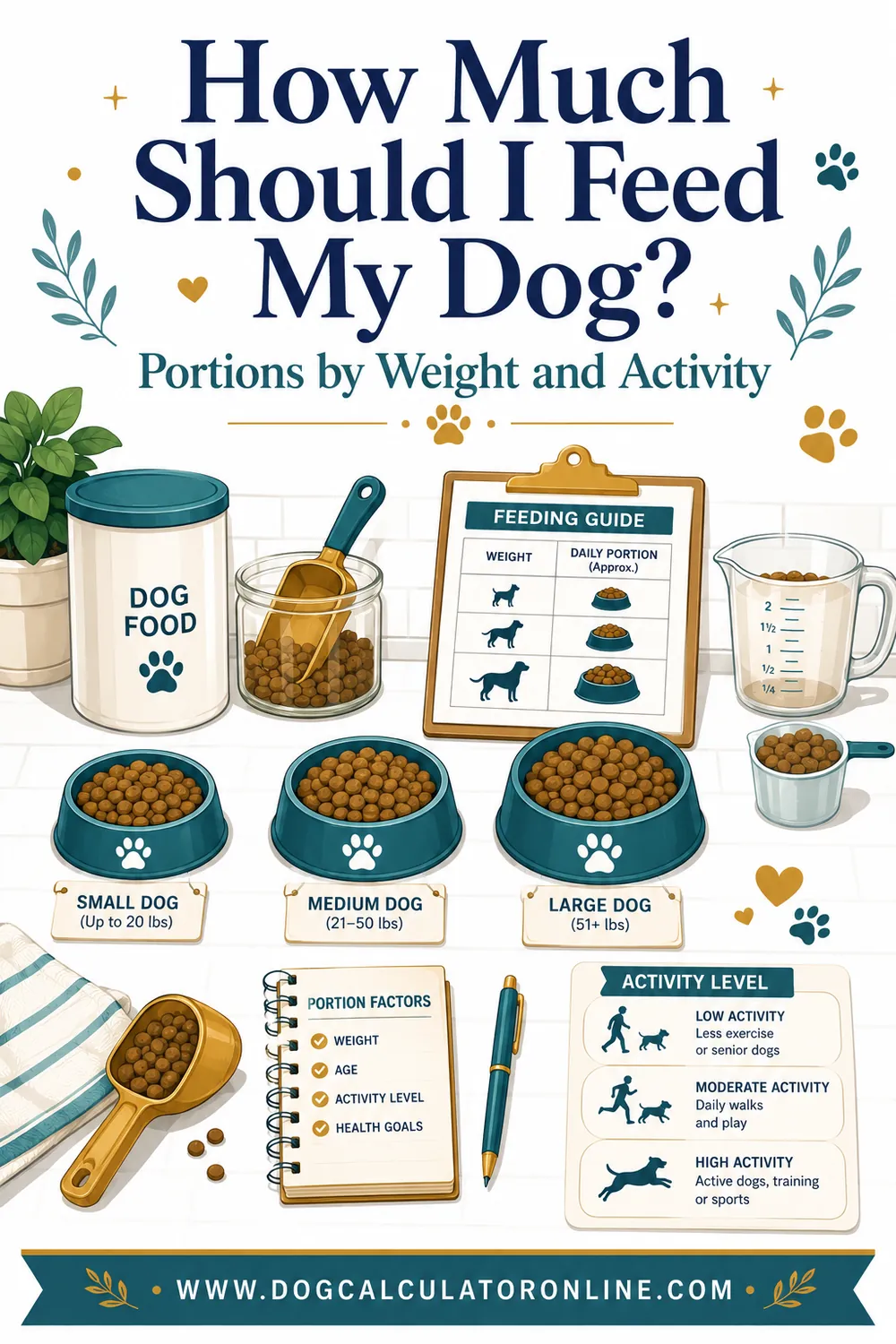
How much should you feed your dog? A clear chart by weight and activity level, how to read your food's calories, and body-condition checks. Free feeding calculator.
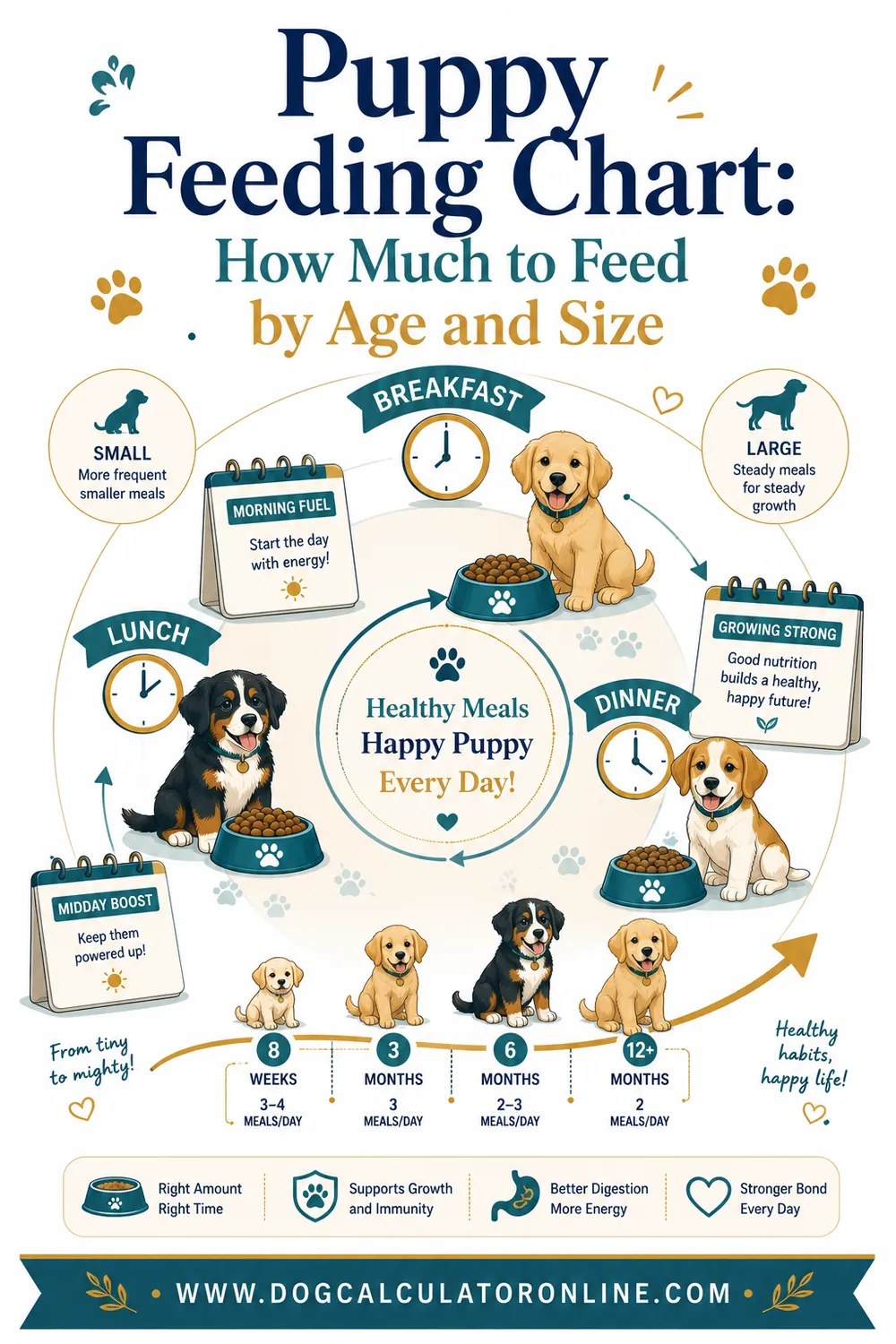
A puppy feeding chart by age and expected adult size — how much and how often to feed from 8 weeks to 12 months. Plus meal schedules and a free puppy calculator.
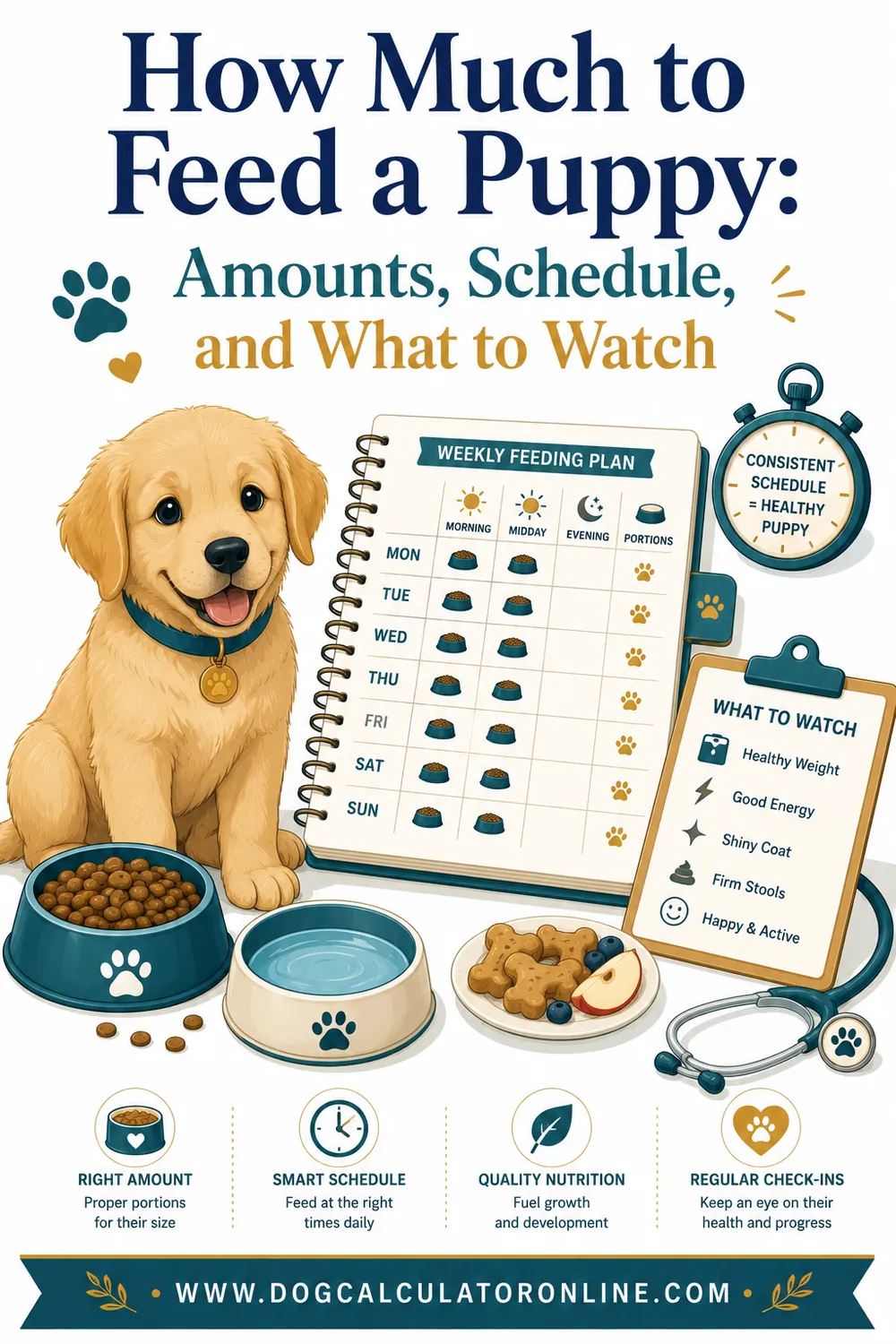
How much to feed a puppy at every age, by size — daily amounts, meal schedule, and how to read the bag. Simple, vet-aligned guidance and a free puppy calculator.
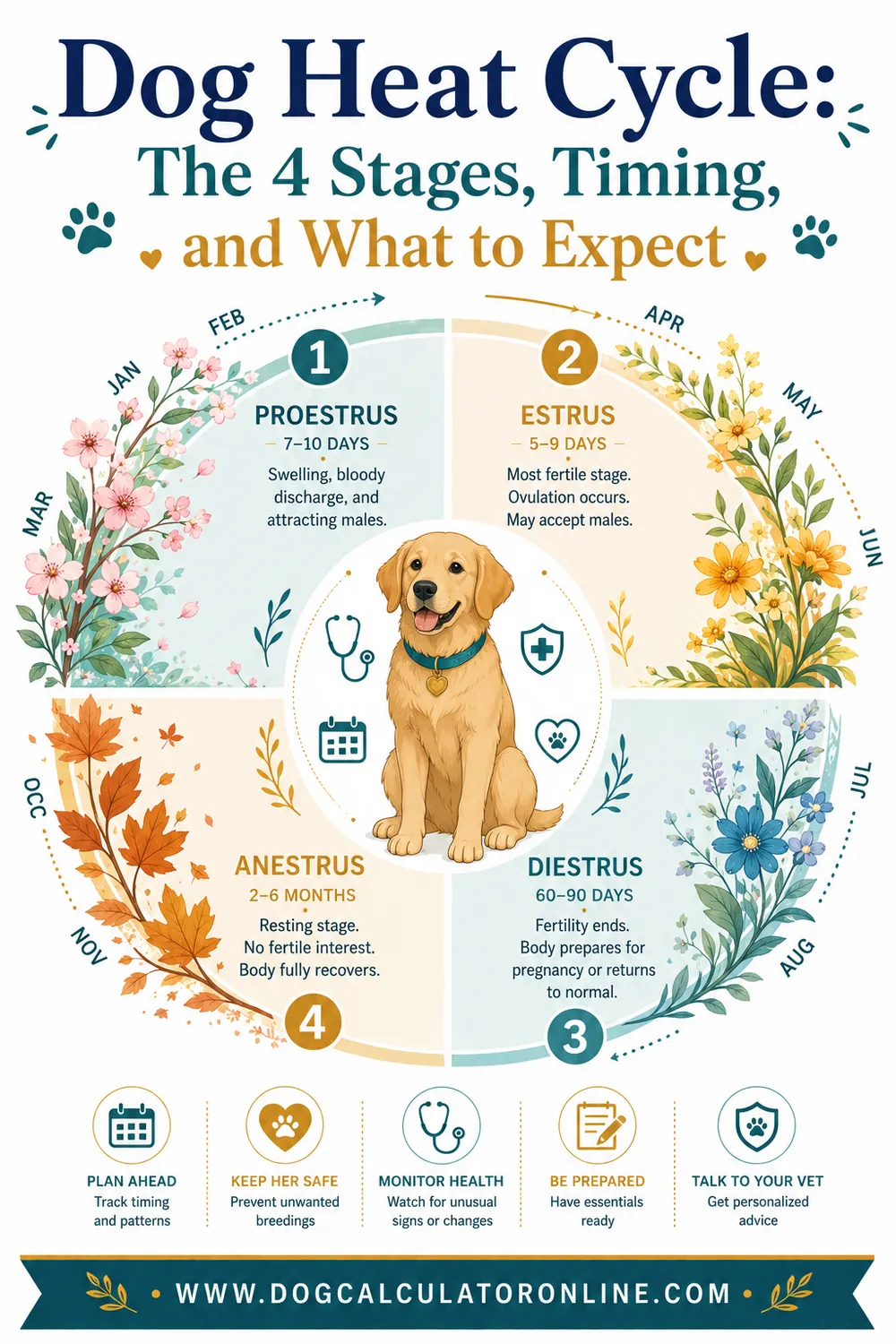
Understand the dog heat cycle — the 4 stages, how long each lasts, how often dogs go into heat, and the signs to watch for. Practical, vet-aligned guidance.
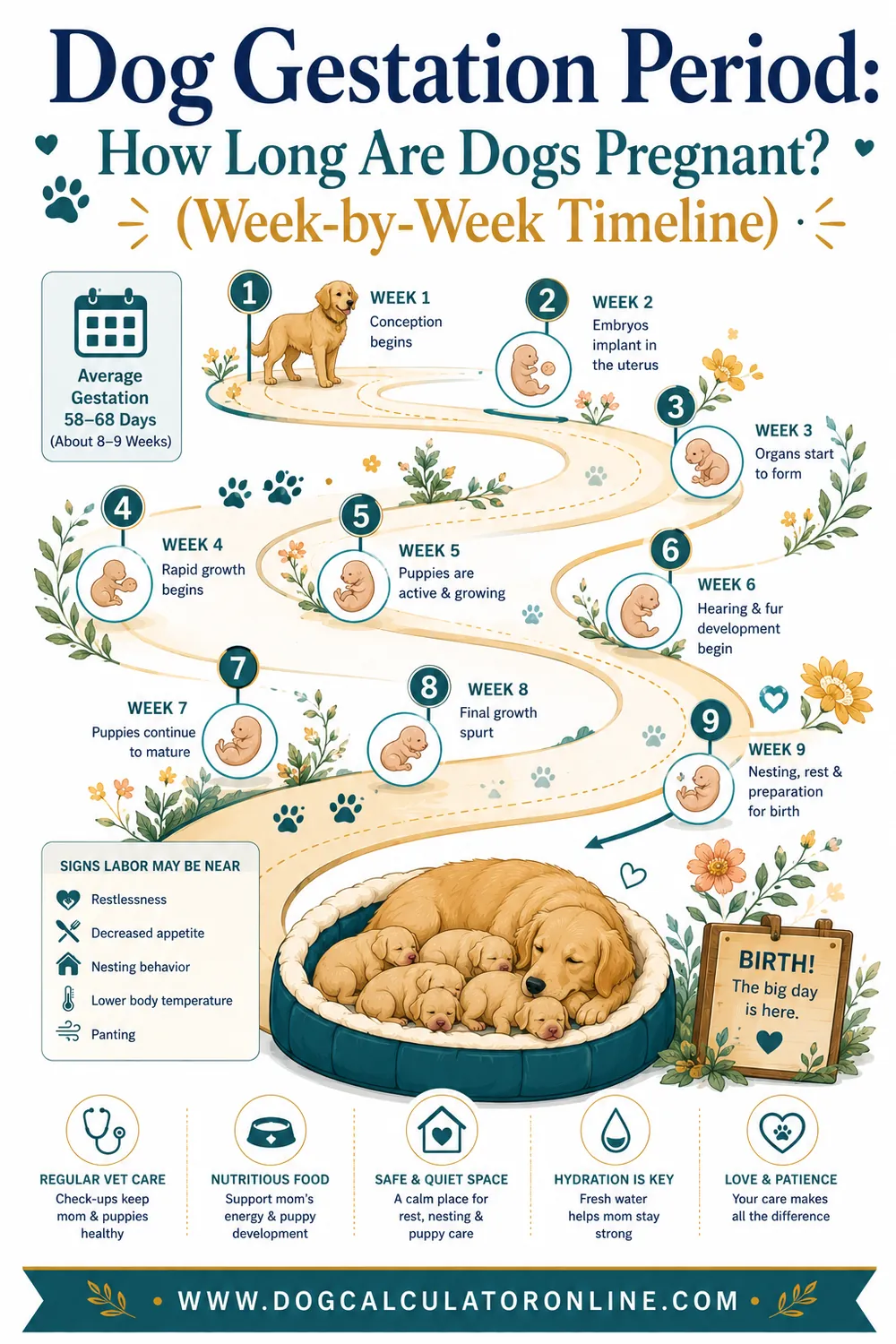
How long are dogs pregnant? The dog gestation period is about 63 days (57–65). See the full week-by-week timeline, labor signs, and care tips for mom.
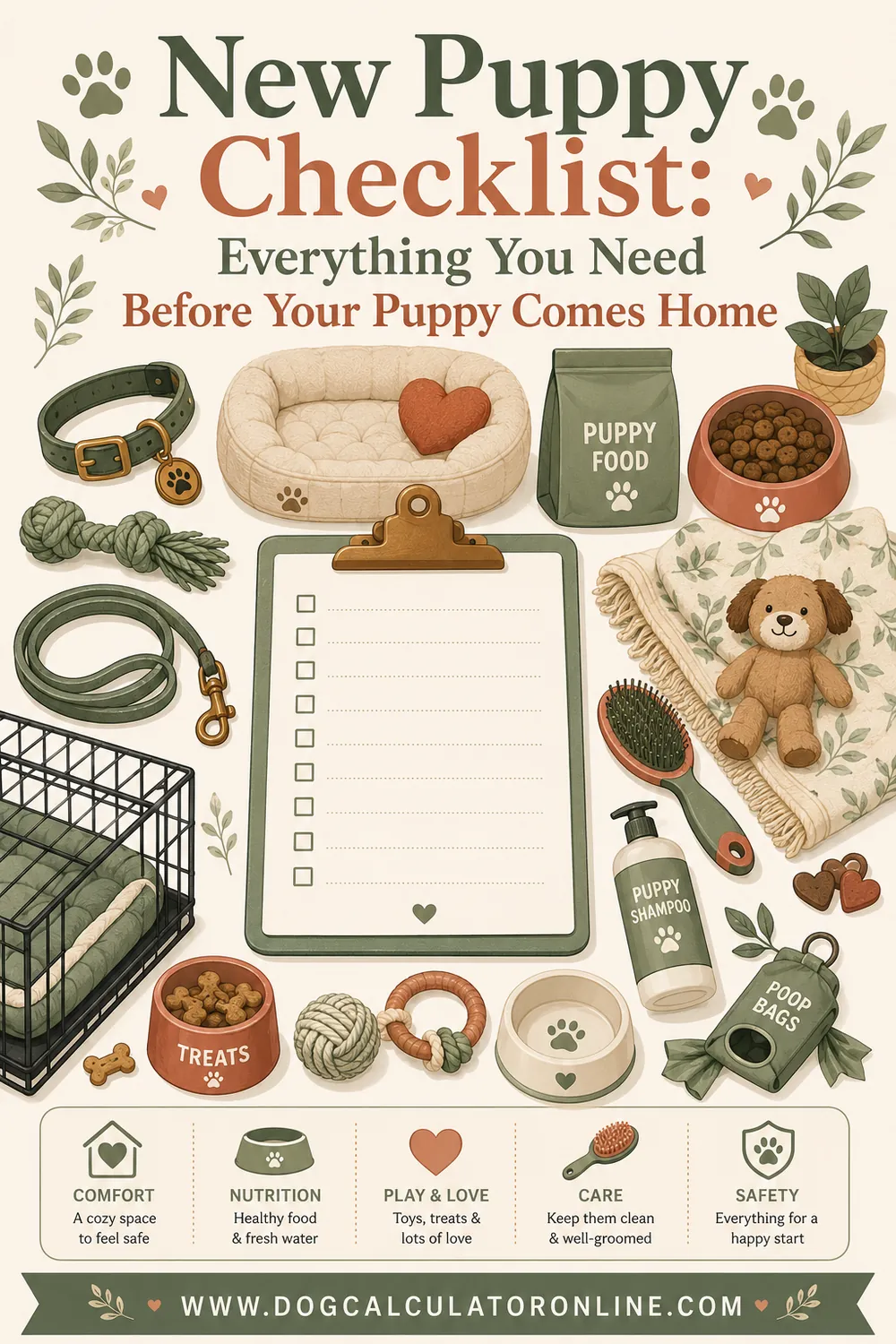
The complete new puppy checklist: supplies, puppy-proofing, first vet visit, and week-one plan. Everything you need before your puppy comes home.
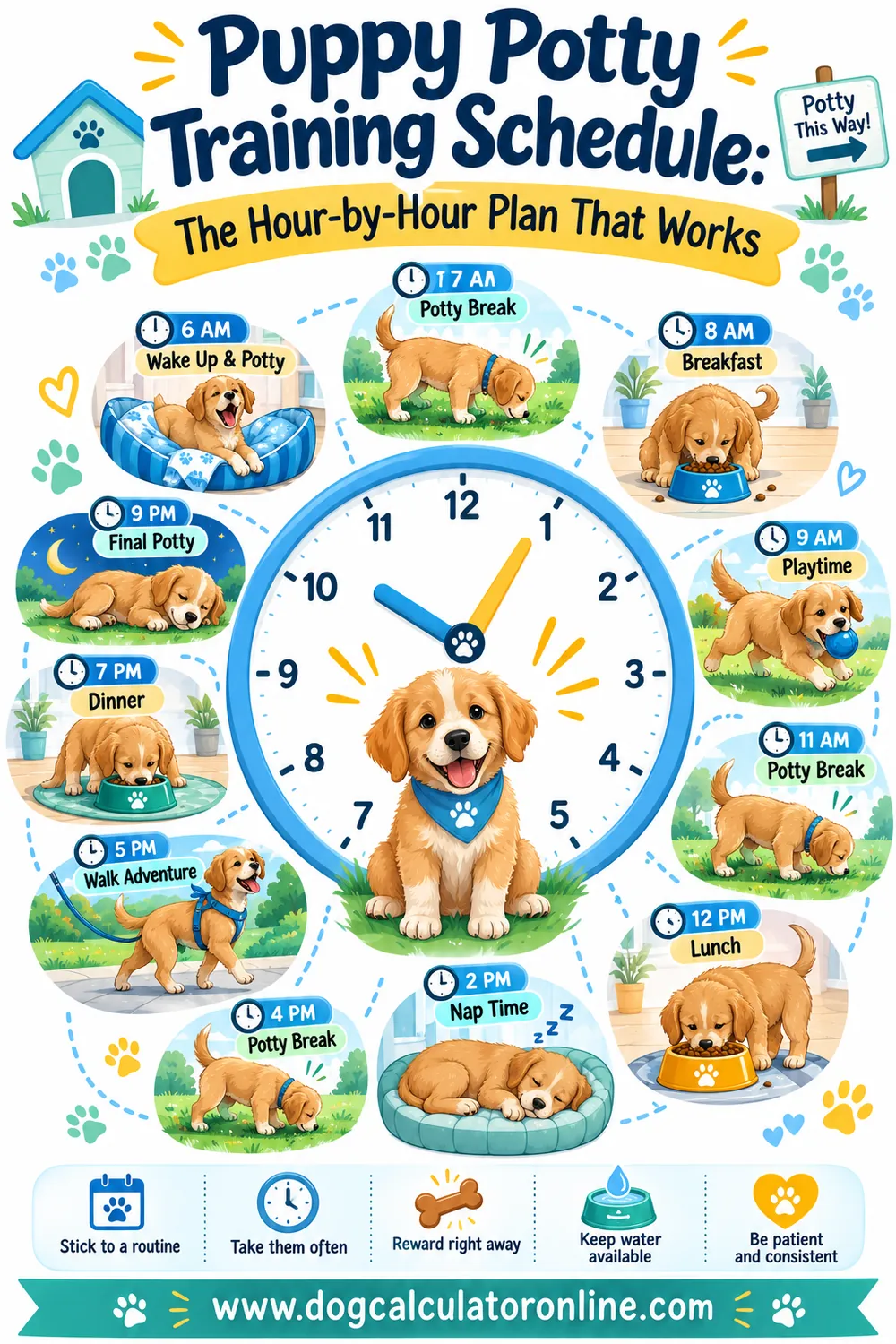
A realistic puppy potty training schedule by age: how often to go out, a sample daily routine, night plan, and how long training really takes.
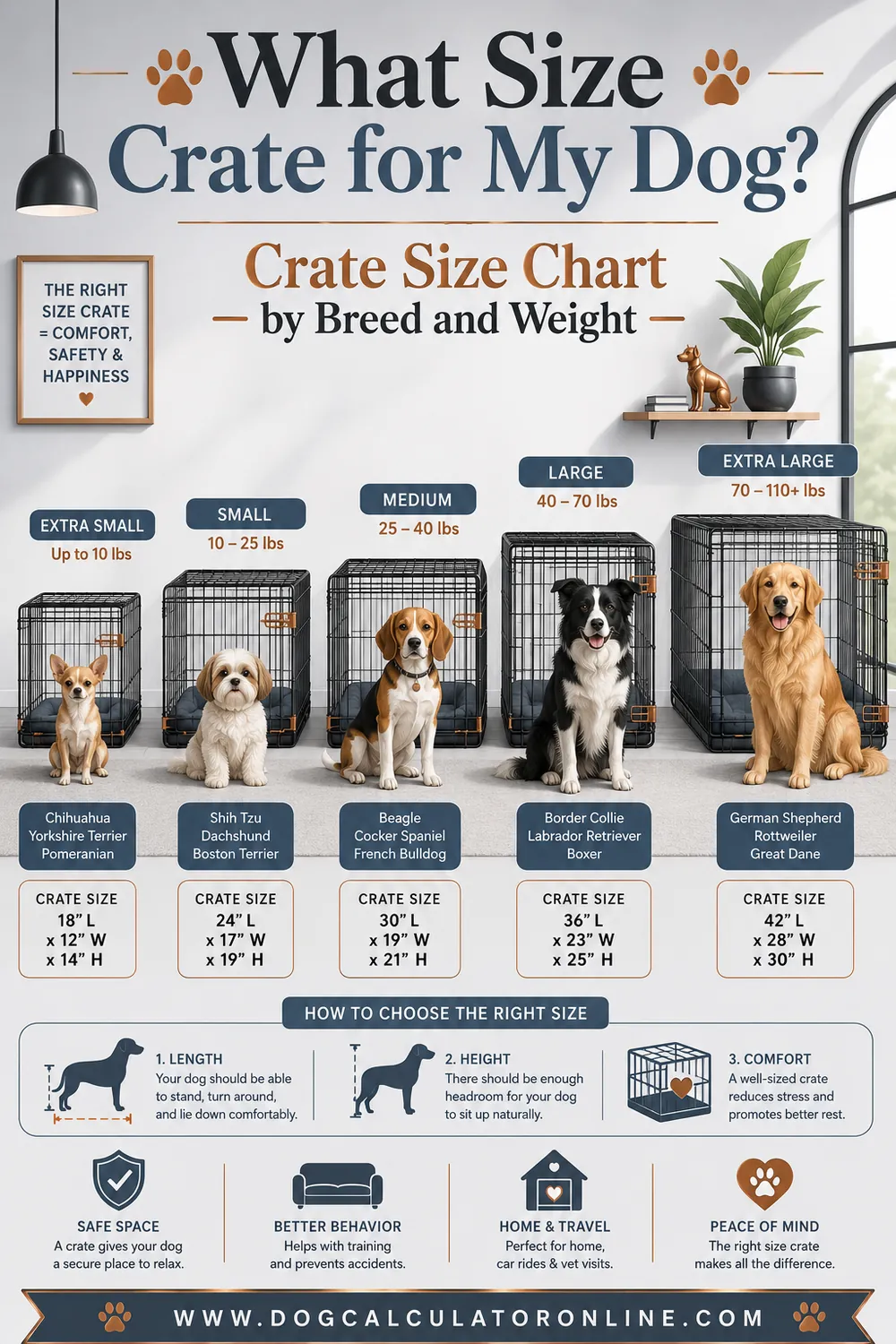
Find the right dog crate size: measure nose to tail base and add 2–4 inches. Full crate size chart by breed and weight, plus puppy divider tips.
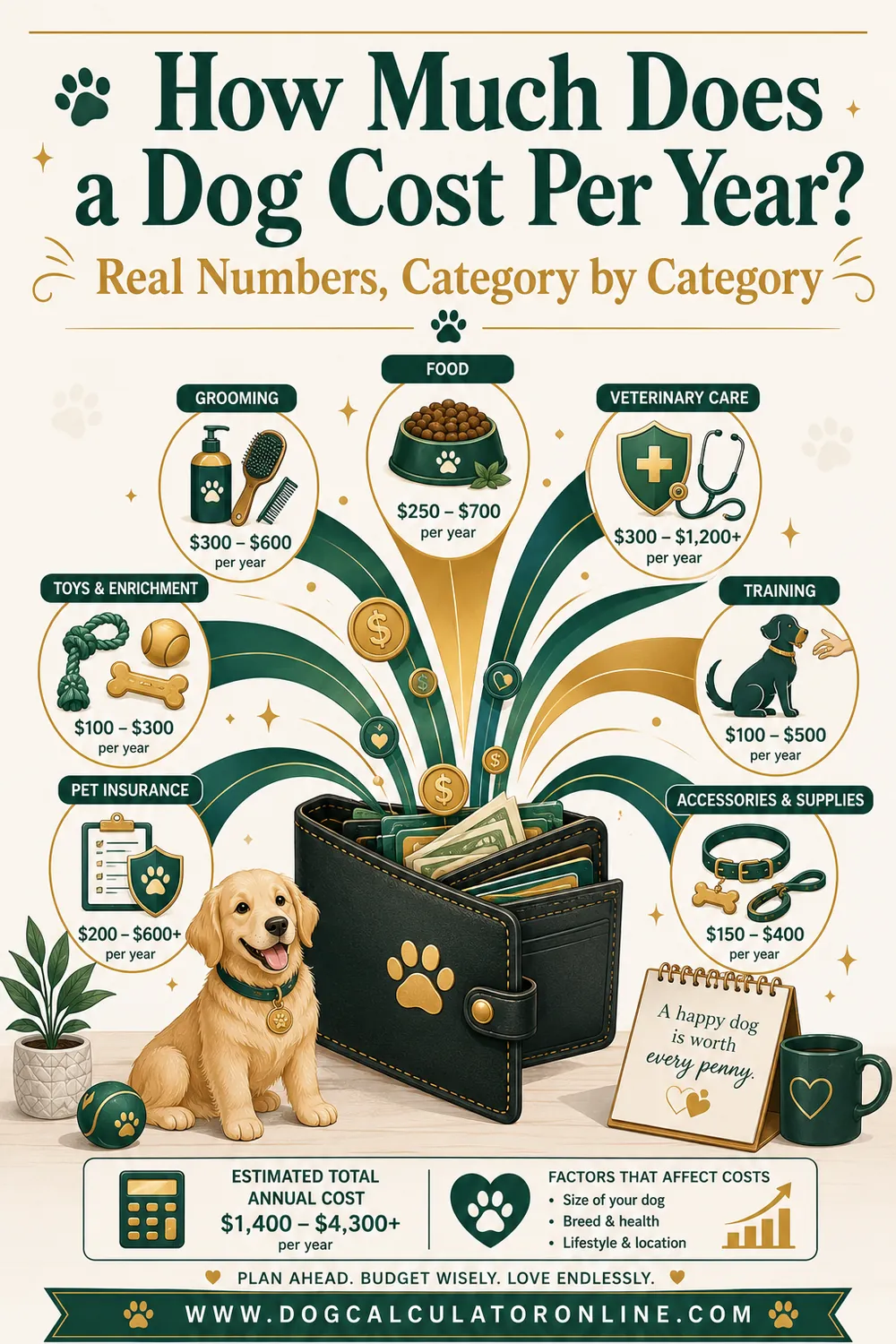
How much does a dog cost per year? Typical US owners spend $1,500–$4,000 annually. See the full breakdown: food, vet, insurance, grooming, and more.
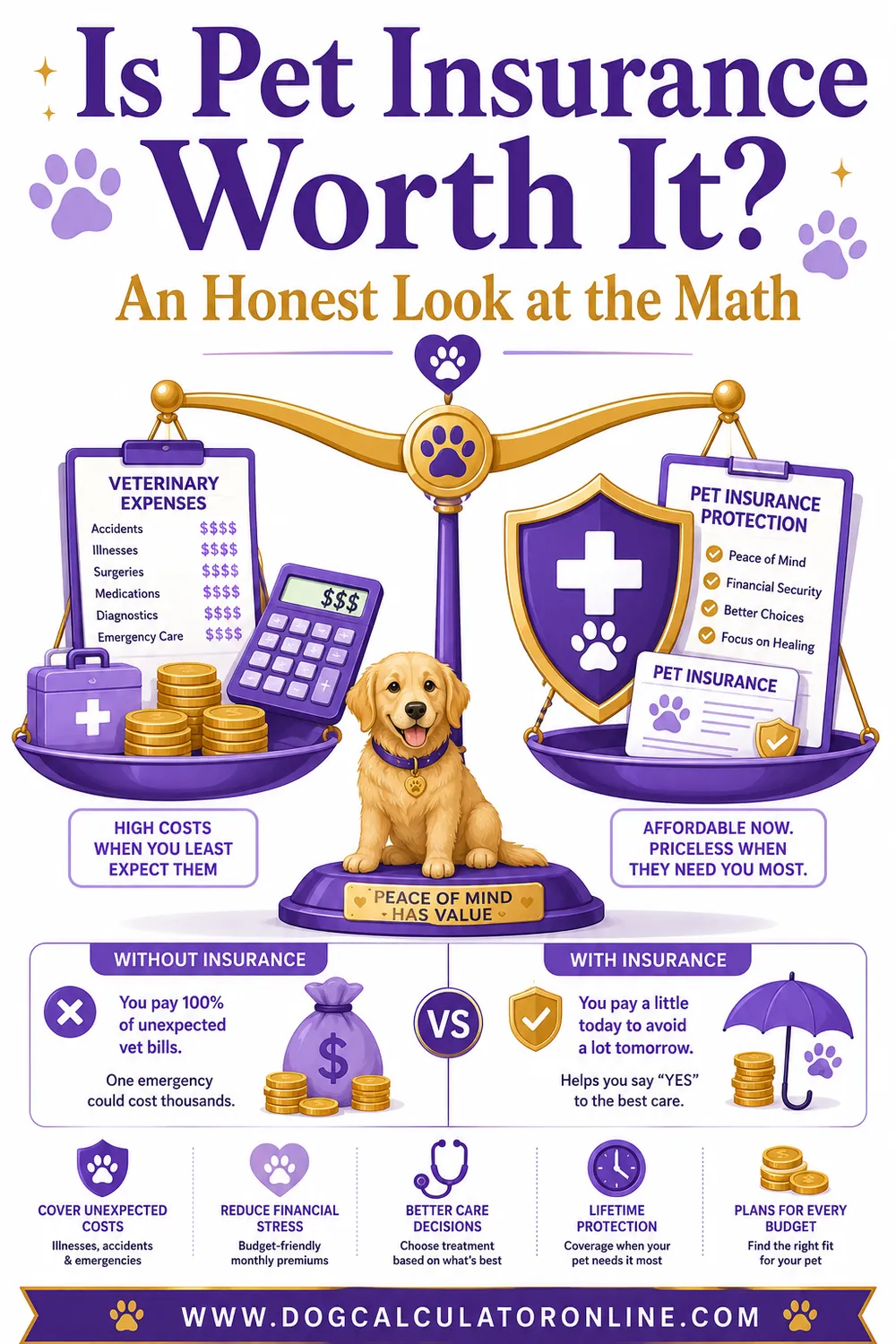
Is pet insurance worth it? Typical dog plans cost $40–$70/month. Here's the honest math, when insurance beats self-insuring, and how to decide.
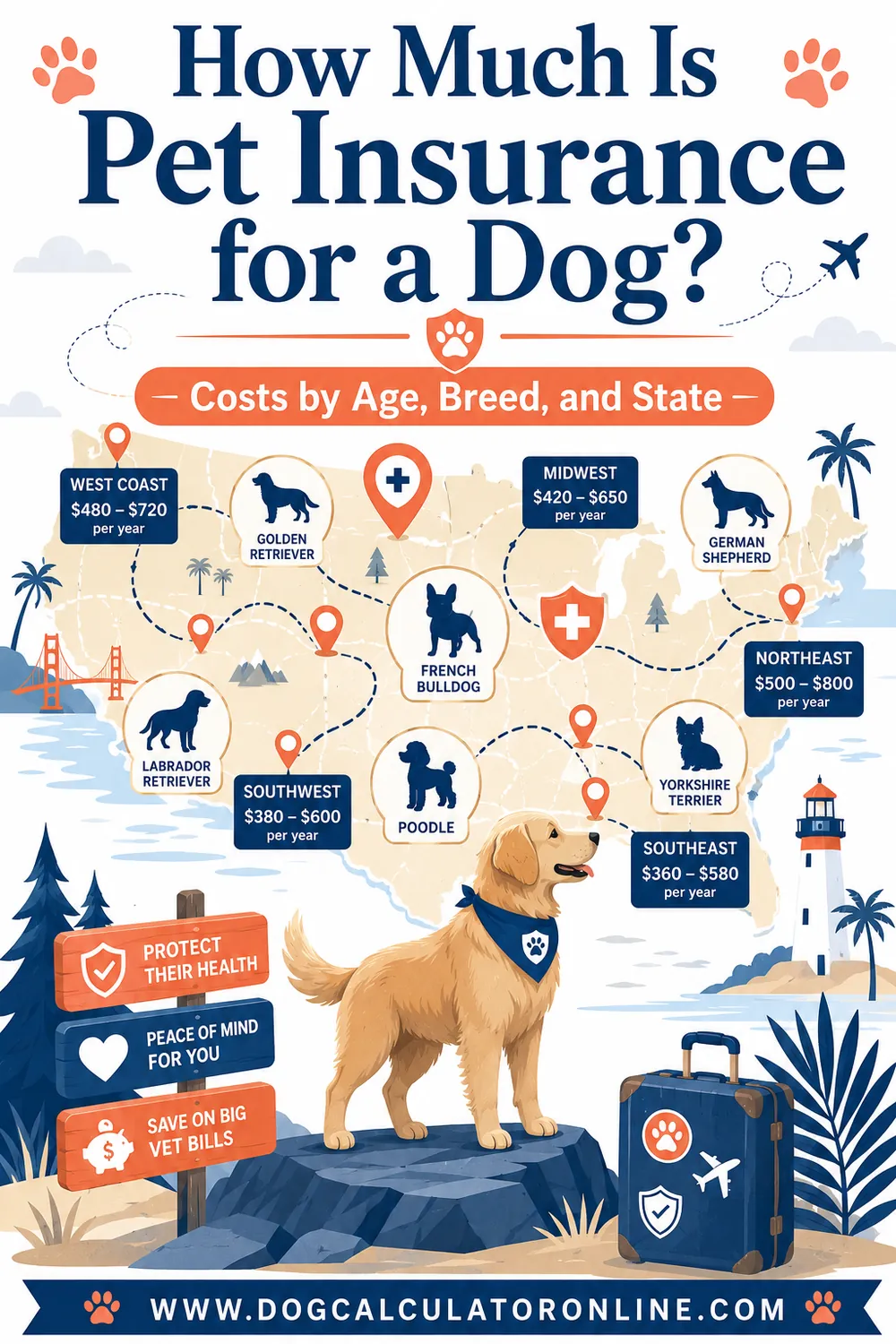
How much is pet insurance for a dog? Typically $40–$70 a month. See how breed, age, state, and deductible change your price — plus easy ways to lower it.
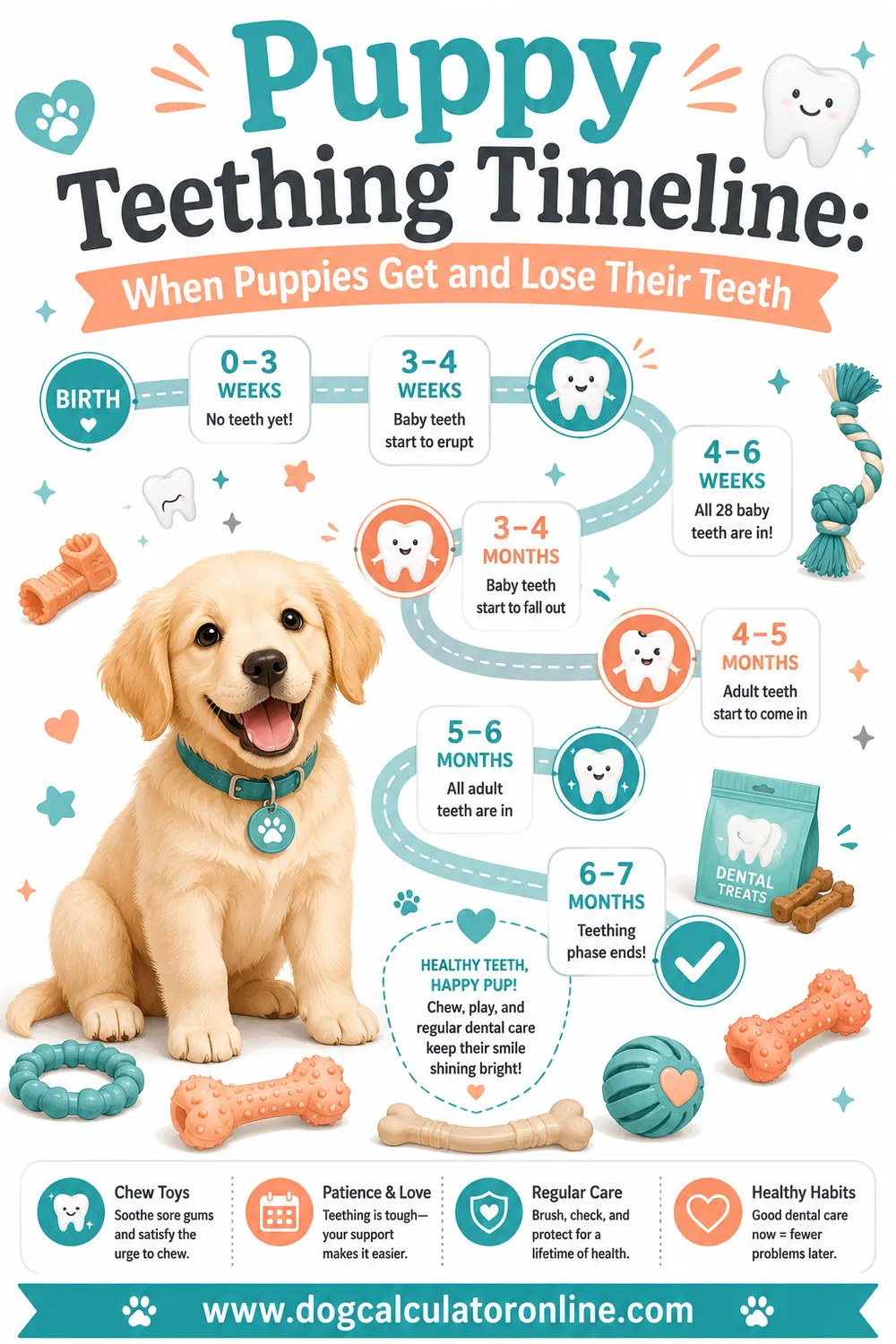
The complete puppy teething timeline: 28 baby teeth by 8 weeks, adult teeth from 12–16 weeks, done by 6 months. Stages, symptoms, and chew tips.
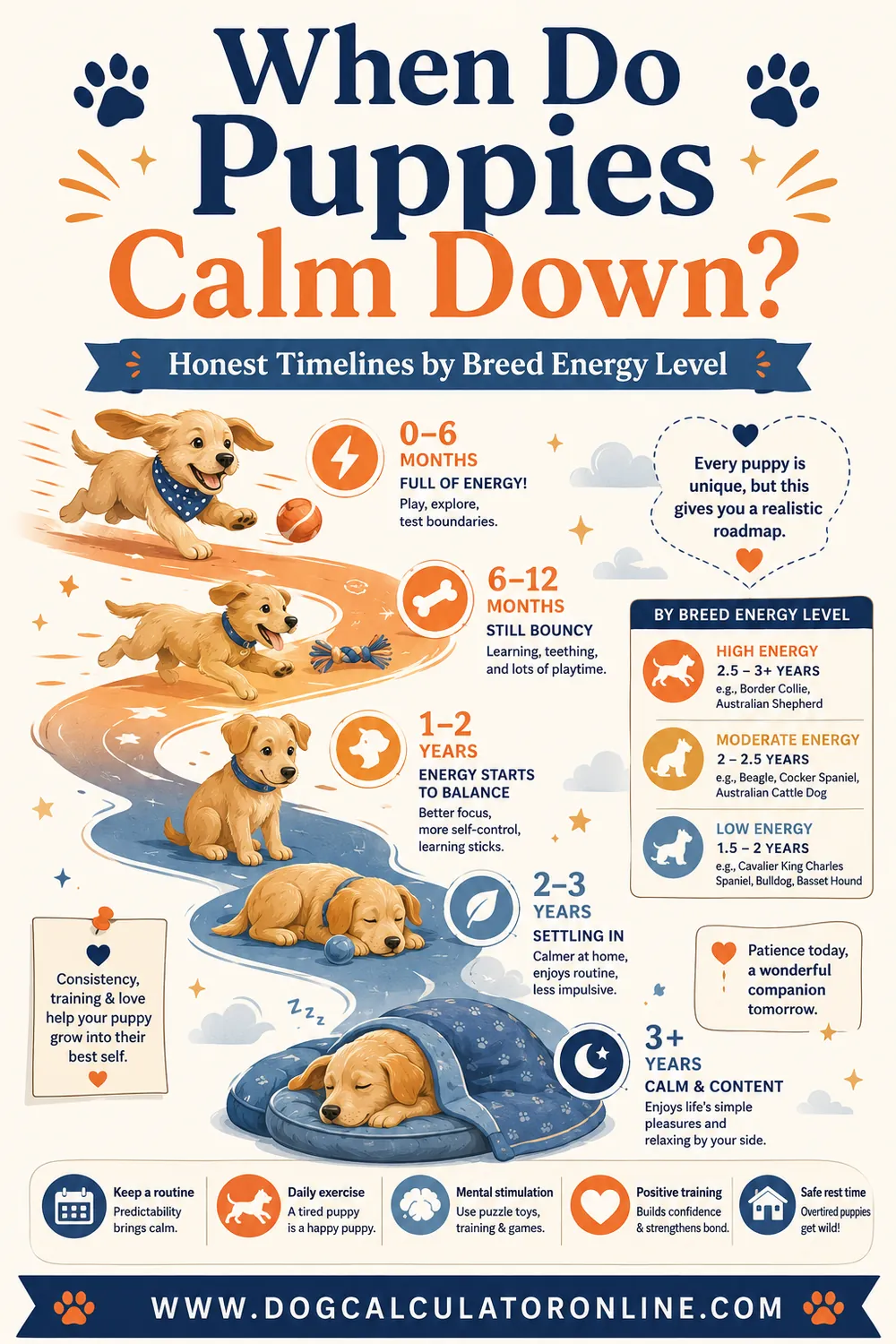
When do puppies calm down? Most settle noticeably between 12 and 18 months, but breed energy matters — see honest timelines and what actually helps.

The best dog names in one place: top popular picks, unique finds, food names, mythology, nature, pop culture and more — 175+ ideas by theme.
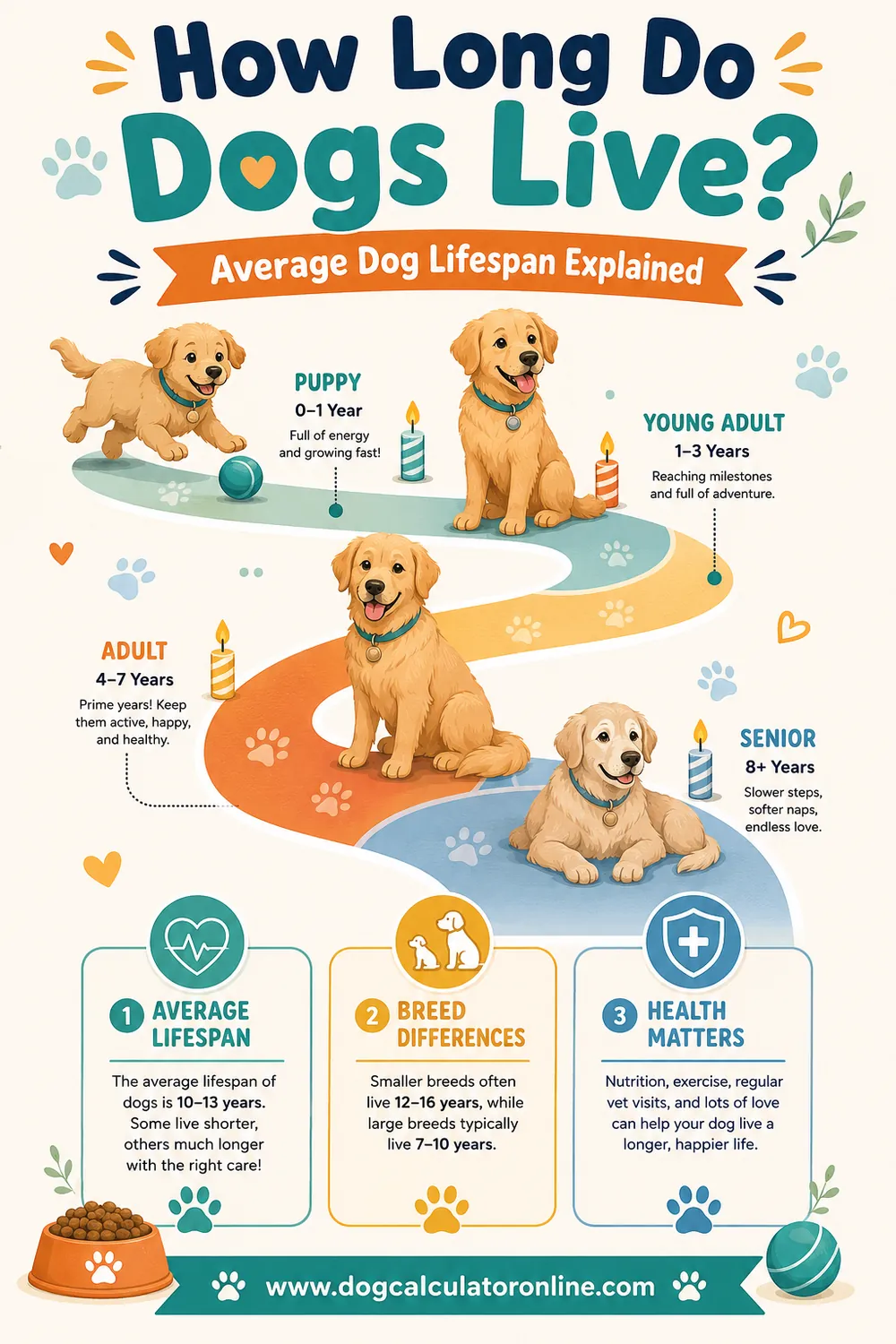
Most dogs live 10-13 years, but size changes everything. See average dog lifespan by size class, what shortens or extends it, and how old your dog really is.
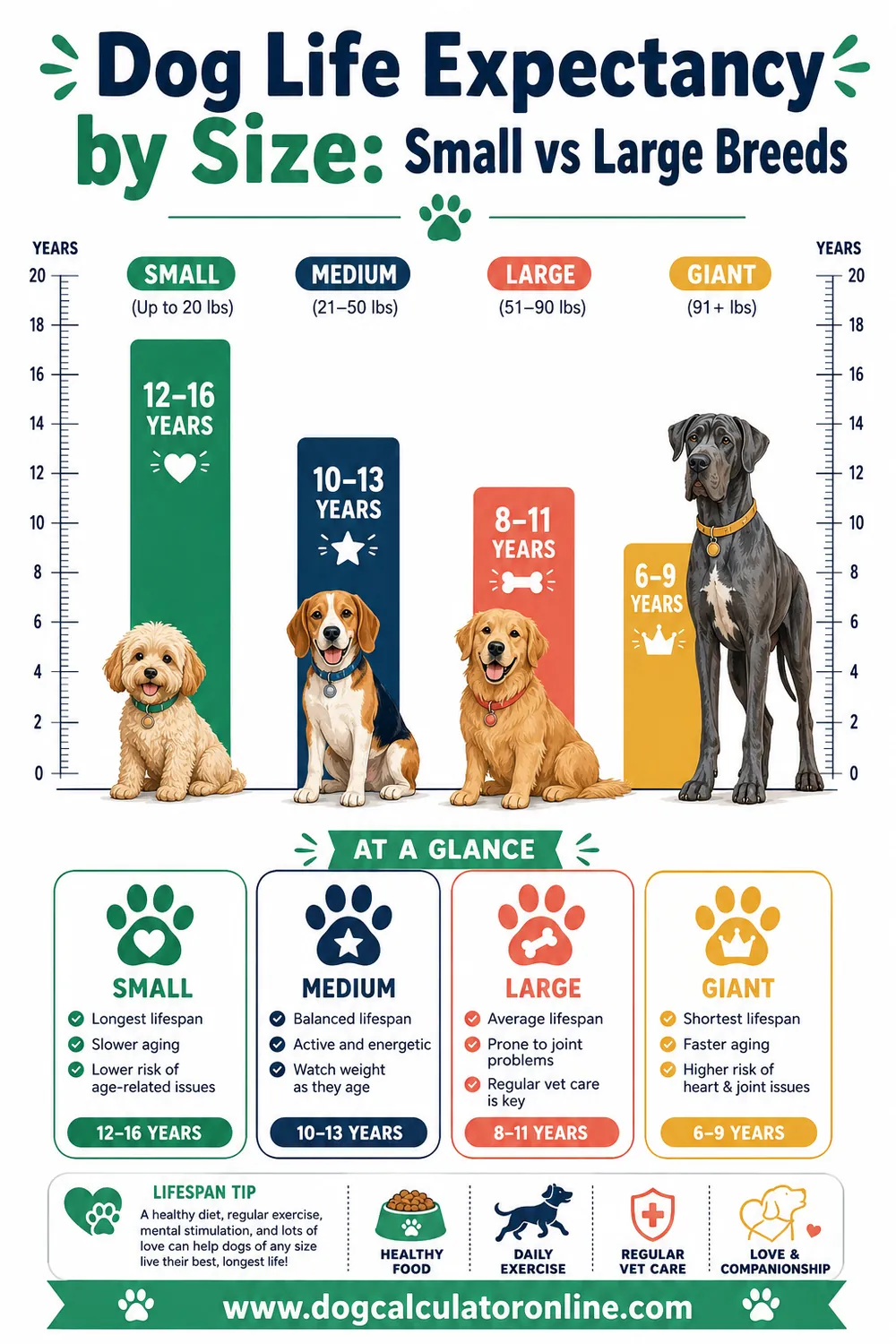
Dog life expectancy by size, explained: small dogs live 12-16 years, giants just 7-10. See the full size table, why the gap exists, and your dog's real age.
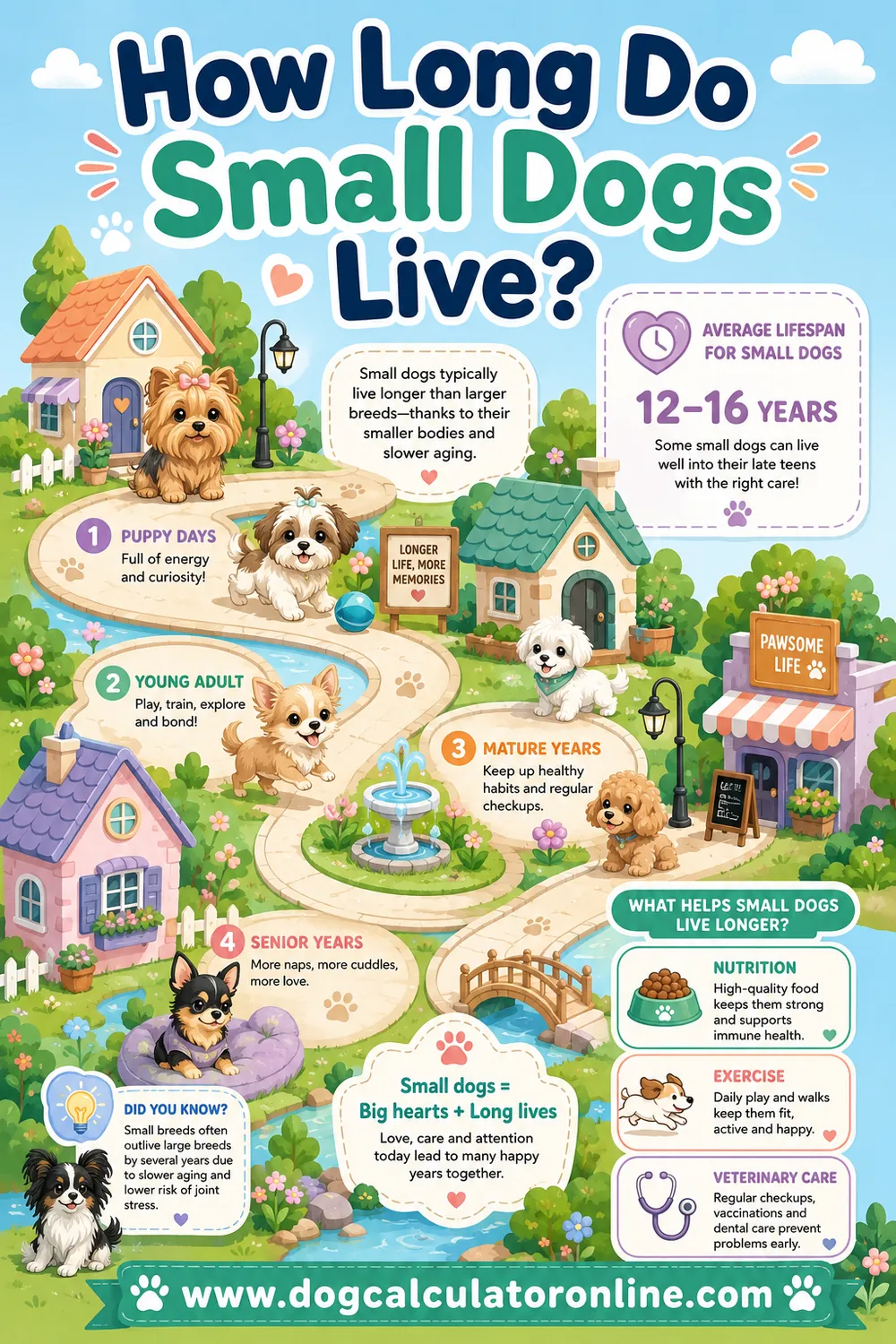
Small dogs typically live 12-16 years, and many reach 17+. See which little breeds live longest, why small dogs outlast big ones, and how old yours is now.
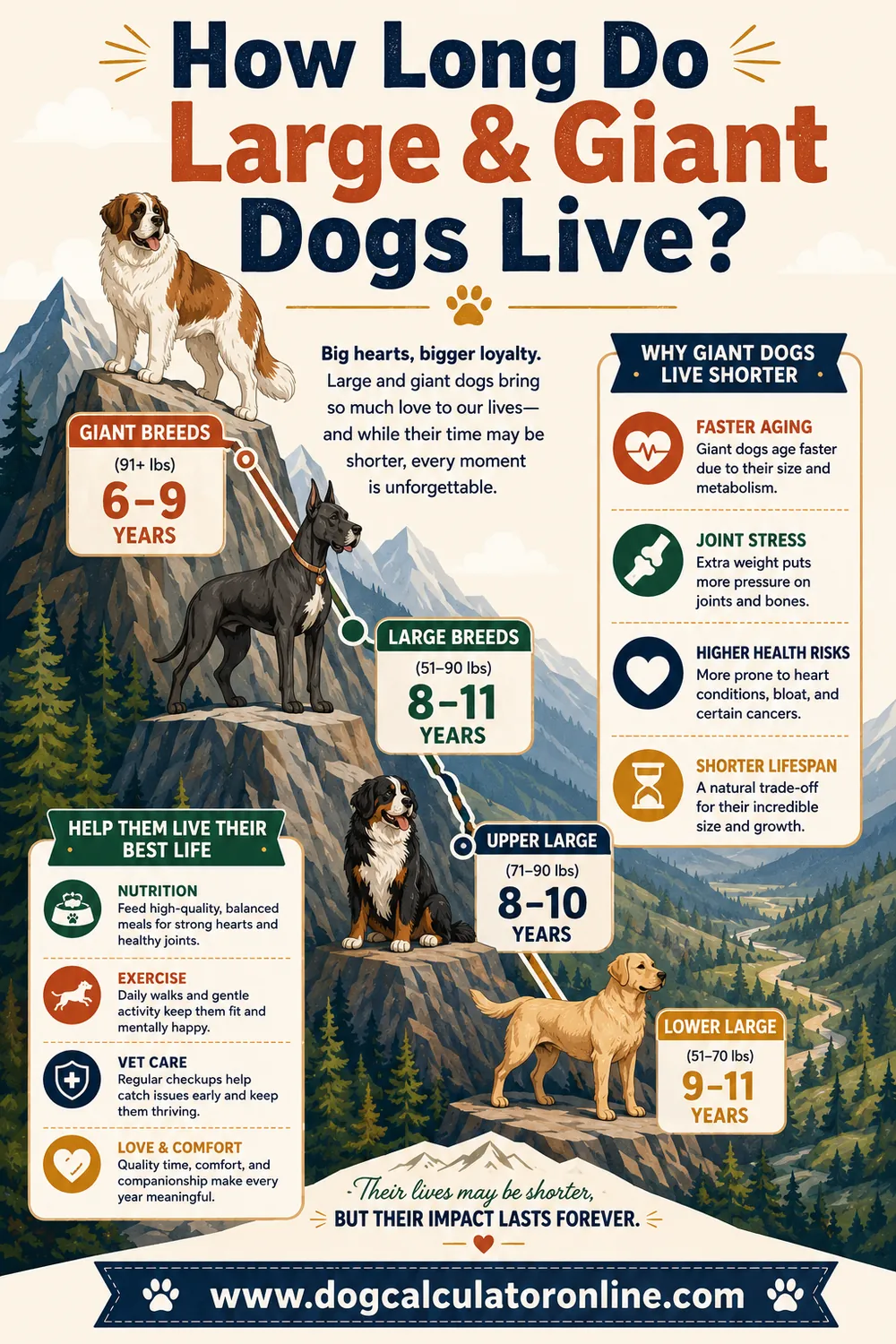
Large dogs typically live 9-12 years and giant breeds 7-10. See lifespans for popular big breeds, why they age faster, and how old your big dog is right now.
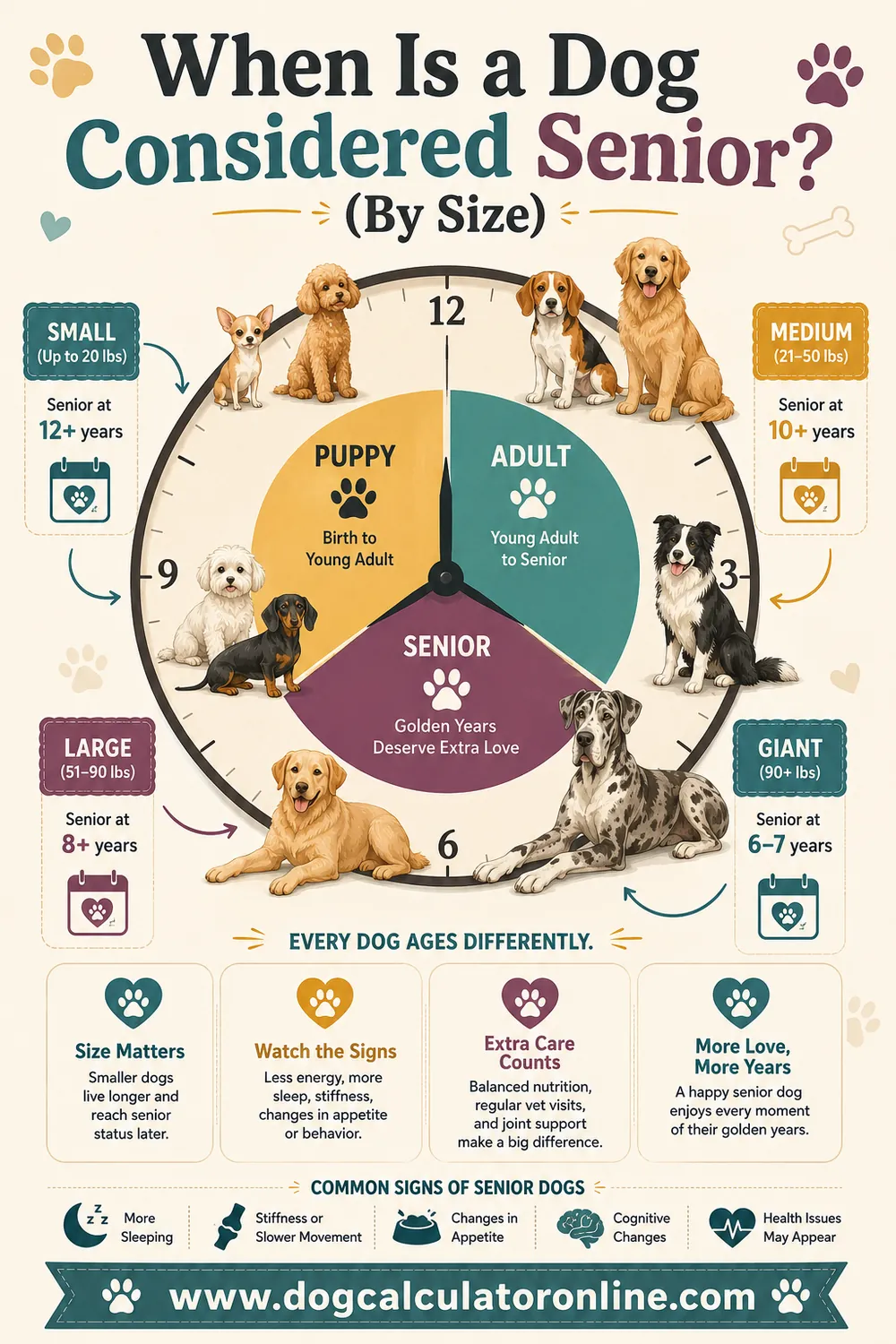
Dogs become seniors at different ages by size: around 7 for small and medium breeds, 6-7 for large, 5-6 for giants. See the table and what changes at senior age.
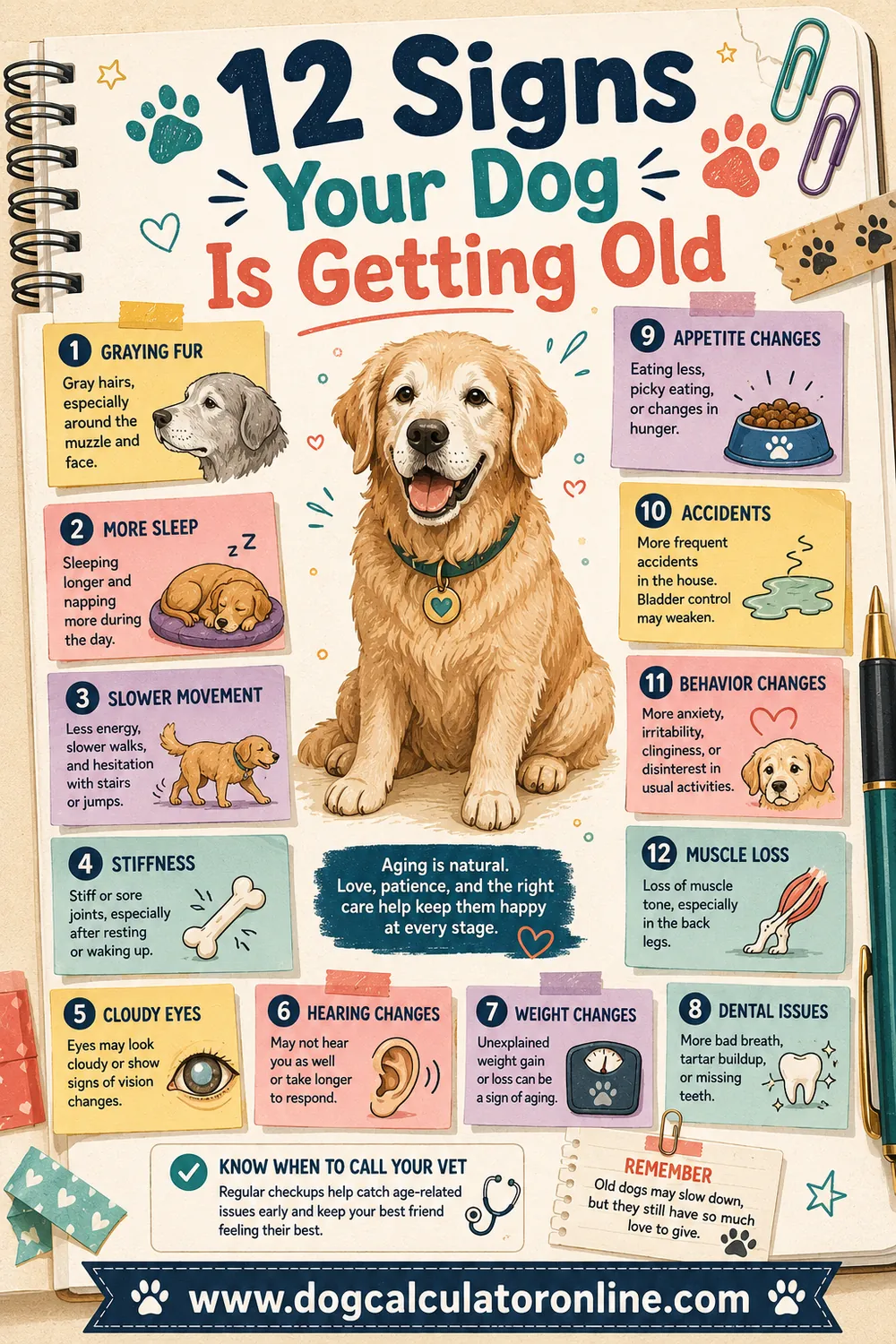
Gray muzzle, stiff mornings, cloudy eyes, more sleep - 12 common signs your dog is getting old, which ones are normal aging, and which need a vet visit.
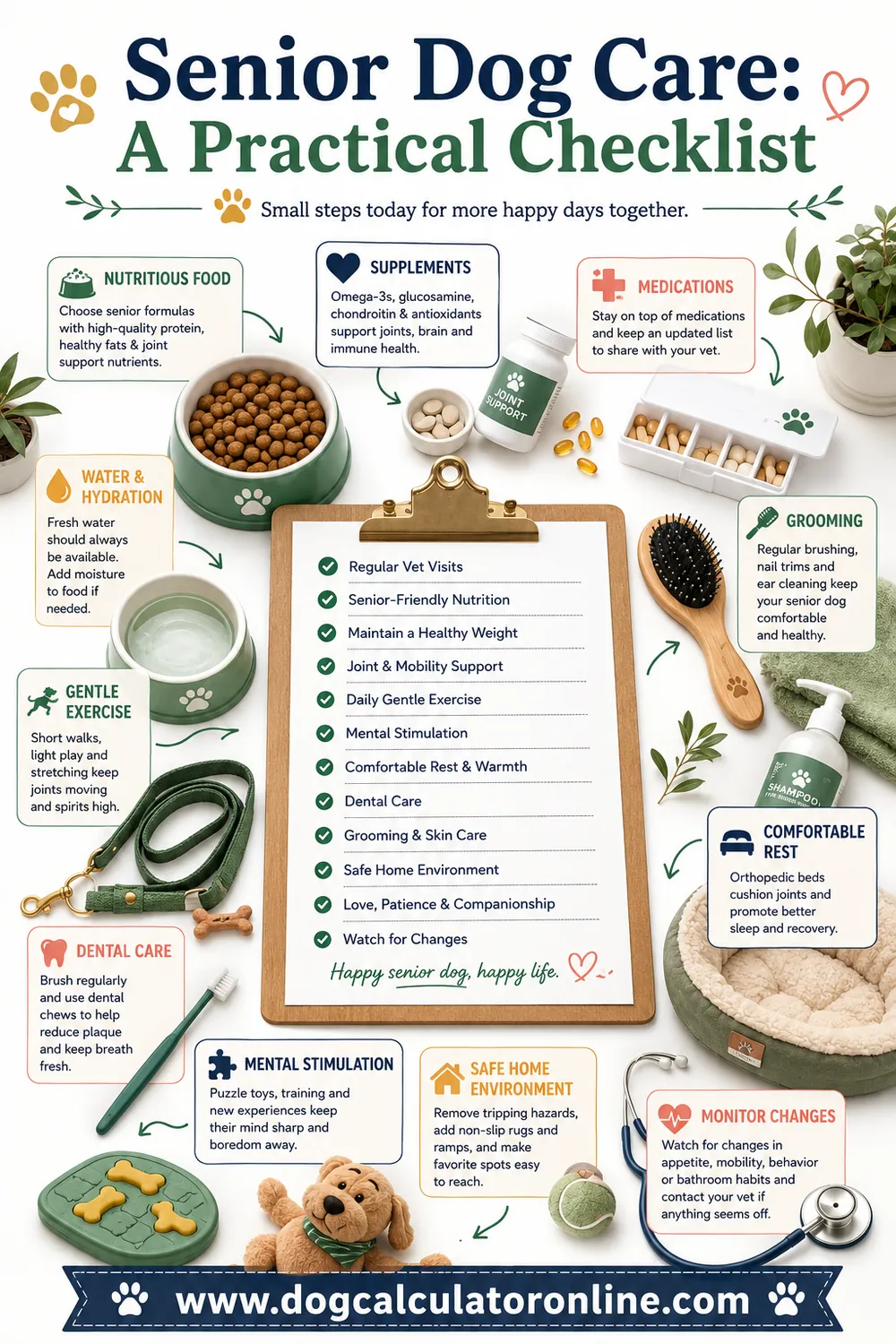
A practical senior dog care checklist: vet schedules, weight, diet, joints, dental, home setup, and enrichment - what actually matters for an aging dog.
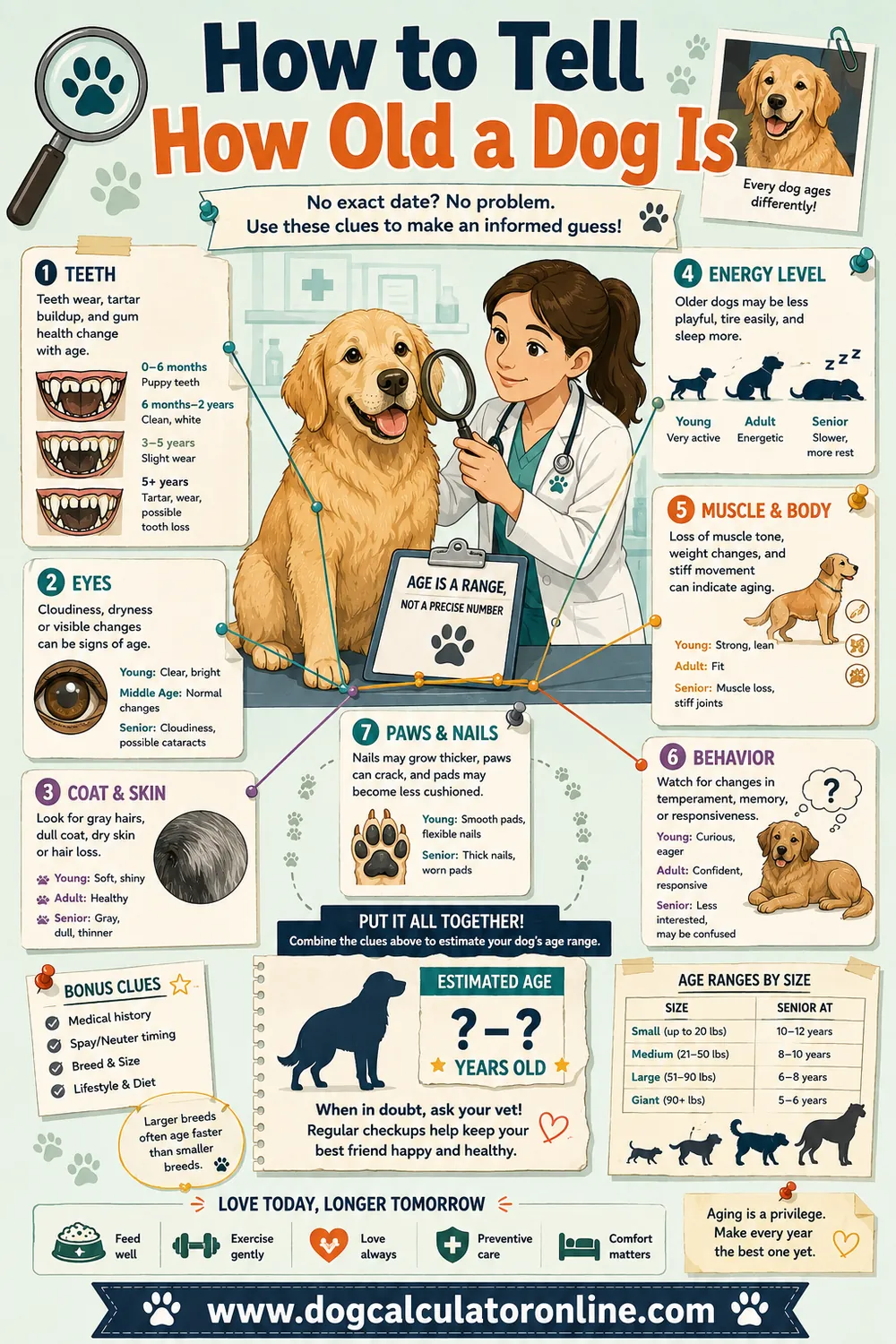
Adopted a dog with no birthday? Learn how vets estimate dog age from teeth, eyes, coat, muscle, and behavior - plus how to convert it to human years.
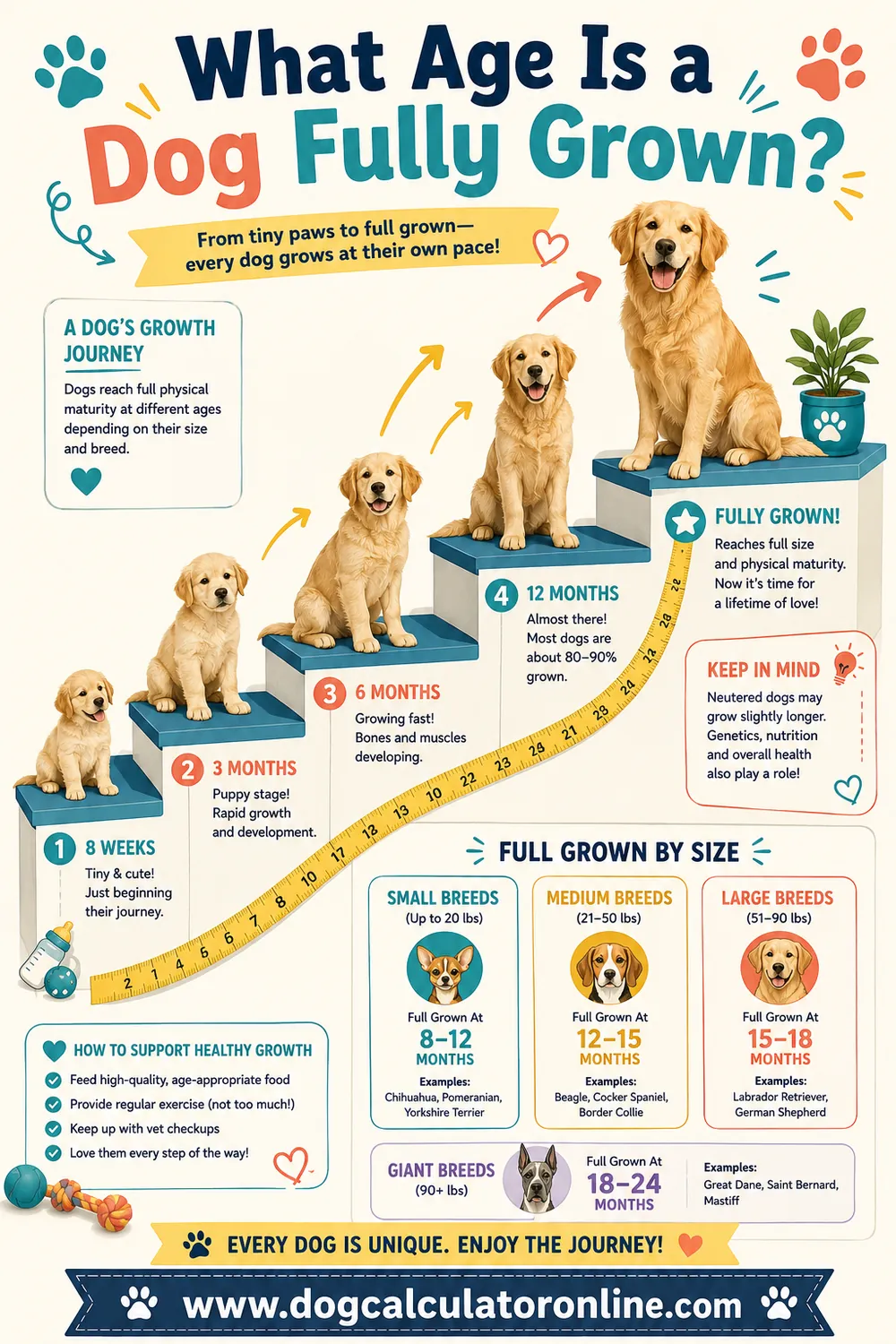
Small dogs finish growing by 9-12 months, large breeds by 12-18, giants by up to 24. See when dogs are fully grown by size and how to predict adult weight.
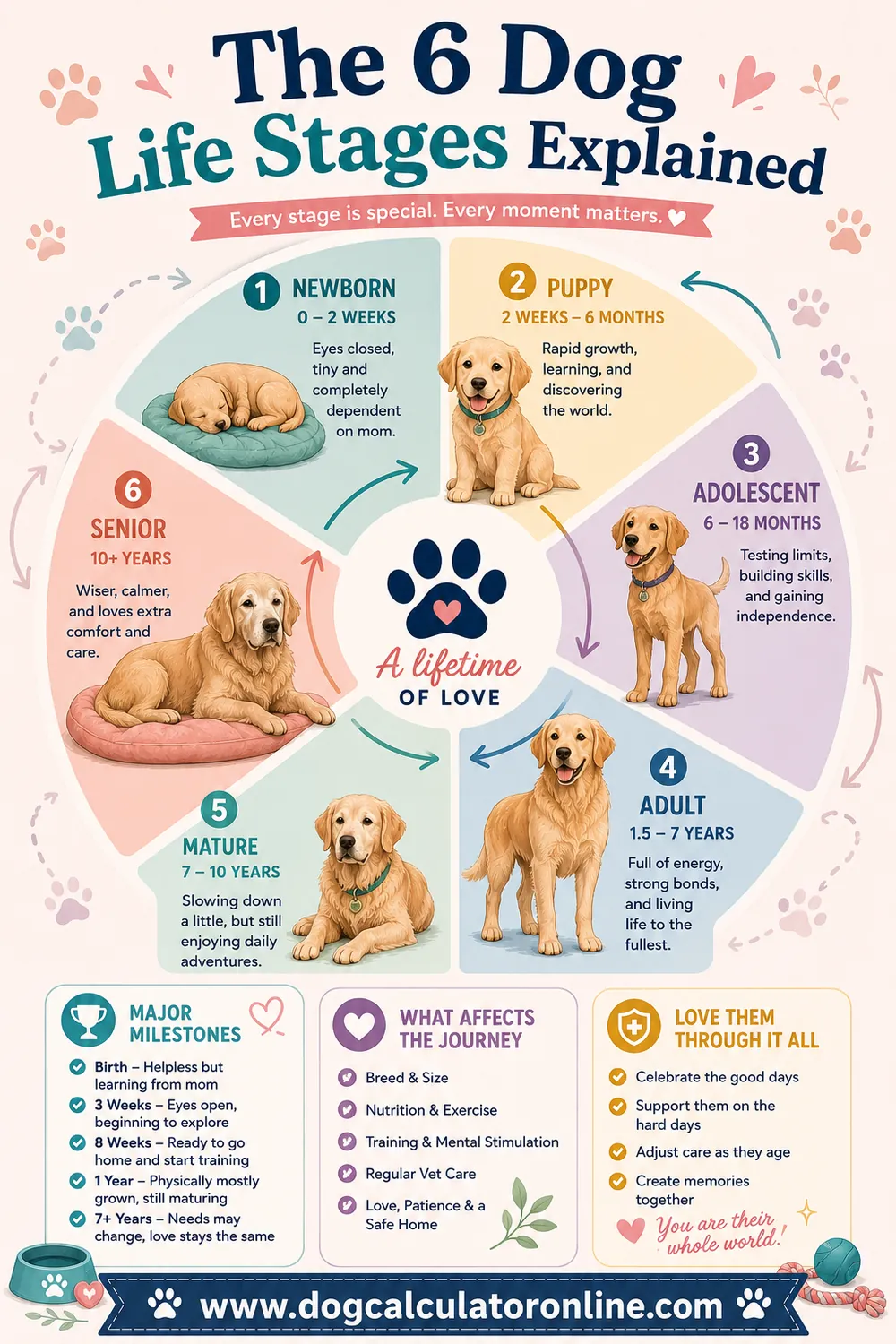
Puppy, adolescent, adult, mature, senior, geriatric - the 6 dog life stages explained, when each starts by size, and what your dog needs at every stage.
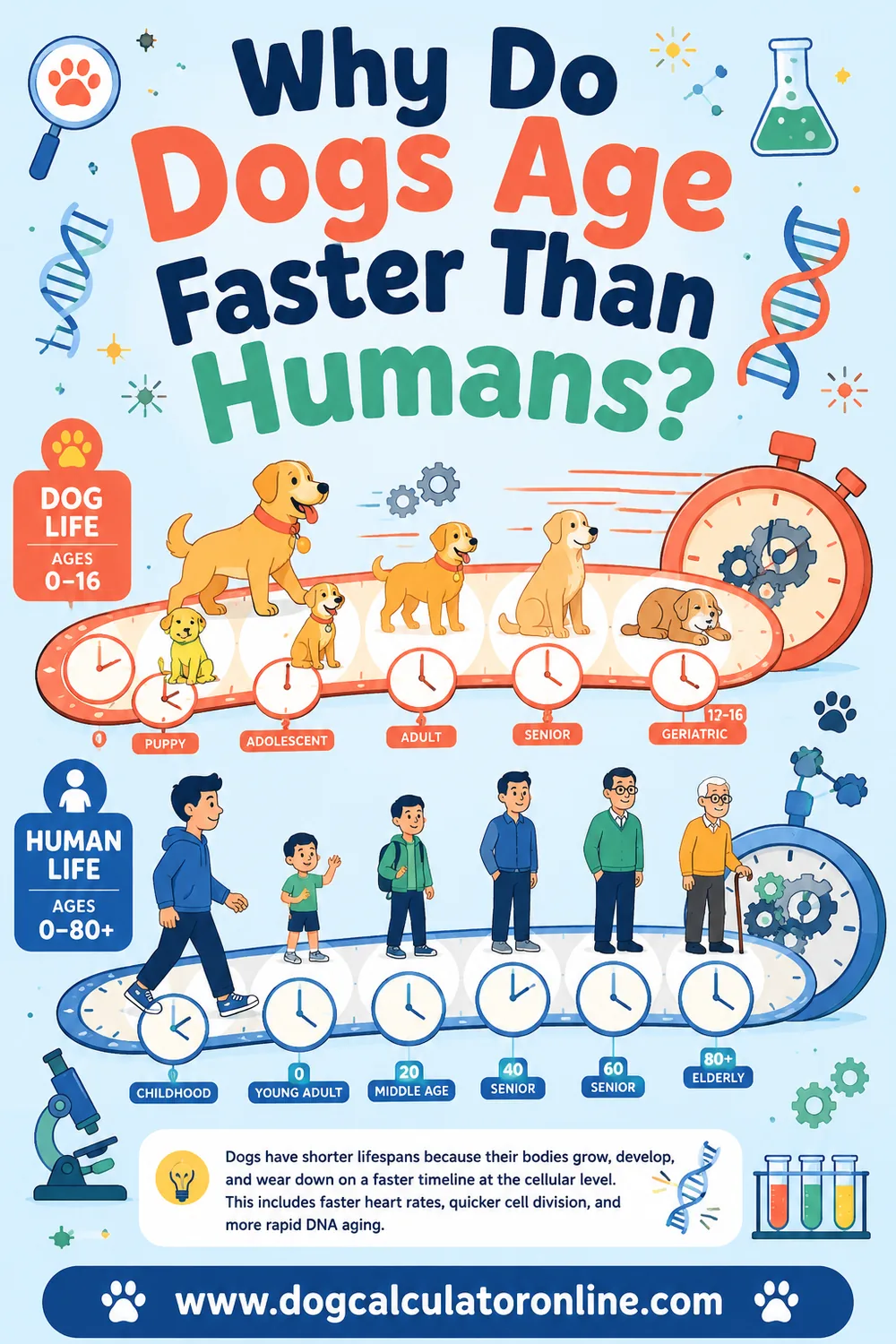
Dogs age faster than humans because of faster metabolism, quicker maturity, and shorter cell-repair timelines. See the science - and what the DNA clock reveals.
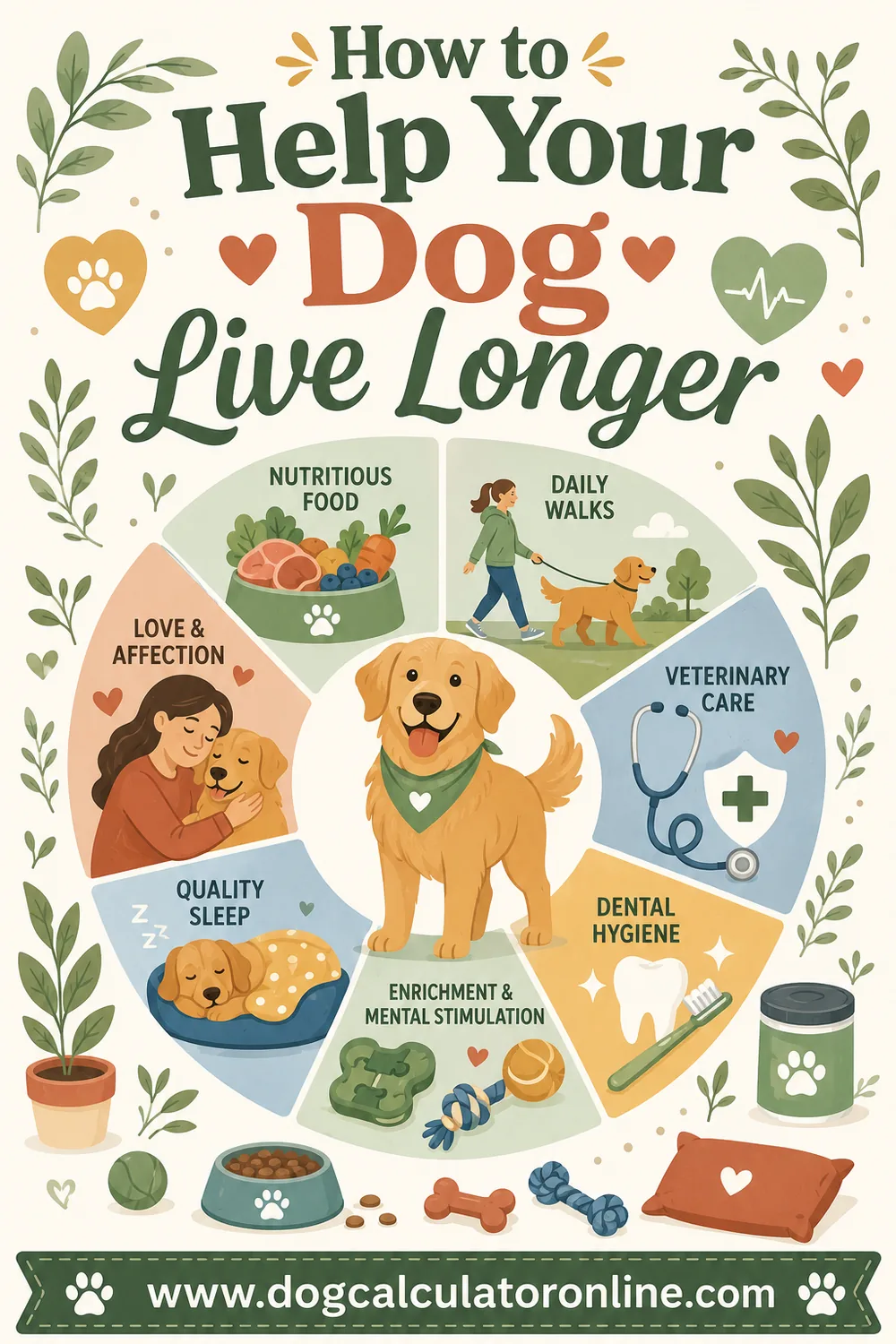
Want more years with your dog? 8 evidence-backed habits that help dogs live longer - lean weight, dental care, exercise, vet checkups, and more.

Do mixed-breed dogs live longer? On average, modestly yes - about a year over size-matched purebreds. See what the research shows and why size matters more.
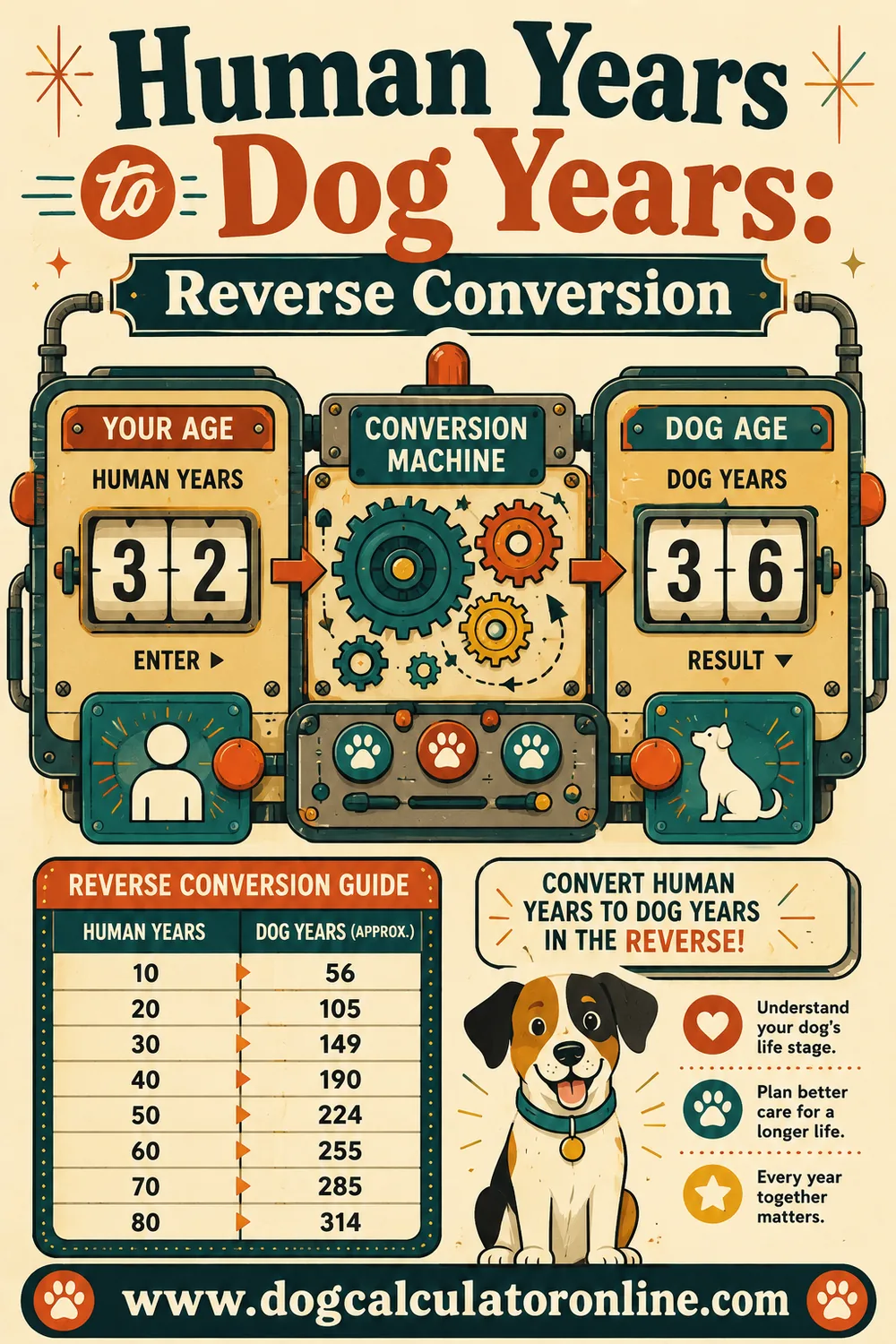
How to convert human years to dog years - the reverse of the usual math. See the size-adjusted table, worked examples, and why it's trickier than it sounds.
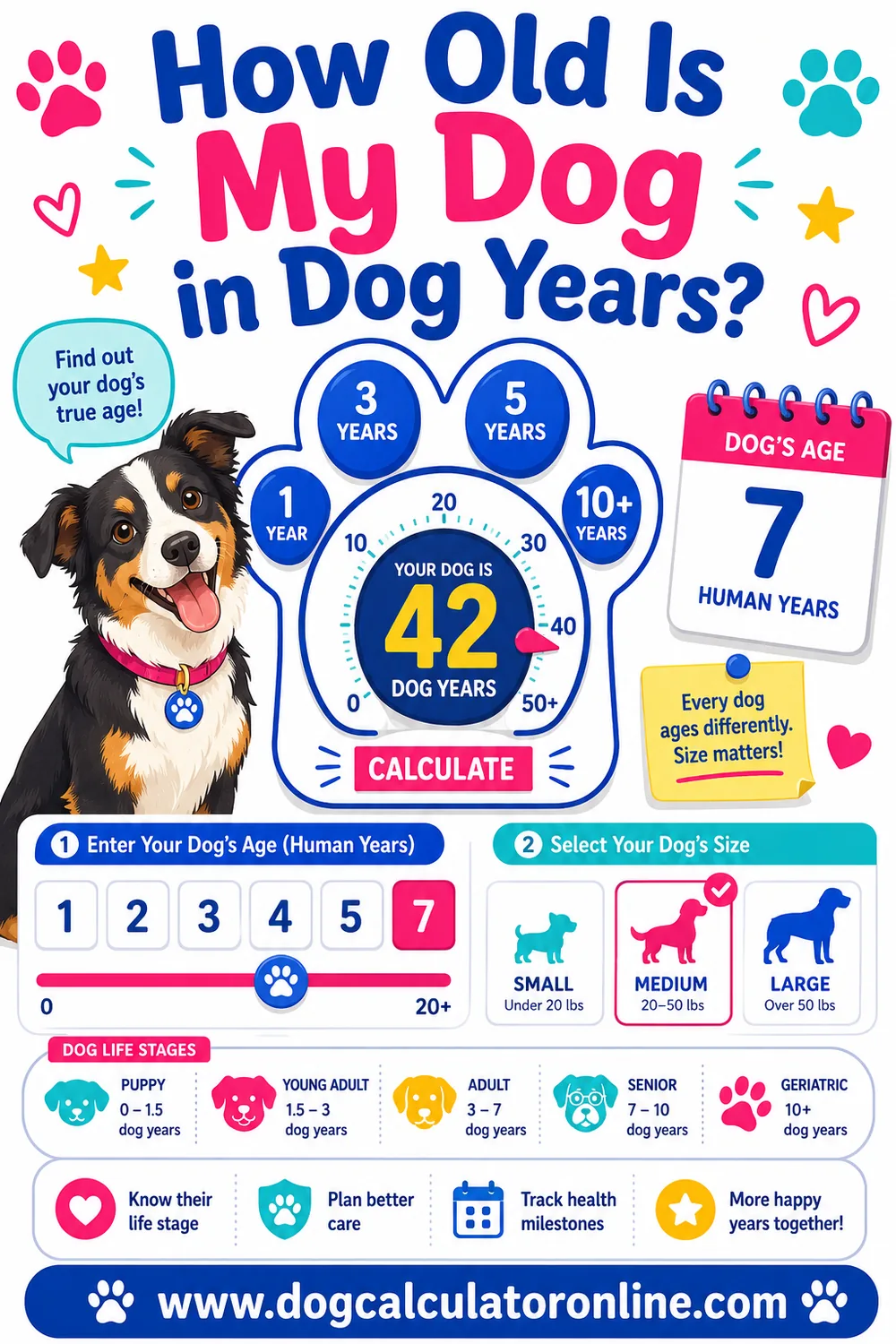
Confused by dog years? Learn what 'dog years' actually means, how it differs from human years, and how to find your dog's real age with a free calculator.

One dog year equals about 15 human years, not 7. See why vets use 15, what the 2019 DNA study says (31!), and how to convert your own dog's age free.
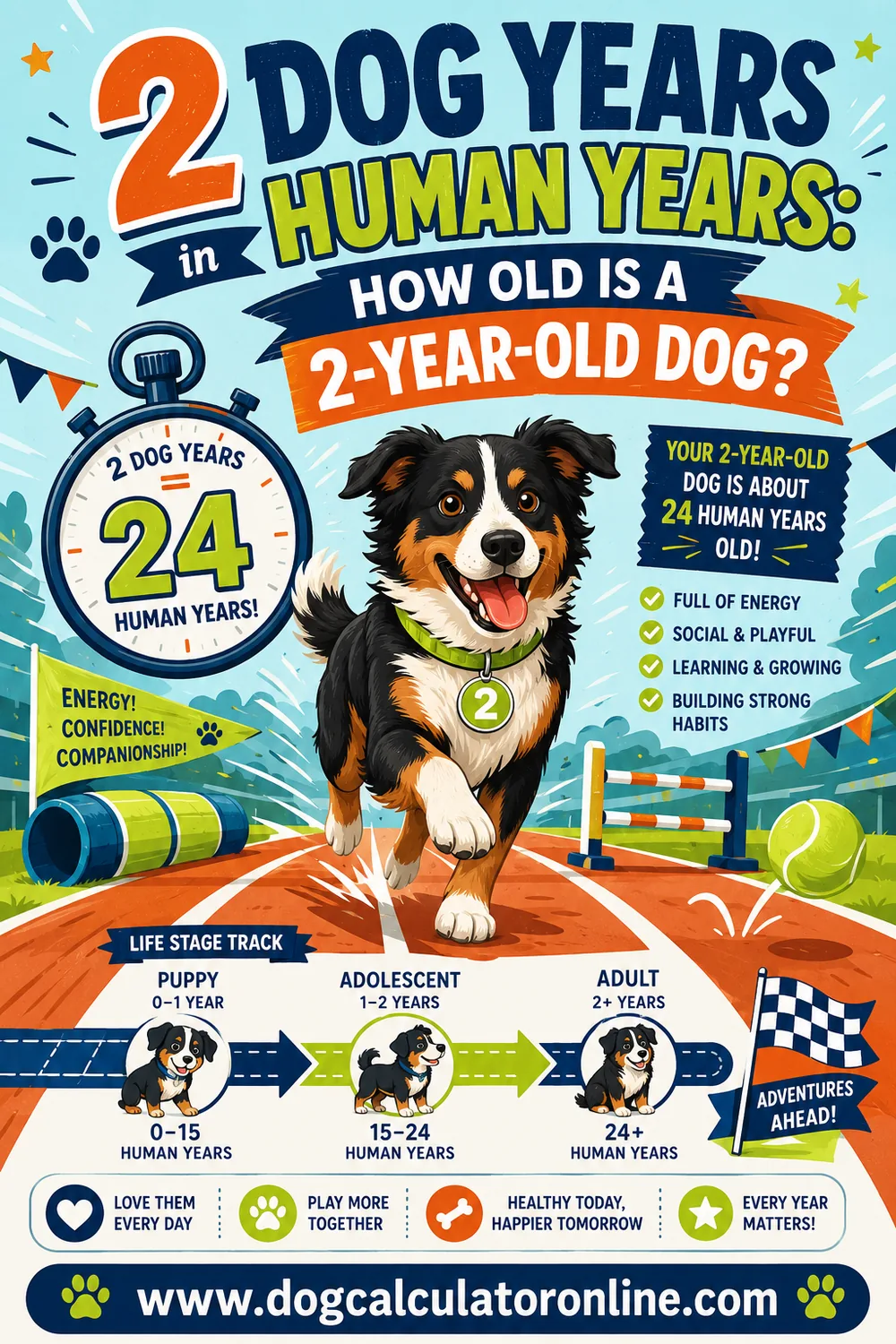
A 2-year-old dog is about 24 in human years — for every breed size. See the vet-backed math, the DNA-study number, and what a 24-year-old dog needs.
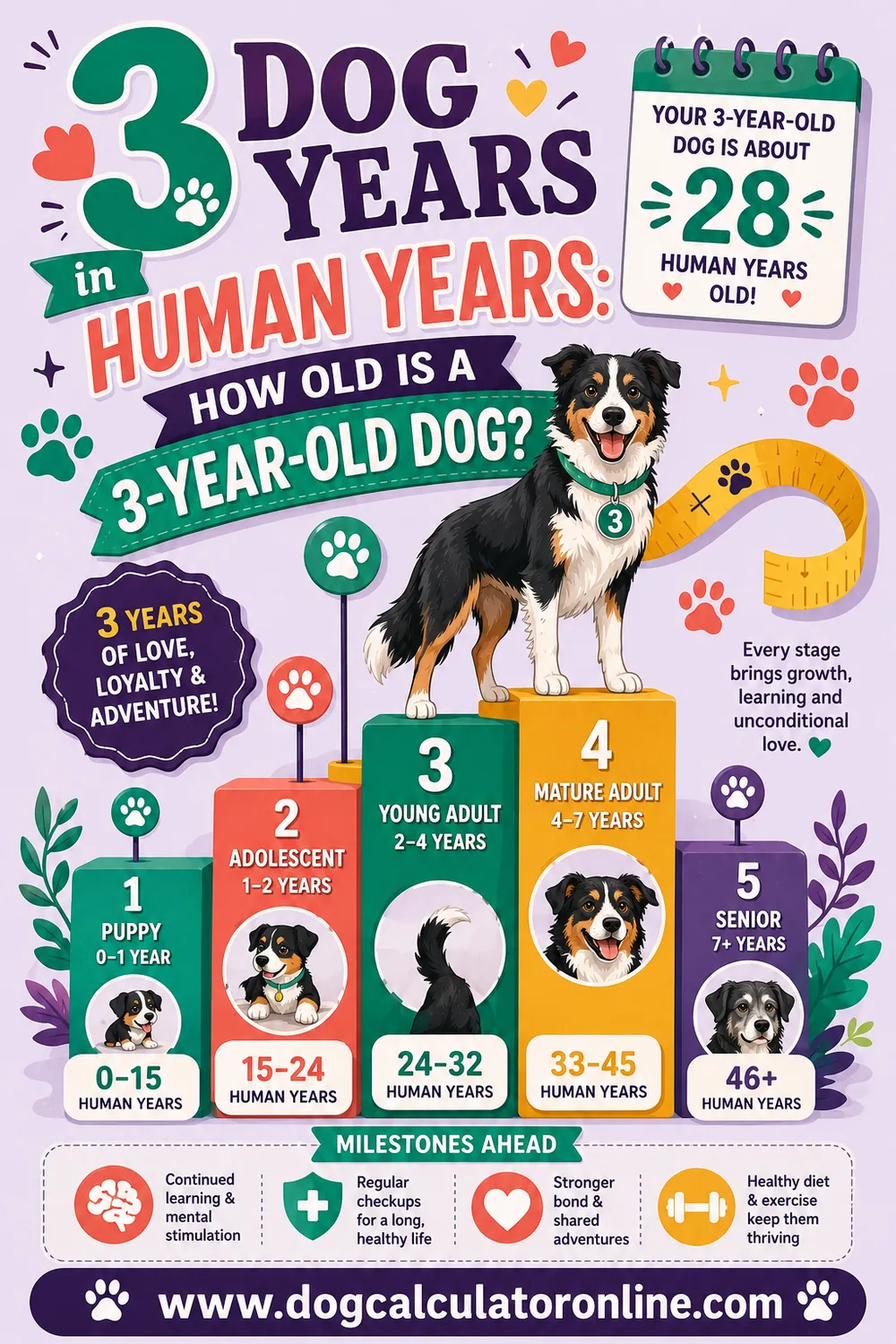
A 3-year-old dog is about 28–31 in human years, depending on size. See the vet-backed conversion, the DNA-study number, and what a dog this age needs.
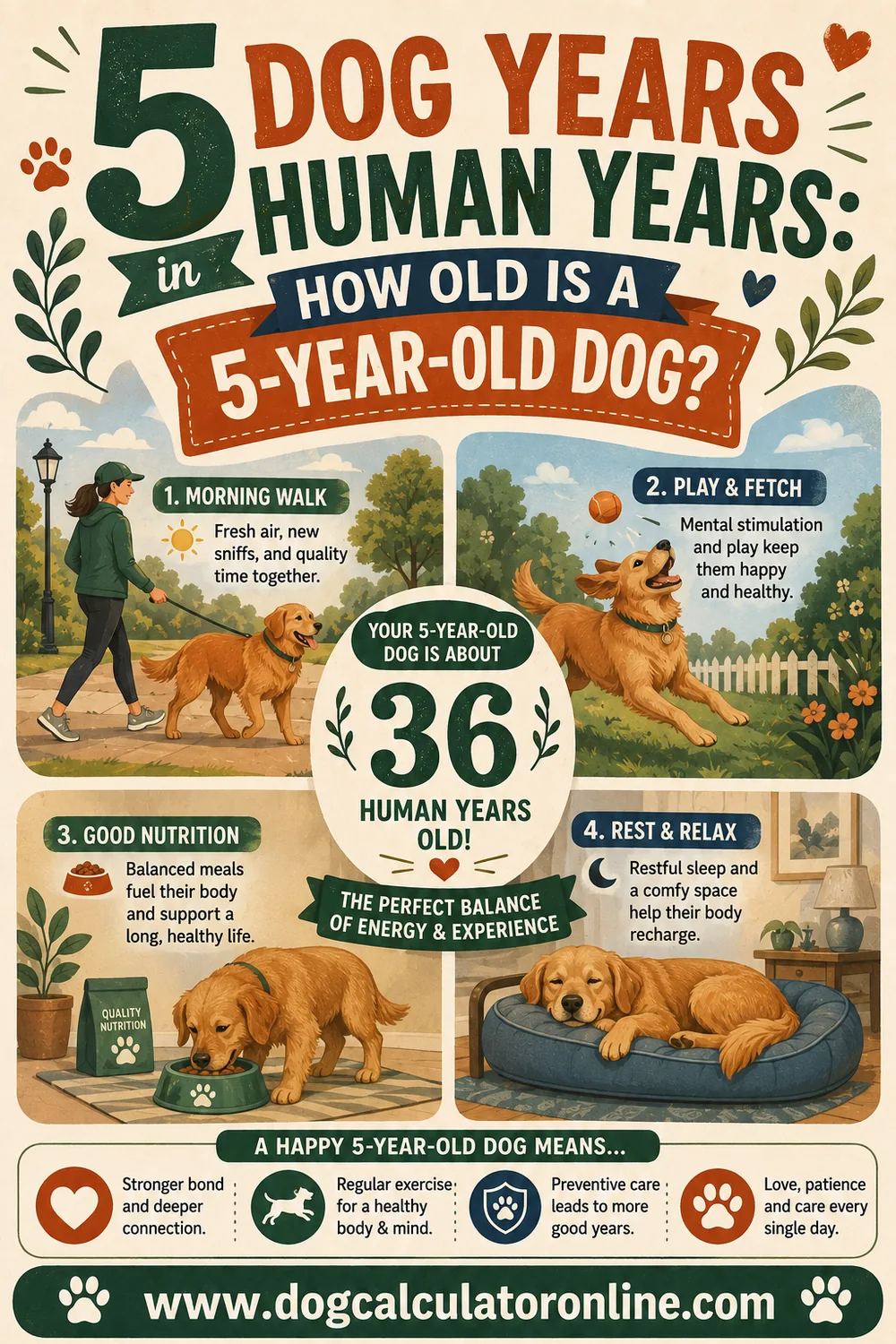
A 5-year-old dog is about 36–45 in human years depending on size. Get the vet-backed conversion, the DNA-study figure, and midlife care tips that matter.
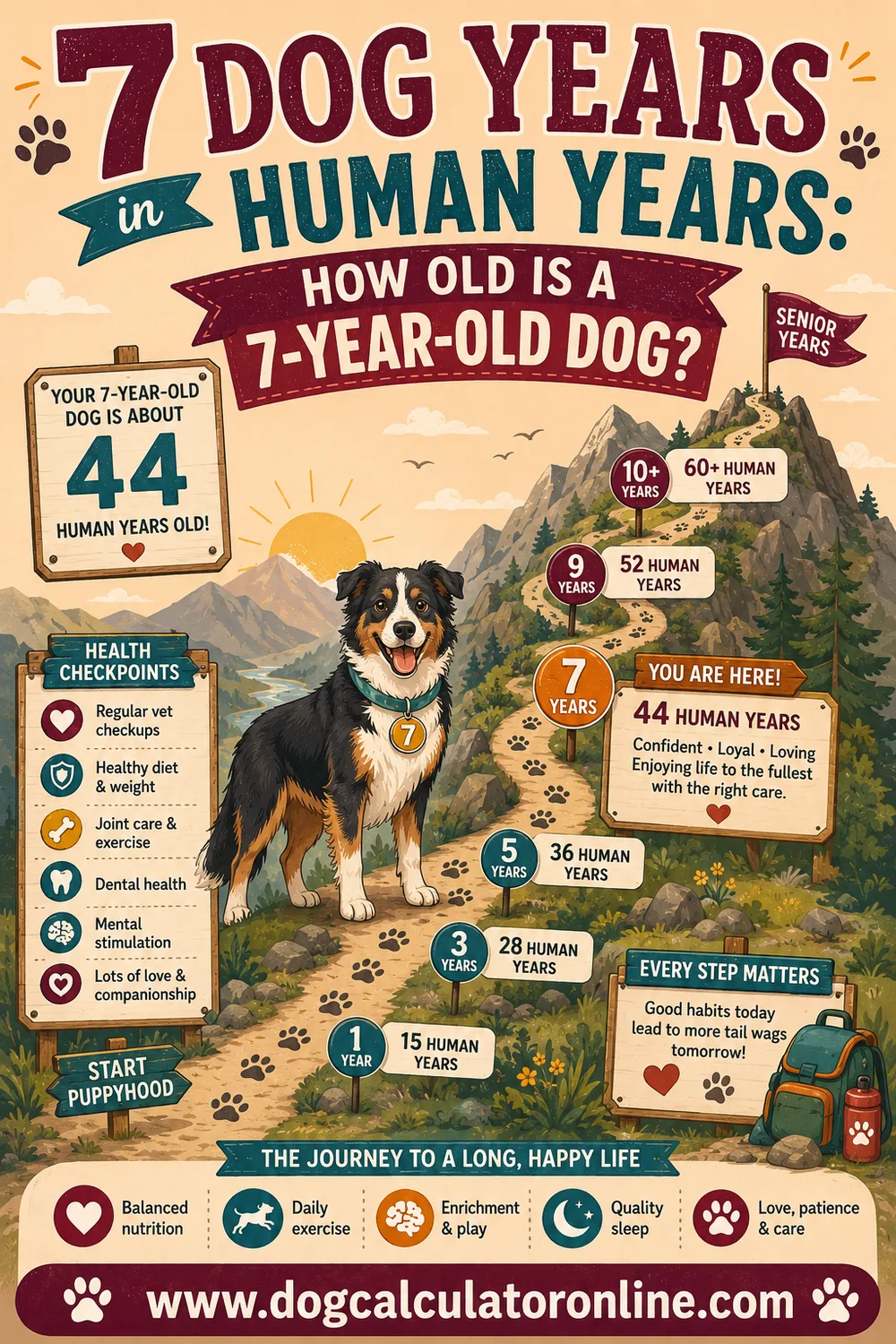
A 7-year-old dog is about 44–59 in human years by size — not 49 for everyone. See the vet-backed math, the DNA formula, and what the senior label means.
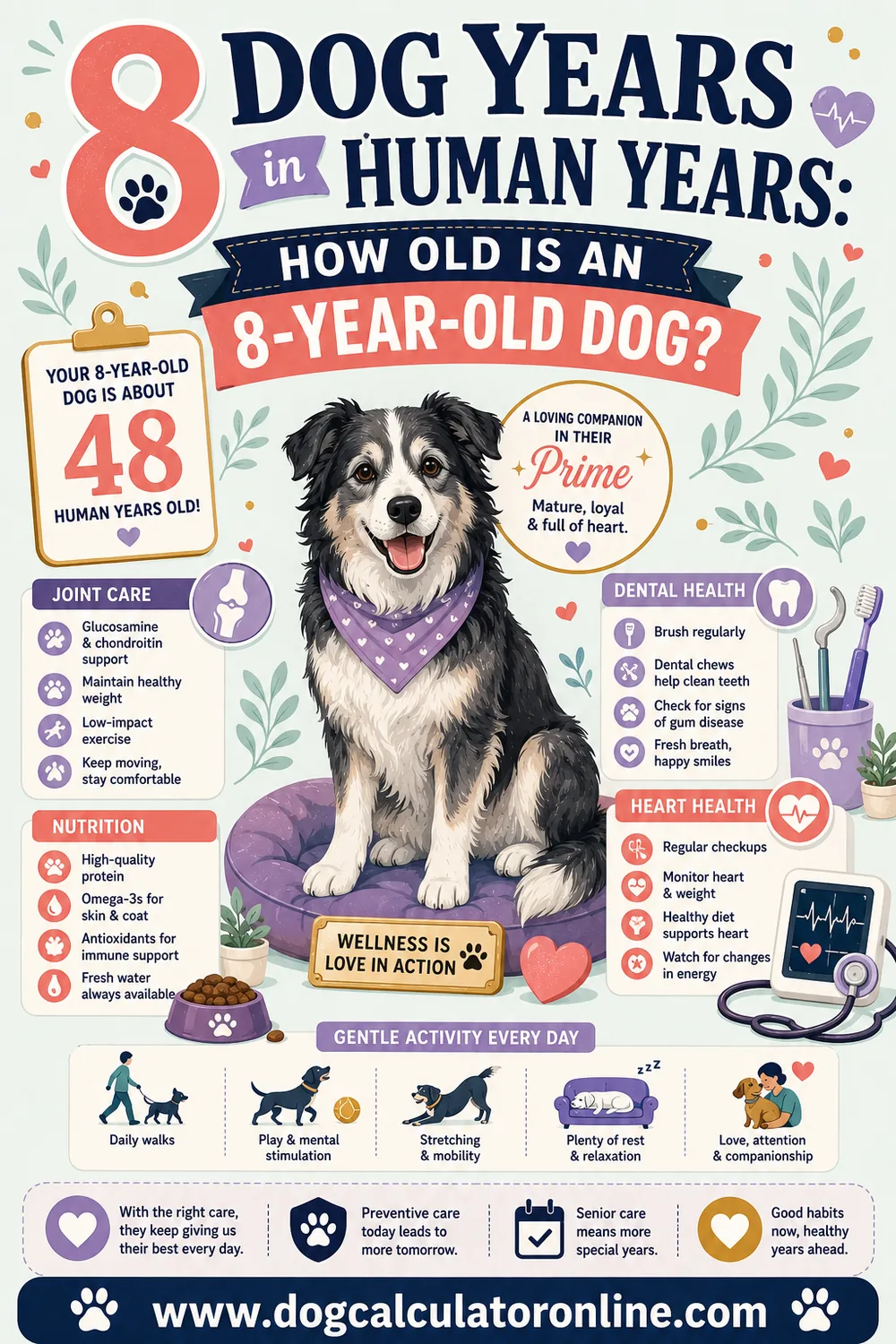
An 8-year-old dog is about 48–66 in human years depending on size. See the vet-backed conversion, the DNA-study number, and smart care for this stage.
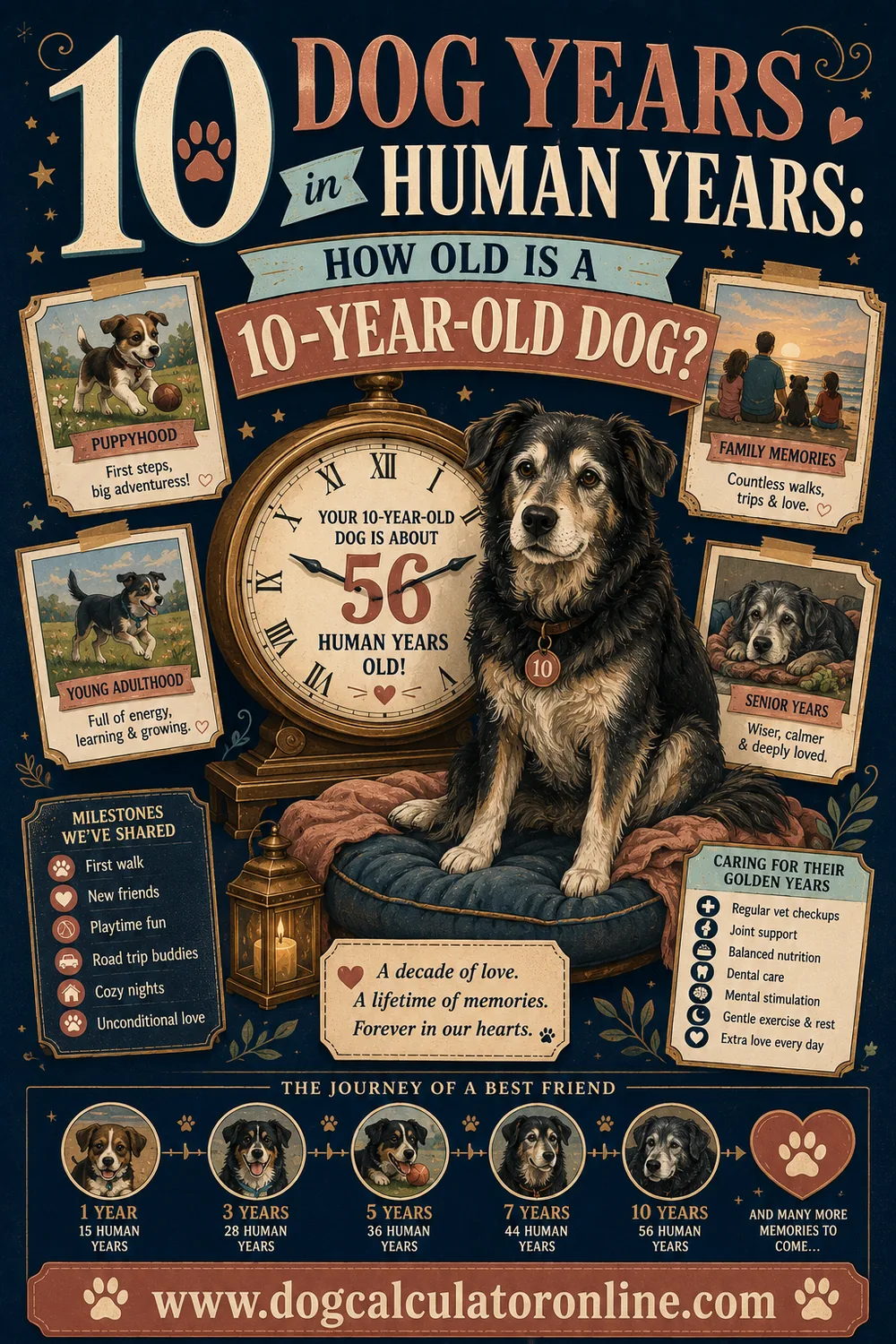
A 10-year-old dog is about 56–80 in human years depending on size. See the vet-backed math, the DNA-study figure, and how to care for a double-digit dog.
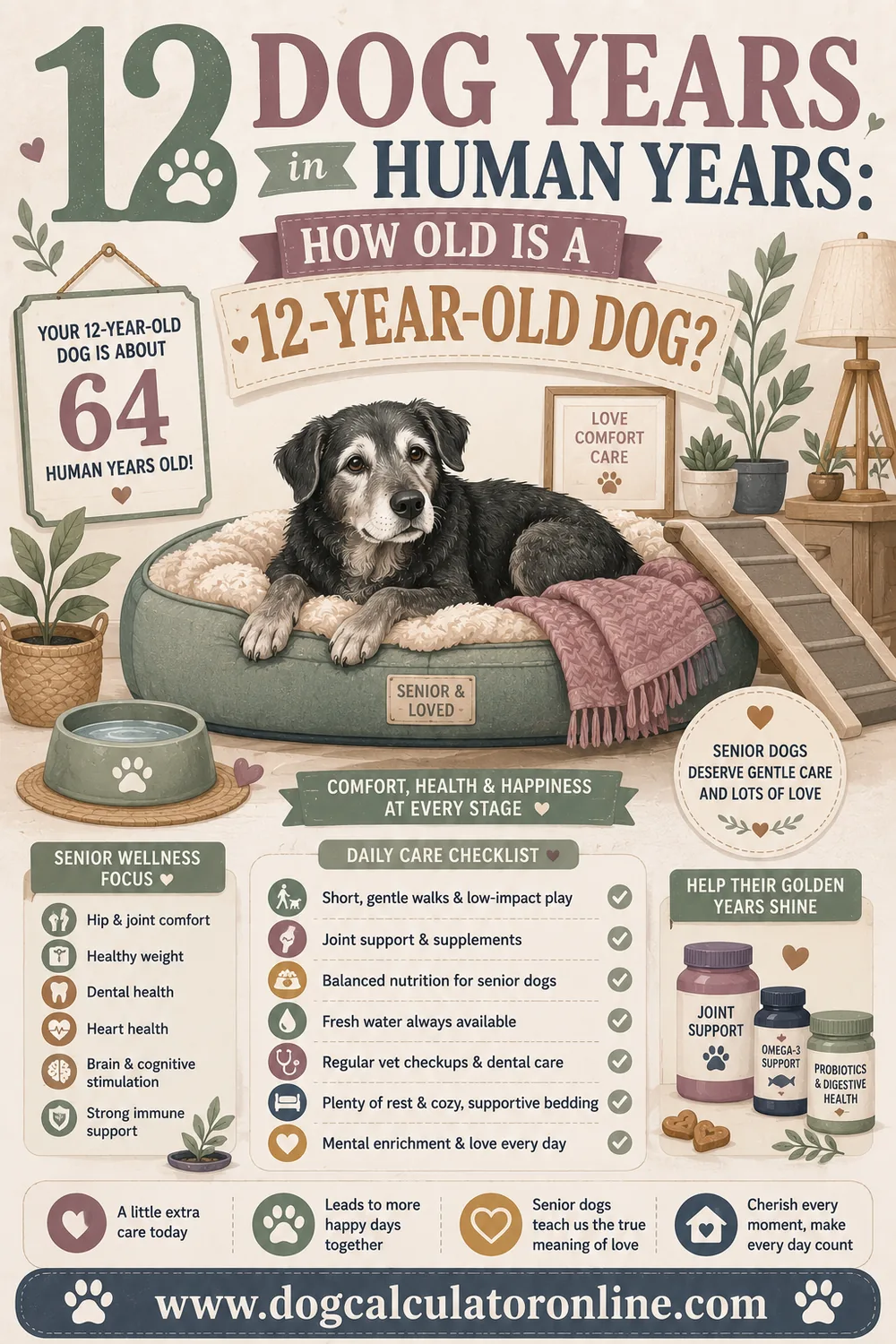
A 12-year-old dog is about 64–94 in human years depending on size. Get the vet-backed conversion, the DNA-study number, and senior comfort essentials.
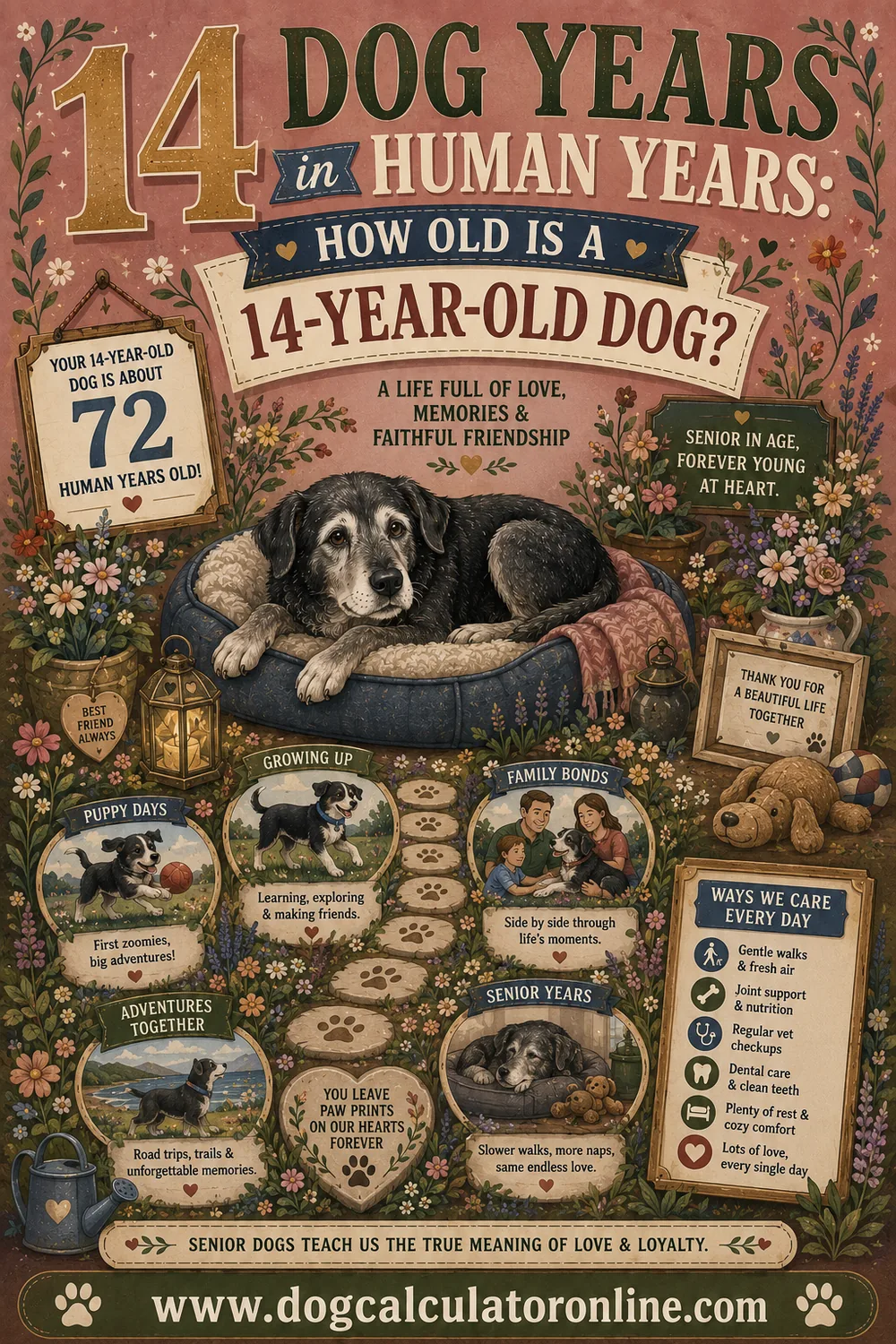
A 14-year-old dog is about 72–108 in human years depending on size. See the vet-backed conversion, the DNA formula, and how to care for a very senior dog.
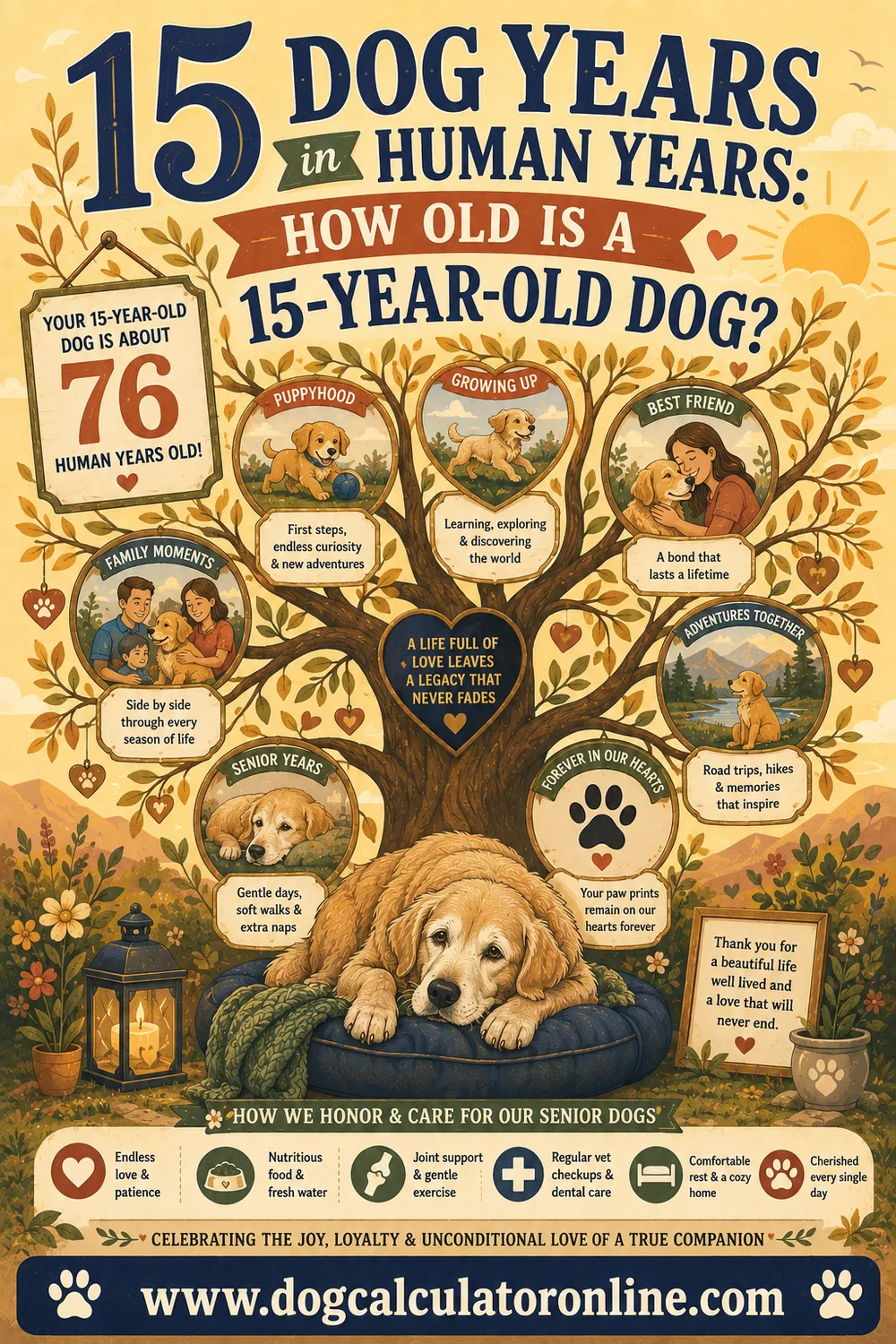
A 15-year-old dog is about 76–115 in human years depending on size. See the vet-backed math, which dogs reach 15, and how to care for a very old dog.
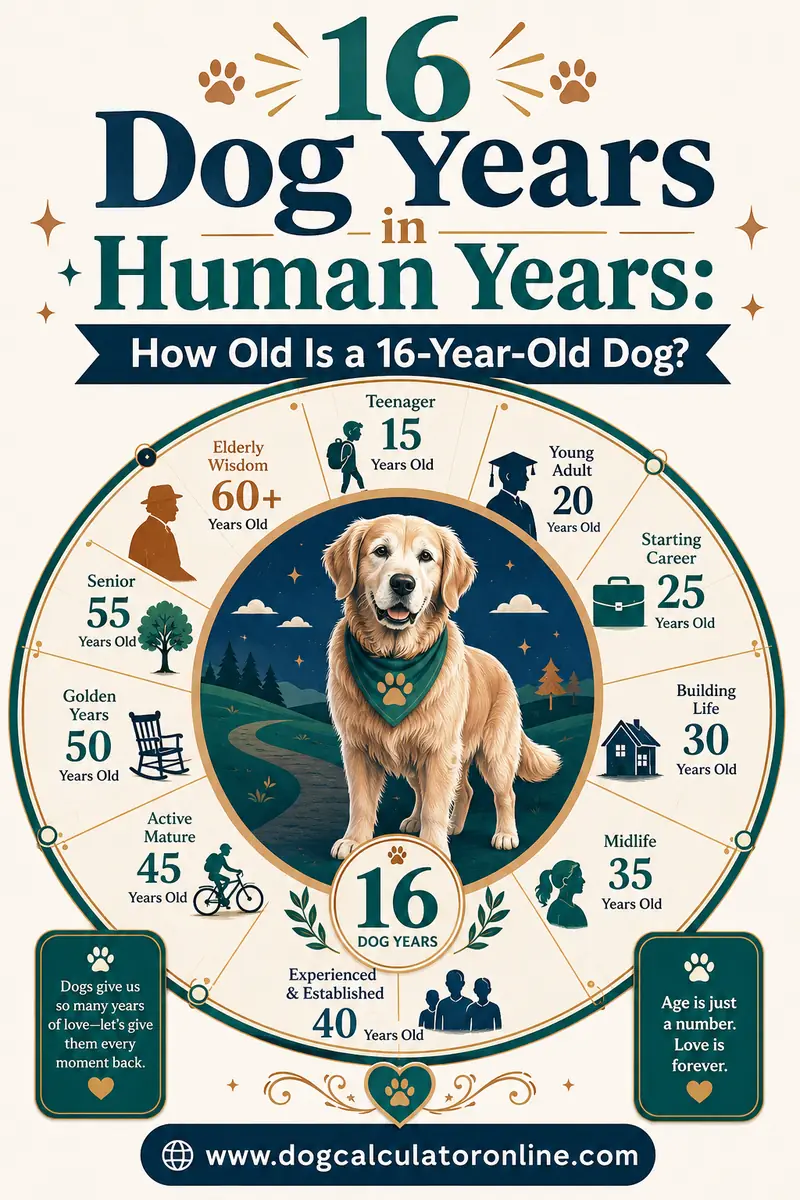
A 16-year-old dog is about 80–122 in human years depending on size. See the vet-backed conversion, longevity secrets, and care tips for a super-senior.
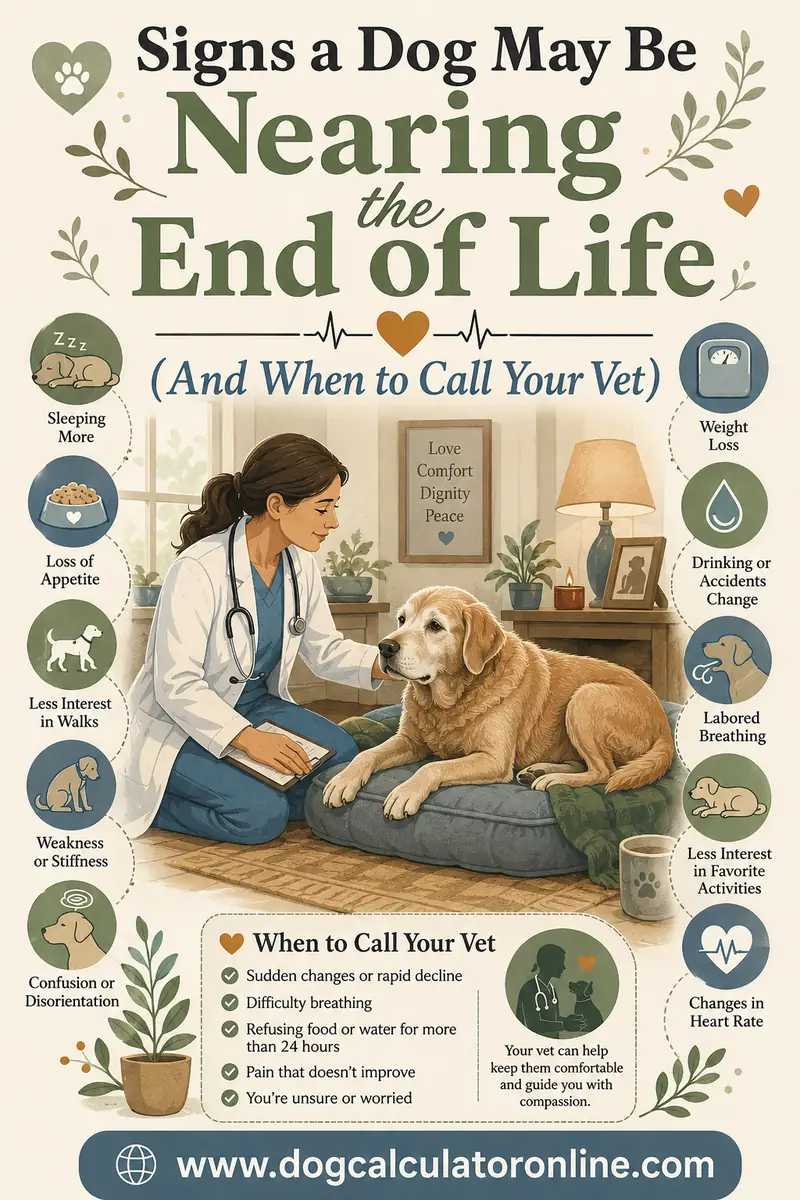
Gentle, factual guide to the common signs a dog may be nearing the end of life, what they can mean, quality-of-life checks, and when to call your vet.
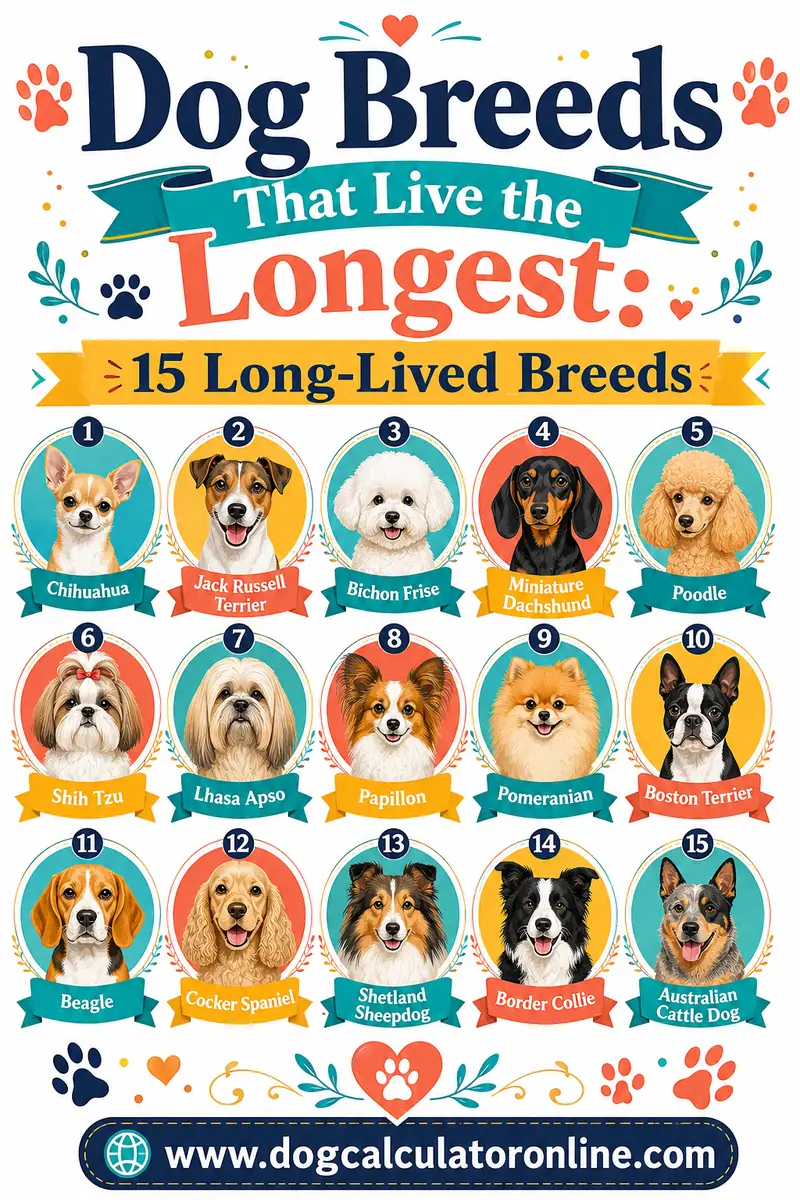
The longest-living dog breeds are small ones: Chihuahuas, Toy Poodles, Dachshunds, and more, often 14–18 years. See the full list and why size matters.
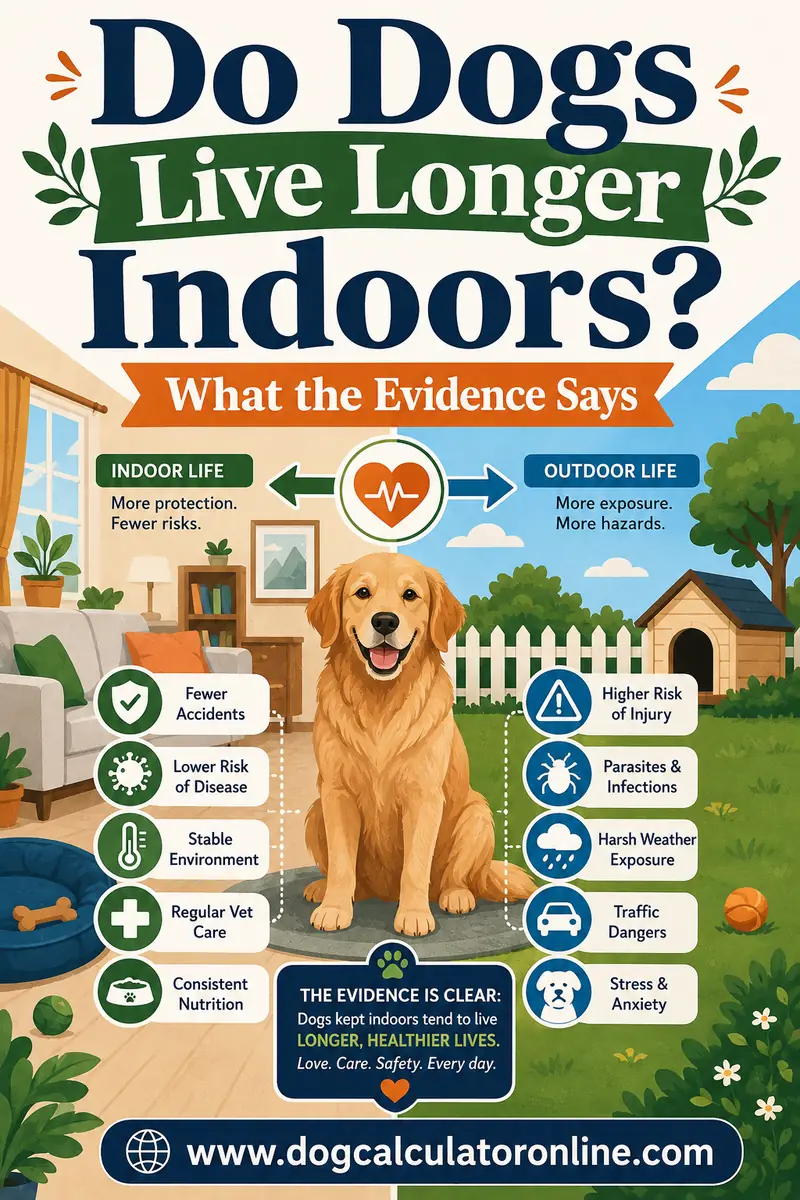
Yes — indoor dogs generally live longer than outdoor dogs. See why roaming shortens lifespans, what indoor dogs still need, and how to add healthy years.
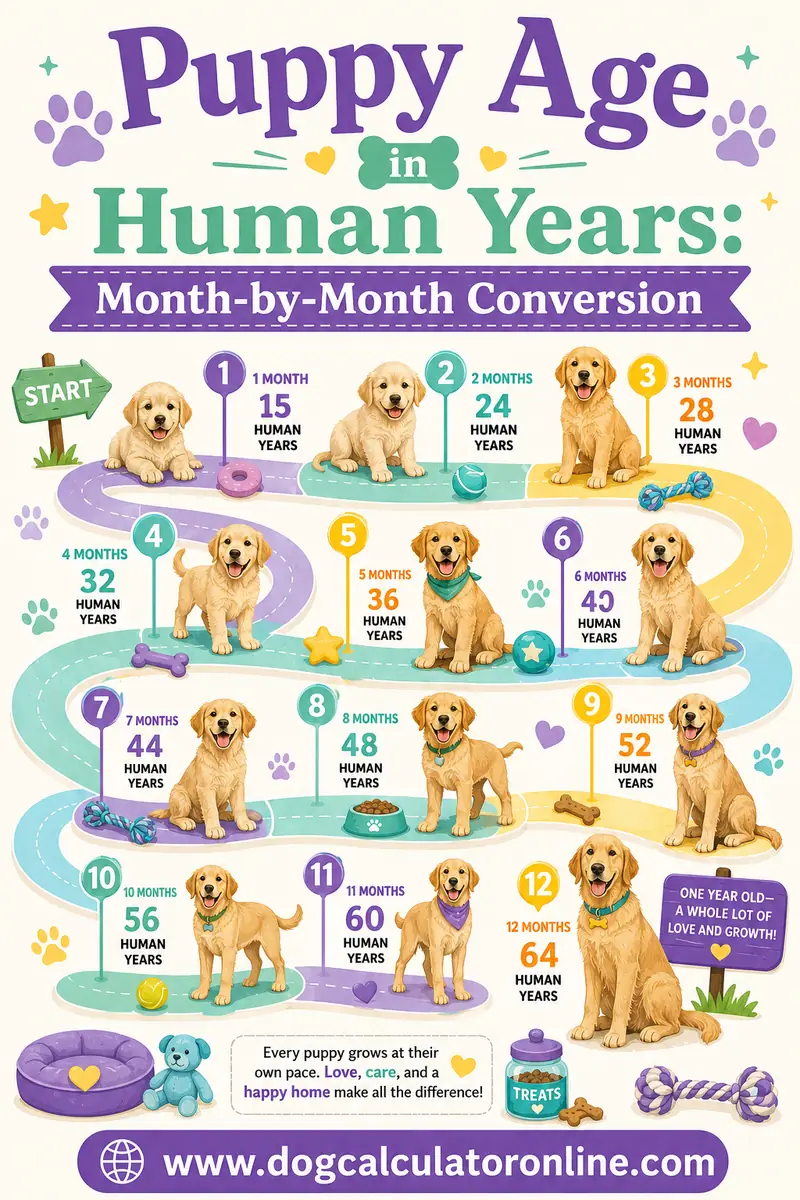
Convert puppy age to human years month by month: a 3-month puppy is like a 4-year-old child, 6 months like an 8-year-old, 1 year like a teen. Full chart.
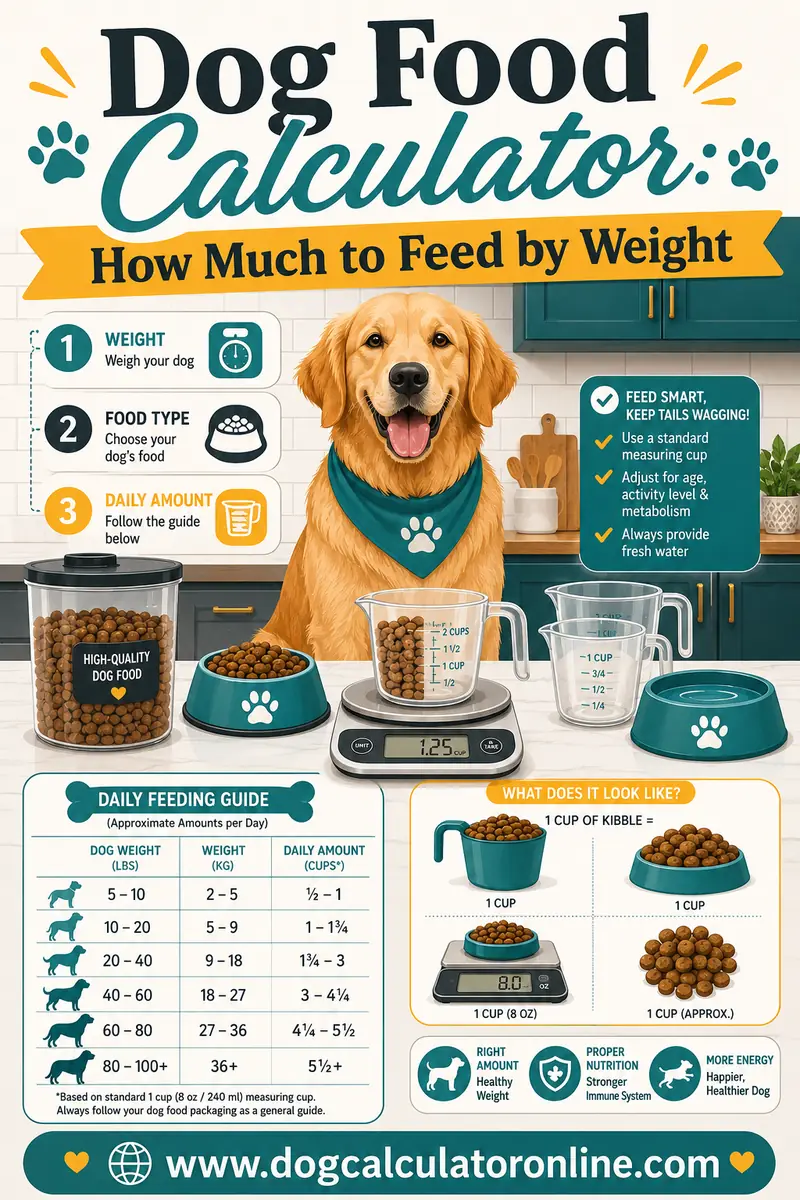
Use a dog food calculator to turn your dog's weight, activity, and food label into a daily portion. Full feeding chart by weight, plus how the math works.
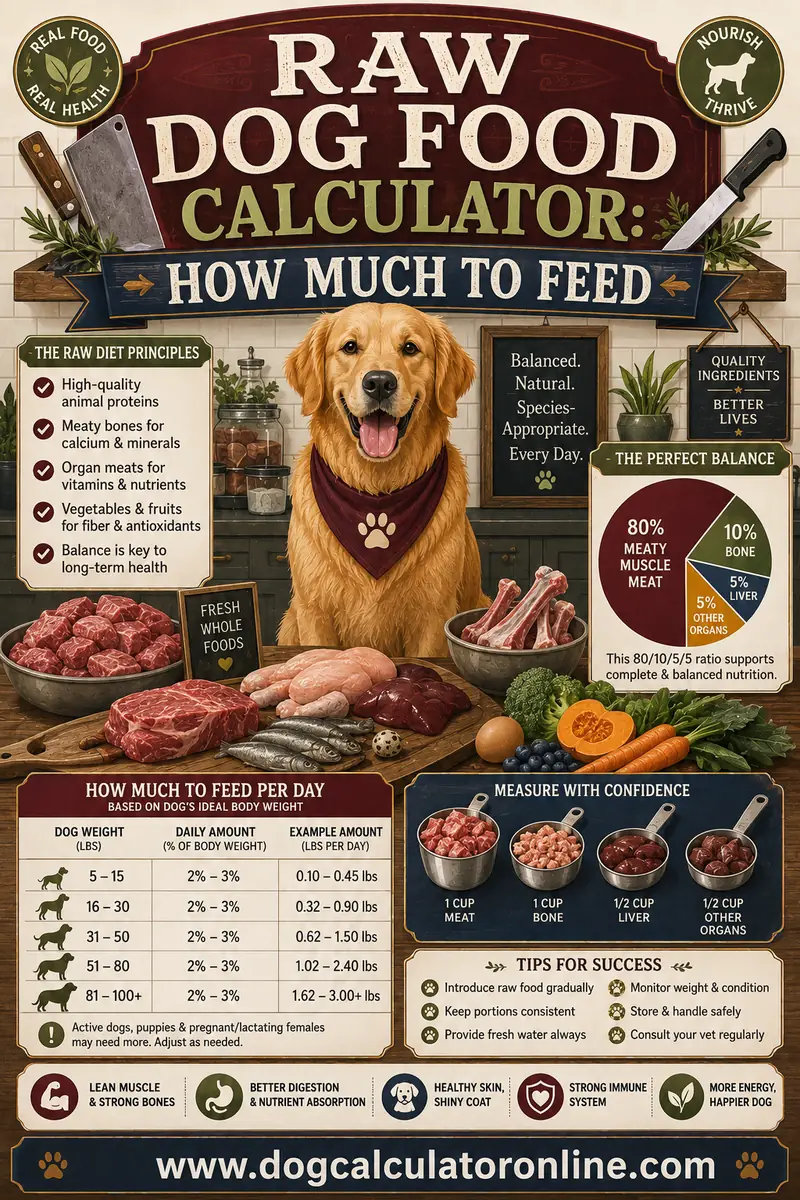
Raw dog food calculator guide: the 2-3% body weight rule, daily raw portions by weight, puppy percentages, and the safety questions to ask your vet first.
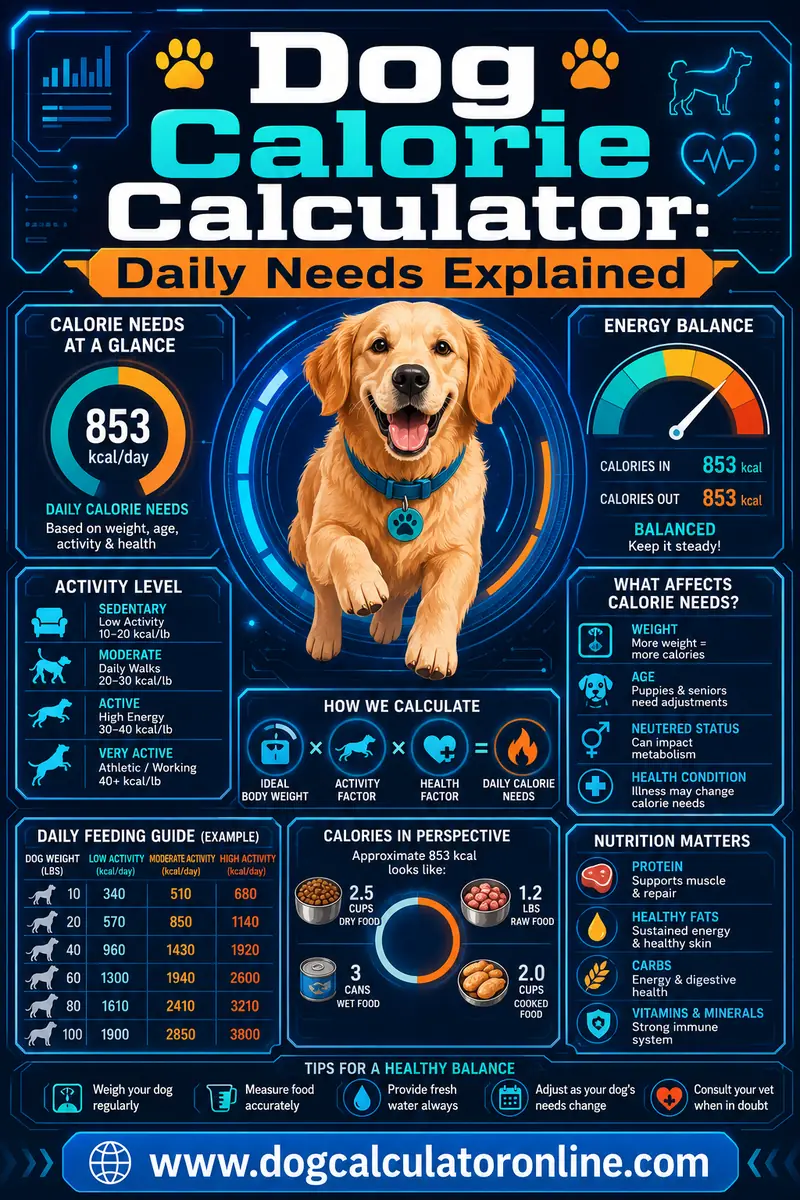
Dog calorie calculator guide: the RER and MER formulas vets use, calorie needs by weight, activity multipliers, worked examples, and how to convert kcal to cups.
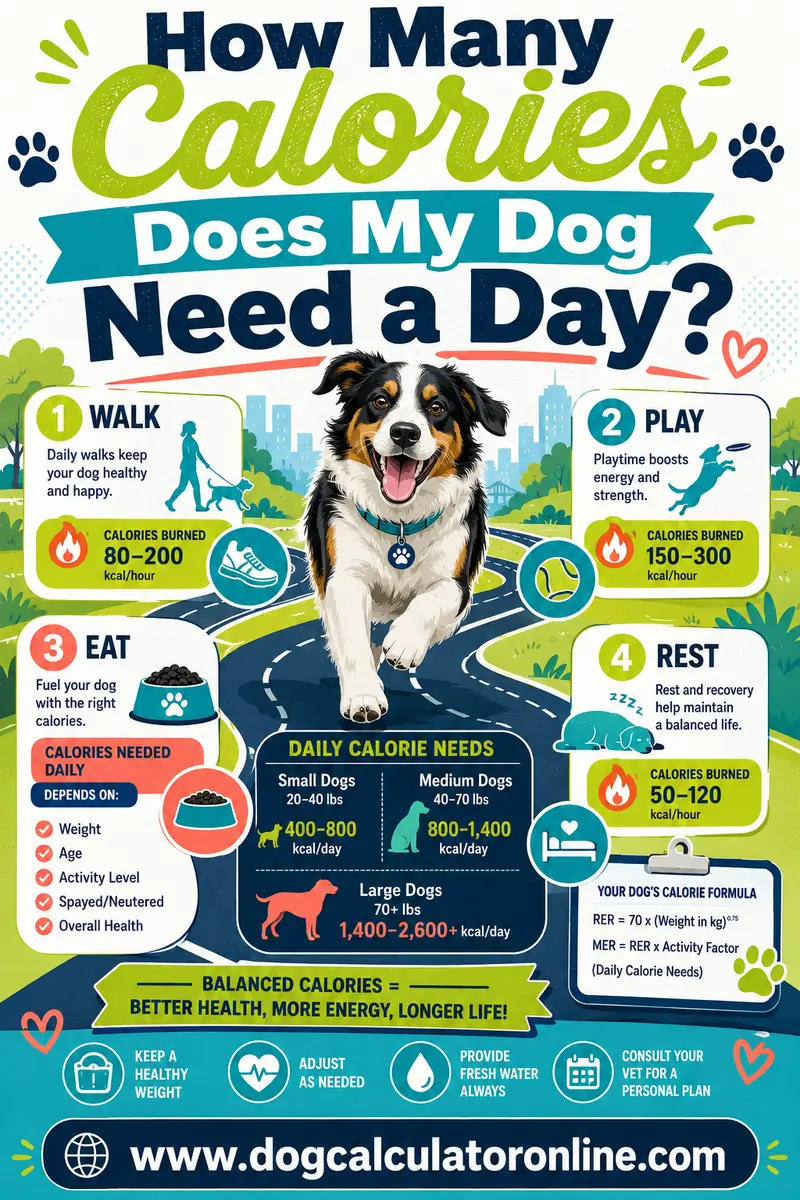
How many calories your dog needs a day, by weight and life stage: 220 kcal at 10 lb, 750 at 50 lb. Charts, treat budgets, and a free calorie calculator.
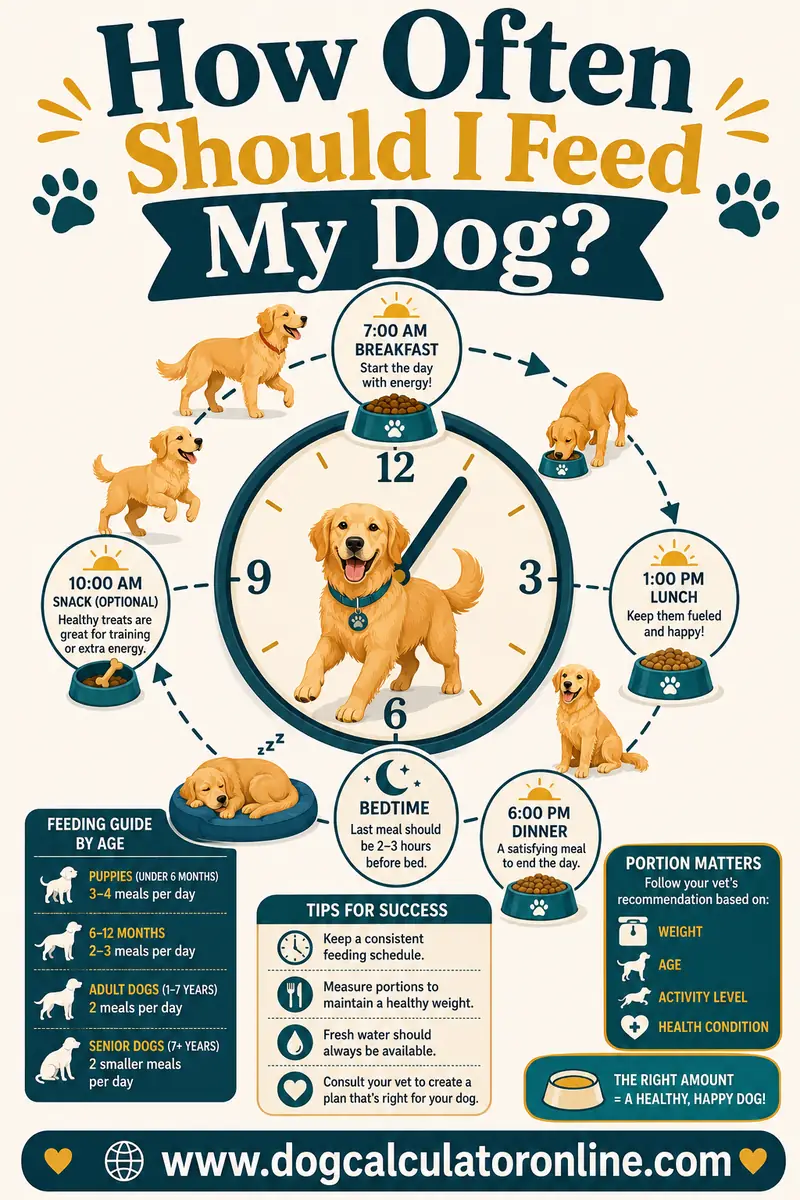
How often to feed your dog: twice a day for most adults, 3-4 meals for puppies, and how to build a schedule that fits your routine. Free portion calculator.
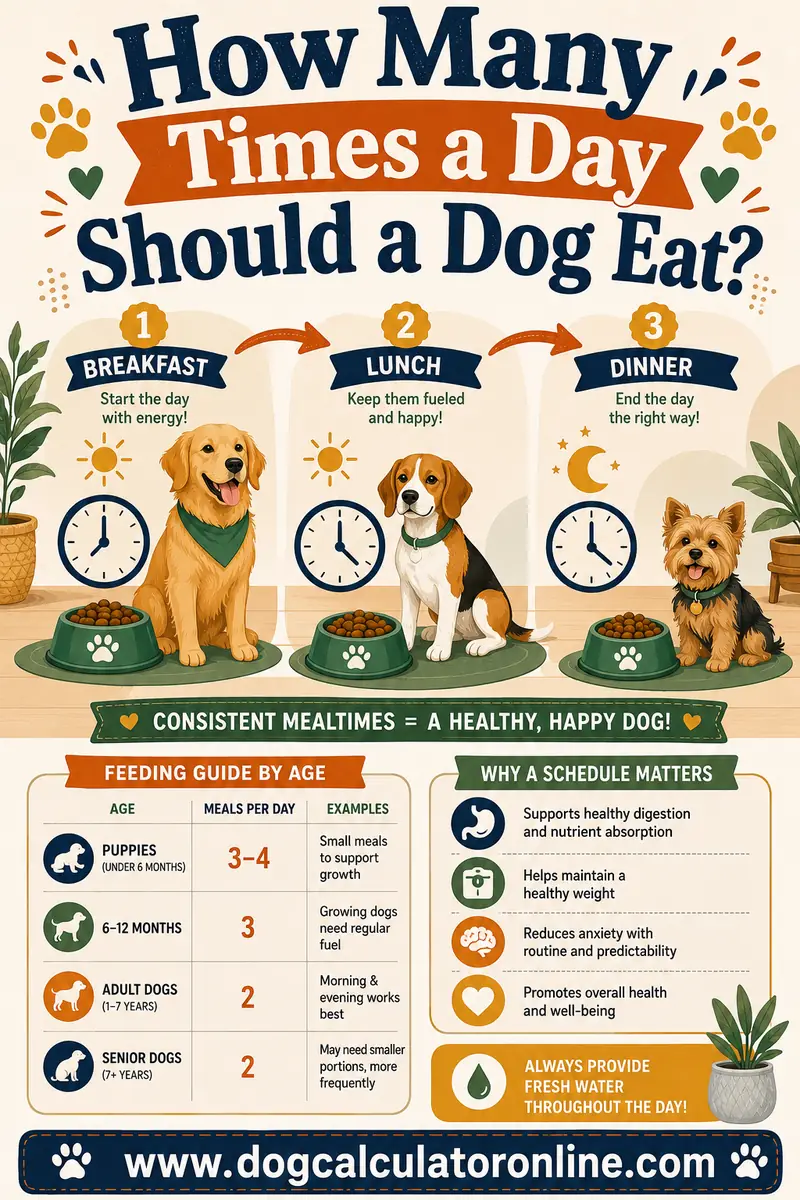
How many times a day a dog should eat: 2 meals for adults, 3-4 for puppies, plus the exceptions — toy breeds, seniors, deep-chested dogs. Free calculator.
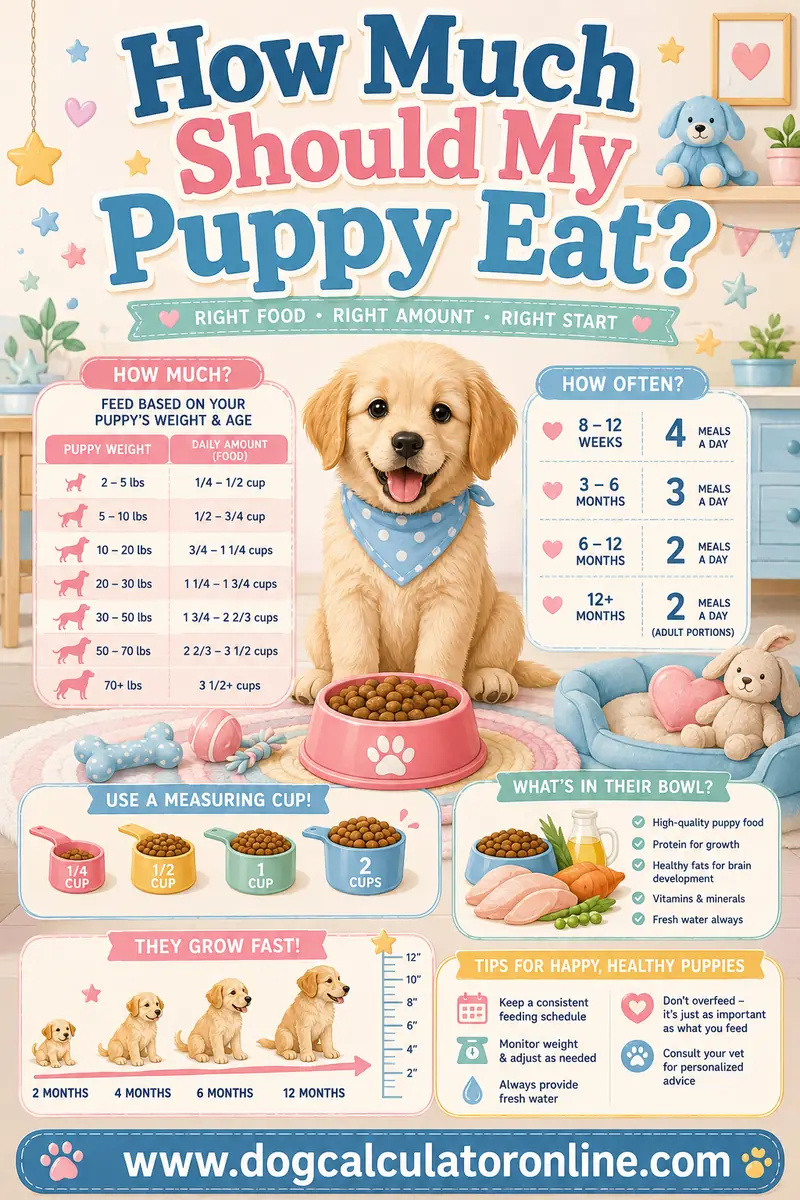
How much your puppy should eat by weight and age: daily cup estimates, why the label beats generic charts, and how portions change as they grow. Free tool.

How often to feed a puppy: 4 meals a day at 6-12 weeks, 3 meals at 3-6 months, 2 from 6 months. Timing examples, toy-breed rules, and a free portion tool.
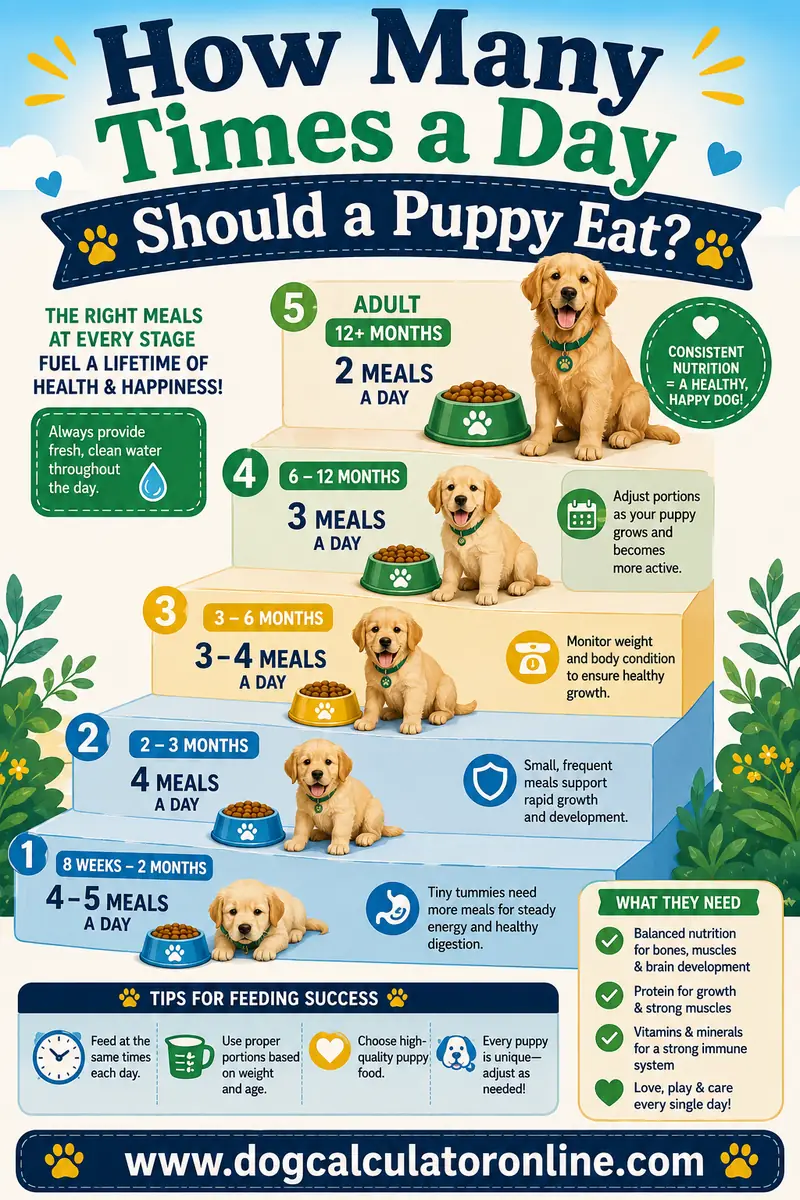
How many times a day a puppy should eat: 4 meals at 6-12 weeks, 3 at 3-6 months, 2 from 6 months. Per-meal portion math and breed-size differences inside.
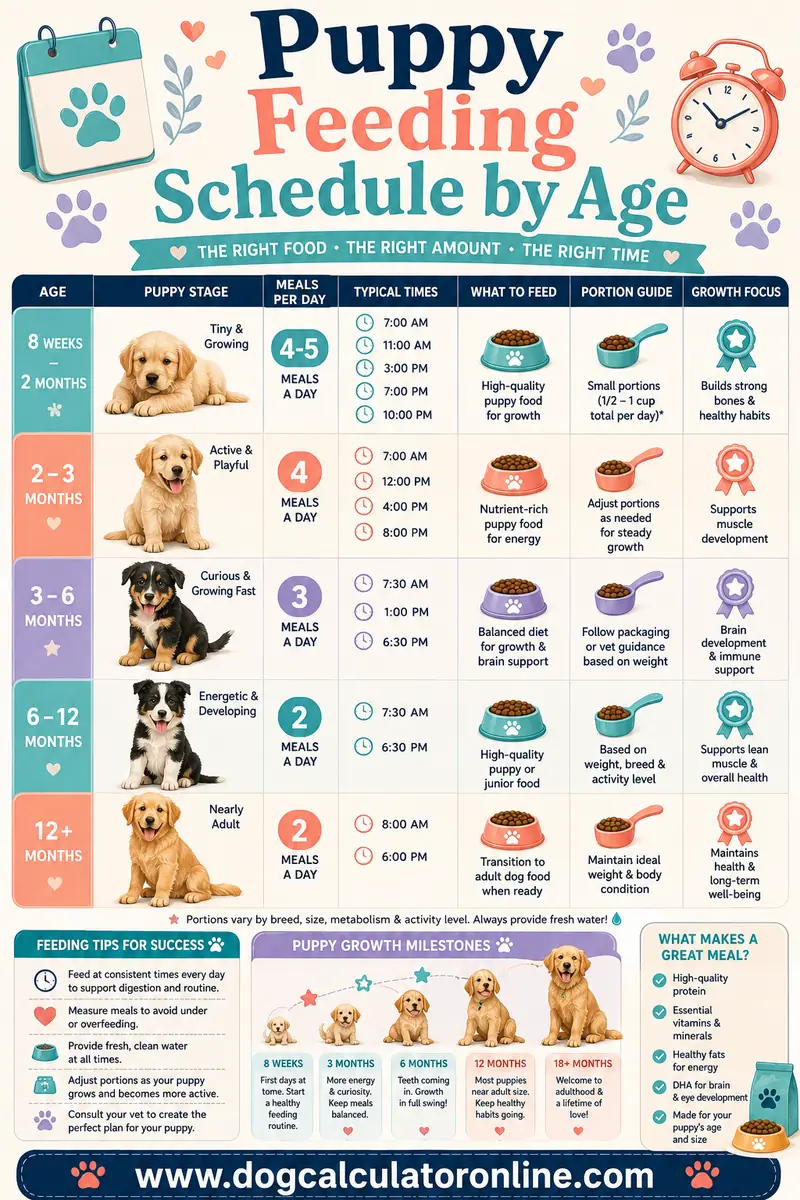
Complete puppy feeding schedule by age with clock times: 4 meals at 8 weeks, 3 at 4 months, 2 at 6 months — plus potty timing and portion links. Free tool.
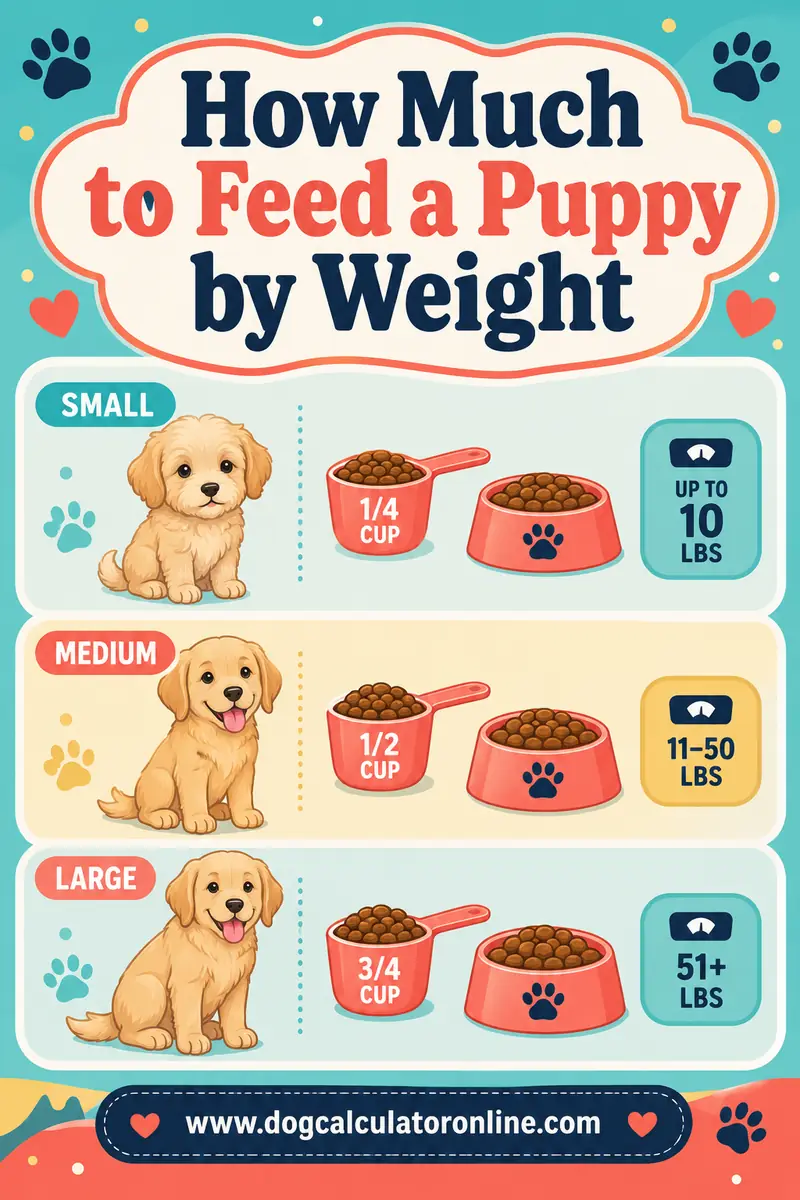
Puppy feeding amounts by weight: calorie and cup charts from 3 to 60 lb, why age changes the math, and worked examples. Free calculator does it for you.

How much to feed an 8-week-old puppy: about 1/2 cup a day for toy breeds up to 3 cups for giants, split into 4 meals. Charts by breed size + free tool.
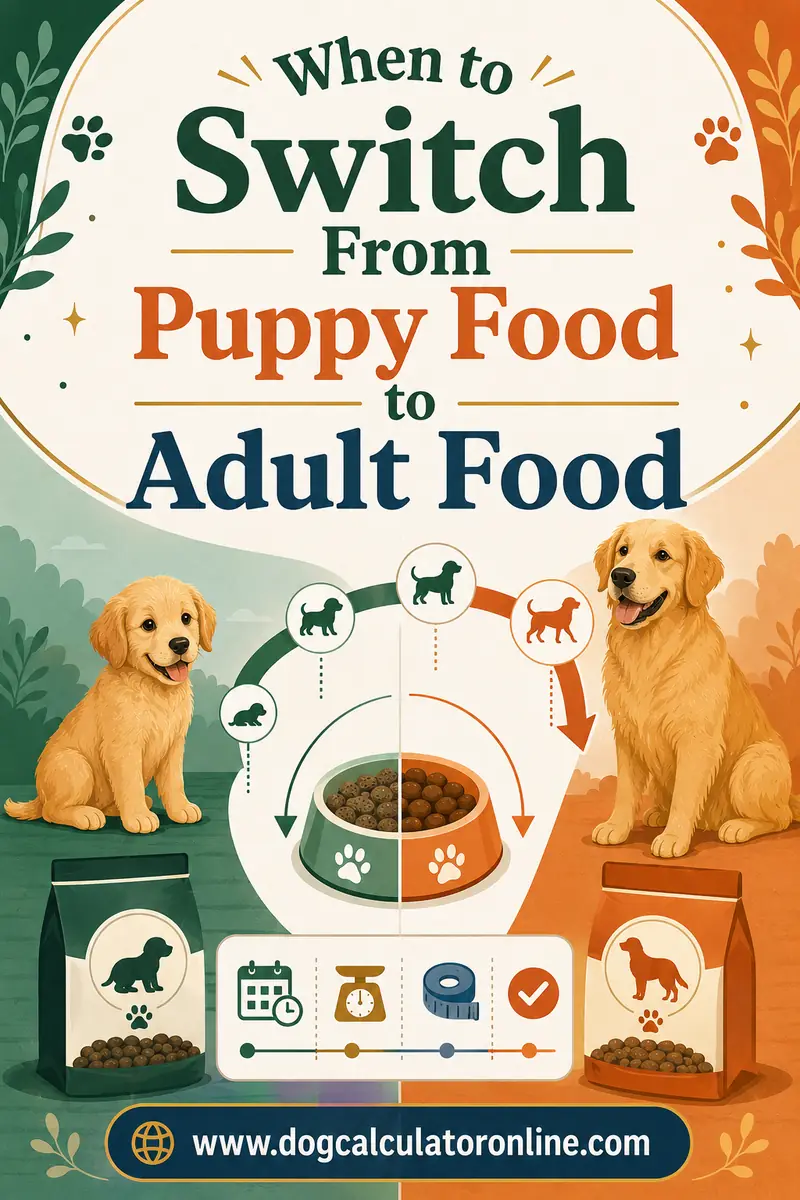
When to switch to adult dog food: 9-12 months for small breeds, 12 for medium, 12-18 for large, 18-24 for giants — plus the 7-10 day transition plan.
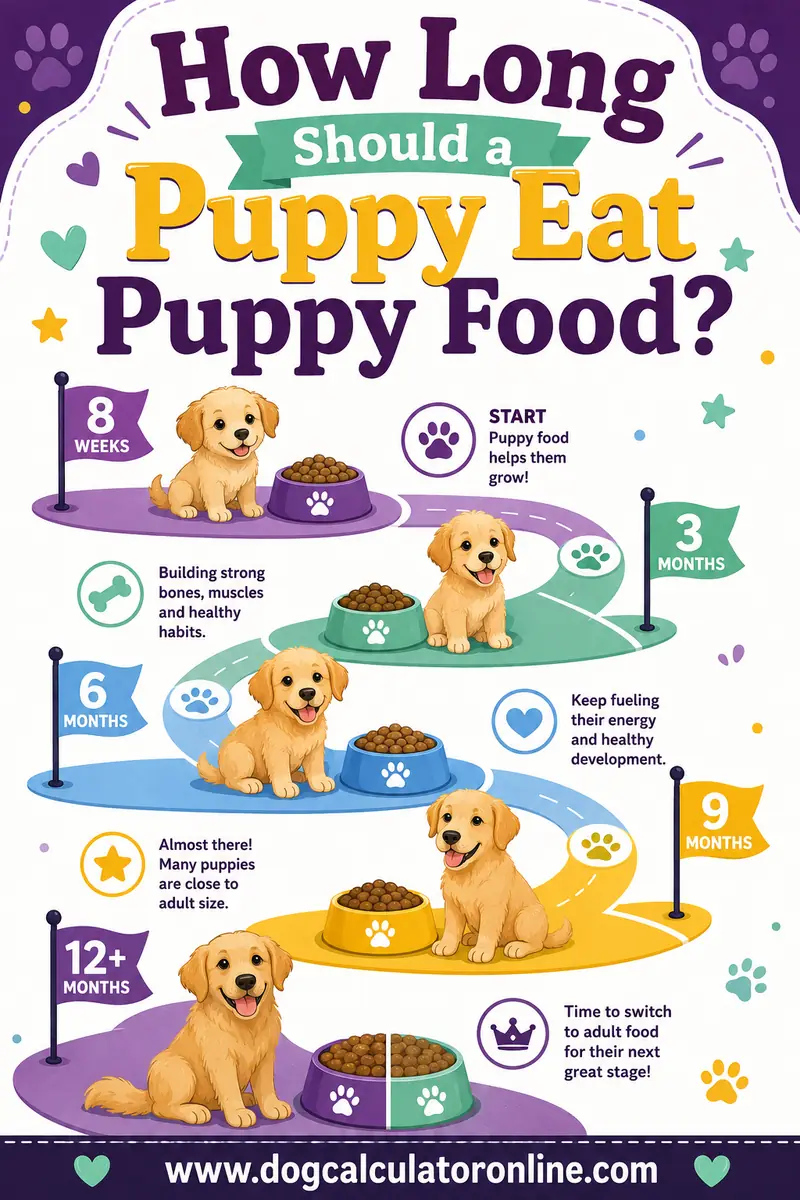
How long to feed puppy food: 9-12 months for small breeds, 12-18 for large, up to 24 for giants. What growth formulas do and why duration follows size.
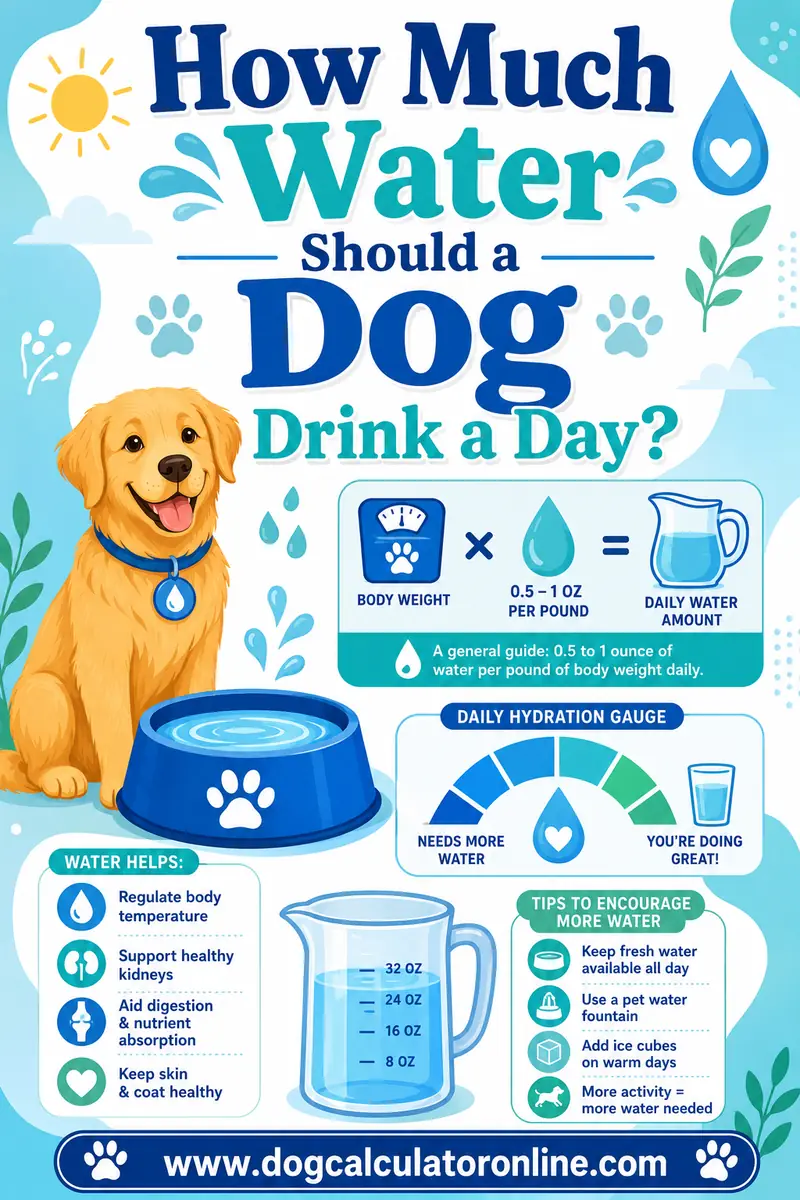
How much water a dog should drink daily: roughly 1 ounce per pound of body weight. Charts by weight, what changes the number, and thirst red flags.

How much water should a puppy drink? About a half cup every two hours for young pups, then an ounce per pound daily. Charts plus dehydration red flags.
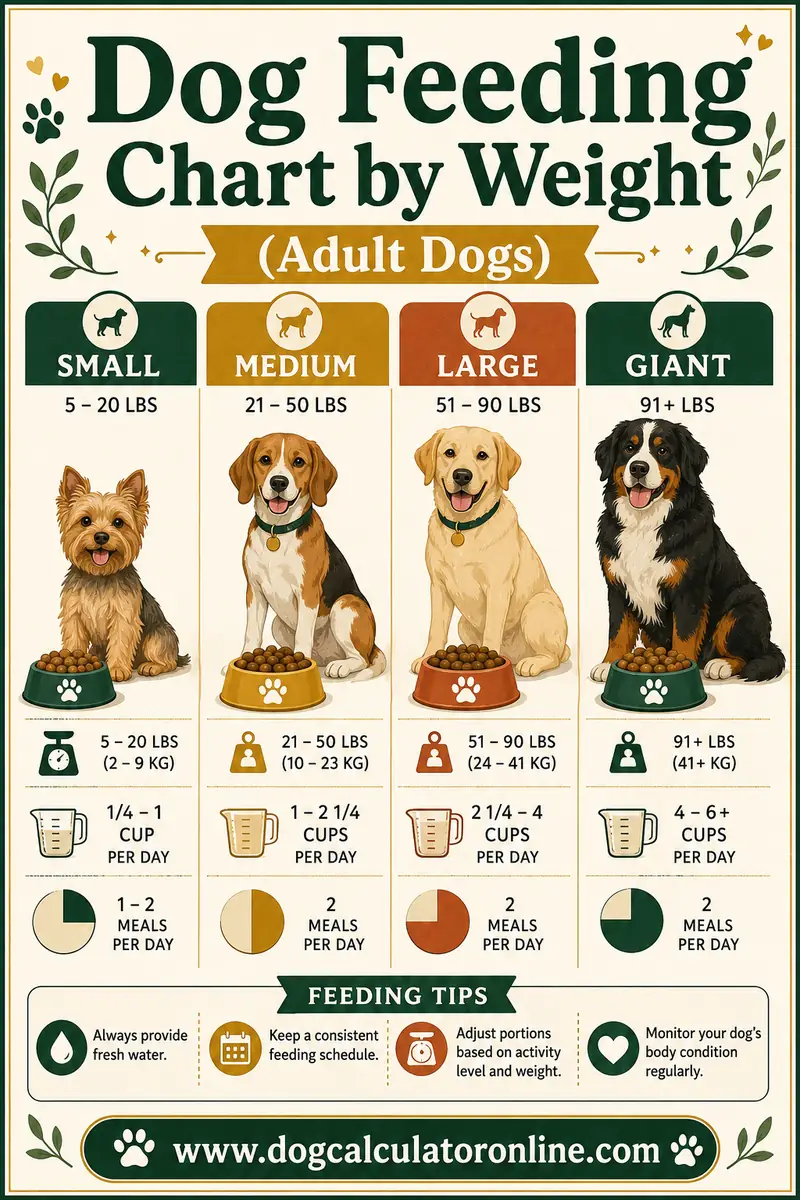
Adult dog feeding chart by weight: daily calories and cups from 5 to 100+ lb, the vet formula behind the numbers, and how to adjust for your dog's food and activity.
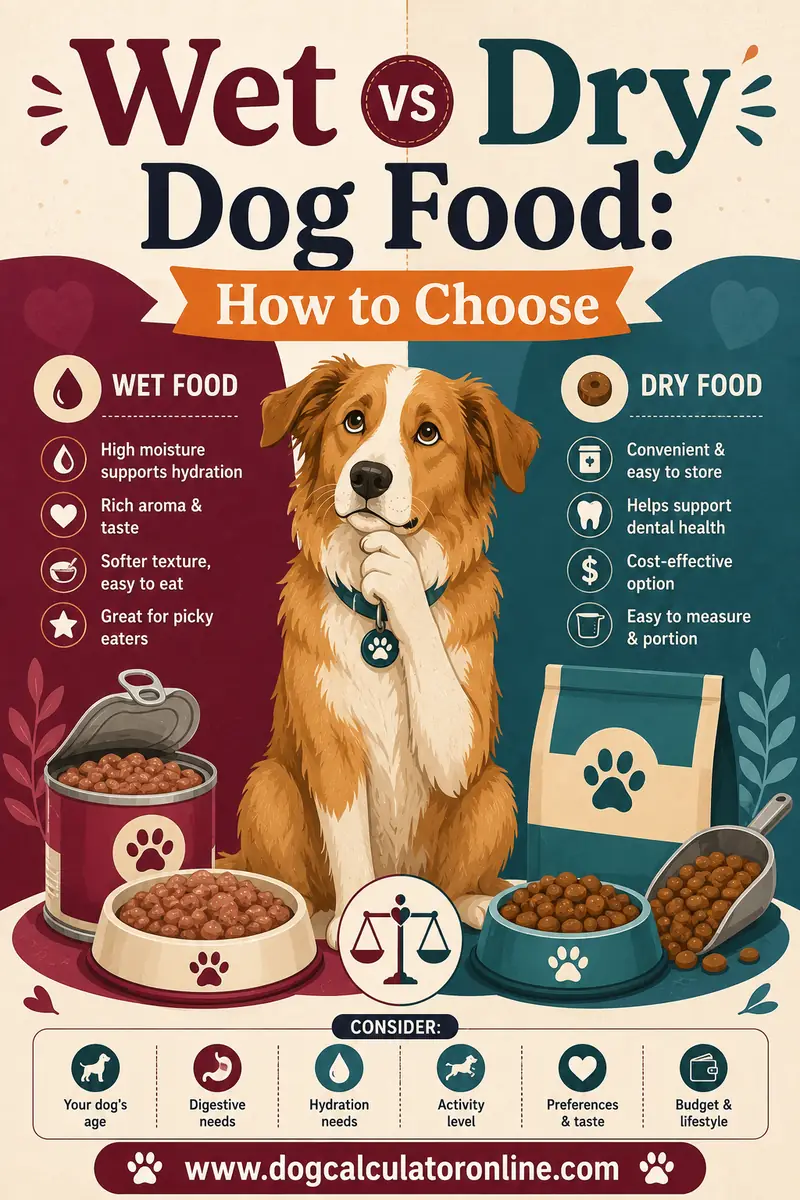
Wet vs dry dog food compared: nutrition, cost, dental effects, hydration, and portioning. When each one wins, how to mix them, and how to keep calories right.

How many cups of food a dog should eat daily: about 1 cup at 10 lb, 2 at 25 lb, 3 at 50 lb on average kibble — and why your food's kcal-per-cup changes everything.
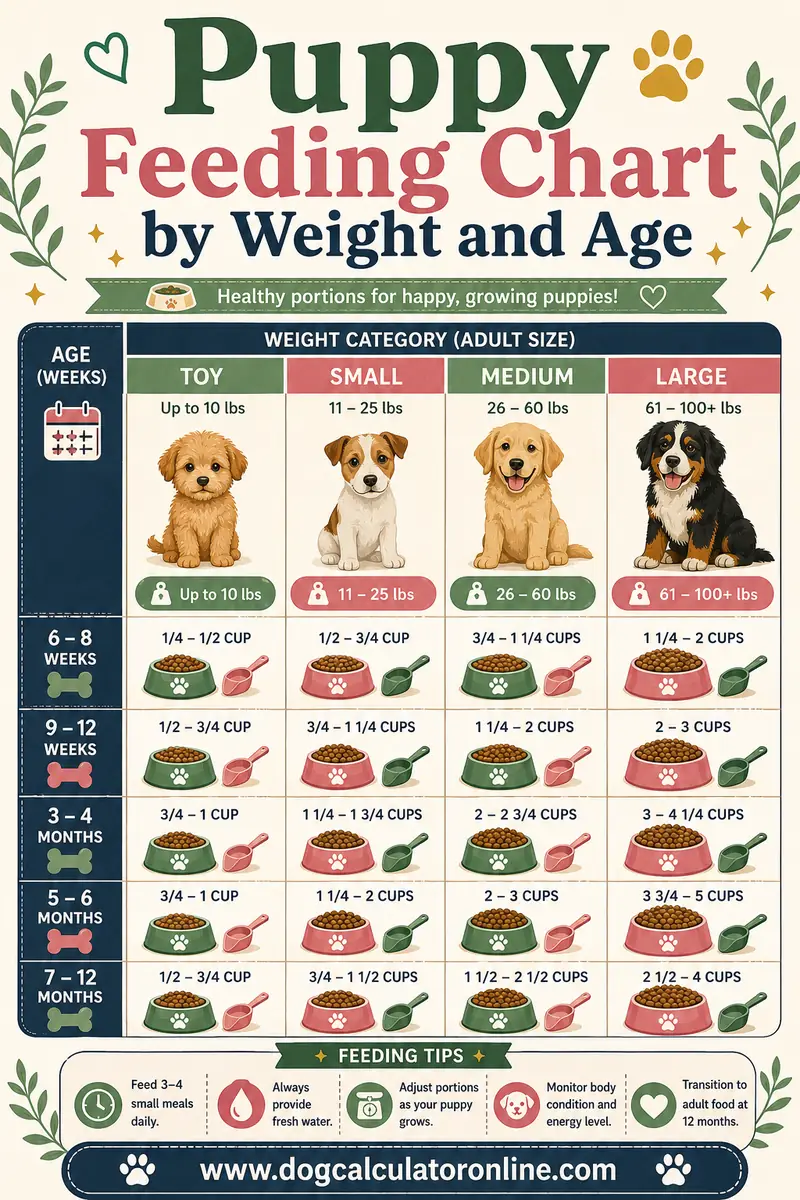
Puppy feeding chart by weight and age: daily cups and meals from 8 weeks to 12 months, why puppies need more per pound than adults, and how to adjust as they grow.
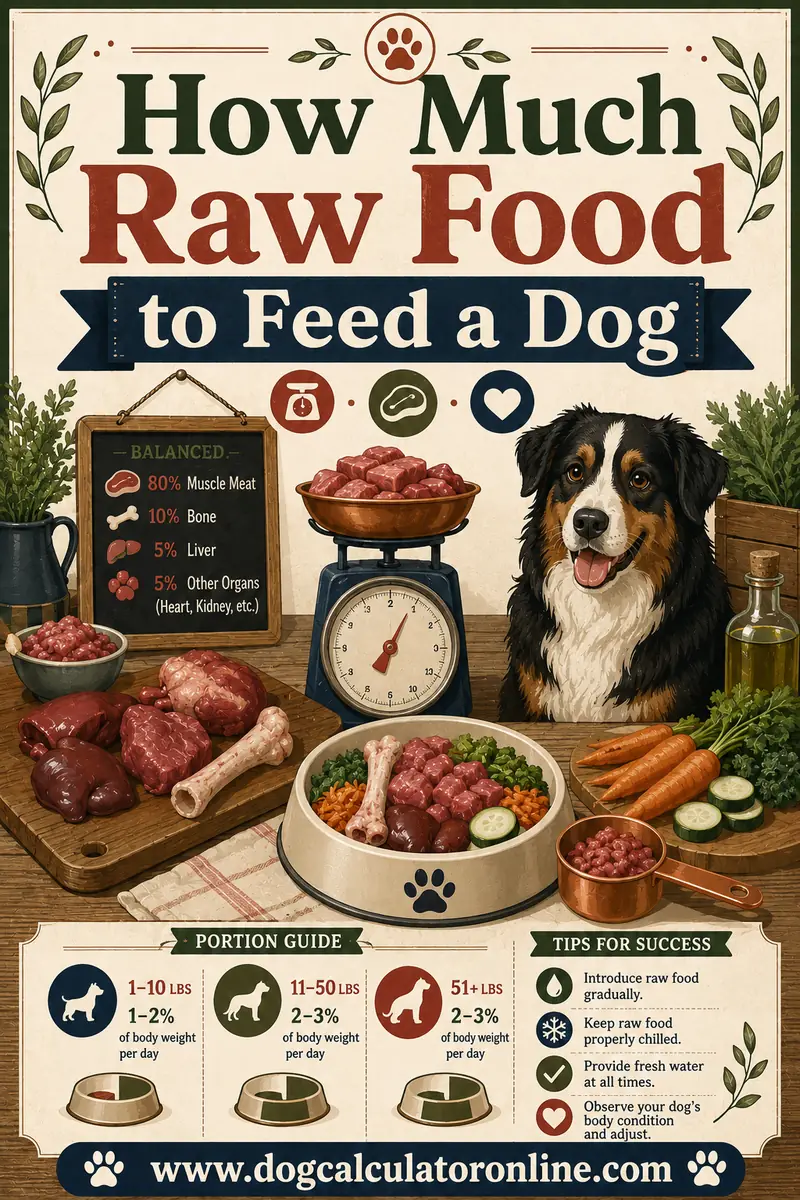
How much raw food to feed a dog: about 2–3% of body weight daily for adults, adjusted for activity and body condition. Charts in lb and oz, plus safety essentials.
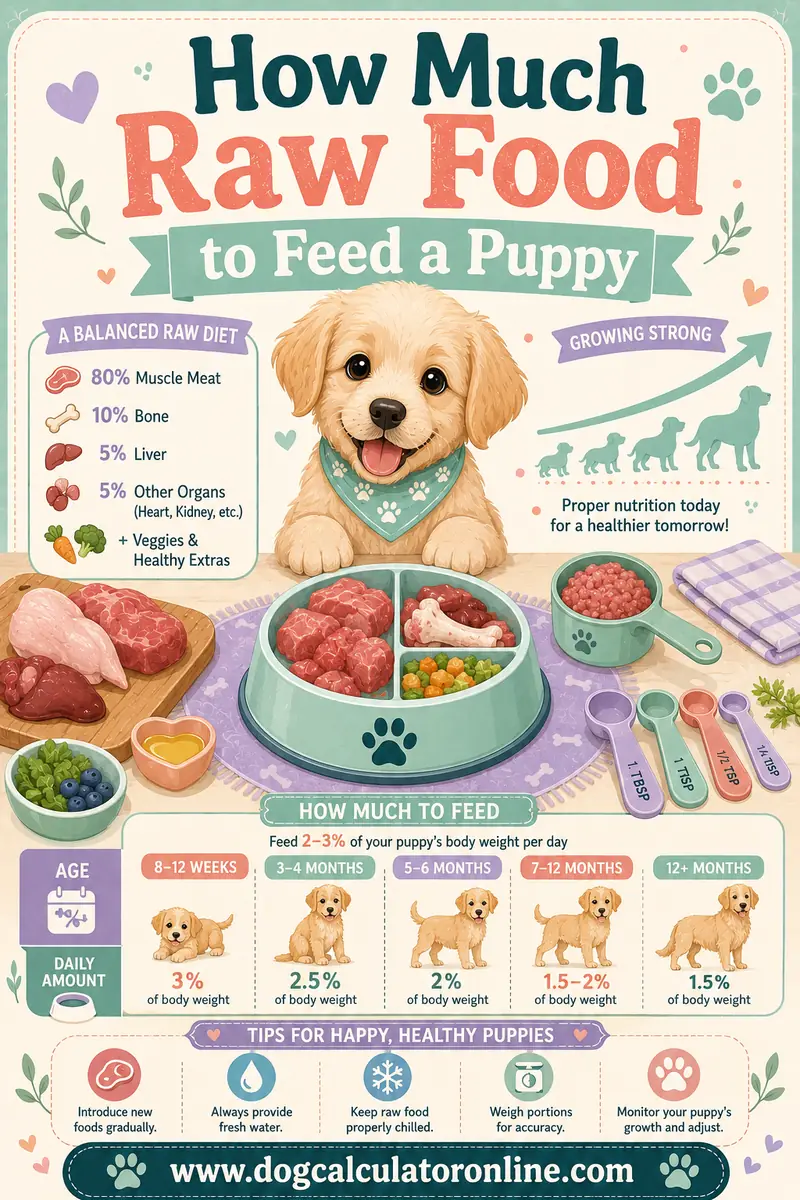
How much raw food to feed a puppy: 2–3% of expected adult weight or 5–10% of current weight daily, split into 3–4 meals. Charts, balance rules, vet cautions.
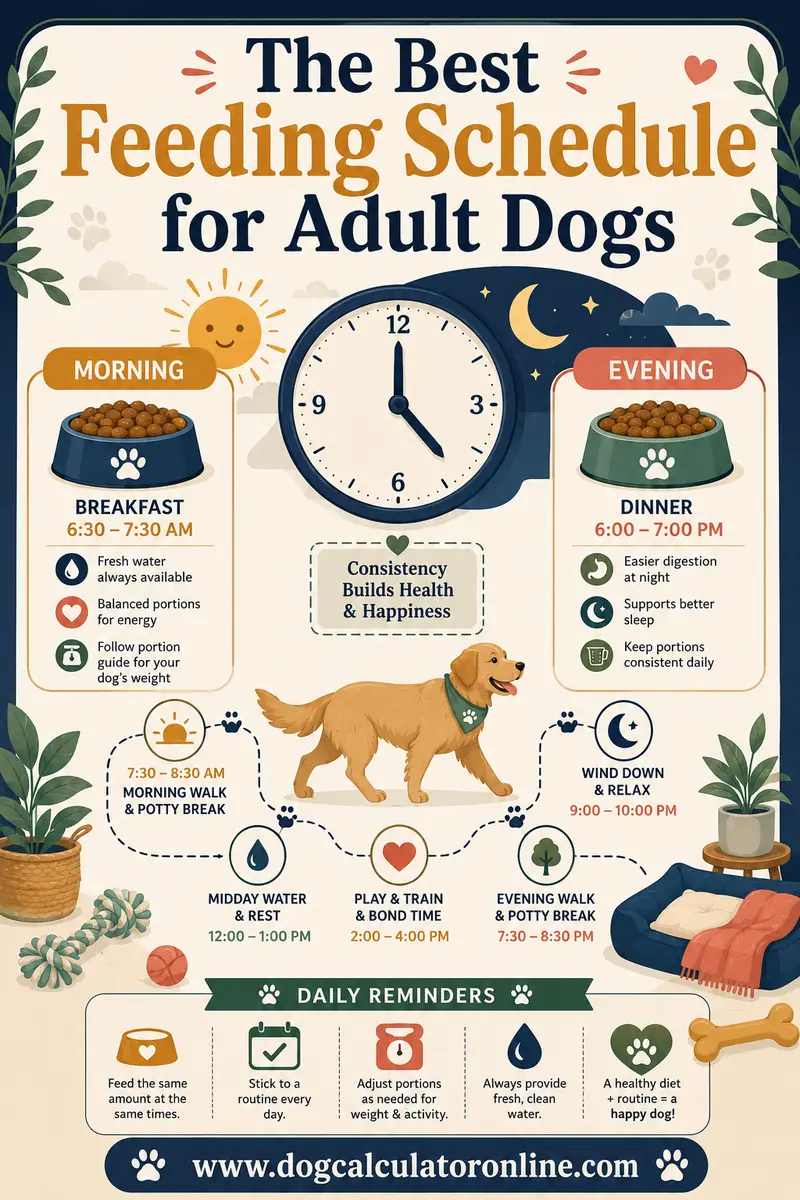
The best feeding schedule for adult dogs: two meals a day, 8–12 hours apart, at consistent times. Sample schedules, timing around exercise, and when to adjust.
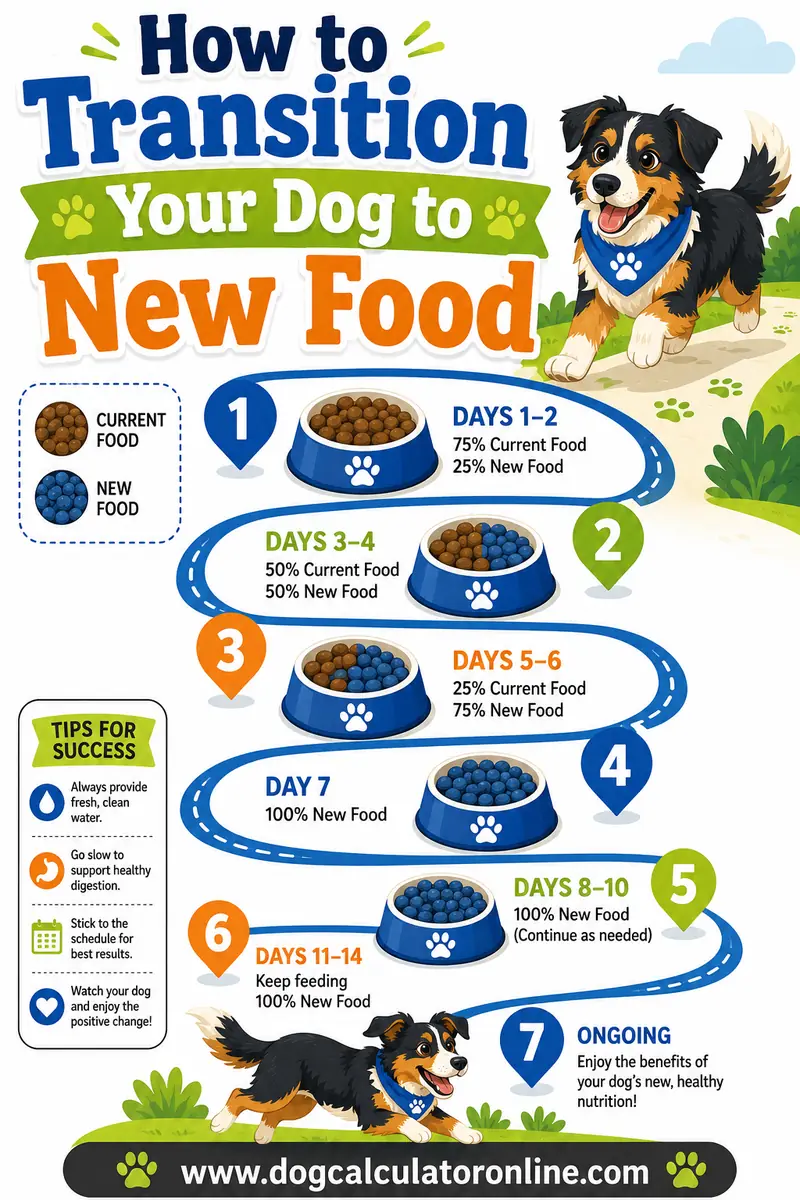
How to transition your dog to new food: the vet-standard 7–10 day mixing plan, day-by-day ratios, troubleshooting soft stools, and when to slow down or call the vet.
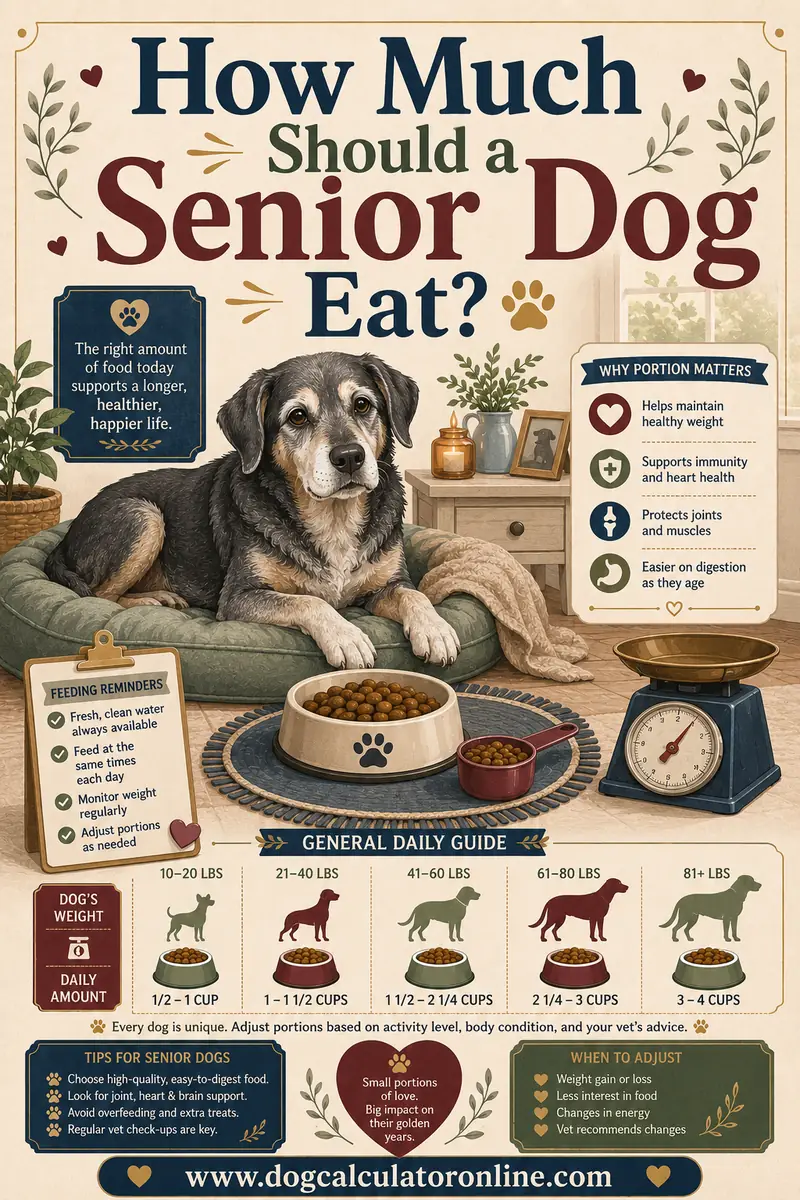
How much to feed a senior dog: often 10–20% fewer calories than younger adults as activity drops, but protein needs may rise. Portions, charts, and vet-first advice.

Free feeding vs scheduled feeding: why vets favor measured meals for weight, potty timing, and health monitoring — plus the few dogs grazing actually suits.

How many treats can a dog have a day? Keep them under 10% of daily calories — about 35 kcal for a 10-lb dog, 100 for a 50-lb. Budgets by weight and smart swaps.

Signs you're overfeeding your dog: vanishing waistline, ribs you can't feel, soft stools, low energy. How to confirm it, fix portions, and when to see a vet.

Signs you're underfeeding your dog: visible ribs, weight loss, low energy, dull coat, and obsessive food-seeking. How to confirm it and fix portions safely.

What human food can dogs eat? The safe list — eggs, carrots, bananas, rice, plain chicken and more — with portion rules, prep tips, and what to skip.

The foods dogs can't eat: chocolate, grapes, xylitol, onions, macadamia nuts and more — why each is dangerous, symptoms to watch, and what to do right away.

Yes, dogs can eat eggs — cooked and plain. How much egg by dog size, why vets advise against raw eggs, whether shells are safe, and how eggs fit the diet.

Yes, dogs can eat bananas in small amounts. How many slices by dog size, why the sugar adds up fast, what to know about peels, and easy ways to serve them.

Yes — carrots are one of the best low-calorie dog treats. Raw vs cooked, frozen carrots for teething puppies, choking-safe prep by dog size, and portions.
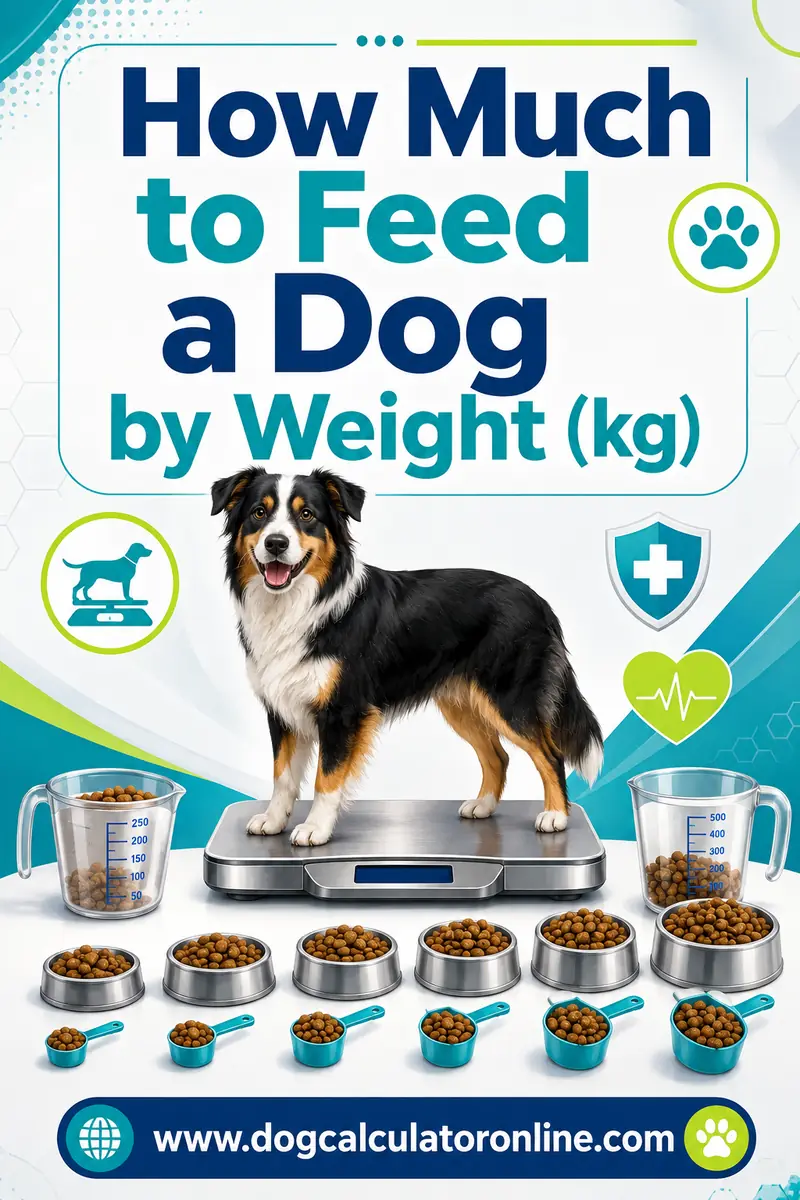
How much to feed a dog by weight in kg: daily calorie and gram estimates for 5–50 kg dogs, the vet RER formula behind them, and how to adjust for your dog.

How many kcals should your dog eat? Daily estimates by weight, the RER formula vets use, what kcal means on dog food labels, and how to adjust for your dog.

A practical 8-12 week puppy feeding schedule: 4 meals a day, sample meal times, portion guidance by expected adult size, and how to adjust as they grow.
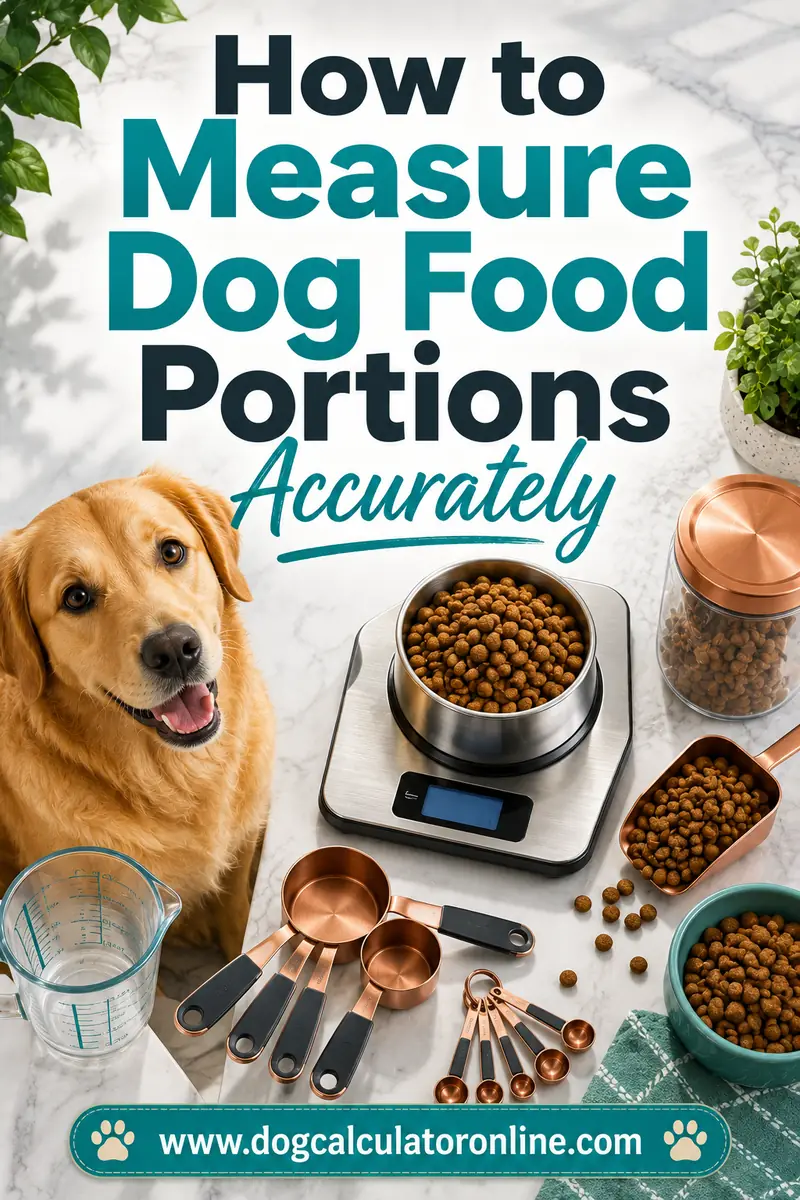
How to measure dog food the right way: gram scale beats measuring cup, how to calibrate your scoop, read kcal labels, and portion wet food and toppers.

Once or twice a day? Most vets recommend two meals for adult dogs. The case for each schedule, which dogs must not eat once daily, and how to switch safely.

Typical cost to feed a dog: rough monthly ranges by size and food type, what drives the price per bowl, and easy ways to trim the bill without cutting corners.

A dog's heat usually lasts 2-4 weeks, about 18-21 days on average. The stage-by-stage timeline, when she's fertile, what's normal, and when to ask your vet.

Most dogs go into heat about every 6 months, but small breeds cycle more often and giants less. Frequency by size and age, plus what's normal and vet flags.

The early signs a dog is going into heat: swollen vulva, spotting, more licking, frequent peeing, and clingy behavior. What to watch for and when it starts.

Dogs usually have their first heat between 6 and 24 months, depending on size. When small, large, and giant breeds start, plus what a first heat looks like.

How to help a dog in heat: keep her comfortable, manage mess, prevent unwanted mating, and know when to ask your vet. A practical, safe home-care guide.

Dogs usually bleed for about 7 to 10 days during heat, heaviest early on. Why lighter bleeding can mean peak fertility, and when bleeding needs a vet.

Spayed dogs shouldn't go into heat, since spaying removes the ovaries. If a spayed dog shows heat signs, it may be ovarian remnant syndrome — ask your vet.

Dogs in heat get clingy, restless, moody, and flirtatious as hormones shift. The behavior changes by stage, why they happen, and how to help your dog cope.

A simple home-care routine for a dog in heat: comfort, hygiene, mess management, containment, and safe daily care — plus when to check in with your vet.

A practical guide to dog diapers for heat: washable vs disposable, how to measure and size, getting your dog used to them, and hygiene tips that prevent issues.

A dog pregnancy calculator estimates your dog's due date from the mating date. How it works, why 63 days matters, how to read the results, and its limits.

The early signs a dog may be pregnant: appetite changes, enlarged nipples, low energy, and nesting. Why signs can mislead and how a vet confirms pregnancy.

A dog's pregnancy week by week, from mating to birth over about 63 days. What happens each week, what to watch for, and when to work with your vet.

Average litter size runs from one or two in toy breeds to ten or more in giants. What changes the number, and why an X-ray count matters during whelping.
Typical litter sizes for eighteen named breeds, from two in a Chihuahua to ten in a Mastiff, plus the breeds that sit well off the body-size trend and why.
A rectal temperature below 99°F / 37.2°C is the one reliable sign labor starts within a day. The stages, the timings, and four reasons to call the vet.

Puppies arrive head or tail first and both are normal. What a whelping night really looks like, why you count placentas, and the two true emergencies.

Size it to her stretched-out length plus a third, fit pig rails, and set it up two weeks early so she settles in it rather than in the back of your wardrobe.

Newborn puppies cannot keep themselves warm for the first two to three weeks. A week-by-week care guide: temperature, daily weighing, and when to call the vet.
A nursing dog at peak lactation needs two to four times her usual calories, scaled by litter size. What to feed, how much, and when to start cutting back.

Puppies open their eyes between day 10 and day 14, but sight takes weeks to sharpen. Milestone timings, why the blue-gray color changes, and when to see a vet.

Eight weeks is the practical minimum and often the legal one, and the reason is behavioral rather than nutritional. What puppies learn in weeks six to eight.

There is no home urine test for dogs. Here is what you can actually tell at home, and why a vet can only confirm a pregnancy from about day 21 to 30 onwards.

False pregnancy in dogs follows the progesterone drop after any season, mated or not. The signs, the usual two to three week course, and when to call the vet.

Gestation is about 63 days from ovulation but 58 to 72 from a mating date. Why sperm survival widens the window, and how progesterone testing narrows it again.

A dog is fertile from her very first season, often at six months. Why physically able is not the same as ready, and what the fertile window actually looks like.

An unsentimental look at breeding a litter: real costs, health testing, the eight weeks it takes, the odds of losing puppies, and reasons that do not hold up.

There is no universal legal limit, but registries cap around four to six and age out at eight. Why recovery, age and the last whelping matter more than a count.

Twice-daily temperatures from day 55 are how you tell days away from hours away. What changes in the last week, and the exact readings that mean tonight.

Do not increase her food for the first six weeks. What actually changes across the nine weeks: diet, exercise, worming, vaccines and the last two weeks of prep.
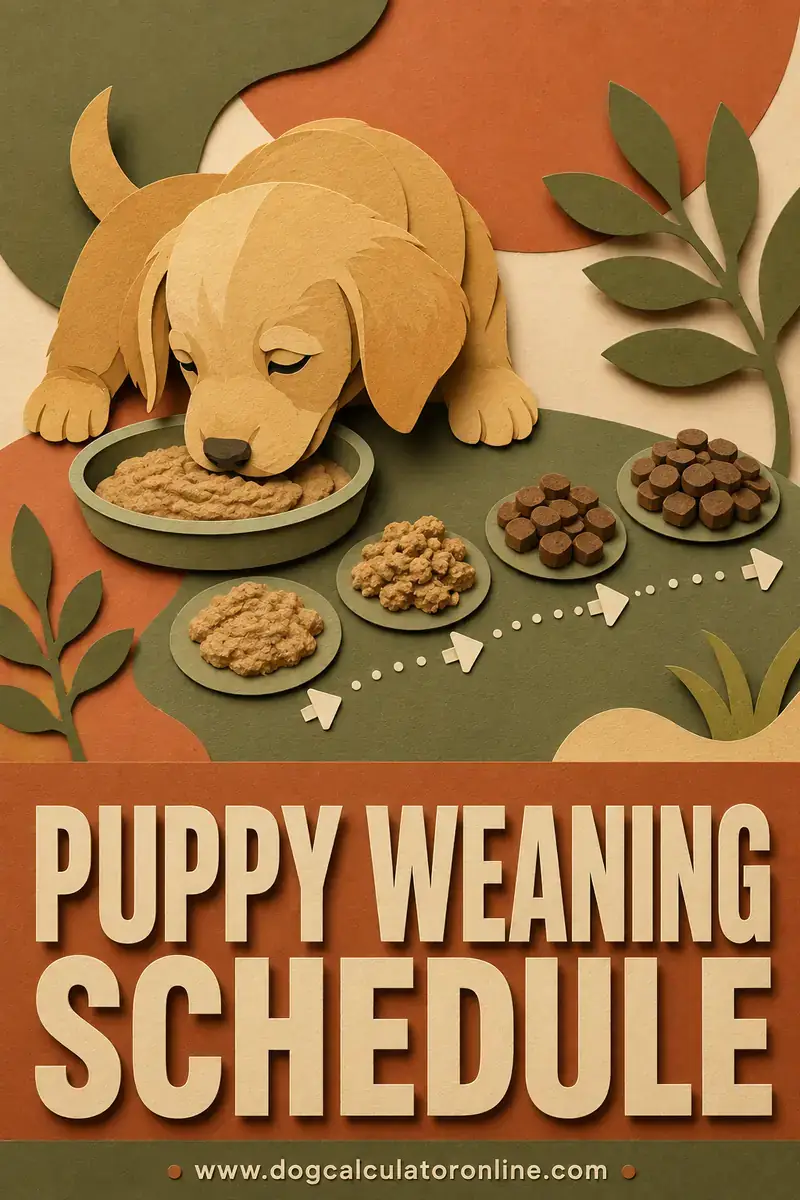
Weaning runs from about three and a half weeks to eight, and it has two sides. A week-by-week schedule for the puppies and for reducing her food safely.

Newborn puppies need about 13 mL of milk replacer per 100 g of body weight a day in week one, split across two-hourly feeds. Volumes, timings and safety rules.

Puppies start solid food at about three and a half to four weeks, as a soupy gruel. How to make it, what to expect at the first meal, and the mistakes to avoid.

Spaying removes pyometra risk entirely and cuts mammary tumour risk sharply if done early. The trade-offs, the recovery timeline and the feeding change.

Neutering a male dog has a far weaker health case than it is usually given. What it genuinely changes, what it will not fix, and the options short of surgery.
Six months is still fine for small dogs, but large breeds may do better waiting for growth plates to close. Why the advice changed and what to ask your vet.

How much is dog insurance per month? Typical accident-and-illness plans run $40-$70 monthly. See ranges by age, size, and plan choices - no sales pitch.

How does pet insurance work? You pay the vet, file a claim, and get reimbursed after your deductible. Here is the whole process explained step by step.

What does pet insurance cover? Accidents, illness, surgery, and diagnostics are in; pre-existing conditions and routine care are out. See the full list.

What is a pet insurance deductible? See how annual vs per-condition deductibles work, real payout math, and how to choose the $250, $500, or $1,000 tier wisely.

Pet insurance reimbursement explained: how 70%, 80%, and 90% rates change your payout, real math on actual vet bills, and which rate is worth choosing.

Accident-only pet insurance costs about $15-$25/month but skips illness coverage. See what each plan type covers, real cost gaps, and who should pick which.

Pet insurance waiting periods explained: typical waits of 2-14 days for accidents and illness, 6 months for knees, why they exist, and how to shorten them.

How pet insurance handles pre-existing conditions: what counts, curable vs incurable rules, bilateral clauses, and smart options if your dog already has one.

Is pet insurance worth it for a puppy? Premiums are lowest, nothing is pre-existing yet, and puppies eat weird things. The honest math for new owners.

Is pet insurance worth it for older dogs? Premiums jump, pre-existing conditions shrink coverage, and age limits apply. Here is the honest senior-dog math.

Your dog is young and healthy, so is pet insurance worth it? Why healthy dogs get the best terms, when savings win instead, and the honest math both ways.

French Bulldog insurance often runs $60-$120+ per month, well above the dog average. See the health reasons behind the price and how to manage the premium.
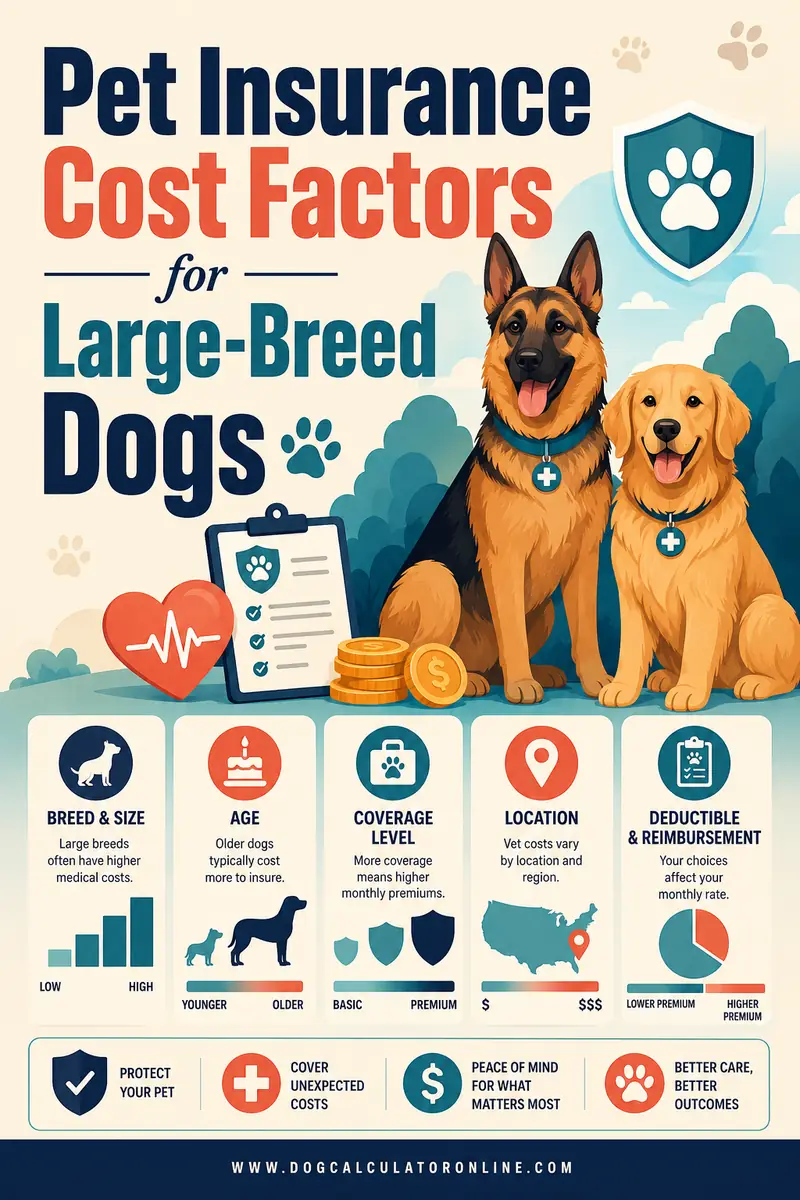
What insurance for large breed dogs really costs in the US, why big dogs quote $50–$90 a month, and the plan settings that protect a giant-sized budget.
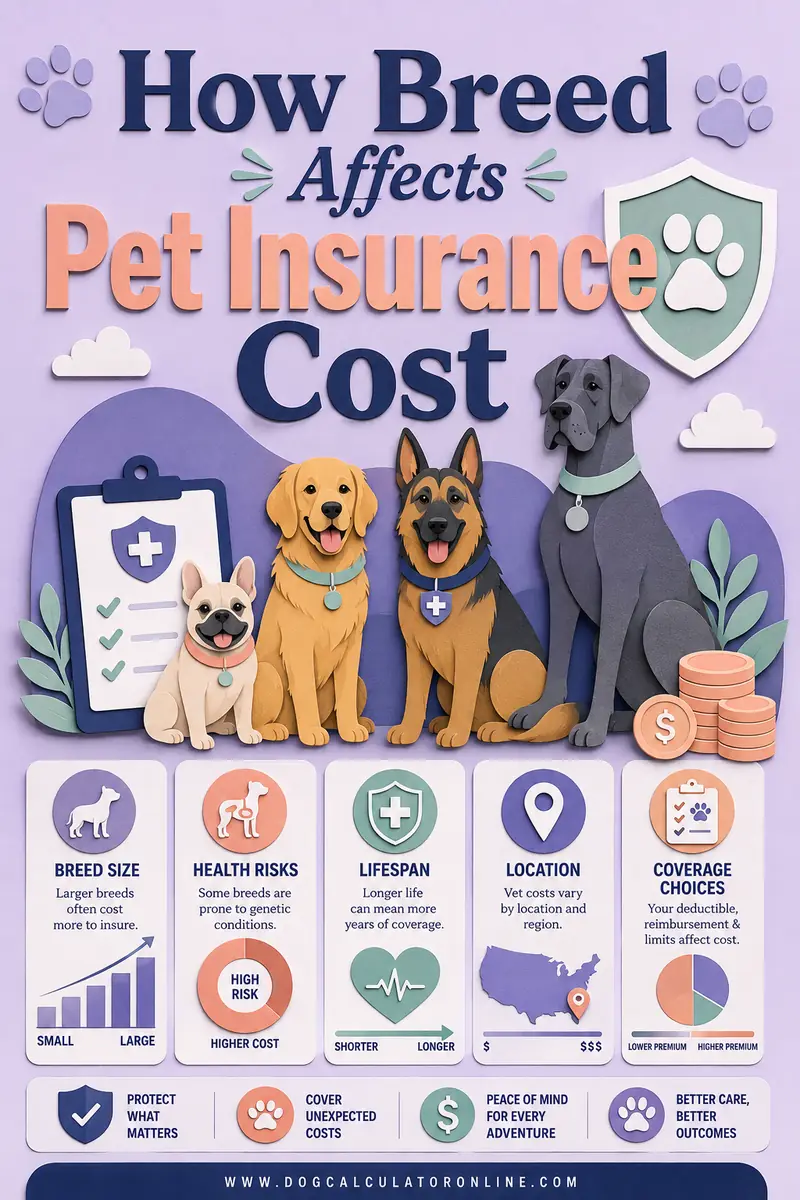
Pet insurance cost by breed, explained: typical US monthly ranges by breed type, why some breeds quote double the average, and what owners can do about it.
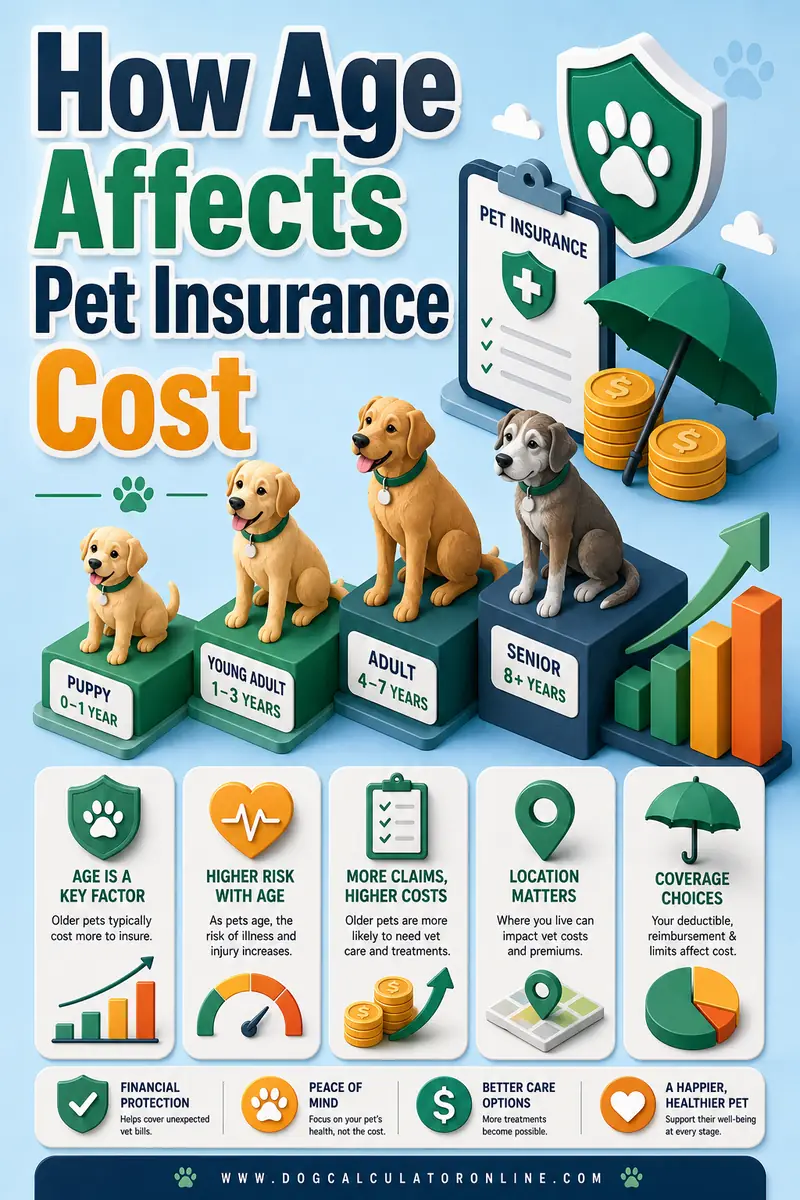
Pet insurance cost by age with honest US ranges: what puppies, adults, and seniors typically pay per month, why premiums keep rising, and when to enroll.
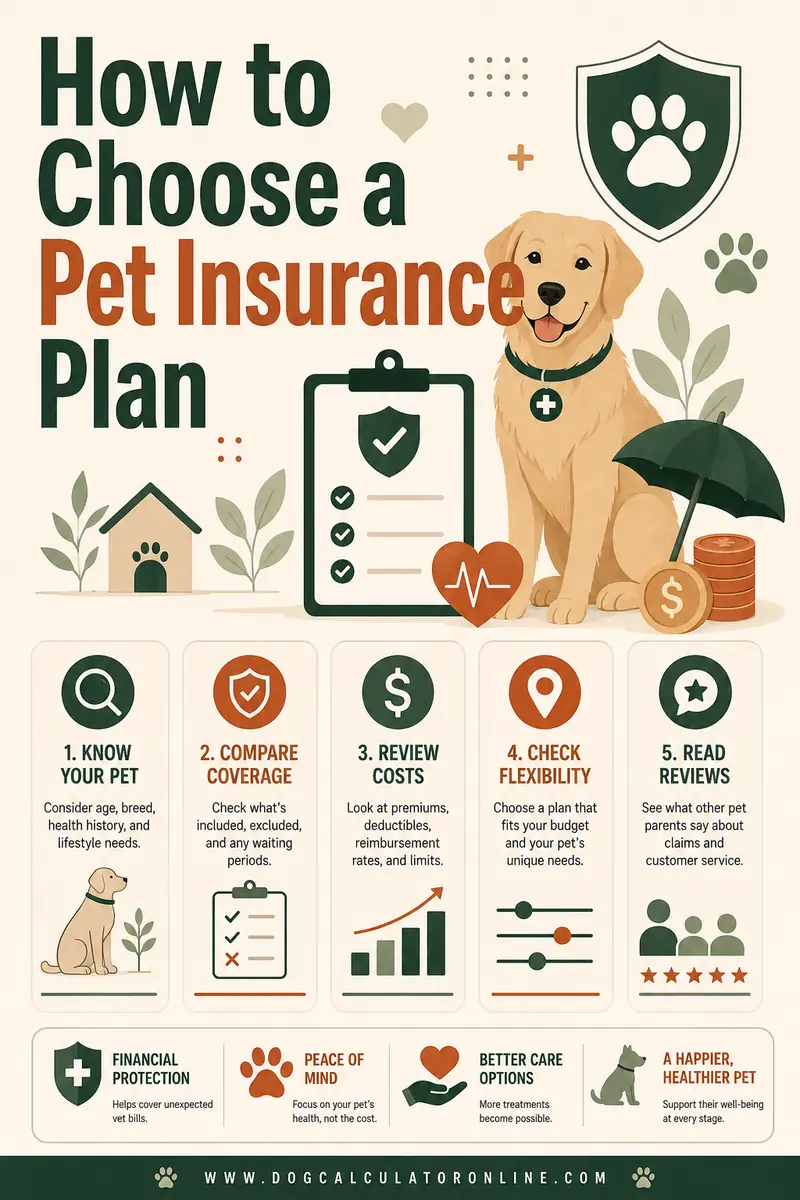
How to choose pet insurance without the brand hype: compare deductibles, reimbursement rates, annual limits, exclusions, and waiting periods like a pro.

What pet insurance doesn't cover: pre-existing conditions, routine care, dental cleanings, exam fees, and the quiet exclusions to read before you ever buy.

Does pet insurance cover dental? Broken teeth from accidents usually yes, dental disease sometimes, routine cleanings almost never. The fine print, explained.

Does pet insurance cover spaying or neutering? Usually not — standard plans exclude elective surgery. Here's why, what wellness add-ons pay, and real costs.

Wellness plan vs pet insurance: one prepays routine care, the other protects you from big surprise bills. How each works, real costs, and which you need.

How to file a pet insurance claim: pay the vet, submit the itemized invoice and records, get reimbursed. Every step, timelines, and documentation tips.

When to get pet insurance: the honest answer is as early as possible — before symptoms, before waiting periods bite. Plus the cases where skipping is fine.

The average cost of dog insurance runs roughly $40–$70/month for accident-and-illness cover. What the industry data shows, and the levers that move your quote.

How much is puppy insurance? Typically $30–$50/month for accident-and-illness cover — the cheapest quotes of a dog's life. What sets the price, honestly.

Pet insurance vs savings: self-insuring works if you fund the account early and leave it alone. Insurance wins on timing. Here's the honest math for both.

The pet insurance premium factors that set your price: breed, age, ZIP code, deductible, reimbursement, annual limit, add-ons, and yearly renewal increases.

What a pet insurance annual limit is, how annual, per-incident, lifetime, and unlimited caps differ, and how limits combine with your deductible — with worked math.

Pet insurance for two dogs usually runs $70–$130 a month combined. How multi-pet discounts work, the math for 2–3 dogs, and when insuring just one makes sense.

Every pet insurance term in plain English — deductible, reimbursement rate, annual limit, waiting period, bilateral condition and more, with why each one matters.

How to use a puppy weight calculator: what to enter, how the growth-curve math works, how to read your estimate, and where the accuracy limits really are.

How to predict puppy adult size: growth-curve math, parents' weights, breed standards, DNA tests, and the truth about paw size — five methods compared honestly.

Puppy growth week by week: neonatal through adolescence, with weight milestones, development markers, and a stage-by-stage table from birth to fully grown.

When do puppies stop growing? Toy breeds finish around 9-12 months, large breeds 12-18, giants up to 24. Full timelines, growth plates, and exercise cautions.
How much should my dog weigh? Healthy ranges by size class, why breed charts mislead for mixed breeds, and why body condition beats any number on the scale.

Is my dog overweight? Learn the rib check, waist check, and profile view, why extra weight is so common in US dogs, and the health stakes — no shame, just steps.
Dog body condition score explained: how the 9-point BCS scale works, how to score your dog at home with rib and waist checks, and what each number means.
Help your dog lose weight the safe way: vet check first, measured portions, a real treat budget, gradual exercise, and weigh-ins. A practical step-by-step plan.

How a dog weight loss calculator works: BCS to ideal weight to calorie concept, a step-by-step walkthrough, honest limits, and how to use results with your vet.
Healthy dog weight by size, from toy to giant: realistic weight ranges, why healthy weights are ranges not single numbers, and how body condition breaks the tie.

Will my puppy be big? The signals that actually predict adult size — parents, weight-for-age, breed mix, DNA tests — and the honest truth about big paws.
Puppy weight calculator accuracy, honestly: why every result is an estimate from average growth curves, when predictions are closest, and how to improve yours.

How fast do puppies grow? Fastest from 8 weeks to 6 months — small breeds finish by 9–12 months, giants take up to 24. The growth curve, size by size.

How to crate train a puppy without the crying: a gentle step-by-step method, realistic timelines, night-time tips, and the mistakes that set training back.

A puppy that stops gaining weight is not the same as a small puppy. The normal gain rates, the common causes, and exactly when it becomes a same-day vet call.
How long a dog can stay in a crate, by age: puppy limits hour by hour, adult maximums, overnight rules, and what to do if your workday is longer than that.

Big paws hint at a big frame but predict nothing precisely. Where the folk rule comes from, when it misleads, and the four methods that work better.

A crate training schedule by age: what to expect at 8 weeks, 3 months, 6 months and beyond, plus a sample daily routine and how to adjust when it stalls.
Toy, small, medium, large and giant weight ranges with typical breeds, plus why the categories matter for food, joints, lifespan and when a dog stops growing.

A dog crate size chart covering 60+ breeds, with the measuring method behind it, what the standard crate sizes actually mean, and how to size a growing puppy.
Weigh your dog with ordinary bathroom scales using the hold-and-subtract method. How to weigh a big dog, how often, and what the number does and doesn't tell you.

Should you cover a dog crate? When a cover helps, when it makes things worse, how to introduce one safely, airflow and overheating risks, and what to use.
How much exercise a dog needs by breed and age, why mental work counts as much as walking, and how to tell if your dog is getting too little or too much.

Target weights for toy and small breeds, why a single kilo matters so much on a small dog, and how to spot gain that coats and small numbers hide.
How much exercise a puppy needs by age, what the five-minute rule means, why over-exercising harms growing joints, and what to do with the rest of the day.
Puppies grow in bursts, not smoothly. When the spurts happen, why plateaus are normal, the lanky stage, and what a spurt changes about food and exercise.
How far a dog can walk by breed, age and fitness, how to build distance up safely, what to carry on a long hike, and the warning signs that mean turn back.

Dog boarding typically costs $30-$60 a night before peak-season surcharges. What moves the rate, what the price should include, and the vaccination deadline.
The behavioral and physical signs a dog needs more exercise, how to tell them apart from boredom, anxiety or pain, and what to change first in the routine.

Doggy daycare typically costs $30-$50 a day. Day rates against packages and monthly plans, the break-even math, and why staff ratio beats price every time.

Indoor exercise ideas for dogs: scent games, puzzle feeding, training drills and physical games that work in a flat, plus what to do on crate rest days.
Dog sitting covers four services at four prices: drop-in visits, walks, house-sitting and boarding at the sitter. What each costs and what to check first.

How often to brush a dog's teeth, how to introduce it to a dog that hates it, which toothpaste is safe, and what to do when brushing isn't possible at all.

What a dog dental cleaning costs, why extractions and bloodwork change the quote, how anaesthesia-free cleaning compares, and how to keep the bill down.

Adoption fees run about $50-$500 and usually include neutering, vaccination and a microchip worth far more. What the fee buys, and what the first month costs.
Most owners spend $70-$200 a month on a dog, but a third of the year's spending arrives in lumps. The real monthly breakdown and how to smooth the spikes.
The early and advanced signs of dental disease in dogs, how to check your dog's mouth at home, which breeds are at highest risk, and when to see a vet.

An itemised first-year puppy budget: vaccinations, neutering, kit, food, training and insurance. Why year one costs two to three times every year after.
How often to bathe a dog by coat type and lifestyle, why over-bathing causes skin problems, which shampoo to use, and how to bathe a dog that hates it.

Dog grooming is priced by coat type and size, not by breed name. Full groom, bath and tidy and de-shed prices, matting surcharges, and the real annual cost.
How often to trim dog nails, how to find the quick on dark nails, what to do if you cut too far, and how to teach a dog that hates having its paws touched.
Body weight drives almost every dog cost: food, drug doses, boarding and kit. See what small, medium, large and giant dogs really cost per year and per life.
A puppy socialization checklist covering people, sounds, surfaces and situations, what to do before vaccinations, and how to tell good exposure from bad.

Group classes run $120-$300 a course, private sessions $75-$200 an hour, board-and-train $1,500-$6,000. What each buys, and which problems need a vet first.
How to stop puppy biting: why puppies mouth, what actually works, the methods that make it worse, and when biting is a sign of something else entirely.
Routine vet care runs about $250-$600 a year. The bills that break budgets are emergencies and surgery, and that is where insurance versus savings matters.
How much sleep a puppy needs by age, a sample daily nap schedule, why overtired puppies seem hyperactive, and how to get a puppy sleeping through the night.

Purchase price is under 5% of a dog's lifetime cost. The traits that genuinely make a dog cheap to run, the breeds that have them, and the ones that don't.

When puppies can go outside after vaccinations, what's safe before then, which places to avoid, and how to balance disease risk against socialization needs.
How long a puppy can hold its bladder by age, a toilet break schedule, what to expect overnight, and when accidents mean something medical is going on.

The dearest dogs are not the priciest puppies. Flat faces, giant frames, long backs and heart disease drive the bills. What each breed really costs a year.

Emergency vet fees, dentals, last-minute boarding, destroyed furniture and pet rent are where dog budgets fail. What each really costs and how to plan for it.

Build a puppy budget in three buckets: setup, running costs and buffer. What to buy before pickup, when each vet bill lands, and where new owners overspend.
Hour-by-hour puppy schedules from 8 weeks to 12 months, with the bladder rule that sets the timetable, nap windows, meal counts and working-day routines.
An hour-by-hour schedule for an 8-week-old puppy: toilet trips, four meals, enforced naps, night waking, and the short training that actually fits the day.

An hour-by-hour schedule for a 12-week-old puppy: toilet gaps, naps, first walks, and how to spend the last four weeks of the socialization window well.

How to potty train a puppy: the bladder rule behind most failures, the step-by-step method, why telling a puppy off backfires, and how to clean up properly.
A puppy training checklist by age from 8 weeks to 12 months: what to teach when, which items have a deadline, and realistic session lengths that work.

Teach a puppy its name in about three days with the charging game, plus a day-by-day plan, what ruins a name, and how to fix one a puppy already ignores.

The seven puppy commands worth teaching first, how to train each one, why sessions should run 3-5 minutes, and how to make cues work outside the kitchen.

How to leash train a puppy: why pulling works, harness versus collar, a four-week plan starting indoors, and what to do about a puppy that refuses to walk.
How many walks a puppy needs each day by age, how long each one should be, why short frequent outings beat one long walk, and the signs of overdoing it.

A day-by-day guide to your puppy's first week home: sleep, feeding, toilet trips, the first night, what is normal, and the signs that need a vet the same day.

A room-by-room puppy-proofing checklist: the hazards that actually send puppies to the vet, toxic foods and plants, cords, bins, gardens and the safe zone.
How to crate train an adult or rescue dog: a slow food-led plan, realistic timings, telling protest from panic, and what to do when a dog refuses the crate.
A nighttime puppy potty schedule by age with real clock times, how to set the alarm, why night trips must stay boring, and when accidents need a vet check.
How to house-train a puppy with no yard: carrying, lift timing, pads versus real grass, balcony setups, and how to move an indoor toilet outside later.

Why puppies cry at night, the crate position that fixes it fastest, whether to let a puppy cry it out, a first-night plan, and when crying needs a vet.

A combined puppy feeding and potty schedule with clock times by age, how long after eating a puppy needs to go, water timing, and how to fix a slipping routine.

When puppy training should start, why sessions must be 3-5 minutes, the one-second reward rule, the socialization window, and what to teach at each age.

How long potty training really takes, week-by-week milestones, what speeds it up or slows it down, the four-month regression, and when to suspect a problem.

What to take to your puppy's first vet visit, what the vet checks, the vaccination schedule, what it all costs in the US, and the questions worth asking.

Why dogs shadow their owners room to room, how to tell a normal velcro dog from separation anxiety, and the one change that should send you to the vet.

Why dogs lick people, what face-licking really inherited from puppyhood, how to read appeasement licking, and the point where licking becomes a vet question.

Nobody has settled why dogs tilt their heads. Here are the three real hypotheses, what the one study found, and when a head tilt is a medical emergency.
What dog sleeping positions actually tell you: mostly temperature and joints, not mood. Plus the position changes that are worth a vet visit, and why.

Why dogs stare at their owners, how to tell a soft affectionate stare from a hard warning one, and what staring into space in an older dog can really mean.

Most dogs that eat grass are not sick and do not vomit. What the surveys actually found, the real risks in the lawn, and when grass eating needs a vet.
A dog yawning is more often tense than tired. How to tell a stress yawn from a sleepy one, the signals that travel with it, and when yawning is medical.

A wagging tail means arousal, not happiness. How to read height, speed and stiffness, the left-right asymmetry research, and the wag that precedes a bite.
Adult dogs sleep 12-14 hours a day and that is normal. How much is too much by age, the difference from lethargy, and the medical causes worth ruling out.

The bathroom is the one door you close, and that is the whole answer. Why dogs push in, why the pack-protection story is wrong, and how to teach a wait.

Zoomies are normal, have a real name, and usually mean pent-up energy or over-tiredness. When they happen, how to make them safe, and the version to check.

Where your dog digs tells you why. Fence lines, shady hollows, flower beds and sofa cushions all mean different things, and each one has a different fix.
Panting is how dogs cool down, but it is also a vital sign. Normal vs abnormal panting, the heat stroke numbers that matter, and when to ring a vet now.

Persistent paw licking is a symptom, not a habit. Allergies, yeast and pain lead the list, boredom rarely does, and here is the point to stop guessing.

Start by asking whether your dog is barking at something or about something. Six night-barking patterns, what each one needs, and when it is a medical sign.

Wire, plastic, soft-sided, furniture and heavy-duty dog crates compared: how each one behaves at home, who it suits, and the trade-offs nobody mentions to you.
Buy the crate your puppy will need as an adult, then divide it. Why oversized crates break toilet training, and how to move the divider as the puppy grows.
Harness sizing runs on chest girth, not weight or breed. Size charts, the two-finger fit test, and why the same dog wears different sizes in different brands.
Where to put the tape for chest girth, neck girth and back length, how tight to pull it, and how to measure a dog that will not stand still.

Collar sizing needs neck girth plus the right strap width. Size charts by breed, the two-finger rule, and why collar size is not harness neck size.

Bed sizing depends on how your dog sleeps. Sprawlers need length, curlers need diameter. Size charts, bolster vs flat, and why most beds sold are too small.
Dog door sizing needs shoulder width, shoulder height and the right step-over height. Why the flap opening matters more than the frame, plus install heights.

Wire or plastic dog crate? The decision comes down to whether your dog wants to see out or hide. Ventilation, cleaning, travel and cost, compared honestly.

Travel crate sizing is stricter than home sizing. The stand-turn-lie rule airlines apply, how to measure for it, and why car crates follow different logic.
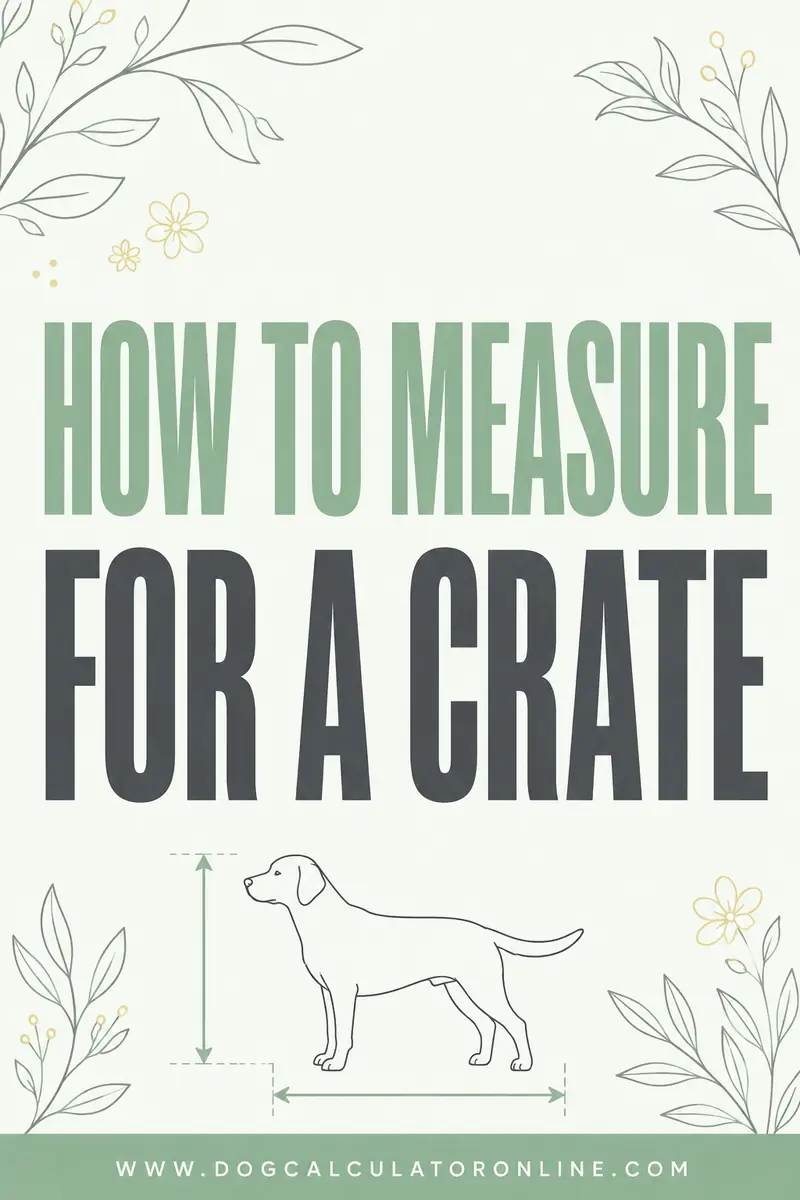
Measure your dog for a crate in two minutes: nose-to-tail-base length, floor-to-head sitting height, and the add-on inches that decide the right crate size.

Coat sizing runs on back length first, then chest girth and neck. Size charts, where the coat should end, and the awkward shapes that need custom cuts.

Dog boots are sized on paw width under load, not on the dog's weight. How to trace a paw properly, why front and back paws differ, and the fit test.
A front-clip harness only works if it fits. Where the chest ring should sit, the shoulder-freedom check, sizing by girth, and the fit errors that cause rubbing.
Carrier sizing runs on length, height and weight limits. How to size a booster seat, why most car seats are not crash-tested, and what actually restrains a dog.
Life jacket sizing runs on chest girth plus back length, and the fit test happens in shallow water. Buoyancy, handles, and which dogs need one most.

Cats and dogs age almost identically for two years. After that, size decides for dogs and not for cats, so a cat ages slower than a labrador and like a terrier.

Cat years and dog years are not the same conversion. See both charts side by side, why dogs need a size adjustment and cats do not, and how to compare yours.

Flying a dog is charged per flight and per direction. In-cabin, cargo and pet-shipper price tiers, the hidden extras, and how to price your own route.

Cabin or cargo is decided by your dog's weight, not by preference. What each is really like for the dog, breed embargoes, heat rules and when not to fly.

Travel paperwork is set by the destination, not the airline. US interstate certificates last 10 days, international takes weeks, and rabies rules take months.
Pet fees are charged per night, per stay or as a deposit, and the gap is huge. Weight caps, unattended-dog rules and the questions to ask before booking.
Plan a long drive around your dog: the two-hour stop rhythm, what to pack, feeding timings, car sickness fixes, heat rules and the paperwork to carry.
For a healthy adult dog the limit is boredom and distress, not the bladder. Why 4-6 hours is a fair ceiling, how to make 8 work, and the signs it is too long.

Boarding, sitters and daycare are priced on different units, so compare per night. The breakeven point, how many dogs flips it, and which dog suits which.
Above 82F walking gets risky and above 90F it is dangerous, but humidity moves those numbers. The real bands, the dogs at higher risk, and when to stop.
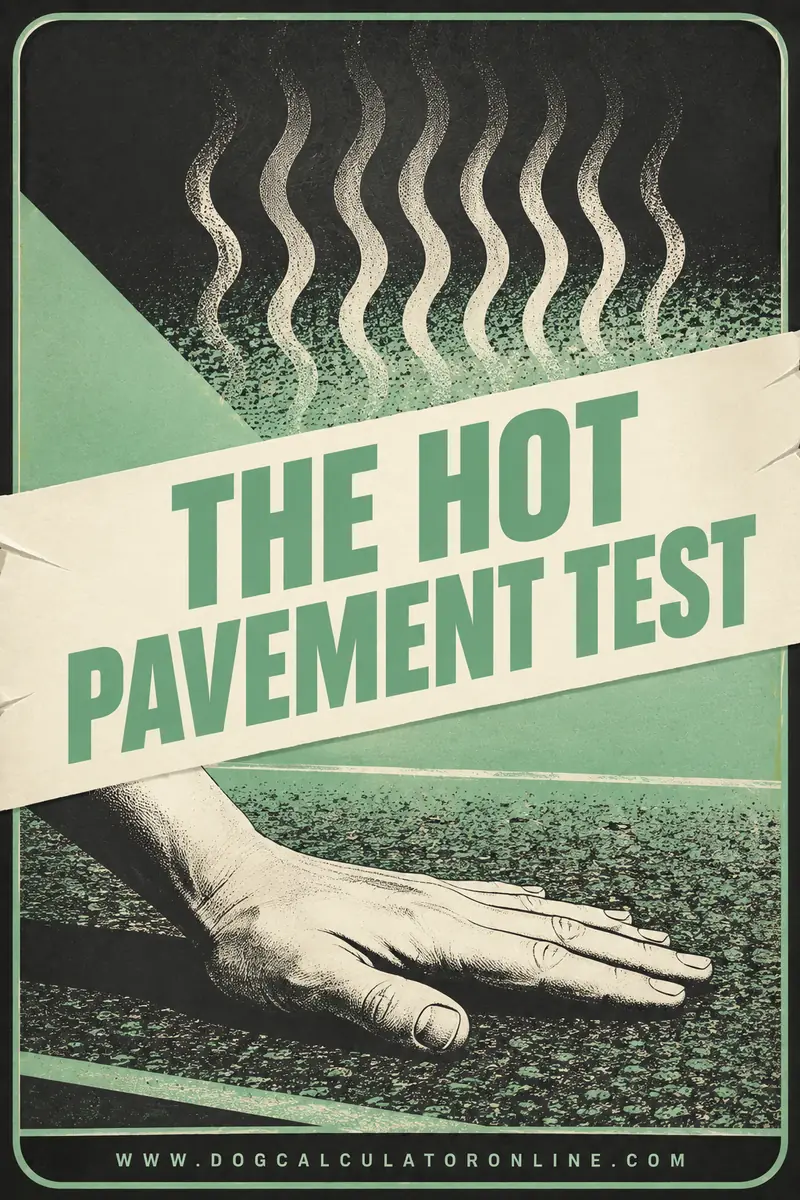
Asphalt runs 40-60F hotter than the air in full sun, so a mild 77F day means 125F tarmac. How to run the seven-second test and what burnt pads look like.
Below 45F small and thin-coated dogs start to feel it, and below 20F is risky for most dogs. Size, coat and wet matter more than the date on the calendar.
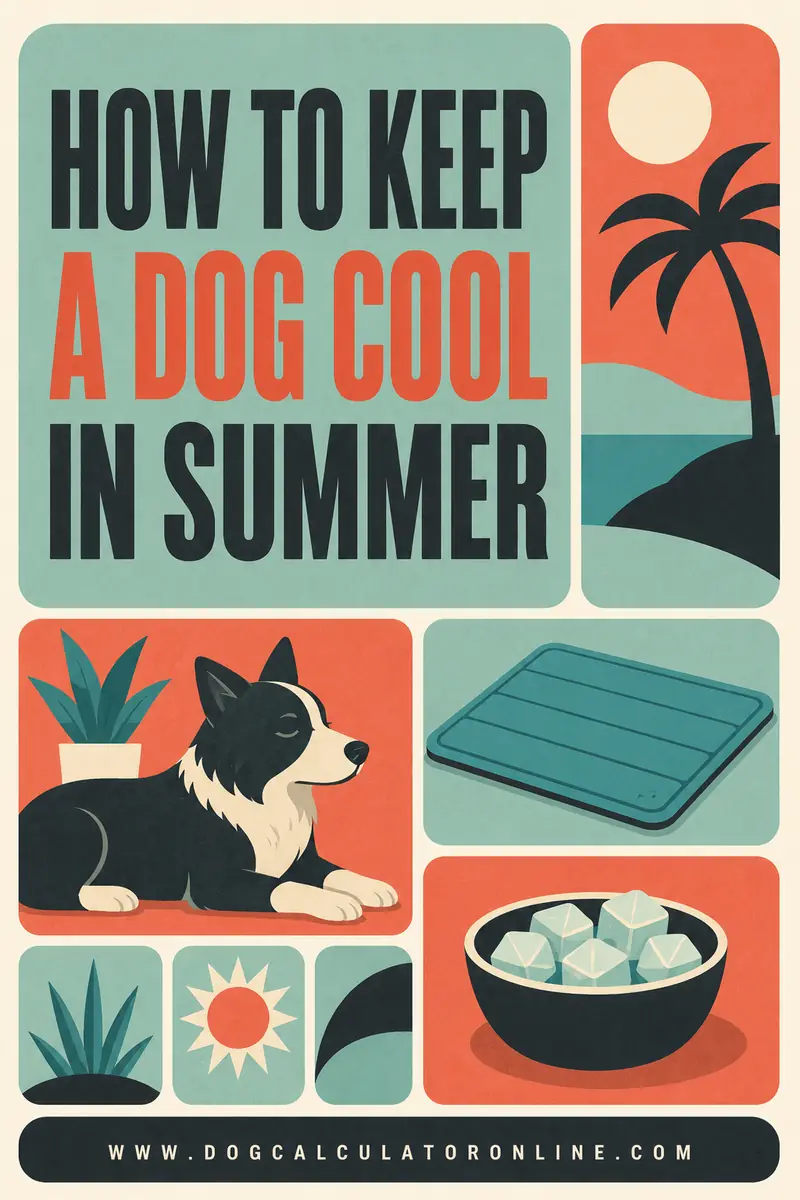
Wetting the belly, groin and paws cools a dog faster than any fan, because dogs shed heat by evaporation. What works at home and what is wasted money.

Road salt dries and cracks paw pads and irritates the mouth when licked off. The rinse-and-dry routine, balm timing and pet-safe de-icers that prevent it.
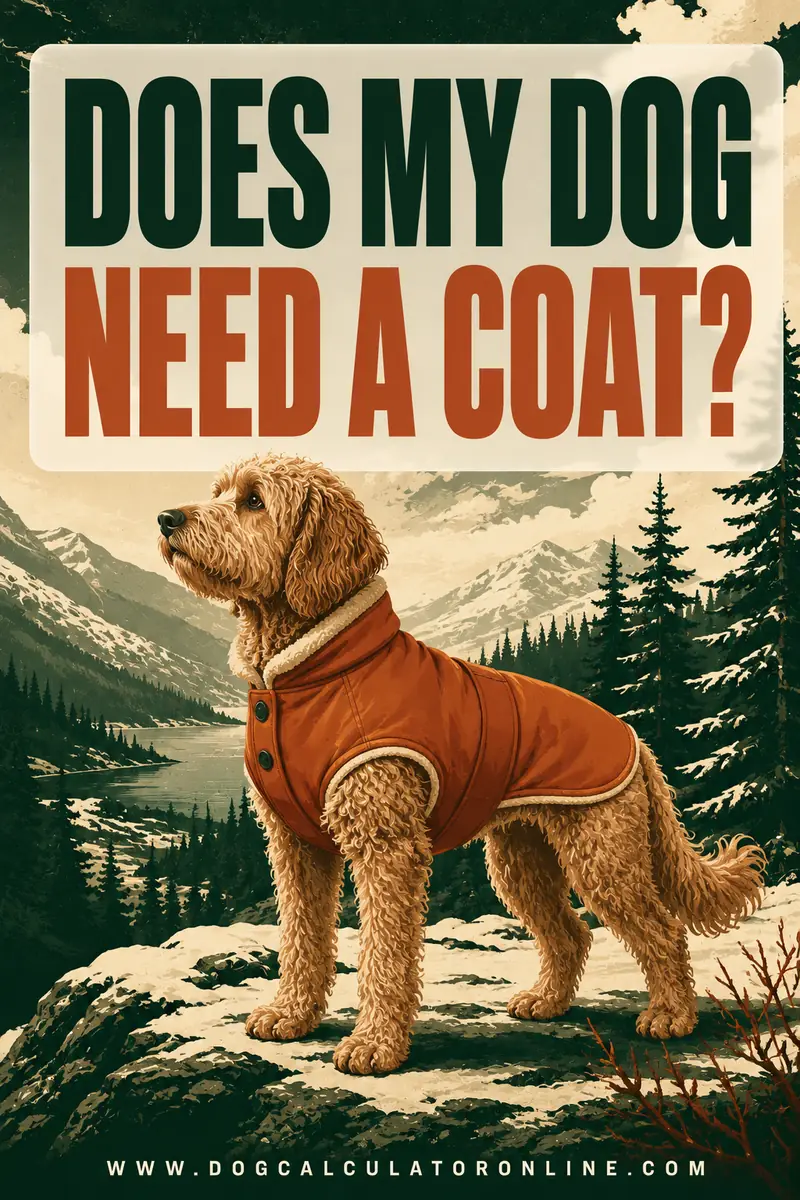
Most double-coated breeds do not need a coat and can overheat in one. Thin-coated, small, short-legged, old and very young dogs genuinely do. How to tell.

Work out exactly how long a bag of dog food lasts: the one-line formula, a table by bag and dog size, and the treats and growth spurts that shift the answer.

Buy a bag your dog finishes in 4-6 weeks. Why the biggest bag is the wrong buy for a small dog, how bulk pricing really works, and a size chart by dog weight.

The four parts of a dog food label that actually matter: the AAFCO statement, the ingredient list, the guaranteed analysis, and the calorie content statement.

Store kibble in its original bag inside the container, not loose. Why the bag matters, ideal temperatures, wet and raw rules, and signs your food has gone off.

An honest look at grain-free dog food: the FDA heart disease investigation, why no causal link is established, grain allergy myths, and what to ask your vet.

Comparing bag prices is meaningless across kibble, fresh and raw. Here is the cost per 1,000 calories formula, a worked comparison, and typical USD ranges.

Adolescence in dogs runs roughly 6-18 months. Recall collapses, a second fear period appears, and training seems to vanish. Why it happens and what works.

The 3-3-3 rule explained honestly, plus what really happens in weeks two to four when the quiet honeymoon dog disappears and the real personality arrives.
Training an adult rescue means assuming nothing. He may never have been house-trained, or may have learned that hands mean trouble. Start at the bottom.
Pulling is self-rewarding: it works. An adult has had years of it working. Fix the equipment so it stops paying, then rebuild loose leash walking properly.
Never call your dog for something he dislikes. That single rule protects recall more than any drill. Build it on a long line, pay generously, never punish.

Graduated absence training starts at seconds, not minutes. How to build a dog up to being left, and how to tell ordinary boredom from separation anxiety.
Puppy prices run roughly $500 to $5,000 by breed. What actually moves the number - health testing, litter size, cesareans, lines - and when cheap is a warning.

The 20 questions that separate a good breeder from a bad one, what a good answer sounds like, and why the best sign of all is a breeder who interviews you back.

parking lot meetings, several breeds at once, gift-card deposits and no health certificates. The red flags of puppy mills and online scams, and what to do next.
A second dog costs less than the first, but not half. What doubles, what does not, and the emergency-vet risk almost nobody budgets for before adding dog two.

Neutral ground first, parallel walks before face-to-face, separate beds and bowls from day one - and why your resident dog sulking for weeks is normal.
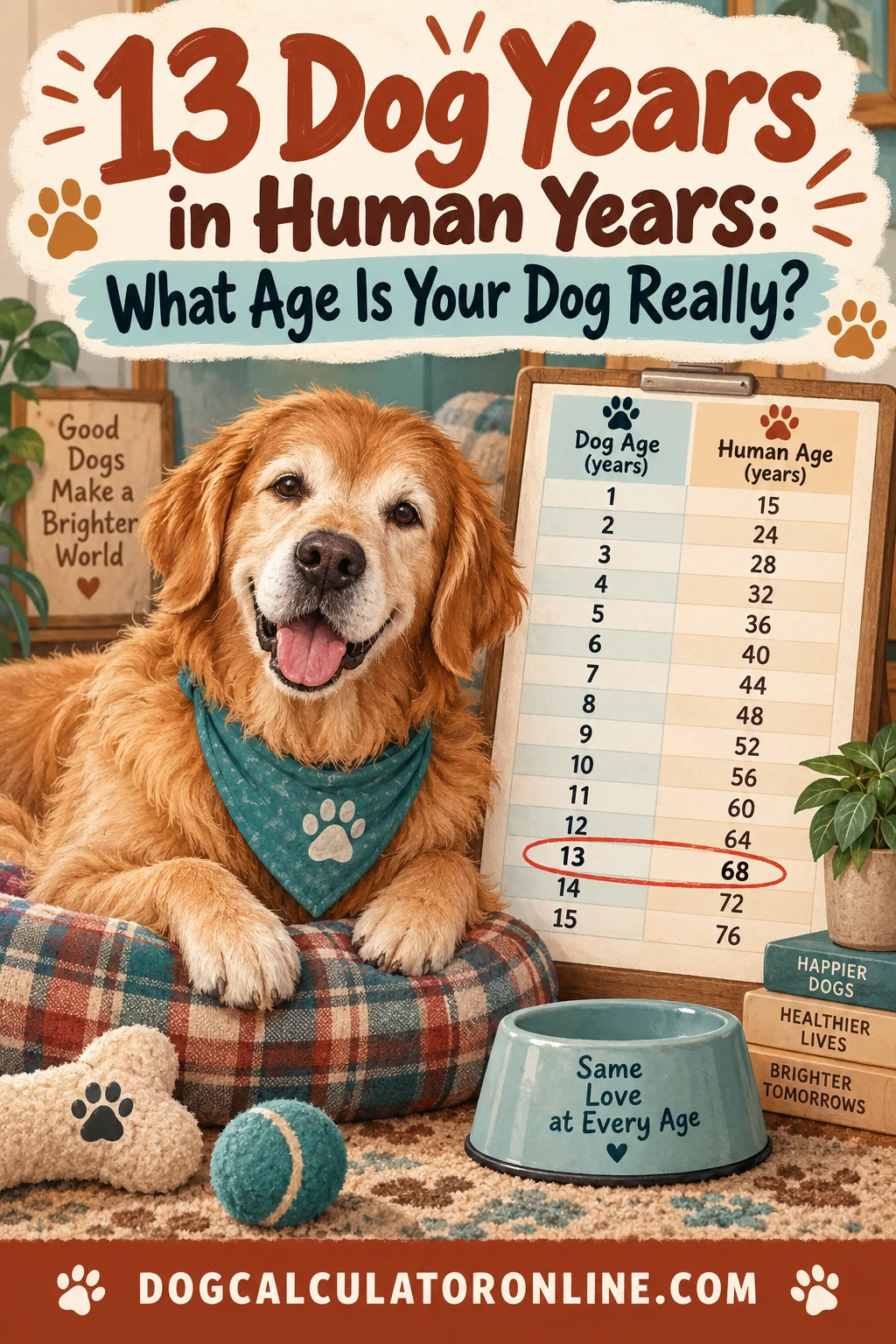
A 13-year-old dog is roughly 68 to 100 in human years depending on size. Full chart by breed size, plus what this life stage looks like and how to care for it.

An 18-year-old dog is roughly 88 to 110 in human years depending on size. Full conversion chart, what this stage looks like, and how to care for a very old dog.
Can a dog live 20 years? Yes, but it is rare and almost always a small breed. Here is what reaching 20 takes, and why no dog has verifiably hit 30.
Convert dog years to people years with the modern vet-backed chart. Full conversion table by dog size, ages 1-16, plus why the 7-year rule is wrong.

Dog years versus people years explained with the real non-linear formula, a full age chart, and why size changes everything.
How can you count dog years accurately? A simple 4-step method with worked examples, plus how to estimate a rescue dog's age when you have no records.
How do dog years work? Not as a fixed ratio. The staged system behind the numbers, why body size changes the rate, and what the science shows.
How do you calculate dog years to human years? Use the 15 + 9 + size formula. Worked examples for a Chihuahua, Labrador and Great Dane at the same age.
How do you figure out dog years without a chart? Use the 15 + 9 + 5 shortcut, adjust for size, and get a solid estimate in under a minute.
How long is one year in dog years? It depends which year. The first is worth 15 human years, later ones 4 to 9. Here is the year-by-year breakdown.

A Shih Tzu age chart using the small-breed formula, plus the life stages and health checkpoints that matter for the breed.
Six months in dog years is roughly 10 human years - a preteen, not a baby. What 6 months means developmentally, plus 4 months and a puppy chart.
What does dog years mean, exactly? The phrase has two meanings, the 7-to-1 rule behind it is a myth, and here is what people are really asking.
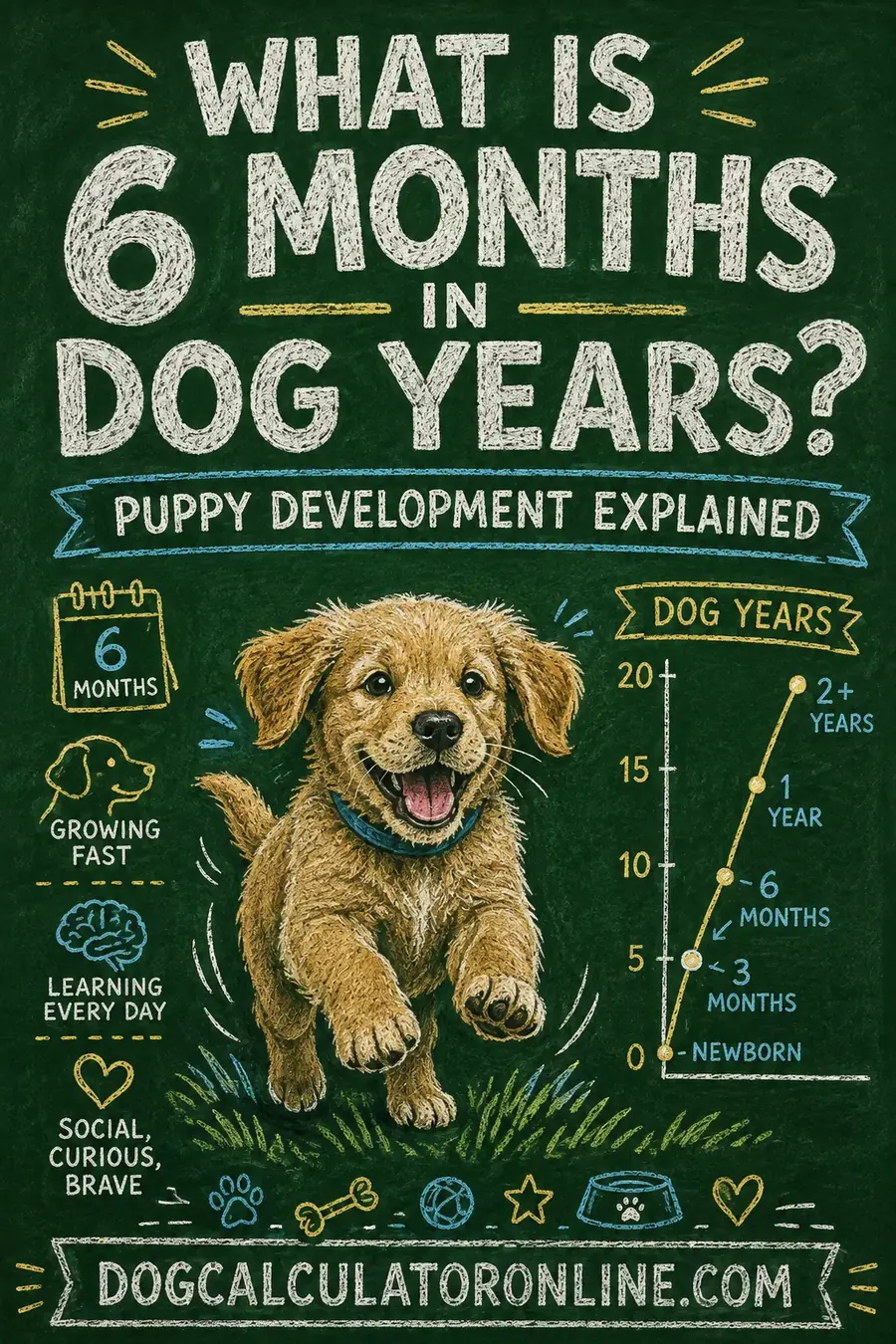
A 6-month-old puppy is roughly 10 human years old in development terms - what that actually means for training, growth, and behavior.
No guides match your search — try another word.