The Adolescent Dog: Why Training Falls Apart at 6-18 Months
Your dog has not forgotten anything, and you have not ruined him. Adolescence in dogs runs roughly from 6 to 18 months, and during it a well-trained puppy can genuinely stop responding to cues he knew perfectly at 5 months. This is a real developmental stage with a real biological engine behind it, not defiance and not a training failure. More dogs are handed to shelters between about 6 and 18 months than at any other age, and the honest reason is that nobody warned their owners this was coming. It passes. Feeding changes in this window too, and the dog food calculator will tell you what an adolescent of your dog's size actually needs.
🐾 What is your adolescent doing?
Tap the behavior that sounds most like your dog:
Tap an option above. Almost everything on this list is a stage, not a personality.
What Adolescence Actually Is in a Dog
Start here, because the mechanism makes the rest make sense.
Adolescence is the gap between sexual maturity and social maturity. A dog can father a litter months before his brain finishes wiring the parts that handle impulse control, risk assessment and frustration. That gap is the whole problem in one sentence.
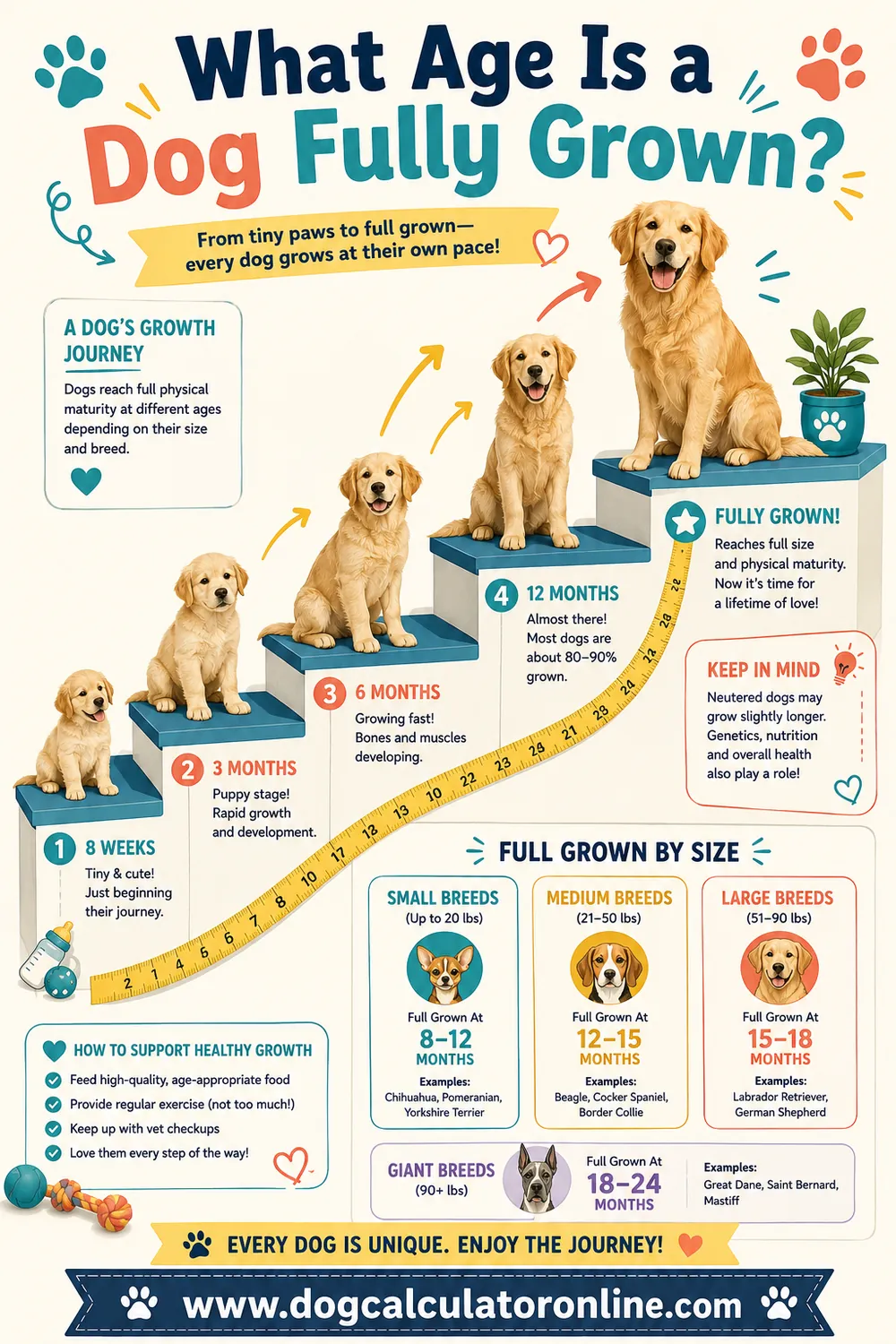
The timing depends on size. A small terrier may start at 5 to 6 months and be through the worst of it by 12. A Labrador typically runs 6 to 16 months. A Great Dane or Mastiff can still be behaving like a teenager at 24 months. Bigger dogs mature later in every sense, which is also covered in the guide to what age a dog is fully grown.
The brain is being rebuilt, not just topped up. Adolescence is a period of heavy pruning and rewiring, especially in the frontal areas that inhibit impulses. A circuit that is under construction does not perform reliably, which is exactly what you are seeing on walks.
Hormones amplify it rather than cause it. Testosterone in males rises steeply from around 6 months and typically peaks somewhere between 10 and 14 months before settling. Females go through their first season, usually between 6 and 15 months depending on size. But neutered adolescents still go through adolescence, which tells you hormones are not the whole story.
It is not a "phase" in the dismissive sense. Real behavior change happens. Dogs who are handled badly during this window can carry the fallout for years. Handled with patience, most come out the other side as the dog you were promised.
Why Recall Falls Apart First
This is the single most common complaint, and it is worth explaining properly.
Recall is the most fragile cue you own because it always competes with something. Sit competes with nothing. Come competes with a squirrel, another dog, a rotting sandwich and a river. Adolescence raises the value of all of those at once.
Independence increases on purpose. A young puppy sticks close because staying near an adult is how puppies survive. An adolescent is biologically primed to explore further from home, and that includes further from you.
The recall was never as strong as it looked. At 4 months your puppy came back because he did not want to be left. That is not trained recall, that is dependence. When dependence fades, the actual training underneath is revealed, and there is usually less of it than you thought.
Every ignored recall makes the next one weaker. If you call and nothing happens, the dog has just practiced ignoring the word. Do that thirty times in a two weeks and the cue is genuinely damaged.
The fix is management, not volume. Put a long line on, stop giving the dog the chance to fail, and rebuild the cue deliberately. The full method is in the guide to teaching a reliable recall.
Never punish a late return. A dog who gets told off when he finally comes back has learned that coming back predicts trouble. That single mistake accounts for a lot of permanently unreliable recalls.
The Second Fear Period Between 6 and 14 Months
Most owners have never heard of this one, and it worries them badly.
A previously confident dog can turn wary of familiar things. The trash can he walked past a hundred times is now terrifying. A man in a hat is suspicious. The vet's waiting room is suddenly too much.
The window is usually 6 to 14 months and it is not a fixed date. Unlike the puppy fear period around 8 to 11 weeks, the adolescent one is variable and some dogs seem to skip it entirely. Others get two short waves.
It typically lasts two to four weeks per episode. If your dog has been spooky for three months, that is not a fear period and it is worth getting help rather than waiting it out.
Flooding makes it worse. Dragging a frightened adolescent up to the thing that scares him to prove it is harmless is the most reliable way to turn a passing wobble into a lasting fear.
What actually works is distance and choice. Stand far enough away that he can look without reacting, feed him for looking, and let him approach on his own timetable or not at all. Boring, undramatic and effective.
Keep experiences small and positive. This is not the moment for the busy summer fair or a long stay in kennels. Protect him for a few weeks; you are not coddling him, you are avoiding a scar.
What Changes Month by Month
Rough guide for a medium breed. Small breeds run a few weeks earlier, giants several months later.
| Age | What usually changes | What to prioritize |
|---|---|---|
| 6-8 months | Recall starts to slip, chewing returns, first season in some females | Long line outdoors, legal chews, calm handling |
| 8-10 months | Peak testing, leash pulling worsens, on-lead frustration appears | Front-clip harness, quiet walking routes, more sniffing |
| 10-12 months | Possible second fear period, barking at novelty, selective hearing peaks | Distance from triggers, short positive outings |
| 12-15 months | Energy still high, but focus starts returning in short bursts | Rebuild recall properly, reintroduce training in real places |
| 15-18 months | Most medium dogs noticeably steadier | Maintain, do not assume it is finished |
| 18-24 months | Giant breeds finish here; some males still boisterous | Consistency, ordinary adult routine |
Do not read the table as a schedule. It is a pattern, not a promise, and plenty of perfectly normal dogs sit a month or two either side of every row.
Why Your Dog Obeys at Home and Ignores You Outside
This one drives people mad, and there is a clean explanation.
Dogs do not generalise well. To a dog, "sit" in your kitchen and "sit" on a wet sidewalk outside a busy shop are two different problems. Adults get better at bridging that gap. Adolescents are terrible at it.
Arousal eats performance. A dog who is excited, frustrated or slightly frightened has less working memory available. The cue arrives, but there is no processing capacity left to act on it.
Behavior is situational, not moral. He is not choosing to embarrass you. He genuinely cannot access the trained response at that arousal level, which is a completely different problem from disobedience.
So train in the situation, not just at home. Take the same easy cue to five progressively harder places: the garden, the quiet sidewalk, the park entrance, the park at a distance from other dogs, then the middle of it. Expect to drop back a level whenever you add difficulty.
Pay far better outside than in. A dry biscuit works in the kitchen. Outside you are competing with the entire world, so use roast chicken, cheese or hot dog. This is the moment to spend properly, and to take the extra calories off his dinner so his waistline does not pay for it.
Management Beats Escalating Corrections
If you take one practical thing from this article, take this.
Every rehearsal of an unwanted behavior makes it stronger. Pulling that gets the dog to the park is rewarded pulling. Bolting after a jogger that ends in a great chase is rewarded bolting. The behavior does not need your approval to be reinforced.
Management removes the rehearsal. A 30 ft (9 m) long line means recall cannot fail. A house line indoors means the sofa raid ends calmly. A pen means the skirting board survives the afternoon.
Escalating corrections in adolescence carry a specific risk. Aversive tools applied during a fear period, or to a frustrated dog on a leash, can attach the bad feeling to whatever the dog was looking at, which is very often another dog or a child. That is how ordinary lead frustration turns into genuine reactivity.
Fewer off-lead gambles for a few months is not a failure. It is a deliberate decision to stop losing ground while you rebuild. Most people can go back to full off-leash freedom by 14 to 18 months if they protect the cue now.
Consistency is worth more than intensity. Ten calm repetitions a day for six weeks beats one furious hour at the weekend, every time. The same principle underpins stopping an adult dog pulling on the leash.
Sleep, Exercise and the Wired Adolescent
The most common mistake with an adolescent is more exercise, not less.
Adolescents need roughly 14 to 16 hours of sleep a day and a great many of them get nowhere near it. An overtired dog looks exactly like an under-exercised one: frantic, mouthy, unable to settle, worse at everything he knows.
Test it before you add another walk. For one week, cap physical exercise where it is and add enforced downtime instead: a chew in a pen, a covered crate, a quiet hour after every outing. If the wildness drops, the problem was rest.
Sniffing tires a dog more than running does. Twenty minutes of nose-to-the-ground work in a hedgerow settles most adolescents better than a 5 mile (8 km) march, and it does not build an athlete you then have to exhaust daily.
Do not build stamina you will regret. A dog conditioned to run 10 miles (16 km) a day at 12 months needs 10 miles a day at 4 years. Look at what your breed and size actually need in the guide to how much exercise a dog needs.
Protect the joints in large breeds. Growth plates in big dogs typically close somewhere between 12 and 18 months. Repetitive high-impact work, long runs on hard ground and steep stair repeats are better left until after that.
Mental work counts as work. Scatter feeding, a snuffle mat, five minutes of nose games, a frozen stuffed toy. Cheap, calm and genuinely tiring.
Does Neutering Fix Adolescent Behavior?
Short answer: less than people hope, and the timing matters.
Neutering reliably changes hormone-driven behaviors such as roaming after a female dog in season, some urine marking and some mounting. It does not reliably change pulling, jumping, recall, chewing or excitement, because those are learned habits rather than hormonal ones.
It does not remove adolescence. A dog neutered at 6 months still goes through the same brain development. Owners who expected a calm dog and got a teenager anyway are often the ones who feel most let down.
For fearful or reactive adolescent males, early neutering can occasionally make things slightly worse. The evidence here is mixed rather than settled, and it is a genuine reason to discuss timing with your vet rather than book it by default.
Size changes the calculation. In larger breeds there is reasonable evidence that neutering before growth plates close is associated with higher rates of some joint problems, which is why many vets now suggest waiting in big dogs. The trade-offs are set out in the guide to the best age to spay or neuter a dog.
Treat it as a health decision with behavioral side effects, not as a behavior fix. If someone tells you it will calm your dog down, be skeptical.
When It Is Not Adolescence
Most of this is normal. Some of it is not, and knowing the difference matters.
Call your vet if behavior changes suddenly and sharply, especially if a previously friendly dog snaps, becomes touch-sensitive, or changes overnight rather than over weeks. Pain is a common and badly under-recognized cause of behavior change in young dogs.
Get seen promptly for any bite that breaks skin, for guarding food or objects that is escalating, or for fear that is getting worse week on week rather than better. Early help is far cheaper and far more effective than late help.
Also flag limping, a change in gait, or reluctance to jump into the car. Elbow and hip problems often show up in this age band and can look like stubbornness.
Ask for a referral to a qualified behaviorist, not just a trainer, for anything involving aggression, severe fear or genuine distress when alone. Look for accredited, force-free credentials and ask what happens if the dog gets it wrong.
Do not wait to see whether it passes if the dog is suffering. Adolescence explains a great deal of ordinary rudeness. It does not explain a dog who is frightened all the time.
FAQ
At what age does adolescence start and end in dogs?
Adolescence in dogs usually starts between 5 and 8 months and ends between 12 and 24 months, depending on adult size. Small breeds start earlier and finish sooner, often by 12 months; large and giant breeds may still behave like adolescents at 18 to 24 months.
Why has my dog suddenly stopped listening at 8 months old?
Because the brain areas handling impulse control are still developing while independence and interest in the environment are rising sharply. The training is still there; it just cannot outcompete distraction yet. Go back to a long line, reward far more generously outdoors, and stop repeating cues the dog is ignoring.
Is the second fear period real?
Yes, though it is less predictable than the puppy fear period. Many dogs show a wave of new wariness somewhere between 6 and 14 months, typically lasting two to four weeks. Keep your distance from the trigger, never force an approach, and reward calm looking rather than bravery.
Will neutering calm my adolescent dog down?
Not usually. Neutering reduces hormone-driven behaviors such as roaming and some marking, but it does not remove adolescence and does not fix learned habits like pulling, jumping or poor recall. Discuss timing with your vet, particularly for large breeds and for fearful males.
How much exercise does an adolescent dog need?
Less than most owners assume, and more sleep. Most adolescents need 14 to 16 hours of rest a day plus one or two moderate outings with plenty of sniffing. If your dog is wild and unsettled, try adding enforced rest for a week before adding another walk.
Should I stop off-leash walks during adolescence?
Usually yes, temporarily. Use a 30 ft (9 m) long line in open spaces for a few weeks or months so recall cannot be rehearsed as failure. Most dogs return to full off-leash freedom by 14 to 18 months once the cue has been properly rebuilt.
The Teenager Becomes the Dog You Wanted
Adolescence is the hardest stretch of dog ownership and the one nobody prepares you for. Your dog is not broken, not spiteful and not beyond help; his brain is halfway through a rebuild and his body got there first. Lower the stakes for a few months. Use a long line, pay generously, protect his sleep, skip the corrections and keep the sessions short and frequent. Most owners look back at 18 months and cannot quite remember why it felt so bleak. If you are still counting the months, the guide to when puppies calm down and the plan for building up alone time will both help, and the dog food calculator keeps his growing frame fed correctly.