Best Age to Spay or Neuter a Dog (Ask Your Vet)
There is no single right age any more, and anyone who gives you one without asking your dog's breed is working from advice that has been overtaken. The honest answer is that it depends on size and sex: around six months remains reasonable for small dogs, while for large and giant breeds a growing body of evidence supports waiting until the growth plates close at roughly 12 to 18 months to reduce the risk of certain joint disorders and cancers. This is a genuinely unsettled area where good vets disagree, and the right approach is a conversation about your specific dog rather than a rule pulled off a leaflet. Predict which size category he or she will land in with the free puppy weight calculator.

🐾 Rough timing by size and sex
Tap your dog:
Tap an option above. Size drives the answer more than age does.
Why Six Months Became the Default
The old rule was not arbitrary, but its reasons were not the ones people assume.
Six months predates most female dogs' first season, which captured the mammary tumour benefit at its greatest.
It was surgically convenient. A six-month puppy is large enough to anaesthetise safely and small enough for a quick, cheap procedure.
Population control drove much of it. Rescue organizations and municipalities pushed early neutering to reduce unwanted litters, and that was a public policy success rather than an individual health recommendation.
It fitted the vaccination schedule, giving practices a natural point to book the surgery.
What it was never based on was long-term data comparing outcomes in dogs neutered at different ages, because that data did not exist.
When it started arriving, it complicated the picture — particularly for the big breeds whose growth is far from finished at six months, as covered in when do puppies stop growing.
What Changed the Advice
A body of breed-specific research over the last decade shifted the conversation.
Large-scale breed studies found associations between early neutering and higher rates of certain joint disorders — cruciate ligament rupture, hip dysplasia, elbow dysplasia — concentrated in larger breeds.
Some breeds also showed higher rates of specific cancers when neutered early, including lymphoma, haemangiosarcoma and mast cell tumours.
The proposed mechanism is skeletal. Sex hormones help close growth plates. Remove them early and the long bones grow for longer, changing joint angles and loading.
Small breeds show little or none of this, which is the clearest finding in the whole area and the reason size sits at the center of the answer.
These are associations, not proven cause and effect, and the effect size differs substantially between breeds — in some it is marked, in others absent.
The result is that blanket advice has largely been abandoned by veterinary bodies in favor of individualised recommendations.
Small and Medium Dogs
For most household dogs under about 55 lb (25 kg), the traditional timing has held up.
Around six months remains standard for small breeds of both sexes, and the concerns driving later timing in big dogs have not been demonstrated in them.
Small breeds finish growing early, typically by 9 to 12 months, so six months is already close to skeletal maturity.
For small females the mammary tumour argument favors earlier, since protection is greatest before the first season and falls with each subsequent one.
Medium breeds sit in the middle, and 6 to 12 months is the usual range. Spaying after the first season or neutering around 9 to 12 months is a defensible middle path.
Small breeds are easier to manage intact in practical terms — a determined 9 lb (4 kg) terrier is a smaller containment problem than a determined 88 lb (40 kg) mastiff.
Where the dog will end up in size terms is the first thing to establish, and for a mixed-breed puppy that is not always obvious — the estimate is in how big will my puppy get.
Large and Giant Breeds
This is where the change in advice actually bites.
Growth plates in large breeds close around 12 to 18 months, and in giant breeds later still, sometimes approaching 24 months.
Waiting until closure is now commonly advised for large males, because there is no pressing health clock on an intact male dog and the joint evidence is reasonably consistent.
For large females the calculation is harder. Waiting means more seasons, and each one erodes the mammary tumour protection. That is a genuine trade-off rather than a clear answer.
Practical management matters too. An intact giant male who roams is a real-world risk, and an intact large female dog means two seasons a year of containment.
Breed-specific evidence should drive it where it exists. Golden Retrievers, Labradors, German Shepherds and Rottweilers have all been studied individually, with different findings, and your vet can weigh those against the individual dog.
Do not extrapolate from one breed to another. A finding in Golden Retrievers is not automatically a finding in Boxers.
Guidelines by Size and Sex
Starting points for a conversation, not prescriptions.
| Size | Female | Male | Reasoning |
|---|---|---|---|
| Under 22 lb (10 kg) | ~6 months | ~6 months | Growth finished early; no joint signal |
| 22–55 lb (10–25 kg) | 6–12 months | 6–12 months | Middle ground; after first season is common |
| 55–88 lb (25–40 kg) | 12–18 months, or after 1–2 seasons | 12–18 months | Growth plates close later |
| Over 88 lb (40 kg) | 12–24 months | 18–24 months | Longest growth period |
| Any size, rescue | Often at rehoming | Often at rehoming | Population control takes priority |
Every row is a default that a specific dog can override — a female dog with a family history of mammary tumours, a male with a retained testicle, an escape artist in a household with an intact female.
The dividing line is skeletal maturity, not a birthday, so a dog who is clearly still filling out at 14 months is still growing.
Sex matters as much as size for females, because their clock is running on mammary tumour risk while a male's is not.
The Case for Earlier That Still Holds
Waiting is not automatically better, and several situations argue the other way.
Rescue and shelter dogs are usually neutered before rehoming, and that policy prevents far more suffering than the joint risks it may add. It is the right call at population level.
Households with both sexes intact face an unplanned litter every six months. Physical separation through a season is harder than it sounds.
Female dogs with a strong mammary tumour history in the line may be better served by spaying earlier, since roughly half of canine mammary tumours are malignant.
Pyometra risk accumulates with every season, and a dog who will never be bred from is carrying that risk for no return — the detail is in spaying your dog: what to know.
A retained testicle should be removed regardless of age discussions, because the cancer risk is substantially higher.
Dogs whose behavior is genuinely unmanageable intact may need earlier intervention, though a hormone implant can trial the effect first — as described in neutering your dog: what to know.
Timing Around Seasons for Females
For a female dog, the calendar has an extra layer.
First seasons typically arrive between 6 and 15 months, later in larger breeds, so an age-based plan can be overtaken by biology.
Do not spay during a season. The tract is engorged and bleeding risk is higher.
Two to three months after a season ends is the usual window, once hormones have settled.
Not during a false pregnancy either, since spaying mid-episode can prolong the nesting and milk production.
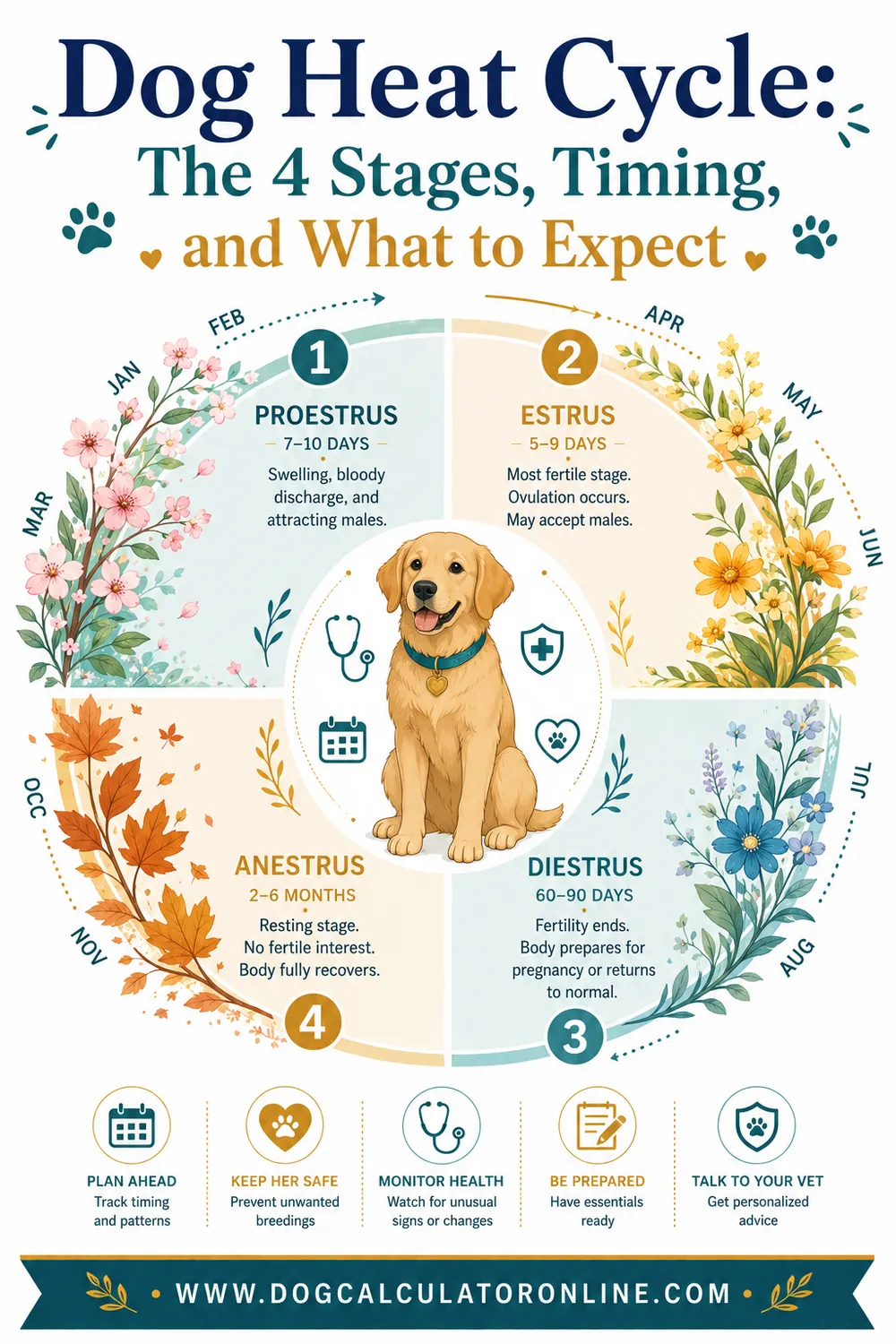
Seasons come roughly every six months, though some large breeds run closer to eight or twelve months apart — the pattern is set out in dog heat cycle.
If you are planning to wait, expect at least one season first in most breeds, and know when it is likely to arrive using what age do dogs go into heat.
What the Evidence Does Not Settle
Being honest about the gaps is more useful than pretending there is a consensus.
Most of the joint and cancer findings are associations from retrospective data, not controlled trials, and confounding is hard to exclude.
Breed coverage is patchy. A handful of popular breeds have been studied in detail; most have not, and mixed breeds are grouped by weight rather than genetics.
The size of the effect varies enormously between breeds, so translating a percentage from one study to your dog is unreliable.
Behavioral outcomes by age are poorly studied, and the claims made about them are usually stronger than the evidence.
Vets differ, reasonably. A practice that sees a lot of pyometra weighs it differently from one that sees a lot of cruciate ruptures, and both are responding to real experience.
Which is exactly why this belongs in a consultation with the vet who knows your dog, rather than being settled by an article — including this one.
Questions Worth Asking Your Vet
Go in with these and the conversation gets far more useful.
"What does the evidence say for this breed specifically?" Breed-level data exists for several popular breeds and is more useful than general advice.
"When will her growth plates close?" This anchors the timing in her body rather than the calendar.
"How does the mammary tumour trade-off look if we wait through another season?" For females this is the crux.
"Would a hormone implant or a vasectomy suit us better?" Both leave options open and neither is offered routinely unless asked about.
"What is your practice's protocol, and why?" A vet who can explain the reasoning is giving you something a leaflet cannot.
"What changes if we simply manage him intact?" For some households this is a realistic answer, and it deserves to be on the table alongside a growth prediction from the puppy weight calculator.
FAQ
What is the best age to spay or neuter a dog?
It depends on size and sex. Around six months remains standard for small breeds, while many vets now advise waiting until growth plates close at 12 to 18 months in large breeds, and later in giants. Discuss your specific breed with your vet.
Why do vets now recommend waiting for large breeds?
Breed-specific studies have linked early neutering in several large breeds to higher rates of joint disorders such as cruciate rupture and hip dysplasia, and to some cancers. Sex hormones help close growth plates, so early removal lets long bones grow longer.
Is six months still fine for a small dog?
For most small breeds, yes. The joint and cancer associations behind later timing have not been demonstrated in small dogs, and they finish growing by about 9 to 12 months, so six months is already close to skeletal maturity.
Should I let my dog have one season before spaying?
It depends on her size. Each season before spaying reduces the mammary tumour protection, which argues for earlier. In large breeds, waiting for skeletal maturity may mean one or two seasons first. It is a genuine trade-off to discuss with your vet.
Can you spay or neuter a dog too early?
Very early neutering, before about four months, is used by shelters for population control and is considered safe surgically. The concerns are longer-term and center on skeletal development in large breeds rather than on the anaesthetic itself.
Is it ever too late to spay or neuter?
Rarely. Older dogs are routinely spayed and neutered, though anaesthetic risk rises with age and with any existing illness, so pre-anaesthetic bloods and a full health check become more important. Pyometra risk keeps accumulating in unspayed female dogs.
Size First, Sex Second, Then Ask Your Vet
The best age to spay or neuter is one of the few areas of routine dog care where the standard answer genuinely changed, and where an owner is right to expect a discussion rather than a date. For a small dog, six months still holds up. For a large or giant breed, waiting until the growth plates close at 12 to 18 months is now a mainstream recommendation, and for males it is easy to justify because nothing is accumulating in the meantime. For females it is a real trade-off between skeletal maturity and mammary tumour protection, and the balance shifts with breed and family history. Take the size question seriously first — a growth estimate from the free puppy weight calculator tells you which set of considerations applies before you book anything.