When Do Puppies Stop Growing?
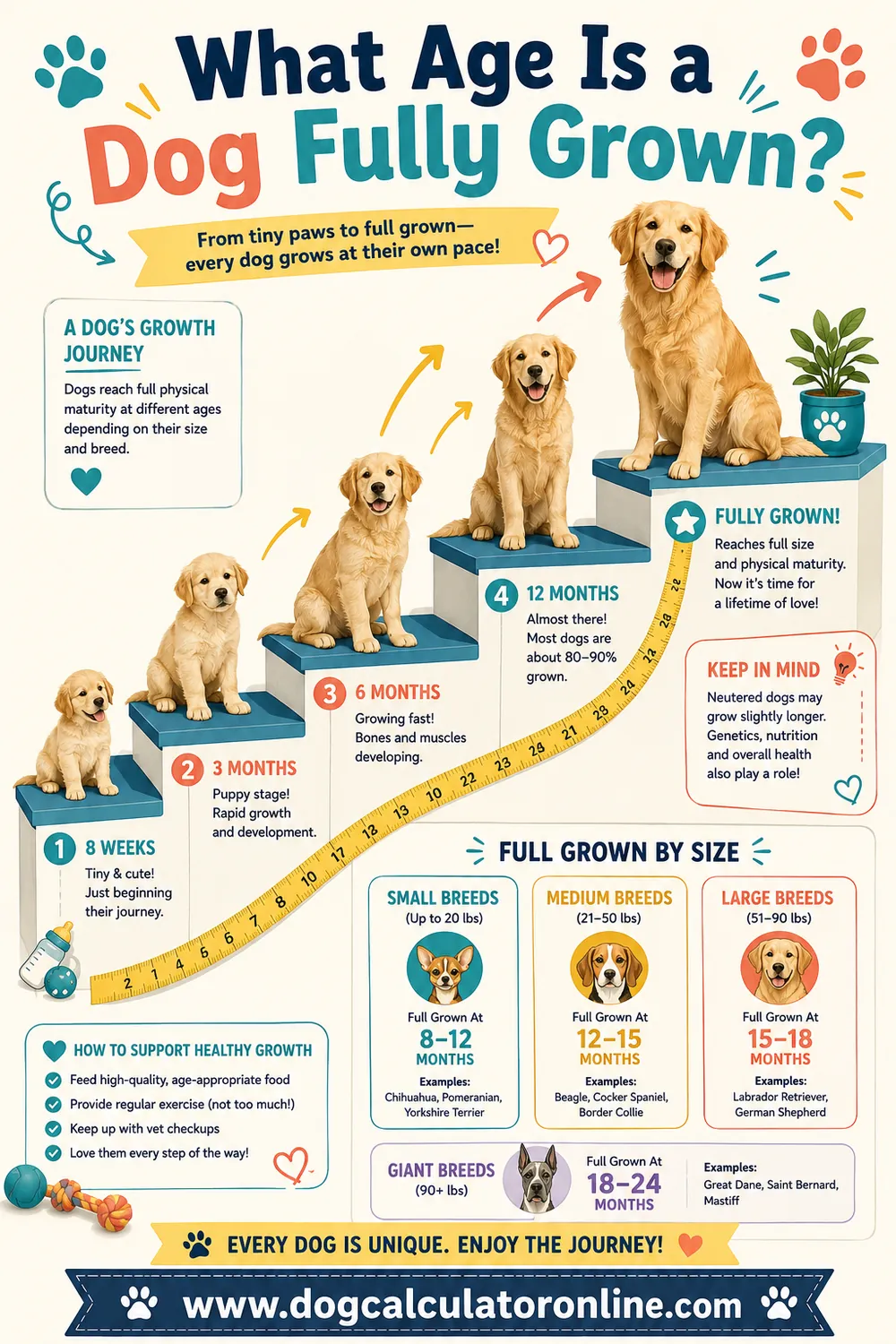
Most puppies stop growing somewhere between 9 and 24 months, and the single biggest predictor is size class: toy and small breeds finish around 9–12 months, medium breeds around 12 months, large breeds between 12 and 18 months, and giant breeds can keep growing until 18–24 months. Height finishes first — the filling out of chest, muscle, and frame continues for months afterward. If you want a projection for your specific pup, the free puppy weight calculator turns a current weight and age into an estimated adult size in seconds.

The Short Answer: Growth Timelines by Size Class
Dogs are unusual among mammals in how wildly adult size varies — a Chihuahua and a Great Dane are the same species, yet one finishes growing in under a year while the other needs more than two. The practical rule: the bigger the adult dog, the longer the growing takes.
| Size class | Adult weight | Adult height reached | Fully grown (weight and frame) |
|---|---|---|---|
| Toy (Chihuahua, Yorkie, Pomeranian) | Under ~12 lb | ~6–9 months | ~9–12 months |
| Small (Dachshund, Shih Tzu, Mini Schnauzer) | ~12–25 lb | ~8–10 months | ~10–12 months |
| Medium (Beagle, Border Collie, Cocker Spaniel) | ~25–50 lb | ~9–11 months | ~12 months |
| Large (Labrador, German Shepherd, Golden) | ~50–90 lb | ~10–14 months | ~12–18 months |
| Giant (Great Dane, Mastiff, Newfoundland) | 90+ lb | ~14–18 months | ~18–24 months |
Two caveats worth flagging honestly. First, these are typical ranges, not deadlines — individual dogs run early or late by a few months and can still be perfectly healthy. Second, "fully grown" hides two separate finish lines: skeletal height, which is set by bone growth, and mature body mass, which includes months of additional muscle and chest development after the skeleton is done. A one-year-old Lab at full height is usually still five to fifteen pounds away from his final adult weight.
If you want the deeper prediction question — not just when growth ends but where it lands — our guide to how big your puppy will get walks through the main estimation methods.
Why Do Small Dogs Finish Growing Before Large Dogs?
It seems backwards at first: shouldn't a bigger body simply grow faster? Big dogs do grow faster in absolute terms — a Great Dane puppy can gain more weight in a week than a Chihuahua gains in two months. But they also have vastly more growing to do, and biology stretches the timeline rather than cramming it.
A toy breed multiplies its birth weight by a factor of maybe 20 to reach adulthood. A giant breed multiplies it by 100 or more. Compressing that much skeletal construction into nine months would put enormous stress on developing joints, so large and giant breeds mature on an extended schedule: their growth plates stay open longer, their hormonal transition to adulthood arrives later, and their bodies prioritize steady bone development over speed.
There's a useful mental model here: small dogs sprint to adulthood, big dogs run a marathon to it. The sprint is finished by the first birthday. The marathon can run to the second.
This is also why feeding matters differently by size. Large-breed puppy foods exist specifically because rapid, calorie-pushed growth in big puppies is associated with developmental joint problems — the goal with a large or giant puppy is steady growth at a controlled rate, not maximum growth at maximum speed. Your vet can tell you whether your puppy's growth curve looks appropriately paced, which is a far better check than comparing him to the biggest pup at the dog park.
What Are Growth Plates — and Why Do Vets Care About Them?
Growth plates (the technical name is epiphyseal plates) are soft zones of cartilage near the ends of a puppy's long bones — the femur, the tibia, the radius, and so on. All the lengthening of a bone happens at these plates: new cartilage forms, then hardens into bone, and the bone gets longer. Once a plate has fully converted to solid bone — vets call this "closing" — that bone can never lengthen again.
Growth plate closure is the true biological answer to the question in this article's title. A puppy stops growing taller when the growth plates close, and closure timing tracks size class:
- Toy and small breeds: most plates close by around 6–10 months.
- Medium breeds: roughly 8–12 months.
- Large breeds: roughly 10–16 months.
- Giant breeds: some plates stay open to 18–24 months.
Different bones close on slightly different schedules within the same dog, which is why growth tapers gradually rather than stopping on a single day.
Two practical consequences follow. First, open growth plates are the most fragile part of a young skeleton — softer than mature bone and softer than the ligaments attached near them. An awkward landing that would bruise an adult dog can fracture a puppy's growth plate, and plate fractures can distort how that bone finishes growing. Second, an x-ray of the growth plates is the definitive way to answer "is my puppy done growing?" — vets use exactly this check when the answer matters, for example before clearing a young dog for high-impact sports. If you genuinely need certainty rather than an estimate, that's a conversation for your vet.
Height Stops First. The Filling Out Comes Later
Owners often panic in the gap between the two finish lines. A ten-month-old Shepherd at full shoulder height but with visible ribs, a narrow chest, and gangly legs looks underfed next to a mature adult of the same breed. Usually she's not underfed — she's a teenager.
Skeletal growth and mass development run on staggered schedules:
- Height finishes when the leg growth plates close — often months before anything else is done.
- Chest and skull continue broadening after height is set, sometimes dramatically in breeds with deep chests or blocky heads.
- Muscle mass builds through the entire adolescent period and into early adulthood as hormones shift and activity increases.
For a Labrador, the sequence might look like: full height at 12 months, near-final chest depth at 15–18 months, final muscled-out adult weight somewhere around 18–24 months. For a Mastiff, stretch every one of those numbers.
The takeaway: judge an adolescent dog by body condition — ribs easily felt but not sharply visible, a defined waist — rather than by whether he looks like the finished product. If you're unsure what a healthy weight even looks like at this stage, our guide to how much your dog should weigh covers why condition beats any number on a chart, and the healthy weight ranges by size article gives you the honest bands for each size class.
How Can You Tell Your Puppy Has Stopped Growing?
Short of an x-ray, you're reading signals rather than certainties. The reliable ones:
- The weight curve flattens. Weigh your puppy every couple of weeks. Growth doesn't stop abruptly — monthly gains shrink from pounds, to a pound, to ounces, to nothing. Two or three months of stable weight in a dog past the typical age for his size class is a strong signal.
- Height stops changing. Measure at the withers (the top of the shoulder blades) monthly against a wall, the same way you'd pencil-mark a child's height. When three consecutive months match, vertical growth is almost certainly done.
- Paws stop looking borrowed. The classic oversized-paw look of a growing puppy fades as the legs catch up. It's folklore as a prediction tool, but as a progress signal it roughly works in reverse — proportionate paws suggest the frame is closing in on final size.
- The vet says so. At routine visits, your vet tracks weight against breed-typical curves and can feel whether a dog still has adolescent looseness in his frame. It's a free answer to a question owners often agonize over alone.
One honest caution: appetite is a terrible signal. Adolescent dogs often eat like they're still growing long after they've stopped, which is exactly how young adult dogs quietly become overweight without their owners noticing. When growth ends, calorie needs drop — the feeding amount that fueled a growing ten-month-old can overfeed a finished fourteen-month-old.
For the week-by-week view of the whole climb — when the fastest gains happen and when they taper — see how fast puppies grow.
Why Shouldn't You Over-Exercise a Large-Breed Puppy?
This is the question hiding inside the growth-plate biology, and it matters most for large and giant breeds precisely because their plates stay open so long.
Open growth plates are soft. Repetitive high-impact loading — long-distance running on pavement, relentless fetch with hard skidding stops, jumping down from heights, agility courses with full-height jumps — hammers exactly the structures that are still made of cartilage. In a small breed, the vulnerable window closes within months. In a Dane or a Shepherd, it can stay open well into the second year, which is also exactly when the dog looks adult, acts athletic, and tempts you into adult-level exercise.
To be clear about what this doesn't mean: puppies need exercise, and lots of it. Free play, sniffy walks, off-leash romping on grass where the puppy sets his own pace, swimming, training games — all excellent at any age. Puppies self-regulate remarkably well when they control the intensity. The concern is forced, repetitive, high-impact exercise where the human sets a pace and duration the puppy wouldn't choose: being taken jogging for miles, endless ball-launcher sessions, stairs sprints.
There's no universally agreed formula for exactly how much is too much — you may have seen a "five minutes per month of age" rule online, and it's a rough folk guideline rather than an established veterinary standard. The genuinely safe path for a large or giant puppy is to ask your vet two specific questions at a routine visit: when is this dog likely to be skeletally mature, and what exercise would you cap before then? For dogs headed into running, hiking, or sport, some vets will confirm growth-plate closure on x-ray before clearing full-impact work. That's not over-caution — it's cheap insurance on joints that have to last a decade.
Does Neutering Change When a Puppy Stops Growing?
It can, and the direction surprises people. Sex hormones are part of the signal that tells growth plates to close. Dogs spayed or neutered before puberty tend to have growth plates that stay open somewhat longer, which typically results in a slightly taller, longer-limbed adult — not a smaller one, as many owners assume.
Whether that matters for your dog is genuinely a case-by-case question. The timing of spay and neuter — especially for large and giant breeds, where skeletal development runs longest — is an active topic in veterinary medicine, and recommendations have shifted over the years and vary by breed, sex, and the individual dog's situation. This is squarely an ask-your-vet decision: they can weigh the growth considerations alongside everything else (behavior, health risks, your household) for your specific dog. What you shouldn't do is decide the timing based on internet forums or on hopes of engineering a bigger or smaller adult dog.
The honest summary for this article's purposes: neuter timing can shift final height by a small amount and shift closure timing by a few months, but it doesn't change the fundamental schedule. A neutered Beagle still finishes around a year; a neutered Dane still takes about two.
How Do You Estimate Your Puppy's Final Size?
If your puppy is mid-climb and you want to know where the curve tops out, you have four practical options, in rising order of accuracy:
- Size-class rules of thumb. A rough classic: small breeds reach about half their adult weight around 4 months, large breeds around 5–6 months. Doubling from the right milestone gives a ballpark.
- Growth-curve projection. Take your puppy's current age and weight and project along a breed-size growth curve. This is what the puppy weight calculator does — it's fast, free, and considerably better than paw-size folklore.
- Parents, if known. For purebreds, the parents (with sex adjustment — males typically finish heavier) are a strong anchor. For mixes, the visible parent can mislead badly.
- Your vet's read. Vets see hundreds of growth curves a year and can eyeball a five-month-old's frame, paws, and skin looseness with real skill. A DNA test adds breed-mix information for shelter puppies whose ancestry is a mystery.
None of these is exact, and that's fine — for most decisions (crate size, food budgets, apartment rules) a range is all you need. And remember the finish line question is separate from the size question: a calculator tells you roughly where the curve lands, and this article's size-class table tells you roughly when. For what "grown up" means beyond the skeleton — behavior, maturity, when a dog truly counts as an adult — see what age a dog is fully grown.
Frequently Asked Questions
Do puppies stop growing at 6 months?
No — six months is roughly the midpoint for many breeds, not the end. Toy breeds are genuinely close to done by six months, but medium breeds have a few months left, and large and giant breeds may have a year or more of growth remaining. The taper is gradual, so slower gains at six months are normal and don't mean growth has stopped.
At what age is a puppy fully grown?
Toy and small breeds: about 9–12 months. Medium breeds: about 12 months. Large breeds: 12–18 months. Giant breeds: 18–24 months, occasionally longer. Adult height arrives earlier than adult weight in every class, because muscle and chest development continue after the skeleton finishes.
Do big paws mean my puppy will be a big dog?
Only loosely. Puppies do tend to grow into their paws, so notably oversized paws suggest more growing ahead — but paw size varies by breed type and is a weak predictor of final weight. Current weight-for-age on a growth curve, breed information, and parent size are all more reliable signals.
When should I switch my puppy to adult food?
Generally around the time growth finishes for their size class — earlier for small breeds, as late as 18–24 months for giants on large-breed puppy formulas. The switch matters because puppy food is calorie-dense fuel for growth that a finished dog no longer needs. Timing varies by breed and food, so confirm the switch point with your vet rather than going by the bag alone.
Can puppies have growth spurts?
Yes. Growth is not perfectly smooth — puppies commonly gain in visible bursts, often alongside big appetite swings, then plateau for a stretch. A week or two of flat weight mid-adolescence is normal. What merits a vet conversation is a sustained flat line during the months when steady gains are expected, or a puppy falling further behind the curve at every check.
My puppy is smaller than the breed chart says. Should I worry?
Usually not — breed charts describe averages, and healthy individuals land above and below them. What matters more than any single data point is the trend: a small puppy who is gaining steadily along her own curve is generally fine, while one who has stopped gaining or is losing ground warrants a vet visit. Bring your weight log; it makes that conversation fast and useful.
Growth has a finish line, but it arrives on your dog's schedule, not the internet's — small dogs by the first birthday, big dogs closer to the second. If you want a live estimate of where your puppy's curve is heading, run their current age and weight through the free puppy weight calculator — it takes under a minute and updates as they grow.