What Age Is a Dog Fully Grown?
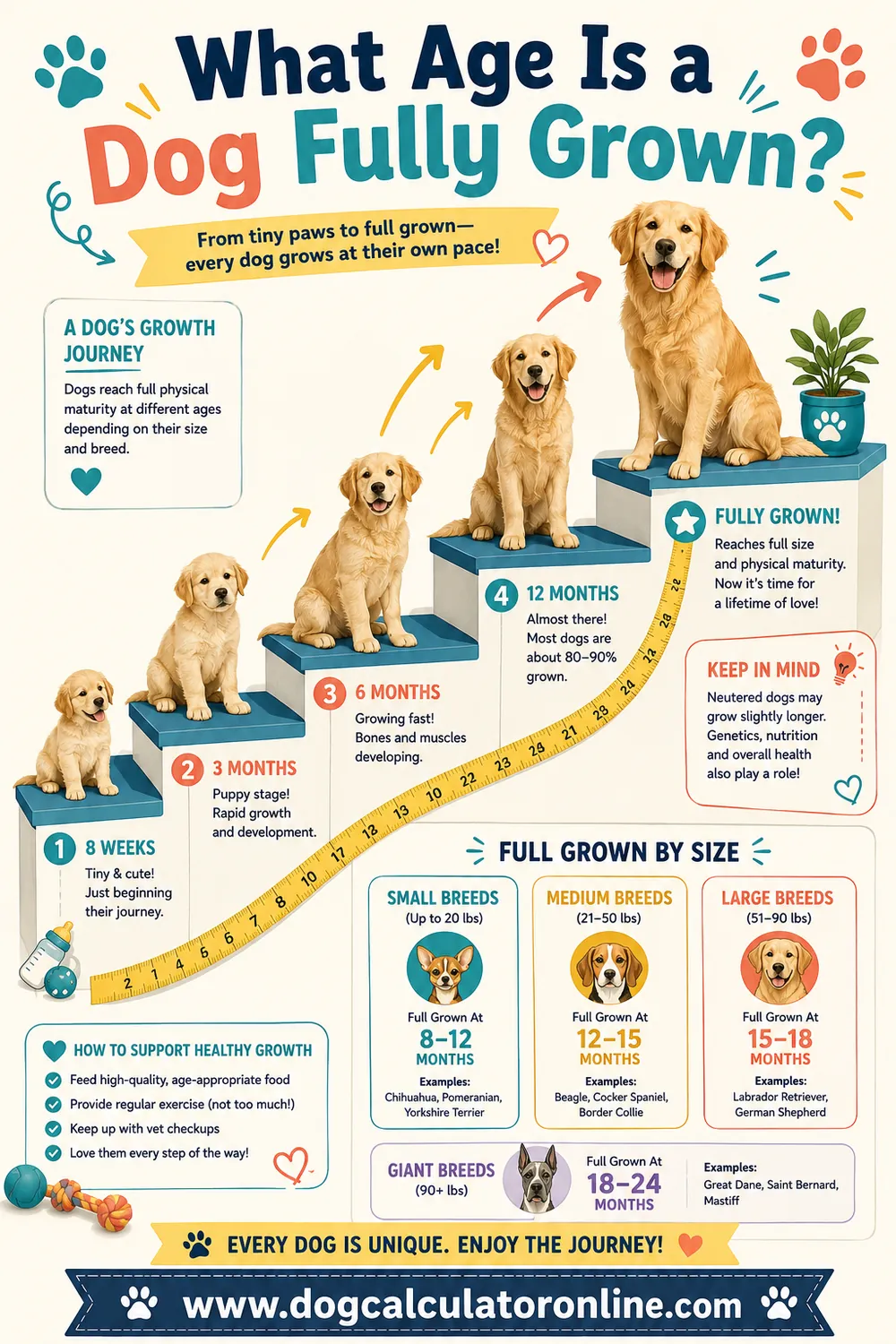
Most dogs are fully grown between 9 and 24 months, depending on size. Small breeds finish growing around 9–12 months, medium breeds around 12 months, large breeds between 12 and 18 months, and giant breeds may keep growing until 18–24 months. The bigger the dog, the longer the build.
If you're mid-puppyhood and wondering how big your dog will end up, our free puppy weight predictor estimates adult size from your puppy's current age and weight in seconds.
🐾 When will my puppy be full-grown?
Tap your dog’s expected adult size:
Tap a size class above.
Full-Grown Age by Size Class
"Fully grown" happens in two phases: dogs reach their adult height first (when the growth plates in their leg bones close), then spend a few more months adding muscle and "filling out" to their adult weight. Here's the schedule:
| Size class | Adult weight | Full height by | Full weight (filled out) by |
|---|---|---|---|
| Toy/Small | Under 20 lb | ~6–9 months | 9–12 months |
| Medium | 21–50 lb | ~9–12 months | 12–15 months |
| Large | 51–90 lb | ~12 months | 12–18 months |
| Giant | Over 90 lb | ~15–18 months | 18–24 months |
A few real-world anchors:
- A Chihuahua is usually done growing before her first birthday.
- A Labrador hits close to full height around 12 months but keeps broadening into a proper adult chest until about 18 months.
- A Great Dane may not be truly finished until his second birthday — nearly a quarter of his expected lifespan spent growing.
Why Big Dogs Take So Much Longer
It sounds backwards — small dogs age slower but grow up faster? Both are true, and for related reasons.
A giant-breed puppy has a vastly bigger skeleton to build. Going from a one-pound newborn to a 120-pound adult means the growth plates — the soft cartilage zones at the ends of long bones where growth happens — must stay open and productive far longer. A Yorkie's growth plates may close by 8 months; a Mastiff's can stay open past 18.
That long construction window is also why vets urge special care with big puppies: while growth plates are open, the skeleton is soft-wired. Which brings us to the practical stuff.
Growth Plates: Why "Fully Grown" Matters for Exercise
Until the growth plates close, high-impact stress can injure them — and a growth-plate injury can permanently affect how a bone develops. That's why the standard advice for large and giant puppies is:
- Avoid forced repetitive exercise — long leashed jogs, treadmill sessions, marathon fetch — until your vet confirms growth is done.
- Free play is fine. Puppies self-regulate in off-leash play in a way they can't when pace is imposed.
- Watch the jumping. Repeated leaps off furniture or out of vehicles are exactly the impact young joints don't need.
- Keep them lean. Extra weight during growth loads soft joints at their most vulnerable — and fast, chubby growth in big breeds is itself a risk factor for skeletal problems.
For small breeds, the window is short and the forces are tiny, so this matters much less. For a Dane or Shepherd puppy, it's one of the most important things an owner controls.
Physically Grown ≠ Mentally Grown
Here's the part every new owner learns the fun way: a dog can be skeletally finished and still be a complete adolescent goofball.
- Physical maturity: 9–24 months by size, per the table above.
- Sexual maturity: typically 6–12 months — well before physical maturity in big breeds.
- Mental/behavioral maturity: usually 18 months to 3 years, with big breeds again on the slow end.
So an 18-month-old Lab has an adult body powered by a teenage brain. If your "fully grown" dog is still stealing socks and testing rules, nothing is wrong — the brain finishes the job a year or so after the bones do.
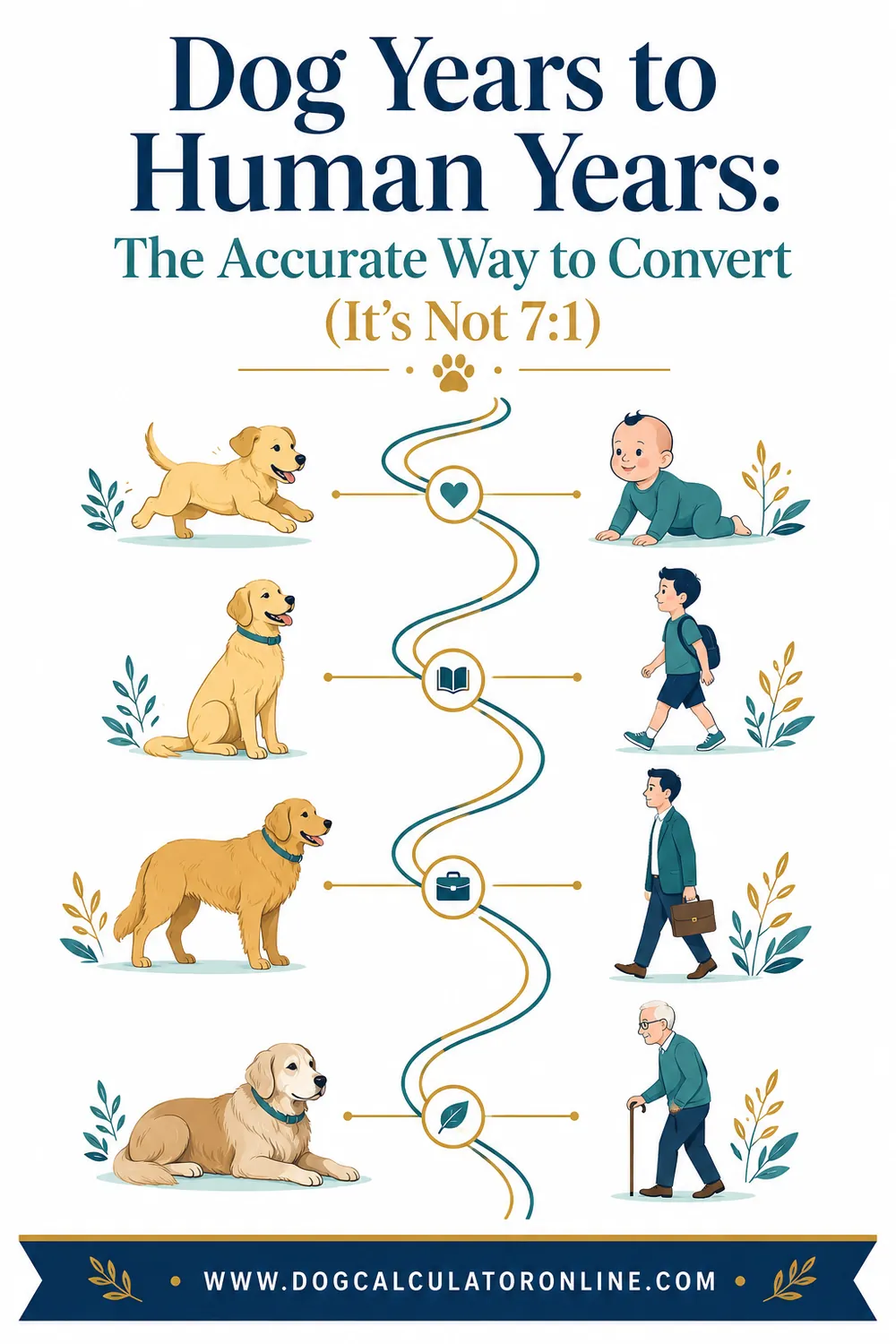
In human-year terms, the size-adjusted formula vets use counts a dog's first year as about 15 human years and the second as 9 more — so a 2-year-old dog is around 24 in human years. Adulthood at last, in both species. You can check any age with the free dog age calculator.
How Big Will Your Puppy Actually Get?
Knowing when growth ends is half the question; the other half is where it lands. Ways to estimate:
- Parents' size — the best single predictor when known. Males often track the sire's side, females the dam's, with plenty of overlap.
- Breed averages — for purebreds, the expected adult range is well documented.
- Growth-percentage math — puppies of each size class complete a known fraction of their growth by a given age. A rough classic: a medium puppy is near half of adult weight around 14–16 weeks; small breeds hit halfway earlier, giants later.
- Paw size and loose skin — the folk methods. Oversized paws do hint at growing room, but they're the least reliable signal.
- A DNA test — for mixed breeds, ancestry plus the parents you can see gives a solid range.
Or skip the arithmetic: enter your puppy's current age and weight into our free puppy weight predictor and get an adult-size estimate instantly. It applies size-class growth curves, which beats any single rule of thumb.
Signs Your Dog Has Stopped Growing
How do you know growth is actually finished, versus just slowing? A few reliable signals:
- Height has held steady for a couple of months — the leg bones aren't getting any taller.
- Weight has plateaued on consistent portions (not because you're feeding less, but because the body has stopped adding frame).
- The proportions look adult. That gangly, oversized-paw, "growing into himself" look has resolved into balanced adult proportions.
- The chest and head have filled out. In many breeds, height finishes first and the body keeps broadening for months afterward — so a dog at full height isn't necessarily done.
If you're genuinely unsure — say, deciding whether a large-breed adolescent is safe for higher-impact exercise — your vet can settle it. An X-ray shows whether the growth plates have closed, which is the definitive answer. This matters most for big breeds, where a few months of patience protects joints for life.
Keep in mind that a growth plateau isn't the same as being mentally grown. Your dog can be skeletally finished at 15 months and still be a rule-testing adolescent for another year or more — the bones beat the brain to the finish line every time.
Feeding Through the Finish Line
Growth timing drives one more practical decision: when to switch from puppy food to adult food. Puppy formulas are calorie- and nutrient-dense to fuel construction; feeding them past the finish invites weight gain, while switching too early can shortchange a still-growing skeleton.
The general pattern — confirm with your vet and your food's label:
- Small breeds: switch around 9–12 months
- Medium breeds: around 12 months
- Large breeds: around 12–18 months (large-breed puppy formulas exist specifically to support controlled growth)
- Giant breeds: as late as 18–24 months
Signs your dog has genuinely finished growing: height stable for a couple of months, weight plateaued on consistent portions, and that adolescent lankiness replaced by adult proportions. Your vet can confirm — in borderline cases an X-ray can show whether the growth plates have closed.
Full-Grown Ages for Popular Breeds
Size classes are the rule; here's how it lands for breeds people actually own:
| Breed | Size class | Typically fully grown by |
|---|---|---|
| Chihuahua | Toy | 9–10 months |
| Yorkshire Terrier | Toy | 9–12 months |
| French Bulldog | Small/medium | 12 months |
| Beagle | Medium | 12–15 months |
| Border Collie | Medium | 12–15 months |
| Labrador Retriever | Large | 15–18 months |
| Golden Retriever | Large | 15–18 months |
| German Shepherd | Large | 18 months |
| Rottweiler | Large/giant | 18–24 months |
| Great Dane | Giant | 18–24 months |
These are typical finish lines, not deadlines — individual dogs run early or late by a few months, and mixed breeds follow whichever size class their adult weight puts them in.
Growth Isn't a Straight Line (Spurts and Plateaus Are Normal)
Weigh a puppy weekly and you won't see a smooth ramp — you'll see jumps, stalls, and the occasional week where nothing seems to happen. That's normal. Puppies grow in spurts, often sleeping extra and eating like vacuum cleaners during a jump, then leveling off for a stretch.
A plateau at 7 months in a Lab puppy doesn't mean growth is over; it usually means a pause before the next push. Judge the trend over 4–6 weeks, not week to week. What is worth a vet chat: a puppy who stops gaining entirely for well over a month during what should be peak growth, or one who drops weight without a diet change.
Why Is My Puppy Small for Their Age?
If your pup is trailing the growth charts, the usual explanations are boring rather than alarming:
- Charts describe averages. Half of all puppies are below the average line — that's how averages work. A healthy puppy tracking a consistent curve, even a low one, is usually just built small.
- Litter position. Runts often start behind and close much of the gap by adulthood — though some simply stay petite.
- Parasites. Worms are a classic, fixable cause of poor puppy growth; routine deworming and fecal checks at puppy visits catch this.
- Diet quality or quantity. A puppy underfed or on food that isn't complete and balanced for growth will lag. Check your label and portions.
- The estimate was off. With rescues especially, a "small for 5 months" puppy is sometimes just a normal 4-month-old.
Bring steady lagging, low energy, or a pot-bellied look to your vet — but know that the most common diagnosis is "perfectly healthy, just not the size you guessed."
Related Guides
If this helped, these go deeper on the same question:
- How Big Will My Puppy Get? 4 Ways to Predict Adult Size
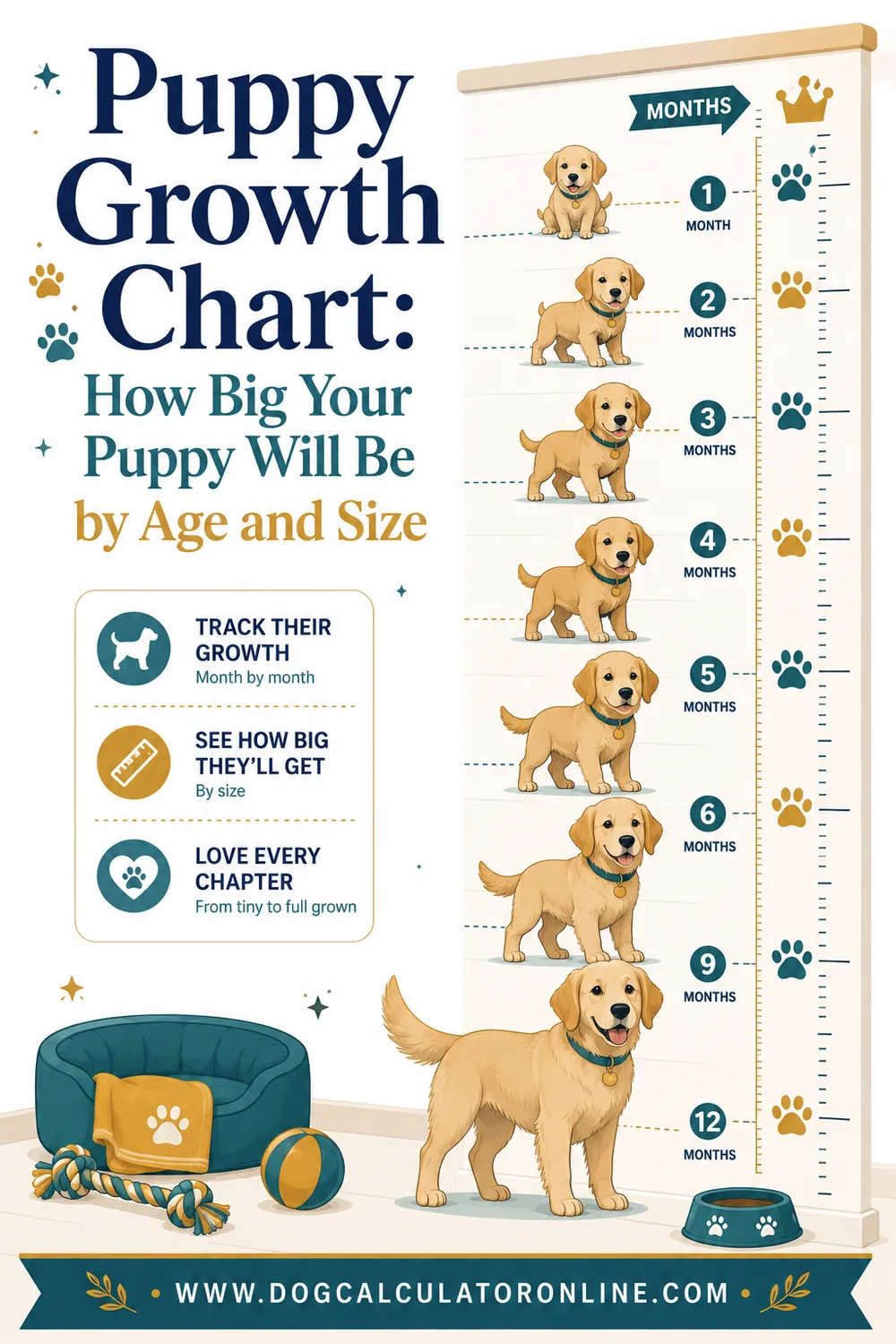
- Puppy Growth Chart: How Big Your Puppy Will Be by Age and Size
- Dog Years to Human Years: The Accurate Way to Convert (It's Not 7:1)
And if you just want your own dog’s number, the free dog age calculator does it in one tap.
FAQ
At what age is a dog fully grown?
Between 9 and 24 months depending on size: small breeds by 9–12 months, medium by 12–15, large by 12–18, and giant breeds by 18–24 months.
Do dogs grow after 1 year?
Small dogs mostly don't. Medium dogs may fill out a little. Large and giant breeds often keep growing well past a year — giants up to their second birthday.
When do dogs stop growing in height vs weight?
Height finishes first, when leg growth plates close. Dogs then spend several more months adding muscle and chest to reach adult weight — the "filling out" phase.
Is my dog an adult at 6 months?
No. A 6-month-old is an adolescent — possibly near adult height if small, but skeletally and mentally unfinished. Even small breeds aren't truly done before about 9 months.
When should I switch to adult dog food?
Roughly when growth ends: 9–12 months for small breeds, around 12 for medium, 12–18 for large, and up to 24 for giants. Confirm timing with your vet.
How can I tell how big my puppy will get?
Parents' size, breed averages, and growth-curve math are the main tools. Our free puppy weight predictor runs the estimate from your puppy's current age and weight.
Why is my large-breed puppy still growing at 18 months?
That's normal. Large breeds often keep filling out until 18 months and giants until 24. Height typically finishes first, then the chest and frame broaden for months afterward. Slow, steady growth is healthier for big breeds than fast growth.
Does neutering affect when a dog stops growing?
It can, especially in large breeds, because the hormones involved play a role in growth-plate closure. This is one reason spay/neuter timing is an individual decision — ask your vet what's best for your dog's breed and size rather than following a fixed rule.
The Bottom Line
Dogs finish growing on a size-based schedule: small breeds around 9–12 months, medium around a year, large breeds by 18 months, and giants by up to 2 years — height first, filling-out second, and the brain last of all. Until then, keep growth lean and impacts low, especially in big puppies.
Want to know where your puppy's curve is heading? The free puppy weight predictor turns today's age and weight into an adult-size estimate — and the dog age calculator tells you how "old" your growing dog is in human years right now.