How Long Do Dogs Live? Average Dog Lifespan Explained
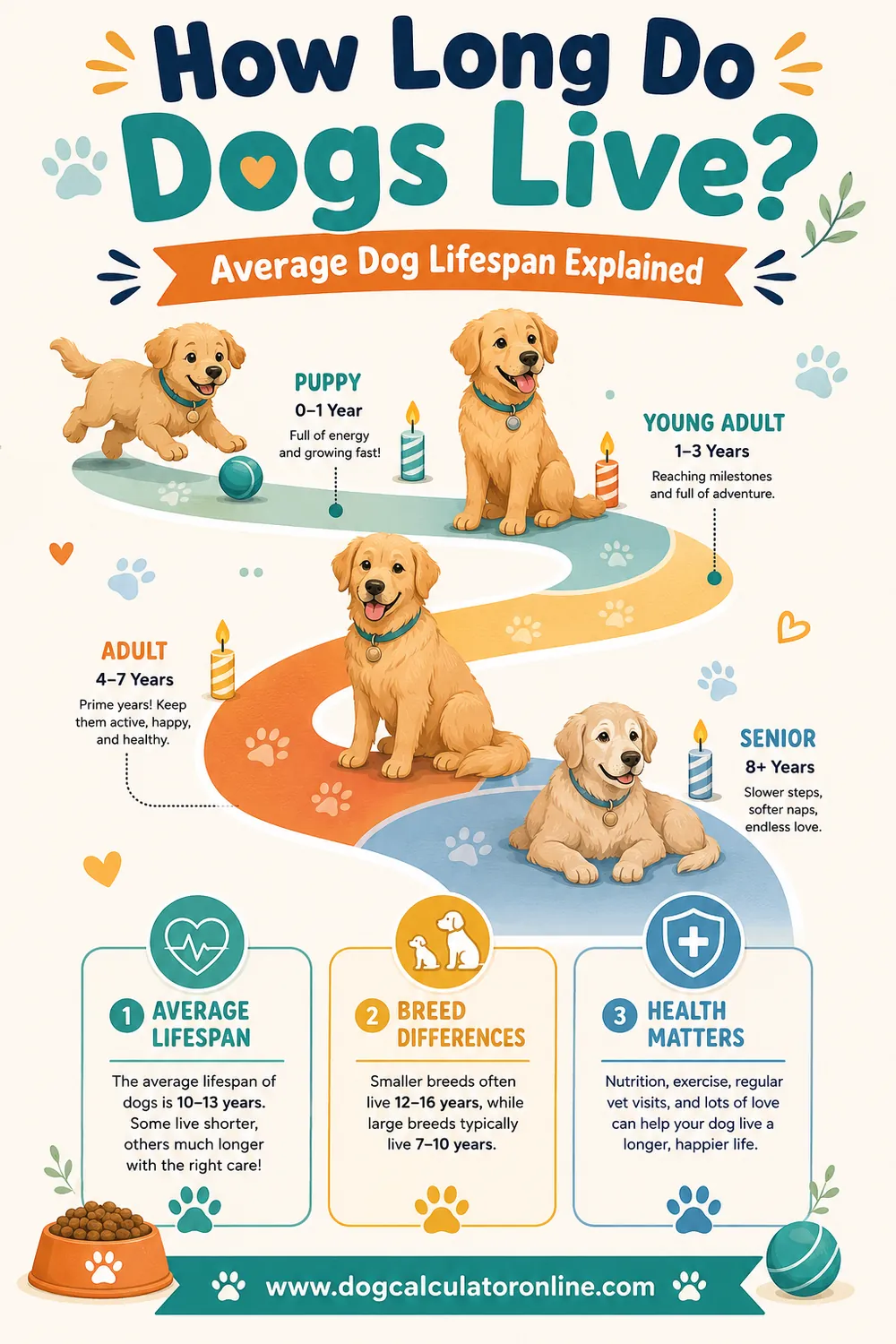
Most dogs live 10 to 13 years, but that average hides a huge range. Small breeds routinely reach 12 to 16 years, while giant breeds often live just 7 to 10. Size is the single biggest predictor of how long a dog lives — bigger dogs age faster, and it's not close.
If you want to see where your own dog sits on the aging curve right now, our free dog age calculator converts your dog's age into human years using the size-adjusted method vets actually use. It takes about ten seconds.
🐾 Quick check: average lifespan by size
Tap your dog’s size class to see the typical lifespan range:
Tap a size above to see the typical range.
The Short Answer: 10–13 Years on Average
Across all breeds and sizes, the average dog lifespan lands somewhere between 10 and 13 years. That number comes up again and again in large veterinary datasets, and it's a reasonable expectation for a typical, well-cared-for dog.
But "average" is doing a lot of work in that sentence. A Chihuahua and a Great Dane are both dogs, yet their life expectancies are nearly a decade apart. Before you can answer "how long will my dog live," you need to know one thing above all: how big your dog is.
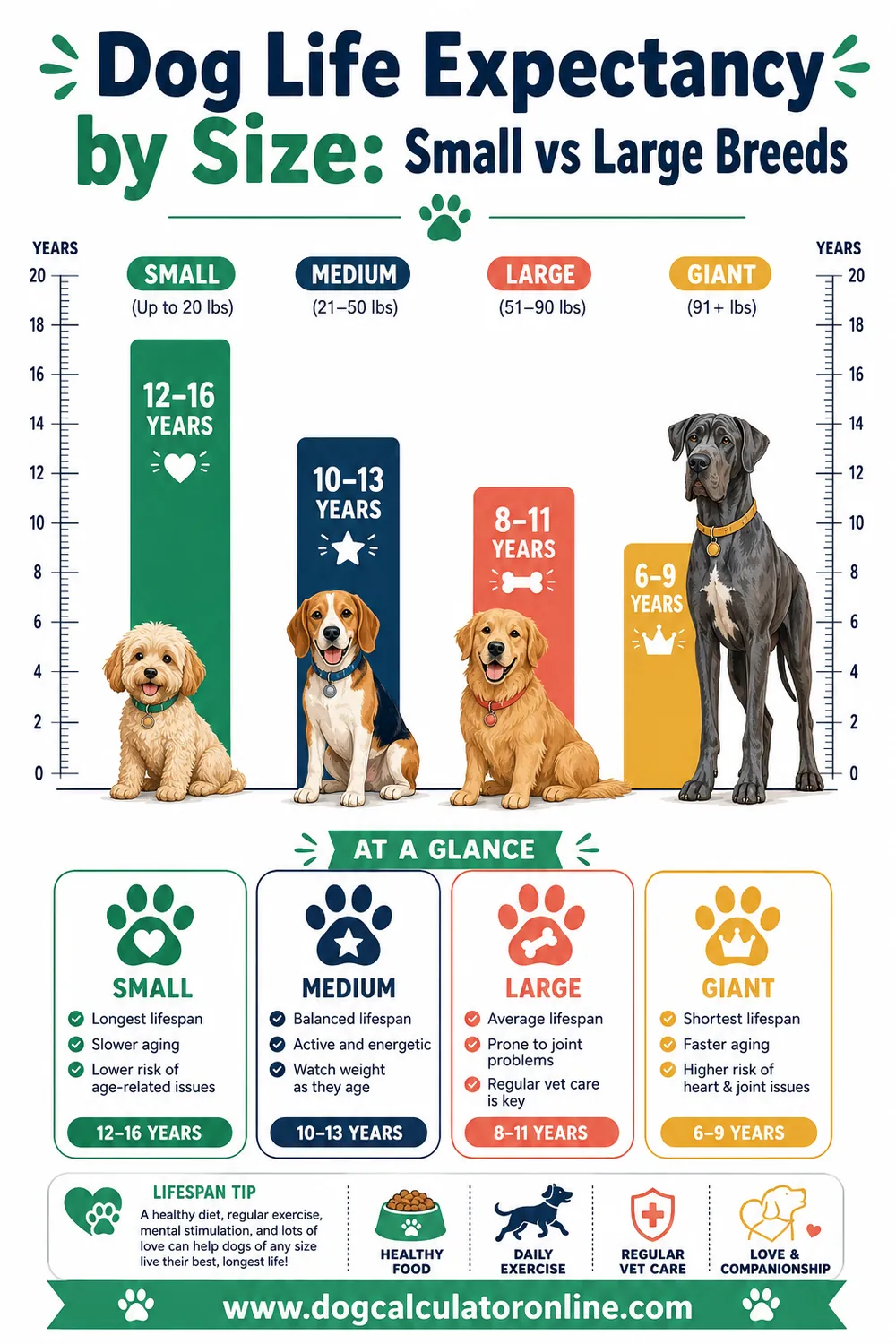
Dog Lifespan by Size Class
Here's the pattern that shows up consistently in veterinary research and breed data:
| Size class | Adult weight | Typical lifespan |
|---|---|---|
| Small | Under 20 lb | 12–16 years |
| Medium | 21–50 lb | 10–14 years |
| Large | 51–90 lb | 9–12 years |
| Giant | Over 90 lb | 7–10 years |
A few things worth noticing:
- Small dogs are the long-haul champions. Many toy and small breeds — Chihuahuas, Toy Poodles, Dachshunds — commonly reach their mid-teens, and some pass 17.
- Giant breeds carry the shortest expectancy. Great Danes, Mastiffs, and Irish Wolfhounds often become seniors by age 5 or 6 and rarely pass 10.
- The middle is wide. Medium and large breeds span the biggest range, because breed genetics matter more once you're out of the extremes.
This is exactly why any honest aging estimate has to ask your dog's weight. Our dog age calculator uses the same size classes to convert your dog's age into human years — a 10-year-old small dog and a 10-year-old giant dog are at completely different points in life.
Why Do Bigger Dogs Live Shorter Lives?
In most of the animal kingdom, big species outlive small ones — elephants live decades, mice live a couple of years. Dogs flip that rule inside a single species, and scientists have a few leading explanations:
- Accelerated growth. A giant-breed puppy multiplies its birth weight roughly a hundredfold in its first year or two. That explosive cell division appears to speed up aging and raises the risk of certain cancers.
- Growth hormone (IGF-1). Larger dogs tend to carry higher levels of insulin-like growth factor 1, which is associated with faster aging and shorter lifespan across many species.
- Earlier onset of age-related disease. Big dogs don't just die younger — they develop arthritis, heart conditions, and cancers earlier in life than small dogs do.
The simplest way to say it: big dogs seem to live their lives on fast-forward. They mature on a similar schedule to small dogs, but once adulthood hits, each calendar year costs them more.
What Dog Years Look Like in Human Years
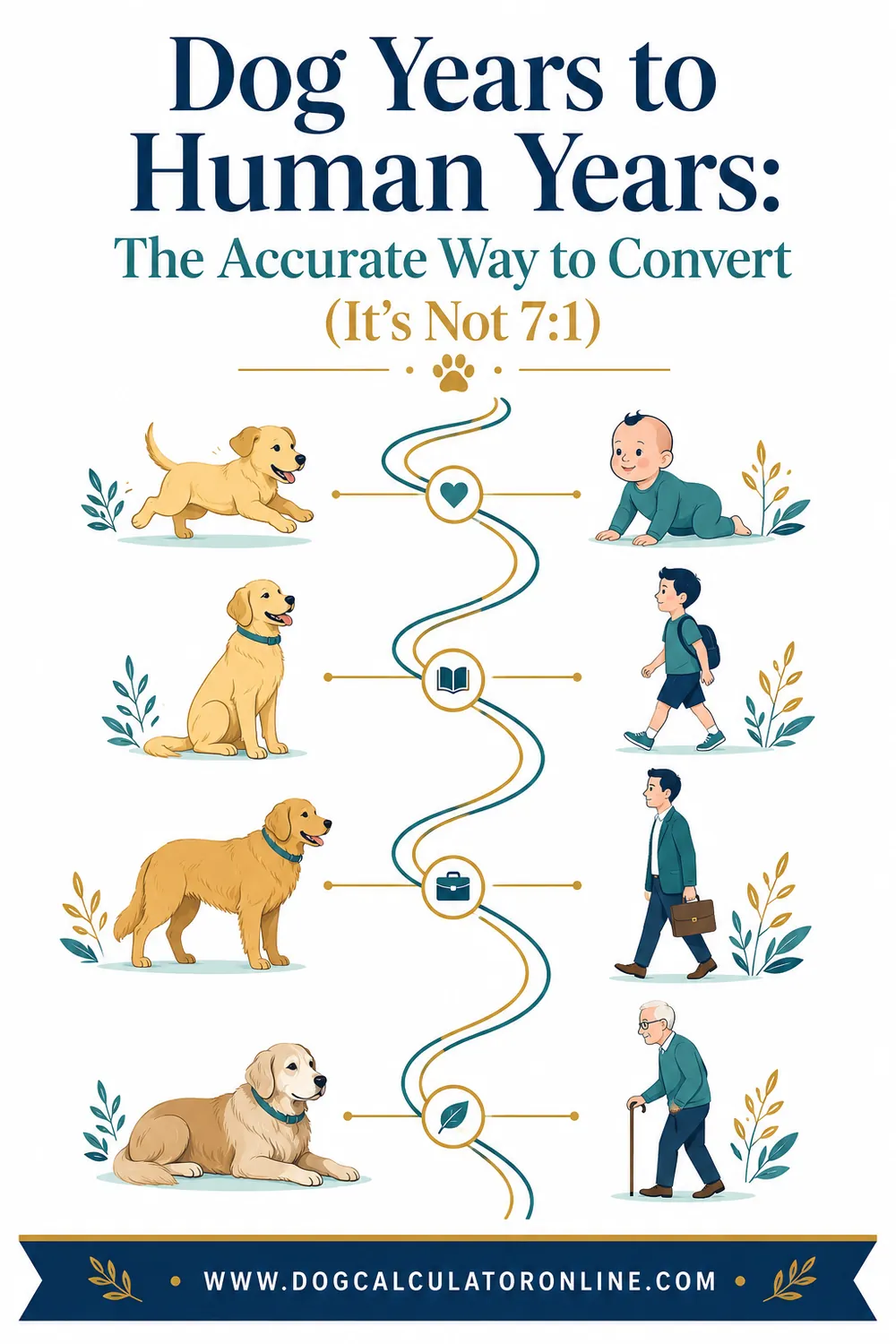
Lifespan makes more sense when you translate it. The American Veterinary Medical Association's size-adjusted guideline works like this: a dog's first year equals about 15 human years, the second adds about 9 more, and every year after that adds 4 to 7 human years depending on size — +4 for small dogs, +5 for medium, +6 for large, +7 for giant.
Run that math to the end of each size class's typical lifespan and you get a striking result:
| Size class | Typical lifespan | Human-year equivalent at that age |
|---|---|---|
| Small | 14 years | ~72 human years |
| Medium | 12 years | ~74 human years |
| Large | 10 years | ~72 human years |
| Giant | 8 years | ~66 human years |
Different calendar ages, similar "human" endpoints. Dogs of every size tend to reach a comparable biological old age — big dogs just get there much faster. A 2019 study from UC San Diego backed this up at the molecular level, using DNA methylation patterns to show that dog aging is fast early and then slows, rather than ticking along at a constant rate.
What Shortens a Dog's Life
Genetics deal the hand, but everyday factors play a real role in how the hand gets played:
- Excess weight. Obesity is one of the most common and most preventable health problems in dogs. A well-known long-term study of Labrador littermates found that dogs fed to a lean body condition lived meaningfully longer than their overweight siblings.
- Dental disease. Untreated dental infections are extremely common in adult dogs and can affect the heart, liver, and kidneys over time.
- Skipped preventive care. Missed vaccinations, skipped parasite prevention, and unnoticed lumps or weight changes all give small problems time to become big ones.
- Accidents and roaming. Dogs with unsupervised outdoor access face traffic, toxins, fights, and infectious disease at far higher rates.
- Breed-specific conditions. Some breeds carry elevated risks — heart disease in certain small breeds, bloat in deep-chested large breeds, higher cancer rates in others. Knowing your breed's watch-list helps your vet catch issues early.
What Helps a Dog Live Longer
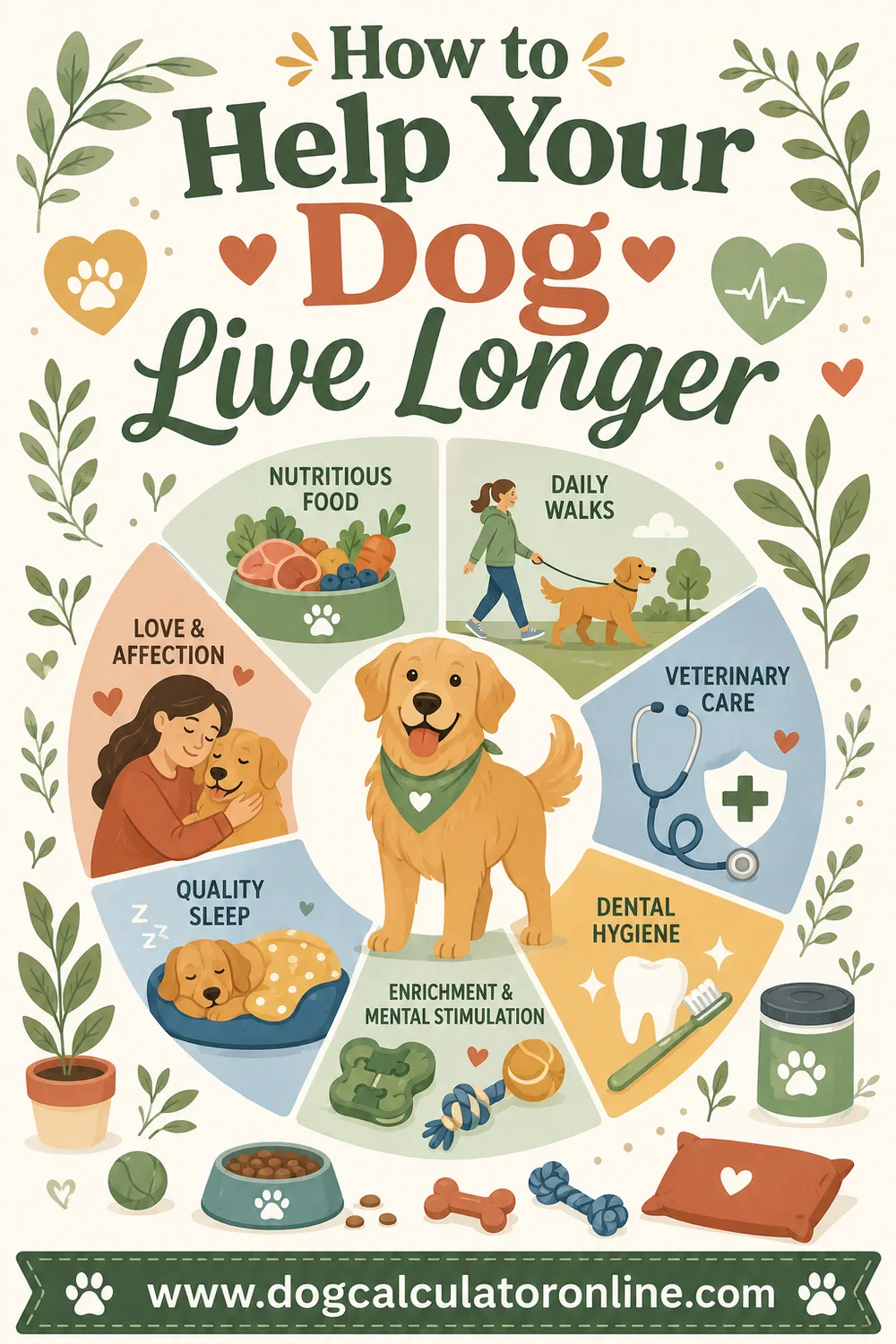
The flip side is encouraging: a handful of unglamorous habits move the needle more than any supplement ever will.
- Keep your dog lean. If you can't easily feel ribs or see a waist from above, talk to your vet about portions. This is the single best-documented lever owners control.
- Take dental care seriously. Brushing, dental chews your vet approves of, and professional cleanings when recommended.
- Stay on top of checkups. Annual exams for young adults, twice-yearly for seniors. Early detection is everything with age-related disease.
- Exercise appropriately, every day. Consistent moderate activity keeps joints, muscles, heart, and mind in shape — and it scales with age.
- Feed a complete, balanced diet. Choose a food that meets established nutrient standards for your dog's life stage, and measure portions instead of eyeballing.
- Keep the brain busy. Training, sniff walks, and puzzle feeders aren't just enrichment fluff — mental engagement is part of healthy aging.
None of this guarantees anything. But across thousands of dogs, lean, well-checked, well-exercised dogs simply live longer on average.
When Is a Dog Considered a Senior?
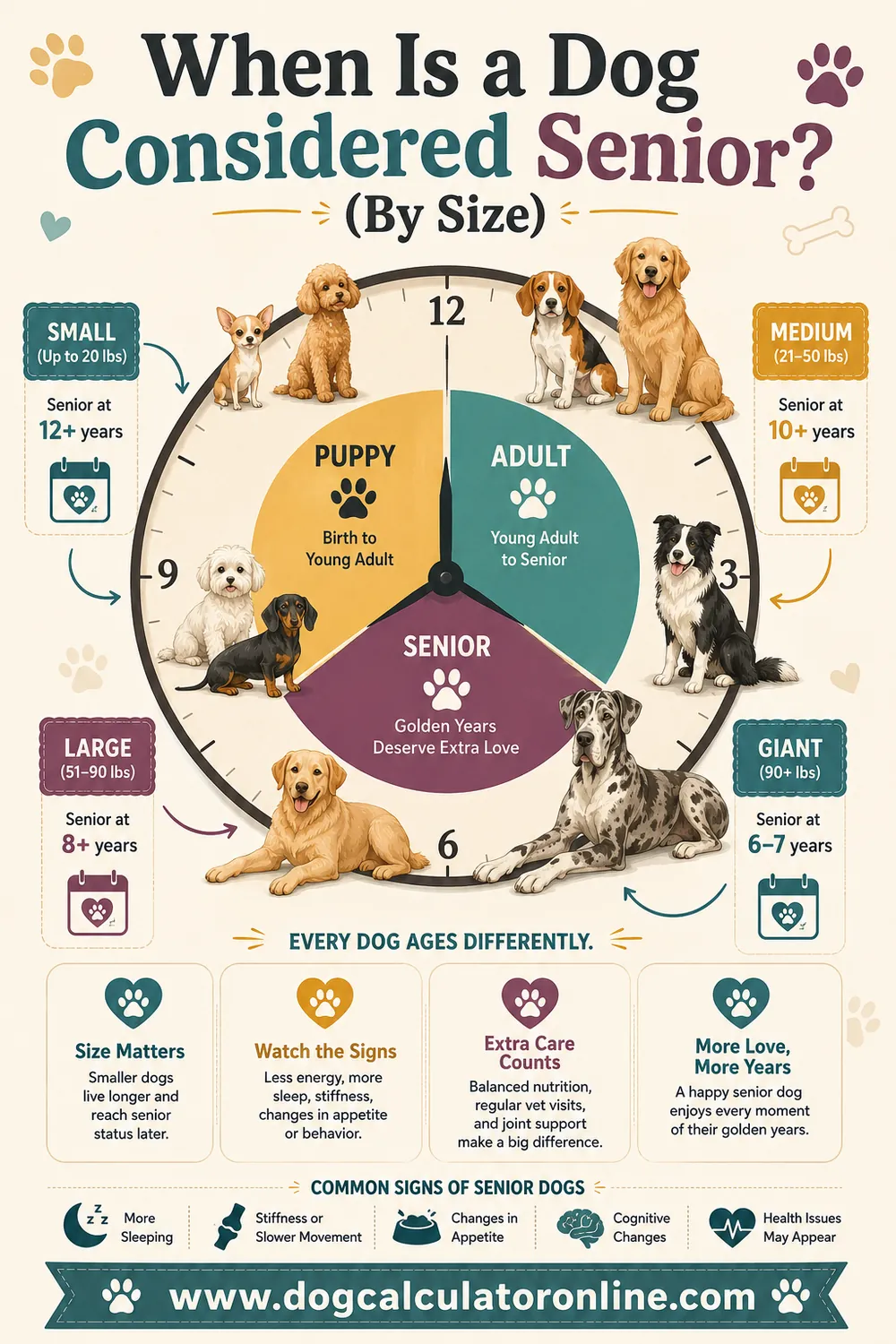
Because lifespan varies by size, so does seniorhood. A useful rule of thumb vets use: a dog enters its senior years in roughly the last quarter of its expected lifespan.
- Small and medium dogs: senior around age 7, with many small breeds staying spry well past that
- Large breeds: senior around 6–7
- Giant breeds: senior as early as 5–6
Senior status isn't a diagnosis — it's a cue to shift care: twice-yearly vet visits, weight monitoring, joint-friendly adjustments at home, and a conversation with your vet about senior diets. If you're not sure where your dog stands, our free dog age calculator gives you the human-year equivalent instantly, which makes the life stage much easier to picture.
Does Spaying or Neutering Affect Lifespan?
It's a common question, and the honest answer is nuanced. Large database studies have generally found that spayed and neutered dogs live somewhat longer on average than intact dogs — partly because sterilization removes the risk of certain reproductive cancers and infections (like the uterine infection pyometra), and partly because altered dogs tend to roam and fight less, avoiding accidents.
But it's not a simple "always do it early" story. For some breeds, especially large ones, the timing of spay/neuter can interact with joint development and certain cancer risks. This is exactly the kind of decision that's individual to your dog's breed, size, and lifestyle — the right call for a small-breed pet may differ from the right call for a giant working dog. Talk to your vet about what's best for your specific dog rather than following a one-size-fits-all rule.
The Longest-Lived Dogs
Records are outliers, but they're fun. The most famous verified record belongs to Bluey, an Australian Cattle Dog from the 1930s who lived to 29. A handful of dogs have credible claims past 20, and they're almost always small or medium-sized dogs from working lines with active lives.
The takeaway isn't that your dog might hit 29 — it's that the ceiling is far above the average, and the dogs who approach it tend to share the same boring traits: lean bodies, active lifestyles, and owners who caught problems early.
Related Guides
If this helped, these go deeper on the same question:
- Dog Life Expectancy by Size: Small vs Large Breeds
- Dog Years to Human Years: The Accurate Way to Convert (It's Not 7:1)
- When Is a Dog Considered Senior? (By Size)
- How to Help Your Dog Live Longer
And if you just want your own dog’s number, the free dog age calculator does it in one tap.
FAQ
How long do dogs live on average?
About 10 to 13 years across all breeds. Small breeds average 12–16 years, medium breeds 10–14, large breeds 9–12, and giant breeds 7–10.
Which dogs live the longest?
Small breeds. Chihuahuas, Toy Poodles, Dachshunds, and similar small dogs routinely reach 14–16 years, and some live past 17.
Why do big dogs die younger than small dogs?
Their rapid growth appears to accelerate aging and cancer risk, and higher levels of the growth factor IGF-1 are linked to shorter lifespans. Big dogs develop age-related diseases earlier than small dogs do.
How old is a 10-year-old dog in human years?
Depends on size. Using the vet-backed size-adjusted method: about 56 human years for a small dog, 64 for a medium dog, 72 for a large dog, and 80 for a giant breed. Our free dog age calculator does this math for you.
Can I actually extend my dog's life?
You can improve the odds. Keeping your dog lean is the best-documented factor owners control, followed by dental care, regular vet checkups, daily exercise, and a balanced diet.
At what age is a dog a senior?
Roughly the last quarter of expected lifespan: around 7 for small and medium dogs, 6–7 for large breeds, and 5–6 for giant breeds.
The Bottom Line
Dogs live about 10–13 years on average, but size rewrites the estimate: small dogs commonly reach 12–16, while giant breeds average 7–10. You can't change your dog's genetics, but keeping them lean, active, and regularly checked genuinely shifts the odds toward more good years.
Curious exactly where your dog is on the curve today? Enter their age and weight into our free dog age calculator and get the vet-backed human-year equivalent — plus the DNA-study version — in seconds.