Puppy Growth Chart: How Big Your Puppy Will Be by Age and Size
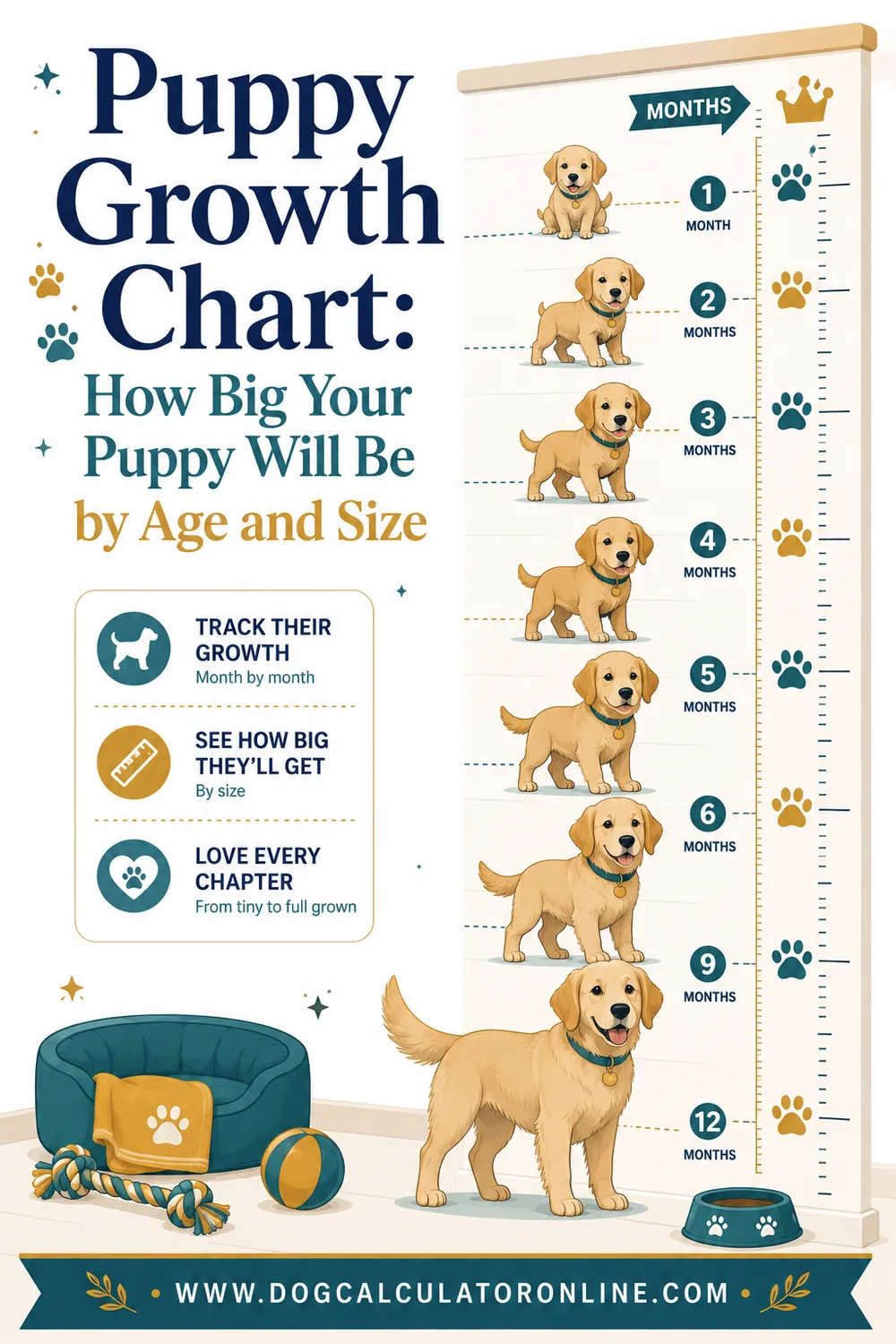
Puppies grow fastest in their first six months, then taper off. As a rule of thumb, a medium-breed puppy reaches about half its adult weight by 4 months and roughly 90% by 9–10 months. Small breeds finish growing around 8–12 months, large breeds around 12–18 months, and giant breeds can keep filling out until 18–24 months. So the puppy growth chart you need depends on your dog's size class.
Want a fast estimate of your puppy's adult size? Our free puppy weight predictor does the math from your puppy's current age and weight. Below, we'll walk through growth charts by size and how to read them.
🐕 Puppy growth check (medium breed)
Tap your puppy's age to see about how much of adult weight they've reached:
Tap an age above to see the growth milestone.
How Puppy Growth Works
All puppies follow the same basic curve: rapid growth early, then a slowdown as they approach adult size. What changes by size is how long the growth lasts and how steep it is.
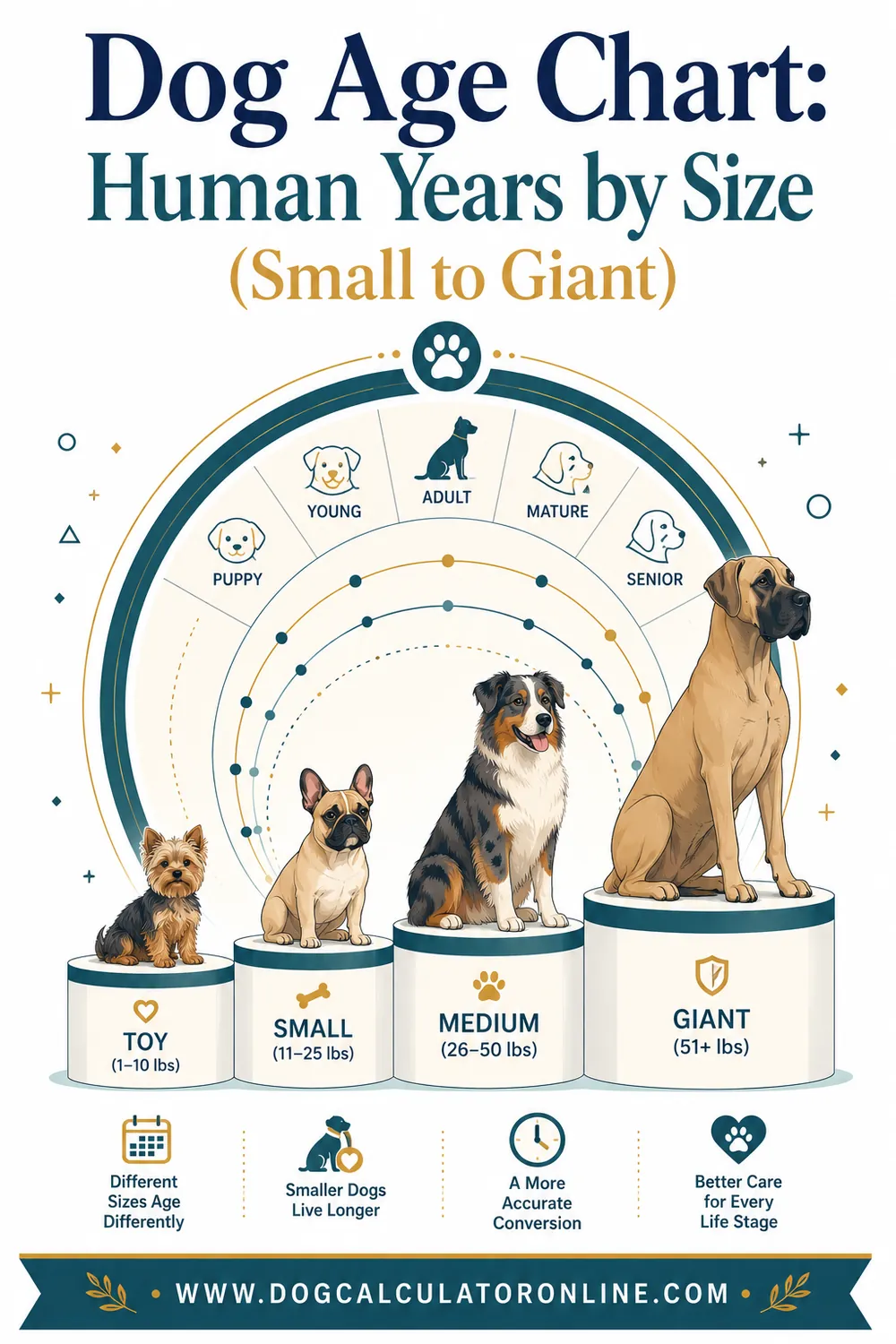
- Small breeds (adult under 20 lb) grow quickly and finish early — often fully grown by 8–12 months.
- Medium breeds (21–50 lb) finish around 12 months.
- Large breeds (51–90 lb) keep growing until 12–18 months.
- Giant breeds (over 90 lb) can take 18–24 months to reach full weight, and they fill out (chest, muscle) even after they stop getting taller.
A useful mental model: by 4 months, most puppies are about half their adult weight. That single checkpoint is one of the easiest ways to estimate final size, and it's built into our puppy weight predictor.
Percent of Adult Weight by Age (by Size Class)
Here's a growth chart showing roughly what percent of adult weight a puppy has reached at each age. Use it to see where your pup is on the curve.
| Age | Small | Medium | Large | Giant |
|---|---|---|---|---|
| 8 weeks | 22% | 15% | 12% | 10% |
| 3 months | 45% | 30% | 25% | 20% |
| 4 months | 60% | 50% | 40% | 35% |
| 6 months | 85% | 75% | 65% | 55% |
| 9 months | 95% | 90% | 80% | 70% |
| 12 months | 100% | 100% | 90% | 85% |
| 18 months | — | — | 100% | 95% |
| 24 months | — | — | — | 100% |
These are approximations — individual puppies vary — but they're accurate enough to plan around. Notice how a giant-breed puppy at 8 weeks is only about 10% of the way to full size, while a small-breed puppy is already at 22%.
Estimating Adult Weight From the Chart
You can flip the percentages around to predict adult weight:
Adult weight ≈ current weight ÷ (percent of adult weight, as a decimal)
Say your medium-breed puppy weighs 15 lb at 4 months. At 4 months a medium pup is about 50% grown, so:
15 ÷ 0.50 = 30 lb estimated adult weight.
Or your large-breed puppy weighs 26 lb at 3 months (25% grown):
26 ÷ 0.25 = 104 lb — a big dog in the making.
This is exactly the method our free puppy weight predictor uses, and it cross-checks it against a couple of other formulas for a tighter estimate. For a deeper dive into all the prediction methods, see how big will my puppy get.
Sample Growth Curves by Size
To make it concrete, here's roughly what the weight-by-age path looks like for a typical dog in each class:
Small breed (target ~12 lb):
- 8 wk: ~2.5 lb · 4 mo: ~7 lb · 6 mo: ~10 lb · 12 mo: ~12 lb
Medium breed (target ~40 lb):
- 8 wk: ~6 lb · 4 mo: ~20 lb · 6 mo: ~30 lb · 12 mo: ~40 lb
Large breed (target ~75 lb):
- 8 wk: ~9 lb · 4 mo: ~30 lb · 6 mo: ~49 lb · 12 mo: ~68 lb · 18 mo: ~75 lb
Giant breed (target ~120 lb):
- 8 wk: ~12 lb · 4 mo: ~42 lb · 6 mo: ~66 lb · 12 mo: ~102 lb · 24 mo: ~120 lb
Your puppy won't match these to the ounce, and that's fine. Growth comes in spurts and plateaus. What matters is the overall trend: steady climbing, then leveling off.
Puppy Weight by Week (lb and kg)
Many owners weigh in kilograms, and many vet records list weight by week rather than by month. This puppy weight gain chart turns the percentages above into week-by-week weights in both pounds and kilograms, using the same four sample dogs from the growth curves section.
| Age | Small (12 lb / 5.5 kg adult) | Medium (40 lb / 18 kg adult) | Large (75 lb / 34 kg adult) | Giant (120 lb / 54 kg adult) |
|---|---|---|---|---|
| 8 weeks | 2.5 lb / 1 kg | 6 lb / 2.5 kg | 9 lb / 4 kg | 12 lb / 5.5 kg |
| 12 weeks (3 mo) | 5.5 lb / 2.5 kg | 12 lb / 5.5 kg | 19 lb / 8.5 kg | 24 lb / 11 kg |
| 16 weeks (4 mo) | 7 lb / 3.5 kg | 20 lb / 9 kg | 30 lb / 14 kg | 42 lb / 19 kg |
| 26 weeks (6 mo) | 10 lb / 4.5 kg | 30 lb / 14 kg | 49 lb / 22 kg | 66 lb / 30 kg |
| 39 weeks (9 mo) | 11 lb / 5 kg | 36 lb / 16 kg | 60 lb / 27 kg | 84 lb / 38 kg |
| 52 weeks (12 mo) | 12 lb / 5.5 kg | 40 lb / 18 kg | 68 lb / 31 kg | 102 lb / 46 kg |
| 78 weeks (18 mo) | — | — | 75 lb / 34 kg | 114 lb / 52 kg |
| 104 weeks (24 mo) | — | — | — | 120 lb / 54 kg |
To use it, find the column closest to your puppy's expected adult size, then compare their weight at each weigh-in. If your dog's adult target is different, scale the numbers: a medium puppy headed for 50 lb instead of 40 lb will run about a quarter heavier at every age. To convert on your own, 1 kg equals about 2.2 lb.
Want to see where the big changes happen week to week? Our guide to puppy growth stages week by week covers the milestones that come with the weight gain.
Puppy Growth Chart by Breed (18 Popular Breeds)
Breed gives you the best starting guess for adult size. The table below lists a typical adult weight range for 18 popular breeds, places each one in a size class, and then estimates weight at key ages by applying this page's size-class percentages to the middle of that range.
| Breed | Typical adult weight | Size class | 8 wk (lb) | 12 wk (lb) | 16 wk (lb) | 6 mo (lb) | 12 mo (lb) |
|---|---|---|---|---|---|---|---|
| Chihuahua | 3–6 lb | Small | 1 | 2 | 2.5 | 4 | 4.5 |
| Pomeranian | 3–7 lb | Small | 1 | 2 | 3 | 4 | 5 |
| Yorkshire Terrier | 4–7 lb | Small | 1 | 2.5 | 3.5 | 4.5 | 5.5 |
| Shih Tzu | 9–16 lb | Small | 3 | 5.5 | 7.5 | 11 | 12 |
| Pug | 14–18 lb | Small | 3.5 | 7 | 9.5 | 14 | 16 |
| Cavalier King Charles Spaniel | 13–18 lb | Small | 3.5 | 7 | 9.5 | 13 | 16 |
| Beagle | 20–30 lb | Medium | 4 | 7.5 | 12 | 19 | 25 |
| French Bulldog | 16–28 lb | Medium | 3.5 | 6.5 | 11 | 16 | 22 |
| Border Collie | 30–55 lb | Medium | 6.5 | 13 | 21 | 32 | 42 |
| Siberian Husky | 35–60 lb | Medium | 7 | 14 | 24 | 36 | 48 |
| Australian Shepherd | 40–65 lb | Large | 6.5 | 13 | 21 | 34 | 47 |
| Boxer | 50–80 lb | Large | 8 | 16 | 26 | 42 | 58 |
| Golden Retriever | 55–75 lb | Large | 8 | 16 | 26 | 42 | 58 |
| Labrador Retriever | 55–80 lb | Large | 8 | 17 | 27 | 44 | 61 |
| German Shepherd | 50–90 lb | Large | 8.5 | 18 | 28 | 46 | 63 |
| Rottweiler | 80–135 lb | Giant | 11 | 22 | 38 | 59 | 91 |
| Bernese Mountain Dog | 70–115 lb | Giant | 9 | 18 | 32 | 51 | 79 |
| Great Dane | 110–175 lb | Giant | 14 | 28 | 50 | 78 | 121 |
A few things to keep in mind when reading this chart:
- These are estimates, not targets. They are worked out from the percentage chart above, so a healthy puppy can easily land a few pounds above or below.
- Males and females differ. In most breeds, males end up toward the top of the range and females toward the bottom, so the middle-of-range estimate will run a little high for many females and a little low for many males.
- Breeds near a size line can behave like either class. A Beagle or French Bulldog sits right at the small/medium border, and a German Shepherd or Bernese Mountain Dog can grow like a large or a giant breed depending on the dog.
- Your puppy's own numbers win. Once you have two or three weigh-ins, plug them into our puppy weight calculator for an estimate based on your dog rather than the breed average.
Male vs. Female Puppy Growth
Male and female puppies follow the same basic curve, so the percent-of-adult-weight chart works for both. The main difference is the finish line: in most breeds, adult males are larger and heavier than adult females. That means a male and a female from the same litter can weigh about the same at 8 weeks, then slowly drift apart over the following months.
When you use a breed table, aim for the upper part of the range for a male puppy and the lower part for a female. Then let your puppy's own weigh-ins confirm where they are really heading.
Puppy Growth Chart for Mixed Breeds
Mixed-breed puppies are harder to predict because you may not know the parents. A few ways to narrow it down:
- Use the parents if you know them. Adult size usually lands somewhere between the two parents. Pick the size class that best fits that middle ground.
- Ask about the breed mix. A shelter or rescue's best guess at the mix gives you a rough size class to start with.
- Lean on the 4-month checkpoint. Because most puppies are near half their adult weight around 4 months, a 4-month weigh-in is one of the most useful clues for a mixed breed.
- Re-check as they grow. Estimates for mixes tighten with each weigh-in. By 6 months you will usually have a much clearer picture.
Paw size is a popular trick, but it is not a reliable predictor on its own. See can paw size predict adult dog size for why, and how to predict your puppy's adult size for the methods that work better.
Feeding a Growing Puppy
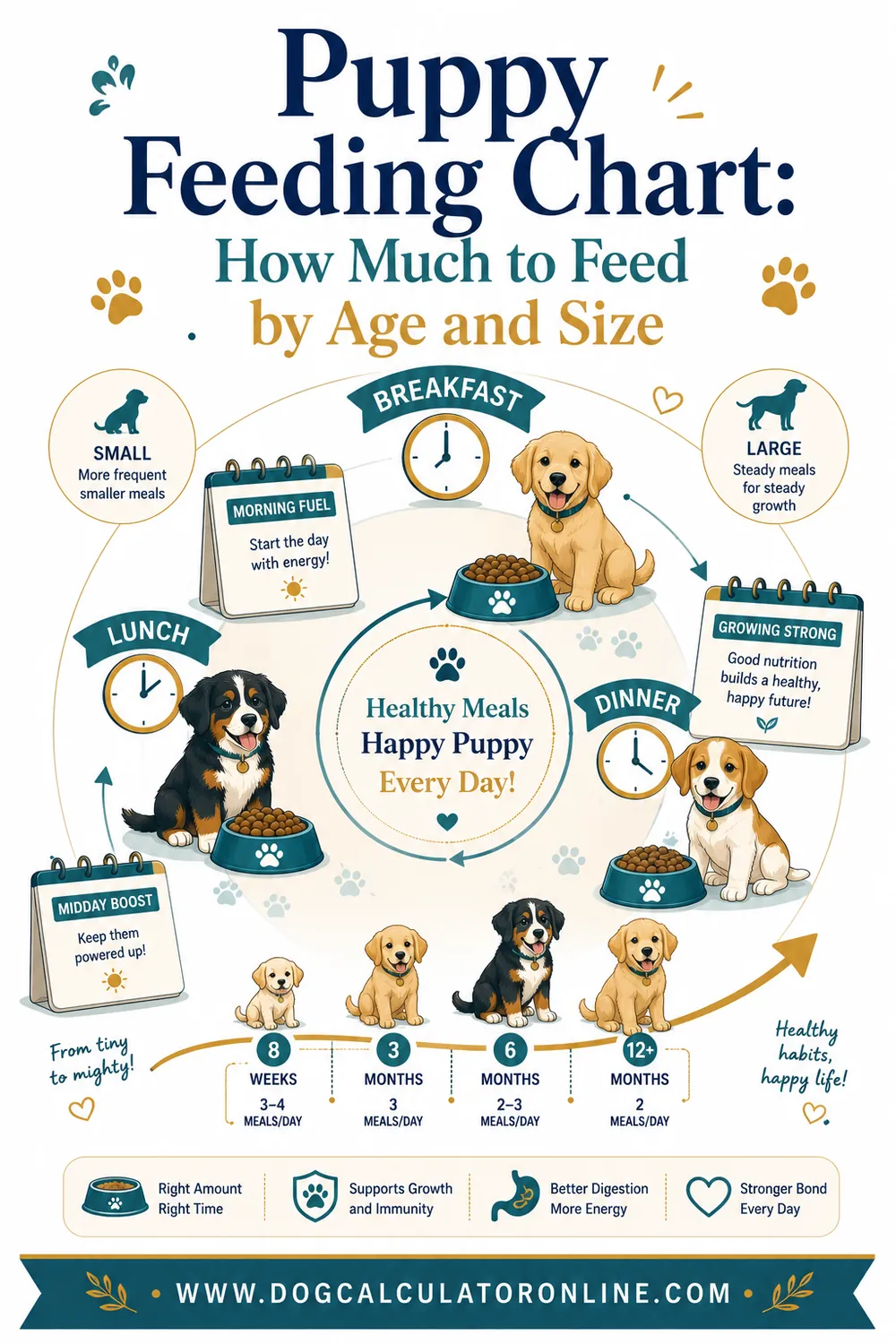
Growth is fuel-hungry. Puppies need roughly twice the calories per pound that adult dogs do, and large or giant breeds need carefully controlled growth to protect their joints — growing too fast is a real risk for big dogs. Feed a size-appropriate puppy food (large-breed puppy formulas exist for exactly this reason) and follow the bag's chart as a starting point.
For portion specifics, our puppy feeding chart breaks down amounts by expected adult weight and age. Always match the amount to your puppy's body condition and your vet's advice, not just the calendar.
How to Weigh and Track Your Puppy at Home
Regular weigh-ins turn the growth chart from theory into a tool. You don't need special equipment:
- Small puppies: step on a bathroom scale holding your puppy, then weigh yourself alone and subtract. A kitchen scale works for very young, tiny pups.
- Bigger puppies: many pet stores and vet lobbies have a floor scale you can use for free.
- How often: every 1–2 weeks during the fast-growth months is plenty. Daily weigh-ins just capture normal fluctuation.
Jot the numbers with dates, or plug them into our puppy weight predictor to watch the adult-size estimate tighten over time. A simple growth log also helps your vet spot if your puppy drifts off a healthy curve. Expect the line to climb steeply early, then bend toward flat as your pup nears adult size.
Signs Your Puppy Is Growing Well
You don't need a scale reading every day. Watch for:
- A visible waist when viewed from above and a slight tuck at the belly. You should feel ribs with light pressure but not see them.
- Steady energy and normal play, eating, and pooping.
- Loose skin on young puppies (they "grow into it").
- Even growth — no sudden crash or plateau that lasts weeks.
If your puppy seems way off the chart in either direction, or growth stalls, check with your vet. Puppy growth charts are guides, not diagnoses.
When Growth Stops
Height usually finishes before weight. Many dogs reach their adult height a month or two before they finish filling out with muscle and chest depth. Rough finish lines:
- Small: 8–12 months
- Medium: 12 months
- Large: 12–18 months
- Giant: 18–24 months
After that, weight should hold steady. If an adult dog keeps gaining, that's about calories, not growth — time to revisit portions.
Growth Spurts, Plateaus, and the "Gangly" Phase
Puppy growth isn't a smooth line. Expect:
- Spurts and pauses. Your puppy may gain fast for a couple of weeks, then plateau. Both are normal. Judge growth over months, not days.
- A gangly teenage stage. Around 5–9 months, many dogs (especially large breeds) look all legs and elbows — tall and lanky before they fill out with muscle and chest. They "grow up before they grow out."
- Height before weight. Dogs usually reach adult height a month or two before they finish adding muscle mass. A dog that looks lean at 12 months may still broaden by 18.
If growth truly stalls for several weeks, or your puppy seems to lose condition, check with your vet — but ordinary spurts and plateaus are nothing to worry about.
Neutering, Nutrition, and Growth
Two owner decisions can nudge the growth curve:
- Spay/neuter timing. For large and giant breeds, the timing of spay or neuter can slightly affect final height, because sex hormones help signal growth plates to close. Many vets now recommend waiting until big-breed dogs are closer to mature. Discuss timing with your vet for your specific dog.
- Diet quality. A complete, size-appropriate puppy food supports steady growth. For large and giant breeds, a large-breed puppy formula deliberately controls calories and calcium to slow growth and protect joints — faster is not better for big dogs.
You can't out-feed genetics to build a bigger dog; you can only build a leaner or heavier one. Feed for healthy, steady growth and let the frame develop on its own schedule.
FAQ
At what age is a puppy half its adult weight?
Around 4 months for small and medium breeds, and roughly 5–6 months for large and giant breeds. Doubling the 4-month weight is a quick adult-size estimate for smaller dogs.
How do I use a puppy growth chart to predict adult size?
Find your puppy's age, see what percent of adult weight that represents for their size class, then divide current weight by that percent. Our puppy weight predictor does it for you.
When do puppies stop growing?
Small breeds around 8–12 months, medium around 12 months, large 12–18 months, and giant breeds up to 18–24 months.
Why is my large-breed puppy growing so slowly compared to a small breed?
Big dogs spread their growth over a longer time to protect developing joints. A slower, longer curve is healthy for them — fast growth in large breeds can cause bone and joint problems.
Is my puppy overweight or just growing?
Look for a visible waist and a belly tuck, and feel for ribs under a thin layer. If you can't feel ribs or there's no waist, ask your vet. Growth should build a lean, athletic puppy.
How accurate are puppy growth predictions?
They're solid estimates, usually within a few pounds for purebreds and a bit looser for mixes. Predictions get more accurate as your puppy gets older.
How often should I weigh my puppy?
Every 1–2 weeks during the fast-growth months is plenty, then about once a month once growth slows. Weigh at the same time of day each time, and see our guide on how to weigh your dog at home for easy methods.
How much weight should a puppy gain each week?
It depends on adult size. Using the chart above, a medium puppy headed for about 40 lb gains roughly 1.5 to 2 lb a week between 8 weeks and 4 months, while a small puppy headed for 12 lb gains only about half a pound a week. Weekly gains slow down as your puppy nears adult size. If your puppy stops gaining, see why is my puppy not gaining weight and check with your vet.
Can I use a puppy growth chart for a mixed-breed dog?
Yes. Pick the size class that best fits the parents or the likely breed mix, then rely on your puppy's own weigh-ins, especially at 4 months. Estimates for mixes get more accurate with every weigh-in.
Do male and female puppies grow at the same rate?
They follow the same curve, but in most breeds males finish bigger. Use the upper part of a breed's weight range for males and the lower part for females.
What is a puppy growth chart in kg?
It is the same chart with weights shown in kilograms. The "Puppy Weight by Week" table on this page lists every age in both pounds and kilograms. To convert yourself, divide pounds by 2.2.
The Bottom Line
A puppy growth chart is really four charts — one per size class — because small dogs finish growing in months while giant breeds take up to two years. The handy checkpoint: most puppies are about half their adult weight by 4 months, and small-to-medium dogs are basically done by their first birthday.
Curious how big your specific pup will get? Skip the arithmetic and use our free puppy weight predictor — enter age and weight for an instant adult-size estimate. Then plan meals with the puppy feeding chart.