How Big Will My Puppy Get? 4 Ways to Predict Adult Size
The quickest estimate: for small and medium breeds, double your puppy's weight at 4 months to get a ballpark adult weight; for large and giant breeds, double the weight at around 5–6 months. So a medium-breed pup that weighs 20 lb at 4 months will likely land near 40 lb full-grown. Paw size, breed size class, and parent size all help sharpen the guess.
For a fast, personalized number, our free puppy weight predictor combines these methods from your puppy's age and current weight. Here are the four ways to predict adult size, and how reliable each one is.

🐾 Predict adult weight (double-up method)
Tap your puppy's current weight at ~4 months (small/medium breed):
Tap a weight above to see the estimated adult size.
Method 1: The "Double at 4 Months" Rule
This is the simplest and one of the most reliable shortcuts for small and medium dogs:
Adult weight ≈ weight at 4 months × 2
Puppies in these size classes reach roughly half their adult weight around 16 weeks, so doubling gets you close. For large and giant breeds, they hit the halfway point a bit later, so double the weight at 5–6 months instead.
Example: a medium-breed puppy weighing 18 lb at 4 months → about 36 lb as an adult. Easy, and usually within a few pounds.
Method 2: The Growth-Percentage Formula
A more flexible version uses the percent of adult weight a puppy has reached at any age:
Adult weight ≈ current weight ÷ (percent grown, as a decimal)
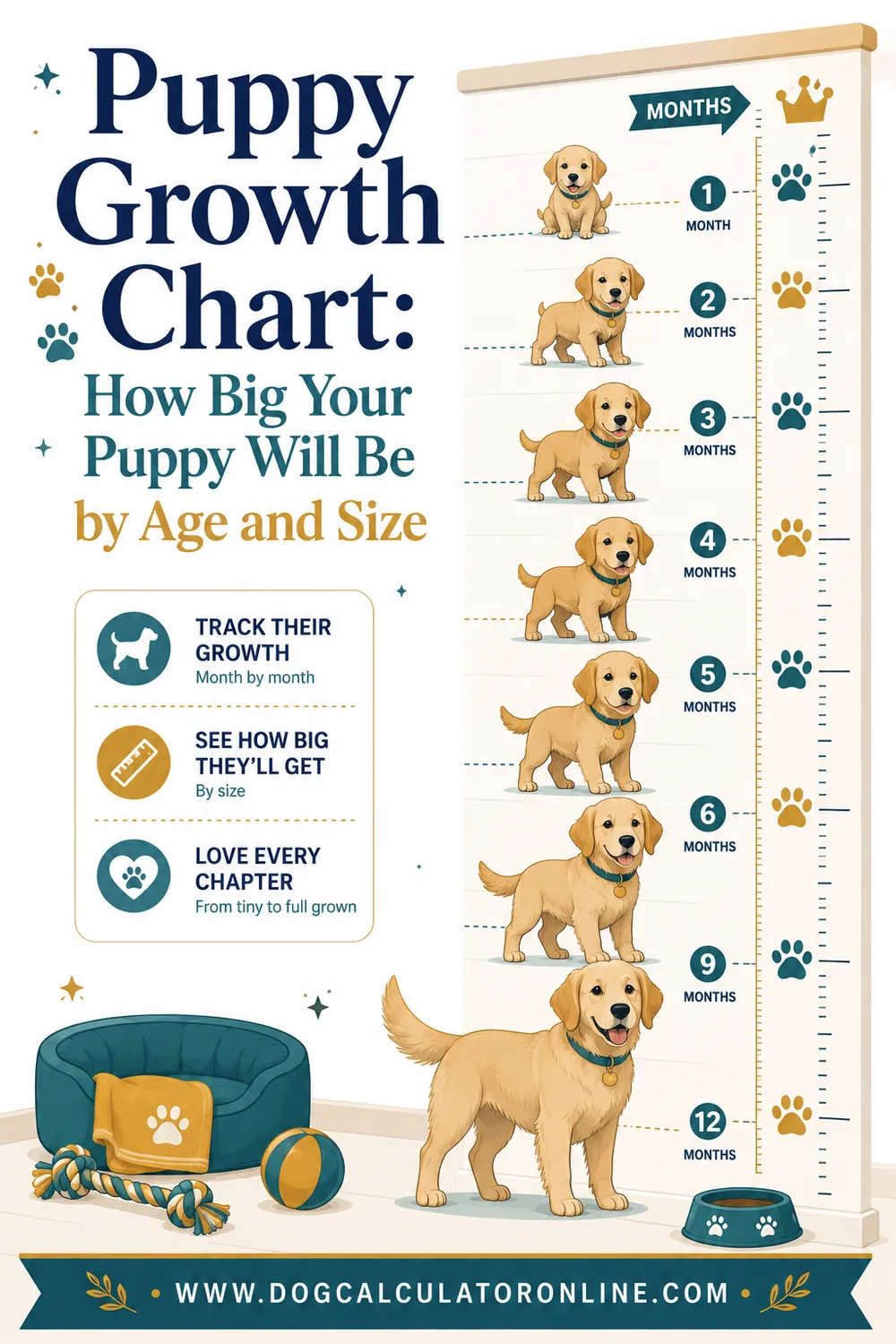
Using typical medium-breed milestones — 30% grown at 3 months, 50% at 4 months, 75% at 6 months — you can estimate at whatever age you have a weight for. A 6-month-old medium pup at 30 lb (75% grown) → 30 ÷ 0.75 = 40 lb.
This is the engine behind our puppy weight predictor, and it's the method that adapts best to different size classes. Our puppy growth chart has the full percentage table if you want to run it by hand.
Method 3: The Paw Test (Quick Gut Check)
Big paws on a young puppy often hint at more growing to do. If your puppy's paws look oversized and clumsy relative to its legs and body — the classic "puppy in big shoes" look — there's likely more size coming. If the paws look proportional, your pup may be closer to done.
The paw test isn't precise. It's a yes/no vibe check, not a number. Use it to sanity-check the math: if the formula says 40 lb but your pup still has enormous paws at 5 months, lean toward the higher end.
Method 4: Breed and Parent Size
Genetics is the strongest predictor of all. If you know the breed or the parents, you already have a great range:
- Purebred: look up the breed's standard adult weight range. Your puppy will very likely fall inside it.
- Known parents: puppies usually end up between the two parents' sizes, often near the same-sex parent. If mom is 45 lb and dad is 55 lb, expect roughly 45–55 lb.
- Mixed breed, unknown parents: use the weight formulas plus the paw test, and consider a breed-ID DNA test if you're very curious.
Here's a rough size-class map to orient yourself:
| Size class | Adult weight | Example breeds |
|---|---|---|
| Toy/small | Under 20 lb | Chihuahua, Yorkie, Pomeranian |
| Medium | 21–50 lb | Beagle, Border Collie, Cocker Spaniel |
| Large | 51–90 lb | Labrador, German Shepherd, Boxer |
| Giant | Over 90 lb | Great Dane, Mastiff, Saint Bernard |
Putting the Methods Together
No single method is perfect, so combine them. A reliable approach:
- Start with the breed or parent size for a range.
- Run the 4-month doubling or growth-percentage formula for a number.
- Use the paw test to nudge your estimate up or down.
- Re-check as your puppy grows — predictions tighten with age.
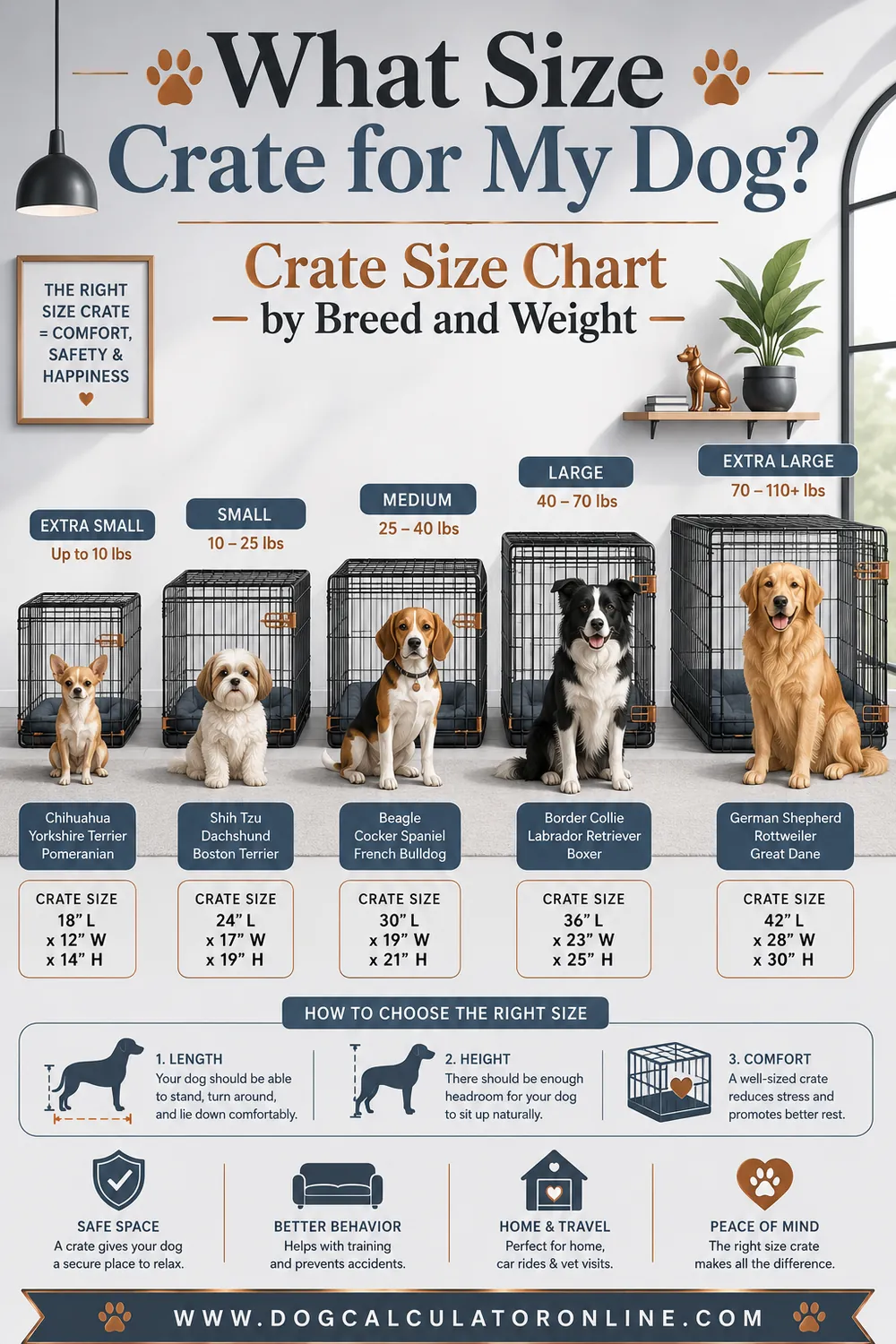
That's essentially what our free puppy weight predictor automates, and re-running it monthly gives you an increasingly accurate target. If you're sizing gear for that target, the what size crate for my dog guide helps you buy once instead of twice.
Why Adult Size Is Worth Predicting Early
Knowing your puppy's final size isn't just curiosity — it shapes practical decisions before your dog outgrows them:
- Crate and bed: buy for the adult size (with a divider for the crate) so you're not repurchasing. Our what size crate for my dog guide sizes it by adult weight.
- Collar, harness, and gear: a fast-growing large-breed pup can outgrow a collar in weeks. Plan ahead.
- Food and budget: a future 90-lb dog eats far more than a future 15-lb dog — a real difference in monthly cost.
- Home and yard: a giant breed needs more space and sturdier fencing than a toy breed.
- Training priorities: teaching a large, powerful dog to walk politely on leash matters more the bigger they'll get — and it's far easier to start while they're small.
Predicting size early lets you set up your home, budget, and training for the dog your puppy is becoming, not just the one in front of you today.
What Affects a Puppy's Final Size
- Genetics. By far the biggest factor. Breed and parents set the range.
- Sex. Males usually finish larger than females of the same litter.
- Nutrition. Proper puppy food supports healthy growth. Underfeeding can stunt; overfeeding (especially in large breeds) causes fast, joint-stressing growth — not a bigger, healthier adult.
- Spay/neuter timing. For large breeds, timing can slightly influence final height; discuss with your vet.
- Health. Parasites or illness during growth can slow things down.
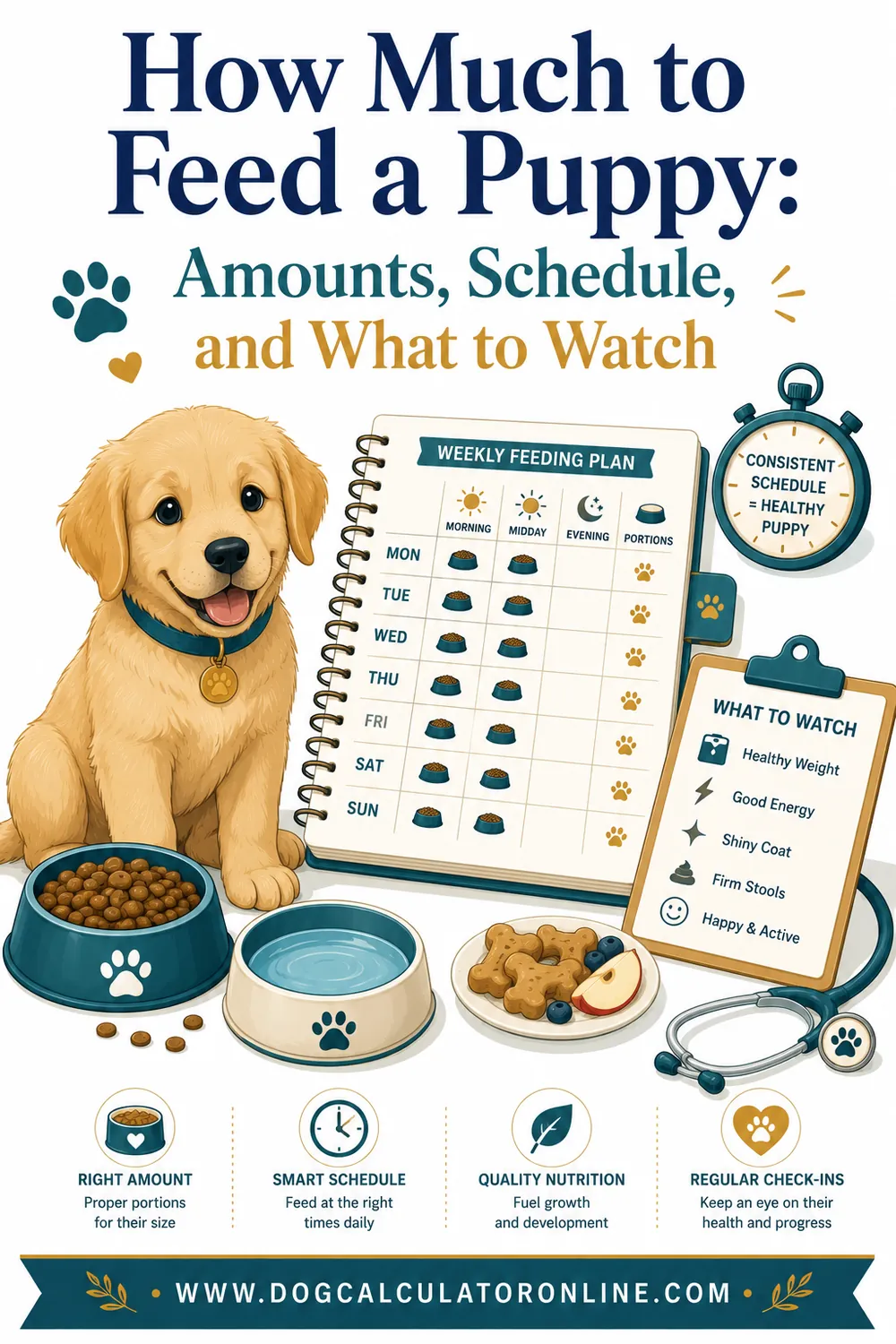
You can't make a dog grow bigger than its genes allow by overfeeding — you'll just make it heavier, not larger-framed. Feed for lean, steady growth; the how much to feed a puppy guide has the amounts.
When Will You Know for Sure?
Predictions get more accurate as your puppy ages:
- 8 weeks: rough range only (breed/parents matter most).
- 4 months: the doubling rule kicks in — decent estimate for small/medium dogs.
- 6 months: small and medium dogs are near-final; large breeds are clearer.
- 12 months: small and medium are basically done; large breeds are close; giants still filling out.
By your dog's first birthday you'll have most of your answer, especially for smaller breeds.
Worked Examples, Start to Finish
Putting the methods together on real puppies:
Example 1 — Mixed-breed pup, unknown parents. At 4 months she weighs 16 lb and still has big, clumsy paws. Doubling the 4-month weight gives about 32 lb. The oversized paws suggest the higher end, so estimate 32–36 lb — a medium dog. Re-check at 6 months to tighten it.
Example 2 — Suspected large-breed mix. At 3 months he weighs 24 lb. Using the growth-percentage method (about 25% grown at 3 months), 24 ÷ 0.25 = 96 lb — a large-to-giant dog. Feed a large-breed puppy formula and plan for big-dog gear.
Example 3 — Purebred with known parents. Mom is 18 lb, dad is 22 lb. Genetics does most of the work here: expect roughly 18–24 lb, likely near the same-sex parent. The formulas should agree; if they don't, trust the parent range.
Common Size Surprises
A few things catch owners off guard:
- Mixed breeds can favor one parent. A "medium" mix can surprise you by taking after a larger grandparent. Wider range, less certainty — that's normal.
- Fluffy coats fake size. A thick double coat can make a puppy look bigger than it weighs. Judge by the body under the fur, not the floof.
- Late fillers. Large and giant breeds can look lean and leggy at a year, then add real bulk by 18–24 months. They're not done when they look done.
- Runts often catch up. The smallest of the litter frequently closes much of the gap by adulthood.
When methods disagree, lean on genetics (breed and parents) first, then re-measure as your puppy grows. Our free puppy weight predictor makes re-checking a ten-second job.
What About Height?
Weight gets all the attention, but height finishes first. Most dogs reach the bulk of their adult height by around 6–9 months (later for giants), then spend the remaining months filling out with muscle and chest. That leads to a handy shortcut: once your pup's height growth stalls, the frame is roughly set, and what's left is mostly width.
Measure height at the withers — the top of the shoulder blades — with your dog standing square. A leggy 9-month-old who's stopped getting taller but still looks skinny isn't done; they're in the filling-out phase, which is completely normal.
FAQ
How can I tell how big my puppy will get?
Double the weight at 4 months (small/medium) or 5–6 months (large/giant), check the breed's standard range, and factor in parent size. The puppy weight predictor combines these for you.
Do a puppy's paws predict adult size?
Big, clumsy paws suggest more growing to come, but it's a rough hint, not a measurement. Use it to sanity-check a formula-based estimate.
Is the "double the 4-month weight" rule accurate?
For small and medium breeds, yes — usually within a few pounds. For large and giant breeds, double the 5–6 month weight instead, since they reach the halfway point later.
Will feeding my puppy more make it bigger?
No. Genetics set the frame. Extra food just adds fat, and in large breeds fast growth can harm joints. Feed for lean, steady growth.
Can a mixed-breed puppy's size be predicted?
Yes, using the weight formulas and paw test, though the range is wider than for purebreds. A DNA breed test can narrow it down.
At what age is a puppy full-grown?
Small breeds around 8–12 months, medium around 12 months, large 12–18 months, and giant breeds up to 24 months.
The Bottom Line
To predict how big your puppy will get, start with breed and parent size for a range, then double the 4-month weight (small/medium) or 5–6 month weight (large/giant) for a number, and use the paw test as a tiebreaker. Predictions sharpen every month.
Don't want to run the formulas yourself? Our free puppy weight predictor gives you an instant adult-size estimate from your puppy's age and weight — and you can re-check it as they grow. Pair it with the puppy growth chart to see the whole journey.