How Fast Do Puppies Grow?
Puppies grow fastest between 8 weeks and 6 months, when many gain 5–10% of their body weight every week — then the pace tapers hard, with small breeds essentially finished by 9–12 months while giant breeds keep filling out until 18–24 months. In other words, growth speed isn't one number: it's a curve that starts steep and flattens on a schedule set mostly by your puppy's adult size. This guide maps that curve week by week and size class by size class, so you know what "normal" looks like for your dog. For a personalized projection, the free puppy weight calculator turns today's weight and age into an adult-size estimate in seconds.

How Fast Do Puppies Grow in the First Weeks?
Faster than at any other point in their lives. Most puppies double their birth weight within the first one to two weeks — a pace that, scaled to a human baby, would be astonishing. Through the neonatal stage they gain steadily every single day, fueled entirely by nursing, and a healthy litter is weighed daily precisely because any pause in gain is a red flag at this age.
From weeks 3 to 8, growth stays brisk while the puppy transforms from a crawling potato into an actual dog: eyes and ears open, teeth arrive, walking turns to romping, and weaning shifts fuel from milk to food. By the time most puppies go home around 8 weeks, they're typically several times their birth weight, with the biggest gains still ahead. If you like tracking these transformations milestone by milestone, our week-by-week guide to puppy growth stages walks the whole timeline.
One caveat on the early numbers: birth weight is a poor predictor of adult size. Litter size, birth order, and early nursing access scramble the picture, which is why serious size predictions start from measurements taken at 8 weeks or later.
What Does the Puppy Growth Curve Look Like?
Every puppy, from teacup to mastiff, follows the same S-shaped curve — only the timescale changes:
- A brisk start (birth to ~8 weeks). Rapid but small in absolute terms: a puppy gaining 10% a week is still only adding ounces.
- The steep middle (roughly 8 weeks to 6 months). This is where the visible transformation happens. Weekly gains peak, paws and legs seem to grow overnight, and the puppy you photographed last month looks like a different animal.
- The long taper (6 months to done). Weight gain slows dramatically. Height mostly finishes first; the final months are more about filling out — chest, muscle, breadth — than getting taller.
The taper is where size classes split apart. A Yorkie exits the steep phase and finishes within a couple of months. A Great Dane exits the same steep phase and then keeps adding weight — sometimes tens of pounds — across another year of slow, steady filling out. Same curve shape, radically different x-axis.
Growth also happens in visible spurts rather than a perfectly smooth line. A week of big appetite and sudden gain followed by a quieter week is normal, which is why single weigh-ins matter less than the trend across a month.
When Do Puppies Grow the Fastest?
The peak window runs from about 8 weeks to 6 months, and within it, roughly 3 to 5 months is the steepest stretch for most dogs. During this phase it's common for a puppy to gain 5–10% of its body weight per week — for a growing Labrador, that can mean 2–4 pounds in a single week at the peak.
Three practical things follow from that:
- Food needs climb fast and change fast. A portion that was right at 10 weeks is wrong at 16 weeks. Puppies in the steep phase eat more per pound than adult dogs do, and the how much to feed a puppy guide covers adjusting portions as the curve climbs.
- Weigh-ins are worth doing every couple of weeks. The steep phase is when a feeding problem — too much or too little — shows up soonest, and when it's easiest to correct with your vet's guidance.
- Don't panic-buy gear for the current size. The crate, harness, and bed that fit at 4 months won't fit at 8. Buy for the projected adult size, or buy adjustable.
There's also a coordination cost to the sprint: legs grow before grace does. The gangly, tripping-over-paws stage sits right in the peak window and is completely normal.
How Fast Do Puppies Grow by Size Class?
Adult size sets the schedule. The bigger the dog, the longer the runway — and the milestones spread out accordingly. Honest ranges, size by size:
| Size class | Adult weight | Reaches ~50% of adult weight | ~75% | Growth essentially done |
|---|---|---|---|---|
| Toy (Chihuahua, Yorkie) | Under 12 lbs | ~3–4 months | ~5 months | 8–12 months |
| Small (Beagle, Frenchie) | 12–25 lbs | ~3.5–4.5 months | ~5.5–6 months | 9–12 months |
| Medium (Border Collie, Aussie) | 25–50 lbs | ~4–5 months | ~6–7 months | 12–15 months |
| Large (Lab, German Shepherd) | 50–90 lbs | ~5–6 months | ~7–9 months | 12–18 months |
| Giant (Great Dane, Mastiff) | 90+ lbs | ~6+ months | ~9–12 months | 18–24 months |
Read the table as ranges, not deadlines — individual dogs drift a month or two either way, and mixed breeds borrow from both parents' schedules. Sex nudges the numbers too: males in most breeds finish a bit heavier and sometimes a bit later than females, though the difference is a footnote compared to the size-class effect. But the pattern is reliable: a toy breed is halfway to adult size around the time a giant breed is barely warming up, and "done growing" spans a full year depending on which row your dog occupies.
Two useful things the table implies. First, if you know your puppy's age and current weight, you can roughly reverse-engineer adult size — that's exactly what the puppy weight calculator automates, weighting the math by size class. Second, the common wisdom "puppies are mostly done at a year" is only true for the left half of the table. Large and giant breed owners should expect visible change well into year two.
When Do Puppies Stop Growing?
Short version: when their growth plates close, which happens earlier in small dogs than big ones. Growth plates are the soft cartilage zones near the ends of a puppy's long bones where all height gain actually happens; once they harden into bone — around 9–12 months in small breeds, and as late as 18–24 months in giants — height is locked in for life. Weight can still change after that, but it's muscle and (hopefully not) fat, not frame.
Height typically finishes before weight does. Many large-breed dogs hit their full shoulder height a few months before they finish adding chest depth and muscle mass, which is why an 18-month-old Shepherd can look leggy and "unfinished" while being fully grown vertically. The full timeline — including how vets estimate plate closure and why it matters for exercise — is in our dedicated guide to when puppies stop growing.
The open-plate window carries one practical caution for big dogs: growth plates are softer than bone, so high-impact activities — repetitive jumping, long forced runs — are worth discussing with your vet before the plates close. Free play on a puppy's own terms is generally the safer default while the skeleton is under construction.
How Can You Tell If Your Puppy Is Growing at a Healthy Rate?
Track the trend, not the single number. Healthy growth looks like a smooth, steady climb along a consistent curve — the same way pediatricians think about percentile lines for children. A puppy tracking the 40th percentile all the way up is doing great; a puppy leaping across percentile lines in either direction is the one worth a conversation with your vet.
The practical toolkit:
- Weigh every 1–2 weeks during the steep phase. A bathroom scale works: weigh yourself, weigh yourself holding the puppy, subtract. Log it — memory smooths curves that data would show as jagged.
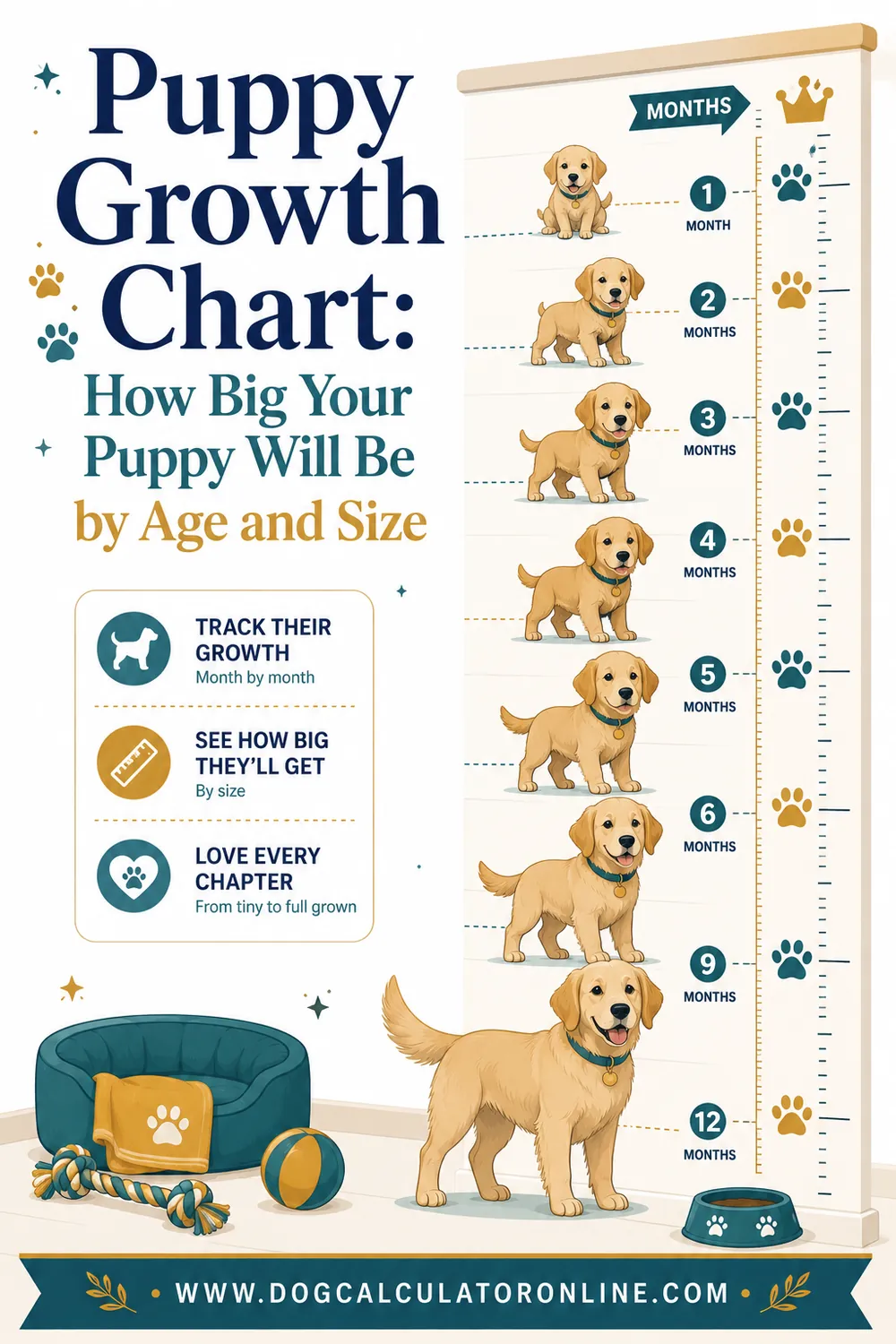
- Plot against a growth chart for your dog's size class. The shape matters more than the exact numbers; our puppy growth chart guide shows typical curves by size so you can see where your puppy's line sits.
- Use hands and eyes, not just the scale. At a healthy weight you can feel ribs easily under a thin layer of padding and see a visible waist from above. A puppy can sit at a "normal" weight for its age and still be too heavy for its individual frame.
- Let your vet interpret the outliers. A flat week during teething is usually nothing; a flat month is a vet visit. Persistent big jumps, a pot-bellied look, or a puppy who's ravenous yet not gaining are all ask-your-vet items, not internet-diagnosis items.
Does Neutering Affect How Fast Puppies Grow?
It can affect how long they grow, if not the weekly pace. Sex hormones are part of the signal that tells growth plates to close, so puppies spayed or neutered before maturity often keep their plates open a little longer and can end up slightly taller and longer-limbed than they otherwise would have. For most dogs the difference is cosmetic, but for large and giant breeds — where joint development is already the sensitive variable — many vets now individualize the timing rather than defaulting to six months. There's no universal right answer here; it's a genuine ask-your-vet decision that weighs breed, size, and your household's situation.
One counterintuitive point deserves emphasis: faster is not better, especially for large and giant breeds. Pushing a big puppy to grow quickly — extra calories, calcium supplements, adult food too soon — can stress developing joints and is associated with orthopedic problems in big dogs. Large-breed puppy formulas exist specifically to keep the curve controlled. The goal is a puppy who reaches its genetic adult size on schedule, not ahead of it. Steady is the win condition.
Can You Predict Adult Size From Growth Speed?
Roughly, yes — the milestones in the table above power some classic rules of thumb. Doubling a large-breed puppy's weight at 6 months gets you in the neighborhood of adult weight, since big dogs are near 50–60% grown at that point (the same trick at 4 months works for many medium breeds, and small breeds are often estimated by doubling closer to 3–4 months). Paw size and parent size add supporting evidence: big paws suggest frame still to come, and a purebred puppy will usually land near the same-sex parent's weight.
Every one of these is an estimate with honest error bars — a pound or two either way for small dogs, five to ten for large ones. Mixed breeds are the least predictable, since they can follow either parent's curve. For the full toolkit — formulas, milestone math, and what actually improves accuracy — see how to predict your puppy's adult size and the deeper dive in how big will my puppy get. Or skip the arithmetic: the puppy weight calculator runs the size-class math from a single age-and-weight pair.
The reverse inference works too, and it's the more useful one day to day. If your 5-month-old "medium mix" already weighs 45 pounds, the growth schedule itself is telling you the adult estimate needs revising upward — growth speed is data about destination, not just progress.
Frequently Asked Questions
How much weight should a puppy gain per week?
During the peak phase (roughly 8 weeks to 6 months), many puppies gain 5–10% of their body weight per week — a few ounces for a toy breed, a few pounds for a large one. The healthy sign is steady gain along a consistent curve rather than any specific number; your vet can tell you the right pace for your puppy's breed and frame.
At what age do puppies grow the fastest?
The steepest stretch for most puppies is roughly 3 to 5 months, inside the broader 8-weeks-to-6-months growth window. Appetite, sleep, and shoe-destroying energy all peak alongside the growth itself, and weekly changes are visible to the naked eye.
Do puppies grow overnight or in spurts?
In spurts. Growth hormone does much of its work during deep sleep — one reason puppies sleep 18–20 hours a day — and gains tend to arrive in bursts: a big-appetite week with obvious change, then a quieter week. That's why trends across a month matter more than any single weigh-in.
How long does it take for a puppy to be fully grown?
Depends almost entirely on adult size: toy and small breeds finish around 8–12 months, medium breeds around 12–15, large breeds 12–18, and giant breeds up to 18–24 months. Height finishes first; the final months are mostly filling out chest and muscle.
Is my puppy growing too fast?
If your puppy is jumping percentile lines upward, looks chubby rather than lean, or is a large breed gaining unusually quickly, bring it up at your next vet visit — controlled growth is healthier for developing joints than rapid growth. Never restrict food on your own to slow growth; portion and formula changes for a growing puppy should be vet-guided.
My puppy stopped gaining weight this week — is something wrong?
A single flat week is common, especially during teething at 4–6 months or right as the curve naturally tapers. Flat stretches lasting several weeks during the steep phase, weight loss at any point, or a flat week paired with low energy or appetite are the versions worth a call to your vet.
The Bottom Line
Puppy growth is a sprint, then a marathon: double birth weight inside two weeks, the steep climb from 8 weeks to 6 months, and a taper that ends before the first birthday for small dogs but runs to two years for giants. Weigh regularly, watch the shape of the curve rather than any single number, keep the pace steady instead of fast, and let your vet arbitrate anything odd. To see where your puppy's line is heading, plug today's age and weight into the free puppy weight calculator — it turns this whole article into one number you can plan around.