How to Predict Your Puppy's Adult Size
The most reliable way to predict a puppy's adult size is to stack methods: start with growth-curve math based on current weight and age, sanity-check it against the parents' sizes (the single best genetic clue you can get for free), and — for purebreds — anchor everything to the breed standard. Mixed-breed owners can add a DNA test for a real accuracy boost, while paw size, the method everyone's grandmother swears by, turns out to be the weakest clue of the bunch. This guide walks through all five methods, what each one is good for, and how to combine them. If you want the math done for you, the free puppy weight calculator handles the growth-curve piece in seconds.

Which Prediction Method Should You Trust Most?
No single method is best for every puppy — the right choice depends on what you know about yours. Here's the honest scorecard:
| Method | Works best for | Cost | Reliability |
|---|---|---|---|
| Growth-curve calculator | Any puppy with known age + weight | Free | Good from ~12 weeks; improves with age |
| Parents' sizes | Pups whose parents you've seen or can ask about | Free | Good — genetics is the main driver of size |
| Breed standard | Purebreds | Free | Very good; narrow published ranges |
| DNA test | Mixed breeds and unknown-history rescues | Moderate (typically $80–$200) | Good for size class; not exact pounds |
| Paw size | Casual guessing | Free | Weak — folklore with limited predictive power |
The pattern worth noticing: the methods stack rather than compete. A purebred Golden Retriever owner barely needs prediction at all — the standard plus the parents tells the story. A shelter puppy of unknown parentage flips the toolkit: growth-curve math becomes the primary method, DNA the optional upgrade, and everything else a rough cross-check. The sections below take each method in turn.
How Does Growth-Curve Math Predict Adult Size?
This is the method behind every puppy weight calculator, and it rests on a reliable observation: puppies of a given size class hit similar percentages of their adult weight at similar ages. A medium-breed pup at four months is typically around half of their final weight; a toy breed at the same age is further along, a giant breed much less far. Know the percentage, and today's weight scales up to an adult estimate with simple division.
You'll also meet the folk-formula versions of this idea:
- The doubling rule — adult weight is about double the four-month weight. True-ish for medium breeds, overshoots for small ones, undershoots for large and giant ones.
- The linear formula — current weight divided by age in weeks, times 52. Assumes constant weekly gain, which real puppies don't do; growth is steep early and flattens late, as our how fast do puppies grow guide shows in detail.
A proper calculator improves on both by matching the multiplier to the age and the size class. The method's strengths: it's free, it needs no pedigree paperwork, and it gets sharper every month as your puppy reveals more of their curve. Its weakness: for mixed breeds you must guess the size class, which is really a small prediction hiding inside the big one. Get that guess wrong and the math confidently scales the wrong curve. The practical workflow — how to weigh, how to pick a class, how to read the output as a range — is covered step by step in how to use a puppy weight calculator.
How Much Can You Learn From the Parents?
More than from any other free source. Adult size in dogs is strongly heritable, so a puppy's most likely destination is somewhere in the neighborhood of their parents' weights. If mom is 30 pounds and dad is 40, a plan built around a 30–40 pound adult will rarely embarrass you.
A few practical refinements:
- Average the parents as a starting point, then widen the range in both directions. Litters vary; a pup can land above the bigger parent or below the smaller one, just not usually by much.
- Sex matters. In most breeds, males finish noticeably heavier than females. A male pup tends toward the upper half of the parental range, a female toward the lower half.
- Seeing beats being told. Breeders can confirm exact weights; with rescues, "mom was about knee height, maybe 45 pounds" is still genuinely useful — treat it as a midpoint with generous error bars.
- Unknown father, known mother is the classic shelter situation. You still have half the genetic picture: it's uncommon for a pup to finish at more than about double or less than about half of what you'd expect from the dam's size class, so mom alone meaningfully narrows the field.
The honest limitation: genes shuffle. Two medium parents can carry size variation that expresses differently across a litter, and a pup's growth pattern along the way is also shaped by nutrition and health. Parents give you the probable neighborhood, not the street address — which is exactly why pairing this method with monthly growth-curve checks works so well.
Can You Just Use the Breed Standard?
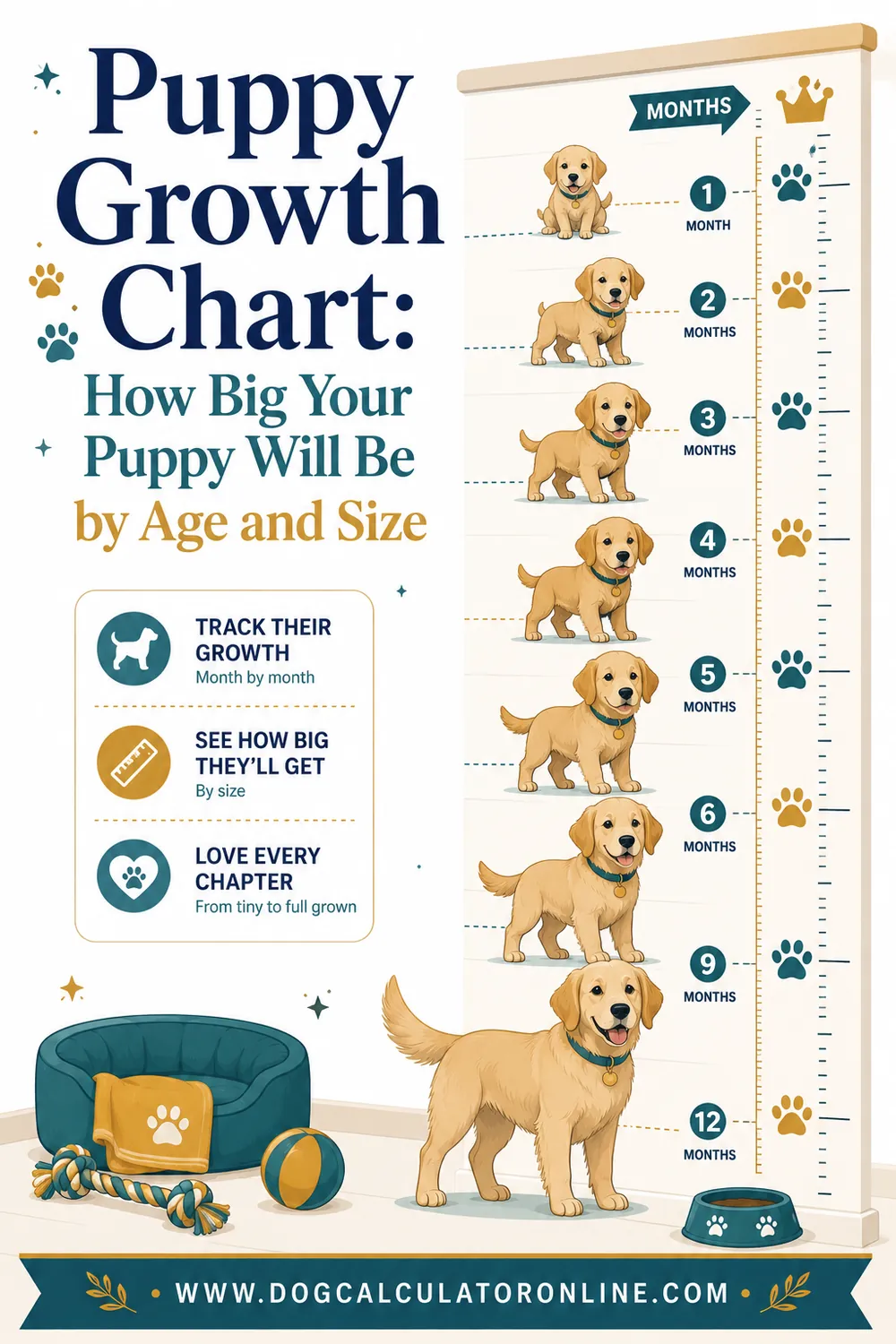
For purebred puppies — mostly, yes. Breed standards published by registries like the AKC specify adult weight and height ranges, and well-bred dogs land inside them with boring regularity. A purebred Beagle is not going to surprise you at 60 pounds. If your puppy is purebred, the prediction task shrinks to a smaller question: where inside the breed's range will this individual fall? The parents answer most of that, and a growth-curve check against a standard puppy growth chart answers the rest.
Three caveats keep this method honest. First, some breeds have wide ranges or distinct size varieties — Poodles and Dachshunds come in official sizes, and a "small standard" versus "large standard" difference is worth pinning down with the breeder. Second, pet-line dogs sometimes run outside show-standard ranges, especially in popular breeds where breeding is less controlled. Third, the standard describes healthy adult weight — your individual dog's ideal number should still come from their body condition, not the book. When your vet says your 70-pound Lab is at a great weight, that beats the standard's midpoint.
For mixed breeds, standards still help indirectly: once you know (or test for) the breeds involved, their standards define the plausible bounds the mix can land between.
Do Big Paws Really Predict a Big Dog?
This is the folklore everyone has heard, so it deserves a straight answer: paw size is a real but weak clue, and it shouldn't carry your prediction on its own.
The grain of truth is that dogs grow into rough proportion — a dog built to be 90 pounds does need bigger feet than one built to be 9, and those feet often do show up early. Noticeably oversized paws on a young puppy are a legitimate hint that more growing is coming, particularly in large and giant breeds where the "puppy on snowshoes" look is common.
The problem is everything else. Paw size varies by breed type independent of final weight — some breeds are simply big-footed or dainty-footed for their size. Growth isn't uniform either: puppies grow in stages, and feet can look huge one month and proportional the next without the final size changing at all. And unlike weight-on-a-curve, "big paws" has no scale — there's no lookup from paw width to adult pounds, which is why no serious estimation tool uses it as an input.
Treat paws the way you'd treat any single spot-check: a fun corroborating detail. If the growth-curve math says "large," the parents say "large," and the pup is tripping over their own feet, believe "large" a little harder. We cover the other early clues — bone thickness, growth pace, loose skin — in how to tell if your puppy will be big.
Are DNA Tests Worth It for Mixed-Breed Puppies?
If your puppy's ancestry is a genuine mystery and the size question actually matters to you — apartment size limits, breed-weight policies, gear you'd rather buy once — a DNA test is the most informative upgrade available. A cheek swab, a few weeks of waiting, and you get a breed-composition report; most of the major canine tests now include a predicted adult size or weight range built from the size genes they detect.
Why this works better than eyeballing: research on dog genetics has found that size in dogs is governed by a relatively small number of genes with large effects — which is why testing companies can turn raw DNA into a size estimate at all, and why those estimates are usually better than guessing from a puppy's looks. Shelter breed guesses based on appearance are notoriously hit-and-miss; genetics doesn't care what the puppy's coat pattern suggests.
The honest limits:
- Expect a range, not a number. A result like "likely 35–50 pounds as an adult" is realistic output; a promise of "43 pounds" would be overselling what the genes can say.
- Accuracy varies with ancestry complexity. A half-Lab, half-Poodle pup gets a tighter prediction than a many-generation village-dog mix.
- Cost-benefit is personal. At a typical $80–$200, the test makes sense when the answer changes a real decision. If you'd love your dog identically at 25 or 55 pounds and your lease doesn't care, free methods plus patience get you to the same truth a few months later.
A nice hybrid approach for rescue pups: run the puppy weight calculator monthly from day one, and use a DNA result — if you get one — to lock in the right size class for the math.
How Do You Combine Methods Into One Prediction?
Here's the practical playbook, in order:
- Set the frame. Purebred? Start from the breed standard. Mixed? Start from the mother's size, or the DNA result if you have one.
- Run the math. Enter current weight, age, and your best size class into the calculator. Do it monthly — the trend matters more than any single reading, and a steadily climbing estimate is your cue that the size class was too small.
- Cross-check with the parents. If the math and the parents disagree wildly, re-examine your inputs before doubting the pup.
- Use soft clues as tiebreakers only. Paws, bone, and loose skin can nudge you between two adjacent size classes; they shouldn't overrule the weighted methods.
- Let time settle it. Every week of growth shrinks the uncertainty — the week-by-week growth stages show exactly what to expect along the way. By six months, your puppy has revealed most of their curve; by the time growth plates close, prediction retires entirely — see what age is a dog fully grown for those finish lines by size.
One caution that applies to every method: prediction should never become a target to steer toward. Overfeeding won't make a genetically medium dog large — it makes a medium dog overweight — and restricting food won't keep a large-breed pup conveniently small; it just risks their development. If you ever feel tempted to adjust feeding based on a predicted size, that's a conversation for your vet, not a calculator.
What Can Skew Any Size Prediction?
Every method above assumes a healthy puppy growing on a normal curve with accurate paperwork. Real life supplies exceptions, and knowing them keeps your confidence calibrated.
Estimated ages. Rescue birth dates are often educated guesses from teeth and size — and if the size guess fed the age guess, an error can loop back on itself. A pup thought to be 12 weeks who is really 9 will look like a future giant on every weight chart. When the age is soft, hold every weight-based prediction softly too, and let your vet's tooth-check anchor the timeline.
Early health history. A rough start — heavy parasite load, serious illness, or plain undernutrition before rescue — can leave a puppy temporarily small for their genetics. Many of these pups show catch-up growth once they're healthy and well fed, blowing past early projections. If your rescue pup arrived skinny, expect the first month or two of estimates to run low, and lean harder on parents or DNA than on the scale.
The runt question. Being smallest at birth is a poor predictor of adult rank. Litter position often reshuffles by adolescence, and plenty of runts finish mid-pack or better. Don't discount a pup's projection because of their newborn reputation.
Coat illusions. Fluffy breeds read bigger than they weigh; sleek breeds read smaller. Eyeball-based guesses — including shelter size labels — are fooled by coat constantly, which is another reason the scale beats the eye.
Overweight inputs. A chubby puppy inflates every weight-based method at once, projecting a bigger frame than actually exists under the padding. If your pup is carrying extra, ask your vet about it — for the pup's joints first, and your prediction second.
None of these break the toolkit; they just widen the error bars in identifiable ways. The fix is always the same: more data points over more weeks, cross-checked against methods that don't depend on the scale.
Frequently Asked Questions
What is the most accurate way to predict a puppy's adult size?
Stacking methods beats any single one: growth-curve math for the trajectory, parents' sizes for the genetic anchor, and the breed standard (purebreds) or a DNA test (mixes) for the frame. When those independent methods agree, confidence is high. When they disagree, the inputs — usually the size-class guess — deserve another look.
At what age can you predict a puppy's adult size?
Rough predictions are possible from about 8 weeks, and they firm up considerably between 12 and 16 weeks once the pup is established on their growth curve. By six months, most of the story is told for small and medium dogs. Large and giant breeds keep meaningful uncertainty a bit longer since they grow past a year.
Will my puppy be as big as the biggest parent?
Usually somewhere between the two parents, adjusted for sex — males trend toward the top of the range, females toward the bottom. Landing a little outside the parental range happens, but big leaps beyond it are uncommon. If only the mother is known, treat her size class as the center of a wider range.
Do big paws mean my puppy will be a big dog?
Sometimes, weakly. Distinctly oversized paws hint that growth is still coming, especially in large breeds, but paw size varies by breed type and growth stage too much to be a dependable predictor. Use it as a tiebreaker alongside weight-based math, never as the main method.
Can a DNA test tell me exactly how big my puppy will get?
No test gives an exact number, but good ones give a useful range. Because canine size is controlled by a fairly small set of influential genes, breed-composition tests can translate DNA into a likely adult size class — typically more reliably than judging a shelter pup by appearance. Expect "probably 35–50 pounds," not "43."
Does neutering or spaying change adult size?
It can influence growth subtly — altering before growth plates close is associated with slightly longer limb growth in some dogs — but it doesn't turn a small dog big or vice versa. Timing questions are genuinely individual, especially for large breeds, so ask your vet what schedule fits your puppy rather than planning around a size effect.
Every method here gets sharper as your puppy grows, so start the habit now: weigh your pup, note the age, and let the free puppy weight calculator turn today's numbers into tomorrow's estimate — then re-run it monthly and watch the prediction close in on the dog your puppy was always going to become.