How to Tell if Your Puppy Will Be Big
The most reliable clues that your puppy will grow up big are, in order: the size of the parents, your puppy's current weight compared to growth curves for their age, and their breed or breed mix — while the famous "big paws" test is mostly folklore with a small grain of truth. No single signal is certain, but stacked together they'll usually land you in the right size class months before your pup gets there. Enter your puppy's age and weight into the free puppy weight calculator for a curve-based estimate, then use this guide to sanity-check it against the other signals.

What's the Most Reliable Sign a Puppy Will Be Big?
The parents. Adult size is strongly inherited, so if you can see or ask about the mother and father, you're holding better information than any formula can compute. A puppy from a 70-pound dad and a 60-pound mom is overwhelmingly likely to become a big dog; a puppy from two 15-pound parents is not going to surprise you with 60 pounds, ever.
A few practical notes on reading parents well:
- Ask the breeder or rescue for actual weights, not impressions. "He's a big boy" might mean 65 pounds or 95. Numbers travel better than adjectives.
- Sex matters. In most breeds, males finish heavier than females — commonly by 10–20 pounds in larger breeds. As a rough rule, expect a male puppy toward the father's end and a female toward the mother's, though plenty of individuals cross over.
- Litter variation is real. Even in a purebred litter, adult sizes spread out. The biggest puppy at eight weeks isn't guaranteed to finish biggest, either — early size partly reflects position at the milk bar, not just genes.
- One unknown parent is common in rescue. If you only know mom, treat her size as a floor-ish anchor and let the other signals below estimate the rest. Mystery fathers are how a "medium mix, probably" becomes 80 pounds — it happens, and every shelter worker has a story.
If you adopted from a shelter and know nothing about either parent, skip to the weight-for-age and DNA sections. That's your toolkit.
How Does Current Weight Predict Adult Size?
After parents, your puppy's weight right now, at their exact age is the strongest clue — because puppies of different adult sizes are on visibly different growth curves almost from the start. A future-90-pound dog and a future-12-pound dog do not weigh the same at 16 weeks; they aren't even close. This is exactly the logic behind every puppy weight calculator: find which average curve your puppy's data point sits on, then follow that curve forward to adulthood.
Here's a rough map of how 16-week weights line up with adult size classes. Treat it as a compass, not GPS — individual pups wobble around these bands:
| Weight at ~16 weeks | Likely adult size class | Rough adult range |
|---|---|---|
| Under ~4 lb | Toy | Under ~12 lb |
| ~4–8 lb | Small | ~12–25 lb |
| ~8–18 lb | Medium | ~25–50 lb |
| ~18–35 lb | Large | ~50–90 lb |
| Over ~35 lb | Giant | 90+ lb |
You may also run into folk formulas — "double the weight at 16 weeks for a medium breed," "adult weight is four times the 8-week weight," and similar. They exist because they're directionally reasonable: they're crude summaries of the same growth-curve logic. But they're rules of thumb, not measurements, and they get less trustworthy the further your pup is from an average purebred. We break down what the formulas can and can't do in how accurate puppy weight calculators are.
Two tips make weight-for-age much more useful:
- Weigh accurately. Bathroom-scale-minus-your-own-weight is fine for small pups; a vet lobby scale is better for bigger ones. A pound of error on a 6-pound puppy is a huge input error.
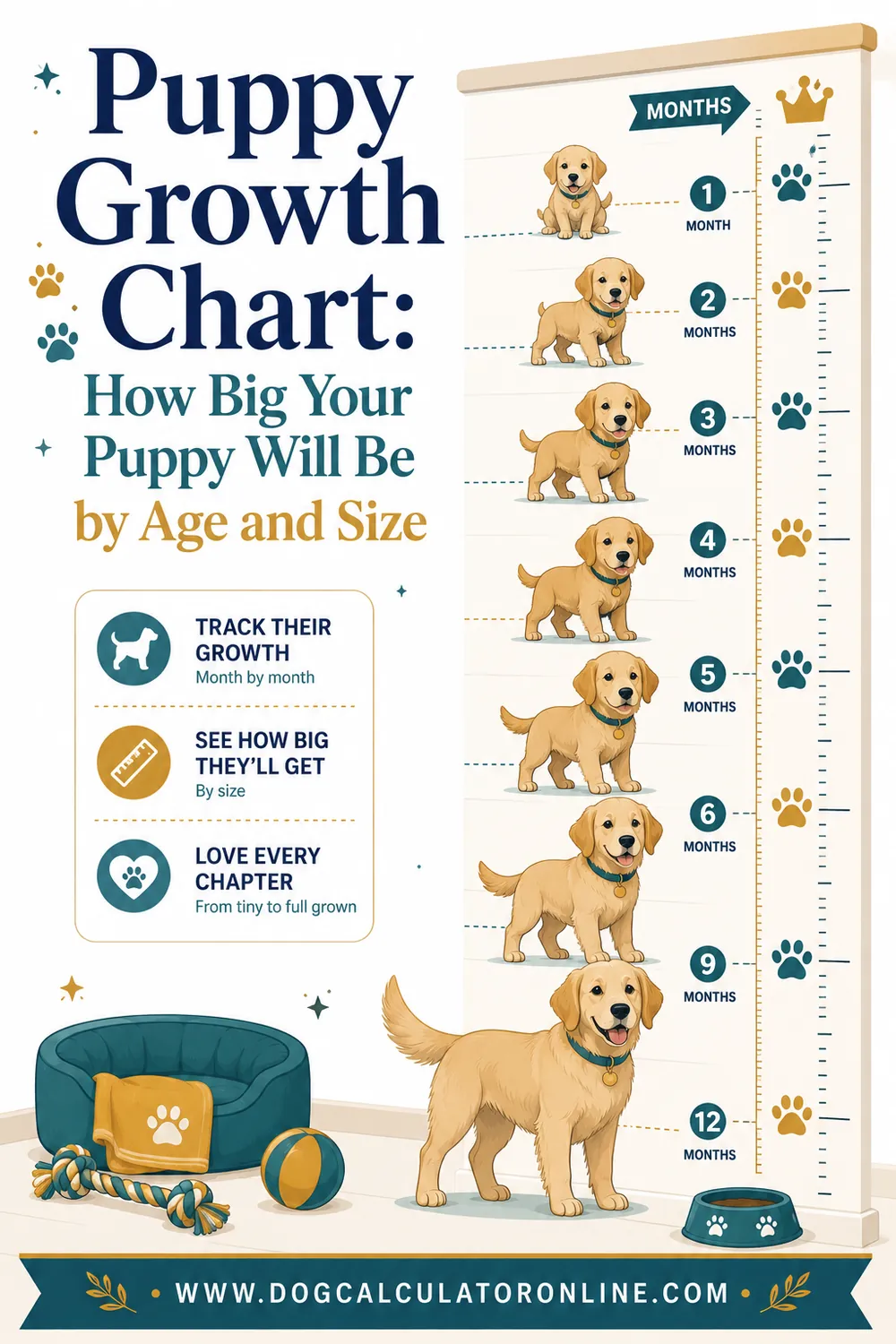
- Weigh more than once. Two or three weigh-ins a few weeks apart show you the slope, and slope is more telling than any single point. A pup gaining fast is announcing a bigger adult size than a same-weight pup whose curve is flattening. A puppy growth chart makes the comparison easy to eyeball.
Do Big Paws Really Mean a Big Dog?
Here's the honest version of the most famous puppy-size test: big paws are a weak hint, not a measurement. The folklore says a puppy with oversized paws has "a lot of growing to do," and there's a kernel of sense in it — puppies do grow somewhat unevenly, and feet, ears, and leg bones can look ahead of the body during growth spurts. A pup who seems to be all paws probably isn't finished.
But nobody has produced a reliable way to read adult weight off paw size, and there's no solid published evidence that paw size predicts adult size better than the boring signals (parents, weight-for-age, breed). Some breeds simply have big feet for their body — many working and mountain breeds, for instance — and some big dogs grow up from puppies with unremarkable paws. If paw-reading worked, breeders and shelters would use it. They use scales and parents instead.
So: enjoy the enormous paws, take the photo, and file "paw test" alongside "loose skin means he'll grow into it" — fun observations that occasionally point the right way, never evidence to plan a crate purchase around.
What Does Breed — or Breed Mix — Tell You?
Breed sets the boundaries the other signals operate inside. Adult size is one of the most breed-determined traits a dog has, which is why the question "will my puppy be big?" is trivially answered for a purebred Great Dane and genuinely hard for a shelter special of unknown ancestry.
For purebred puppies, look up the breed's typical adult range (our guide to healthy weight ranges by size collects the size-class bands), adjust for sex, and glance at the parents. Done — your uncertainty is maybe ten pounds wide.
For mixes, the useful move is thinking in possibilities:
- A known mix narrows things fast. A Lab-Border Collie mix will very likely land between the two parents' typical sizes — call it 35–70 pounds — and won't land at 8 or 130.
- An unknown mix is where the guessing gets wide. Shelter breed labels are guesses from appearance, and appearance is a famously unreliable guide to ancestry — mixed dogs often look like none of their actual component breeds.
- Extreme sizes need extreme genes. Giant adult size essentially requires giant-breed ancestry. If your mystery pup's weight-for-age is tracking a medium curve, hidden Mastiff genes are not going to ambush you at month ten.
The deeper dive on combining breed information with curves and milestones is in how to predict your puppy's adult size.
Can a DNA Test Tell You How Big Your Puppy Will Get?
Yes, with useful-but-not-perfect accuracy — and for total mystery mixes, it's the single biggest uncertainty-reducer you can buy. Consumer dog DNA tests do two relevant things. First, they estimate breed ancestry, which lets you look up the component breeds' sizes instead of guessing from floppy ears. Second, several tests now report a predicted adult size range based on known size-influencing genes — researchers have identified a relatively small set of genes (IGF1 is the most famous) that account for a large share of size variation between dogs, which is what makes genetic size prediction workable at all.
The honest limits: ancestry percentages for very mixed dogs come with real uncertainty, size predictions are ranges rather than exact numbers, and tests cost real money — typically somewhere in the $80–$200 neighborhood depending on the panel. For a purebred pup with known parents, a DNA size prediction tells you little you didn't already know. For an eight-week-old shelter puppy of totally unknown origin, it can collapse "15 to 90 pounds, who knows" down to a genuinely plannable range — often before the growth curve has had time to reveal much.
If you're choosing between running a DNA test and just waiting a month for more weigh-ins, consider timing: the earlier you need the answer (apartment rules, crate and gear sizing, adopter matching), the more the test is worth.
When Will You Know for Sure?
Certainty arrives on a schedule set by size itself — bigger dogs take longer to finish, so ironically, the bigger the answer, the longer the question stays open. Rough milestones:
- By 4–6 months, the size class is usually clear. A future-big dog is conspicuously outpacing small-dog weights by now, and the 16-week table above sorts most puppies correctly.
- Small breeds are typically at or near adult size by 8–12 months.
- Medium breeds generally finish around 12 months.
- Large breeds usually reach adult height by around a year, then fill out to adult weight through 12–18 months.
- Giant breeds can keep growing until 18–24 months.
So a good working answer — "he'll be a big dog, probably 60–80 pounds" — is usually available months before the final number is. The full timeline, with what finishes when (height before weight, frame before muscle), is in when puppies stop growing, and if you want the size question answered from every angle at once, see how big will my puppy get.
One caution while you wait: resist the urge to feed a puppy up to meet a big prediction. Growth rate and adult size are set by genetics; extra calories don't make a bigger dog, just a rounder puppy — and carrying extra weight during growth is hard on developing joints, especially in the large and giant breeds this article is about. Keep your pup lean on a curve, and let the genes decide the destination. If you're ever unsure whether your puppy's weight or growth pace looks right, that's a question for your vet, who can put hands on the actual dog.
What Do Height, Build, and Littermates Add?
A few secondary signals are worth reading — not because any of them beats the scale, but because they're free and they occasionally catch what the scale misses.
Height at the shoulder. Weight can be muddied by body condition — a chubby small pup and a lean big pup can briefly weigh the same — but height isn't. A puppy who's already tall for their age is announcing skeleton, and skeleton is what "big" is made of. If your pup's shoulder height keeps pace with the big pups at puppy class while their weight reads medium, trust the height and expect the weight to catch up as they fill out. Measuring is easy: stand the puppy square, measure from the floor to the top of the shoulder blades, and jot it down next to each weigh-in.
Build and proportion. Future-big puppies often carry visibly heavier bone — thicker leg bones, broader chests, blockier heads — than future-small pups of the same current weight. Like paw size, this is a hint rather than a measurement, but experienced foster homes and breeders do read it, and it's most useful for splitting the difference when the curve says "could be medium, could be large."
Littermates, if you can see them. A whole litter tracking heavy for their age is stronger evidence than one heavy puppy, since it points at genetics rather than at one pup out-hustling the others at mealtime. And if you're picking a puppy from a litter, remember that today's ranking isn't destiny — the chunkiest 8-week-old is often just the best eater, and littermates commonly reshuffle as they grow.
The adolescent lanky phase. From roughly 4 to 8 months, many pups look like they're assembled from spare parts — all legs, no chest. Don't read the awkwardness as a size signal in either direction. Height arrives before width in most breeds; the frame goes up first, and the body fills it in over the following months.
None of these secondary signals should override parents or weight-for-age. But when the main signals leave you between two answers, height and bone are the tiebreakers most worth consulting.
How Do You Combine the Signals Into One Answer?
Stack them from strongest to weakest, and let agreement build your confidence:
- Start with parents (if known). That's your anchor range — say, "both parents 60–70 pounds, so probably a big dog."
- Check weight-for-age. Run the puppy weight calculator with a fresh, accurate weight. If the curve estimate agrees with the parent anchor, you're basically done. If they disagree, trust the parents a bit more for purebreds and the repeated weigh-ins more for mixes.
- Bound it with breed. Make sure the estimate is plausible for the breeds involved. An estimate outside every plausible component breed's range means an input error — usually a bad weigh-in or a wrong birth date.
- Add DNA if the mystery is expensive. When gear, housing rules, or adopter expectations hinge on the answer, a DNA size prediction is the strongest tool for unknown mixes.
- Re-measure and revise. Every few weeks, weigh again. Each new point either confirms the curve or bends the estimate toward the truth — by mid-growth, the estimates get quite stable.
Notice what's not on the list: paws, loose skin, ear size, and confident strangers at the dog park. Enjoy their predictions; don't buy crates based on them.
Frequently Asked Questions
How can I tell if my puppy will be big?
Check the parents' sizes first — that's the strongest predictor. Then compare your puppy's current weight to growth curves for their age, since future-big puppies are already noticeably heavier than future-small ones by 3–4 months. Breed mix bounds the possibilities, and a DNA test can narrow things for unknown mixes. Big paws alone prove very little.
Do big paws mean my puppy will be a big dog?
Not reliably. Oversized paws can hint that a puppy has growing left to do, but there's no solid evidence that paw size predicts adult weight better than parents, current weight-for-age, or breed. Some breeds just have big feet, and some big dogs had average puppy paws. Treat it as folklore with a grain of truth.
At what age can you tell how big a puppy will get?
The size class — small, medium, large — is usually apparent by 4–6 months from weight-for-age alone. Precise adult weight firms up later: small breeds finish around 8–12 months, large breeds by 12–18 months, and giant breeds may grow until nearly two years. Estimates made mid-growth, around 4–6 months, tend to be reasonably close.
Will my puppy be as big as his dad?
Male puppies often finish nearer the father's size and females nearer the mother's, but it's a tendency, not a rule — individuals in the same litter spread across and sometimes outside the parents' range. Use dad's weight as one anchor, then confirm with your puppy's own growth curve as weigh-ins accumulate.
Can a DNA test predict my puppy's adult size?
Yes, within a range. Tests estimate breed ancestry and read known size-influencing genes (IGF1 is the best-known), producing a predicted adult size range that's especially valuable for mystery mixes. Expect a range rather than an exact number, and typical costs of roughly $80–$200 depending on the test.
Does feeding a puppy more make it grow bigger?
No — adult size is set by genetics, and extra calories produce a fatter puppy, not a taller dog. Overfeeding during growth mainly adds joint strain, which is riskiest for the large breeds people most want to "grow big." Keep your puppy lean and let your vet confirm the growth pace looks healthy.
Parents, curve, breed — read those three and you'll rarely be surprised at the final size. For the curve part, do the two-minute version: weigh your pup, open the free puppy weight calculator, and get an adult-weight estimate you can re-check as they grow.