Puppy Growth Stages Week by Week
Puppies grow through five recognized stages: neonatal (weeks 0–2), transitional (weeks 2–4), socialization (weeks 3–12), juvenile (roughly 3–6 months), and adolescence (6 months to as late as 24 months for giant breeds). Along the way they typically double their birth weight in the first week or so, open their eyes around two weeks, come home around eight weeks, hit about half their adult weight near four months (medium breeds), and finish growing anywhere from 10 to 24 months depending on size. This guide walks the whole timeline week by week — and once your pup is home, the free puppy weight calculator can tell you where today's weight is heading.
What Are the Five Puppy Growth Stages?
Every puppy, Chihuahua or Great Dane, moves through the same developmental sequence — size only changes how long the later stages last. Here's the whole map before we zoom in:
| Stage | Age | Key developments | Weight picture |
|---|---|---|---|
| Neonatal | Weeks 0–2 | Eyes and ears sealed; nursing and sleeping; can't regulate body temperature | Doubles birth weight in ~the first week; steady daily gains |
| Transitional | Weeks 2–4 | Eyes open (~2 weeks), ears open, first steps, first teeth, first barks | Rapid proportional gain continues |
| Socialization | Weeks 3–12 | Critical learning window; weaning (~3–6 weeks); vaccines begin; go-home day (~8 weeks) | Growth is fast and visible week to week |
| Juvenile | ~3–6 months | Teething (baby teeth out, adult in); coordination improves; adult coat starts | Medium breeds hit ~50% of adult weight near 4 months |
| Adolescence | ~6–24 months | Sexual maturity; growth plates close; filling out of chest and muscle | Small dogs finish ~10–12 months; giants up to 18–24 |
Two themes run through the whole timeline. First, development front-loads: the most dramatic changes — senses, mobility, learning capacity — happen before most owners ever meet their puppy. Second, weight tells a story at every stage, which is why breeders weigh newborns daily and why a monthly weigh-in remains the single best growth check once your pup is home.
Weeks 0–2: What Happens in the Neonatal Stage?
A newborn puppy is a work in progress. Eyes and ear canals are sealed, teeth haven't erupted, and the pup can neither walk nor regulate body temperature — warmth comes from mom and the puppy pile. Life is nursing, sleeping, and growing, roughly in that order, with sleep claiming the vast majority of each day.
The growth itself is astonishing. Healthy newborns gain weight every single day, and doubling birth weight within about the first week to ten days is the classic benchmark breeders watch for. Birth weight varies enormously by breed — a toy-breed newborn may weigh just a few ounces while a giant-breed pup can start well over a pound — but the pattern of steady daily gain is universal, which is why a newborn who stalls or loses weight for more than a day is a call-the-vet situation, not a wait-and-see one.
Week two brings the first hints of what's coming: stronger front-leg paddling, more purposeful crawling toward mom, and — right around the 10-to-14-day mark — the first slivers of open eye. Vision starts blurry; the eyes are open long before they're useful.
Weeks 2–4: What Changes in the Transitional Stage?
These two weeks are the fastest transformation of a dog's entire life. In rapid succession: eyes fully open, ear canals open and hearing switches on, the first wobbly standing turns into actual walking, the first baby teeth erupt around week three, and the first play-growls and squeaky barks appear. A pup who was functionally a warm potato at day 14 is, by day 28, a small unsteady dog investigating the whelping box.
Other systems come online too. Puppies begin regulating their own body temperature, start eliminating without mom's stimulation, and begin interacting with littermates as individuals — the very first drafts of play. Toward week four, many breeders introduce the first taste of softened solid food, the opening move of weaning.
For weight, expect the steep climb to continue. There's no universal poundage to quote here because breeds diverge so much, but proportionally, a four-week-old pup is typically several times their birth weight and visibly thickening from a slim newborn into the round classic puppy shape.
Weeks 3–12: Why Is the Socialization Stage So Important?
This is the stage behavior professionals care about most. Roughly from week three to somewhere between weeks 12 and 14, a puppy's brain is uniquely open to new experiences — people of different kinds, other dogs, surfaces, sounds, handling, car rides. Experiences banked now are accepted as normal for life; gaps can surface later as fear or reactivity, which is why veterinary behavior organizations emphasize early, positive socialization so heavily. It's a genuine once-only window: it doesn't reopen at six months when the vaccine series is done, which is why the standard advice is to socialize safely during the series (controlled settings, known-vaccinated dogs) rather than waiting for it to finish. Your vet can help you draw that line for your area.
The logistics of this stage are busy:
- Weeks 3–6: weaning. Softened food gradually replaces nursing; most litters are fully weaned around six to eight weeks.
- Weeks 6–8: first vaccines and vet checks. The puppy vaccine series typically starts in this window and continues in rounds every few weeks — your vet sets the exact schedule.
- Week 8 (give or take): go-home day. Most puppies join their new families at eight weeks or a little later; many small breeds stay with the litter a bit longer, and responsible sources won't release a pup much before eight weeks because littermate time in weeks six through eight teaches bite inhibition and dog-to-dog manners.
- Weeks 8–12: settling in. House-training begins, sleep schedules collide with reality, and the first at-home weigh-ins start your pup's growth record.
Weight-wise, a rule-of-thumb worth knowing: at eight weeks, most pups sit somewhere around a fifth to a quarter of their adult weight, with small breeds proportionally further along and giants less far. That's exactly the kind of position-on-the-curve fact a puppy weight calculator uses to project forward — eight weeks is the earliest age where running it starts to pay off, and our step-by-step calculator guide shows how to get a clean first estimate.
Months 3–6: What Happens in the Juvenile Stage?
If the earlier stages were about switching systems on, the juvenile stage is about raw construction. This is peak visible growth — the stretch where owners swear the puppy got longer overnight, and where weekly photos genuinely show differences. Legs lengthen ahead of the body catching up, giving many pups a gangly, borrowed-legs look that's completely normal.
Three things define these months:
The growth spurt. Week-over-week gains hit their peak somewhere in this window. As a landmark, medium breeds typically reach about half their adult weight around four months — the fact behind the folk "doubling rule" — while small breeds are past halfway by then and giants still well short of it. If you're tracking the numbers, how fast do puppies grow breaks down typical gain rates by size class.
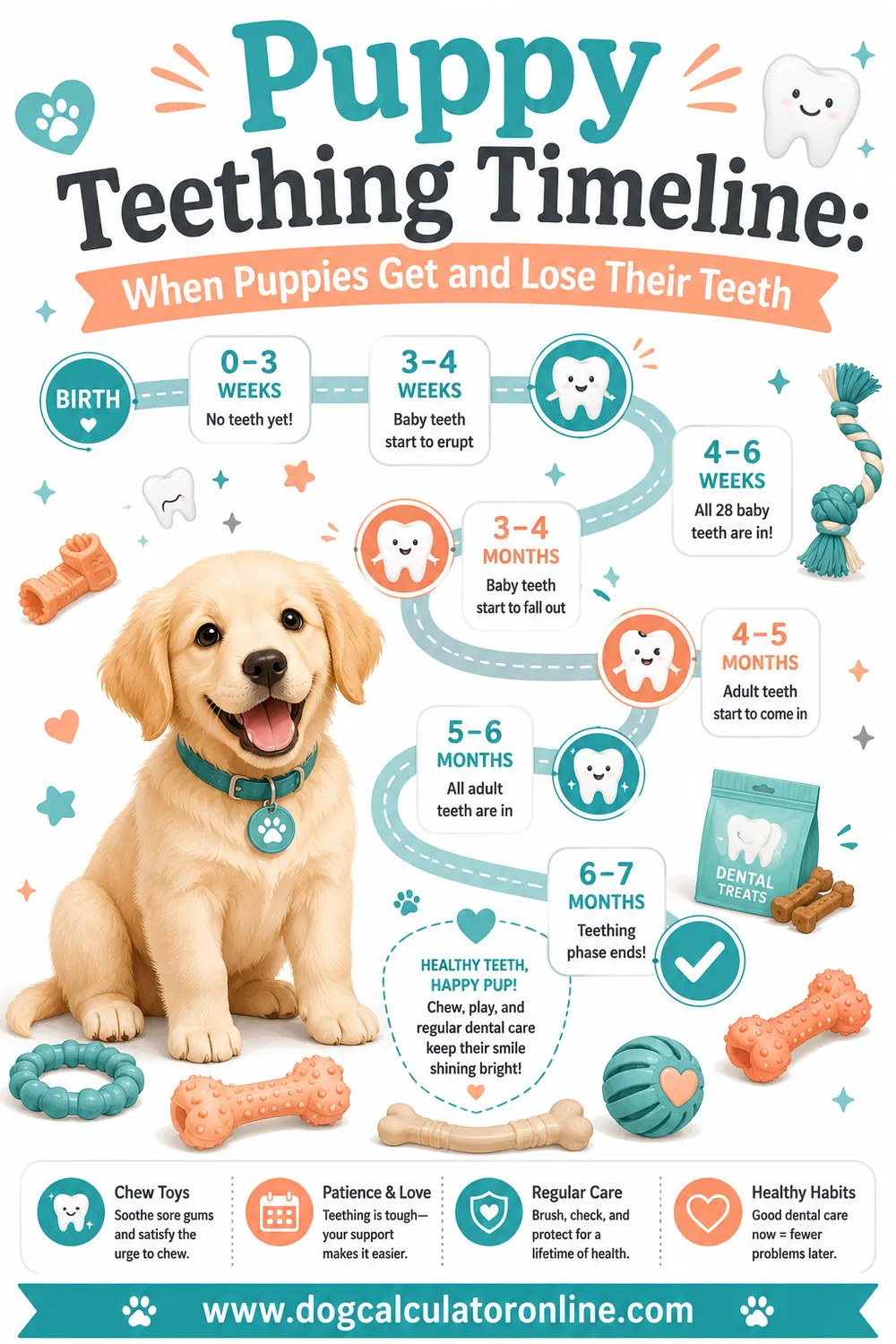
Teething. Baby teeth start falling out around month three or four, and by roughly six months the full set of 42 adult teeth has typically replaced them. The chewing pressure during the swap is real and relentless — sacrificial chew toys are cheaper than chair legs. The full schedule, with survival tactics, is in our puppy teething timeline.
Appetite to match. Rapid construction needs fuel, and feeding a fast-growing pup is its own skill — portions climb, then need re-checking monthly because last month's amount goes stale fast. Large and giant breeds in particular should grow steadily, not maximally; ask your vet about appropriate large-breed puppy food, since controlled growth is gentler on developing joints. For the practical portions math, see how much to feed a puppy.
By six months, small breeds are approaching their adult silhouette, and even large-breed pups have clearly declared their trajectory. This is also when adult-size estimates become quite reliable — a good moment to re-run the calculator and update your plans.
Months 6–24: What Does Adolescence Look Like?
Adolescence is the long deceleration. Growth continues, but the curve bends: monthly gains shrink, height mostly finishes before weight does, and the last phase is less about getting bigger than about filling out — chest broadening, muscle developing, the gangly juvenile frame getting furnished.
The milestones of this stage:
- Sexual maturity arrives early in adolescence, typically somewhere between six and twelve months, well before physical or behavioral maturity. This is also when spay/neuter timing becomes a live question — one worth deciding with your vet, since the best timing varies by breed size.
- Growth plates close — the true end of skeletal growth. Small breeds close early; giant breeds latest of all. Until then, veterinary guidance generally favors going easy on high-impact exercise like forced running or repetitive jumping, especially for large pups.
- The teenage brain does teenage things. Selective hearing, boundary testing, and a second fear phase in some dogs are all normal adolescent behavior, not failed training. Consistency wins; the calm adult dog is under construction behind the chaos.
When does it end? By size, roughly: toy and small breeds are physically done around 10–12 months, medium breeds around 12, large breeds 12–18, and giant breeds anywhere up to 18–24 months — with "filling out" continuing after height stops. The full breakdown, including how to tell when your own dog has finished, is in when do puppies stop growing.
How Do You Know if Your Puppy Is Growing Normally?
The reassuring truth: normal is a wide band. Littermates diverge, growth comes in visible spurts with flat stretches between, and a pup can be perfectly healthy while tracking the bottom edge of a chart. What matters is the pattern, not any single reading.
Green flags worth trusting:
- Steady direction. Weight moves upward over any two-to-four-week window, even if individual weeks look flat.
- Good body condition. You can feel ribs under a light fat cover, and there's a visible waist from above. A growing puppy should look lean-ish, not round — chubby puppies aren't "healthy big," and extra weight during growth is worth raising with your vet.
- Energy, appetite, and normal digestion. The boring vitals outrank the scale.
Worth a vet conversation: weight loss at any age, a genuine plateau lasting weeks during what should be the fast-growth months, a pot-bellied look with thin shoulders (a classic parasite pattern in young pups), or a pup dramatically off the pace of an otherwise-known litter. None of these are diagnoses — they're exactly the kind of observations your vet would want brought in early.
A simple tracking habit covers all of this: weigh monthly (weekly during months three to five if you enjoy data), jot the number somewhere durable, and re-run the projection as your pup grows. If the projected adult weight climbs steadily instead of holding steady, you've learned your pup is a bigger dog than first assumed — useful intelligence for food, crate, and budget planning, and one of the methods covered in how to predict your puppy's adult size.
How Do the Stages Differ by Breed Size?
The early stages barely differ at all: a Papillon and a Newfoundland open their eyes, cut teeth, and hit the socialization window on essentially the same calendar. Size divergence is a late-timeline phenomenon — the bigger the dog, the longer the juvenile and adolescent stages stretch.
A same-age snapshot makes the divergence vivid:
| Age | Toy/Small breed | Medium breed | Large/Giant breed |
|---|---|---|---|
| 4 months | Past halfway to adult weight | About halfway | Well under halfway |
| 6 months | Near-adult silhouette forming | Roughly two-thirds grown | Still visibly a puppy |
| 12 months | Fully grown | Finished or nearly | Months of growth left |
| 18 months | Long done | Done | Giants may still be filling out |
The practical consequences are worth planning around:
- Small breeds compress everything. Growth ends early, so decisions tied to maturity — adult food transitions, adult exercise loads — arrive sooner than most first-time owners expect. Ask your vet when to switch off puppy formula; for small dogs it can be before the first birthday.
- Giant breeds stretch everything. An 80-pound, ten-month-old Great Dane is still skeletally a puppy, with open growth plates and months of building ahead. The big-dog rules — controlled growth over maximum growth, restraint with high-impact exercise, large-breed puppy formulas — apply longest to exactly the dogs where joints matter most.
- Time-based expectations mislead; stage-based ones don't. "A one-year-old dog is an adult" is true for a Yorkie and false for a Mastiff. Whenever you read guidance keyed to age, mentally convert it to your dog's position on their curve rather than the calendar.
The upside of all this stretching: you get more time to fine-tune your adult-size estimate for a big dog, and each month of data makes the projection sharper — while small-dog owners get their final answer sooner. Either way, the curve does the telling; the calendar just watches.
Frequently Asked Questions
When do puppies open their eyes?
Around 10 to 14 days old, with vision sharpening over the following weeks — eyes open well before they see clearly. Ear canals open on a similar schedule, so sight and sound both switch on during the transitional stage between weeks two and four.
How much weight should a puppy gain per week?
There's no single number — a Yorkie and a Mastiff pup gain on completely different scales. The universal rules: newborns should gain daily and double birth weight in about a week, and from there weight should trend clearly upward across any few-week window. Judge your pup against their own curve and body condition, not a generic poundage, and bring stalls or losses to your vet.
At what age is a puppy half its adult weight?
Around four months for medium breeds — the basis of the folk doubling rule. Small breeds pass the halfway point earlier, often before three and a half months, while large and giant breeds reach it later, sometimes closer to five or six months. That size-class difference is exactly why growth-curve calculators ask what kind of dog you have.
When can a puppy leave its mother?
Eight weeks is the widely accepted minimum, and many small breeds benefit from staying until 10–12 weeks. Weeks six through eight with mom and littermates teach bite inhibition and dog manners that are hard to replicate later, which is why responsible breeders and rescues hold pups until at least the eight-week mark.
When does the socialization window close?
Gradually, somewhere around 12 to 14 weeks — after which new experiences are still valuable but no longer land on a maximally open brain. Since the window overlaps the vaccine series, the practical approach is safe socialization during it: controlled environments, known-vaccinated dogs, and lots of positive exposure. Your vet can help you balance disease risk against the behavioral stakes.
When is a puppy fully grown?
Depends almost entirely on size: toy and small breeds around 10–12 months, medium breeds around a year, large breeds 12–18 months, and giant breeds up to 18–24 months, with chest and muscle filling in after height finishes. Growth-plate closure is the true finish line, and your vet can tell you when your dog has reached it.
Wherever your puppy sits on this timeline, the next milestone is more fun when you can see it coming. Weigh your pup, note the week, and let the free puppy weight calculator show you where the curve leads — then check back each month and watch the little construction project hit every mark.