How Many kcals Should My Dog Eat?
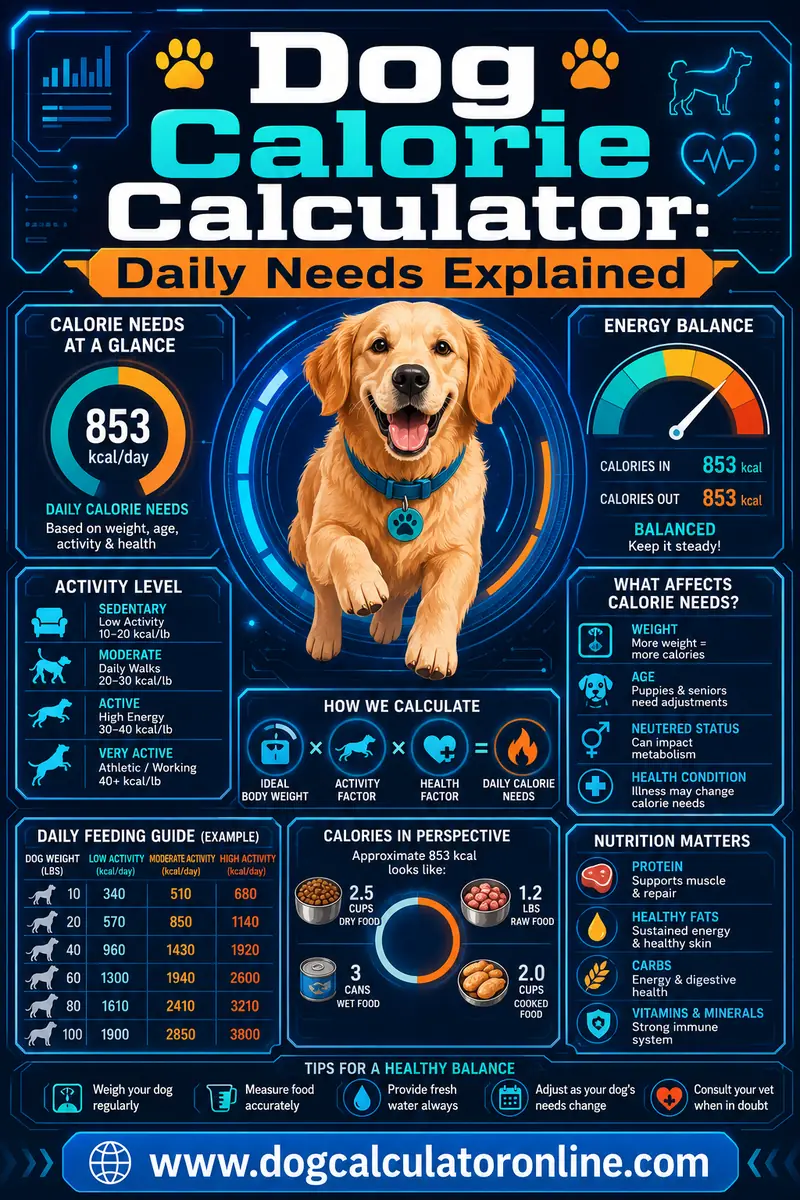
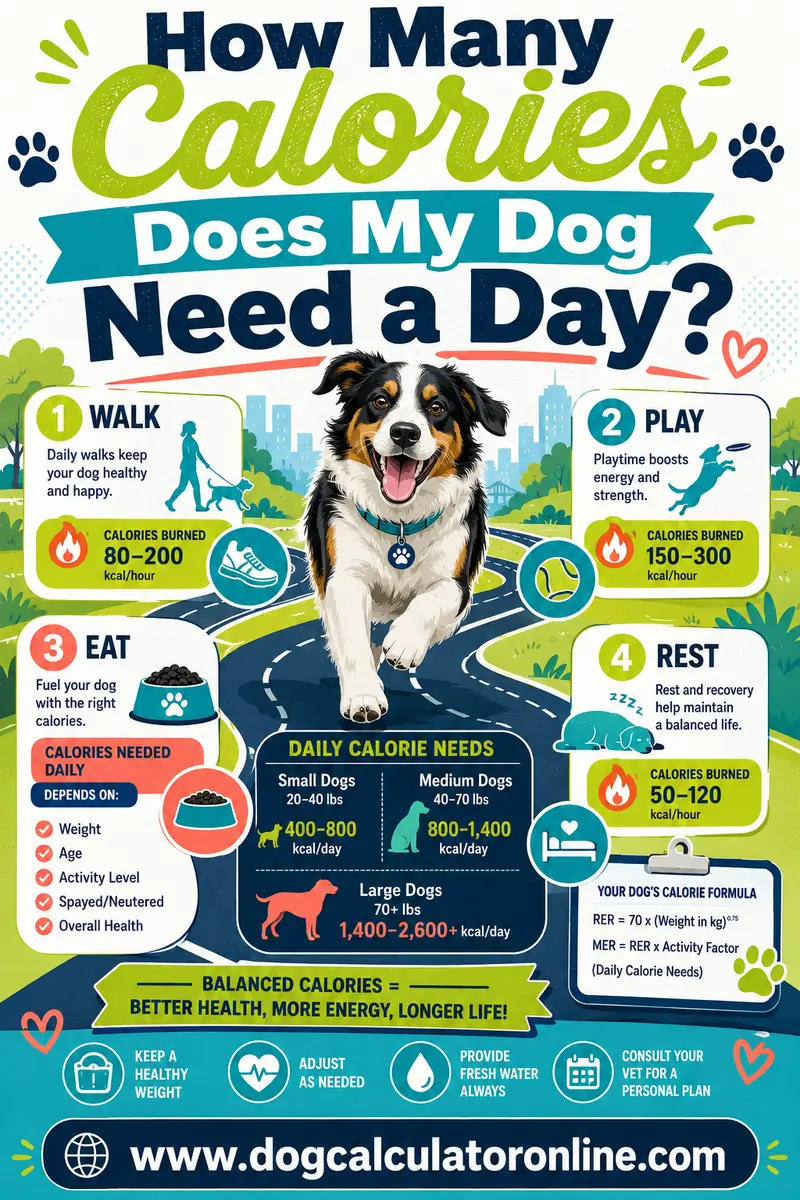
As a rule-of-thumb starting point, a typical neutered adult dog needs roughly 400 kcal a day at 10 lb, 700 kcal at 25 lb, 1,100 kcal at 50 lb, and 1,700 kcal at 90 lb. The number comes from the veterinary standard formula — resting energy requirement (70 × kg^0.75) multiplied by a lifestyle factor — and "kcal" on a dog food label means exactly the same thing as the "calories" on your own food packaging. Age, activity, and neuter status swing the figure enough that two same-weight dogs can legitimately need very different amounts.
The free dog food calculator runs that formula for your dog's actual weight, age, and activity in seconds, then turns kcal into a portion of food. This guide covers the estimates by weight, what kcal actually means when you're squinting at a bag, the formula itself, and the adjustments that make the difference between a trim dog and a chunky one.

🔥 Daily kcal check
Tap your dog’s weight for a daily kcal estimate (neutered adult, normal activity):
Tap a weight above. Estimates for healthy neutered adults — your food label and vet fine-tune it.
First: kcal, Calories, and Why Labels Say kcal
A kcal (kilocalorie) is identical to the "Calorie" you count in human food — nutrition labels for people capitalize it; pet food labels write it as kcal. So a food listing "376 kcal/cup" delivers the same energy as a 376-Calorie human snack. No conversion needed, no trick.
On a dog food bag, look for the calorie content statement, required on US labels and usually printed near the guaranteed analysis. It reports "metabolisable energy" (ME) — the energy your dog can actually use — as kcal per kilogram and usually kcal per cup (dry) or kcal per can (wet). Kcal per cup is the number you'll use daily; typical dry foods run roughly 325–450 kcal per cup, which is exactly why "one cup twice a day" means completely different things on different foods.
Daily kcal Estimates by Weight
Starting estimates for neutered adult dogs at normal pet activity:
| Weight | Daily kcal (est.) | On a 375 kcal/cup food |
|---|---|---|
| 5 lb | ~230 kcal | ~0.6 cup |
| 10 lb | ~370–400 kcal | ~1 cup |
| 20 lb | ~630 kcal | ~1.7 cups |
| 25 lb | ~700 kcal | ~1.9 cups |
| 35 lb | ~880 kcal | ~2.3 cups |
| 50 lb | ~1,100 kcal | ~3 cups |
| 70 lb | ~1,400 kcal | ~3.7 cups |
| 90 lb | ~1,700 kcal | ~4.5 cups |
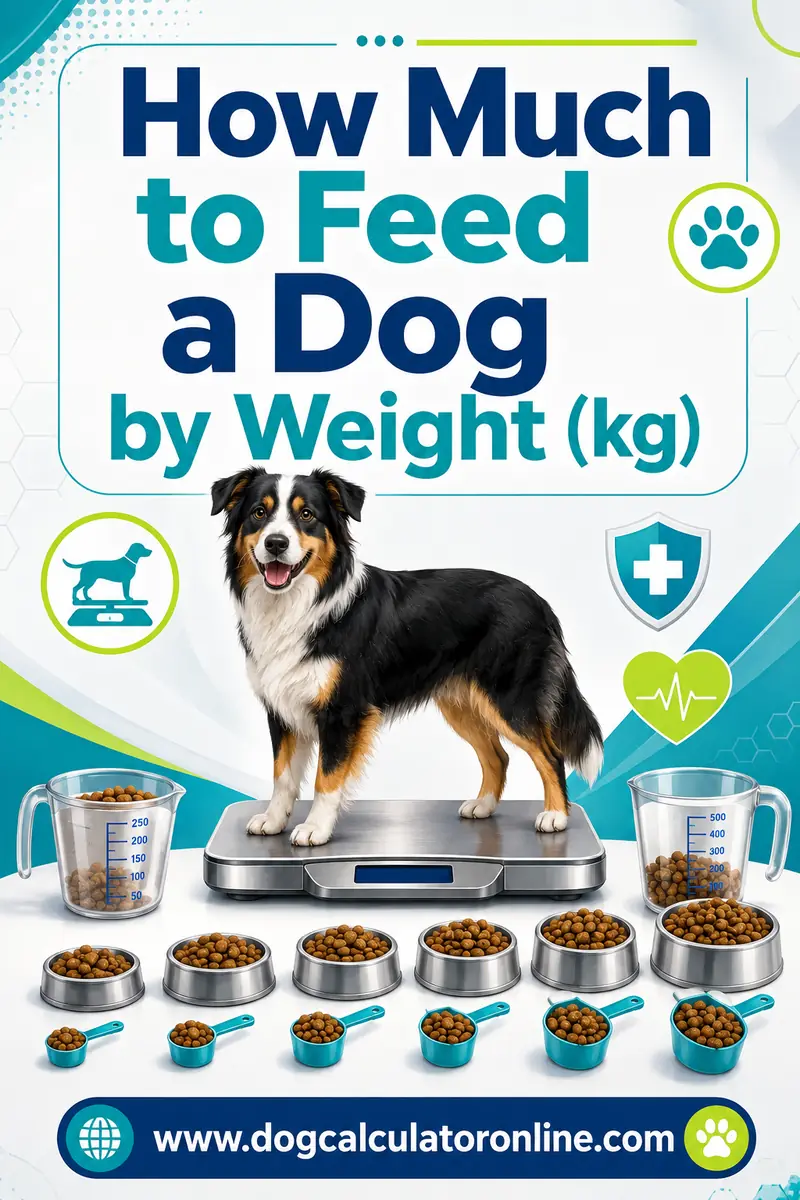
Notice the curve: the 90 lb dog weighs nine times the 10 lb dog but needs only about four and a half times the calories. Energy needs scale with weight^0.75, not weight — which is why per-pound rules of thumb overfeed big dogs and underfeed small ones. (Metric thinker? The same tables in kg live in our feeding by kg guide.)
The Formula Behind the Numbers
Two steps, both reproducible on any calculator:
1. RER (resting energy requirement): RER = 70 × (weight in kg)^0.75. A 50 lb dog is ~22.7 kg; 22.7^0.75 ≈ 10.4; × 70 ≈ 730 kcal just to run the body at rest.
2. Multiply for life stage and lifestyle:
| Situation | Factor × RER |
|---|---|
| Neutered adult | ~1.6 |
| Intact adult | ~1.8 |
| Inactive / obesity-prone | ~1.2–1.4 |
| Vet-supervised weight loss | ~1.0 |
| Active / working | ~2.0–5.0 |
| Young puppy (to ~4 months) | ~3.0 |
| Older puppy (to adult size) | ~2.0 |
The 50 lb neutered adult lands around 730 × 1.6 ≈ 1,170 kcal — matching the table. The factor is where honest judgment enters: "active" means genuine daily running, sport, or work, not enthusiastic yard laps. Most pet dogs are closer to the 1.4–1.6 band than their owners guess, and picking the flattering multiplier is the most common way the math goes wrong. The dog food calculator walks the same steps with plain-English activity choices; our calorie needs guide goes deeper on the physiology.
Turning kcal Into Actual Meals
- Get the daily kcal target from the formula or calculator.
- Subtract the treat allowance — keep treats within ~10% of daily kcal, so a 1,100 kcal dog gets ~990 from meals and ~110 from extras. Every chew, dental stick, and training treat has a kcal number; they count.
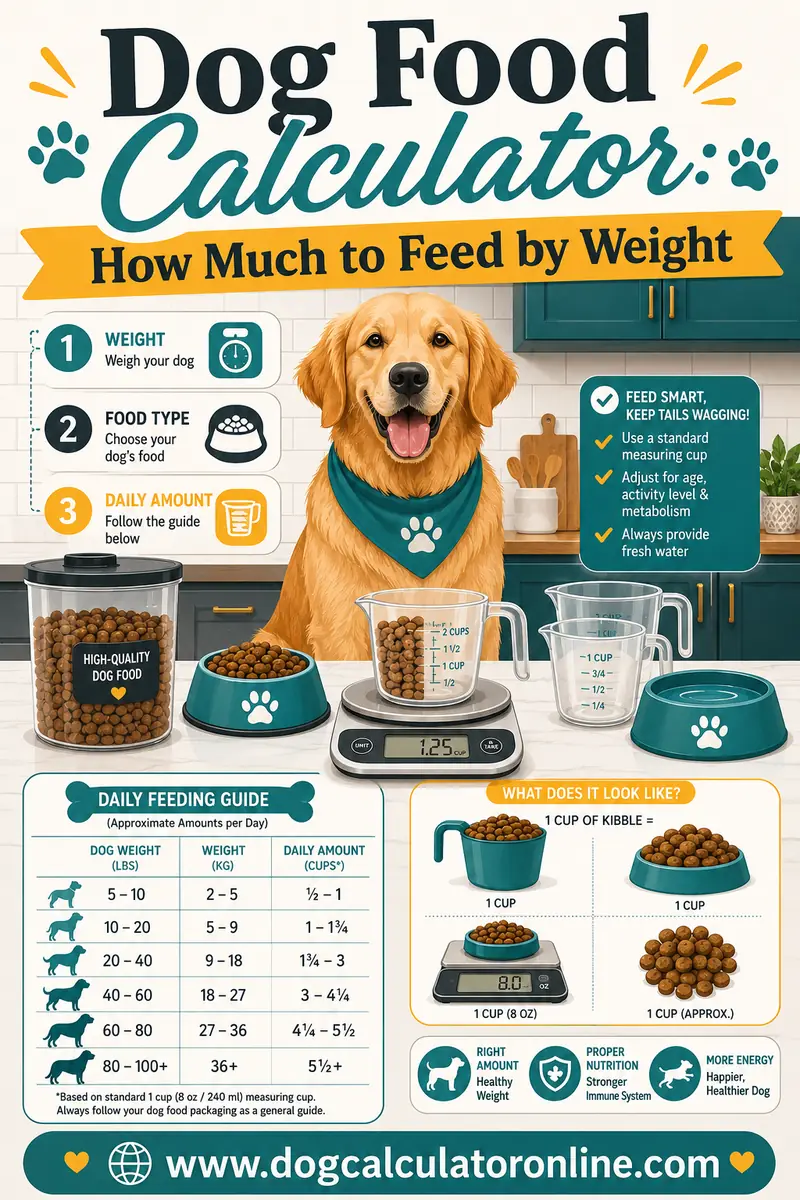
- Divide by the label's kcal per cup (or can) to get the daily amount, then split across meals — twice daily suits most adults.
- Weigh, don't scoop, if you can. Labels also list kcal/kg, and feeding by grams on a kitchen scale is far more repeatable than cup-fills — meaningful for any dog, decisive for small ones.
Worked example: 25 lb terrier mix, target ~700 kcal. Treats claim ~70, leaving 630 from food. Her food runs 340 kcal/cup: 630 ÷ 340 ≈ 1.85 cups a day, so ~0.9 cup per meal, twice daily. That's the entire system.
Where kcals Hide: Auditing a Day Honestly
Most "the formula must be wrong" cases turn out to be accounting errors, not physiology. Before adjusting a target that doesn't seem to work, audit a normal day the way a vet would:
- The dental chew. Many popular dental sticks run 70–100+ kcal each. Given daily, that's a whole meal a week for a small dog — and it almost never appears in anyone's mental tally.
- Training treats at volume. Individually small, collectively serious. A busy training week can add hundreds of kcal. Using pieces of the regular kibble ration as training currency neatly zeroes this line.
- The topper that never displaced anything. A spoon of wet food, a splash of gravy, a scrambled-egg Sunday — legitimate extras, if the kibble shrank to make room. It usually didn't.
- Multiple feeders. Two family members "just feeding the dog" is the classic. One written number on the food bin — kcal and grams per meal — ends the double-dinner era.
- The scoop itself. A heaped cup on a 400 kcal/cup food is an extra 50–100 kcal per meal. Weighing in grams removes the rounding.
Run the audit for three days, writing everything down, and compare the true total against the formula's target. In most households the gap explains itself — and closing it beats recalculating the target every time. If intake genuinely matches the target and weight is still drifting, that's the finding worth bringing to your vet.
When the Formula Isn't Enough
The formula outputs a starting point, not a destiny. Body condition is the feedback that tunes it:
- Rib check every couple of weeks: ribs easily felt under a light layer, waist visible from above, tummy tuck from the side = the kcal number is right, whatever the math said.
- Getting plump: trim daily kcal ~10% and re-check in 2–4 weeks.
- Getting thin or lethargic: raise ~10% and re-check the same way.
- Weight changing with no feeding change: that's a medical question — thyroid, parasites, and other conditions move weight independently of the bowl. Ask your vet.
And some dogs should skip DIY calorie math altogether: puppies of giant breeds (growth-rate control matters), pregnant or nursing dogs (needs can multiply several-fold), and dogs with diabetes, kidney disease, or on prescription diets. For those, the kcal target should come from your vet, not a website — ours included.
Related Guides
If this helped, these go deeper on the same question:
And for your own dog’s numbers, the free dog age calculator does the math in one tap.
FAQ
How many kcal does a dog need per day?
Roughly 30–40 kcal per pound for small dogs sliding down to ~18–22 per pound for giants — but the accurate route is the vet formula: 70 × (kg)^0.75 for resting needs, × ~1.6 for a typical neutered adult. A 50 lb dog lands around 1,100–1,200 kcal/day.
Is kcal the same as calories in dog food?
Yes. One kcal equals one food "Calorie" as counted on human nutrition labels. Dog food labels simply use the technically precise unit, reporting metabolisable energy in kcal per kg and kcal per cup or can.
How many kcal are in a cup of dog food?
Typically about 325–450 kcal per cup for dry foods, but the spread across brands and formulas is wide — puppy and performance foods run denser. Always read your own bag's calorie statement; it's the difference between "2 cups" being correct and being 30% too much.
How many kcal should a puppy eat?
Puppies need roughly 3× their resting requirement during early growth and about 2× until they reach adult size — far more per pound than adults, spread over 3–4 daily meals. Feed a puppy-formulated food and follow your vet's guidance, especially for large and giant breeds where growth pace matters.
How many kcal should my dog eat to lose weight?
Weight-loss feeding is typically built around ~1.0 × RER of the dog's ideal weight — but severity, target, and pace should be set with your vet, because crash-dieting dogs is unsafe. Cutting treats to near-zero and re-measuring meals accurately does half the job on its own.
Why does my dog gain weight on the "correct" kcal amount?
Usually one of three things: the lifestyle multiplier was too generous (most pet dogs are less active than owners estimate), untracked extras like dental chews and toppers are inflating the real total, or measuring error is adding a stealth surplus at every meal. If a written three-day audit rules all three out and weight still climbs, ask your vet — conditions like hypothyroidism can slow a dog's calorie burn.
Do treats count toward daily kcal?
Fully. The standard guideline caps treats, chews, and table extras at about 10% of daily kcal, with balanced dog food supplying the rest. For a 400 kcal small dog, that's a 40 kcal allowance — one dental chew can spend it entirely.
From Formula to Food Bowl in One Step
The kcal question has a real answer: resting requirement × lifestyle factor, converted through your label's kcal per cup, checked against your dog's ribs a few weeks later. You can run it by hand — or let the free dog food calculator do the whole chain at once from weight, age, and activity, and hand you a daily kcal target plus portion estimate that fits the dog actually sitting next to you.