Dog Calorie Calculator: Daily Needs Explained
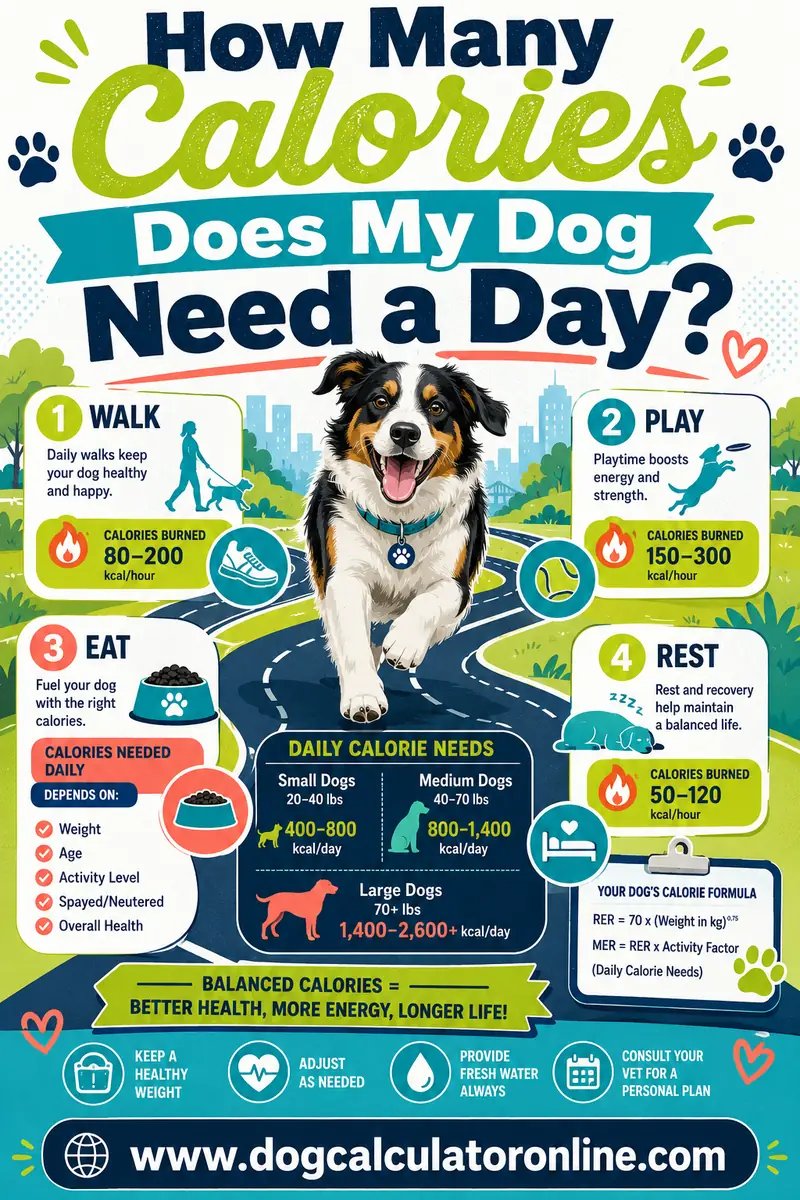
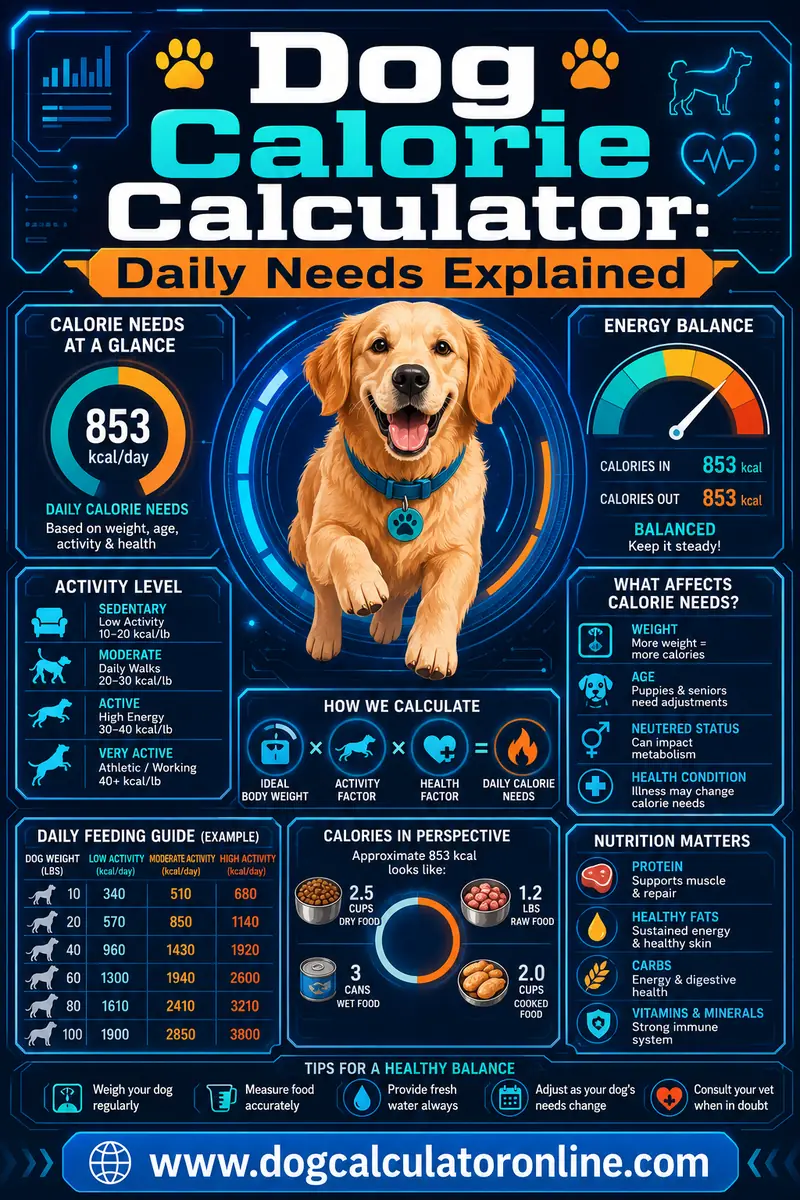
A dog calorie calculator estimates daily energy needs from two inputs: body weight and lifestyle. The math behind it is the same used in veterinary nutrition — Resting Energy Requirement (RER = 70 × kg^0.75) multiplied by an activity factor. In practice, a typical neutered 10-lb adult dog needs roughly 305 kcal a day, a 30-lb dog about 695 kcal, a 50-lb dog about 1,020 kcal, and an 80-lb dog about 1,450 kcal — with a real spread either side of those figures. Active dogs need more; seniors and dieting dogs need less.
Our free dog calorie calculator runs the formula for your dog in seconds. Below is exactly how the calculation works, a calorie chart by weight, and how to turn a kcal number into actual cups of food.
🔥 Daily calorie check (typical neutered adult)
Tap your dog’s weight for an estimated daily calorie need:
Tap a weight above for an estimated daily calorie need.
The Two-Step Formula Vets Use
Every serious dog calorie calculator is built on the same two-step calculation.
Step 1: Resting Energy Requirement (RER)
RER is the energy a dog burns at rest — keeping warm, breathing, digesting, thinking about squirrels. The formula:
RER = 70 × (body weight in kg)^0.75
The 0.75 exponent is why small dogs need more calories per pound than big dogs. A 5-kg dog's RER works out to about 47 kcal per kg, while a 40-kg dog's is only about 28 kcal per kg. Bodies don't scale linearly — surface area, metabolism, and heat loss all bend the curve.
Step 2: Maintenance Energy Requirement (MER)
Real dogs don't rest all day. Multiply RER by a lifestyle factor to get the daily target:
| Life stage / lifestyle | Multiplier |
|---|---|
| Weight loss (vet-supervised) | 1.0 × RER |
| Neutered adult, typical pet | 1.2–1.6 × RER |
| Intact adult | 1.4–1.8 × RER |
| Lightly active senior | 1.1–1.4 × RER |
| Active / working dog | 2.0–5.0 × RER |
| Pregnant (late term) | ~3.0 × RER |
| Nursing | 4.0–8.0 × RER |
| Puppy under 4 months | ~3.0 × RER |
| Puppy 4 months to adult size | ~2.0 × RER |
These multipliers come from veterinary nutrition guidelines: the WSAVA global nutrition guidelines and the framework the Ohio State University Veterinary Medical Center publishes. They are estimates with real spread — Ohio State notes an individual pet can vary by as much as 50% from the calculated figure — which is why every calculator answer needs a body-condition follow-up.
Worked Examples
Seeing the math once makes the calculator less of a black box.
Example 1 — 12-lb neutered adult (5.4 kg):
RER = 70 × 5.4^0.75 ≈ 249 kcal. At 1.4 × RER that is about 350 kcal/day, and the full 1.2–1.6 range runs roughly 300–400 kcal. A quiet indoor dog of this size usually needs the lower end. This is exactly why you verify with ribs and waist, not just math.
Example 2 — 55-lb neutered adult (25 kg):
RER = 70 × 25^0.75 ≈ 783 kcal. At 1.4 × RER that is about 1,100 kcal/day, with a 1.2–1.6 range of roughly 940–1,250 kcal.
Example 3 — same 55-lb dog, needs to lose weight:
Target weight 48 lb (21.8 kg). RER at target = 70 × 21.8^0.75 ≈ 706 kcal. Weight-loss factor 1.0 → ~700 kcal/day, ideally split into two meals plus zero-calorie chew time. A cut this size should be vet-supervised.
Example 4 — 4-month-old, 20-lb puppy (9 kg):
RER = 70 × 9^0.75 ≈ 364 kcal. Growth factor ~2.0 → ~730 kcal/day — nearly what the 55-lb dieting adult gets. Growing is expensive.
Dog Calorie Chart by Weight
Every figure below comes from the same method as the calculator: resting needs (70 × kg0.75) multiplied by a life-stage factor. The middle column uses 1.4 × RER, the factor the WSAVA guidelines give for a neutered, moderately active adult dog; the range spans 1.2 (quiet indoor pet) to 1.6 (busy and active). Quiet indoor dogs usually sit near the bottom. Start in the range, then verify with body condition:
| Weight | Typical kcal/day (1.4 × RER) | Range (1.2–1.6 × RER) |
|---|---|---|
| 5 lb | 180 | 155–205 |
| 10 lb | 305 | 260–350 |
| 20 lb | 510 | 440–585 |
| 30 lb | 695 | 595–795 |
| 40 lb | 860 | 740–985 |
| 50 lb | 1,020 | 875–1,165 |
| 60 lb | 1,170 | 1,000–1,335 |
| 70 lb | 1,310 | 1,125–1,500 |
| 80 lb | 1,450 | 1,240–1,655 |
| 100 lb | 1,715 | 1,470–1,960 |
Nursing mothers, hard-working dogs, and growing puppies can blow past the top of these ranges — that's normal and by design.
Turning Calories Into Cups
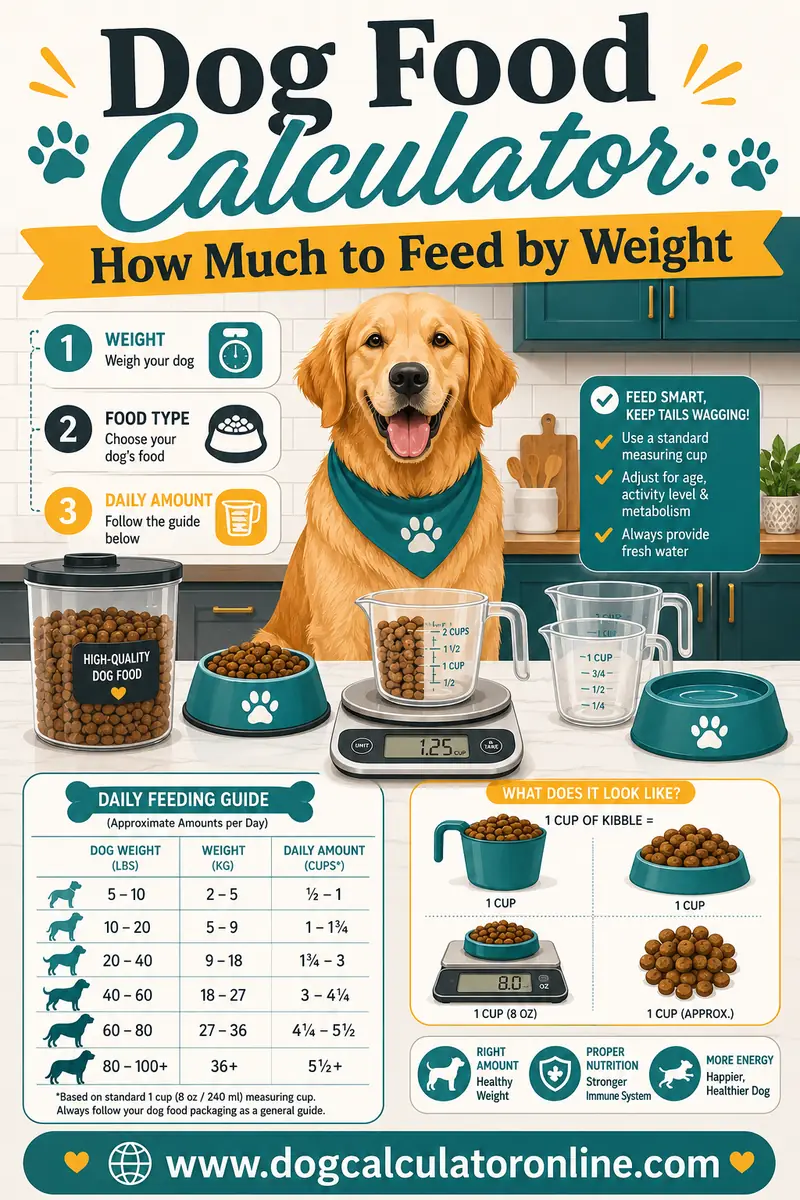
A kcal number is only useful once it becomes a scoop. Every complete dog food sold in the US prints a calorie content statement — usually kcal per cup for dry and kcal per can for wet.
Cups per day = daily kcal target ÷ kcal per cup.
A 750-kcal dog on a 375 kcal/cup food eats exactly 2 cups a day. Switch to a 450 kcal/cup food and the same dog needs just 1⅔ cups — keep feeding 2 and you've added roughly a pound of body weight every few months. This conversion is the whole reason calorie math matters more than the scoop your neighbor uses. Our dog food calculator chains both steps together: calories in, cups out.
Don't Forget the Treat Budget
Treats are where careful calorie plans quietly fail. The standard guidance: treats should stay under 10% of daily calories, both to protect the balance of the main diet and to keep the total honest.
For a 500-kcal dog, that's a 50-kcal daily treat allowance. For scale: a medium dog biscuit can run 40+ kcal, a dental chew 70+, a tablespoon of peanut butter about 90. One "harmless" extra a day can be 15–20% of a small dog's entire budget. Subtract treats from meals rather than stacking them on top, and lean on low-calorie options — many dogs are just as thrilled by a green bean or a carrot piece.
When Calorie Needs Change
Recalculate your dog's target whenever one of these shifts:
- Neutering/spaying — energy needs drop noticeably afterward; keep portions the same and weight creeps on.
- Age — seniors typically need 10–20% fewer calories as activity falls, though some old dogs need more protein even at lower calories. Ask your vet at senior checkups.
- Season and routine — a winter couch season vs a summer of trail runs can swing needs by hundreds of kcal for a big dog.
- Weight goals — dieting dogs get fed for target weight at a reduced multiplier, ideally with vet supervision.
- Pregnancy and nursing — needs climb late in pregnancy and can quadruple (or more) during peak nursing. This is vet-guided territory.
A quick re-run of the dog calorie calculator after each life change takes seconds and prevents the slow drift that turns into an overweight dog by the next checkup.
The Feedback Loop: Body Condition Beats Math
Every number in this article is an estimate. Individual dogs run hot or cold metabolically, and the only ground truth is your dog's body:
- Ribs: easy to feel with flat fingers and light pressure — not buried, not sharp.
- Waist: visible tuck behind the ribs from above.
- Belly: rises from chest to hips when viewed from the side.
If your dog drifts plump, cut the daily kcal by about 10% and re-check in two weeks. Drifting thin, add 10%. When a dog gains or loses weight quickly on unchanged portions, that's a vet conversation, not a math problem — thyroid and other medical issues can move weight independent of calories.
The Human-Food Cheat Sheet: What Sharing Actually Costs
Calorie budgets make shared human food suddenly legible — and the numbers are sobering when your dog's whole day is 500 kcal. Rough figures for common counter offerings:
| The "little something" | Approx. kcal | Share of a 30-lb dog's day (~695 kcal) |
|---|---|---|
| Slice of cheese (1 oz) | ~110 | ~16% |
| Half a hot dog | ~75 | ~11% |
| One scrambled egg | ~90 | ~13% |
| Slice of bacon | ~40 | ~6% |
| A few french fries | ~50 | ~7% |
| Baby carrot | ~4 | ~0.6% |
| Green bean | ~2 | ~0.3% |
The pattern jumps out: one slice of cheese is a fifth of a smaller dog's entire daily budget — the human-equivalent of a large fast-food meal as a casual snack. Meanwhile the vegetable options barely register, which is why vets keep recommending them as training treats.
This isn't an argument for never sharing — it's an argument for sharing on the books. If the household routinely donates an egg's worth of extras, subtract an egg's worth of kibble. And keep the usual safety list in mind: no onions, grapes, raisins, chocolate, or anything sweetened with xylitol, regardless of calorie math. When unsure whether a food is dog-safe, ask your vet before it leaves the plate.
Calorie Math in a Multi-Dog Household
Two or more dogs turn portion control into logistics. The common failure mode: everyone eats from generously filled bowls, the fast eater finishes both, and six months later the Lab is plump while the Chihuahua is somehow still hungry. What works instead:
- Run the calculator per dog, not per bag. A 12-lb senior and a 60-lb adolescent living under one roof have wildly different targets — roughly 300 vs 1,000+ kcal. There is no shared "house portion."
- Feed in separate stations. Different rooms, crates, or a baby gate. Meals end when bowls are empty and bowls come up — free-feeding is how multi-dog calorie plans die.
- Watch the treat multiplier. Three dogs sitting nicely tends to mean three treats, several times a day. Budget treats per dog, and remember the smallest dog's budget runs out first.
- Different foods are fine. A puppy, an adult, and a dieting senior can each eat their own formula at their own station. It's more scoops, not more complexity — label each container with the dog's name and daily amount.
- Weigh everyone on the same schedule. A monthly weigh-in per dog catches the classic multi-dog drift — one gaining, one losing — while it's still a 10% portion tweak.
FAQ
How many calories does my dog need per day?
Roughly: 220 kcal at 10 lb, 370 at 20 lb, 500 at 30 lb, 750 at 50 lb, and 1,050 at 80 lb for a typical neutered adult. Active dogs need more, seniors less. The dog calorie calculator personalizes it.
What formula does a dog calorie calculator use?
RER = 70 × (weight in kg)^0.75, then multiplied by a lifestyle factor — about 1.2–1.6 for a typical neutered adult, up to 2.0–5.0 for working dogs, about 2.0–3.0 for puppies.
How many calories are in a cup of dog food?
Commonly 300–450 kcal per cup for dry food, but it varies widely by formula — the exact number is printed on your bag as the calorie content statement. Always use your own label.
How many calories should my dog eat to lose weight?
A common vet-supervised approach feeds around 1.0 × RER calculated at the dog's target weight. Never crash-diet a dog, and involve your vet before a major cut — especially for small breeds.
Do puppies need more calories than adult dogs?
Per pound, yes — roughly double. A puppy under four months runs at about 3 × RER, dropping to about 2 × RER until fully grown, which is why puppy portions look big for their size.
Why is my dog gaining weight on the calculated calories?
Uncounted treats are the usual culprit, followed by an activity multiplier set too high and measuring by scoop instead of scale. Trim 10%, count everything, and re-check in two weeks; persistent gain is worth a vet visit.
The Bottom Line
Dog calorie math is simple once you see it: 70 × kg^0.75 for resting needs, times a lifestyle multiplier, then divided by your food's kcal per cup. The formula gets you close; ribs and waistline get you exact.
Run your dog's real numbers through the free dog calorie calculator — weight in, daily kcal and portion out. For the practical feeding side, see how many calories your dog needs and the dog food calculator by weight.