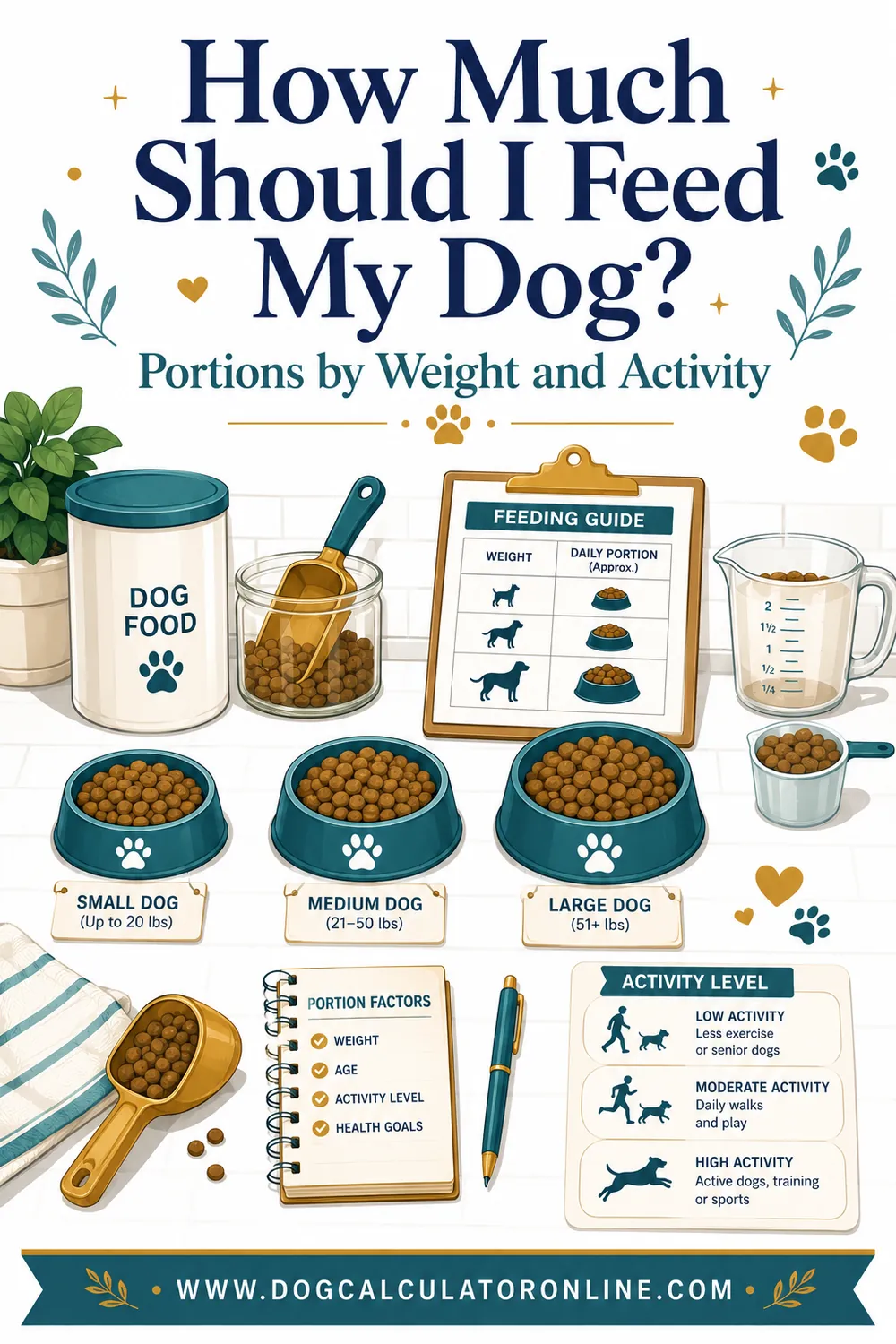
How Much Should I Feed My Dog? Portions by Weight and Activity
Most adult dogs need somewhere between 25 and 30 calories per pound of body weight per day, which works out to roughly ½–¾ cup of dry food for a 10-lb dog, 1–1½ cups for a 25-lb dog, and 2½–3¼ cups for a 75-lb dog. Active dogs need more, couch-potato and senior dogs need less. Always check your specific food's label — calories per cup vary a lot — and confirm with your vet.
Our free dog food calculator turns your dog's weight and activity into an estimated daily portion in seconds. Below is the full chart plus how to fine-tune it for your dog.
🥣 How much to feed (adult dog, dry food)
Tap your dog's weight for an estimated daily amount:
Tap a weight above for an estimated daily portion.
Feeding Chart by Weight (Adult Dogs)
This chart assumes a typical adult dog with moderate activity, fed a standard dry food of about 350–400 calories per cup. Treat it as a starting point, then adjust to your dog's body condition.
| Dog weight | Daily calories (approx.) | Dry food per day |
|---|---|---|
| 5 lb | 140–170 | ⅓–½ cup |
| 10 lb | 200–275 | ½–¾ cup |
| 20 lb | 350–450 | ¾–1¼ cups |
| 25 lb | 400–550 | 1–1½ cups |
| 40 lb | 600–800 | 1¾–2¼ cups |
| 50 lb | 700–950 | 1¾–2½ cups |
| 60 lb | 850–1,100 | 2¼–3 cups |
| 75 lb | 1,000–1,250 | 2½–3¼ cups |
| 90 lb | 1,150–1,450 | 3–3¾ cups |
| 100 lb | 1,300–1,600 | 3¼–4¼ cups |
Split the daily amount into two meals for most adult dogs. Because foods differ so much in calorie density, the single most important step is reading your own bag — the dog food calculator lets you plug in your food's calories per cup for a tighter number.
The Real Formula Vets Use
If you like the underlying math, feeding is based on calories, not cups. Vets start with Resting Energy Requirement (RER):
RER = 70 × (body weight in kg)^0.75
Then multiply by an activity factor to get daily calories:
| Situation | Multiplier |
|---|---|
| Weight loss needed | 1.0 × RER |
| Neutered adult, typical | 1.6 × RER |
| Intact adult, active | 1.8 × RER |
| Working / very active | 2.0–5.0 × RER |
| Senior / less active | 1.2–1.4 × RER |
Example: a 22 kg (about 48 lb) neutered adult → RER = 70 × 22^0.75 ≈ 710, then × 1.6 ≈ 1,140 calories/day. Our calculator runs this for you, but the chart above is close enough for most homes.
Adjust for Activity Level
The chart's ranges exist because activity swings needs a lot:
- Low activity / senior / overweight: aim for the lower end, or below it. Older dogs and lounge-lovers burn fewer calories.
- Moderate activity (normal daily walks): the middle of the range.
- High activity (running partner, herding, sport): the upper end or beyond.
- Weight loss: feed for your dog's goal weight, not current weight, and ask your vet before cutting hard.
A working sled dog can need several times what a same-sized house pet needs. Match the food to the life your dog actually lives.
Read the Label — Cups Lie, Calories Don't
Two foods can look identical in the bowl but differ by hundreds of calories per cup. Every complete dog food in the US lists a calorie content statement (usually "kcal/cup" or "kcal/kg"). Use it:
- Find your dog's daily calories (chart or calculator).
- Divide by the food's calories per cup.
- That's your cups per day.
Example: 1,000 daily calories ÷ 380 kcal/cup = about 2.6 cups/day. If you switch to a richer food at 450 kcal/cup, the same dog needs only about 2.2 cups — feeding the old amount would slowly add weight.
Don't forget treats: they should stay under about 10% of daily calories. Those count too.
Body Condition: The Real Answer
Charts and formulas get you close, but your dog's body tells the truth. Use the Body Condition Score check:
- Ribs: you should feel them easily with light pressure, like the back of your hand. Can't feel them? Too much food. Can see them sharply? Too little.
- Waist: from above, look for a tuck behind the ribs — an hourglass, not a sausage.
- Belly: from the side, the belly should tuck up, not hang level or sag.
Re-check every couple of weeks and adjust portions by about 10% at a time. Steady body condition beats any chart. If you're unsure, your vet can score your dog and set a target.
Meal Frequency
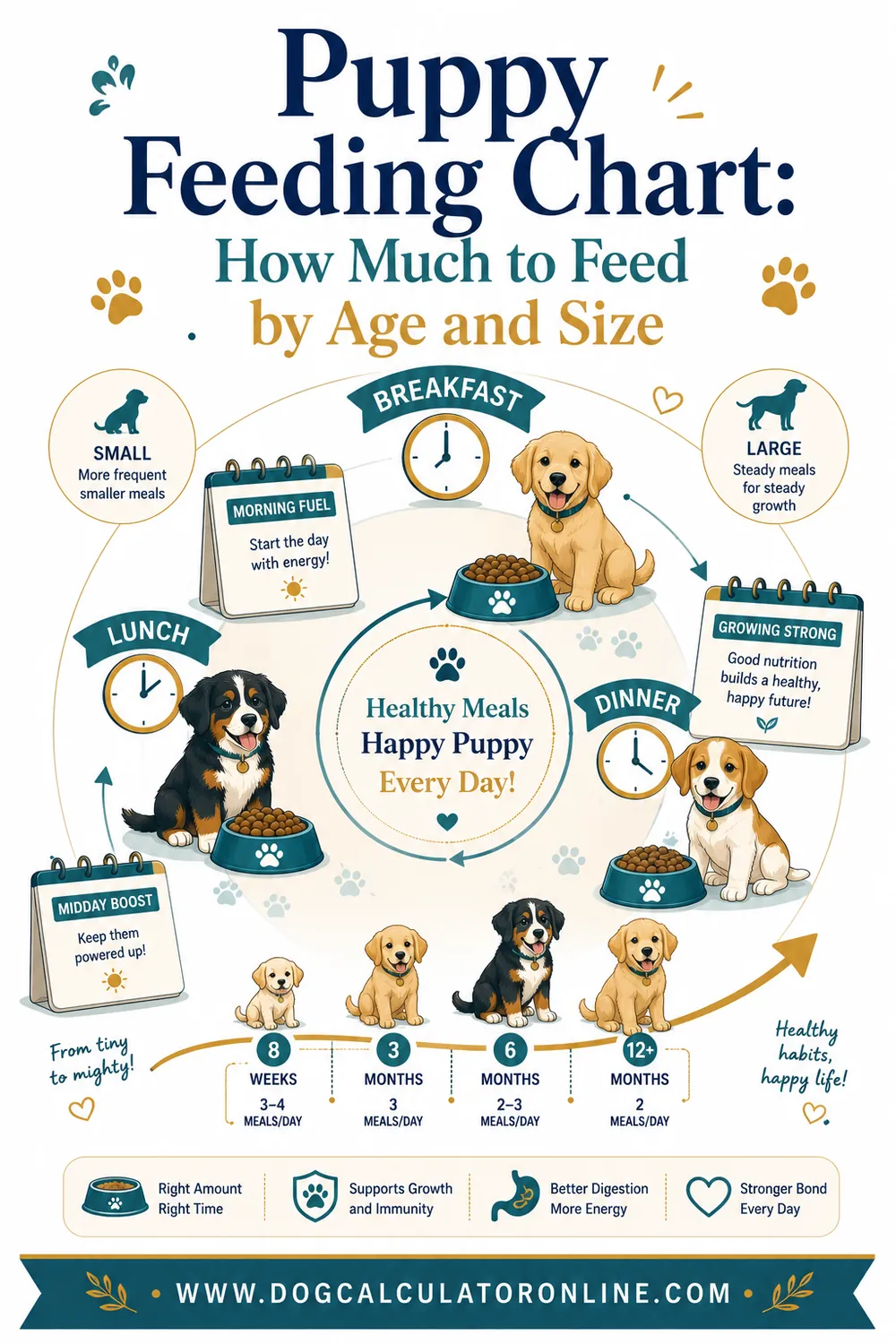
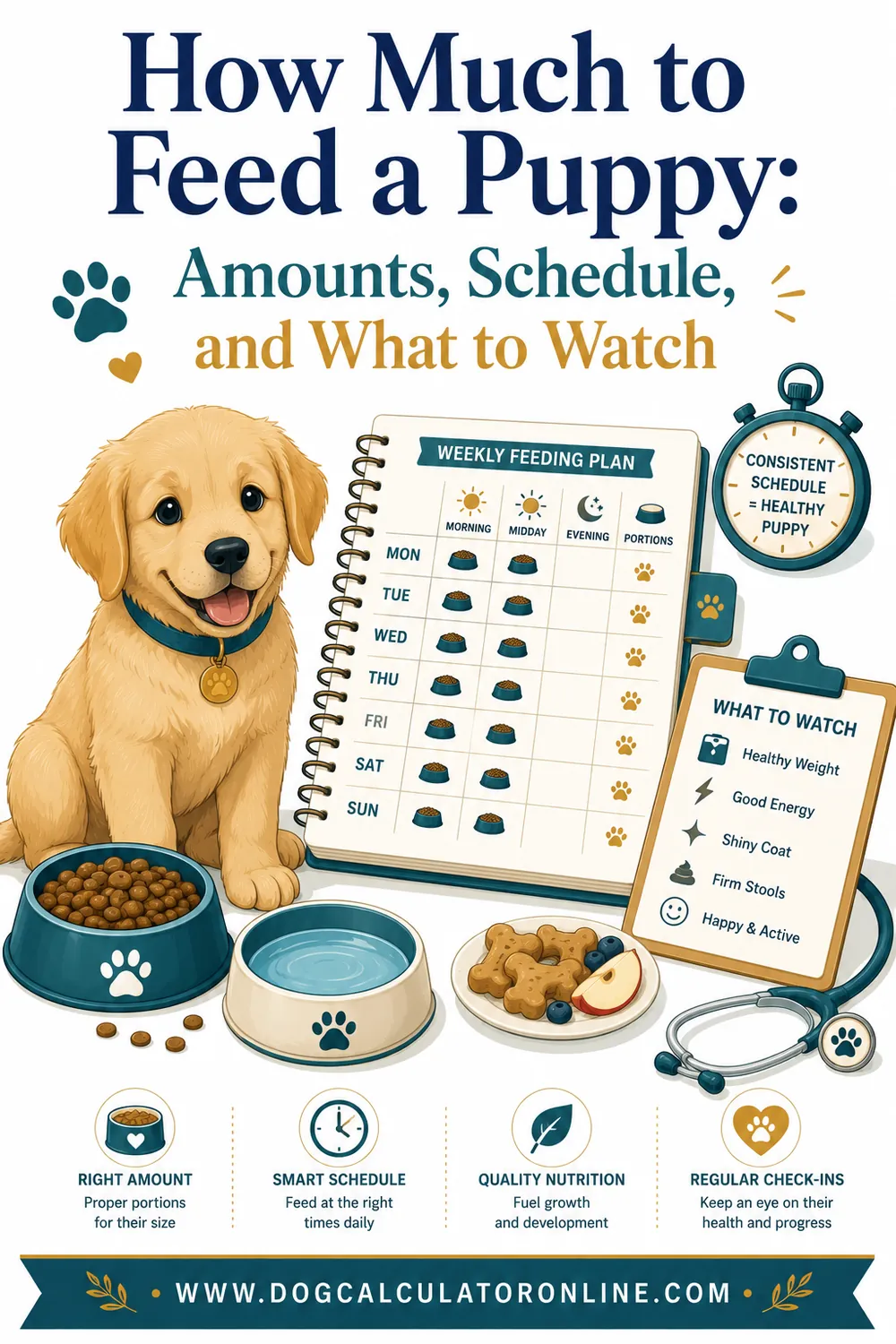
- Puppies: 3–4 meals a day (see how much to feed a puppy).
- Adult dogs: twice a day is standard and helps digestion and hunger.
- Seniors: twice a day, adjusted down for lower activity.
Once-a-day feeding is possible for some adult dogs but leaves them hungry longer; two meals is gentler on the stomach and easier for portion control.
Special Cases: Seniors, Puppies, and Weight Loss
The base chart is for a healthy adult. Adjust for these situations:
- Seniors. Older dogs are usually less active and burn fewer calories, so they often need the lower end of the range — sometimes 10–20% less. But some seniors lose muscle and need more protein, not less. Let body condition and your vet guide you.
- Puppies. Growing dogs need roughly double the calories per pound and more frequent meals. Use our puppy feeding chart instead of the adult numbers.
- Weight loss. Feed for the target weight, not the current weight, and cut gradually. Aim for slow, steady loss and check with your vet before any big reduction — crash diets are unsafe for dogs.
- Pregnant or nursing dogs. Needs rise sharply, especially while nursing. This is a vet-guided situation, not a chart one.
Wet Food vs. Dry Food
The portions in this guide assume dry kibble. If you feed wet food or a mix, switch your thinking to calories:
- A can of wet food lists its calorie content just like dry food. Find your dog's daily calorie target, then split it between wet and dry so the total lands on target.
- Wet food is less calorie-dense by volume (it's mostly moisture), so the "cup" amounts don't transfer directly.
- Mixing is fine — just count both sides toward the same daily calorie budget, and keep treats within the 10% allowance.
Switching Foods Safely
Changing foods too fast is a classic cause of upset stomachs. Transition over 7–10 days: start with about 25% new food mixed into the old, then move to 50/50, then 75%, then all new. If your dog gets loose stools, slow down. When you switch, re-check the new food's calories per cup — a richer food means smaller portions for the same dog.
How to Read a Dog Food Label
The bag holds the two numbers that make feeding accurate:
- Calorie content statement. Usually printed as "kcal/cup" and "kcal/kg." This is the number that matters most — divide your dog's daily calorie target by kcal/cup to get cups per day.
- Feeding guidelines. A weight-and-age chart. Useful as a starting point, but often generous, so verify against body condition.
- AAFCO statement. Confirms the food is "complete and balanced" for a life stage (adult maintenance, growth, or all life stages). Make sure it matches your dog.
If you ever switch foods, re-check the calories per cup — two foods that look identical in the bowl can differ by hundreds of calories.
How Much Water Does a Dog Need?
Food gets the attention, but water matters just as much. A rough guide is about one ounce of water per pound of body weight per day — so a 50-lb dog needs roughly 50 ounces (a bit over 6 cups). Dogs eating wet food get some water from their meals and may drink less. Keep fresh water available at all times, and note that hot weather, exercise, and nursing all increase needs. A sudden jump or drop in drinking is worth mentioning to your vet.
Common Feeding Mistakes
- Free-feeding (leaving food out). Makes portioning impossible and drives weight gain. Feed measured meals.
- Eyeballing scoops. Use an actual measuring cup or, better, a kitchen scale in grams.
- Ignoring treats. They add up fast — count them in the daily total.
- Feeding the bag's max by default. Bag charts often run generous. Start mid-range and watch body condition.
- Not adjusting after neutering. Neutered dogs need fewer calories; keep the same portion and weight creeps up.
FAQ
How much should I feed my dog per day?
Roughly 25–30 calories per pound for a typical adult — about ½–¾ cup for a 10-lb dog and 2½–3¼ cups for a 75-lb dog on standard dry food. Adjust for activity and check the label. The dog food calculator personalizes it.
Should I feed my dog once or twice a day?
Twice a day is best for most adult dogs. It aids digestion, reduces hunger, and makes portion control easier. Puppies need 3–4 smaller meals.
How do I know if I'm feeding too much?
Feel for ribs and look for a waist. If you can't feel the ribs or there's no tuck behind the ribcage, you're likely overfeeding. Reduce portions about 10% and recheck in two weeks.
Do I feed based on my dog's current or ideal weight?
For a healthy dog, current weight is fine. For an overweight dog, feed for the target weight and consult your vet on a safe pace.
Why does the bag say to feed more than the chart?
Bag guidelines often assume active, intact dogs and tend to run high. Start at the lower-to-middle range and let body condition guide adjustments.
Do treats count toward the daily amount?
Yes. Keep treats under about 10% of daily calories and subtract them from the meal total so your dog doesn't drift over.
The Bottom Line
Feed your adult dog by weight and activity, starting from about 25–30 calories per pound, then fine-tune with the one thing that never lies: body condition. You should be able to feel the ribs and see a waist. Read your food's calories-per-cup, count treats, and split the total into two meals.
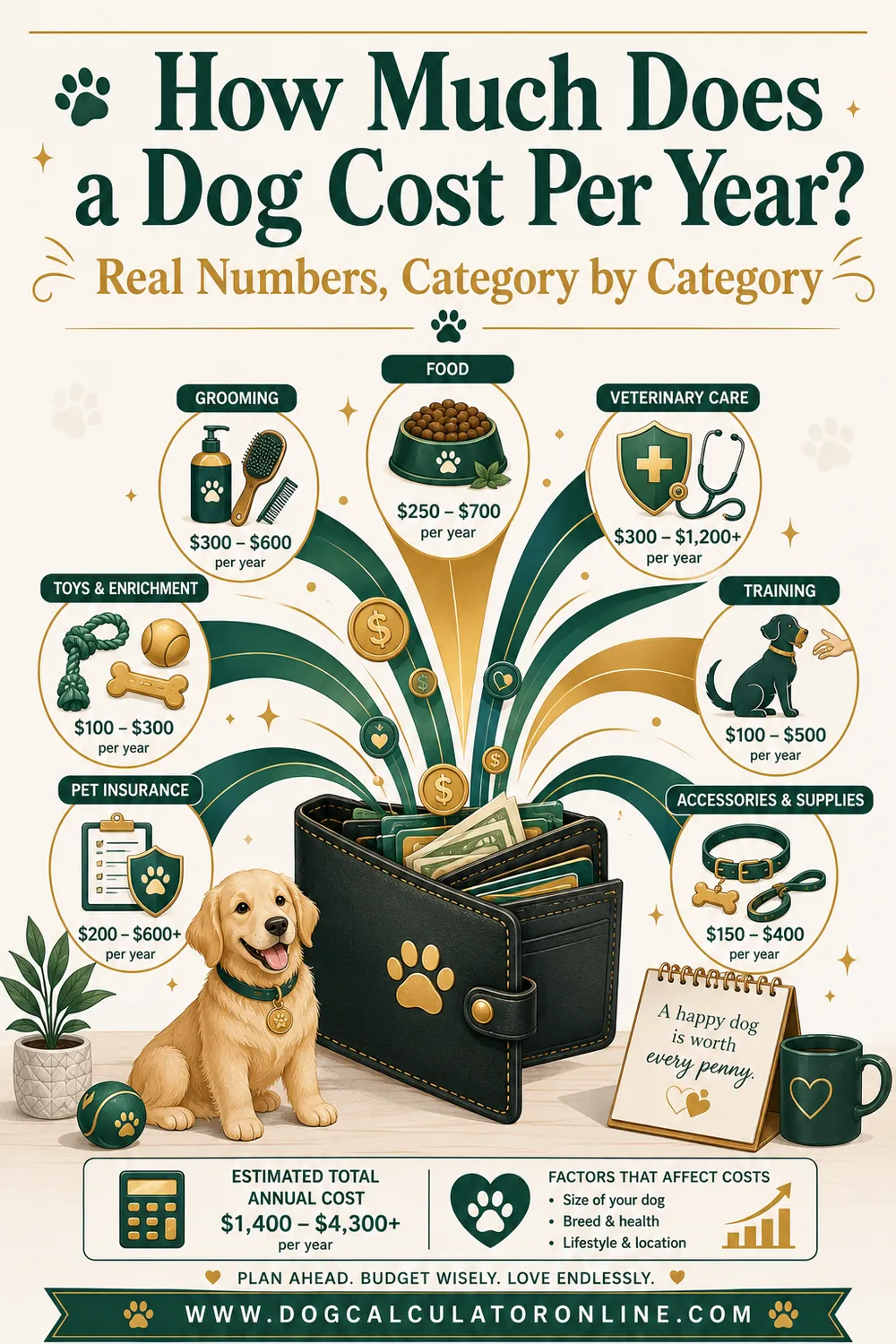
Skip the guesswork with our free dog food calculator — enter weight, activity, and your food's calories for a personalized daily portion. Feeding a puppy? Jump to the puppy feeding chart. Curious what all that food costs? See how much a dog costs per year.