How Many Calories Does My Dog Need a Day?
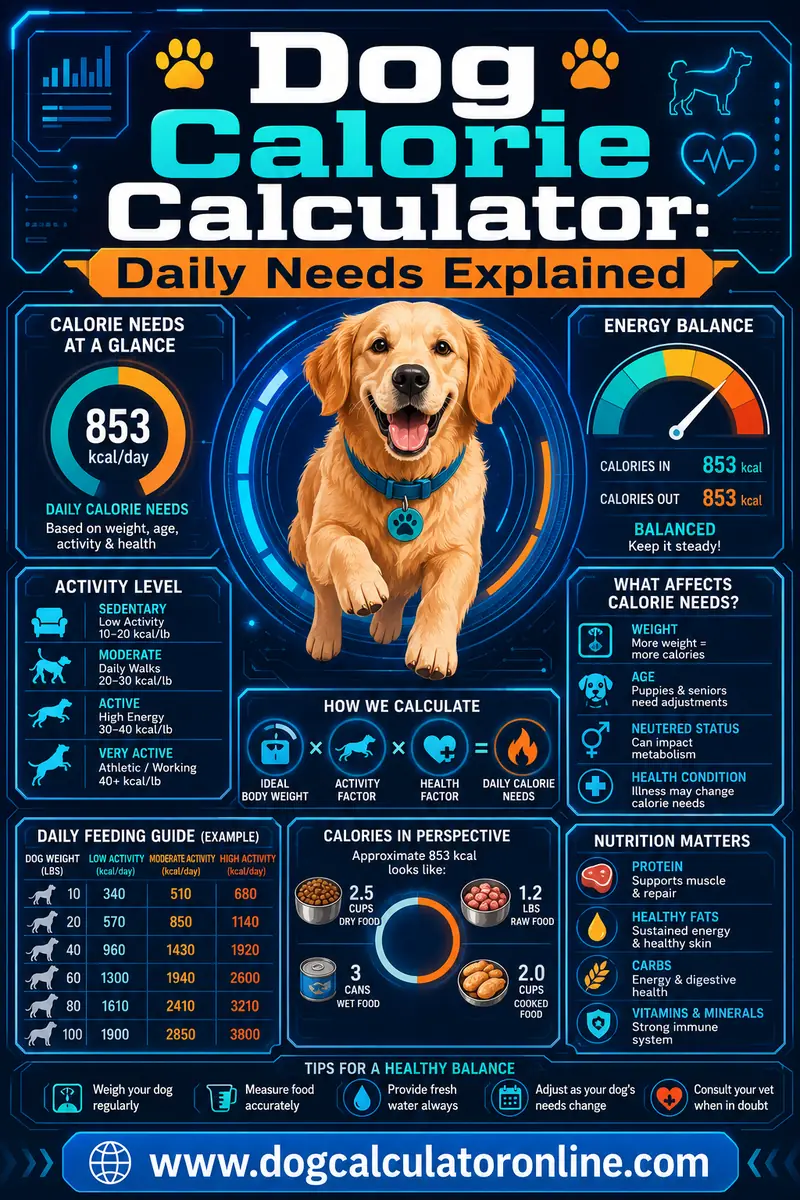
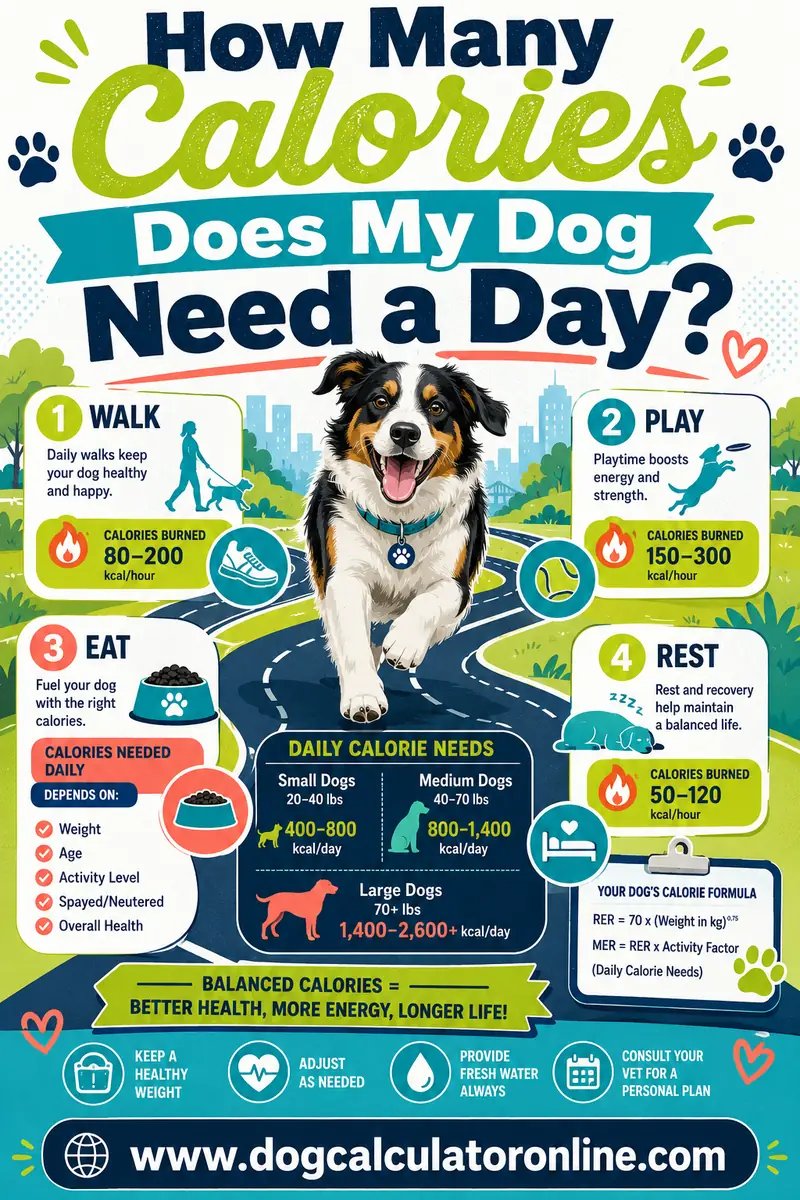
A typical neutered adult dog needs roughly 25 to 30 calories per pound of body weight per day — about 220 kcal for a 10-lb dog, 500 kcal for a 30-lb dog, 750 kcal for a 50-lb dog, and 1,050 kcal for an 80-lb dog. Puppies, working dogs, and nursing mothers need considerably more; seniors and couch potatoes need less. The exact number depends on weight, age, activity, and whether your dog is spayed or neutered.
The free dog calorie calculator does the math for your specific dog in a few seconds. Below you'll find the calorie chart by weight, how life stage changes the answer, and how to turn a calorie number into real food in a bowl.
🔥 Quick calorie check
Tap your dog’s weight for a typical daily calorie need (neutered adult):
Tap a weight above to see an estimate.
The Short Answer, by Weight
Here's the chart most owners are actually looking for. These figures assume a typical adult house dog — spayed or neutered, moderately active, healthy weight:
| Dog's weight | Calories per day (typical) | Realistic range |
|---|---|---|
| 5 lb | 140 kcal | 115–170 |
| 10 lb | 220 kcal | 180–260 |
| 15 lb | 300 kcal | 250–360 |
| 20 lb | 370 kcal | 300–440 |
| 30 lb | 500 kcal | 410–600 |
| 40 lb | 620 kcal | 510–740 |
| 50 lb | 750 kcal | 620–900 |
| 60 lb | 850 kcal | 700–1,020 |
| 80 lb | 1,050 kcal | 870–1,260 |
| 100 lb | 1,250 kcal | 1,030–1,500 |
Two things jump out. First, calorie needs don't scale in a straight line — a 100-lb dog needs far less than ten times what a 10-lb dog needs. Small dogs burn more energy per pound. Second, every row has a wide range, because individual metabolism genuinely varies by 20% or more between dogs of the same size.
That's why any chart — including this one — is a starting point, not a verdict. You start in the range, then adjust based on your dog's body condition over the following weeks.
Where These Numbers Come From
Veterinary nutrition uses a two-step formula, and it's worth seeing once so the numbers aren't a mystery.
Step 1: Resting Energy Requirement (RER). This is what your dog burns just existing — breathing, staying warm, digesting. The formula is RER = 70 × (weight in kg)^0.75.
Step 2: Multiply by lifestyle. A typical neutered adult gets about 1.6 × RER. An intact adult gets about 1.8. A quiet senior might get 1.2 to 1.4. A working farm dog can run 2 to 5 times RER, and a nursing mother can need 4 to 8 times RER at peak milk production.
For a 50-lb (22.7 kg) dog: RER ≈ 727 kcal, times 1.6 ≈ 1,160 kcal — noticeably above the 750 in the chart. That gap is real and worth understanding: the strict formula assumes a reasonably active dog, while most modern pets are closer to "two walks and a nap." Real-world feeding charts, and the dog calorie calculator, lean toward the practical end. When in doubt, start lower and watch the waistline.
How Life Stage Changes the Answer
The same dog needs very different calorie totals across its life.
- Puppies under 4 months run at roughly 3 × RER — per pound, about double an adult's needs. Growth is metabolically expensive.
- Puppies from 4 months to adult size drop to about 2 × RER. This taper is why puppy portions need re-checking every few weeks.
- Adults (1–7 years) sit at the 1.4–1.6 × RER range that the chart above reflects.
- Seniors typically need 10–20% fewer calories as activity drops. Some older dogs actually need more protein even while eating fewer calories — a good topic for the senior wellness visit.
- Pregnant dogs need little extra until the final third of pregnancy, when needs climb toward 3 × RER.
- Nursing mothers have the highest calorie needs a dog will ever experience — commonly 4 to 8 times RER depending on litter size. Many vets suggest free-feeding a nursing dog a high-calorie diet; ask yours what's right for your situation.
How Activity Changes the Answer
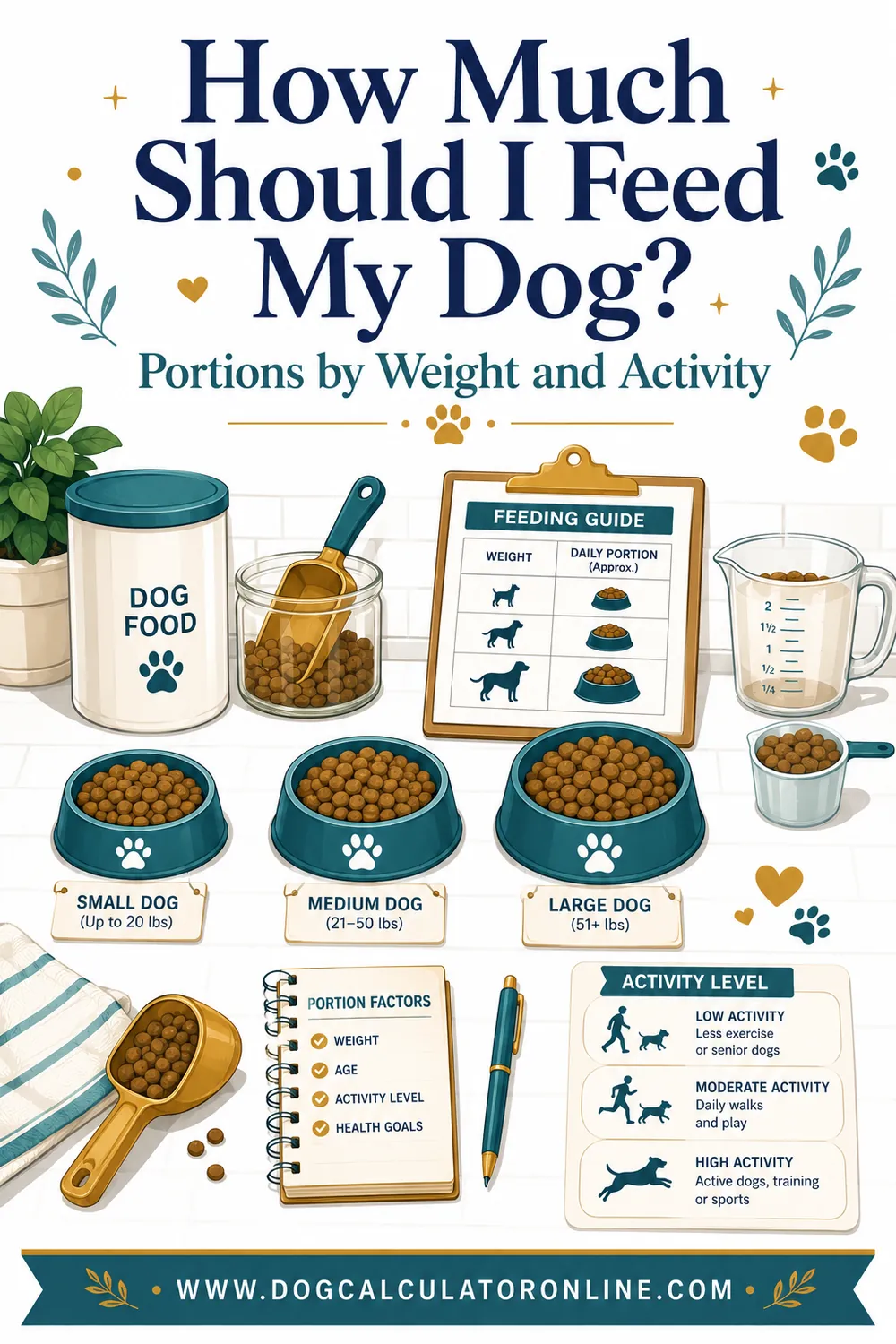
Activity is the biggest lever after weight, and owners routinely overestimate it. A useful gut check:
| Activity level | What it actually looks like | Adjustment |
|---|---|---|
| Low | Short leash walks, mostly indoors | −10–20% from typical |
| Moderate | 30–60 min of daily walks and play | The chart as-is |
| High | 1–2 hours of running, hiking, fetch daily | +20–40% |
| Working / sport | Herding, sledding, field trials | Can be 2× typical or more |
An hour of casual sniffing around the block is low to moderate, not high. Marking your dog "active" when they're really "enthusiastic about dinner" is one of the most common reasons calorie estimates come out too high.
Season matters too. A dog that hikes all summer and hibernates all winter can honestly need a few hundred fewer calories a day in January than in July — for a big dog, that's a real difference in the bowl.
Turning Calories Into Cups of Food
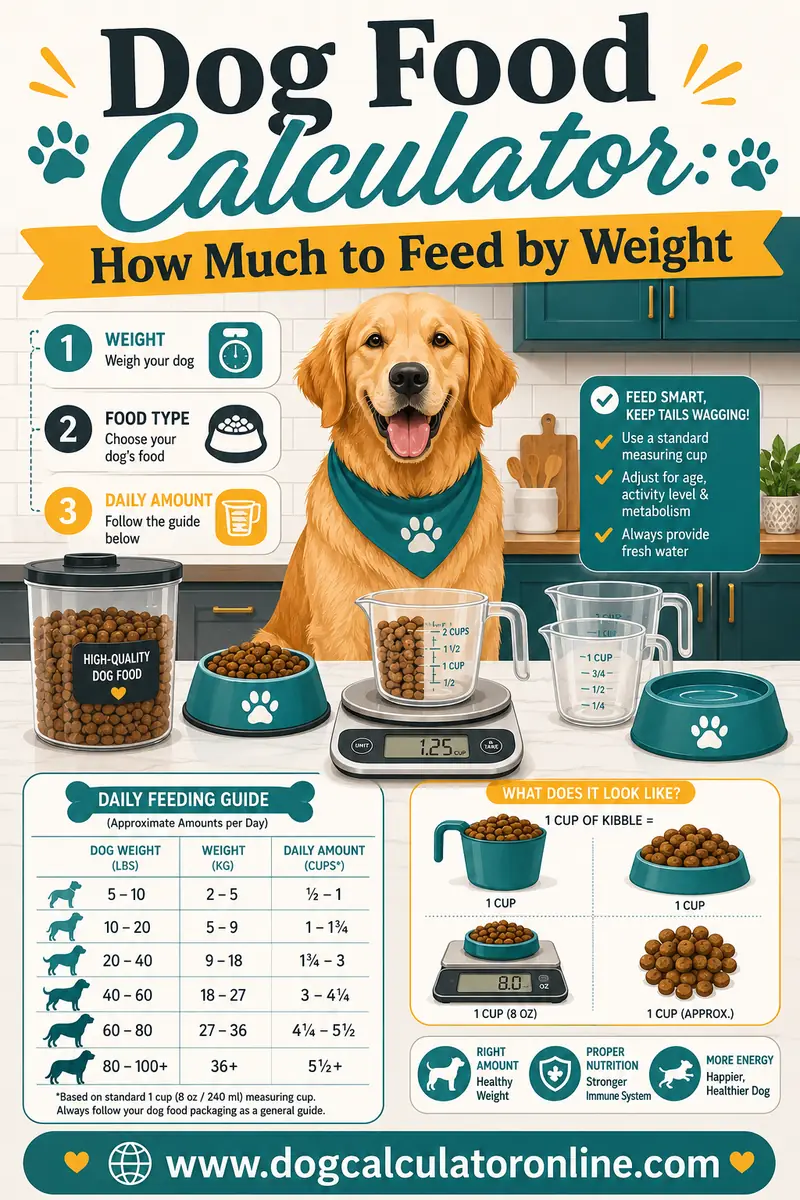
A calorie target only helps once it becomes a portion. Every complete dog food sold in the US lists a calorie content statement on the label — typically kcal per cup for kibble and kcal per can for wet food.
The conversion is one line: cups per day = daily calorie target ÷ kcal per cup.
Dry foods commonly run 300–450 kcal per cup, which means the same dog might need 2½ cups of one food but only 1⅔ cups of another. This is exactly why "how many cups?" has no universal answer and why switching foods without re-doing the math quietly adds weight. The dog food calculator chains the whole thing together — weight in, cups out — and there's a deeper dive in how many kcals should my dog eat.
Weigh the portion once with a kitchen scale if you can. Scooped "cups" are notoriously generous, and a 10% daily over-scoop compounds into a visibly rounder dog within months.
Don't Forget Treats — They Count
The standard veterinary guidance is that treats should make up no more than 10% of daily calories. That's not just about weight — the main food is formulated to be complete and balanced, and a treat-heavy diet dilutes it.
Put the 10% rule in real numbers: a 30-lb dog on 500 kcal a day has a 50-kcal treat budget. A single medium dog biscuit can use most of that. A dental chew can blow past it. A tablespoon of peanut butter is roughly 90 kcal — nearly double the budget in one lick session.
Practical fixes: subtract treat calories from meals rather than adding them on top, break big treats into several small pieces (dogs count events, not grams), and lean on green beans, carrot pieces, or a bit of plain air-popped popcorn for high-frequency rewards.
Signs You've Got the Number Right (or Wrong)
Your dog's body is the final answer key. Check monthly:
- Ribs: you should feel them easily with flat palms and gentle pressure — padded, not buried, not sharp.
- Waist: a visible tuck behind the ribs when viewed from above.
- Tummy line: rising from chest toward hips when viewed from the side.
If your dog is drifting soft and round, cut daily calories by about 10% and re-check in two to three weeks. Too bony, add 10%. And if weight is changing quickly while the food hasn't — in either direction — that's a vet conversation, because thyroid problems and other medical issues can move weight independently of the bowl.
For portion sizes rather than calorie counts, our companion guide on how much to feed your dog translates all of this into cups by weight.
FAQ
How many calories does my dog need per day?
A typical neutered adult needs roughly 220 kcal at 10 lb, 370 at 20 lb, 500 at 30 lb, 750 at 50 lb, and 1,050 at 80 lb. Active dogs need more; seniors and low-activity dogs need less. The dog calorie calculator gives a number tailored to your dog.
How many calories per pound should I feed my dog?
Roughly 25–30 kcal per pound for a typical mid-sized adult, but it scales with size: small dogs may need 35–40 kcal per pound while giant breeds may need closer to 20. That's why per-pound rules are rougher than the weight chart.
Do puppies need more calories than adult dogs?
Yes — per pound, roughly double. Puppies under 4 months run at about 3 × their resting energy requirement, easing to about 2 × until they reach adult size.
How many calories should my overweight dog eat?
Weight-loss plans typically feed for the dog's target weight at a reduced multiplier, which often lands around 60–70% of their current-weight maintenance number. Make the plan with your vet — crash-dieting a dog is unsafe, especially for small breeds.
How many calories are in a cup of dog food?
Commonly 300–450 kcal per cup for dry food, but it varies a lot between formulas. The exact figure is printed on your bag as the calorie content statement — always use your own label.
Why is my dog gaining weight on the "right" calories?
The usual suspects: uncounted treats and table scraps, an activity level set too optimistically, and scooping instead of weighing. Trim 10%, count everything for two weeks, and re-check. Persistent unexplained gain deserves a vet visit.
The Bottom Line
Your dog's daily calorie need comes down to weight × life stage × honest activity level — roughly 220 kcal at 10 lb up to about 1,250 kcal at 100 lb for typical adults, with puppies and hard workers needing much more. Get the estimate, convert it with your food label's kcal per cup, keep treats under 10%, and let ribs and waistline fine-tune the rest.
Skip the hand math: run your dog through the free dog calorie calculator for a personalized daily number, then see the dog calorie calculator guide if you want the formula behind it.