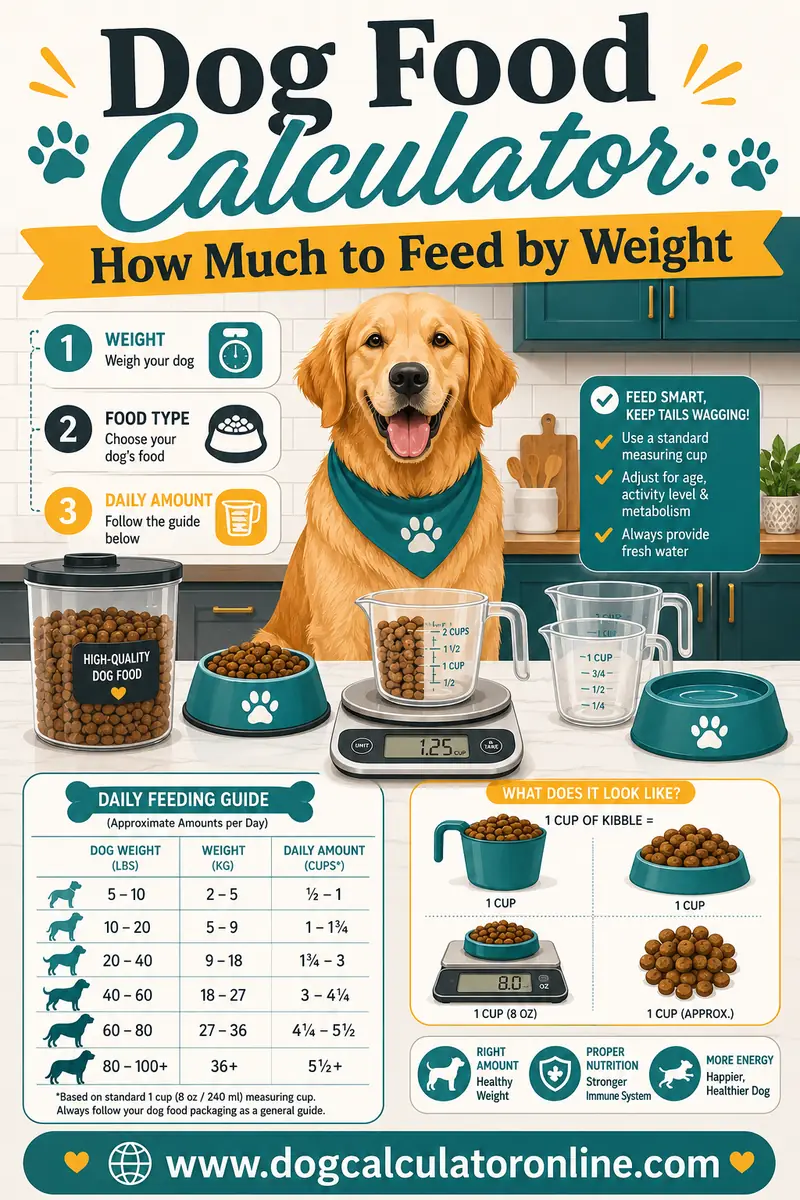
Dog Food Calculator: How Much to Feed by Weight
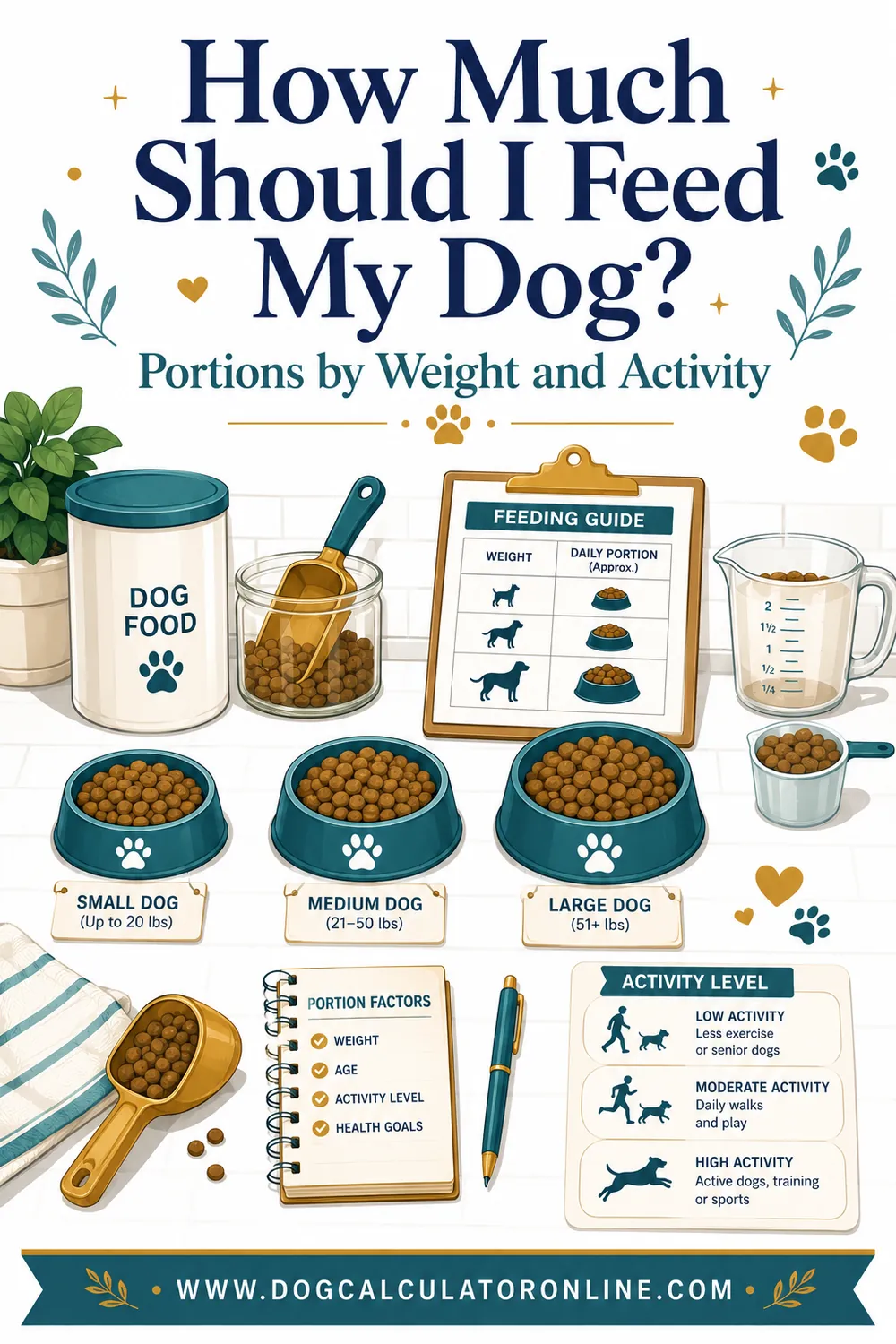
A dog food calculator takes three things — your dog's weight, activity level, and the calories in your specific food — and turns them into a daily portion. For a quick starting point: a typical 10-lb adult dog needs about ½–¾ cup of dry food per day, a 25-lb dog about 1–1½ cups, a 50-lb dog about 1¾–2½ cups, and a 75-lb dog about 2½–3¼ cups. Your dog's exact number depends on the food's calorie density, so always check the bag and confirm big changes with your vet.
Our free dog food calculator does the math in seconds. Below you'll find the full chart by weight, the formula behind it, and how to fine-tune the result so your dog stays at a healthy weight.
🥣 Quick portion check (adult dog, dry food)
Tap your dog’s weight for an estimated daily amount:
Tap a weight above for an estimated daily portion.
What a Dog Food Calculator Actually Does
A good calculator doesn't guess in cups. It works in calories, then converts to cups at the end. Here's the chain:
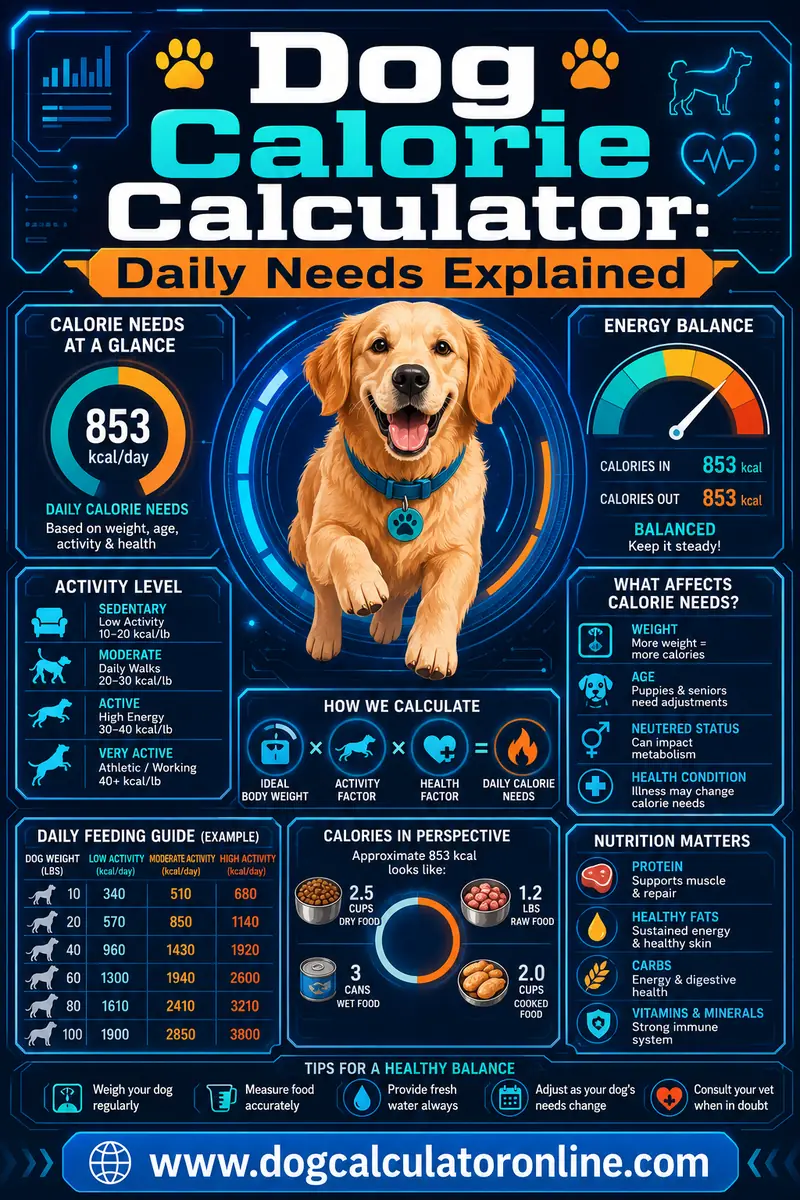
- Weight → resting calories. The calculator starts with your dog's Resting Energy Requirement (RER), the calories a dog burns just existing.
- Activity → daily calories. RER gets multiplied by a factor for your dog's life stage and activity — a neutered couch companion needs far less than a working farm dog.
- Food label → cups. Daily calories get divided by your food's calories per cup (printed on every bag) to give the actual scoop amount.
That last step is why two dogs of the same weight can need very different amounts of food. A dense performance kibble might pack 450 kcal into a cup while a weight-management formula holds 300. Same dog, same calories — very different portions. If you want to see the calorie math on its own, our dog calorie calculator breaks out that middle step.
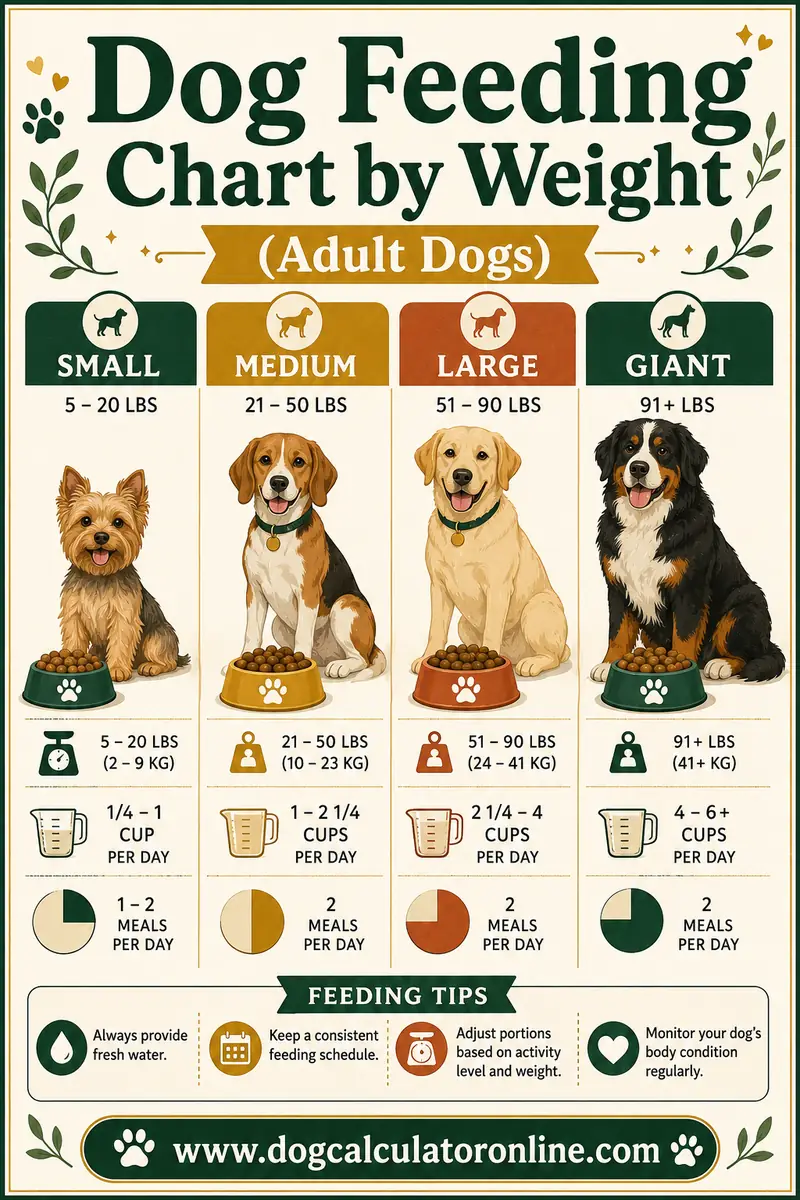
Dog Feeding Chart by Weight
If you just want a starting number, this chart assumes a healthy adult dog with moderate activity eating a standard dry food around 350–400 kcal per cup:
| Dog weight | Daily calories (approx.) | Dry food per day |
|---|---|---|
| 5 lb | 140–170 | ⅓–½ cup |
| 10 lb | 200–275 | ½–¾ cup |
| 15 lb | 275–350 | ¾–1 cup |
| 25 lb | 400–550 | 1–1½ cups |
| 35 lb | 500–700 | 1½–2 cups |
| 50 lb | 700–950 | 1¾–2½ cups |
| 65 lb | 900–1,150 | 2¼–3 cups |
| 75 lb | 1,000–1,250 | 2½–3¼ cups |
| 90 lb | 1,150–1,450 | 3–3¾ cups |
| 100 lb | 1,300–1,600 | 3¼–4¼ cups |
Split the daily total into two meals for most adult dogs. These are estimates — your food's label and your dog's body condition make the final call, and your vet can confirm a target if your dog is over or under weight.
The Formula Under the Hood
The math most veterinary nutrition resources use starts with RER:
RER = 70 × (body weight in kg)^0.75
Then daily calories = RER × a multiplier:
| Dog | Multiplier |
|---|---|
| Weight loss (vet-guided) | 1.0 × RER |
| Neutered adult, typical | 1.6 × RER |
| Intact adult | 1.8 × RER |
| Active / working | 2.0–5.0 × RER |
| Senior / low activity | 1.2–1.4 × RER |
| Puppy under 4 months | ~3.0 × RER |
| Puppy 4 months to adult | ~2.0 × RER |
Worked example: a 30-kg (66-lb) neutered adult. RER = 70 × 30^0.75 ≈ 897 kcal. Multiply by 1.6 → about 1,435 kcal per day. On a 400 kcal/cup food, that's roughly 3½ cups, split into two meals.
You don't need to memorize any of this — the dog food calculator runs it for you — but knowing the logic helps you sanity-check any feeding advice you read.
Why the Bag's Chart Isn't Enough
Every bag of dog food prints feeding guidelines, so why use a calculator at all? Three reasons:
- Bag charts run generous. They're usually written for intact, active dogs. Most family pets are neutered and moderately active, which means the bag can overshoot by a meal's worth of calories a week.
- Bag charts use huge weight bands. "26–50 lb: 2–3 cups" isn't much help when a 26-lb dog and a 50-lb dog have very different needs.
- Bag charts can't see your dog. Activity, age, body condition, and treat habits all shift the right portion. A calculator lets you dial those in.
Treat the bag as a cross-check, not the answer. If the calculator and the bag disagree wildly, start between the two numbers and watch your dog's body condition.
Adjusting the Calculator's Answer
Any calculator output is a starting point. Fine-tune it with these rules:
- Feel for ribs every couple of weeks. You should feel them with light pressure, like the back of your hand. Buried ribs mean trim the portion; sharply visible ribs mean add.
- Adjust in 10% steps. Small changes, then re-check in two weeks. Big swings cause stomach upset and rebound hunger.
- Count treats. Keep them under about 10% of daily calories and subtract them from meals. A single dental chew can be 70+ kcal — real money for a 15-lb dog.
- Recalculate after life changes. Neutering, turning senior, an injury that cuts exercise, or a new running habit all change the multiplier.
- Overweight dog? Feed for the goal weight, not the current weight, and loop in your vet on a safe pace before making a big cut.
Feeding by Weight in kg
If you think in kilograms, the same chart converts cleanly. A 10-kg dog (about 22 lb) needs roughly 470–630 kcal per day; a 20-kg dog (about 44 lb) roughly 795–1,060 kcal; a 30-kg dog (about 66 lb) roughly 1,075–1,435 kcal — the spread is the 1.2–1.6 × RER range for a typical adult pet dog. The RER formula is metric-native — weight in kg raised to the 0.75 power, times 70 — so a calculator handles kg just as easily as pounds. Enter whichever unit you use at the vet.
Wet Food, Toppers, and Mixed Bowls
The cup amounts above assume dry kibble. If your dog eats wet food, a topper, or a mix:
- Work in calories, not volume. Wet food is mostly moisture, so a cup of it carries far fewer calories than a cup of kibble. Check the can's kcal statement.
- Budget the bowl. Find the daily calorie target, then split it: if the topper adds 150 kcal, subtract 150 kcal worth of kibble.
- Weigh in grams for precision. A kitchen scale beats a scoop, especially for small dogs where 10 extra kibbles a meal adds up over a year.
What About Raw Diets?
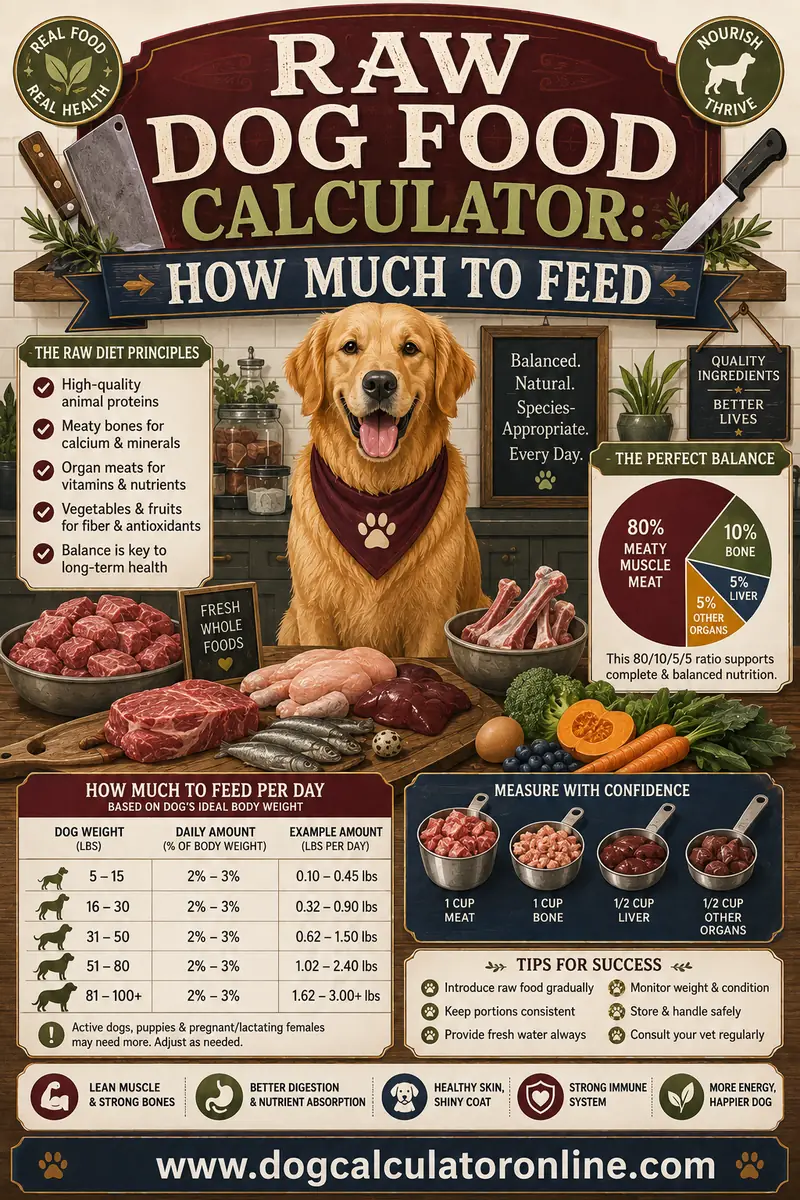
Raw feeders usually portion differently — by percentage of body weight rather than by cups. The common starting guideline in raw feeding communities is about 2–3% of an adult dog's body weight per day, adjusted for activity and body condition. Raw diets also carry food-safety and nutritional-balance considerations that kibble doesn't, so talk to your vet before switching. If that's your route, our raw dog food calculator converts weight into daily raw portions, and the companion article covers the details.
Common Mistakes a Calculator Helps You Avoid
- Eyeballing the scoop. A "cup" scooped generously can run 20% over. Use a real measuring cup or a gram scale.
- Free-feeding. Leaving the bowl full makes portion control impossible. Measured meals let the math work.
- Forgetting to update after a food switch. New bag, new kcal/cup, new portion. Recalculate every time you change foods.
- Feeding the same amount year-round. A dog that hikes all summer and naps all winter doesn't need identical portions in July and January.
- Ignoring the 10% treat rule. Training treats, chews, and table scraps count toward the daily total.
Three Worked Examples: Real Dogs, Real Portions
Watching the math run end-to-end makes the whole system click. Three typical households:
Bella, 12-lb neutered senior terrier, short daily walks. 12 lb ≈ 5.5 kg. RER = 70 × 5.5^0.75 ≈ 250 kcal. Senior/low-activity multiplier of about 1.3 → roughly 325 kcal per day. Her food runs 380 kcal per cup, so she gets about ¾ cup daily, split into two small meals — and because she adores training treats, her owner budgets 30 of those calories for them and scoops accordingly.
Cooper, 45-lb neutered adult mix, two brisk walks plus weekend hikes. 45 lb ≈ 20.4 kg. RER ≈ 70 × 20.4^0.75 ≈ 672 kcal. He's more active than average, so a 1.8 multiplier fits → about 1,210 kcal per day. His kibble is calorie-dense at 440 kcal/cup, so he eats about 2¾ cups daily — noticeably less volume than the bag's "3–4 cups" band suggests, which is exactly the trap dense foods set.
Luna, 80-lb intact working shepherd on a farm. 80 lb ≈ 36.3 kg. RER ≈ 70 × 36.3^0.75 ≈ 1,037 kcal. Genuine working activity earns a 2.5 multiplier → roughly 2,590 kcal per day, or about 6½ cups of a 400 kcal/cup food across two or three meals.
Same formula, three very different bowls. All three are estimates to refine against body condition — and worth confirming with a vet, especially for Bella's senior metabolism and Luna's workload.
Body Condition Score: How to Grade Your Own Answer
The calculator proposes; your dog's body disposes. Vets formalize the rib-check into a body condition score (BCS), usually on a 9-point scale, and it's easy to run at home:
- Ribs: With flat hands on the rib cage, you should feel ribs under a thin cushion — like the bones on the back of your hand. Ribs you can see from across the room score too thin; ribs you have to press to find score too heavy.
- Waist: From above, a healthy dog narrows visibly behind the ribs. A straight or bulging profile means excess weight.
- Tummy tuck: From the side, the belly should slope up from chest toward hips rather than hanging level.
A dog hitting all three marks sits around the ideal 4–5 out of 9 — and whatever portion produced that result is the right portion, regardless of what any chart says. Re-run the check every couple of weeks; it takes thirty seconds during a cuddle and catches drift months before the vet's scale does. If you're unsure how to score your dog, ask at the next visit — vets love being asked this question far more than they love the alternative.
FAQ
How much food should I feed my dog by weight?
As a rough guide on standard dry food: ½–¾ cup daily for a 10-lb dog, 1–1½ cups for 25 lb, 1¾–2½ cups for 50 lb, and 2½–3¼ cups for 75 lb. Your food's calorie density shifts these numbers, so check the label or use the dog food calculator.
How does a dog food calculator work?
It calculates your dog's resting calorie needs from body weight (RER = 70 × kg^0.75), multiplies by an activity factor, then divides by your food's calories per cup to produce a daily portion.
Is the feeding chart on the bag accurate?
It's a reasonable starting range, but bag charts tend to run high and use wide weight bands. Start at the low-to-middle end and adjust based on your dog's body condition.
How many cups of dog food are in a pound?
Roughly 3½–4 cups per pound for typical dry kibble, though it varies with kibble size and density. That's useful for estimating how long a bag lasts, not for portioning — portion by calories instead.
Should I weigh my dog's food instead of using cups?
Yes, if you can. Grams on a kitchen scale are far more consistent than scoops, and consistency is what keeps weight stable — especially for small dogs.
How often should I recalculate my dog's portion?
Whenever weight, activity, life stage, or food changes — and at least a couple of times a year. Re-check body condition every two weeks and nudge portions 10% at a time.
Does the calculator work for puppies too?
Yes, with different multipliers — puppies under 4 months need roughly 3 × RER and older puppies about 2 × RER, because growing is calorie-expensive. Puppy portions also change every few weeks as weight climbs, so recalculate often, feed a food labeled for growth, and let your vet confirm the plan at each puppy visit.
The Bottom Line
A dog food calculator beats guesswork because it works the way vets do: weight → calories → cups, using your actual food's label. Start with the chart above, run your dog's real numbers through the free dog food calculator, and then let body condition — ribs you can feel, a waist you can see — steer the fine-tuning. For the calorie step in detail, see the dog calorie calculator guide, or jump to the full dog feeding chart by weight.