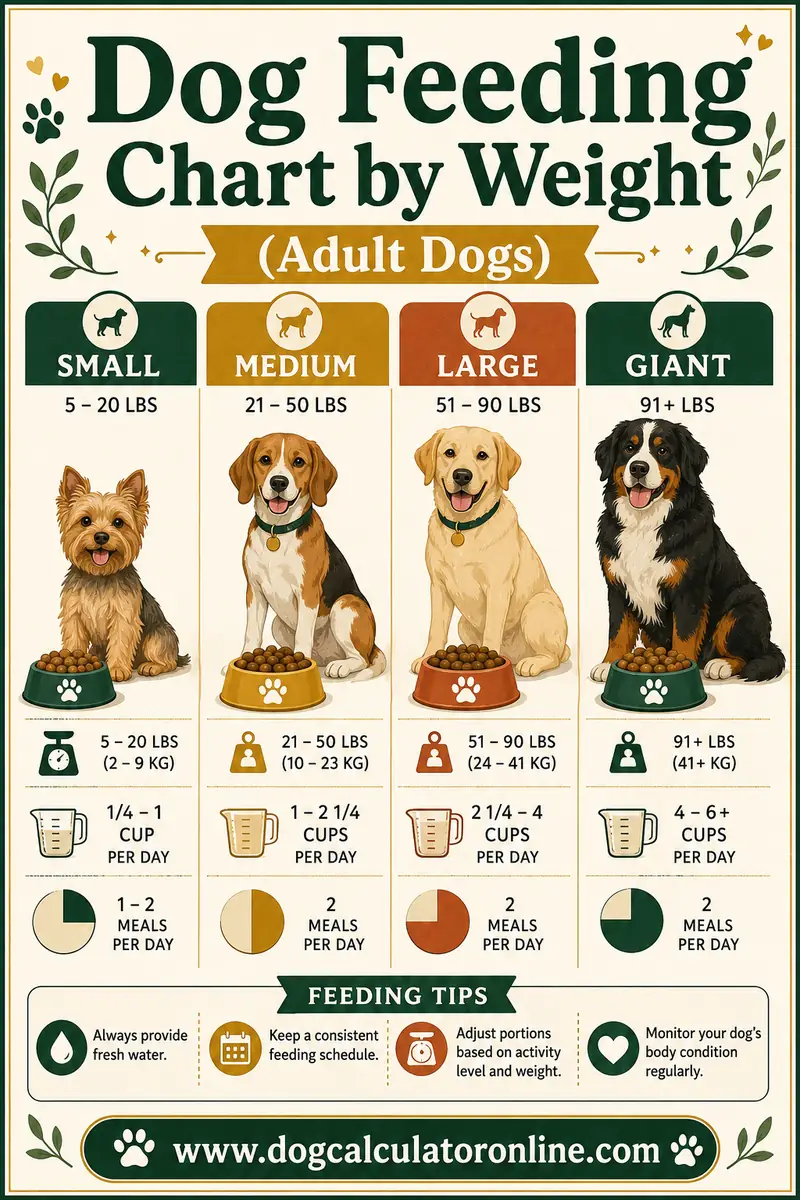
Dog Feeding Chart by Weight (Adult Dogs)
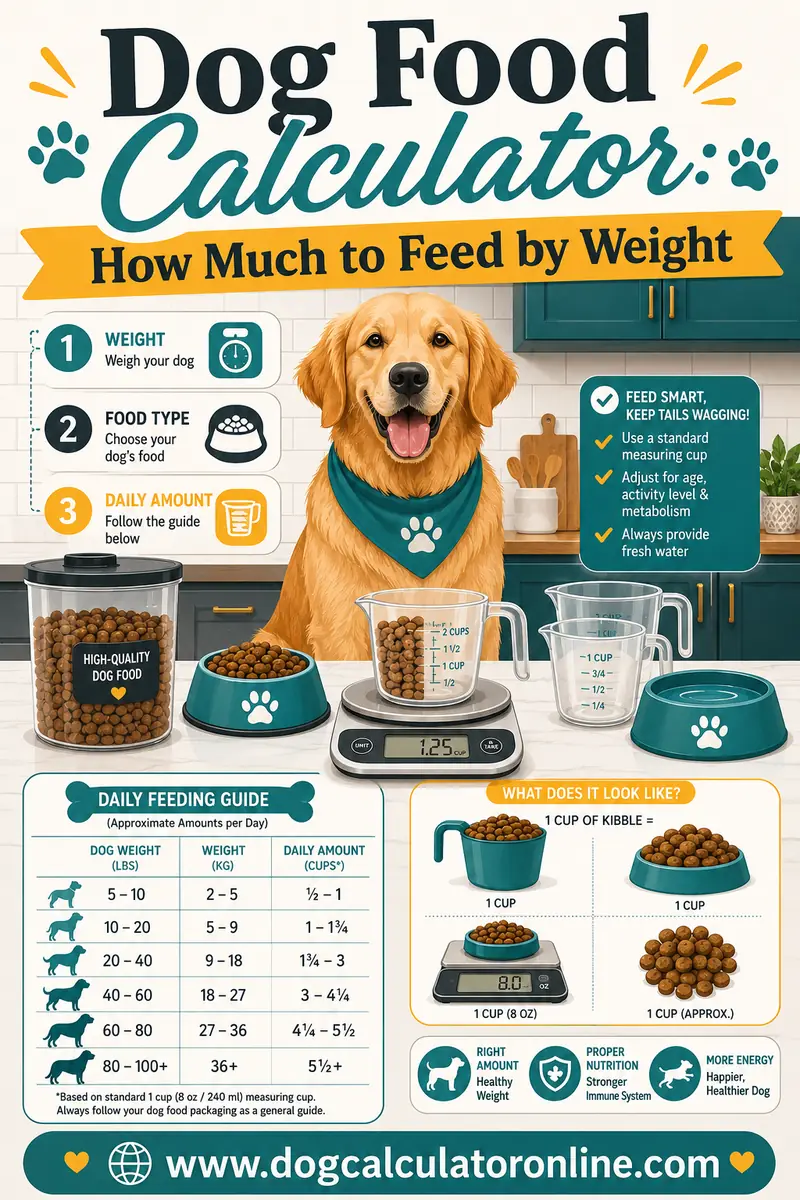
A typical neutered adult dog needs roughly ¾–1 cup of standard dry food per day at 10 lb, 1½–2 cups at 25 lb, 2½–3¼ cups at 50 lb, and 3¾–4½ cups at 75 lb — split into two meals. Those ranges assume an average kibble around 350–400 kcal per cup; your bag's calorie density and your dog's activity level can move the real number by 25% or more in either direction.
That's why a chart is a starting point, not a prescription. The free dog food calculator runs the same weight-to-calories-to-cups math vets use, with your dog's actual details. Below: the full chart, the formula behind it, and how to adjust it until it fits the one dog you're actually feeding.
🍽️ Quick portion check
Tap your adult dog’s weight for a typical daily portion (standard kibble, neutered adult):
Tap a weight above for an estimate. Your food’s kcal-per-cup changes the cup count.
The Adult Dog Feeding Chart
Daily amounts for typical neutered adult dogs at normal activity, assuming kibble around 375 kcal per cup. Split the total into two meals.
| Adult weight | Daily calories (approx.) | Dry food per day | Per meal (2 meals) |
|---|---|---|---|
| 5 lb | ~180–210 kcal | ~½ cup | ~¼ cup |
| 10 lb | ~275–350 kcal | ~¾–1 cup | ~½ cup |
| 15 lb | ~390–460 kcal | ~1–1¼ cups | ~½–⅔ cup |
| 20 lb | ~475–575 kcal | ~1¼–1½ cups | ~⅔–¾ cup |
| 25 lb | ~550–700 kcal | ~1½–2 cups | ~¾–1 cup |
| 35 lb | ~700–875 kcal | ~2–2⅓ cups | ~1–1¼ cups |
| 50 lb | ~900–1,150 kcal | ~2½–3¼ cups | ~1¼–1⅔ cups |
| 65 lb | ~1,100–1,400 kcal | ~3–3¾ cups | ~1½–1⅞ cups |
| 75 lb | ~1,250–1,550 kcal | ~3¾–4½ cups | ~1⅞–2¼ cups |
| 90 lb | ~1,400–1,750 kcal | ~4–4¾ cups | ~2–2⅓ cups |
| 100 lb | ~1,550–1,950 kcal | ~4½–5½ cups | ~2¼–2¾ cups |
Three honest caveats. First, these are estimates for average dogs — a couch-potato Basset and a field-trial Lab at the same weight can differ by hundreds of calories. Second, kibble calorie density varies enormously (roughly 300 to 500+ kcal per cup), so always check your own bag's label. Third, the chart assumes your dog is already at a healthy weight; if your dog needs to lose or gain, portion for the target weight, ideally with your vet's guidance.
The Formula Behind the Chart
Vets don't guess portions — they calculate calories in two steps, and the chart above is just that math pre-run for common weights.
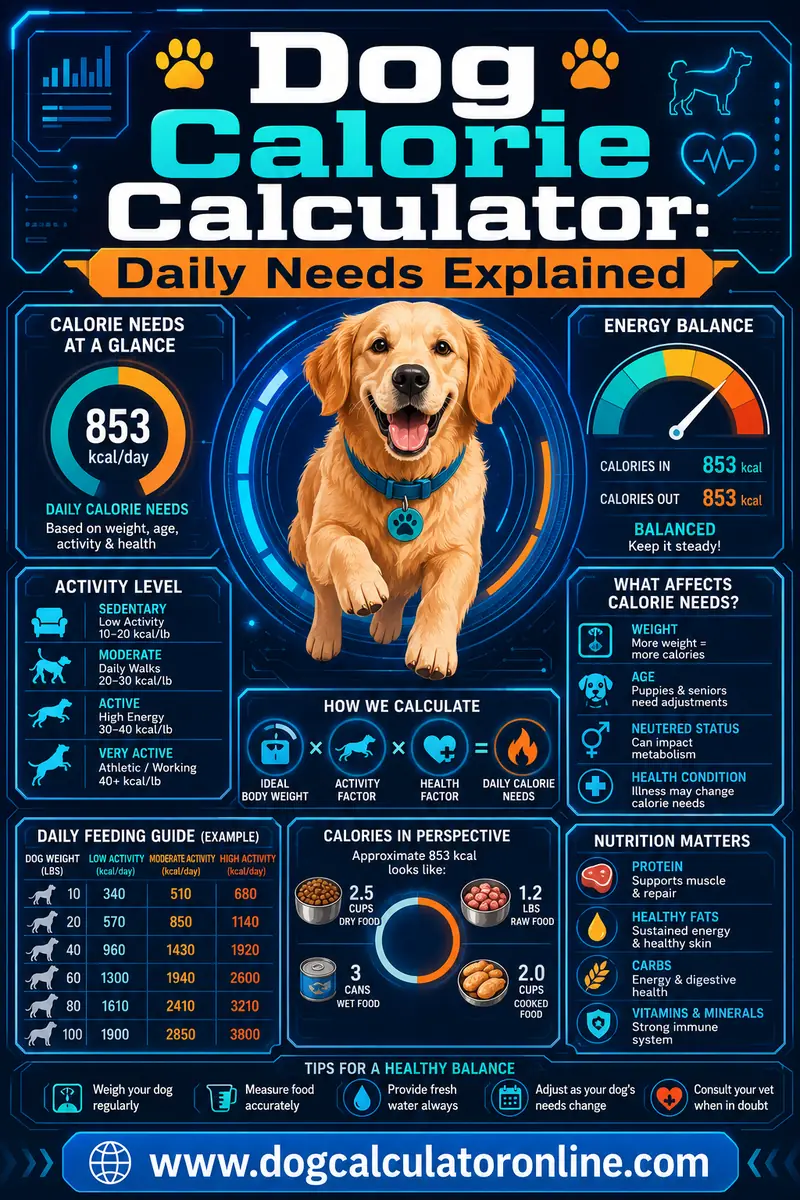
Step 1 — Resting Energy Requirement (RER). This is what your dog burns just existing: `RER = 70 × (weight in kg)^0.75`. A 50-lb (22.7 kg) dog has an RER around 730 kcal.
Step 2 — Multiply for lifestyle. RER gets multiplied by a factor for your dog's situation: about 1.6 for a typical neutered adult, ~1.8 for an intact adult, higher for genuinely working or sporting dogs, and lower for weight loss. Our 50-lb neutered example: 730 × 1.6 ≈ 1,170 kcal per day.
Step 3 — Convert calories to cups. Divide daily calories by the kcal-per-cup number printed on your bag. At 375 kcal/cup, that 1,170 kcal becomes just over 3 cups a day.
You don't need to memorize any of it — the dog food calculator runs all three steps in seconds — but knowing the logic lets you sanity-check any chart, including this one and the one on your bag. The dog calorie calculator guide breaks down the middle step in more detail.
Why Your Bag's Chart and This Chart Disagree
Put your food bag's feeding table next to the chart above and you'll probably see different numbers. That's expected, for three reasons:
- Bag charts are tuned to that specific food's calorie density, while a generic chart assumes an average kibble.
- Bag charts often run generous. They're written for a wide range of dogs, and the upper ends tend to suit very active dogs — feeding an ordinary house dog from the top of the bag range is a common route to weight gain.
- Bag charts can't see your dog. Age, neuter status, and activity all move the number, and the bag knows none of them.
The practical resolution: start from a calculated estimate (chart or calculator), compare it against your bag's range, pick the point that matches your dog's activity honestly, and then let body condition make the final call.
Body Condition: The Feedback Loop That Beats Every Chart
Every chart, calculator, and label produces a starting number. Your dog's body tells you whether it's right. Check monthly:
- Ribs: you should feel them easily under a light layer of padding — like the back of your hand, not like a bag of marbles (too thin) or a padded armrest (too heavy).
- Waist: viewed from above, there should be a visible tuck behind the ribs.
- Belly: from the side, the belly should slope up from chest to hind legs, not hang level.
If your dog is drifting plump, cut the daily portion by about 10% and re-check in two to four weeks. Drifting thin, add 10%. Small, patient adjustments beat dramatic ones — and a dog whose weight changes rapidly without a portion change deserves a vet visit rather than a bigger scoop.
Adjusting the Chart for Real Life
The most common tweaks, in the direction they push portions:
- Spayed/neutered: metabolism runs a bit lower; most fixed dogs sit at or below the chart midpoint.
- Senior dogs: activity usually drops with age, and portions should follow — many seniors need 10–20% fewer calories than their younger selves, though some need more protein. Worth a vet conversation at the annual exam.
- High activity: a dog who genuinely runs, hikes, or works hours daily can need well above the chart. Weekend fetch doesn't count as "working dog."
- Treats and extras: everything counts. Keep treats under about 10% of daily calories and subtract them from meals — a 25-lb dog's entire treat budget is only about 55–70 kcal.
- Cold outdoor living: dogs who live or work outdoors in winter burn more; indoor dogs in heated homes don't.
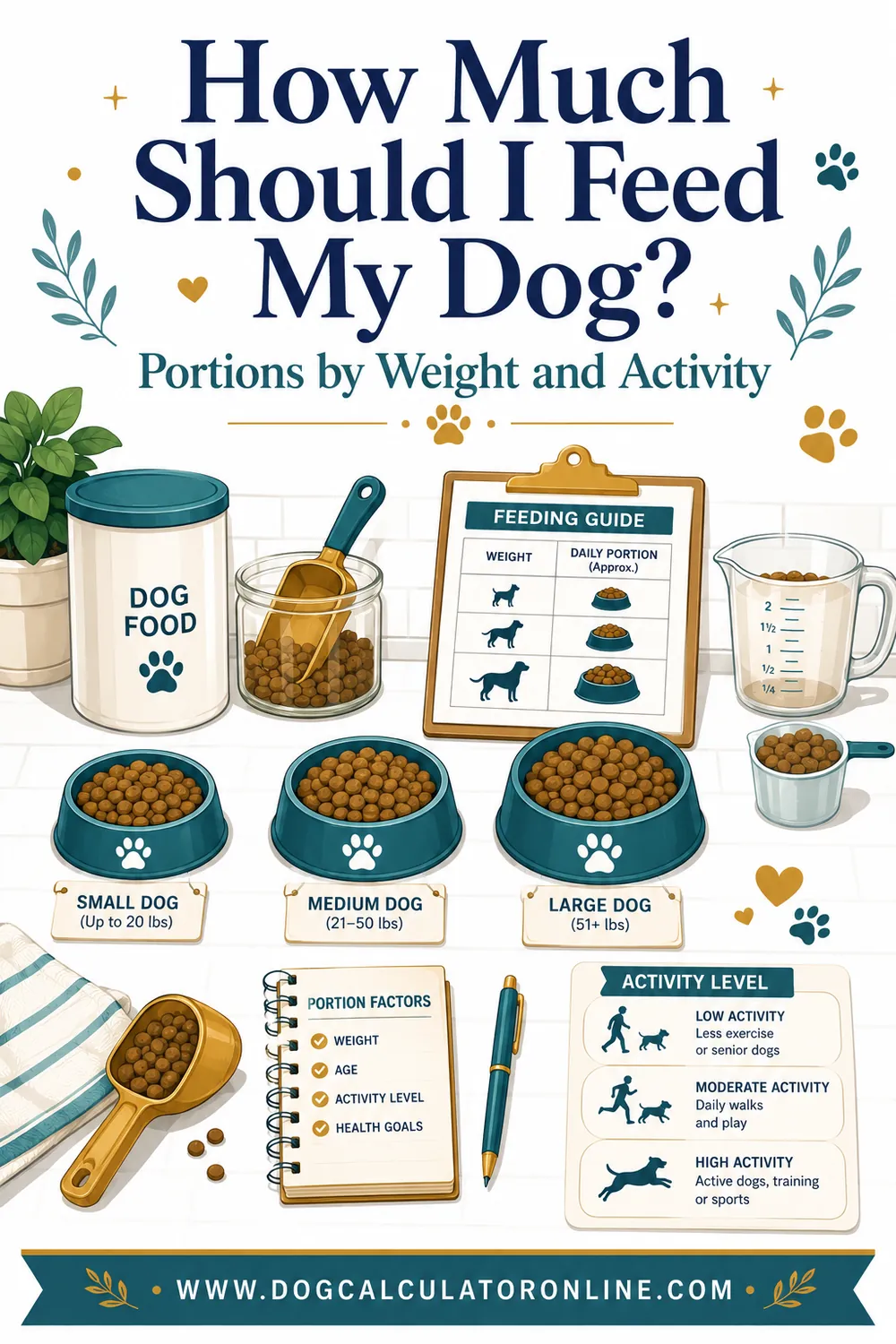
For a deeper walkthrough of these adjustments, see how much should I feed my dog.
Small Dogs vs Big Dogs: Why the Chart Isn't a Straight Line
Look closely at the chart and you'll notice a 100-lb dog doesn't eat ten times what a 10-lb dog eats — it eats roughly five times as much. That's not a typo. Calorie needs scale with metabolic body size (weight raised to the 0.75 power), not raw pounds. Small dogs run hot for their size; big dogs are metabolically efficient.
Two practical consequences follow. For small breeds, every stray calorie is enormous in relative terms — a single 35-kcal biscuit is 10% of a 10-lb dog's entire day, the equivalent of a person eating an extra cheeseburger. Portion drift that a Great Dane would shrug off will pudge a Yorkie in weeks. For large breeds, the danger runs the other way: owners scale portions up linearly ("he's twice the size, double the food") and quietly overfeed by 30–40%. When in doubt at either extreme, trust the curve — or let the calculator run it for you.
Common Chart Mistakes to Avoid
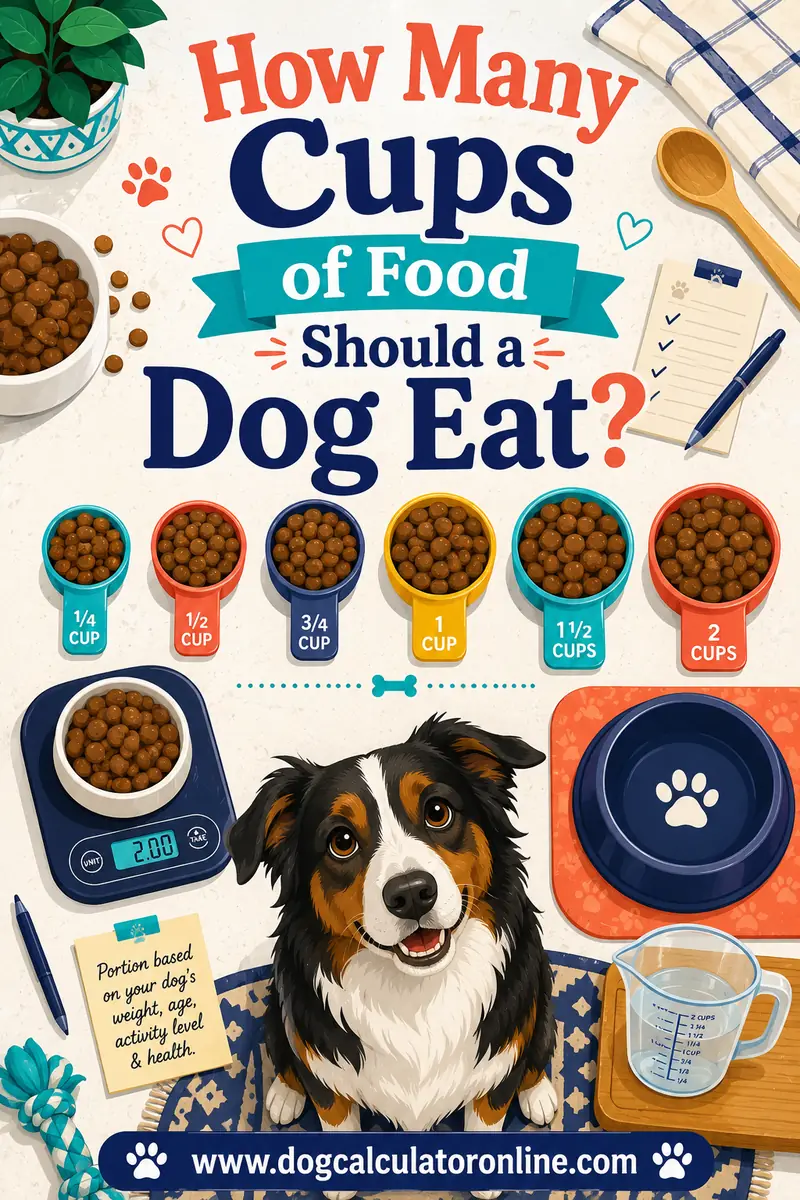
- Using a coffee mug as a "cup." An actual 8-oz measuring cup, leveled, is the unit every chart assumes. Mugs and scoops routinely run 20–50% over. (More on this in how many cups of food should a dog eat.)
- Feeding the breed's "typical" weight instead of your dog's actual weight. Weigh your dog — vet scale, or the pick-up-and-subtract trick on a home scale for small dogs.
- Forgetting to re-run the numbers after a food switch. New bag, new kcal-per-cup, new portion. Two foods can look identical in the bowl and differ by 100 kcal per cup.
- Chasing hunger theater. Most dogs act starving on any portion. Feed to body condition, not to performance.
- Changing everything at once. Adjust one variable — portion, food, or treats — and give it two weeks before judging.
FAQ
How much should I feed my dog by weight?
As a rough rule on standard kibble: ¾–1 cup daily at 10 lb, 1½–2 cups at 25 lb, 2½–3¼ cups at 50 lb, 3¾–4½ cups at 75 lb, split into two meals. Confirm against your bag's kcal-per-cup and your dog's body condition.
How many cups of dog food per day for a 50-lb dog?
Typically about 2½–3¼ cups of average kibble (≈375 kcal/cup) for a neutered adult at normal activity — roughly 900–1,150 kcal. A denser food means fewer cups; a lighter one means more.
Is the feeding chart on the dog food bag accurate?
It's calibrated to that food, which is useful, but the ranges run generous and can't account for your dog's age, neuter status, or true activity. Start near the low-to-middle of the bag range and adjust by body condition.
Should adult dogs eat once or twice a day?
Twice is the standard vet recommendation — steadier energy and hunger control, and split portions are gentler on digestion. The chart's daily totals divide evenly into two meals.
Do I feed current weight or ideal weight?
Ideal weight. Feeding an overweight dog by its current weight locks in the extra pounds. If your dog needs to lose more than a little, plan the target with your vet.
How accurate are feeding charts?
Within roughly ±25% for typical dogs — good enough to start, not good enough to stop watching your dog. Individual metabolism varies, which is why monthly rib-and-waist checks matter more than any table.
The Bottom Line
Use the chart to land in the right neighborhood, use your bag's kcal-per-cup to convert calories into real portions, and use your dog's ribs and waistline to fine-tune from there. Weight in, calories calculated, cups out — it's the same process every time, and the free dog food calculator does it for your exact dog in seconds. For the full method behind the numbers, see the dog food calculator guide.