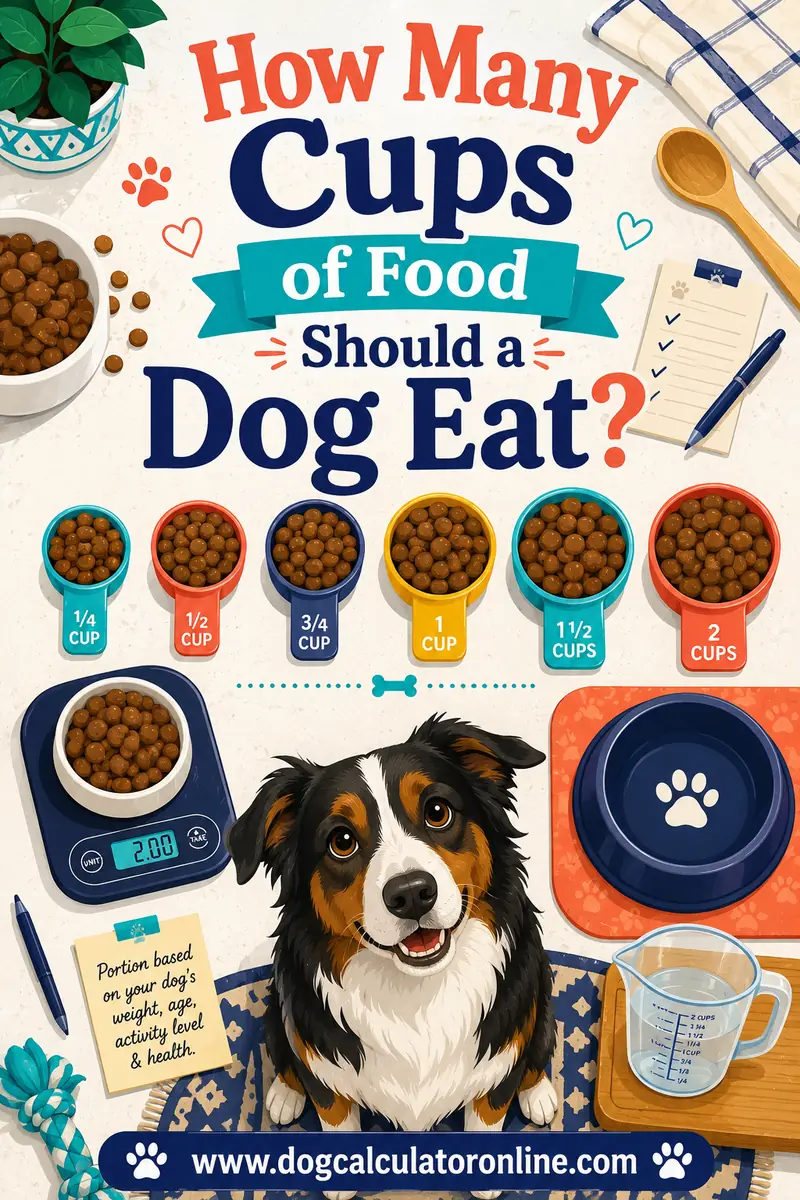
How Many Cups of Food Should a Dog Eat?
On an average dry food (~375 kcal per cup), a typical neutered adult dog eats about ¾–1 cup a day at 10 lb, 1½–2 cups at 25 lb, 2½–3¼ cups at 50 lb, and 3¾–4½ cups at 75 lb, split into two meals. But "cups" is a slippery unit: kibbles range from roughly 300 to over 500 kcal per cup, so the same dog might need 2½ cups of one food and 4 cups of another.
That's the trap in every cups-based answer — the cup count only means something once you know your food's calorie density. The free dog food calculator does the conversion for your exact dog and your exact bag in seconds. Below: the cups chart, the calorie logic behind it, why measuring technique quietly ruins portions, and how to adjust when the number isn't working.
🥣 Cups-per-day check
Tap your dog’s weight for a typical daily cup count (average kibble, neutered adult):
Tap a weight above. Dense kibbles need fewer cups; light ones need more.
The Cups-Per-Day Chart
For a typical neutered adult dog at normal activity, on kibble around 375 kcal per cup:
| Dog's weight | Cups per day | Cups per meal (2 meals) |
|---|---|---|
| 5 lb | ~½ cup | ~¼ cup |
| 10 lb | ~¾–1 cup | ~½ cup |
| 15 lb | ~1–1¼ cups | ~½–⅔ cup |
| 20 lb | ~1¼–1½ cups | ~⅔–¾ cup |
| 25 lb | ~1½–2 cups | ~¾–1 cup |
| 40 lb | ~2–2¾ cups | ~1–1⅓ cups |
| 50 lb | ~2½–3¼ cups | ~1¼–1⅔ cups |
| 60 lb | ~3–3½ cups | ~1½–1¾ cups |
| 75 lb | ~3¾–4½ cups | ~1⅞–2¼ cups |
| 100 lb | ~4½–5½ cups | ~2¼–2¾ cups |
Notice the pattern: cups don't scale in a straight line with weight. A 100-lb dog eats far less than ten times what a 10-lb dog eats, because calorie needs scale with metabolic body size (weight to the 0.75 power), not raw pounds. Small dogs run hot for their size; giants are efficient. That's also why "just eyeball it bigger for a bigger dog" tends to overfeed large breeds.
Why "Cups" Is a Slippery Unit
Three separate problems hide inside every cups-based feeding answer:
1. Calorie density varies wildly between foods. A weight-management kibble might hold ~300 kcal per cup while a performance or puppy formula packs 500+. Same dog, same calorie needs — the cup counts differ by 60% or more. This is the single biggest reason to check the kcal/cup line on your bag (it's in the guaranteed analysis area, usually as "kcal ME/cup").
2. Kibble shape changes how cups pack. Big airy discs and tiny dense pellets fill a cup differently. Two bags with identical kcal/kg can measure differently by volume — which is why kcal per cup on the label is the number to use, and why a gram scale beats cups entirely.
3. Nobody's "cup" is a cup. The chart assumes a level 8-oz measuring cup. Coffee mugs, scoops that came with a bin, plastic cups from the cupboard, and heaping pours all inflate portions — studies of owner measuring habits consistently find generous errors, often 20% or more. Over a year, a daily 20% over-pour is roughly six weeks of extra food.
Cups → Calories → Cups: The Right Way to Get Your Number
The reliable path runs through calories, and it takes two minutes:
- Find your dog's daily calorie need. For a typical neutered adult: 275–350 kcal at 10 lb, 550–700 at 25 lb, 900–1,150 at 50 lb, 1,250–1,550 at 75 lb. (The dog food calculator computes this from your dog's weight, age, and activity.)
- Find your food's kcal per cup on the bag label.
- Divide. Daily calories ÷ kcal per cup = cups per day. Split into meals.
Worked example: a 60-lb neutered Lab mix, moderately active, needs roughly 1,300 kcal a day. On a 420-kcal/cup food, that's about 3 cups daily — 1½ cups per meal. Switch that same dog to a 340-kcal/cup food and the answer becomes nearly 4 cups. The dog didn't change; the unit did.
If the calculator or math gives you a number that's noticeably different from what you feed now, don't lurch — move in steps of about 10% and let body condition (next section) referee.
Let the Dog Grade Your Math
Charts get you close; your dog's body confirms it. Once a month:
- Feel the ribs. Easy to feel under light padding = right. Buried = too many cups. Sharp and prominent = too few.
- Look for the waist. From above, a visible tuck behind the ribs; from the side, a belly that rises toward the hips.
- Watch the trend, not the day. Weigh monthly if you can — same scale, same time. Two consecutive months drifting the wrong way = adjust the daily portion ~10% and re-check.
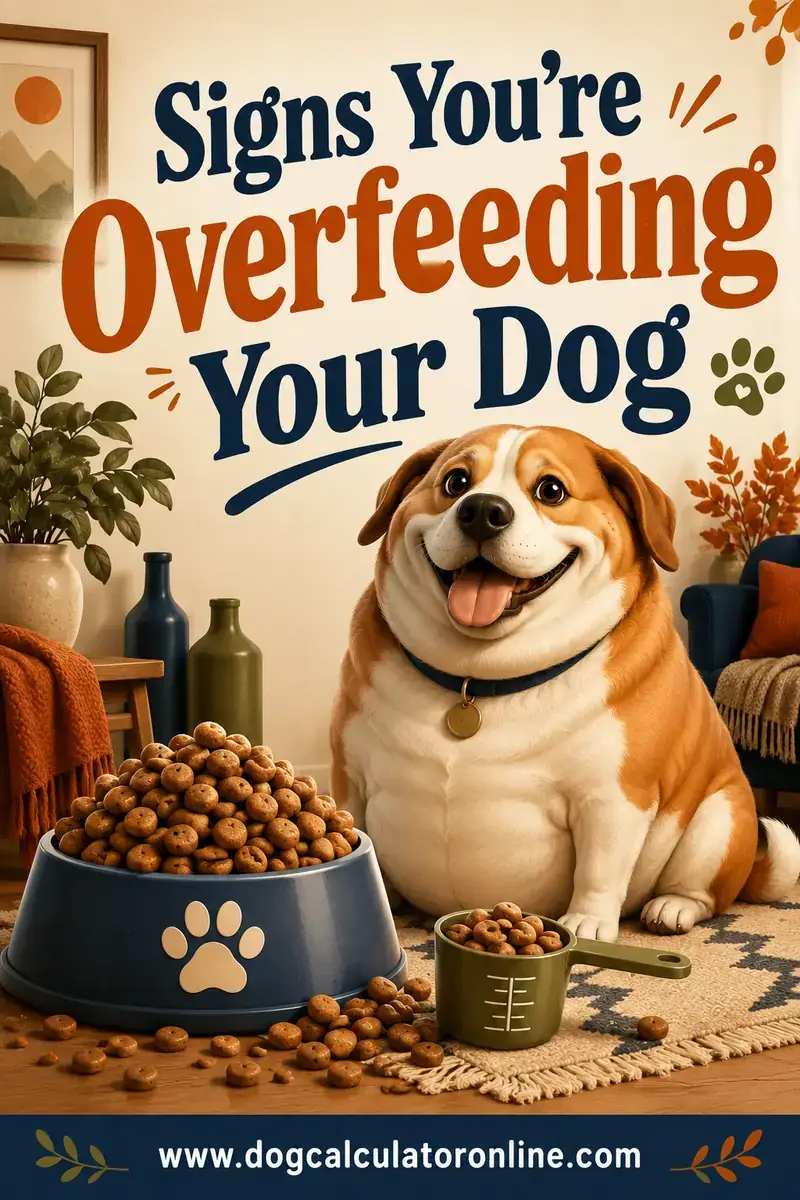
Persistent gain despite correct portions, or loss despite generous ones, is a vet conversation — thyroid issues, parasites, and other conditions can move weight independently of the food bowl. And if you suspect the drift is your pour rather than your dog, the rib-check evidence is covered in more detail in signs you're overfeeding your dog.
Measuring Tips That Keep Cups Honest
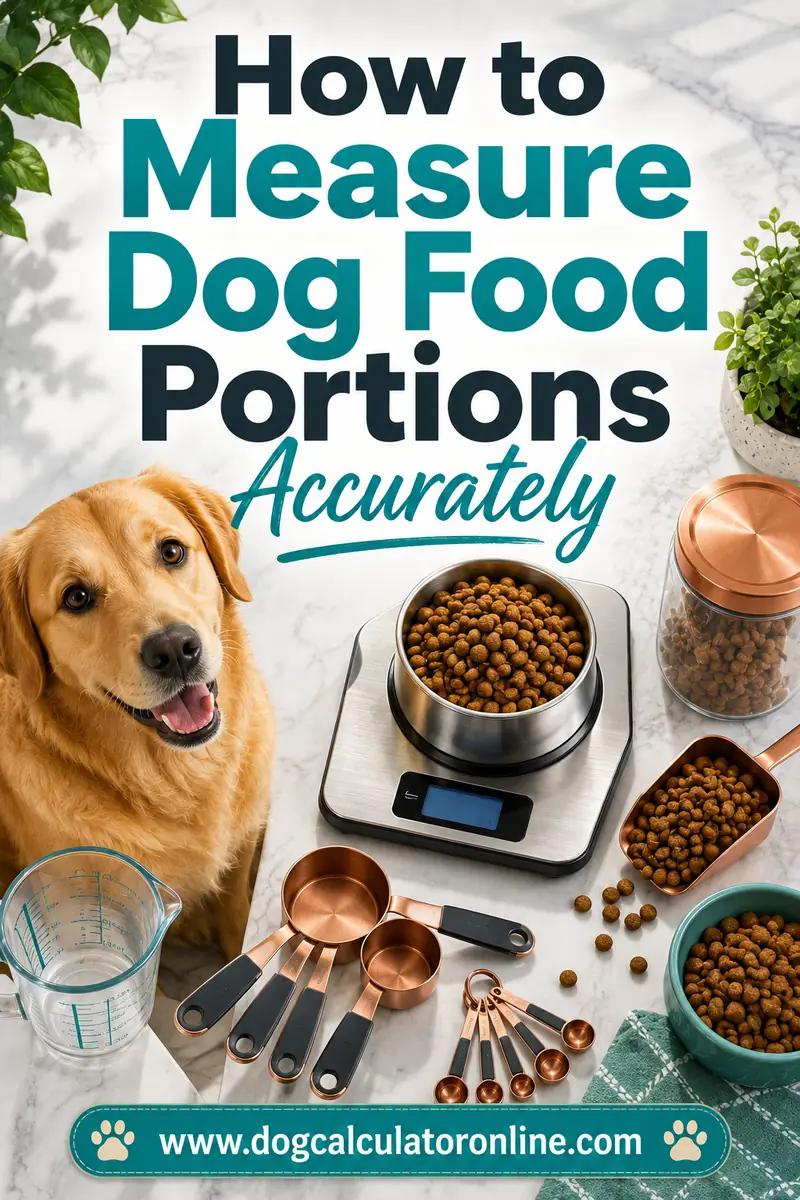
- Use a real dry-measuring cup, leveled — not a mug, not the bin scoop. Better yet, weigh meals in grams on a kitchen scale; the bag lists kcal/kg, and grams don't lie.
- Measure the treats too. Treats and chews should stay under ~10% of daily calories, subtracted from meals. A 25-lb dog's whole treat budget is roughly 55–70 kcal — one heaping extra "half cup for being good" can double the day's surplus.
- Assign one feeder, or use a checklist. The classic multi-person household bug is everyone feeding "the usual" — twice. A whiteboard tick or a filled-in-the-morning container fixes it.
- Pre-portion for the day. Measure the full day's kibble into a container each morning; meals and training treats come out of it. When it's empty, the kitchen is closed.
- Re-measure after every food change. New formula, new bag size, or new brand = re-check kcal/cup and redo the division.
There's a full technique guide in how to measure dog food portions.
When the Cup Count Should Change
Your dog's cup count isn't a lifetime constant. Re-run the numbers when:
- Weight changes by more than a pound or two (in either direction) — portions should track the target weight, not just the current one.
- Activity shifts seasonally. Many dogs exercise less in winter or brutal summer heat; their cups should shrink a bit with it.
- Your dog is spayed or neutered. Calorie needs typically drop afterward; keeping pre-surgery portions is a common cause of creeping weight gain.
- Age advances. Seniors often need 10–20% fewer calories as activity declines — though some need more protein, which is a food-choice question for your vet.
- The food changes. Always. Even a formula update within the same brand can shift kcal/cup.
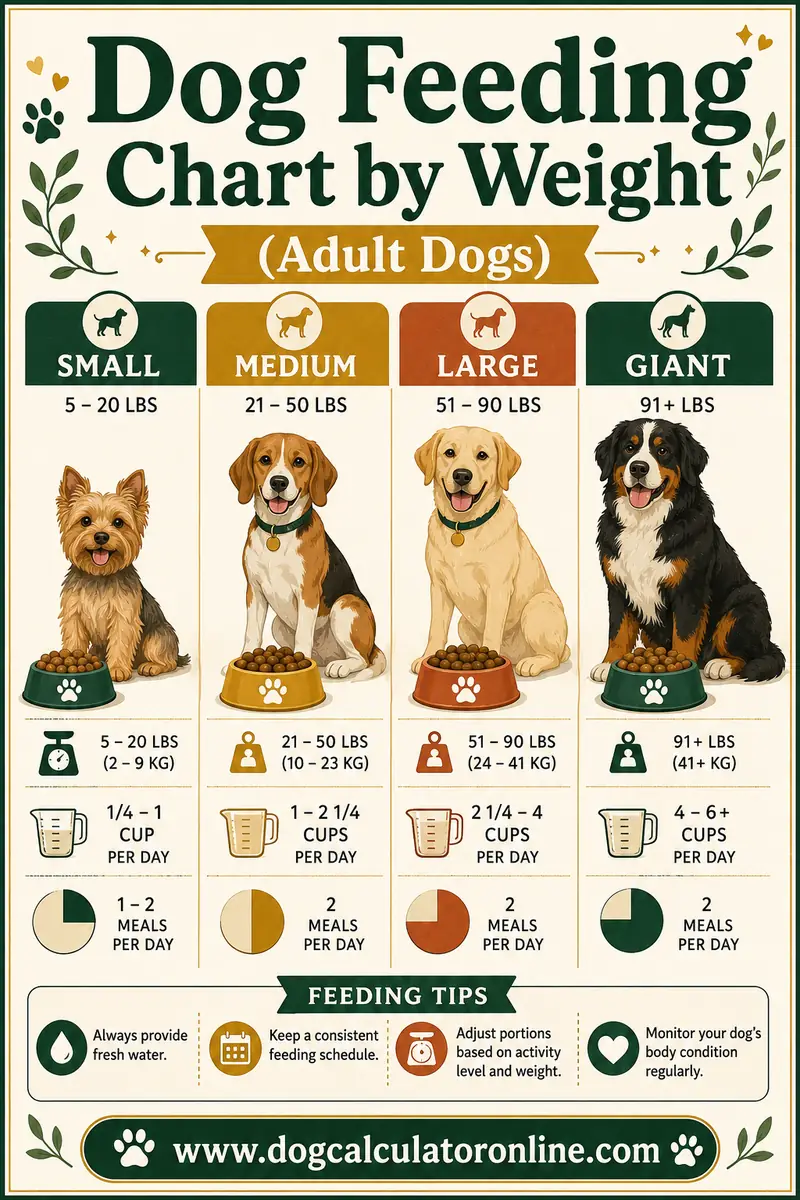
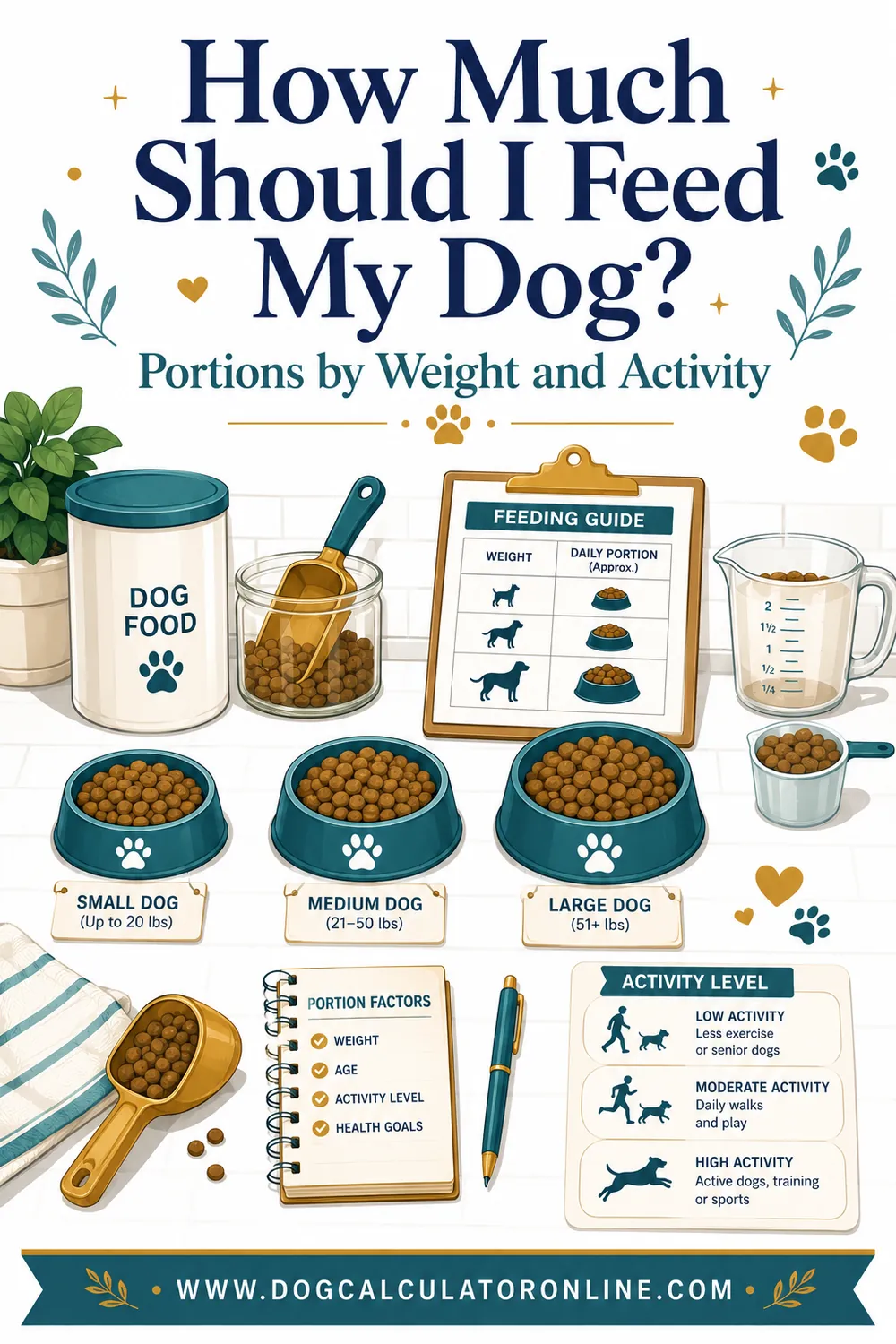
For the broader feeding framework — life stages, activity multipliers, and the full feeding chart — see how much should I feed my dog and the dog feeding chart by weight.
A Note on Puppies and Cups
Everything above assumes an adult dog — puppy cup counts play by different rules. Puppies eat far more per pound than adults (growth is expensive), their needs change every few weeks as they gain weight, and they eat from puppy-formula bags whose calorie density runs higher than adult food. A 20-lb puppy and a 20-lb adult are not interchangeable rows on a chart: the puppy may need half again as many calories.
The practical version: feed a puppy food matched to expected adult size (large-breed puppies need large-breed formulas), follow the bag's puppy table by age and current weight, split the total into 3–4 meals for young pups, and re-measure every two weeks because the right amount keeps moving. Body condition still referees — you should feel ribs easily under a thin cover, and a healthy puppy has a waist even while growing. Once growth finishes (roughly 12 months for most dogs, longer for giants), switch to the adult math on this page.
FAQ
How many cups of food should a dog eat per day?
On average kibble (~375 kcal/cup): about ¾–1 cup at 10 lb, 1½–2 cups at 25 lb, 2½–3¼ cups at 50 lb, and 3¾–4½ cups at 75 lb, split into two meals. Your food's kcal-per-cup shifts these numbers.
How many cups is 1 pound of dog food?
Roughly 3½–4 cups for typical kibble, but it varies with kibble size and density. For portioning, work in calories (kcal/cup from your bag) or grams on a scale rather than converting through pounds.
Is 1 cup of food enough for a dog?
It's about right for a typical 10–12 lb adult on average kibble, and too little for most bigger dogs. Match cups to your dog's weight and your food's calorie density rather than a one-size answer.
How many cups should a 60-lb dog eat?
Usually around 3–3½ cups per day of average kibble (roughly 1,100–1,400 kcal), split into two meals — less of a calorie-dense food, more of a light one.
Why does my dog seem hungry on the right portion?
Most dogs act hungry regardless of portion — it's excellent theater. Judge by ribs and waistline, not begging. If body condition is ideal, the portion is right; add low-calorie volume like green beans (vet-approved) if the begging wears you down.
Should I use the feeding chart on the bag?
Use it as a cross-check. Bag charts fit that specific food but run generous and don't know your dog's age, neuter status, or activity. Start low-to-middle of the range and let body condition steer.
The Bottom Line
Cups are just calories wearing a costume. Get your dog's daily calorie number, read the kcal-per-cup off your own bag, divide, and level the cup when you scoop. From there, your dog's ribs and waistline tell you everything the chart can't. Skip the arithmetic entirely by running your dog through the free dog food calculator — weight in, cups out, adjusted for your actual food.