How Much to Feed a Dog by Weight (kg)
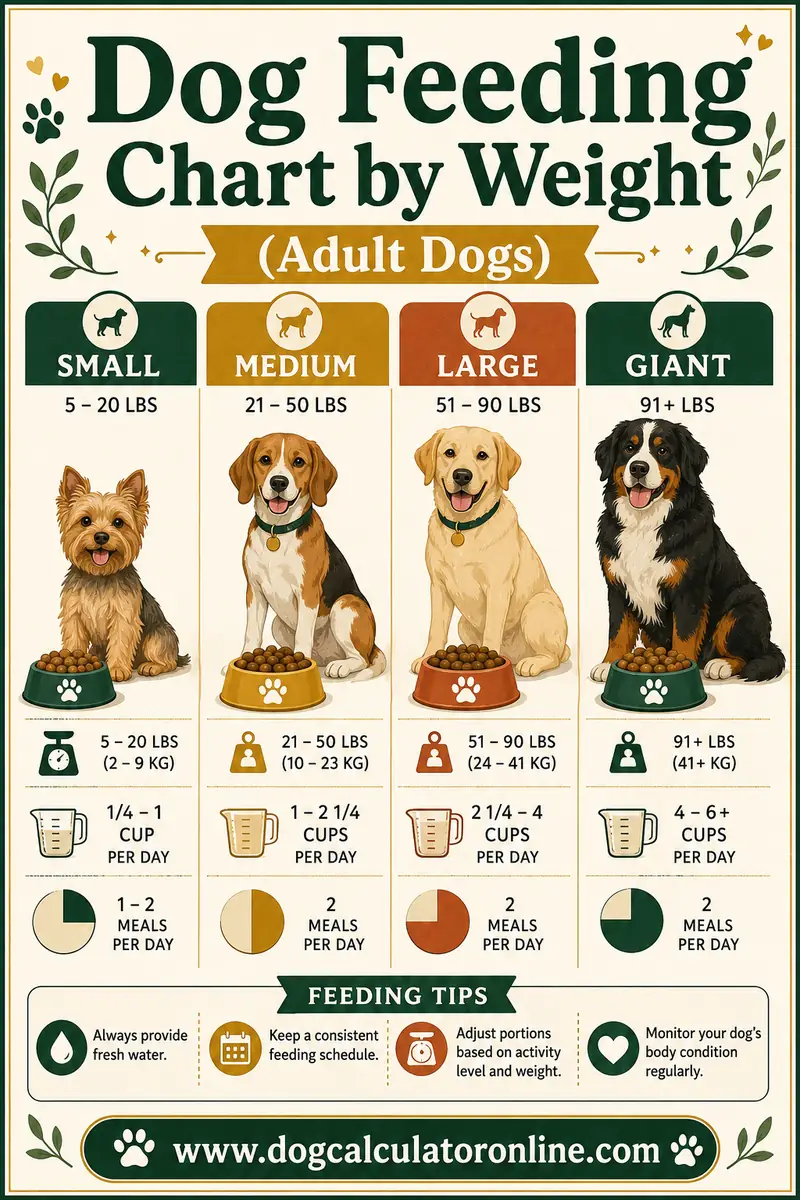
As a starting estimate, a typical neutered adult dog needs roughly 370 kcal a day at 5 kg, 630 kcal at 10 kg, 1,050 kcal at 20 kg, 1,430 kcal at 30 kg, and 1,780 kcal at 40 kg — which works out to somewhere between about 100 g and 500 g of typical dry food per day across that range. Those numbers come from the same resting-energy formula vets use (70 × kg^0.75, multiplied for lifestyle), and they're estimates: your dog's food label, body condition, and vet visits are what fine-tune them.
If you'd rather skip the exponents, the free dog food calculator runs the exact same math from your dog's weight in kilograms, age, and activity level in seconds. This guide gives you the full kg-by-kg table, shows the calculation so you can check any number yourself, explains how to convert calories into grams of your food, and covers the adjustments that matter — puppies, seniors, working dogs, and dogs that need to lose a little.
⚖️ Quick kg check
Tap your dog’s weight for a daily starting estimate (neutered adult, normal activity):
Tap a weight above. Estimates only — age, activity, and your food’s calorie density all shift the number.
The Feeding Chart: kcal and Grams by Weight in kg
Starting estimates for neutered adult dogs with normal activity, using a typical dry food at ~370 kcal per 100 g. Your food's density will differ — the conversion section below shows how to redo the grams column for your exact bag.
| Dog weight | Daily calories (est.) | Typical dry food (est.) | Example dogs |
|---|---|---|---|
| 2 kg | ~190 kcal | ~50 g | Chihuahua, teacup breeds |
| 5 kg | ~370 kcal | ~100 g | Shih Tzu, Maltese |
| 7 kg | ~490 kcal | ~130 g | Pug, Mini Dachshund |
| 10 kg | ~630 kcal | ~170 g | Beagle, Cavalier |
| 15 kg | ~850 kcal | ~230 g | Cocker Spaniel, small Staffy |
| 20 kg | ~1,050 kcal | ~285 g | Border Collie, Whippet mix |
| 25 kg | ~1,250 kcal | ~340 g | Springer, small Lab |
| 30 kg | ~1,430 kcal | ~390 g | Labrador, Boxer |
| 35 kg | ~1,610 kcal | ~435 g | German Shepherd |
| 40 kg | ~1,780 kcal | ~480 g | Rottweiler, big GSD |
| 50 kg | ~2,100 kcal | ~570 g | Great Dane, Mastiff-type |
Three things to hold onto. First, these are day-one estimates, not verdicts — the real test is your dog's body condition over the following weeks. Second, the relationship isn't linear: a 40 kg dog doesn't need eight times a 5 kg dog's food, because bigger bodies are more calorie-efficient per kilo. Third, treats come out of this total — the standard guidance is to keep them within about 10% of daily calories.
The Math Behind the Table
The table isn't folklore — it's two steps of vet-standard arithmetic you can reproduce on any phone calculator.
Step 1: Resting Energy Requirement (RER). This is what a dog burns just existing, and the widely used formula is:
RER = 70 × (body weight in kg)^0.75
For a 20 kg dog: 20^0.75 ≈ 9.46, × 70 ≈ 660 kcal.
Step 2: Multiply for lifestyle (MER). Daily maintenance = RER × a factor:
| Life stage / situation | Typical factor |
|---|---|
| Neutered adult, normal activity | ~1.6 |
| Intact adult | ~1.8 |
| Weight loss (vet-supervised) | ~1.0–1.2 |
| Active / working dog | ~2.0–5.0 |
| Puppy (weaning to ~4 months) | ~3.0 |
| Puppy (4 months to adult size) | ~2.0 |
So the 20 kg neutered adult lands at 660 × 1.6 ≈ 1,050 kcal a day — exactly the table's row. These factors are ranges for a reason: a sofa-loving neutered Lab and a flyball-competing one might differ by 50% or more at the same weight. If sums aren't your idea of fun, the dog food calculator applies weight, age, and activity in one pass — and our kcal guide digs deeper into the calorie side specifically.
Converting Calories to Grams of Your Food
The step most feeding charts skip: calories only become a scoop once you know your food's density.
- Find the kcal figure on your bag — listed as "metabolisable energy," usually as kcal per 100 g (common range for dry food: ~330–420 kcal/100 g) or kcal per cup.
- Divide: daily kcal target ÷ label kcal per 100 g × 100 = grams per day.
- Split into meals — most adults eat twice daily, so halve it per meal.
Example: a 30 kg Labrador needs ~1,430 kcal. On a food at 380 kcal/100 g: 1,430 ÷ 380 × 100 ≈ 375 g per day, or ~190 g per meal. Switch to a richer 420 kcal/100 g food and the same dog needs only ~340 g — which is exactly how food switches quietly cause weight gain when nobody redoes this one line of math.
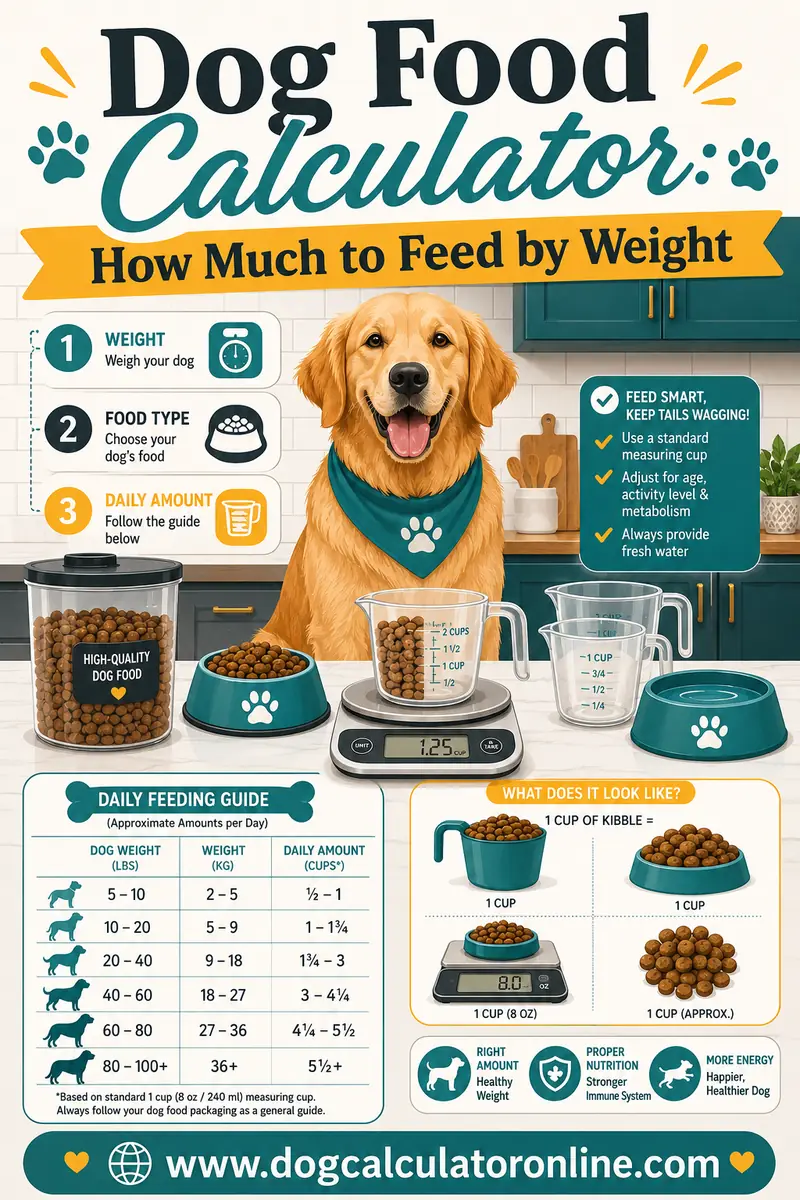
Weigh in grams on a kitchen scale rather than eyeballing cups — gram scales are dramatically more consistent, and at small-dog portions a "little extra" in the cup is a meaningful daily overfeed. Our feeding chart by weight has the pounds-based version of these tables if you think in lb.
Wet Food and Mixed Feeding, in Metric
Everything above assumes dry food, but the same logic runs on cans and pouches — with one big difference: water content. Wet food is typically 70–80% moisture, so its calorie density per 100 g is a fraction of kibble's — often somewhere around 80–120 kcal per 100 g versus 330–420 for dry. That's why a 10 kg dog who eats "170 g a day" of kibble would need several times that weight in wet food to hit the same calories, and why can labels talk in kcal per can rather than per 100 g.
For wet-only feeding, take the daily kcal target from the table or formula, find your product's kcal per can or pouch, and divide. A 10 kg dog needing ~630 kcal on a 300 kcal can eats about two cans a day.
For mixed feeding — the most common real-world setup — work in kcal, not grams. Decide the split (say, one 150 kcal pouch as a topper), subtract that from the daily target, and convert only the remainder into kibble grams. The classic mixed-feeding mistake is adding the wet food on top of an unchanged kibble portion; that's a 15–25% daily surplus dressed up as a treat, and it shows up on the scale within a couple of months.
Treats live in the same budget. The ~10% ceiling means our 10 kg dog has roughly 60 kcal a day of treat room. Check packets — many list kcal per treat — and remember that dental chews are often the single biggest treat calorie item in the house.
Common kg-Feeding Mistakes
- Scaling linearly. "He's twice her weight, so double the food" overfeeds the big dog badly — needs scale with weight^0.75, not weight.
- Using the current weight for an overweight dog. Feed toward the ideal weight (with your vet's input), or the math just maintains the problem.
- Trusting the scoop. Grams on a scale, always. A "roughly 100 g" scoop that actually holds 120 g overfeeds a small dog by 20% forever.
- Ignoring the label change. New bag, new brand, new kcal/100 g — the gram number must be recalculated even if the dog and the bowl are identical.
- Forgetting the extras. Training treats, chews, table tastes, and the toddler's dropped toast are all part of the daily total whether or not they were "meals."
Adjusting the Estimate to Your Actual Dog
Puppies eat much more per kilo than adults — roughly 3× RER during early growth, easing to ~2× until they reach adult size — spread over 3–4 meals a day when young. Feed a puppy food and follow its label by expected adult weight guidance where given.
Seniors often need fewer calories as activity drops, but not always — some need more digestible food, not less of it. Body condition, not birthdays, drives the adjustment; see how much should I feed my dog for the life-stage rundown.
Overweight dogs should be fed toward their ideal weight, not their current one, typically with a vet-supervised plan around 1.0–1.2 × RER of target weight. Crash-dieting a dog is genuinely dangerous — this adjustment belongs in a vet conversation.
Pregnant and nursing dogs are a special case with sharply rising needs (nursing can multiply requirements several-fold) — feed under vet guidance.
The feedback loop beats every formula: weigh your dog every 2–4 weeks and run the hands-on rib check. Ribs easily felt under a light fat cover, a visible waist from above, a tucked belly from the side = right amount. Trending plump: cut portions ~10% and re-check in a few weeks. Trending thin: add ~10%. And if weight changes without a portion change, that's a vet visit, not a scoop adjustment.
FAQ
How much should I feed my dog per kg of body weight?
There's no flat per-kg rate — calorie needs scale with weight^0.75, so small dogs need more per kilo than big dogs. A 5 kg dog needs roughly 370 kcal/day (~74 per kg) while a 40 kg dog needs roughly 1,780 (~45 per kg). Use the RER formula (70 × kg^0.75 × lifestyle factor) or a dog food calculator instead of a per-kg rule.
How many grams of food does a 10 kg dog need?
A neutered 10 kg adult with normal activity needs roughly 630 kcal a day — about 170 g of a typical dry food at 370 kcal/100 g. Check your own bag's kcal per 100 g and divide, because food densities range widely.
How much dry food does a 30 kg dog need per day?
Roughly 1,430 kcal for a neutered adult with normal activity — around 375–390 g of typical dry food, split into two meals. Active or working 30 kg dogs can need considerably more; the label and your dog's body condition make the final call.
Why does my bag's feeding guide differ from these numbers?
Bag guides assume that specific food's calorie density and usually print generous ranges spanning all activity levels. Treat the bag as that food's own estimate, this chart as the physiology-based one, and your dog's body condition as the referee between them.
Should I weigh dog food in grams or use a cup?
Grams, on a kitchen scale. Scoop-and-cup measuring routinely runs well over or under, and at small portions the error is a meaningful daily overfeed or underfeed. Weigh a few meals to calibrate your scoop at minimum.
How much wet food does a dog need per kg of body weight?
Work through calories, not weight of food: get the daily kcal target for your dog's weight (for example ~630 kcal for a neutered 10 kg adult), then divide by your product's kcal per can. Wet food is mostly water, so gram-for-gram it carries far fewer calories than kibble — typical cans run roughly 80–120 kcal per 100 g.
How do I know if I'm feeding the right amount?
Watch the dog, not the bowl: ribs easily felt with light cover, visible waist from above, belly tuck from the side, stable weight month to month. Adjust portions about 10% at a time and recheck in 2–4 weeks — and see your vet if weight shifts without a feeding change.
Get Your Dog's Number, Not the Average Dog's
Kilogram tables get you a solid starting point, and the RER math shows why the numbers are what they are. But the difference between a 25 kg couch potato and a 25 kg agility dog can be hundreds of calories a day — averages can't see your dog. The free dog food calculator takes weight in kg, age, and real activity level and returns a daily calorie and portion estimate built for your dog — then two weeks of rib checks tells you it's right.