Signs a Dog Is in Labor (Ask Your Vet)
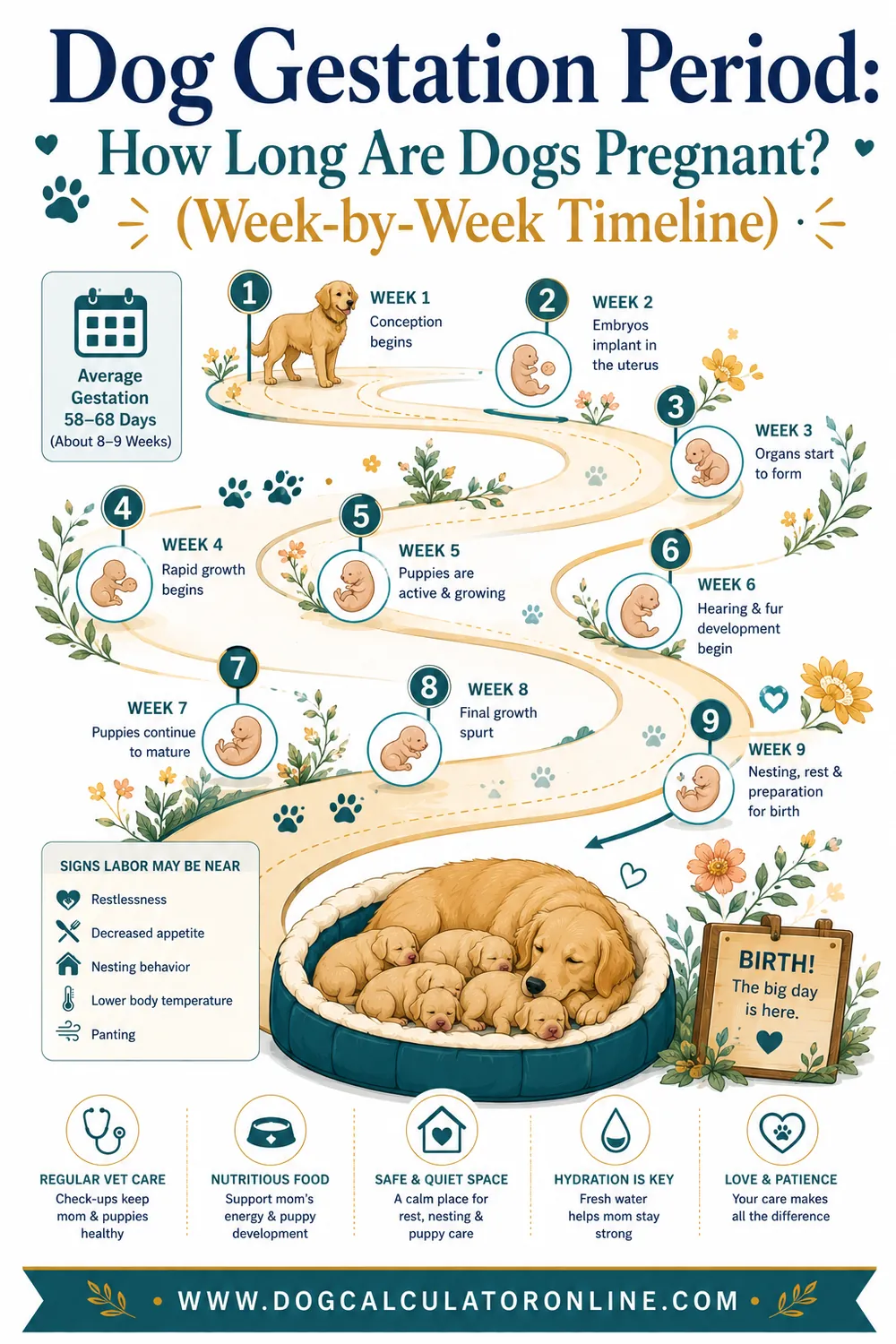
Most of the signs people watch for — nesting, panting, going off her food — are real but vague, and they can appear days before anything happens. The one sign with genuine predictive power is a number: a rectal temperature that drops below about 99°F / 37.2°C means whelping usually begins within 24 hours. That is why twice-daily temperature taking in the final week is not fussing, it is the whole technique. Everything else tells you labor is coming; the temperature drop tells you when. This page covers what each stage actually looks like, how long each should take, and the four situations that mean ringing the vet now rather than waiting. Work out where you are in the pregnancy with the free dog pregnancy calculator.

🐾 Is this labor?
Tap what you are seeing:
Tap an option above. The temperature drop is the only sign that reliably predicts timing.
The Temperature Drop Is the Only Reliable Predictor
Everything else on this page describes labor. The temperature predicts it, which is a different and more useful thing.
A dog's normal rectal temperature is roughly 101–102.5°F (38.3–39.2°C). In the 12 to 24 hours before whelping, the fall in progesterone causes it to drop, typically to somewhere between 98 and 99°F (36.7–37.2°C).
Take it twice daily from about day 55, morning and evening, at roughly the same times. A digital thermometer with a little petroleum jelly, inserted about an inch, takes ten seconds.
One reading is worthless; the trend is everything. You are looking for a clear fall away from her own established baseline, which is why you start early enough to have a baseline to compare against.
The drop is transient. It rebounds shortly before or during stage two, so a normal reading after a low one does not mean labor has been canceled — it usually means it is closer.
It is not perfect. Some dogs never show a clear drop, and in some the drop is missed between readings. A missed drop is a reason to watch harder, not a reason to relax.
Write every reading down with the time. On the night, being able to say "she dropped to 36.9 at 8pm" is far more use to a vet than "she seemed cold earlier". The full countdown routine is set out in how to know your dog's labor is close.
Stage One: Restlessness, Nesting and Panting
Stage one is uterine contractions you cannot see, and it is where owners spend the longest night of their lives watching for something to happen.
It normally runs 6 to 12 hours, and in first-time mothers it can stretch to 24 without anything being wrong.
Restlessness is the headline sign. She paces, settles, gets up, moves to another room, comes back. She may follow you everywhere or want to be entirely alone; both happen.
Nesting means digging and shredding. She will scratch at bedding, tear up newspaper, and rearrange the whelping box. If she has not been introduced to the box early, this is when she chooses the back of a wardrobe instead — one reason it should be up two weeks beforehand, as covered in how to prepare a whelping box.
Panting, shivering and trembling are normal here. So is refusing food; most dogs go off their last meal or two, and many vomit once.
A clear, stringy vaginal discharge is expected as the mucus plug comes away. It should be clear or slightly cloudy, not green, black or foul.
The most useful thing you can do in stage one is nothing. Keep the house quiet, keep other animals away, sit nearby without fussing, and note the time contractions or restlessness began.
Stage Two: Straining, and the First Puppy
Stage two is the part that is unmistakable, and it is also the part with hard time limits.
Visible abdominal straining is the marker. She will brace, curl, and push in a way that looks nothing like the restless shifting of stage one.
The waters usually break first, releasing clear or straw-colored fluid. From that point a puppy should follow within an hour, and two hours without one is a call to the vet.
A puppy should arrive within 30 minutes of strong, regular straining. Thirty minutes of hard, productive-looking pushing with nothing to show for it is the single most common reason a whelping needs veterinary help.
Between puppies she will often rest completely. Gaps of 20 minutes to 2 hours are normal, and she may clean, nurse and settle in between. The gap is measured from the birth of one puppy to the next.
The whole delivery can take anywhere from an hour to more than twelve, depending on the number of puppies. Big litters are slow by nature.
Knowing the count changes how you read the pauses. If an X-ray said seven and six have arrived, a long settled pause is still a puppy outstanding — the reasoning is in how many puppies do dogs have.
Stage Three: Placentas, and Why You Count Them
Stage three overlaps stage two rather than following it, and it gets skipped in most descriptions.
A placenta follows each puppy, usually within about 15 minutes, though it may arrive with the next puppy instead.
Count them against the puppies. By the end there should be one placenta per puppy. Missing one is worth telling the vet about, because a retained placenta can cause infection.
She will try to eat them. This is normal instinct. Letting her have one or two is fine; several often cause vomiting and diarrhea, so it is reasonable to remove the rest.
Dark green or brown discharge after a puppy is born is normal — that color comes from the placenta and is expected once puppies are arriving.
The same color before any puppy is born is not normal, and that distinction is the one worth memorising.
A red-brown discharge continuing for days or weeks afterwards is expected and is called lochia. Foul-smelling discharge, or fresh bleeding that does not settle, is not.
Timings to Judge Against
Time everything and write it down. Almost every escalation decision below is a clock decision.
| What you are seeing | Normal | Call the vet if |
|---|---|---|
| Temperature drop to whelping | Within 24 hours | Over 24 h passes with no stage one |
| Stage one (restless, nesting) | 6–12 h, up to 24 | Beyond 24 h with no straining |
| Waters broken to first puppy | Under 1 hour | Over 2 hours |
| Strong straining to a puppy | Under 30 minutes | 30 minutes of hard straining, no puppy |
| Gap between puppies | 20 min – 2 hours | Over 2 h with puppies still due |
| Placentas | One per puppy | One or more never appears |
| Gestation length | 58–65 days from mating | Past day 65–66 from ovulation |
Note that gestation is counted differently depending on the reference point. Fifty-eight to 68 days from a mating is normal because mating date is imprecise; 63 days from ovulation is far tighter, which is why progesterone-timed pregnancies get better predictions — the math is in dog gestation period.
Four Reasons to call the vet Immediately
These are not judgement calls. Any one of them means phoning, whatever the hour.
Thirty minutes or more of strong straining with no puppy delivered. This suggests obstruction, and it does not resolve by waiting.
Two hours or more between puppies when more are still expected. Uterine inertia — the uterus simply stopping — is common in toy breeds and in very large litters.
Green or black discharge before the first puppy is born. It means a placenta has separated and a puppy is losing its oxygen supply.
Gestation past 65 to 66 days from a known ovulation date, or past about day 70 from mating, with no sign of labor.
Add three more that are just as urgent: a puppy visibly stuck in the birth canal for more than a few minutes, the mother collapsing, shaking uncontrollably or becoming disoriented, and heavy fresh bleeding.
Have the number written down before the night starts, including the out-of-hours service, and know the route. Anyone who has hunted for a phone number at 3am with a dog straining in the next room only does it once.
Signs That Worry Owners but Are Usually Fine
Plenty of normal whelping looks alarming to someone watching their first.
Puppies arriving tail-first. Roughly 40% do, and it is a normal presentation in dogs, not a breech emergency as it would be in humans.
The mother chewing the cord vigorously and licking the puppy roughly. That rough licking is what starts the puppy breathing.
Trembling and heavy panting between puppies. Expected. Persistent tremors or twitching hours or days after whelping is different and needs a vet — that can be low blood calcium.
Eating the placentas, as above.
Long, calm rests. If she is settled, nursing, and not straining, a gap is not automatically a problem. It is straining without progress that has the 30-minute rule attached.
A little dark discharge and a swollen vulva for days afterwards. Both normal. What happens on the night itself, step by step, is in what to expect when your dog gives birth.
What to Have Ready Before the Signs Start
Set this out in the last two weeks, not on the night.
A digital thermometer and a written temperature chart, because the whole prediction rests on it.
Clean towels, far more than you think — for drying puppies and swapping out soaked bedding.
A kitchen scale that reads in grams, plus a notebook. Every puppy gets weighed at birth and daily afterwards; steady weight gain is the earliest indicator that feeding is working.
Unwaxed dental floss and blunt scissors, in case a cord needs tying and cutting, and a bulb syringe for clearing a nose.
A warm, safe holding box with a covered heat source, so puppies already born are not underfoot while the next arrives.
The vet's day and night numbers, the address, and a note of the X-ray puppy count, all in one place. The full setup, including box dimensions and heating, is in how to prepare a whelping box.
Dogs That Need Closer Watching
Some pregnancies carry a higher chance of needing help, and knowing that in advance changes the plan.
Flat-faced breeds — French Bulldogs, English Bulldogs, Pugs, Boston Terriers — frequently cannot deliver naturally because of head-to-pelvis proportions, and planned caesareans are common. This should be arranged in advance, not discovered at midnight.
Toy breeds have a higher rate of uterine inertia and of single large puppies that will not pass.
Singleton litters may not generate enough fetal signalling to trigger labor cleanly, and often go over.
Very large litters mean a long whelping and an exhausted mother, which is itself a reason for veterinary input partway through.
First-time mothers over about five years old, and any dog with a history of a difficult whelping, warrant a plan agreed with the vet beforehand.
A pregnancy where the mating date is a guess is the hardest of all to manage, because none of the day-count thresholds mean much — which is the practical argument for tracking the weeks properly, as in dog pregnancy week by week.
FAQ
What is the first sign a dog is going into labor?
A rectal temperature falling below about 99°F / 37.2°C is the earliest reliable sign, usually 12 to 24 hours ahead. Restlessness, nesting, panting and refusing food follow, but those can appear days early and are far less specific.
How long does dog labor last?
Stage one runs 6 to 12 hours, occasionally 24. Stage two, the actual deliveries, can take an hour for a small litter or well over twelve for a large one. Individual puppies should arrive within 30 minutes of strong straining.
How long can a dog go between puppies?
Twenty minutes to two hours is normal, and she may rest, clean and nurse in between. More than two hours with puppies still expected, or any 30-minute stretch of hard straining without a delivery, means calling the vet.
Is green discharge during dog labor normal?
Only after the first puppy has been born, when it comes from the placenta. Green or black discharge before any puppy has arrived means a placenta has separated early and the remaining puppies are at risk. call the vet immediately.
Do dogs pant a lot before giving birth?
Yes. Heavy panting, shivering and trembling are all normal during stage one and between puppies. Persistent tremors, twitching or disorientation in the days after whelping is different and needs urgent veterinary attention.
Can a dog be in labor for hours without pushing?
Yes — that is stage one, and 6 to 12 hours of restlessness without visible straining is entirely normal. It becomes a concern beyond about 24 hours with no progression into visible abdominal contractions.
Watch the Thermometer, Then Watch the Clock
Labor signs come in two useful categories: the ones that tell you it is coming, and the ones that tell you whether it is going well. The temperature drop below 99°F / 37.2°C is the only sign in the first category worth relying on, which is why twice-daily readings from day 55 are the core of the whole exercise. Once she is in stage two, the job changes to timing: 30 minutes of hard straining without a puppy, two hours between puppies with more still due, green discharge before the first arrival, or a pregnancy past day 65 from ovulation all mean picking up the phone. Everything else — the panting, the pacing, the rough licking, the tail-first arrivals — is usually just a dog having puppies. Check your dates with the free dog pregnancy calculator.