Dog Gestation Period: How Long Are Dogs Pregnant? (Week-by-Week Timeline)
Updated October 13, 2026
The dog gestation period is about 63 days from ovulation — roughly nine weeks. Most litters arrive somewhere in the 57 to 65 day window, and that range is completely normal because the exact day of ovulation is hard to pin down from the outside. If you know (or can estimate) the breeding date, you can map out the whole pregnancy week by week, and our free dog pregnancy calculator will give you an estimated due date in seconds.
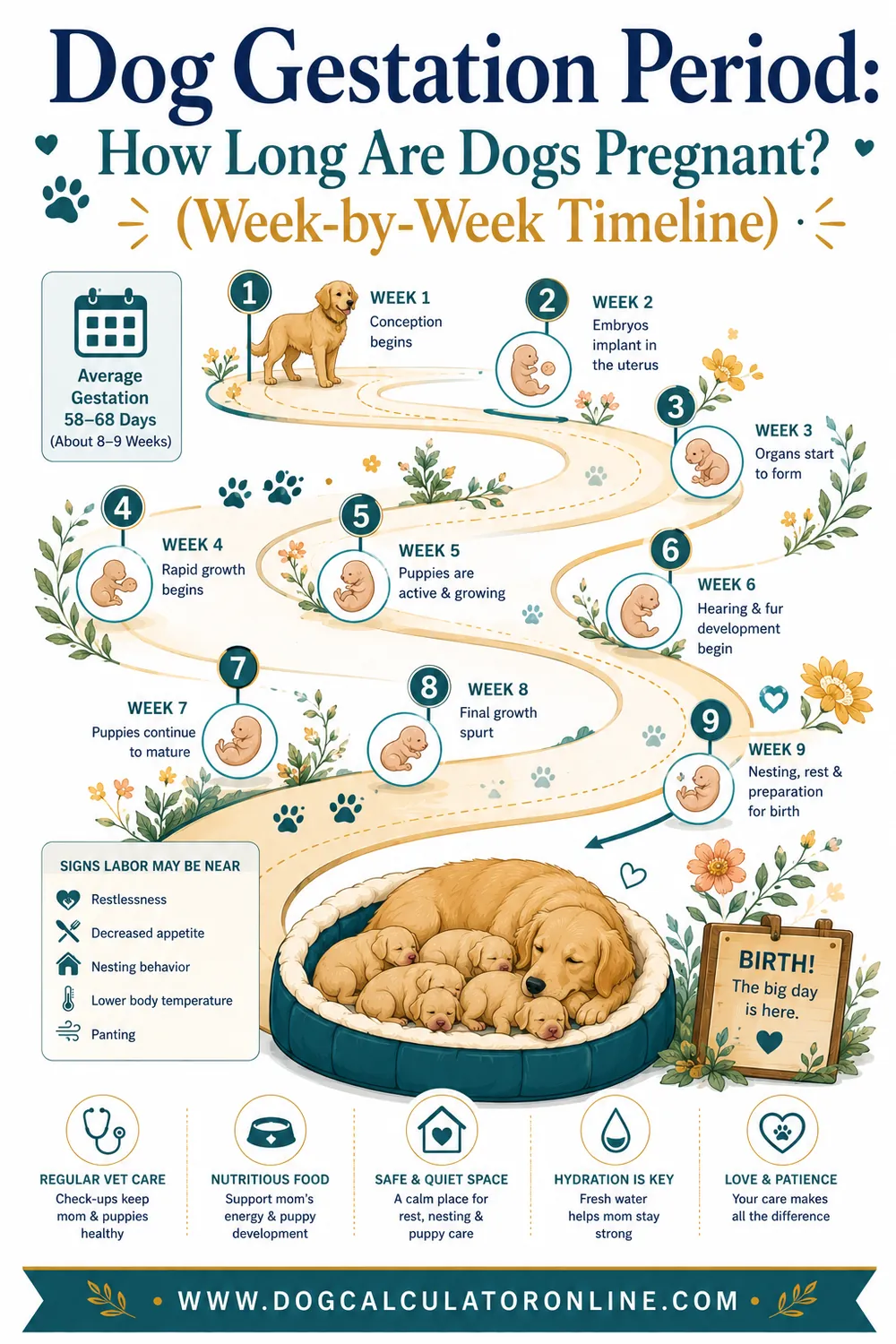
How Long Is a Dog Pregnant?
Dogs are pregnant for approximately 63 days, counted from ovulation. Because most owners only know the mating date — and sperm can survive in the reproductive tract for several days — the practical window is 57 to 65 days from breeding. A litter born anywhere in that range is right on schedule.
Here's why the range exists. A female dog can be bred a few days before or after she actually ovulates and still conceive. If she was bred early, the pregnancy will look longer counted from the mating date. If she was bred late, it will look shorter. The puppies themselves develop on a very consistent clock; it's our starting point that's fuzzy.
A few useful reference points:
- From ovulation: 62–64 days (very consistent)
- From the first mating: 57–72 days possible, most litters at 61–65
- Practical planning number: 63 days, with supplies ready by day 55
Breed size doesn't change gestation length in any meaningful way — a Chihuahua and a Great Dane carry for about the same number of days. What differs is litter size, not the calendar.
How to Tell If Your Dog Is Pregnant
Early dog pregnancy is sneaky. For the first three weeks, most dogs look and act completely normal. Home pregnancy tests made for humans don't work on dogs (they detect a hormone dogs don't produce), so confirmation comes from your veterinarian.
| Method | When it works | What it tells you |
|---|---|---|
| Relaxin blood test | Day 25–30 | Yes/no pregnancy confirmation |
| Ultrasound | Day 25–28 | Confirms pregnancy, shows heartbeats |
| Abdominal palpation | Day 28–35 | An experienced vet can feel the embryos |
| X-ray | Day 55+ | Counts puppies once skeletons mineralize |
Signs you might notice at home in the first month include a slightly decreased appetite around week three (a mild "morning sickness" phase), a bit more clinginess or tiredness, and slightly enlarged, pinker nipples. None of these are proof on their own — a vet visit is.
Dog Pregnancy Week by Week
Here's what happens during each week of the roughly nine-week dog gestation period.
Weeks 1–2 (Days 1–14): Fertilization and Travel
After breeding, sperm fertilizes the eggs in the oviducts. The fertilized eggs spend these first two weeks slowly traveling toward the uterus. Mom needs nothing special yet — normal food, normal walks, normal life. Don't increase her food; early overfeeding just adds fat, not healthier puppies.
Week 3 (Days 15–21): Implantation
The embryos implant in the lining of the uterus around day 16 to 18. Some dogs go off their food a little this week or seem slightly queasy. Keep meals small and appealing, and don't panic if she skips one — but call your vet if she refuses food for more than a day or two.
Week 4 (Days 22–28): Confirmation Time
This is the week pregnancy becomes confirmable. An ultrasound around day 25–28 can show tiny heartbeats, and a relaxin blood test turns positive. The embryos are at their most vulnerable stage right now, so it's smart to switch to gentler exercise — steady leash walks instead of rough play or jumping.
Week 5 (Days 29–35): The Fetal Stage
The embryos officially become fetuses. Organs are formed, and now the puppies mainly need to grow. Mom's belly starts to round out and her weight climbs. This is a good time to ask your vet about gradually transitioning her to a higher-calorie food — many vets recommend a quality puppy formula through late pregnancy and nursing.
Week 6 (Days 36–42): Visible Changes
There's no hiding it now. Her belly is clearly bigger, her nipples darken and enlarge, and her appetite grows — but her stomach has less room, so feed smaller meals more often. Three to four small meals a day beats two big ones from here on.
Week 7 (Days 43–49): Whelping Prep
Puppies are developing their coats and moving into their birth positions over the coming weeks. Set up the whelping box now, in a quiet, warm, low-traffic spot, so mom has time to accept it as her space. Line it with washable bedding or newspaper. Mom may start shedding hair on her belly — that's normal.
Week 8 (Days 50–57): Puppy Count
You can often see and feel puppies moving when mom lies on her side. After day 55, an X-ray can count the skeletons — genuinely useful information, because during delivery you'll know when she's done and whether a puppy is stuck. Milk may begin to appear. From day 57 onward, birth could safely happen any time.
Week 9 (Days 58–65): Labor Watch
Mom starts nesting — digging, shredding bedding, seeking privacy. Begin taking her rectal temperature twice a day. A dog's normal temperature is about 100–102.5°F; a drop below 99°F usually means labor will start within about 24 hours. She may refuse food and become restless as things begin.
Dog Gestation Chart: Day-by-Day Milestones
If you like to see the whole pregnancy at a glance, this chart lines up the key days counted from the breeding date. Pin it to the fridge and tick off each milestone as you reach it.
| Days from breeding | What's happening | Your to-do |
|---|---|---|
| Day 0 | Breeding | Write down the date (and any repeat breeding dates) |
| Days 1–14 | Fertilization; embryos travel to the uterus | Normal food, normal routine |
| Days 16–18 | Embryos implant in the uterine lining | Watch for a dip in appetite |
| Days 25–30 | Pregnancy can be confirmed | Book an ultrasound or relaxin blood test |
| Days 28–35 | Fetal stage begins; belly starts to round | Switch to gentle exercise; ask your vet about diet |
| Days 35–45 | Rapid puppy growth | Begin a gradual move to a higher-calorie food |
| Days 45–50 | Puppies develop coats | Set up the whelping box so mom can settle in |
| Day 55+ | Puppy skeletons visible on X-ray | Ask about an X-ray count; stage whelping supplies |
| Days 57–65 | Normal due window | Take her temperature twice a day |
| Past day 65 | Overdue counted from breeding | Call your vet |
Quick due-date chart (bred on the 1st of the month)
Want a ballpark due date without doing the math? Find the month she was bred. Dates assume a non-leap year and a single breeding on the 1st; shift by the same number of days if she was bred later in the month. For your dog's exact dates, use the dog pregnancy calculator.
| Bred on | Normal due window (days 57–65) | Day 63 estimate |
|---|---|---|
| January 1 | February 27 – March 7 | March 5 |
| February 1 | March 30 – April 7 | April 5 |
| March 1 | April 27 – May 5 | May 3 |
| April 1 | May 28 – June 5 | June 3 |
| May 1 | June 27 – July 5 | July 3 |
| June 1 | July 28 – August 5 | August 3 |
| July 1 | August 27 – September 4 | September 2 |
| August 1 | September 27 – October 5 | October 3 |
| September 1 | October 28 – November 5 | November 3 |
| October 1 | November 27 – December 5 | December 3 |
| November 1 | December 28 – January 5 | January 3 |
| December 1 | January 27 – February 4 | February 2 |
Small breeds vs. large breeds
As noted above, breed size doesn't change the calendar much: a toy breed and a giant breed both carry for about 63 days from ovulation. What changes is everything around it. Small breeds usually carry fewer puppies, which can mean each puppy is relatively large for mom's size. Large and giant breeds tend to have bigger litters and a longer delivery simply because there are more puppies to deliver. Flat-faced breeds such as Bulldogs are known for needing planned C-sections more often, so talk to your vet early if you have one of these breeds. See average litter size by breed type for more.
Caring for a Pregnant Dog
Keep it simple and consistent:
- Nutrition: normal food for the first four to five weeks, then a gradual switch to a higher-energy diet (many vets suggest puppy food). By week nine she may eat 25–50% more than usual, split into small meals.
- Exercise: daily gentle walks throughout — fitness genuinely helps labor. Skip roughhousing, jumping, and dog-park wrestling from week four on.
- Vet care: confirm the pregnancy around day 25–30, ask about a late-term X-ray, and check before giving any medication, supplement, or flea/tick product — several common ones aren't safe during pregnancy.
- Weigh-ins: weekly weight checks help you track that things are progressing. Our free dog calculators can also help you plan food portions as her needs change.
Feeding a Pregnant Dog Week by Week
Good nutrition matters most in the second half of pregnancy, when the puppies do most of their growing. Here's a simple week-by-week plan. Your vet knows your dog best, so check in before making big changes, especially if she's a small breed, a giant breed, or carrying extra weight.
| Weeks | How much | What to feed |
|---|---|---|
| Weeks 1–4 | Her normal amount | Her usual complete and balanced food. Extra food now only adds fat. |
| Weeks 5–6 | Start increasing gradually | Begin mixing in a higher-calorie food (many vets suggest a quality puppy or growth formula) over about a week. |
| Weeks 7–8 | More each week | Fully on the higher-calorie food. Split into three or four smaller meals, since her stomach has less room. |
| Week 9 | Up to about 25–50% more than usual | Small, frequent meals. Don't worry if she eats less in the last day or so; that's a common sign labor is near. |
| After whelping | Much more, rising as the puppies grow | Keep her on the puppy formula while she nurses. Her needs peak a few weeks after birth. |
A few feeding rules of thumb:
- Don't add calcium on your own. Giving extra calcium during pregnancy can actually raise the risk of a dangerous drop in calcium after birth. Only supplement if your vet tells you to.
- Skip the "eating for two" mindset early on. Overweight moms can have harder deliveries.
- Keep fresh water available at all times, especially once she's nursing.
- Change food slowly. Mixing old and new over about a week avoids an upset stomach. Our guide on how to transition your dog to new food walks through it.
- Plan for nursing. A nursing mom can need a lot more food than usual. See how much a nursing dog should eat.
Signs Labor Is Near
Watch for this cluster of signals in the final week:
- Temperature drop below 99°F (the most reliable sign — labor typically within 24 hours)
- Restlessness and nesting — pacing, digging at bedding, hiding
- Refusing food in the last 12–24 hours
- Panting and shivering as early contractions start
- Clear vaginal discharge shortly before delivery begins
Once active labor starts, most dogs handle delivery on their own. Puppies typically arrive 30–60 minutes apart, though a rest of up to two hours between puppies can be normal.
When to Call the Vet
Have your vet's number and the nearest emergency clinic saved before day 57. Call immediately if:
- She goes past day 65 from breeding with no signs of labor
- She has strong contractions for 30–45 minutes without producing a puppy
- More than 2–4 hours pass between puppies and you know more are coming
- You see green or black discharge before the first puppy arrives
- She seems weak, feverish, or in distress at any point
Trust your gut — a "probably nothing" phone call is always the right call during a whelping.
Whelping Supplies to Have Ready by Day 55
Gather everything the week before the due window opens, so nothing is missing at 3 am:
- Whelping box with low sides mom can step over but puppies can't escape
- Lots of clean towels — more than you think; then double it
- Digital thermometer for the twice-daily temperature checks
- Heat source (heating pad under half the box, or a heat lamp) — newborns can't regulate their own temperature
- Unwaxed dental floss and blunt scissors in case you must tie and cut a cord (mom usually handles this)
- Bulb syringe for gently clearing a puppy's airway
- Kitchen scale to weigh each puppy at birth and daily after — steady weight gain is the best early health signal
- Notebook for birth times, weights, and markings, plus your vet and emergency clinic numbers taped to the wall
None of it is exotic, and most of it you already own. The point is having it staged in one basket before labor starts, not scattered around the house during it.
Possible Problems During and After Delivery
Most dogs give birth without any trouble, but it helps to know what can go wrong so you can act fast. The "When to Call the Vet" list above covers the timing red flags. Here are the specific problems behind them:
Dystocia (difficult birth)
Dystocia simply means a hard or stalled delivery. It can happen when a puppy is too large or in an awkward position, when mom's contractions are too weak, or when she becomes exhausted. Signs include long periods of strong straining with no puppy, weak or stopped contractions while puppies remain, or obvious pain and distress. This needs a vet right away.
A puppy stuck in the birth canal
If you can see part of a puppy at the opening and it isn't moving out with mom's pushes after several minutes, call your vet or emergency clinic immediately. Don't pull hard on a puppy; you can injure the puppy or mom. Your vet can talk you through what to do while you get there.
Uterine inertia
Sometimes the uterus simply doesn't contract strongly enough to start or continue labor. It's more common with very large or very small litters. If her temperature dropped more than a day ago and nothing is happening, or labor stops partway with puppies still inside, call your vet.
Retained placenta
Each puppy should be followed by its own placenta. That's why counting placentas matters. If the count comes up short, or mom develops a fever or foul-smelling discharge in the days after birth, have her checked.
Eclampsia (milk fever)
Eclampsia is a dangerous drop in blood calcium, most often seen in the first few weeks of nursing, especially in small breeds with large litters. Watch for restlessness, heavy panting, trembling, stiff walking, or seizures. It's an emergency: go to the vet immediately.
Metritis and mastitis
Metritis is an infection of the uterus after birth, usually with fever, a smelly discharge, and a dull mom who isn't eating. Mastitis is an infection of the mammary glands, where one or more teats becomes hot, hard, red, or painful. Both need prompt veterinary treatment.
For a full walk-through of a normal birth, see what to expect when your dog gives birth and our guide to the signs a dog is in labor.
Newborn Puppy Care: The First Two Weeks
Once the last puppy arrives, a new countdown begins. Mom does most of the work, but these first two weeks are when puppies are most fragile. Here's what to keep an eye on:
The first 24 hours
- Make sure every puppy nurses. The first milk (colostrum) passes on early immune protection, so each puppy should nurse within the first few hours.
- Keep them warm. Newborns can't control their own body temperature. Keep the whelping area warm, around 85–90°F at puppy level in the first days, with a cooler spot so they can move away from the heat.
- Weigh each puppy. Record birth weights in your notebook so you have a starting point.
- Check mom. She should be alert, interested in her puppies, eating a little, and drinking.
Days 2–7
- Weigh daily. Puppies should gain steadily every day. A puppy that loses weight or stays flat after the first day needs a vet check.
- Watch for crying. Content puppies mostly sleep and eat. Constant crying can mean a puppy is cold, hungry, or unwell.
- Leave the umbilical cords alone. They dry and fall off on their own within a few days.
- Let mom clean them. Mom licks puppies to help them pee and poop at this age. That's normal.
Days 8–14
- Lower the heat gradually. As puppies grow, you can let the box cool slowly toward room temperature over the following weeks.
- Eyes and ears start opening. Most puppies open their eyes at around 10 to 14 days, and their ear canals open around the same time.
- Keep the box clean and dry. Swap bedding daily; damp bedding chills puppies quickly.
- Schedule a checkup. Ask your vet when to bring mom and puppies in for their first exam.
Next steps are in our newborn puppy care week by week guide, plus how much milk a newborn puppy should drink and when puppies open their eyes.
One Curveball: False Pregnancy
Here's something that surprises many owners: a dog can show real pregnancy signs — enlarged nipples, milk production, nesting, even "adopting" toys — without being pregnant at all. False pregnancy (pseudopregnancy) is common in unspayed females a month or two after a heat cycle, because canine hormones follow the same pattern whether or not conception happened. It usually resolves on its own within two to three weeks, but it's the reason behavior alone never confirms a pregnancy. If breeding did occur, get the day-25–30 vet confirmation rather than relying on symptoms; if it didn't and the signs persist or she seems unwell, have your vet take a look.
FAQ
How long is a dog pregnant in months?
About two months. The dog gestation period is roughly 63 days, or nine weeks — dramatically shorter than a human pregnancy, which is part of why each week matters so much.
Can a dog give birth at 58 days?
Yes. Anything from day 57 onward is generally considered full term when counting from breeding. Puppies born before day 57 may have underdeveloped lungs, so contact your vet if labor starts early.
How many puppies do dogs usually have?
The average litter is five to six puppies, but it varies hugely by breed size. Small breeds often have one to four puppies, while large breeds can have eight to twelve or more. A day-55+ X-ray gives you the real count.
Does gestation length differ by breed?
Not meaningfully. Small and giant breeds both carry for roughly 63 days from ovulation. Breed affects litter size and delivery risk (some flat-faced breeds often need C-sections), not the length of pregnancy.
How soon after a heat cycle can a dog get pregnant?
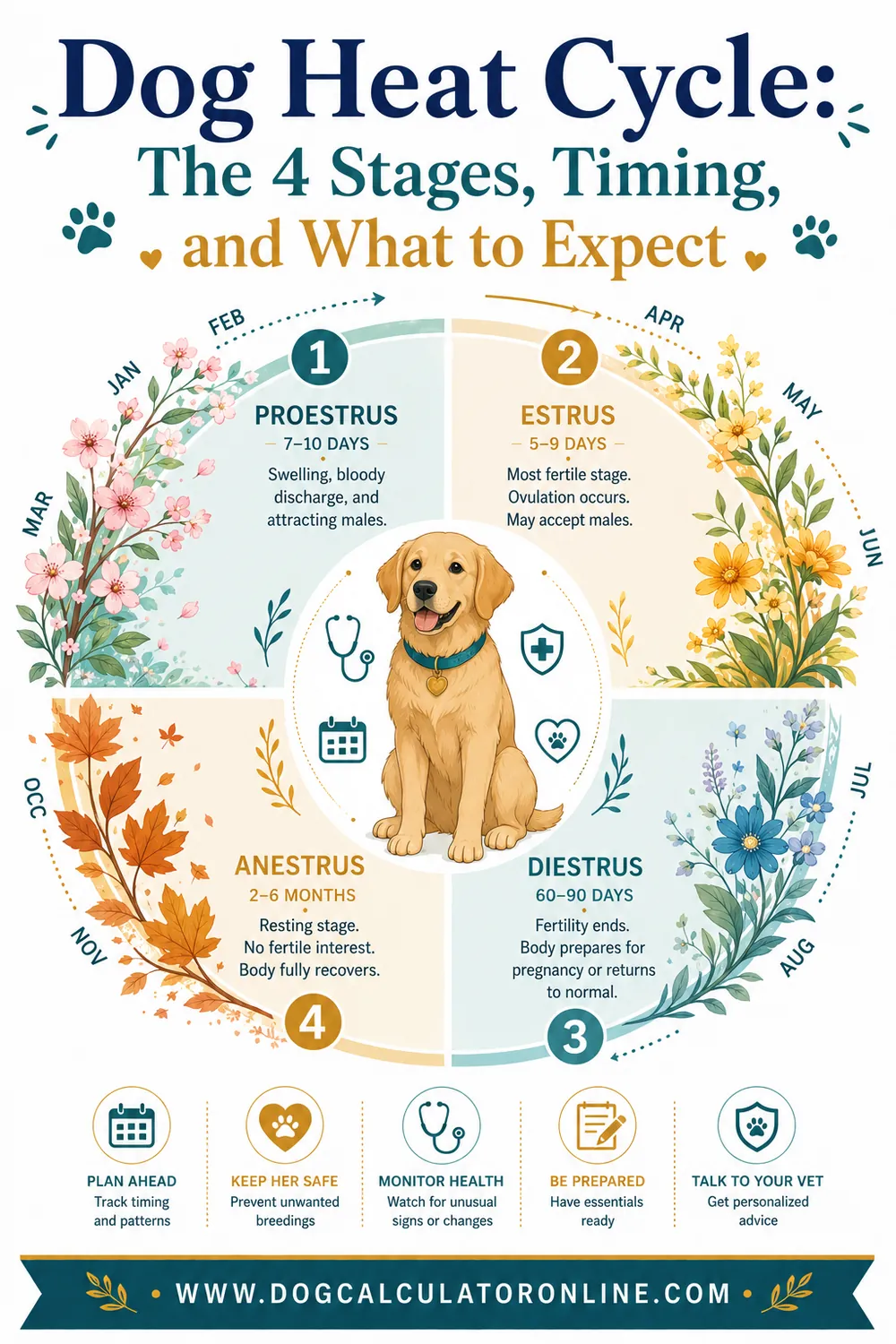
Dogs conceive during the heat cycle, specifically around ovulation in the estrus phase. If you're trying to understand the timing, our guide to the dog heat cycle breaks down all four stages.
What should I do the day the puppies are born?
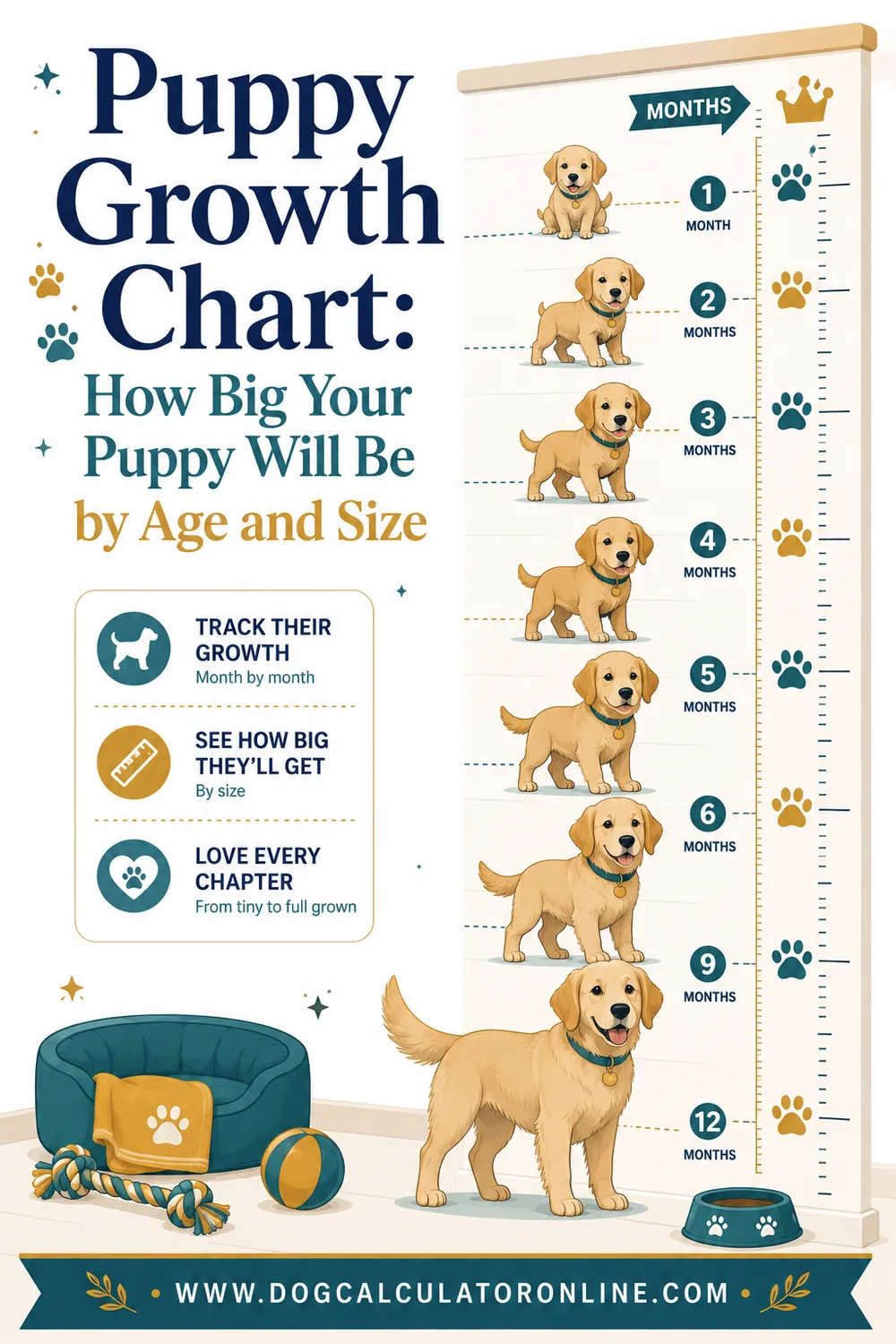
Keep the room warm and calm, let mom work, and count placentas (one per puppy). Make sure each puppy nurses within the first few hours. Then start tracking their growth — our puppy growth chart shows what healthy weight gain looks like week by week.
Is a dog pregnant for 63 days, or 58 to 68?
Both answers are describing the same thing from different starting points. Counted from ovulation, gestation is very steady at about 63 days. Counted from the breeding date, which is what most owners know, the normal range is about 57 to 65 days, and a little longer is possible if she was bred well before she ovulated. That's why vets give a due window rather than a single date.
Can a dog be pregnant for 70 days?
Counted from the first breeding, a delivery close to 70 days can happen if she was bred several days before ovulating. Still, don't wait and see: if she passes day 65 from breeding with no signs of labor, call your vet so they can check on her and the puppies.
How is a dog's due date calculated?
The simplest method is to add 63 days to the breeding date, then treat days 57 to 65 as the due window. If your vet tracked her hormone levels to pinpoint ovulation, the due date can be much more precise. Our guide to using a dog pregnancy calculator explains how it works.
How long after mating does a dog show she's pregnant?
Most dogs don't look pregnant until about week five or six, when the belly starts to round out. A vet can confirm pregnancy earlier, around day 25 to 30. More detail is in how long after mating a dog is pregnant.
Count Down to Puppy Day
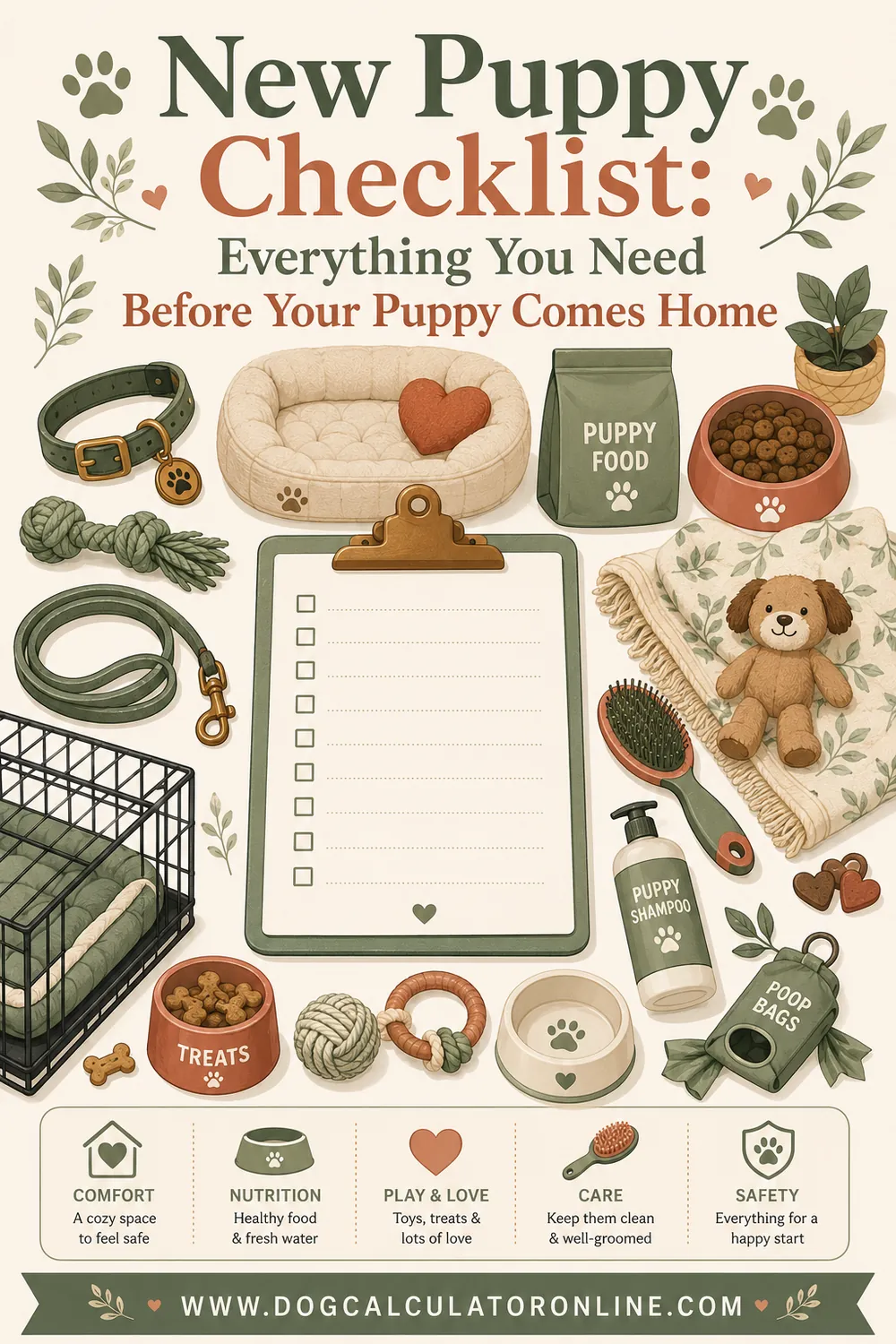
Sixty-three days goes fast. Mark the breeding date, prep the whelping box by week seven, and start temperature checks in week nine — that's 90% of good whelping management. For an instant due-date estimate and week-by-week milestones tailored to your dog's dates, try the free dog pregnancy calculator — and once the puppies arrive, our new puppy checklist will help you get ready for the fun part.