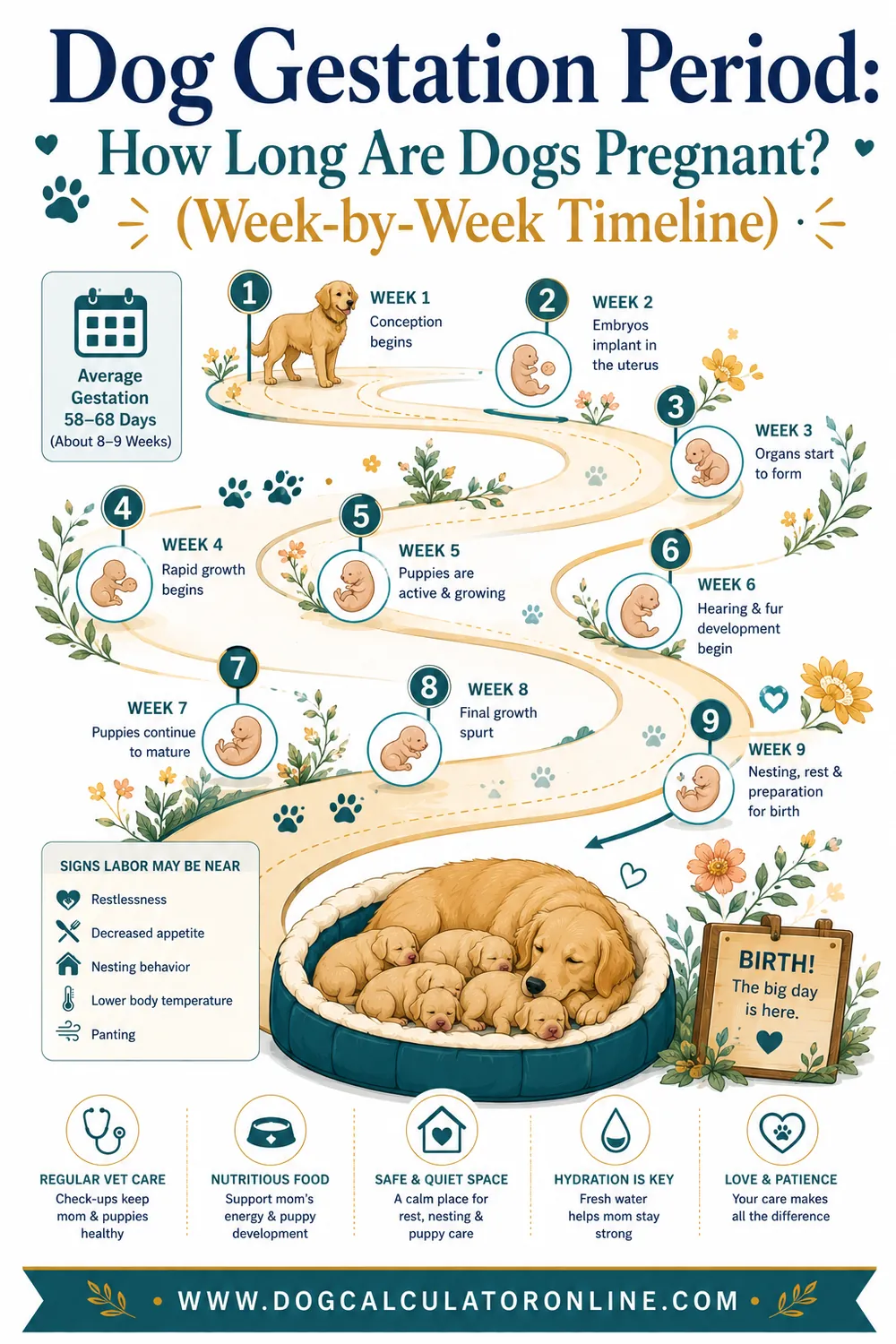
How to Know Your Dog's Labor Is Close
The honest answer to "is it tonight?" is that you cannot tell by looking, and people who claim otherwise are reading normal late-pregnancy behavior as prophecy. There is exactly one measurement that separates soon from now: twice-daily rectal temperatures, taken from about day 55, watching for a drop below roughly 99°F / 37.2°C, which puts whelping inside the next 24 hours. Everything else — the belly dropping, milk appearing, the sudden interest in cupboards — narrows things to days rather than hours. This page is about the countdown week specifically: how to run the temperature chart, what changes and when, and which signals genuinely mean tonight. Pin down your dates first with the free dog pregnancy calculator.

🐾 How close is she?
Tap what you have noticed:
Tap an option above. Only the temperature drop reliably converts days into hours.
Days Away Versus Hours Away
The countdown has two different questions in it, and mixing them up is why owners spend three sleepless nights instead of one.
The "days away" signs are structural. The belly drops, the vulva swells and softens, milk appears, she slows right down. These narrow the window to roughly the last week.
The "hours away" signal is physiological. Progesterone falls, and the temperature falls with it. Nothing you can see from across the room does this job.
Nesting sits awkwardly between the two. Some dogs nest for four days; others start an hour before the first puppy. It confirms the general phase but not the timing.
Gestation itself only narrows it so far. Sixty-three days from ovulation is tight, but 58 to 68 days from a mating date is a ten-day spread, because mating and ovulation are not the same event — the distinction is set out in dog gestation period.
This is why the thermometer earns its place. It converts a ten-day window into a one-day one, for the cost of twenty seconds twice a day.
Once labor actually starts, the questions change again — from timing to whether it is progressing normally, which is covered in signs a dog is in labor.
How to Chart the Temperature Properly
Most failed temperature charts fail for the same three reasons: started too late, taken too rarely, not written down.
Start at day 55, and earlier if your dates are loose. You need a week of readings to know what her normal actually is, because dogs vary and the published range is wide.
Take it twice daily, morning and evening, at consistent times. Once a day genuinely can miss the drop, since the low point is transient.
Use a digital rectal thermometer, lubricated, inserted about 3/4 inch (2 cm), held until it beeps. Ear thermometers are not reliable enough for this job.
Take it when she is settled and cool. A reading straight after a walk, a nap on a radiator, or a stressful car trip will be misleadingly high.
Write down date, time and reading, every time. A chart shows a trend; a memory shows nothing.
The target is a fall of around 2°F (one degree Celsius) from her own baseline, landing somewhere near 98–99°F (36.7–37.2°C). Her baseline matters more than the textbook number.
Expect a rebound. The temperature comes back up as stage one gets going, so a normal reading after a low one is not a false alarm — it usually means things have moved on.
The Final Week, Day by Day
Approximate, and every dog rewrites it slightly, but this is the shape of it.
| Days before whelping | What typically changes |
|---|---|
| 7–10 | Belly visibly drops; she looks pear-shaped from the side |
| 7 | Start or continue twice-daily temperatures; whelping box in use |
| 5–7 | Vulva softens and swells; mammary glands fill out |
| 2–5 | Milk may be expressible; appetite becomes erratic |
| 1–2 | Clear mucus discharge; restlessness; heavy nesting |
| Under 1 | Temperature drops below 99°F / 37.2°C; food refused; possible vomiting |
| 0 | Stage one contractions, panting, shivering, then straining |
Treat the table as a sequence, not a schedule. The order is fairly consistent; the spacing is not.
A first-time mother often shows less of everything, right up until stage one. Fewer visible signs does not mean a longer wait.
A dog who has whelped before frequently runs the whole sequence faster and may go from the temperature drop to a first puppy in well under twelve hours.
The Physical Changes and What They Actually Tell You
Each of these is real, and each is less precise than it sounds.
The belly drops in the last week as the puppies move back into position. Seen from the side she goes from round to pear-shaped, and her waist reappears slightly. Useful, but only to about a week.
The vulva swells and softens and often produces a clear discharge. This is the tissue preparing to stretch. It usually shows in the final few days.
Mammary development runs on its own timetable. Glands enlarge over the last two weeks. Milk that can be expressed usually means within a week, sometimes within 24 to 48 hours — but some dogs produce milk two weeks early and some not until after the first puppy.
Movement becomes visible from outside. Puppies kicking against the flank in the last two weeks is normal and reassuring, and it typically quietens in the final day.
She slows down noticeably. Short lead walks are still right, but the lively dog of week six is not the dog of week nine — the whole-pregnancy routine is in how to care for a pregnant dog.
Weight gain stops or reverses slightly in the last days. Not alarming on its own.
Behavior in the Final 48 Hours
Behavior is the part owners notice first and trust too much, but the combination is informative.
Clinginess or withdrawal — either one. Some dogs shadow their owner room to room; others vanish under the bed. Both are normal and both are a change from her usual.
Nesting intensifies. Digging, circling, shredding paper and rearranging bedding. If she has been introduced to her box early she does this in it; if not, she picks a wardrobe.
Appetite falls away. Many dogs refuse the last meal or two entirely, and vomiting once is common. Combined with a low temperature this is a strong signal.
Panting and shivering appear without exertion or cold, and increase as stage one begins.
She may become unusually vocal, whining or grumbling, and unusually intolerant of other pets.
Frequent trips outside to urinate are normal from the pressure. Watch for straining outside that does not produce urine, because that can be an early contraction rather than a toilet trip.
What Actually Means Tonight
Reduced to the shortlist worth acting on.
A temperature under 99°F / 37.2°C, roughly 2°F below her established baseline. Assume within 24 hours.
Refusing food plus that low reading. The two together are more convincing than either alone.
Hard, sustained nesting with panting and shivering. This is stage one, and stage one runs 6 to 12 hours, occasionally 24.
The mucus plug passing as a clear or slightly cloudy stringy discharge. Can be days early, but combined with the above it belongs in the tonight column.
Any straining, curling or visible abdominal push. That is stage two, and a puppy should arrive within 30 minutes.
Green or black discharge before a puppy is born is not a countdown signal at all. It is an emergency, and the vet gets a phone call immediately regardless of the day count.
What to Do at Each Point in the Countdown
Doing the right thing at the right time mostly means doing less than you feel like doing.
Two weeks out: the box goes up. She needs long enough to accept it as hers, or she will choose somewhere else at the worst moment. Dimensions, pig rails and heating are in how to prepare a whelping box.
One week out: temperatures twice daily, and the whelping kit assembled — towels, gram scale, notebook, dental floss, blunt scissors, bulb syringe, and the vet's out-of-hours number written on paper.
Temperature drops: cancel everything. Stay home, keep the house quiet, keep visitors and other pets out, and start noting times.
Stage one: leave her alone in the box. Sit within sight, do not hover, do not keep checking her physically. Note when restlessness began.
Stage two: time everything and write it down. Birth time, sex and weight of each puppy, and each placenta counted off.
Do not schedule the last week around anything else. A pregnancy timed from a mating date can legitimately arrive a week either side of the estimate — the week-by-week picture is in dog pregnancy week by week.
When the Countdown Runs Long
Sometimes the signs all appear and then nothing happens, and there is a threshold where waiting stops being reasonable.
Twenty-four hours after a confirmed temperature drop with no stage one is worth a phone call. It is not always an emergency, but it needs a vet's opinion.
Past day 65 to 66 from a known ovulation date means ringing the vet regardless of how well she seems. Post-term pregnancies carry real risk to the puppies.
Past about day 70 counted from a mating with no labor is the equivalent threshold when ovulation was never tested, and the vagueness is exactly why it sits later.
Stage one that has run beyond 24 hours without progressing into visible straining is a call, not a wait.
Singleton pregnancies commonly go over, because a single puppy may not produce enough hormonal signal to trigger labor cleanly. These often end in a planned cesarean.
If she seems unwell rather than simply late — lethargic, feverish, a foul discharge, refusing water — that is a same-day veterinary problem and the calendar is irrelevant.
Mistakes That Throw Away the Warning
The temperature method fails often, and nearly always for avoidable reasons.
Starting on day 60. Too late to establish a baseline, and quite possibly too late full stop.
Taking it once a day. The drop can come and go inside twelve hours.
Not writing it down. Without a chart you cannot tell a real fall from a normal fluctuation.
Reading the textbook number instead of her number. A dog whose baseline is 100.4°F (38.0°C) will not necessarily reach 99°F, but a fall of a full degree Celsius — about 2°F — still counts.
Treating milk as a clock. It varies by more than a week in either direction.
Panicking at the rebound. The temperature rising again is normal and expected as labor begins — what happens next is described in what to expect when your dog gives birth.
FAQ
How can you tell a dog is going to give birth soon?
A rectal temperature below about 99°F / 37.2°C, roughly 2°F under her own baseline, means whelping usually begins within 24 hours. Belly drop, milk, vulval swelling and nesting narrow it only to the last few days.
How many days before labor does a dog's belly drop?
Usually seven to ten days before whelping, as the puppies move into position. She looks lower and more pear-shaped from the side. It is a useful confirmation of the final week but tells you nothing about which day.
How long after milk comes in do dogs give birth?
Typically within a week, and sometimes within 24 to 48 hours, but the range is wide enough to be unhelpful. Some dogs produce milk two weeks early and some not until after the first puppy arrives.
Do dogs stop eating before labor?
Very often, yes. Most refuse the last meal or two in the final 24 hours and some vomit once. On its own it means little, but combined with a temperature drop it is a strong indication that labor is close.
How long does nesting last before a dog gives birth?
Anything from a few hours to several days. Light nesting can start a week out; hard, sustained digging and shredding alongside panting and shivering is stage one, which runs 6 to 12 hours and occasionally 24.
When should I call the vet if she is overdue?
Ring if she passes day 65 to 66 from a known ovulation date, or roughly day 70 from mating, with no labor. Also call if a confirmed temperature drop is followed by 24 hours of nothing.
The Thermometer Turns a Week Into a Night
Late pregnancy gives you plenty to look at and very little to time by. The belly drop, the swollen vulva, the milk and the nesting all confirm you are in the final stretch, but each carries an error of several days, and stacking vague signs together does not make them precise. Twice-daily temperatures from day 55, written on a chart, cost almost nothing and are the only thing that reliably tells you the difference between a week away and tonight. When the reading falls below 99°F / 37.2°C, stay home, keep the house quiet, and start noting times — from there it is a matter of watching the clock rather than the calendar. Set your dates properly with the free dog pregnancy calculator.