How Many Puppies Do Dogs Have?
Across all dogs the average litter is about five or six puppies, but that average is close to meaningless on its own because the range runs from a single puppy in a Chihuahua to more than a dozen in a Mastiff. Size is the dominant factor, and after that it is the mother's age, how many litters she has had before, and the timing of the mating. There is also one practical reason the number matters more than curiosity: knowing the count before whelping tells you when labor is actually finished, and a puppy still inside after the others have arrived is an emergency rather than a wait-and-see. This page covers the realistic ranges, what moves them, and how a count is obtained. Work out your due date with the free dog pregnancy calculator.

🐾 Typical litter size by dog size
Tap a size:
Tap a size above. Body size sets the range; everything else adjusts it.
Average Litter Size by Body Size
Body size explains more of the variation than anything else, because litter size scales roughly with the room available.
| Size category | Typical adult weight | Usual litter | Notes |
|---|---|---|---|
| Toy | under 11 lb (5 kg) | 1–3 | Singletons common |
| Small | 11–22 lb (5–10 kg) | 3–4 | First litters smaller |
| Medium | 22–55 lb (10–25 kg) | 5–6 | The all-breeds average |
| Large | 55–88 lb (25–40 kg) | 6–8 | Retrievers near the top |
| Giant | over 88 lb (40 kg) | 8–10+ | Occasionally into the teens |
The all-breeds average of five to six is a medium-dog figure, and quoting it to the owner of a Yorkshire Terrier is unhelpful.
Uterine capacity is the limit. A dog carries puppies in two horns, and there is only so much room; a bigger dog has more of it.
Individual variation is wide even within a breed. Two Labradors of the same age and weight can produce four and eleven, and neither is abnormal.
Breed-level detail is worth checking separately, because some breeds sit well off the size trend — the breakdown is in average litter size by breed type.
What Actually Changes the Number
Several factors move the figure, and they are not all within anyone's control.
The mother's age. Litter size typically peaks between about two and five years, then declines. A first litter in a very young dog and any litter in an older one tend to be smaller.
How many litters she has had. The first is usually the smallest. Litter size often rises through the second, third and fourth, then falls away.
Timing of the mating relative to ovulation. This is the biggest controllable factor. Matings that happen at the optimal point after ovulation produce measurably larger litters than those a day or two early or late, because fewer eggs are missed. It is the main argument for progesterone testing rather than guessing from day counts.
The mother's condition. A dog in good body condition, neither thin nor overweight, produces larger litters than one at either extreme.
Genetics. Litter size is heritable to a degree — a female dog from a line of large litters tends to have them.
Inbreeding reduces it. Closely related pairings produce smaller litters and higher losses.
The father contributes, mostly through semen quality and the number of viable sperm at the right moment.
Singletons and Very Large Litters
The two ends of the range both carry specific issues.
A single-puppy litter is not rare, especially in toy breeds and in first or late litters. It brings two problems. The single puppy often grows unusually large, which raises the risk of a difficult birth, and there may be too little fetal signalling to trigger labor normally — so singleton pregnancies are watched closely and frequently end in a planned cesarean.
Singleton puppies also miss littermate learning — bite inhibition, sharing, and being told off by an equal. They benefit from meeting other puppies early once vaccination allows it.
Very large litters bring the opposite problem. More puppies means smaller birth weights, more competition at the teats, and a real chance the mother cannot produce enough milk. Supplementary feeding, rotating puppies onto the best teats, and daily weighing all become necessary.
Whelping a large litter takes longer, sometimes many hours, and exhaustion in the mother is itself a reason to call a vet.
The largest recorded litter is 24, born to a Neapolitan Mastiff in 2004. It is a record precisely because it is extraordinary.
In both cases the useful preparation is the same: know the count in advance, and have the vet's out-of-hours number written down before the day — the practical setup is in how to prepare a whelping box.
Why the Count Matters on the Night
This is the part that turns a piece of trivia into something worth paying for.
Whelping is finished when the last puppy has arrived, and there is no reliable way to tell that by looking. A mother will often settle and begin nursing with a puppy still inside.
A retained puppy is a genuine emergency. It can be fatal to that puppy within hours and can make the mother seriously ill.
If you know there are seven and six have arrived, you keep watching or call. If you do not know, you are guessing during the exact hours when guessing is worst.
An X-ray count is the standard way to get that number, and it is the single most useful thing most breeders pay for.
Write the number on the whelping record alongside each puppy's time of birth, sex and weight, so anyone taking over knows where things stand — what the night itself looks like is set out in what to expect when your dog gives birth.
How Puppies Are Counted Before Birth
Two methods, and they answer different questions.
Ultrasound, from about day 25, confirms that the dog is pregnant and that the puppies are alive — you can see heartbeats. It is poor at counting. Puppies overlap, move, and hide behind each other, and an ultrasound count is routinely wrong in both directions.
X-ray, from about day 45, counts reliably. The puppies' skeletons have mineralised by then and can be seen and counted. This is the method to use if you want a number.
Earlier than day 45 an X-ray shows little, because there is no bone yet to see.
The radiation dose is small and considered acceptable at that stage of pregnancy; it is standard veterinary practice in the last two weeks.
Palpation by a vet at around three to four weeks can suggest a rough number in a slim dog, but it is an estimate, and it stops being possible as the pregnancy advances.
Counting the teats tells you nothing. It is an old piece of folklore and it does not work.
The timing matters — day 45 onwards means late in the roughly 63-day pregnancy, which is why the due-date math is worth getting right early, as covered in dog gestation period.
When a Small Number Means Something
Most small litters are simply normal. A few are worth asking about.
Early resorption is common and usually silent. If an embryo fails in the first few weeks the mother reabsorbs it entirely, with no discharge and nothing to see. A dog scanned at four weeks and X-rayed at seven can genuinely have fewer puppies, and in most cases nobody ever learns why.
A count that drops between ultrasound and X-ray is usually a counting artefact, not a loss, because the ultrasound number was never reliable to begin with.
Repeated small litters in a healthy young female dog point at timing more often than fertility. Progesterone testing to pin ovulation is the first thing to change.
Infection is the serious possibility. Brucellosis in particular causes late losses and small litters, and it is testable, contagious between dogs and relevant to any breeding program.
Very small litters in an older dog are expected rather than alarming, and are one of the reasons breeding is usually stopped well before old age.
Discuss any unexplained drop with the vet who did the scans, because they have the images and can compare them properly.
What the Number Does Not Tell You
Worth saying plainly, because a count is reassuring in ways it should not be.
It does not predict how many will survive. Puppies are occasionally stillborn or fade in the first days, and this happens in perfectly well-managed litters.
It does not tell you the sexes. Nothing before birth does.
It does not tell you the sizes. A large count implies smaller puppies on average, but individuals within a litter vary enormously and the smallest is not necessarily in trouble.
It does not predict whether a cesarean will be needed. That depends far more on the size of individual puppies relative to the mother's pelvis, and on how labor actually progresses.
And a count taken at day 45 can change. Late losses happen. The number is a working figure for the whelping night, not a guarantee.
A Realistic Timeline Around the Count
Where counting sits in the pregnancy as a whole.
Day 0 to 21: nothing visible, no reliable test. Appetite may dip.
Day 25 to 30: ultrasound confirms pregnancy and viability. Any count offered here is a guess.
Day 30 to 45: the abdomen becomes obviously distended; appetite rises.
Day 45 to 50: X-ray for a count. Also the point to confirm the whelping plan with the vet.
Day 50 onwards: the whelping box goes up so the mother can get used to it, and temperature monitoring begins in the last week.
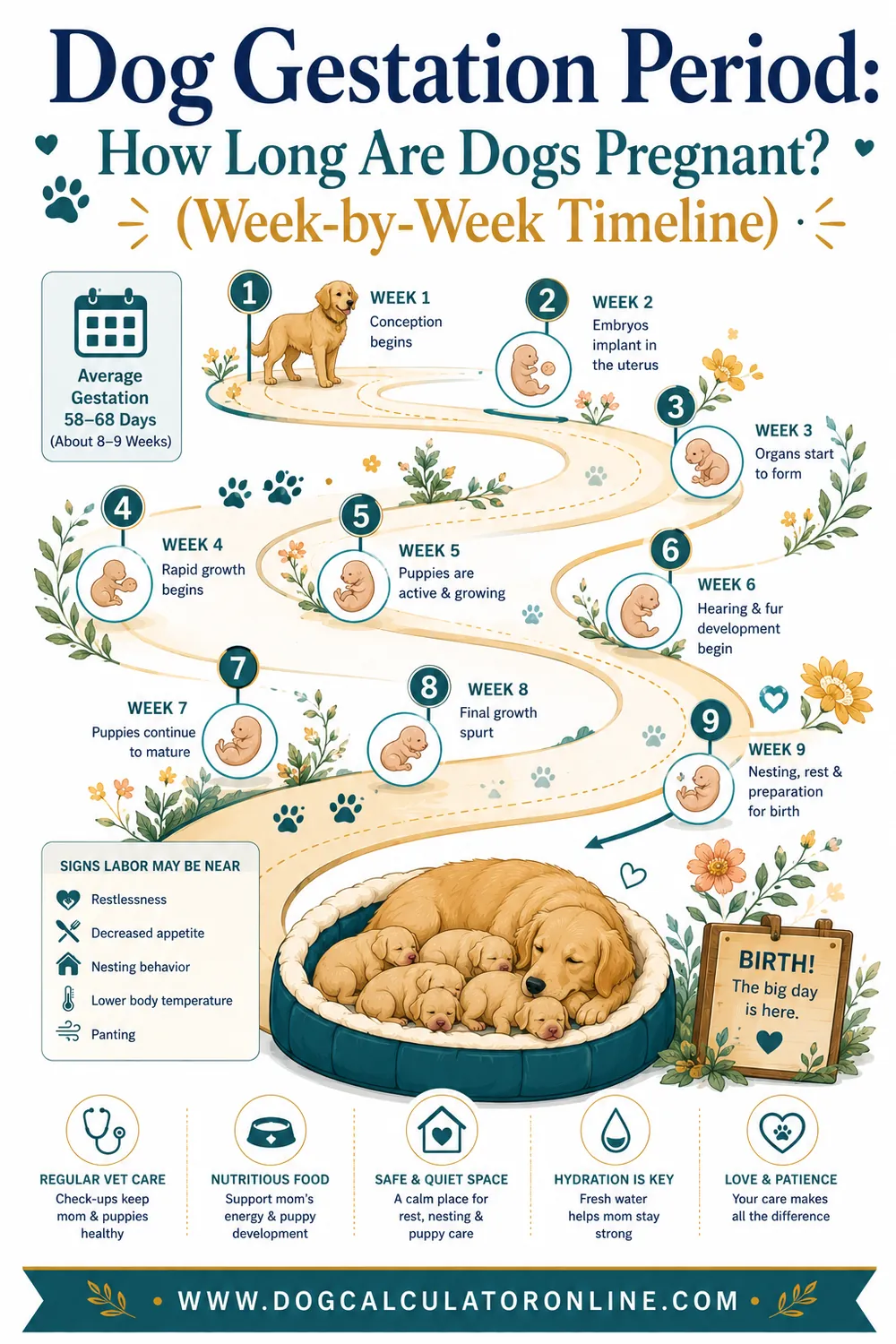
Around day 63: whelping, give or take a few days from the mating date — the week-by-week detail is in dog pregnancy week by week, and the signs that the night has started are in signs a dog is in labor.
Common Misconceptions
The ones that come up most.
"Count the nipples to count the puppies." No. There is no relationship.
"A big belly means a big litter." Often, but a single very large puppy can produce a comparable bulge, and a slim dog can carry more than she looks.
"The first litter is always the biggest." The reverse is usually true.
"More matings mean more puppies." Only if the timing is right; two well-timed matings beat five badly timed ones.
"An ultrasound told us six, so it is six." Ultrasound counts are unreliable. Only an X-ray count is worth acting on.
"She has stopped pushing, so she is done." The single most consequential mistake on this list, and the reason to have a count at all.
FAQ
How many puppies do dogs usually have?
About five or six on average across all breeds, but that is a medium-dog figure. Toy breeds typically have one to three, small breeds three to four, large breeds six to eight, and giant breeds eight to ten or more.
Can a dog have just one puppy?
Yes, and it is fairly common in toy breeds and in first or late litters. Singletons often grow large, may not trigger labor normally, and are frequently delivered by planned cesarean, so they need closer veterinary supervision.
How can you tell how many puppies a dog is having?
An X-ray from about day 45, once the puppies' skeletons have mineralised, gives a reliable count. Ultrasound from day 25 confirms pregnancy and viability but is unreliable for counting.
Does the first litter tend to be smaller?
Usually, yes. Litter size typically rises through the second, third and fourth litters and then declines with age, with the peak generally between about two and five years old.
What is the largest litter of puppies ever recorded?
Twenty-four, born to a Neapolitan Mastiff in 2004. It is recorded precisely because it is far outside the normal range, even for a giant breed.
Why does knowing the number matter?
Because it tells you when whelping is finished. A mother will often settle and nurse with a puppy still inside, and a retained puppy is an emergency — without a count you are guessing at the worst possible moment.
Size Sets the Range, the Count Settles the Night
How many puppies a dog has is mostly a question of how big she is: one to three in a toy breed, five or six in a medium dog, eight or more in a giant, with her age, her litter history and the timing of the mating adjusting the figure from there. Well-timed mating around ovulation is the one factor within anyone's control, and it makes a measurable difference. But the reason to want an actual number is practical rather than curious — an X-ray count from about day 45 is what tells you whether whelping has finished, and that single fact is worth more on the night than every average on this page. Get the due date right first with the free dog pregnancy calculator.