How Old Is My Dog in Human Years? A Simple, Accurate Answer
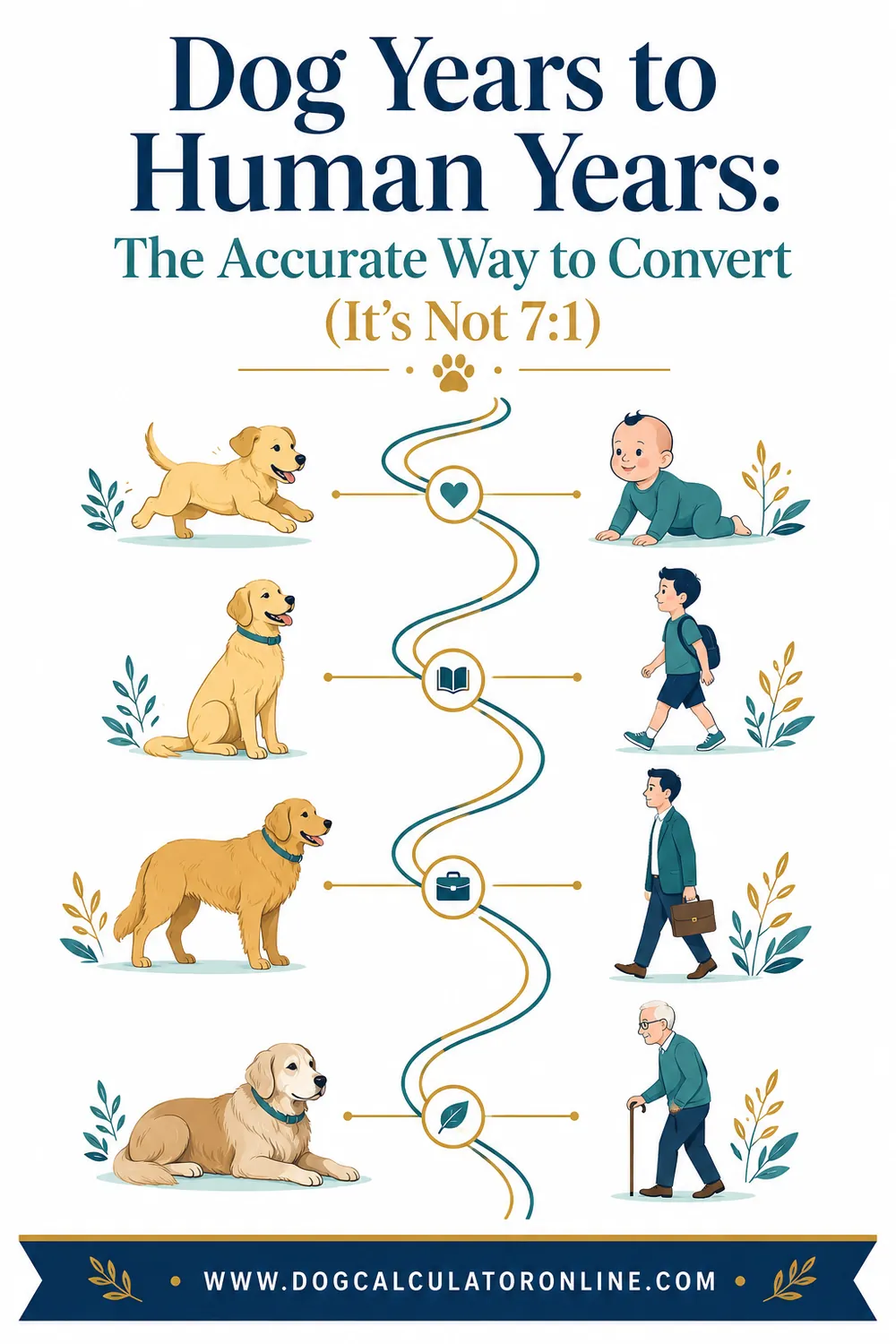
To find your dog's age in human years, count 15 for the first year, add 9 for the second, then add 4 to 7 for every year after that depending on your dog's size (small to giant). So a 4-year-old medium dog is about 34 in human years, and a 4-year-old giant breed is closer to 38. The old "multiply by 7" trick is not accurate.
The fastest way to get your dog's real human-year age is our free dog age calculator — enter age and weight, and it shows both the vet-backed number and the DNA-study number. Below, we'll walk through the method so you can do it by hand too.
🐾 How old is your dog in human years?
Tap your dog's age (medium breed, 21–50 lb):
Tap an age above to see the human-year equivalent.
The Quick Method (Do It in Your Head)
You don't need a spreadsheet. Here's the whole thing:
- First year = 15 human years.
- Second year = 9 more (running total: 24).
- Each year after that adds a number based on size:
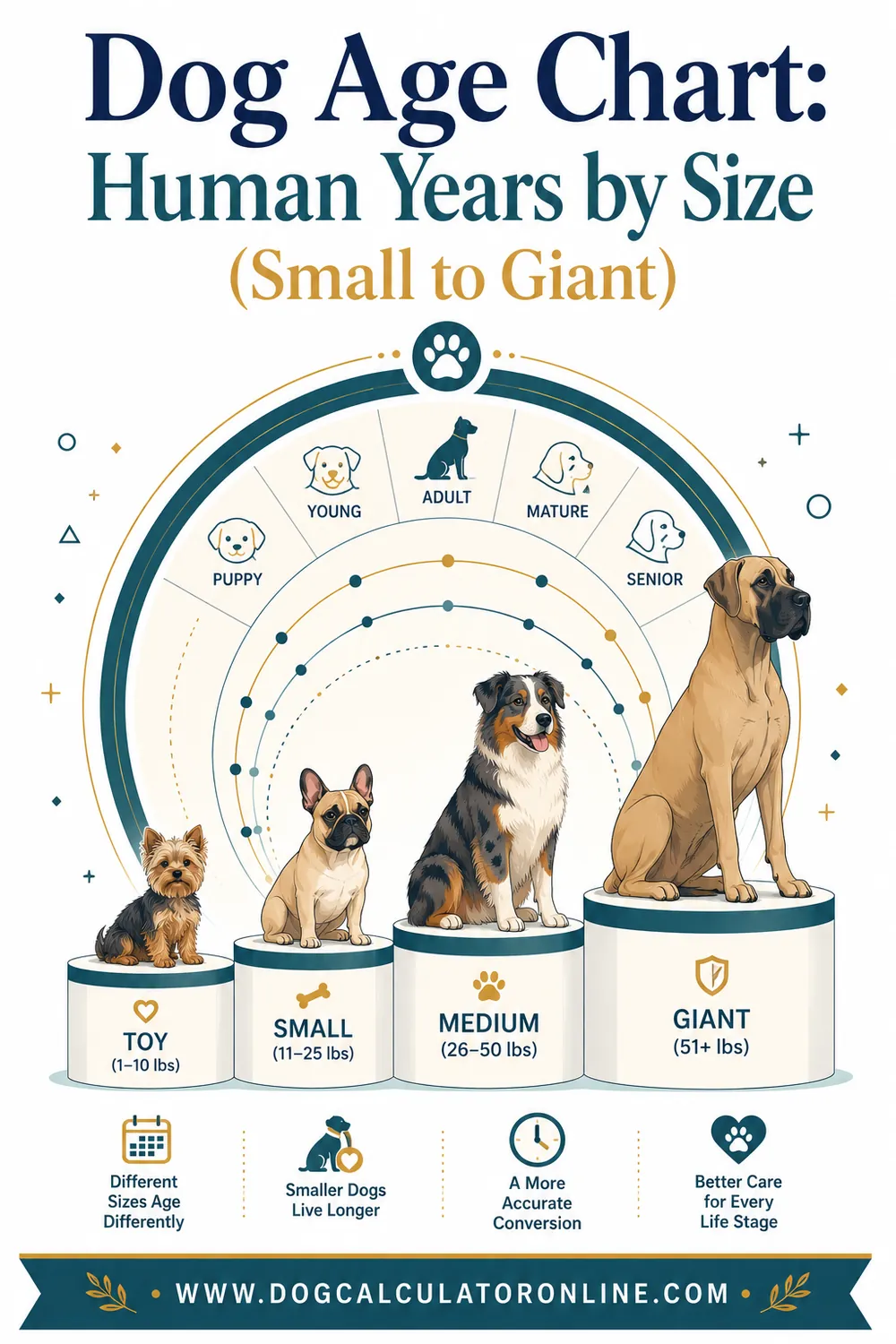
- Small (under 20 lb): +4 per year
- Medium (21–50 lb): +5 per year
- Large (51–90 lb): +6 per year
- Giant (over 90 lb): +7 per year
So for a 5-year-old medium dog: 15 + 9 + (3 years × 5) = 39 human years. For a 5-year-old giant breed: 15 + 9 + (3 × 7) = 45 human years. Same calendar age, different human age — because size changes how fast dogs age.
This is the guideline the American Veterinary Medical Association and most vets use today. It replaced the old 7:1 rule because that rule ignored two facts: dogs mature incredibly fast in year one, and big dogs age faster than small ones.
But First — How Old Is Your Dog, Actually?
If you adopted your dog or rescued a stray, you might not know their birthday. Vets estimate age using a few clues:
- Teeth. Puppies get all their adult teeth by about 6–7 months. After that, tartar buildup, wear, and yellowing give rough age hints — clean white teeth suggest a young adult, heavy tartar suggests middle age or older.
- Eyes. A cloudy, bluish haze in the lens (called lenticular sclerosis) commonly appears around 6–8 years and up.
- Coat. Gray hairs around the muzzle and eyebrows usually start showing in middle age, though some dogs gray early.
- Muscle tone and energy. Younger dogs are typically leaner and more energetic; older dogs may be stiffer or carry more weight.
None of these is exact, so a vet will usually give a range ("probably 3 to 5 years"). Once you have a best-guess calendar age, the human-years math is easy. Pop your estimate into the dog age calculator and you'll have a number in seconds.
Full Human-Years Chart by Size
Here's the size-adjusted method laid out so you can find your dog fast:
| Dog age | Small (<20 lb) | Medium (21–50 lb) | Large (51–90 lb) | Giant (>90 lb) |
|---|---|---|---|---|
| 1 | 15 | 15 | 15 | 15 |
| 2 | 24 | 24 | 24 | 24 |
| 3 | 28 | 29 | 30 | 31 |
| 4 | 32 | 34 | 36 | 38 |
| 5 | 36 | 39 | 42 | 45 |
| 6 | 40 | 44 | 48 | 52 |
| 7 | 44 | 49 | 54 | 59 |
| 8 | 48 | 54 | 60 | 66 |
| 10 | 56 | 64 | 72 | 80 |
| 12 | 64 | 74 | 84 | 94 |
| 14 | 72 | 84 | 96 | — |
(Giant breeds rarely reach 14, which is why that cell is blank.) For a deeper breakdown by month and breed, see our full dog age chart.
The DNA-Study Answer (A Fun Second Opinion)
In 2019, University of California San Diego scientists studied chemical "age marks" on dog DNA and built a formula from about a hundred Labradors:
Human age = 16 × ln(dog age) + 31
It gives higher numbers for young dogs (a 1-year-old comes out at 31) and then flattens out fast. It's genuinely interesting and rooted in real biology, but it was based on one breed and measures molecular aging rather than life stage. Think of it as a second opinion, not a replacement. Our calculator shows both numbers so you can compare — the dog years to human years guide explains exactly why they differ.
What the Number Actually Tells You
The human-years figure is more than a party fact. It's a shortcut to your dog's life stage, and life stage drives real care decisions:
- Young adult (roughly 15–30 human years): full energy, needs training and exercise, on adult food.
- Mature adult (30–50): settled, watch weight, keep up dental care.
- Senior (50+): consider twice-yearly vet visits, joint support, senior diet, and watch for changes in appetite, thirst, or mobility.
Knowing your medium dog is "about 54" (age 8) is a nudge to start senior screening. That's the practical payoff of getting the number right.
Signs Your Dog Is Getting Older
The human-years number tells you when to start watching for age-related changes. In dogs entering their senior years (roughly the human 50s and up), keep an eye out for:
- Slowing down. Less enthusiasm for stairs, jumps, or long walks can signal joint stiffness.
- Graying muzzle and cloudy eyes. Common and usually cosmetic, but the vet should check vision changes.
- Weight shifts. Older dogs often gain weight as activity drops, or lose it if illness is brewing.
- Changes in thirst, appetite, or bathroom habits. These can be early clues to kidney, thyroid, or other issues — worth a vet visit.
- Sleeping more and subtle behavior changes. Some slowing is normal aging; sudden changes are not.
Knowing your dog is, say, "about 60 in human years" is a useful nudge to take these signs seriously and schedule that senior checkup.
Common Mistakes People Make
- Using 7× for everything. It overstates young dogs and understates the size difference.
- Ignoring size. A conversion that doesn't ask your dog's weight can't be accurate.
- Treating the number as exact. It's a well-founded estimate, not a birth certificate. Two dogs of the same age and size can still differ based on genetics, weight, and health.
Always pair the number with your vet's input on your specific dog. The math sets expectations; your vet reads the real animal in front of them.
Human-Years Examples for Popular Breeds
It helps to see the method applied to real dogs. Here are a few at age 6, sorted by size class:
- Chihuahua (5 lb, small): 15 + 9 + (4 × 4) = 40 human years — barely middle-aged, likely years of energy left.
- Beagle (25 lb, medium): 15 + 9 + (4 × 5) = 44 human years.
- Labrador Retriever (70 lb, large): 15 + 9 + (4 × 6) = 48 human years.
- Great Dane (130 lb, giant): 15 + 9 + (4 × 7) = 52 human years — approaching senior, despite being the same calendar age as the Chihuahua.
Same six candles on the cake, a 12-year spread in human terms. That gap is exactly why the calculator asks for weight, not just age.
What Changes the Real Number
The formula gives an average for a size class, but individual dogs drift from it based on:
- Genetics. Some breeds and family lines simply age slower. Mixed breeds often benefit from a wider gene pool.
- Weight. Lean dogs tend to age better than overweight ones. Keeping your dog trim can add healthy years.
- Dental and preventive care. Untreated dental disease and skipped checkups can make a dog "older" than the chart says.
- Spay/neuter and lifestyle. These influence long-term health in ways that show up over years.
Think of the human-years number as a solid starting estimate you can improve on with good care — not a fixed sentence.
FAQ
What is my dog's age in human years?
Add 15 for year one, 9 for year two, then 4–7 per year after that based on size. A 3-year-old medium dog is about 29; a 6-year-old large dog is about 48. The dog age calculator does it instantly.
Is 1 dog year 7 human years?
No. Year one alone is worth about 15 human years, and later years vary by size. The flat 7:1 rule is outdated and inaccurate.
How can I tell how old my rescue dog is?
Vets estimate age from teeth wear and tartar, eye clouding, gray hairs, and muscle tone. They usually give a range. Use the midpoint of that range in the calculator.
Does my dog's breed change the answer?
Mostly through size. Bigger breeds age faster after adulthood. Two same-weight dogs of different breeds will land close together, but a Chihuahua and a Mastiff of the same calendar age are very different in human years.
When is my dog considered old?
Small and medium dogs are typically seniors around 7; large and giant breeds around 5–6. That's roughly the mid-50s to 60s in human years.
Why do the calculator's two numbers differ?
One uses the vet-backed size-adjusted guideline (best for life stage); the other uses the 2019 Labrador DNA formula (best for molecular aging). Different methods, different questions.
The Bottom Line
Your dog's age in human years isn't "times seven." It's 15 for the first year, 9 for the second, and 4–7 more per year after that depending on size. That gives you a realistic number — and, more usefully, a life stage you can plan around.
Skip the mental math: enter your dog's age and weight into our free dog age calculator and get the exact human-year age, plus the DNA-study version, in one tap. Then keep going with our dog age chart for the full breakdown.