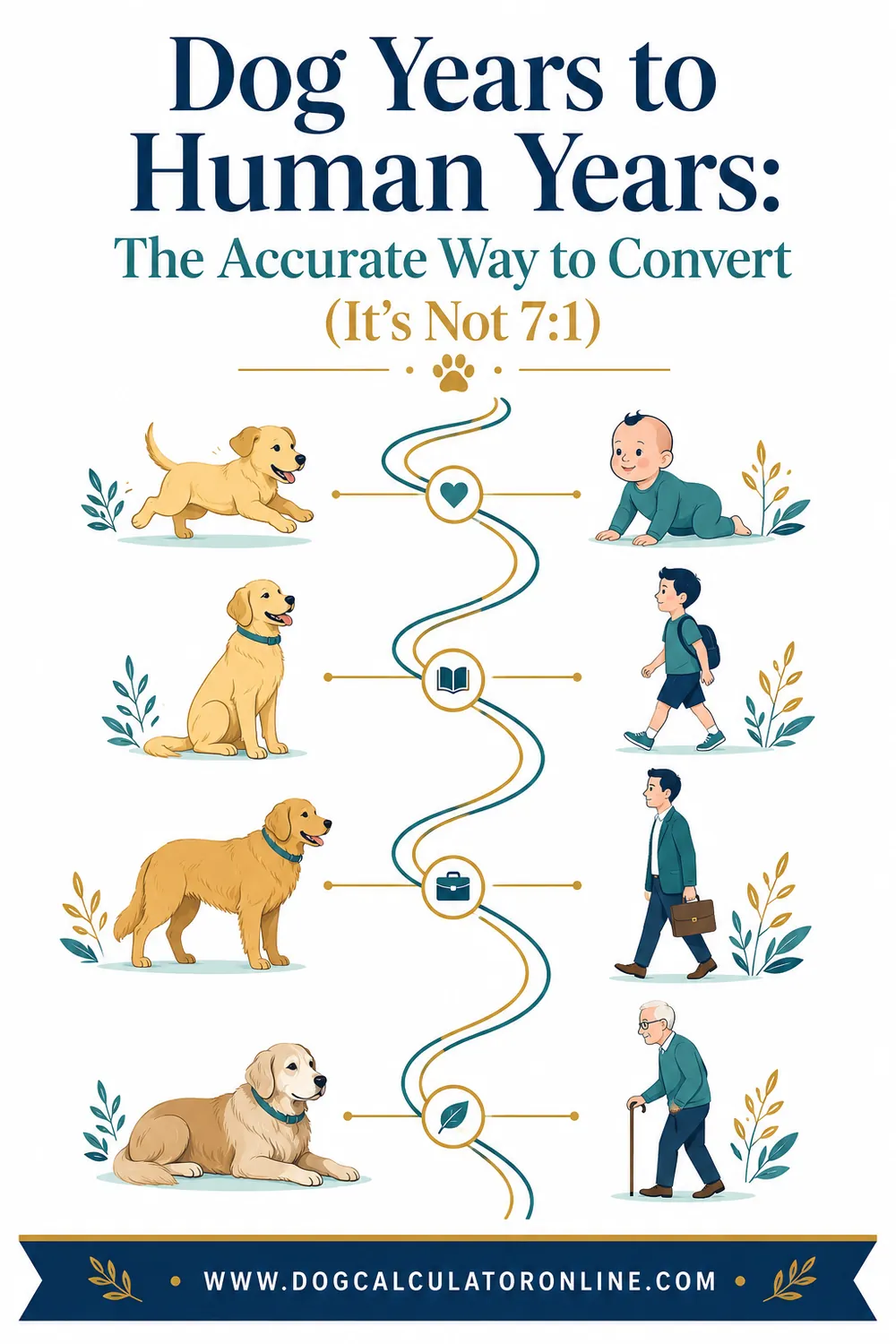
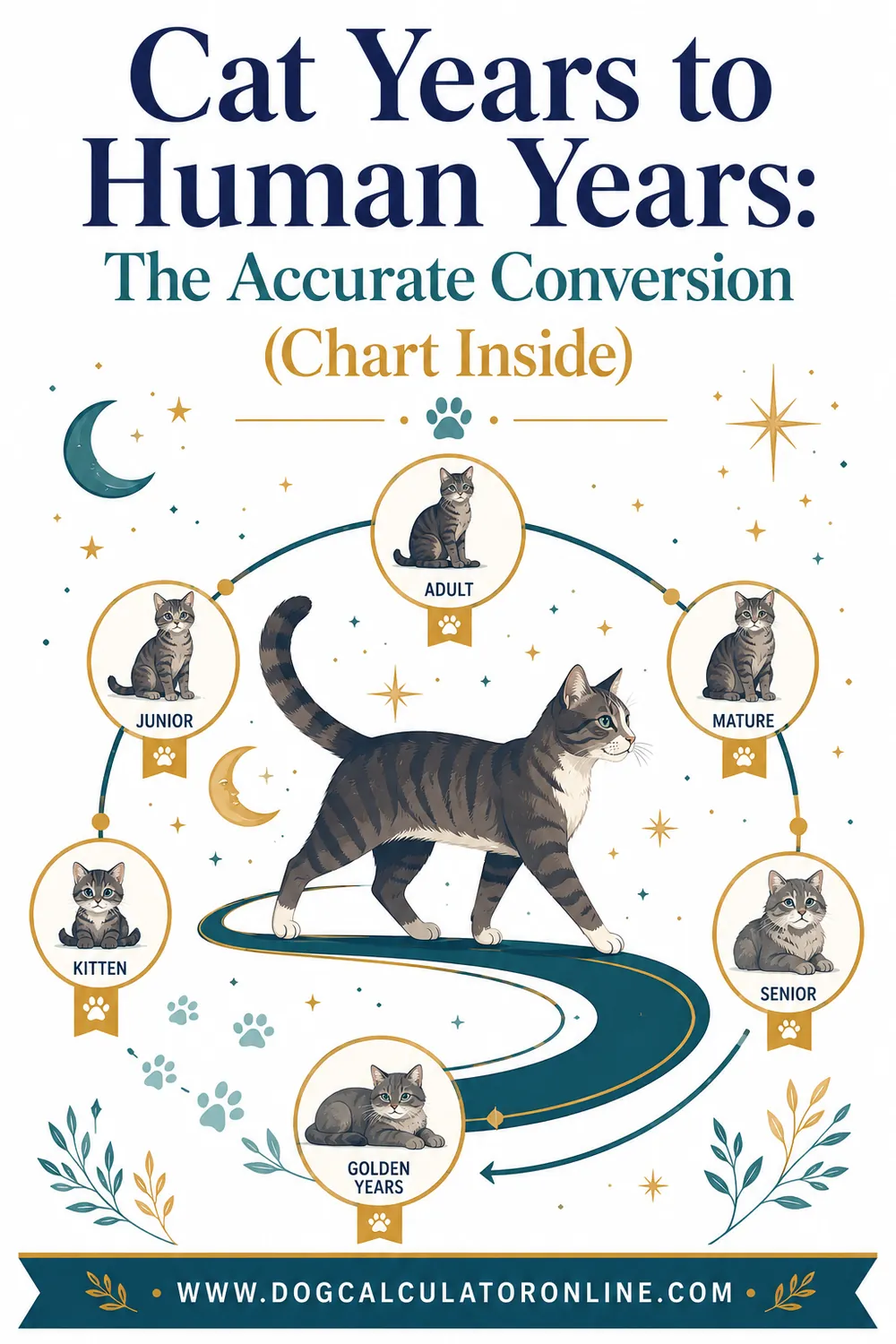
Cat Years to Human Years: The Accurate Conversion (Chart Inside)
A cat's first year equals about 15 human years, the second year adds about 9 more (reaching 24), and every year after that adds roughly 4 human years. So a 5-year-old cat is about 36 in human years, and a 10-year-old cat is about 56. Like dogs, cats do not age at a flat 7 years per year — they mature fast, then slow down.
Our free dog age calculator also handles cats, so you can get your cat's human-year age in one tap. Below is the full method, a complete chart, and how cat aging differs from dog aging.
🐱 Quick converter: cat years → human years
Tap your cat's age to see the human-year equivalent:
Tap an age above to see the human-year equivalent.
The Cat Aging Method (Used by Vets)
Veterinary groups like the American Association of Feline Practitioners use a simple, size-independent system for cats (cats vary far less in size than dogs, so there's no small/medium/large split):
- First year ≈ 15 human years. A 1-year-old cat is a full young adult.
- Second year ≈ 9 more, reaching about 24. A 2-year-old cat is roughly a 24-year-old human.
- Every year after that ≈ +4 human years.
So the math is easy: after age 2, just add 4 for each additional year.
- 3-year-old cat: 24 + 4 = 28
- 6-year-old cat: 24 + (4 × 4) = 40
- 12-year-old cat: 24 + (4 × 10) = 64
- 18-year-old cat: 24 + (4 × 16) = 88
Full Cat-Years-to-Human-Years Chart
| Cat age | Human age | Life stage |
|---|---|---|
| 6 months | 10 | Kitten |
| 1 year | 15 | Junior |
| 2 years | 24 | Young adult |
| 3 years | 28 | Young adult |
| 4 years | 32 | Prime |
| 5 years | 36 | Prime |
| 6 years | 40 | Prime |
| 7 years | 44 | Mature |
| 8 years | 48 | Mature |
| 10 years | 56 | Mature/senior |
| 12 years | 64 | Senior |
| 14 years | 72 | Senior |
| 15 years | 76 | Senior |
| 18 years | 88 | Super-senior |
| 20 years | 96 | Super-senior |
Cats commonly live 12–18 years, and indoor cats reaching 20 is not rare. That's why the chart runs so much longer than a typical dog chart.
How Cat Aging Differs From Dog Aging
The starting point is similar — both cats and dogs pack a huge amount of aging into year one — but the paths diverge:
- No size adjustment for cats. Dogs range from 3-pound Chihuahuas to 150-pound Mastiffs, and size changes how fast they age. Cats are all roughly the same size, so one formula fits nearly all of them.
- Cats add a flat +4 per year; dogs add +4 to +7. Because there's no giant-breed effect, cats settle into a steady, gentle +4 per year after age two.
- Cats often live longer. A 16-year-old cat (about 80 in human years) is common; a 16-year-old large dog is exceptional.
If you're curious how the dog side works, our dog years to human years guide breaks down the size-adjusted method in detail, and the how old is my dog in human years article shows it step by step.
Cat Life Stages, Explained
The number is handy, but the life stage is what guides care:
- Kitten (0–6 months): rapid growth, kitten food, vaccines, socialization.
- Junior (7 months–2 years): reaches full size, high energy, spay/neuter window.
- Prime (3–6 years): healthy adult, watch weight, annual vet visits.
- Mature (7–10 years): the feline "40s and 50s" — start monitoring weight, teeth, and kidney health.
- Senior (11–14 years): consider twice-yearly checkups and bloodwork.
- Super-senior (15+): extra attention to hydration, mobility, and comfort.
Always talk to your vet about your specific cat, especially around the mature and senior transitions when issues like kidney disease and dental problems become more common.
How to Estimate a Cat's Age If You Don't Know It
Adopted a cat with no history? Vets use similar clues to dogs:
- Teeth: kittens get adult teeth by 6–7 months; tartar and wear increase with age.
- Eyes: young cats have smooth, clear irises; older cats may show a cloudy lens or a jagged iris edge.
- Coat: senior cats often develop coarser, sometimes patchy fur and may groom less.
- Muscle and activity: younger cats are lean and springy; seniors may be bonier along the spine or less agile.
A vet will usually give a range. Use the middle of that range in the dog age calculator (cat mode) for a human-years estimate.
Do Some Cat Breeds Live Longer?
While the aging formula is the same for nearly all cats, typical lifespan does vary a little by breed and lifestyle:
- Long-lived breeds like Siamese, Burmese, and many domestic shorthairs and longhairs often reach 15–20 years.
- Larger breeds like the Maine Coon mature more slowly and reach a bigger adult size, but their per-year aging still follows the standard curve.
- Mixed-breed cats frequently enjoy excellent longevity thanks to a diverse gene pool.
The single biggest lifespan factor isn't breed, though — it's indoor living plus good preventive care. A pampered indoor cat of almost any breed can reach the human equivalent of 90 or more. Compare that to dogs, where breed size drives huge lifespan differences: our dog years to human years guide shows how a small dog can outlive a giant breed by nearly a decade.
Why Not Just Multiply by 7?
The same reasons the 7× rule fails for dogs apply to cats:
- A 1-year-old cat is sexually mature and can have kittens — nothing like a 7-year-old child.
- Aging isn't linear. Cats race through the first two years, then aging slows to a steady crawl.
- It gives silly numbers. By the 7× rule, a 20-year-old cat would be "140," which overstates things; the vet method puts it near 96 — very old, but believable.
Indoor vs. Outdoor: A Big Lifespan Gap
One factor swings feline lifespan more than almost any other: whether a cat lives indoors. Indoor cats commonly reach 15–18 years and beyond, while outdoor cats face traffic, predators, disease, and fights that shorten their lives considerably. That's not a moral judgment — it's why the chart above runs all the way to 20 and why so many indoor cats hit the human equivalent of 80 or 90.
If your cat goes outside, extra vigilance on vaccines, parasite prevention, and identification (microchip, collar) matters even more. Ask your vet what's right for your cat and your area.
Helping Your Cat Age Comfortably
The human-years number is a cue to adjust care as your cat matures:
- Watch the waistline. Obesity is common in indoor cats and drives diabetes, joint issues, and a shorter life. You should feel ribs with light pressure and see a slight waist from above.
- Keep water flowing. Kidney disease is one of the most common problems in older cats. Fresh water, and often wet food, support hydration.
- Don't skip dental care. Dental disease is widespread in cats and often hidden. Vet dental checks catch it early.
- Add senior checkups. From about age 11 (the human 60s), twice-yearly vet visits and periodic bloodwork help catch kidney, thyroid, and other age-related issues while they're manageable.
- Make the home senior-friendly. Older cats appreciate low-sided litter boxes, easy-to-reach perches, and warm, quiet resting spots.
Small adjustments at the right life stage can add comfortable years. The number simply tells you when to start paying closer attention.
How Old Is a Kitten in Human Years, Month by Month?
That first-year jump from 0 to 15 isn't spread evenly — kittens do most of their "growing up" in the first six months. Here's roughly how the months break down:
| Kitten age | Human age |
|---|---|
| 1 month | ~1 year |
| 3 months | ~4 years |
| 6 months | ~10 years |
| 9 months | ~13 years |
| 12 months | ~15 years |
This is why a 4-month-old kitten acts like a hyper preschooler while a 10-month-old already seems like a moody teenager — because developmentally, that's about right. It also explains why vets pack so much into the first year: vaccines, spay/neuter, and diet changes all land in a window that covers the feline equivalent of birth through high school.
FAQ
How many human years is 1 cat year?
The first cat year is worth about 15 human years, not 7. The second year adds about 9 (reaching 24), and each year after that adds roughly 4.
How old is a 10-year-old cat in human years?
About 56. The math: 15 (year one) + 9 (year two) + 4 × 8 more years = 56.
Do cats age faster than dogs?
Early on they're similar. But cats age at a steady +4 per year after age two with no size effect, while large dogs age faster (+6 or +7). Cats also tend to live longer overall.
Does my cat's breed change the answer?
Far less than with dogs. Cats vary little in size, so the same formula fits almost all breeds. A few large breeds like Maine Coons mature a bit slower, but the difference is small.
When is a cat a senior?
Around 11 years (about 60 in human years). Cats 15 and older are often called super-seniors.
Can I use the dog calculator for my cat?
Yes. Our free dog age calculator has a cat mode that applies the feline formula. Just enter your cat's age.
The Bottom Line
For cats, the accurate conversion is 15 human years for the first year, 24 by the end of the second, and +4 for every year after that. There's no size adjustment like dogs need, and cats often live well into their late teens — meaning your cat can reach the human equivalent of 90-plus.
Want the exact figure for your cat (or your dog)? Our free dog age calculator does the feline and canine math instantly — no charts to memorize. Then explore the dog age chart if you've got a pup at home too.