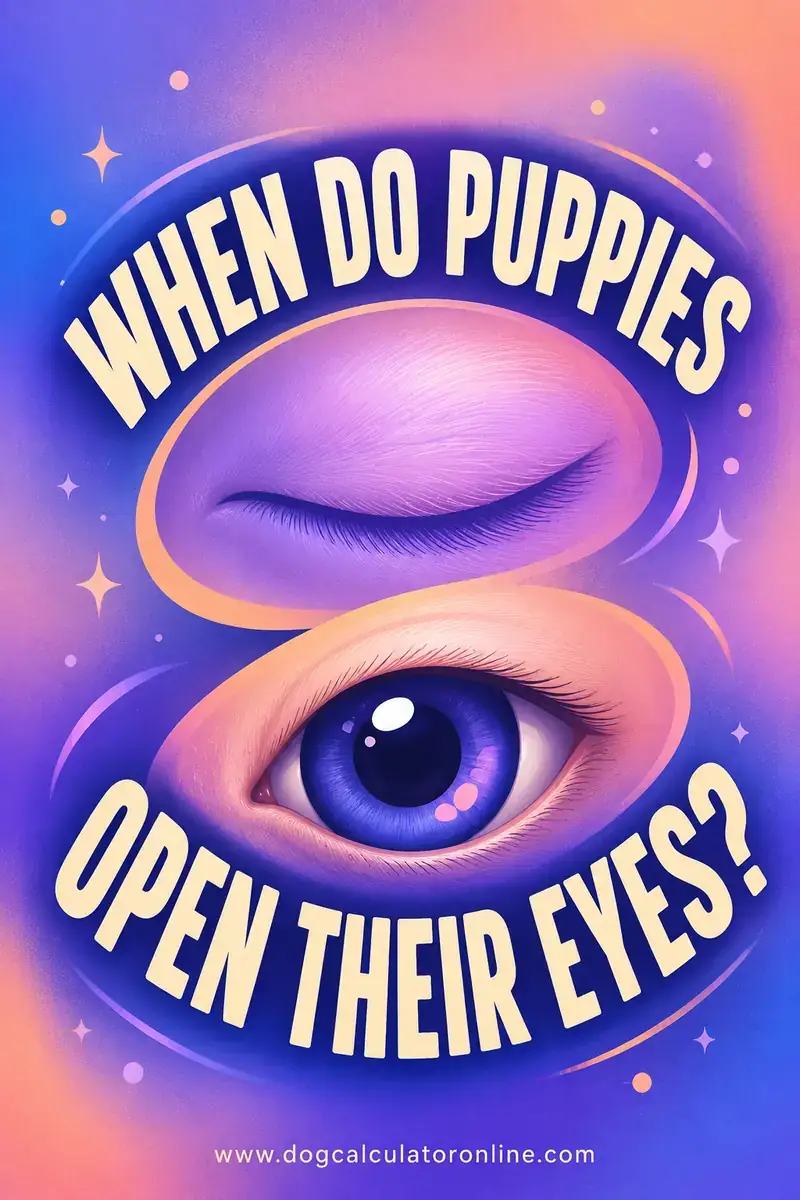
When Do Puppies Open Their Eyes?
Puppies open their eyes between about day 10 and day 14, and the two things people get wrong are what happens next and what to do if it happens late. Open eyes do not mean working eyes: a two-week-old puppy sees light, movement and vague shapes, and proper vision takes several more weeks to arrive. The murky blue-gray color everyone photographs is also temporary and tells you nothing about the adult eye color. The one rule that matters more than any timing is this: never try to open a puppy's eyes yourself, and a lid that is bulging, crusted or weeping before it opens needs a vet rather than patience. Keep an eye on the other milestone that matters most with the free puppy weight calculator.
🐾 Newborn milestones, in order
Tap a milestone:
Tap a milestone above. Eyes first, then ears, then legs, then teeth.
The Answer, With the Normal Range
Day 10 to 14 is the headline, and there is a legitimate spread around it.
Most puppies open their eyes between day 10 and day 14 from birth, with day 12 being the commonest single answer.
A window of day 8 to day 16 is still within normal. Some lines and some breeds run consistently early or late, and breeders who whelp the same bloodline repeatedly often know their own timing.
They almost never open both eyes at once. One eye opens first, often by a day or more, and each starts as a narrow slit at the inner corner that widens over a day or two.
Larger, stronger puppies in a litter tend to open first, which is why a runt lagging by a couple of days is usually just smaller rather than unwell.
Beyond about day 17 with no sign of opening, mention it to your vet at the next check. It is rarely urgent by itself, but it is worth a look.
Premature puppies open late, roughly in line with how early they arrived, because the timetable runs from conception rather than from birth.
Why Puppies Are Born With Their Eyes Shut
There is a reason, and it explains the fragility.
Dogs are born at a much earlier stage of development than we are. Puppies arrive blind, deaf and unable to walk or keep themselves warm, which is a trade-off that lets a mother carry a large litter for only about 63 days.
The eye is still developing behind the lid. The retina and the cornea are not finished at birth, and the fused eyelid acts as a sterile, dark incubator while they complete.
Light exposure too early can damage a developing retina, which is the practical reason not to force the lids apart and the reason to keep the whelping box dimly lit rather than brightly floodlit.
The lids are genuinely fused, not simply closed. They separate on their own schedule as the tissue matures.
The same pattern applies to the ears. The ear canals are sealed at birth and open a few days after the eyes, around day 14 to 18.
Smell and touch work from day one, and are how a newborn finds the mother — the full picture of that first two weeks is in newborn puppy care week by week.
What a Puppy Can Actually See
Open eyes are the start of vision, not the arrival of it.
At two weeks a puppy sees light and rough movement, little more. The retina is immature and the pupils respond sluggishly.
Newly opened eyes often look cloudy or hazy. That is normal in the first days and clears as the cornea finishes developing.
By three weeks puppies track a moving hand and turn towards it, which is the first sign the visual system is wiring up.
By four to five weeks vision is functional — puppies judge distance well enough to charge at each other, avoid the sides of the box and find the food dish.
Full visual acuity takes months, and even an adult dog sees detail far less sharply than a person while beating us comfortably on movement and low light.
Dogs never develop our color range. They see blues and yellows well and cannot distinguish red from green, which is worth knowing when choosing toys that need to be found in grass.
The Milestone Timetable
Where eye opening sits among everything else in the first eight weeks.
| Age | Milestone |
|---|---|
| Day 1–3 | Umbilical stump dries and drops off |
| Day 8–16 (usually 10–14) | Eyes open, one at a time, as slits |
| Day 14–18 | Ear canals open, first startle response |
| Day 15–21 | Standing, then first wobbly steps |
| Around week 3 | First milk teeth; toileting without help |
| Week 3–4 | Vision tracking; first gruel offered |
| Week 4–5 | Play with littermates; supplementary heat comes off |
| Week 6–8 | Weaning complete; first vaccination |
Eye opening is the first visible milestone after the cord drops off, which is why it feels like such a landmark.
The order is more reliable than the exact days. A litter that runs a day or two behind on everything is usually fine; a litter where one milestone is far out of sequence is worth mentioning.
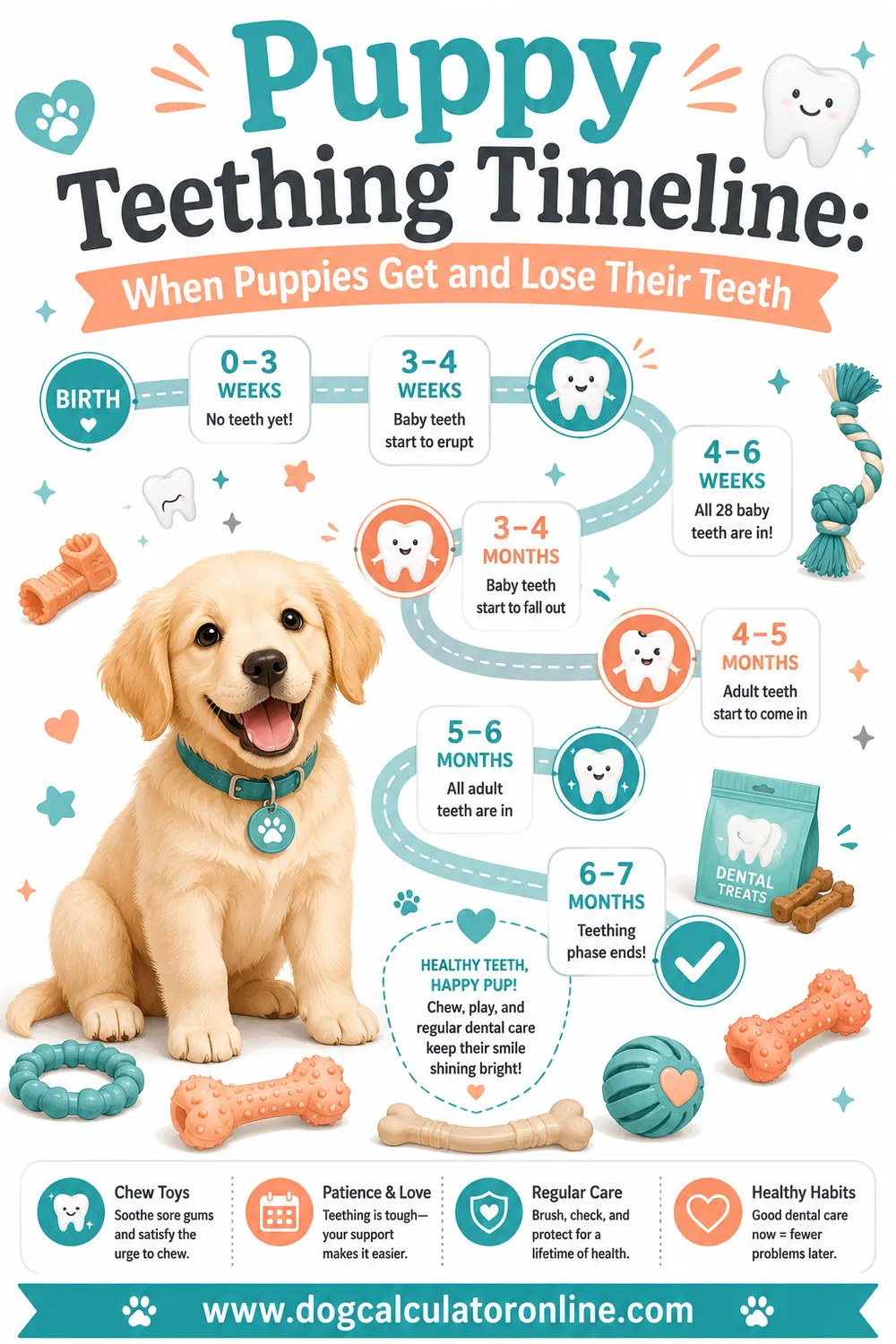
Teeth follow shortly behind the eyes, and the full eruption and replacement sequence is set out in the puppy teething timeline.
The broader growth picture across the first year is in puppy growth stages week by week.
Never Force an Eye Open
The most important sentence on this page.
Do not prise, peel or wipe a puppy's eyes open, however tempting it is when littermates have gone ahead. The lids separate as the underlying tissue matures, and forcing them tears delicate skin and exposes an unfinished eye.
Damage from forcing is not always visible immediately and can result in permanent corneal scarring.
Do not bathe closed eyes in salt water, tea or anything else unless a vet has told you to.
Gentle cleaning of crust around an already-open eye is fine, using cotton wool and cooled boiled water, wiping outwards from the inner corner and using a fresh piece for each eye.
Keep the whelping box out of direct sunlight and bright lamps for the first two weeks. Warm, yes; brightly lit, no.
Handle the litter briefly and daily, but the eyes are not part of the daily check beyond looking at them.
Why Every Puppy Looks Blue
A photogenic phase that means nothing about the future.
Almost all puppies have blue-gray eyes when they first open. The color comes from a lack of mature pigment in the iris rather than from actual blue pigment.
Pigment develops from about three to four weeks, and the color shifts gradually.
Most dogs settle at their adult eye color by nine to twelve weeks, though some continue changing subtly to about sixteen weeks.
A few breeds genuinely keep blue eyes — Siberian Huskies, some Australian Shepherds, merle-patterned dogs and dogs carrying certain white markings. In those cases the blue stays vivid rather than fading to gray.
Merle and double-merle genetics carry real eye and ear risk. Two merle parents can produce puppies with serious visual and hearing defects, which is why merle-to-merle matings are widely discouraged.
You cannot predict adult eye color from the newborn shade. Wait for the pigment.
Problems Worth a Vet Appointment
Most eye issues in newborns are uncommon but move quickly.
A bulging, swollen or domed lid before the eye opens is the classic warning. Infection can develop behind a fused lid — sometimes called neonatal ophthalmia — and pus builds with nowhere to go. This needs a vet, who will open and flush the eye properly. Treated promptly the outcome is usually good; left alone it can destroy sight.
Pus, discharge or crusting at the lid margin before or after opening.
An eye that stays cloudy or blue-white beyond the first week of being open.
A puppy that keeps one eye shut, paws at the face, or is obviously light-sensitive.
Redness of the white of the eye, or a visible scratch or gray spot on the cornea.
Eyes that have not opened at all by day 17 to 18.
Anything asymmetric. One eye markedly different from the other is a better warning sign than both being slightly odd.
None of this is a diagnosis. Newborn eyes are small and unforgiving, and a same-day appointment is nearly always the right call.
What Changes Once the Litter Can See
Open eyes mark a shift in how you manage the box.
Puppies start moving with purpose. Once they can see the edges of the box they explore them, and the litter stops staying in a neat pile.
Play begins in earnest between two and three weeks, and with it the first bite-and-yelp exchanges that build bite inhibition.
The socialization window opens at about three weeks. From this point, sights, sounds, surfaces and gentle handling by different people shape adult temperament — the checklist of what to introduce and when is in the puppy socialization checklist.
Weaning follows quickly. Seeing the food dish is part of what makes gruel work at three and a half to four weeks, covered in when do puppies start eating solid food and staged in the puppy weaning schedule.
The box needs a bigger, safer footprint as soon as puppies can see and walk, with a low-sided pen area they cannot climb out of.
Everything from here builds towards the eight-week point, when a puppy has enough social learning behind it to leave — the reasoning is in when can puppies leave their mother.
FAQ
At what age do puppies open their eyes?
Between about day 10 and day 14, with day 12 the commonest. Anywhere from day 8 to day 16 is normal, and they usually open one eye before the other, starting as a narrow slit at the inner corner.
Can you help a puppy open its eyes?
No. The eyelids are fused while the eye finishes developing, and forcing them apart risks tearing the lid and permanently scarring the cornea. If they have not opened by day 17 or look swollen, see a vet.
Why are puppies born blind?
Dogs are born at an early stage of development, after only about 63 days of pregnancy. The retina and cornea are still forming at birth, and the fused eyelid protects them from light and infection while they mature.
Do puppies see straight away once their eyes open?
Not properly. At first they detect light and vague movement. They track a moving hand by around three weeks and have functional vision for play and feeding by four to five weeks, with acuity still improving for months.
Why do puppies have blue eyes?
Because the iris has not yet developed its pigment. Color starts changing from three to four weeks and usually settles by nine to twelve weeks. Huskies, merles and some Australian Shepherds genuinely keep blue eyes.
When do puppies start to hear?
Ear canals open a few days after the eyes, around day 14 to 18. Puppies are born deaf, so the first visible startle at a sudden noise in the third week is a useful sign that hearing has come online.
two weeks of Waiting, Then Everything Speeds Up
Eyes opening at day 10 to 14 is one of the more reliable markers in a puppy's first weeks, but it is the start of vision rather than the arrival of it — expect hazy, light-and-movement sight at first, tracking by three weeks and real working vision by four or five. The blue-gray color is temporary pigment immaturity and predicts nothing about the adult eye. The rules worth remembering are short: keep the box dim, never force a lid apart, and treat a swollen, crusted or weeping eye as a same-day veterinary problem rather than something to bathe. After that the milestones come thick and fast. Keep recording those daily weights with the free puppy weight calculator.