When Can Puppies Leave Their Mother?
Eight weeks is the minimum, and the reason is behavioral rather than nutritional. That distinction is the whole point. A puppy is usually eating solid food independently by six weeks, which is why breeders under pressure sometimes offer them then — but the two weeks from six to eight weeks is when a puppy learns bite inhibition and basic dog-to-dog manners from its littermates and its mother, and those are lessons no human household can teach. Puppies separated early are measurably more likely to show behavior problems as adults. Many countries and states also set eight weeks in law. Get the timing right and the rest of the first year is easier. Track how the litter is growing with the free puppy weight calculator.
🐾 Is this puppy ready to leave?
Tap an age:
Tap an age above. Weaned at six weeks, ready at eight, and they are not the same thing.
The Short Answer, and the Two Different Questions
People ask one question and mean two.
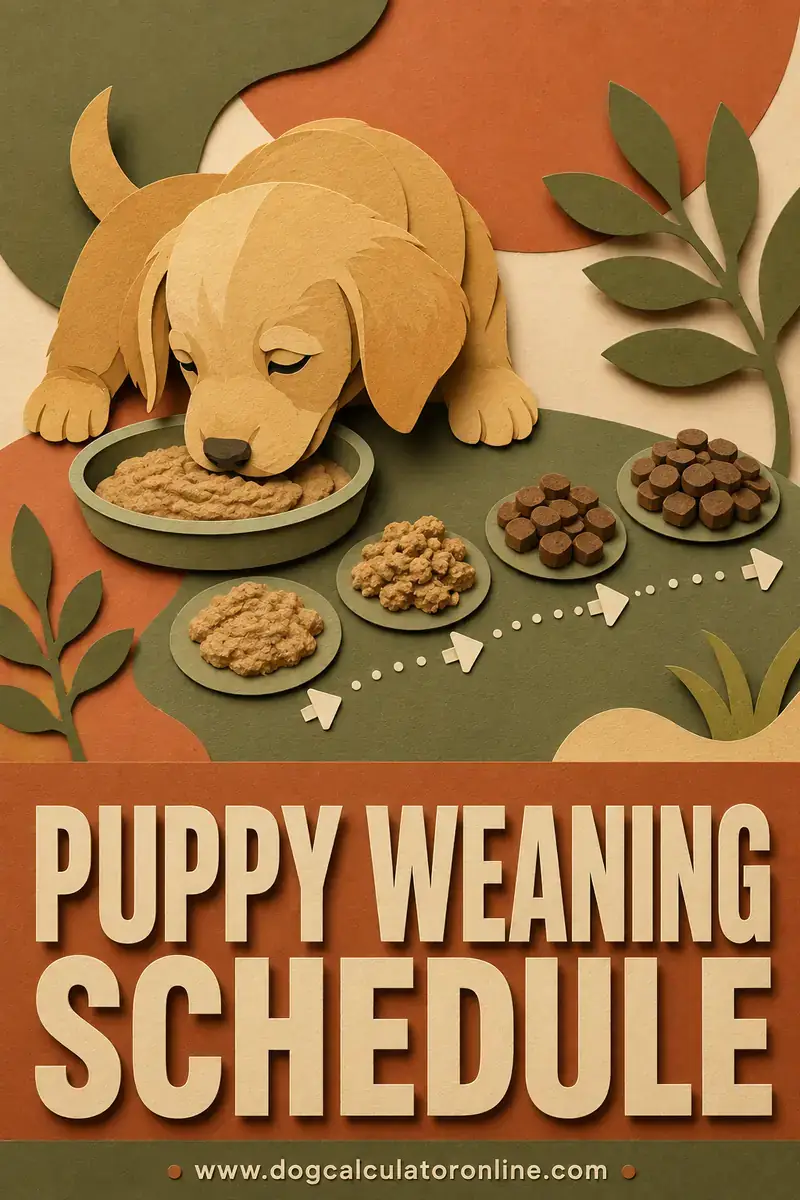
Nutritionally, a puppy is independent at around six to seven weeks, once fully weaned onto solid food. That question is answered by the puppy weaning schedule.
Behaviourally, a puppy is ready at eight weeks, and this is the constraint that actually matters.
Eight weeks is the answer given by most vets, most breed clubs and most rescue organizations, and it is written into law in a great many places.
Ten to twelve weeks is common and reasonable for toy breeds, and for breeders who continue structured socialization past eight weeks.
Under eight weeks is a red flag on a breeder, not a bargain. A breeder offering six-week-old puppies is either uninformed or clearing a litter quickly, and both are worth walking away from.
Never let a puppy leave before the first vaccination and worming are done and documented.
Why Six Weeks Is Too Early
The specific thing that happens in those two weeks.
Bite inhibition is learned from littermates. A puppy bites too hard, the other puppy yelps and stops playing, and over hundreds of repetitions the biter learns to control the pressure of its jaws. This is the single most valuable lesson of puppyhood and it happens mostly between six and eight weeks.
People cannot replicate it. We are too slow, too inconsistent, and we do not yelp convincingly. Owners of early-separated puppies spend months on mouthing that a litter would have sorted out in two weeks — practical help for that is in how to stop puppy biting.
Dog-to-dog communication is learned in the same window. Reading play signals, backing off, taking turns, tolerating being pinned, and the difference between a warning and a threat.
The mother teaches boundaries. Her growl when a puppy is too rough, and her withdrawal when nursing gets uncomfortable, are the puppy's first experience of a limit set by another dog.
Frustration tolerance develops here too. Being told no by mother and littermates and recovering from it is where resilience begins.
Puppies removed early often show more anxiety, more reactivity and more resource guarding as adults, and studies of early-separated puppies have found consistently higher rates of these problems compared with puppies kept to eight weeks or beyond.
What the Evidence Says
Worth being precise, because the eight-week figure is often asserted without support.
Research comparing puppies separated at around 30–40 days with puppies kept to about 60 days has found the early group significantly more likely as adults to show destructiveness, excessive barking, fearfulness on walks, reactivity to noise, possessiveness over food or toys, and attention-seeking.
The effect appears independent of where the puppy came from, which is why it is attributed to the separation age rather than to breeder quality alone.
It is a statistical association, not a guarantee. Plenty of early-separated puppies turn out well, and plenty of eight-week puppies develop problems for other reasons. The point is that early separation loads the dice against you.
The reverse is not automatically true. Keeping a puppy with the litter until twelve weeks does not improve outcomes by itself if nothing else is happening — after about eight weeks the marginal benefit shifts from littermates to novel experiences and human contact.
Singleton puppies are the exception that proves the rule. With no littermates, they miss the same lessons, and good breeders arrange supervised play with other suitable puppies.
Litter learning is not a substitute for socialization with the wider world — the sights, sounds, people and surfaces on the puppy socialization checklist still need covering.
The Legal Minimum Where You Are
Many places legislate this, and the details vary.
| Jurisdiction | Typical minimum age |
|---|---|
| United Kingdom | 8 weeks, and puppies must be seen with their mother |
| Most US states with a law | 8 weeks |
| Australia (varies by state) | 8 weeks in most states |
| Canada (varies by province) | 8 weeks commonly, guidance-based in some |
| Much of the EU | 8 weeks, some countries longer |
Check your own jurisdiction rather than relying on any summary, including this one. Rules change, and in federal countries they are set at state or provincial level rather than nationally.
Some laws go further than an age. Several jurisdictions require a puppy to be sold by the breeder who bred it, and to be shown to the buyer alongside its mother, specifically to shut down third-party dealers.
Airlines and transporters set their own minimums, often higher than the law, and international movement usually requires rabies vaccination at a minimum age plus a waiting period, which can push travel past twelve weeks.
Rescue organizations frequently set eight weeks as policy even where the law is silent.
A breeder who cannot show you the mother is a reason to leave, regardless of the puppy's age.
When Waiting Longer Is Better
Eight weeks is a floor, not always the ideal.
Toy and very small breeds are often held to ten or twelve weeks. Tiny puppies are prone to hypoglycaemia, are more fragile in transit, and cope better with a new home once they are a little larger.
A breeder actively socialising the litter — car trips, household noise, visitors, different surfaces, brief separations — is giving a puppy more at nine or ten weeks than most new homes will.
Show and working prospects are sometimes held longer so the breeder can assess structure or drive, which is a legitimate reason with no downside if socialization continues.
Some trainers prefer to avoid moving a puppy at exactly eight to nine weeks because it coincides with a well-described fear period, when frightening experiences make an unusually lasting impression. Moving at seven and a half or after nine weeks is one way around it; a calm, gentle first few days is another.
Past about twelve weeks the balance tips the other way. The prime socialization window is roughly three to twelve or fourteen weeks, and a puppy that has only ever known the breeder's kennel by then has lost time it cannot get back.
The exception is a genuinely enriched environment. A litter raised in a busy home meeting new people weekly is better off at eleven weeks than a litter in an outbuilding is at eight.
What a Puppy Should Come With
The checklist that separates a good handover from a hurried one.
Fully weaned and eating dry puppy food in four meals a day, as covered in when do puppies start eating solid food.
First vaccination given, usually between six and eight weeks, with the certificate and the date of the next dose.
Worming records, typically fortnightly from about two weeks, plus any flea treatment.
Microchip details, which are a legal requirement for puppies in a number of countries before sale.
A written record of birth weight and weekly weights, which is genuinely useful for spotting whether growth is on track later.
Several days of the food they are currently eating, so the diet does not change on the same day as everything else.
Something that smells of the litter — a piece of bedding or a cloth — which measurably reduces the first few nights of distress.
Health screening results for the parents where the breed has known hereditary conditions.
Settling In After the Move
The first two weeks sets the tone.
Expect a disrupted first few nights. A puppy that has slept in a warm heap of siblings every night of its life is alone for the first time. A crate beside the bed, a warm covered water bottle and the litter blanket all help.
Keep the food identical for the first week, then change gradually over five to seven days if you want to switch.
Loose stools in the first days are common from stress and water changes. Watery diarrhea, vomiting, refusal to eat for more than a day, or lethargy are vet calls rather than settling-in wobbles, especially in a small breed where blood sugar can drop fast.
Toilet training starts immediately, because the puppy has never had a reason to hold anything.
Socialization continues from day one — this is the busiest and most important part of the window, and the practical starting list is in the new puppy checklist.
Vaccination status limits where the puppy can go, but not whether it is socialized; carrying, car trips and visits to vaccinated adult dogs all count. The timing is in when can puppies go outside.
Keep the routine that worked at the breeder's where you can — meal times, food, and even the same word for the same thing. Fewer changes at once means a faster settle. The care that came before the handover is described in newborn puppy care week by week.
FAQ
At what age can a puppy leave its mother?
Eight weeks is the standard minimum and is written into law in many countries and states. Puppies are usually weaned by six or seven weeks, but the extra two weeks with the litter is where bite inhibition and dog-to-dog manners are learned.
Why can puppies not leave at six weeks?
Because weeks six to eight are when littermates teach bite inhibition and social signals. Puppies separated in that window show measurably higher rates of fearfulness, reactivity, destructiveness and resource guarding as adults.
Is eight weeks a legal requirement?
In many places, yes. The UK, most US states with legislation, most Australian states and much of the EU set eight weeks as the minimum age for sale, and some also require the puppy to be seen with its mother. Check your own local rules.
Should small breeds stay longer than eight weeks?
Often, yes. Toy breeds are commonly kept to ten or twelve weeks because very small puppies are prone to low blood sugar, travel less well, and cope better with a new home once slightly larger and more robust.
Is twelve weeks too late to take a puppy home?
Not by itself, provided the breeder has kept socialising the litter. The prime socialization window runs to roughly twelve to fourteen weeks, so a puppy that has met little of the world by then has lost ground that is hard to recover.
What should a puppy have before leaving the breeder?
Fully weaned onto solid food, first vaccination with the certificate, worming records, microchip details, a weight record, several days of its current food and something that smells of the litter for the first nights.
Weaned at Six Weeks, Ready at Eight
The confusion behind this question is a simple one: being able to feed itself and being ready to leave are two different milestones, and they land two weeks apart. A puppy is nutritionally independent at six or seven weeks, but weeks six to eight are when littermates and mother teach bite inhibition, play signals and how to accept a limit — lessons that a human household genuinely cannot deliver, and whose absence shows up years later as mouthing, reactivity and guarding. Eight weeks is therefore both the practical minimum and the legal one in much of the world, with ten to twelve weeks sensible for toy breeds. Check your local rules, insist on seeing the mother, and take home the vaccination and weight records with the puppy. Keep tracking those weights with the free puppy weight calculator.