When Do Puppies Start Eating Solid Food?
Puppies start on solid food at about three and a half to four weeks old, and the word "solid" is misleading — the first food is a thin, soupy gruel of puppy food blended with warm water or milk replacer, closer to porridge than to kibble. What triggers the change is not a date on a calendar but a set of physical developments arriving together: the first sharp milk teeth, the ability to stand and walk to a dish, and a milk supply that can no longer keep up with a growing litter. Weaning is gradual and largely puppy-led, taking three to four weeks rather than happening on one day. Portions for the months that follow can be worked out with the free dog food calculator.
🐾 What goes in the dish, by age
Tap an age:
Tap an age above. Thin to thick over about four weeks, never in one step.
The Age Solid Food Starts
Three and a half to four weeks is the answer, with reasons behind it.
Before three weeks a puppy physically cannot manage solids. It has no teeth, cannot stand steadily, and its digestive enzymes are set up for milk.
By three and a half weeks the first milk teeth have erupted, and this is what changes everything. Sharp teeth on the teat make nursing uncomfortable for the mother, and she begins to shorten and space out feeds.
Four weeks is the reliable starting point for most litters. Some large-breed litters are ready a few days earlier because they grow faster; toy breeds are often a few days later.
Very large litters wean earlier out of necessity, simply because the mother cannot produce enough milk for eight or ten puppies past about four weeks.
Orphaned or hand-reared puppies can start at three and a half weeks and often take to a dish sooner, because they have already learned to feed from something that is not their mother — the milk side is covered in how much milk should a newborn puppy drink.
Starting before three weeks is a mistake, not a head start. The gut is not ready and the usual result is diarrhea in a puppy with no reserves.
Signs a Litter Is Ready
Look at the puppies rather than the date.
They have teeth. Run a finger gently along the gum — the needle-sharp incisors and canines are unmistakable.
They can stand and walk, well enough to reach a dish and stay upright at it rather than falling into it.
They are showing interest in the mother's food bowl, climbing towards it or licking at it. This is the clearest single signal.
They chew and mouth things — littermates, bedding, your fingers.
They seem hungry after nursing, crying or rooting soon after a feed, especially in a big litter.
The mother is standing up to nurse, or leaving the box. Maternal weaning behavior and puppy readiness usually arrive together, and hers is described in how much should a nursing dog eat.
What the First Solid Food Actually Is
Not kibble, and not anything from your kitchen.
Take a complete puppy food — the same one they will grow up on — and soak it in warm water or made-up puppy milk replacer until it softens completely.
Blend or mash it to a smooth, thin gruel, the consistency of thin porridge or a runny milkshake. It should pour, not sit in lumps.
Milk replacer rather than water makes the first few days easier, because the taste and smell are familiar. Move to water over the following week.
Wet puppy food works too, thinned with warm water and warmed slightly to body temperature to bring out the smell.
Serve it lukewarm. Cold food from the fridge is far less appealing and less well digested.
Nothing else belongs in the bowl. Cow milk, adult dog food, bread, gravy, mince, eggs and baby rice all either upset the gut or dilute a diet that needs to be nutritionally complete at the exact point of fastest growth.
How the First Meal Actually Goes
Set expectations low and you will not be disappointed.
Use a wide, shallow, heavy dish — a saucer or a flat baking sheet works better than a bowl with sides puppies cannot reach over.
Offer it when they are moderately hungry, an hour or so after the mother has been away, not immediately after a big nursing session.
Expect them to walk in it, sit in it and wear it. Most of the first meal ends up on the puppies rather than in them, and that is normal.
Dab a little on your fingertip and offer it at the lip if a puppy shows no interest at all. Do not push a face into the dish — puppies have inhaled gruel that way.
Wipe them clean afterwards with a warm damp cloth, and dry them, because damp puppies get cold fast in a box that is still being heated.
Keep the mother out for the ten or fifteen minutes it takes, or she will eat the lot, then let her back in to clean up and to nurse.
Two short sessions a day is plenty at first. The calories still come from milk at this stage; the point of week one of weaning is learning, not nutrition.
Thickening It Up, Week by Week
The whole method is one long dilution in reverse.
| Age | Texture | Meals a day | Milk source |
|---|---|---|---|
| 3.5–4 weeks | Thin, pourable gruel | 1–2 | Nursing, most calories |
| 4–5 weeks | Thick porridge | 3–4 | Nursing, roughly half |
| 5–6 weeks | Lumpy, lightly mashed | 4 | Nursing, dropping fast |
| 6–7 weeks | Softened whole kibble | 4 | Brief, mostly comfort |
| 7–8 weeks | Dry puppy food | 4 | None |
Move one step at a time and only when the previous one is being eaten cleanly. Rushing the texture is the commonest cause of puppies going off their food.
Fresh water in a shallow dish from four weeks, changed several times a day. Puppies drinking water is part of weaning, not separate from it.
Watch the stools. Soft is expected during changes; watery or blood-streaked is not, and diarrhea in a four-week-old puppy dehydrates it fast enough to need a vet the same day.
Weigh them through the transition. Steady daily gain means the handover is working; a flat week means milk is falling away faster than solids are replacing it, and the routine to use is in newborn puppy care week by week.
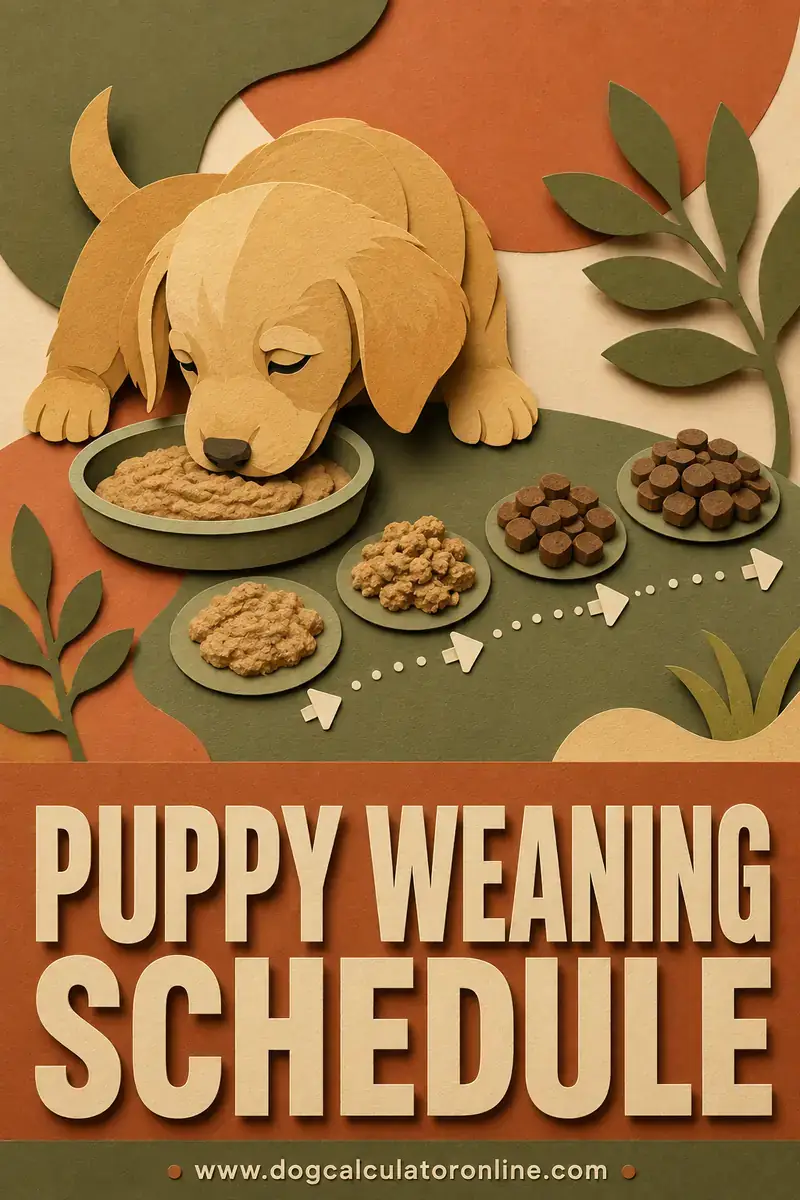
The full timetable including the mother's side is set out in the puppy weaning schedule.
Choosing the Food They Wean Onto
This decision lasts a year, so it is worth a minute.
A complete puppy or growth food — not adult food. Puppies need considerably more protein, fat, calcium and phosphorus per calorie than adults.
Large and giant breeds need a large-breed puppy formula. These are deliberately lower in calories and controlled in calcium, because growing too fast is a direct cause of developmental joint disease in big dogs.
Small breeds benefit from small-kibble formulas, simply because they can pick them up.
Wet or dry both work. Dry is cheaper, better for teeth and easier to measure; wet is more palatable and adds moisture. Many breeders use both.
Whatever you choose, tell the new owners and send some with each puppy. Changing home and changing food on the same day is a reliable route to diarrhea.
Portions from eight weeks should follow the food's own chart adjusted for expected adult weight, with the practical numbers in how much food for an 8 week old puppy.
Mistakes That Set Weaning Back
The recurring ones, in order of how often they happen.
Starting too early. Before three weeks the puppies cannot chew, cannot stand at a dish, and their gut is not ready.
Going too thick too fast. A puppy that cannot manage the texture simply walks away, and you lose several days.
Cow milk in the gruel. The lactose causes diarrhea, and it dilutes an otherwise complete food.
Separating the litter from the mother to force weaning. Abrupt separation is stressful for everyone, risks mastitis in her, and skips the maternal teaching that makes weaning work.
Free-feeding gruel all day. It sours, attracts flies and lets puppies gorge. Put it down, take it up after 15–20 minutes, and wash the dish.
Forgetting the worming schedule. Weaning coincides with fortnightly worming from about two weeks; heavy worm burdens are a common reason a litter stops gaining exactly when solids start.
Leaving her on peak rations while the puppies eat more, which invites mastitis in a mother who is no longer being emptied properly.
From First Gruel to Four Proper Meals
The endpoint, and what comes after.
Fully weaned by seven to eight weeks is the normal target: dry puppy food, four measured meals a day, water always available.
Four meals a day continues to about three or four months, then three, then two from around six months for most breeds.
Meal size is set by expected adult weight, not current weight, which is why puppy food charts run on adult-weight columns — the age progression is in puppy feeding schedule by age.
Solid food does not mean ready to leave. A puppy can be nutritionally independent at six weeks and still need the next two weeks with its littermates for behavioral reasons, which is the argument set out in when can puppies leave their mother.
Expect a wobble at rehoming. New home, new water, new routine — a day or two of loose stools is common, and anything longer, or any vomiting, listlessness or blood, warrants a vet call.
Keep them lean through growth. An overweight puppy is not a healthy one, and the growth-rate consequences in large breeds are lifelong.
FAQ
At what age do puppies start eating solid food?
At about three and a half to four weeks, once their first milk teeth have erupted and they can stand and walk to a dish. The first food is a thin gruel of puppy food blended with warm water or milk replacer, not kibble.
What is the first solid food for puppies?
Complete puppy food soaked in warm water or puppy milk replacer and blended to a thin, pourable porridge. Nothing else — no cow milk, adult food, mince, bread or baby cereal, which either upset the gut or dilute the diet.
How many times a day should a four-week-old puppy eat?
Three or four gruel meals a day at four to five weeks, alongside nursing. Put the dish down for 15 to 20 minutes, then take it up and wash it rather than leaving food out to sour.
Can puppies eat solid food at three weeks?
It is too early for most. Three weeks is when teeth first appear and puppies begin standing, so a few forward litters manage a taste, but the digestive system is not ready and starting early commonly causes diarrhea.
When are puppies fully weaned onto solid food?
Between seven and eight weeks for most litters. By then they should be eating dry puppy food in four measured meals a day with water always available, and taking no meaningful nutrition from the mother.
Do puppies still need milk once they start solids?
Yes, for several weeks. Nursing supplies most calories at four weeks and falls away gradually through weeks five and six. Once fully weaned they need no milk at all, and cow milk is not a useful addition at any point.
Thin to Thick, Over About Four Weeks
Solid food starts at three and a half to four weeks, and the signal to begin is the litter itself — teeth through the gums, steady on their feet, and eyeing up the mother's bowl. Start with a thin gruel of the puppy food they will grow up on, blended with warm water or milk replacer, offered in a wide shallow dish for fifteen minutes at a time and expect most of the first few meals to end up on the puppies. Thicken it one step at a time across the following month until they are on dry puppy food in four measured meals by seven to eight weeks. Weigh them throughout, and treat diarrhea at this age as a same-day veterinary matter. Work out the portions ahead with the free dog food calculator.