Puppy Feeding Schedule by Age
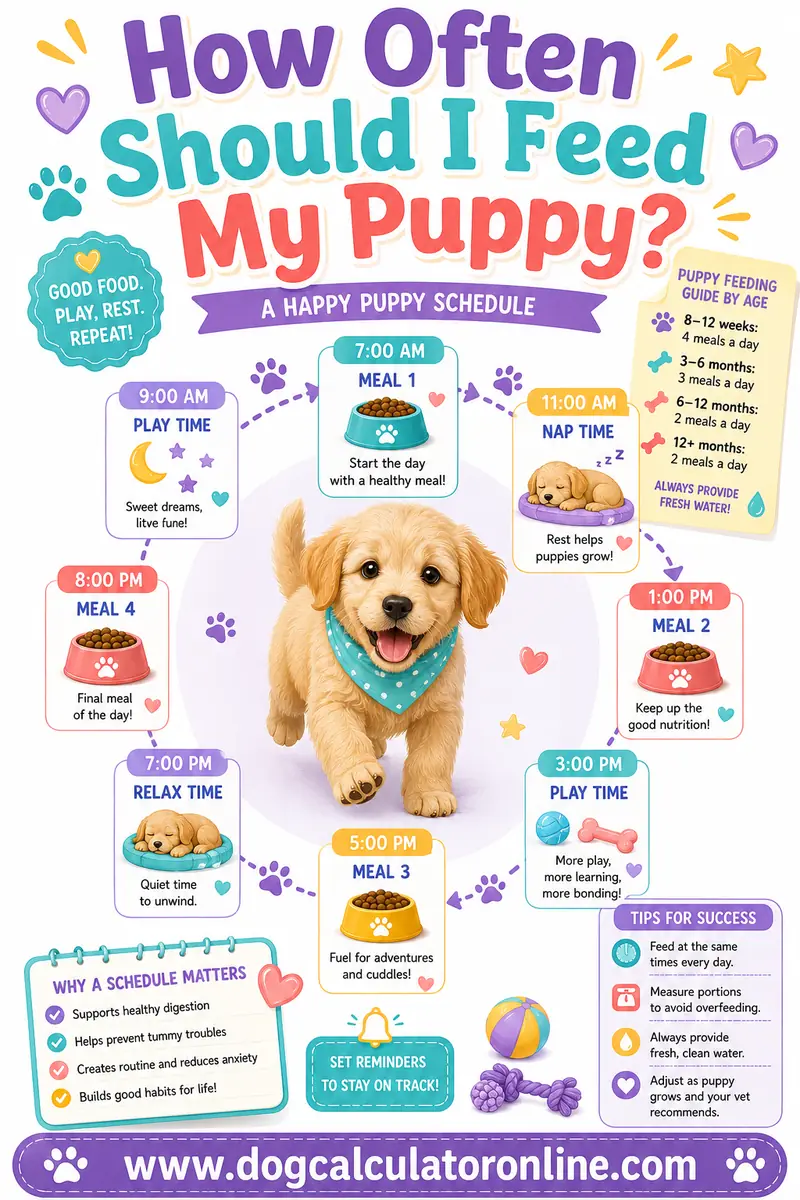
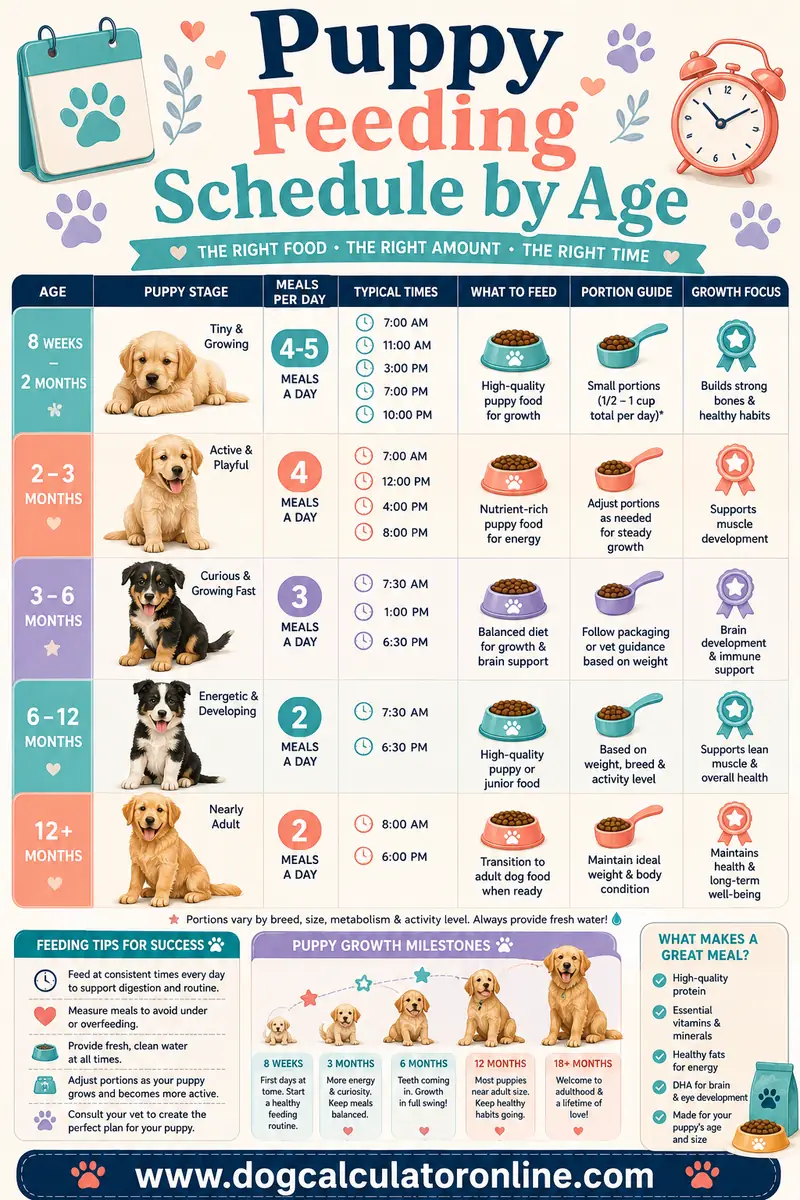
A puppy feeding schedule follows a simple arc: four meals a day at 6–12 weeks, three meals at 3–6 months, and two meals from 6 months onward — served at consistent times, with the last meal a few hours before bed. The schedule matters as much as the food, because regular meals drive regular potty breaks, steady energy, and easy appetite monitoring.
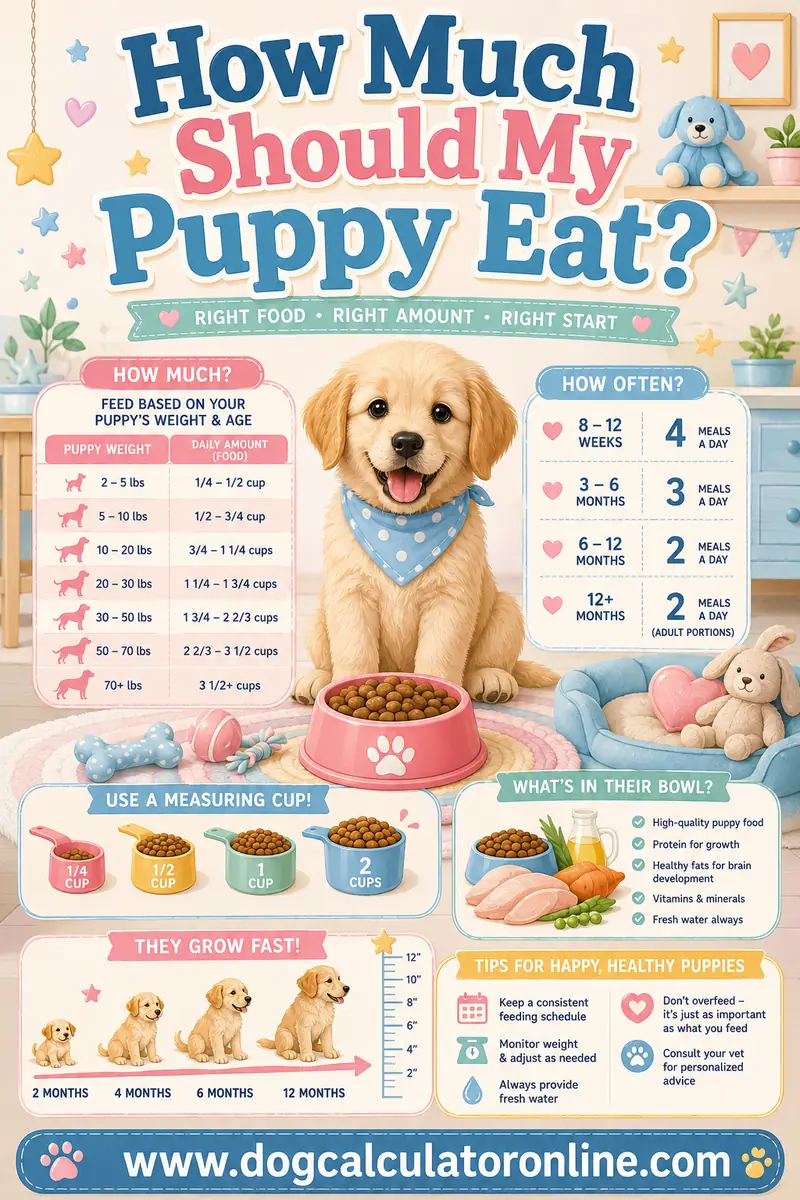
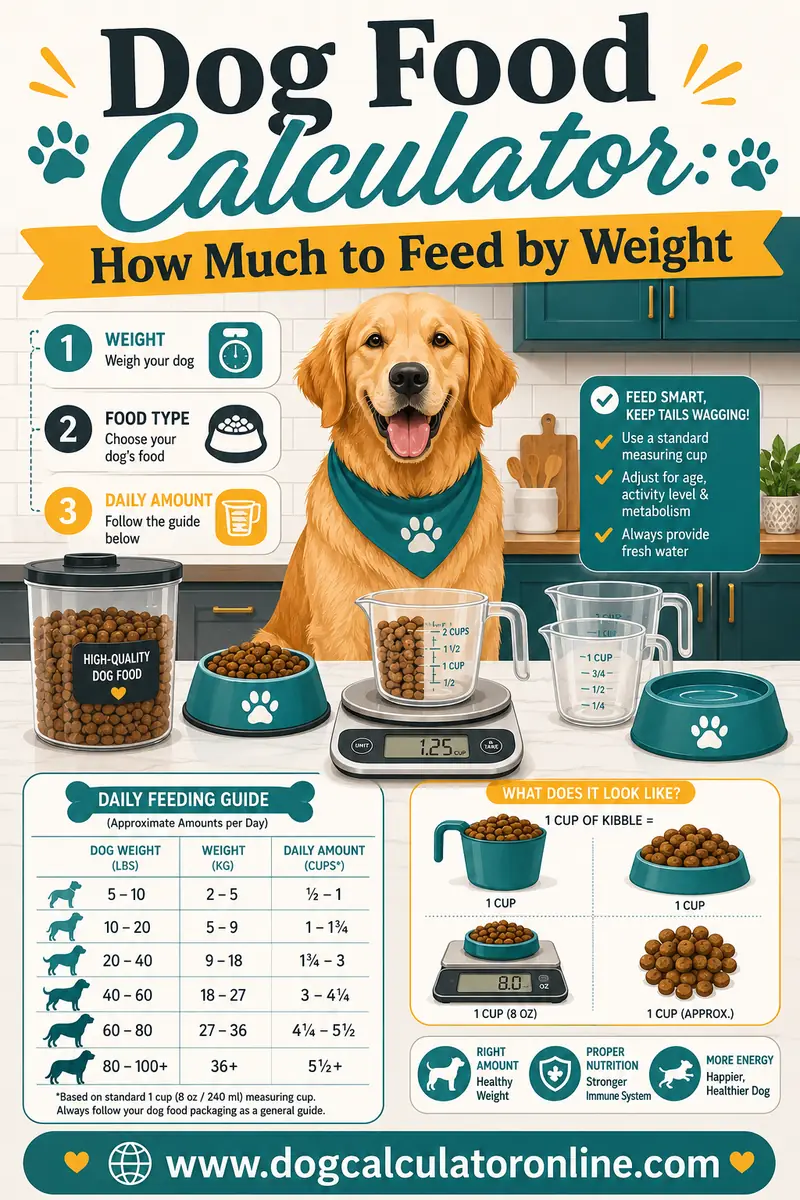
Amounts change with every growth spurt, so pair this schedule with the free dog food calculator — it turns your puppy's current weight and age into a daily portion you can split across the meals below. Here's the full timeline, stage by stage, with real clock times you can copy.
📅 Instant schedule builder
Tap your puppy’s age to see a ready-made daily meal plan:
Tap an age above for a sample plan.
The Master Schedule Table
| Age | Meals/day | Sample times | Food type |
|---|---|---|---|
| 6–8 weeks | 4 (weaning onto solid) | 7 am, 11 am, 3 pm, 7 pm | Puppy food, moistened |
| 8–12 weeks | 4 | 7 am, 11 am, 3 pm, 7 pm | Puppy food |
| 3–4 months | 3 | 7 am, 12:30 pm, 6 pm | Puppy food |
| 4–6 months | 3 | 7 am, 12:30 pm, 6 pm | Puppy food |
| 6–12 months | 2 | 7 am, 6 pm | Puppy food |
| ~12 months+ | 2 | 7 am, 6 pm | Adult food (small/medium); large breeds stay on puppy food longer |
Times are templates — shift everything earlier or later to fit your life. The two rules that shouldn't bend: keep times consistent day to day, and keep the last meal 2–3 hours before bedtime so the final potty trip actually empties the tank.
Stage 1: 8–12 Weeks — Four Meals and a Routine
This is when most puppies come home, and the schedule is doing three jobs at once: fueling peak growth, protecting blood sugar (especially in toy and small breeds, where long gaps between meals can cause dangerous hypoglycemia), and laying down the house-training rhythm.
The template: meals at 7 am, 11 am, 3 pm, and 7 pm, each followed immediately by a trip to the potty spot — young puppies typically need to eliminate within 5–30 minutes of eating. Offer each meal for 15–20 minutes, then lift the bowl. No all-day grazing: it wrecks both appetite signals and potty predictability.
What to feed: the same food the breeder or shelter used, at least for the first week or two — a home change plus a food change at once is a recipe for diarrhea. If you plan to switch, do it gradually over 7–10 days after your puppy has settled.
How much: by the label's chart for current weight and age, cross-checked with the dog food calculator. At this stage that might be as little as ½ cup a day for a toy breed or nearly 3 cups for a giant-breed puppy — the spread is enormous, which is why per-meal "eyeballing" fails. The dedicated guide for this window is puppy feeding schedule: 8 to 12 weeks.
Stage 2: 3–6 Months — Three Meals, Growing Portions
Around 12 weeks, consolidate to three meals: breakfast, midday, dinner. Make the change gradually — shrink the 3 pm meal over several days, moving its food into the others.
This stage is deceptively long and covers a lot of growth. Two things need active management:
Portions climb fast. A medium-breed puppy can double its weight during this stage. Weigh your puppy every two weeks and re-run the numbers; the right portion at 14 weeks is wrong by 18. Teething (roughly 4–6 months) can cause a few picky days — softening kibble with warm water helps more than switching foods.
The midday meal meets the workday. If nobody's home at lunch, use a family member, neighbor, or walker; a timed automatic feeder with a pre-measured portion is a solid plan B. Skipping the midday meal entirely at 3–4 months isn't a good plan A — the gaps get long, and small breeds especially don't handle them well. More options in how often to feed a puppy.
Stage 3: 6–12 Months — The Adult Rhythm
Around 6 months, most puppies move to two meals — the schedule they'll likely keep for life. Morning and evening, 8–12 hours apart, portions still based on puppy-food charts because growth isn't done: small breeds are approaching adult size, but large breeds are barely halfway.
Watch for the quiet trap of this stage: calorie needs per pound are falling even as your dog looks full-grown. Growth slows, and spay/neuter (commonly done in this window) lowers energy needs further. The chubby adolescent dog is usually a puppy whose portions never got the memo. Keep up the every-few-weeks weigh-and-recheck habit — how much should my puppy eat covers the body-condition checks that keep you honest.
When the Schedule Changes Food, Not Just Times
The switch from puppy food to adult food is its own milestone with its own timing:
- Small breeds (under ~20 lb adult): around 9–12 months
- Medium breeds (20–50 lb): around 12 months
- Large breeds (50–100 lb): 12–18 months
- Giant breeds (100+ lb): 18–24 months
Until then, puppies need a food formulated for growth — and large-breed puppies specifically need large-breed puppy formulas with controlled calcium to protect developing joints. When the time comes, transition over 7–10 days, mixing increasing amounts of the new food into the old. Jumping foods overnight is the most reliable diarrhea generator in dog ownership.
Making the Schedule Work: Six Field Rules
- Feed, then potty, every time. The meal-to-elimination link is the engine of house-training. Our combined puppy feeding and potty schedule maps the full day.
- Measure every meal. Same measuring cup, level scoops — or better, a kitchen scale. Portion drift is invisible day to day and very visible by the six-month vet visit.
- Fifteen minutes, then up. A meal is an event, not an installation. Puppies learn the window fast, and you learn instantly when appetite changes.
- Water always available during the day; many owners lift the water bowl an hour or two before bed during house-training. Food is scheduled — water mostly isn't.
- Treats come out of the budget. Training uses a lot of food rewards at this age. Reserve part of the daily kibble ration as training currency, and keep true extras under about 10% of daily calories.
- Consistency beats perfection. A schedule that runs at 7/12:30/6 on weekdays and 8/1/7 on weekends is fine. One that exists only on weekdays isn't a schedule.
Troubleshooting by Symptom
- Skipping meals: In a young puppy, refusing food for a day is a same-day vet call. In an older puppy, occasional disinterest during teething is normal; persistent appetite loss isn't.
- Soft stools: Often too much food per sitting — recheck the portion math before blaming the food. Persistent or watery diarrhea in a puppy is a vet matter.
- Frantic hunger between meals: Recheck the daily total first (puppies outgrow portions in weeks), then consider whether a stage-down happened too early.
- Early-morning bile vomiting: Classic long-overnight-gap symptom in older puppies — shift dinner later or the schedule tighter. Recurring vomiting of any other pattern: vet.
- The 2 am potty alarm: Dinner too late or water down too late. Shift the evening sequence earlier and keep the pre-bed potty trip unhurried.
Fitting the Schedule Around Your Work Day
The templates above quietly assume someone's home at midday. Real jobs disagree, so here's how the same meal counts map onto common work patterns:
| Your day | 4-meal stage (8–12 wks) | 3-meal stage (3–6 mo) | 2-meal stage (6 mo+) |
|---|---|---|---|
| Work from home | 7 am, 11 am, 3 pm, 7 pm | 7 am, 12:30 pm, 6 pm | 7 am, 6 pm |
| Office 9–5 | 6:30 am, helper or timed feeder at 10:30 am and 2:30 pm, 6:30 pm | 6:30 am, midday helper or feeder, 6:30 pm | 6:30 am, 6 pm |
| Early shift (out by 6 am) | 5 am, feeder at 9 am and 1 pm, 5:30 pm | 5 am, midday feeder, 5:30 pm | 5 am, 5 pm |
| Evening shift | 9 am, 12:30 pm, 4 pm, 7:30 pm | 9 am, 2 pm, 7:30 pm | 9 am, 7:30 pm |
A few notes on making the away-from-home slots work. A timed automatic feeder handles kibble reliably — load it with a pre-measured portion, not a hopper set to "generous." A dog walker or willing neighbor is better than a feeder at the youngest ages, because the midday visit doubles as the potty trip the schedule depends on. And be honest with yourself about the four-meal stage: it's genuinely hard to run solo with a full-time job, which is why many owners time vacation days, remote weeks, or family help to land in those first few weeks home.
When Life Breaks the Schedule
Every puppy owner eventually faces a travel day, a vet-visit morning, or an alarm that didn't go off. The recovery rules are simple:
- One late or missed meal isn't an emergency for a healthy puppy past 12 weeks — offer the next meal at its normal time and move on. Toy breeds have thinner margins, so get food into a tiny puppy as soon as you reasonably can.
- Don't double up. Adding a missed meal's food to the next bowl trades one skipped meal for one oversized one, and the oversized one is likelier to cause stomach upset. The daily total is a target, not a debt to be repaid by dinner.
- Shift times gradually when the schedule itself must move. New job, new time zone, clocks changing — slide every meal 15–30 minutes per day toward the new times rather than jumping an hour overnight. Appetite and potty timing follow along almost unnoticed.
- Pack the routine when you travel. Bring the usual food in pre-measured portions, keep meal times as close to normal as you can, and go light on food right before a long car ride if your puppy is prone to motion sickness.
The Weigh-In Habit That Keeps the Schedule Honest
The times in this article barely change for months at a stretch — the portions never stop changing. The fix is a standing weigh-in routine: same day every week, weigh yourself on the bathroom scale holding the puppy, subtract, and jot the number somewhere you'll actually look. Once your puppy is past the every-week growth frenzy, every two weeks is plenty.
After each weigh-in, two quick checks. First, re-run the numbers — through the dog food calculator or your food label's chart — because a growing puppy can outgrow a portion in a couple of weeks, and the jump is often bigger than intuition suggests. Second, glance at body condition: you should feel ribs easily under a light fat layer and see a waist from above. If the ribs are disappearing, the portion got ahead of the puppy; if they're sharp and prominent, the puppy got ahead of the portion. The log turns "hmm, he seems bigger" into an actual answer, and it makes the vet's growth questions easy at every checkup.
FAQ
What is a good feeding schedule for a puppy?
Four meals a day at 6–12 weeks (7 am, 11 am, 3 pm, 7 pm), three meals from 3–6 months (7 am, 12:30 pm, 6 pm), then two meals from 6 months (7 am, 6 pm) — adjusted to your own routine and kept consistent.
What times should I feed my puppy?
Any consistent times that space meals across waking hours, with the last meal 2–3 hours before bed. The specific hours matter far less than the daily repetition.
When do puppies go from 3 meals to 2?
Around 6 months. Shrink the midday meal gradually over a week, folding its food into breakfast and dinner so the daily total stays the same.
How much should I feed at each meal?
Take the daily amount from your food label or the dog food calculator, then divide by the number of meals. Never build the day from a per-meal guess — small errors multiply by four.
Should I feed my puppy before or after a walk?
Potty trips come right after meals, but save vigorous exercise for at least 30–60 minutes after eating — a precaution vets especially emphasize for large, deep-chested breeds.
Can I just free-feed my puppy instead of following a schedule?
It's not recommended during puppyhood. Food left down all day makes potty timing unpredictable, hides the early warning sign of a skipped meal, and makes overeating easy. Scheduled meals give you house-training rhythm and a daily appetite check for free.
When should my puppy have the last meal of the day?
About 2–3 hours before bedtime, followed by a final potty trip. Late dinners are the leading cause of the 2 am wake-up.
The Bottom Line
The puppy feeding schedule is a countdown: four meals, then three, then two — held together by consistent times, measured portions, and a potty trip after every bowl. Get the rhythm right in the first weeks and everything downstream (house-training, weight, even bedtime) gets easier.
Portions change every few weeks even when the schedule doesn't — re-run the free dog food calculator after each weigh-in, and see how much your puppy should eat for the amounts behind the times.