Combined Puppy Feeding and Potty Schedule
Feeding times control toilet times, which means the fastest route to a house-trained puppy is a fixed feeding clock rather than more trips outside. Eating triggers movement further down the gut — the gastrocolic reflex — and in a young puppy that shows up as a need to defecate somewhere between five and thirty minutes after the bowl is emptied. Feed at unpredictable times, or leave food down all day, and you get unpredictable toilet needs that no amount of vigilance catches. Feed at 7am, noon, 5pm and 8pm, and by the end of the first two weeks you will know within ten minutes when your puppy needs to go out. Work out the portions first with the dog food calculator, then build the clock below.
🐾 How many meals and toilet trips?
Tap your puppy’s age:
Tap an option above. Fixed meal times make toilet times predictable.
Why Meals Set the Toilet Clock
Understanding the mechanism makes the schedule obvious rather than arbitrary.
Food entering the stomach stimulates the colon. This is the gastrocolic reflex, and it is strong in young animals. The result is that a meal is the single most reliable predictor of a bowel movement you will ever get.
The lag in puppies is 5 to 30 minutes, shortening as puppies get younger and stretching as they mature. A twelve-week-old is often at fifteen minutes; a six-month-old may be at forty.
Urination follows drinking on a different clock — usually 10 to 30 minutes after a decent drink, and every 45 to 60 minutes anyway at eight weeks.
Free feeding destroys the predictability. A bowl left down all day means small amounts of food entering the gut constantly, and toilet needs scattered randomly across sixteen hours.
Measured meals also tell you when something is wrong. A puppy that suddenly refuses a meal is giving you information; a puppy grazing from a full bowl gives you none.
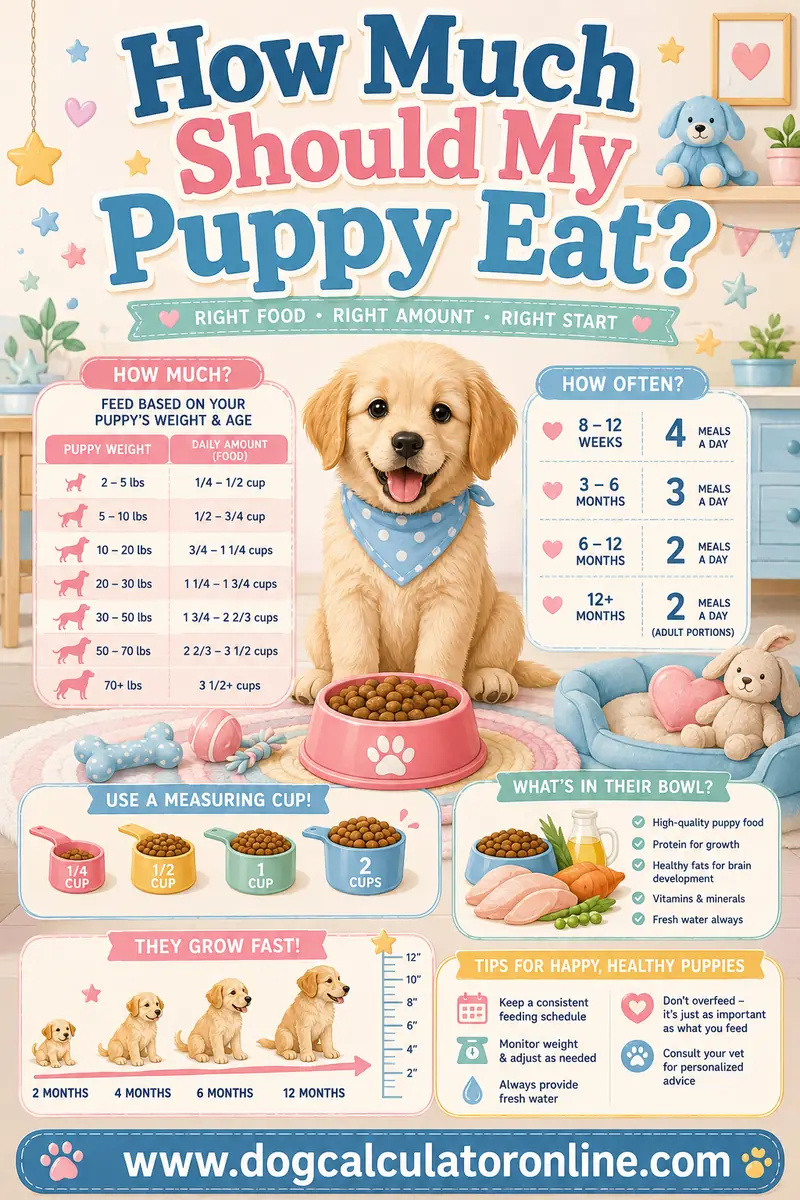
The portion matters as much as the timing. Overfeeding produces more, looser and less predictable stools — see how much should my puppy eat.
How Many Meals and How Many Trips by Age
| Age | Meals/day | Toilet trips while awake | Poos/day | Night trips |
|---|---|---|---|---|
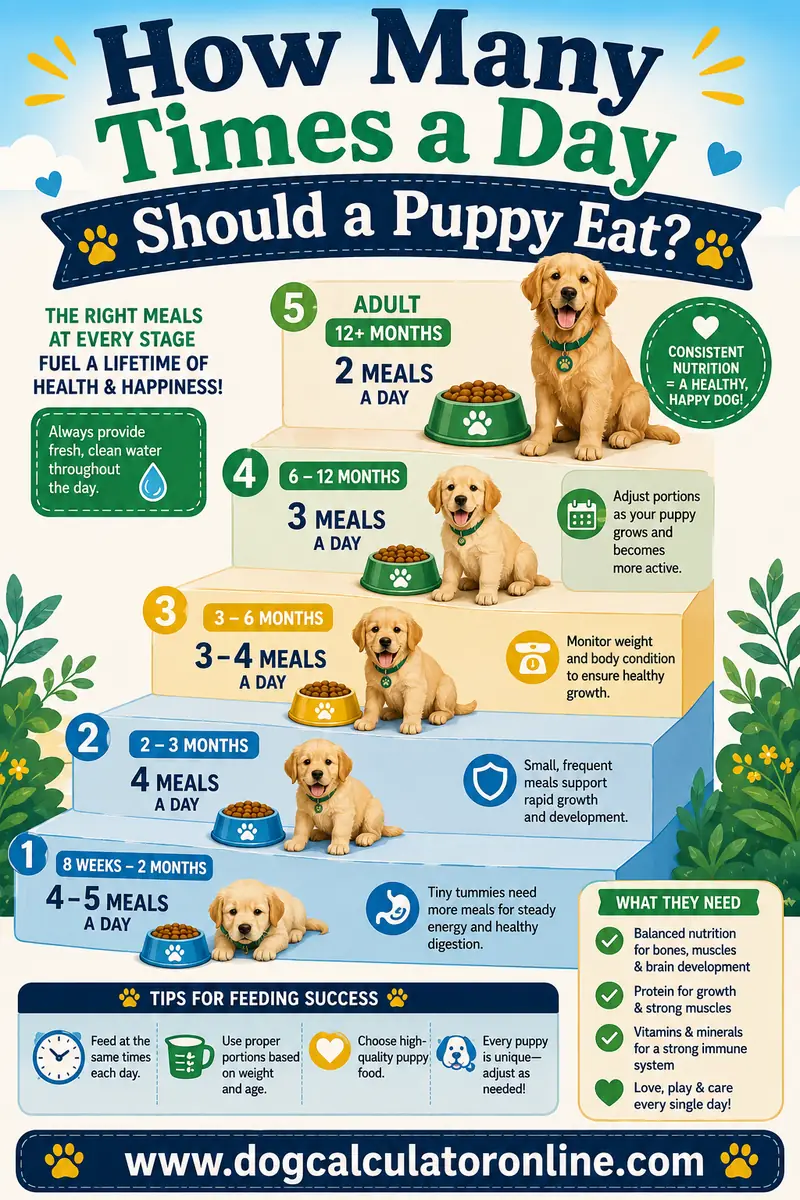
| 8–10 weeks | 4 | Every 30–60 min | 4–5 | 2 |
| 10–12 weeks | 3–4 | Every 45–60 min | 4 | 1–2 |
| 12–16 weeks | 3 | Every 1–2 hrs | 3–4 | 0–1 |
| 4–6 months | 3 | Every 2–3 hrs | 2–3 | 0 |
| 6–12 months | 2 | Every 3–4 hrs | 2 | 0 |
| Adult | 2 | Every 4–6 hrs | 1–2 | 0 |
Four meals at eight weeks is not negotiable for small breeds. Toy-breed puppies are prone to low blood sugar and need frequent small meals; a Chihuahua puppy on two meals a day is a genuine risk.
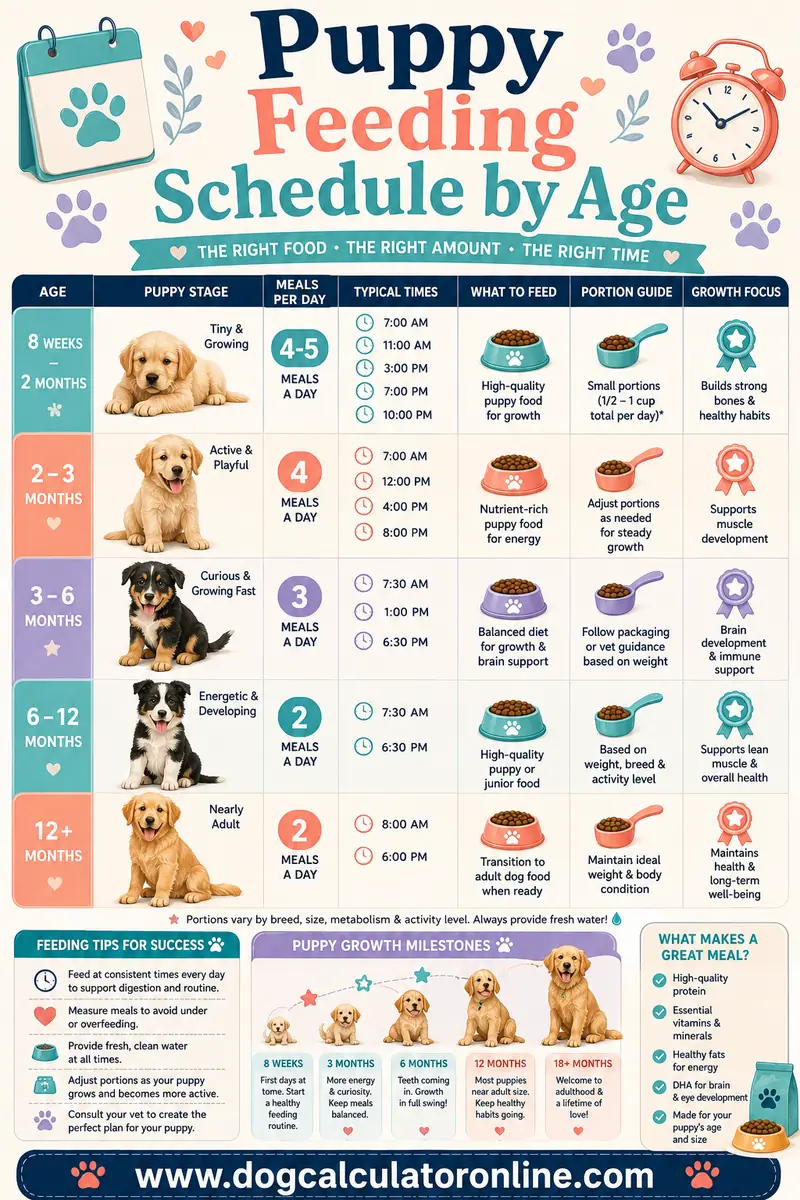
The drop from four to three meals normally happens between ten and sixteen weeks, and from three to two at around six months. There is no ceremony to it — you merge two meals and watch the stools for a few days.
Poo frequency drops steadily with age. Four or five a day at eight weeks is normal; still four or five at six months is worth a conversation with your vet about diet.
Toilet trip counts are separate from walks. A garden trip is thirty seconds of standing on the same patch of grass, not an outing. The frequency rationale is in how long can a puppy hold its bladder.
The Combined Schedule at 8 to 10 Weeks
The busiest version. Times assume a 6:30am start and an 11pm bedtime.
6:30am — Out of the crate, straight outside. Toilet, reward on the spot.
7:00am — Meal 1. Out again 15 minutes after finishing.
7:30am–9:00am — Awake time: play, short training, handling. Toilet every 30–45 minutes.
9:00am — Nap in the crate. Toilet immediately on waking.
11:30am — Toilet, short outing or carried trip.
12:00pm — Meal 2. Out 15 minutes later.
12:30pm–2:00pm — Awake time, then nap.
2:00pm–4:30pm — Nap, toilet on waking, quiet play.
5:00pm — Meal 3. Out 15 minutes later.
5:30pm–7:00pm — The difficult hour: expect biting and zoomies. A chew and a nap, not more play.
8:00pm — Meal 4, the last of the day. Out 15 minutes later.
9:00pm — Water bowl lifted (see the caveats below).
10:30pm — Calm chew, lights dimming.
11:00pm — Final toilet trip, then crate.
1:30am and 4:00am — Alarm toilet trips, silent and brief.
Reward within one second of finishing, outside, on the spot. A treat handed over indoors a minute later does not connect to anything.
The 5pm to 7pm window is when routines fall apart. That is overtiredness, not naughtiness. More sleep, not more activity.
The Schedule at 12 to 16 Weeks
Fewer trips, longer stretches, and the first real progress.
7:00am — Out, then Meal 1 at 7:15am, out again at 7:45am.
Mid-morning — Toilet every 60 to 90 minutes while awake, nap after about an hour of activity.
12:30pm — Meal 2, out at 12:50pm.
Afternoon — Toilet every 90 to 120 minutes. One short walk once vaccinations allow.
5:30pm — Meal 3, out at 5:50pm.
Evening — A calm chew, one short training session of five minutes, toilet at 9pm.
10:30pm — Final toilet, then crate.
3:00am — One alarm trip, dropped once the puppy is dry three nights running.
Three meals from around twelve weeks suits most medium and large breeds; small breeds often stay on four to sixteen weeks. The age-by-age version is in puppy feeding schedule by age.
Move the last meal earlier, to around 5:30pm, as soon as you drop to three meals. That single change usually removes the middle-of-the-night bowel movement.
Start noticing the pattern, not just following the clock. By now most puppies have a reliable morning poo, a post-lunch one, and an evening one.
Dropping to Three Meals, Then Two
Transitions cause more upset than the schedule itself, so make them gently.
Merge, do not remove. Going from four meals to three means splitting the same daily amount into three bowls, not skipping a feed.
Change one thing at a time. Do not drop a meal in the same week you change food brands or move house.
Expect two or three days of looser stools after each change, and firmer ones afterwards.
Keep the total daily amount driven by weight and expected adult size, not by the number of bowls. Recalculate with the dog food calculator every few weeks while the puppy is growing fast.
Two meals from around six months for most breeds. Some large and giant breeds do better staying on three for longer, partly to reduce the volume in the stomach at any one time — ask your vet, particularly for deep-chested breeds.
Do not feed immediately before or after hard exercise. Leave about an hour either side. The meal-count reasoning is set out in how many times a day should a puppy eat.
Water Timing, and the Bit People Get Wrong
Water is where well-meant advice goes astray.
Fresh water all day, always. Restricting water during the day is never appropriate and can cause real harm, particularly in hot weather or for puppies on dry food.
Lifting the bowl an hour or two before bedtime is the only restriction worth using, and only in the first few weeks while night control is developing.
Skip even that in hot weather, if your puppy drinks very little, if it is unwell, or if your vet has advised otherwise.
Offer a small drink at the last toilet trip, then nothing.
A puppy drinking noticeably more than usual needs a vet check rather than a smaller bowl. Excessive drinking with excessive urinating is a genuine clinical sign.
Expect roughly ½ to 1 fl oz of water per pound of body weight per day (about 30–60 mL per kg), more in heat and on dry food. It is a rough figure, and appetite for water varies a lot.
When the Schedule Slips
It will. The recovery matters more than the slip.
A missed meal time shifts the toilet need with it. Take the puppy out fifteen minutes after the late meal rather than at the usual clock time.
Diarrhea suspends the schedule. A puppy with loose stools cannot hold on, and accidents during illness should never be treated as training failures.
Growth spurts increase appetite sharply for a week or two at a time. Weigh weekly and adjust the portion rather than adding an extra meal.
Adolescent regression at four to six months is common: a reliable puppy starts having accidents again. Return to the twelve-week trip frequency for two weeks and it usually resolves.
Weekends break routines. Puppies do not distinguish Saturday from Tuesday, and a lie-in with a two-hour later breakfast produces an accident. Keep meal times within about thirty minutes across the week.
A holiday or a house move disturbs both eating and toileting for roughly a week. Hold the routine and it settles. The full toilet-training structure is in puppy potty training schedule.
Reading Your Own Puppy's Pattern
The published schedule is a starting point; your puppy's actual timing is better data.
Keep a four-day log on your phone: meal times, toilet times, and whether each trip produced anything. Four days is enough to see the pattern.
Look for the lag. Most puppies are remarkably consistent — if yours goes eighteen minutes after breakfast, it will do that most days, and you can plan the trip rather than hover.
Note the misses too. Accidents cluster at predictable times, and those are the gaps to close.
Adjust the schedule to your puppy, not the other way round. If your puppy reliably needs a trip at 2pm and the chart says 3pm, the chart is wrong for you.
Review it monthly. Every stage change — dropping a meal, dropping a night trip, adding walks — shifts the whole pattern.
Night trips have their own logic, since sleeping puppies last longer than awake ones. How long a puppy actually sleeps at each age is in puppy sleep schedule by age.
FAQ
How long after eating does a puppy need to poo?
Usually 5 to 30 minutes, with most puppies falling around the fifteen-minute mark. Eating triggers movement in the colon, which is why fixed meal times make toilet timing predictable. Plan the trip rather than waiting for signals, which come only seconds before it happens.
How many times a day should a puppy eat and go out?
At eight weeks, four meals and a toilet trip every 30 to 60 minutes while awake plus two at night. By four months, three meals and trips every two to three hours. By six months, two meals and trips every three to four hours, with no night trips.
Should I take water away from my puppy at night?
Lifting the bowl an hour or two before bedtime helps in the first weeks while night control develops, but skip it in hot weather, for puppies that drink little, and if your vet has advised otherwise. Water should never be restricted during the day.
What time should a puppy have its last meal?
About three hours before bed. A 9pm dinner reliably produces a middle-of-the-night bowel movement. Moving the final meal to 5:30pm or 6pm is often the single change that gets a twelve-week-old sleeping through.
Why is my puppy pooing four or five times a day?
That is normal at eight to twelve weeks and drops to two or three by six months. Still going four or five times a day at six months, or persistently loose stools, is worth a vet conversation about diet, portion size or parasites.
Does free feeding slow down house training?
Yes, noticeably. Food arriving at random times means toilet needs at random times, and the whole method depends on being able to predict when the puppy needs to go. Measured meals at fixed times also make it obvious when a puppy goes off its food.
Making the Two Schedules Work Together
House training gets much easier once you stop treating feeding and toileting as separate problems. Fix the meal times first — four bowls at eight weeks, three from around twelve weeks, two at six months — and put the last one about three hours before bed. Then take the puppy out roughly fifteen minutes after each meal, on top of the routine trips every 30 to 60 minutes while awake. Reward within a second, outside, on the spot. Keep a four-day log to find your own puppy's lag, adjust the clock to fit it, and re-check the portion every few weeks with the dog food calculator while your puppy is still growing.