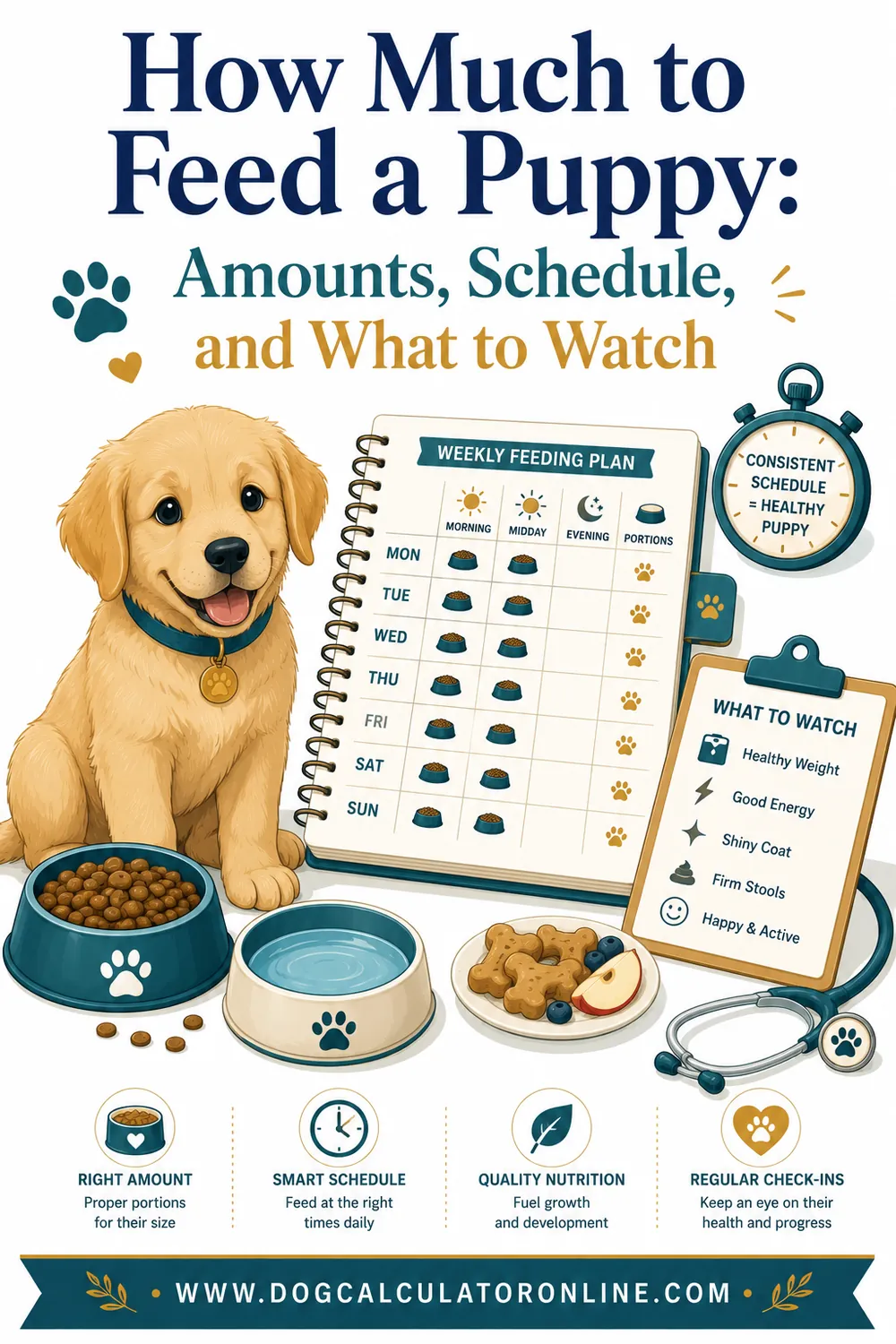
How Much Should My Puppy Eat?
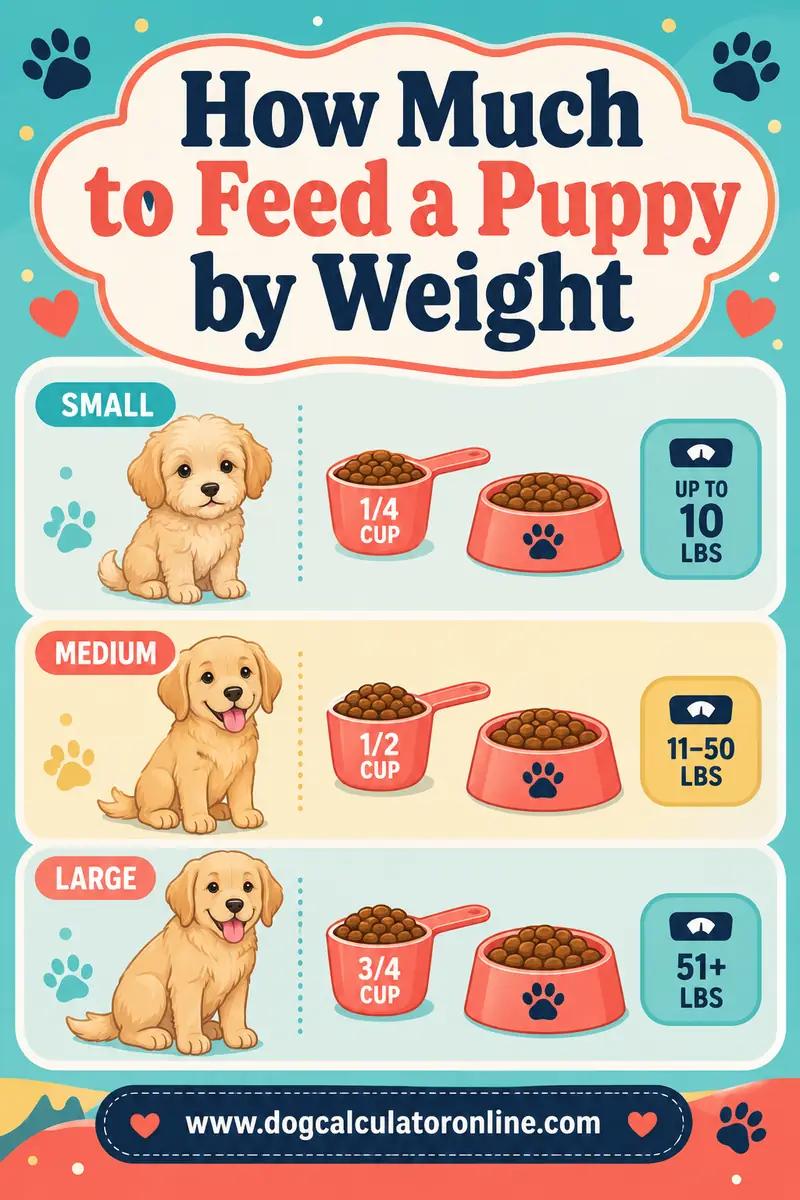
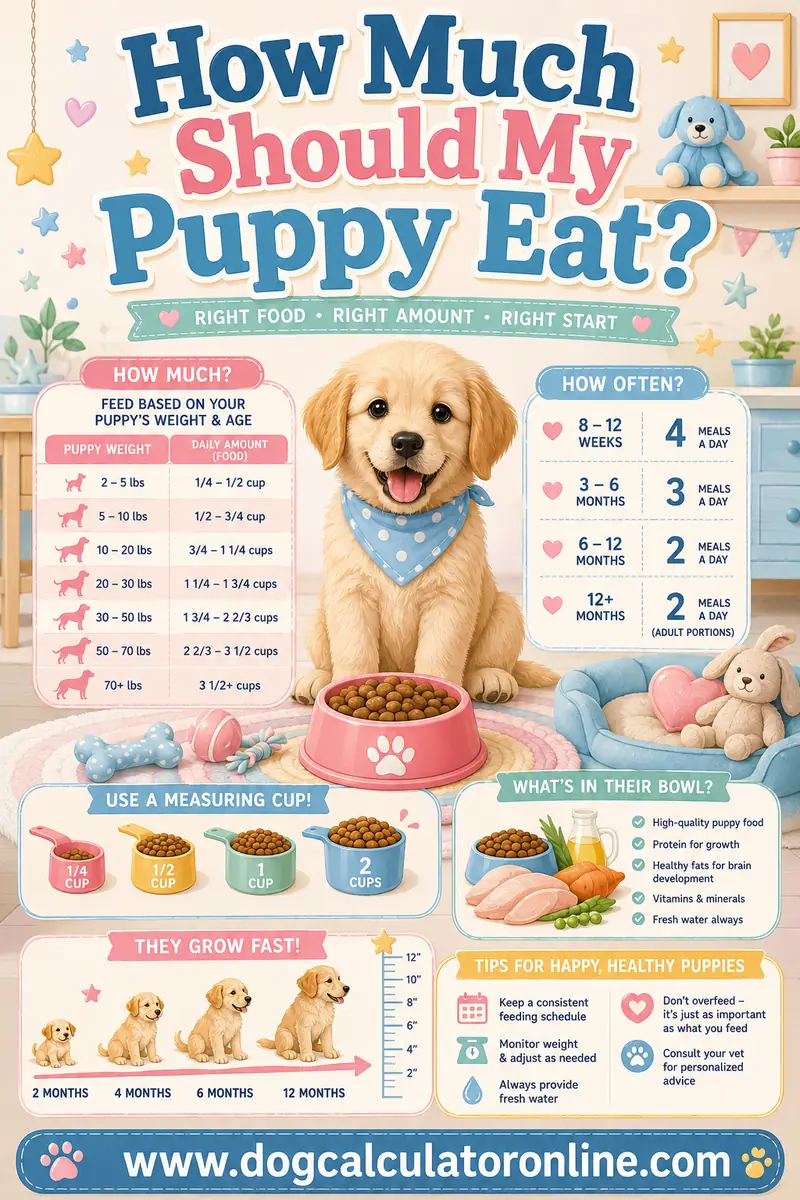
A puppy should eat roughly twice as many calories per pound as an adult dog — in practice, that's about ⅔–1 cup of puppy food a day for a 5-lb puppy, 1–1⅔ cups at 10 lb, 1¾–2¾ cups at 20 lb, and 2½–3¾ cups at 30 lb, split into three or four meals. The exact amount depends on your puppy's age, expected adult size, and the calorie density of the specific food — which is why your bag's feeding chart and your vet outrank any generic number.
Those ranges are wide because puppies vary a lot. The free dog food calculator narrows it down for your puppy's actual weight and age in seconds. Here's how puppy portions really work, with charts, worked examples, and the signs you're feeding too much or too little.
🐶 Puppy portion check
Tap your puppy’s current weight for a rough daily total (typical puppy kibble, ~400 kcal per cup):
Tap a weight above for a daily estimate.
Why Puppies Eat So Much for Their Size
A 20-lb puppy eats nearly as much as a 50-lb adult on a diet, and that's not a mistake. Growing tissue — bone, muscle, brain, coat — is metabolically expensive. Veterinary nutrition puts a young puppy's needs at roughly 3 × resting energy requirement (RER) until about 4 months old, easing to about 2 × RER from 4 months until they reach adult size. A typical neutered adult, for comparison, runs around 1.4–1.6 × RER.
Concretely, for a 10-lb (4.5 kg) puppy: RER ≈ 218 kcal, so a 3-month-old at 3 × RER needs about 650 kcal a day — roughly what a 25-lb adult dog eats. Growth is expensive.
The flip side: those needs per pound fall steadily as your puppy matures, even while the puppy itself gets heavier. Portions need re-checking every couple of weeks, because the right amount is a moving target.
Daily Amount Estimates by Weight
These estimates assume a typical dry puppy food around 400 kcal per cup. Your bag might run 350 or 450 — the label's feeding chart always wins, because it's calibrated to that exact formula.
| Puppy's current weight | Under 4 months (≈3×RER) | 4+ months (≈2×RER) |
|---|---|---|
| 3 lb | ~½ cup | ~⅓ cup |
| 5 lb | ~1 cup | ~⅔ cup |
| 10 lb | ~1⅔ cups | ~1 cup |
| 15 lb | ~2¼ cups | ~1½ cups |
| 20 lb | ~2¾ cups | ~1¾ cups |
| 30 lb | ~3¾ cups | ~2½ cups |
| 40 lb | ~4½ cups | ~3 cups |
| 50 lb | — | ~3½ cups |
| 60 lb | — | ~4 cups |
(Amounts are per day, not per meal. Very few puppies under 4 months weigh 50+ lb, hence the blanks.)
Two honest caveats. First, these are estimates with real spread — individual puppies can need 20% more or less. Second, current weight alone doesn't tell the whole story: a 20-lb puppy that's a nearly-grown Beagle and a 20-lb puppy that's a 10-week-old Great Dane are on very different trajectories. That's why the dog food calculator also asks about age, and why the deeper dive in how much to feed a puppy by weight breaks it out further.
How to Read Your Puppy Food Label
The feeding chart on the bag is more useful than most owners realize, but it takes a minute to decode:
- Find the calorie statement — something like "3,650 kcal/kg, 380 kcal/cup." That per-cup number is what makes portions comparable across brands.
- Check the chart's inputs. Most puppy charts use current weight plus age, or expected adult weight. Read the column headers carefully — feeding a 4-month-old on the 2-month-old column overfeeds significantly.
- Check for an AAFCO growth statement. The label should say the food is formulated for "growth" or "all life stages." Large-breed puppies (expected adult weight over ~70 lb) should eat a food that also passes the large-breed growth standard, which controls calcium — important for developing joints.
- Treat the chart as a starting range. Start in the middle, then adjust based on body condition every two weeks.
If the bag's chart and this article disagree, trust the bag — and if the bag and your puppy's ribs disagree, trust the ribs and ask your vet.
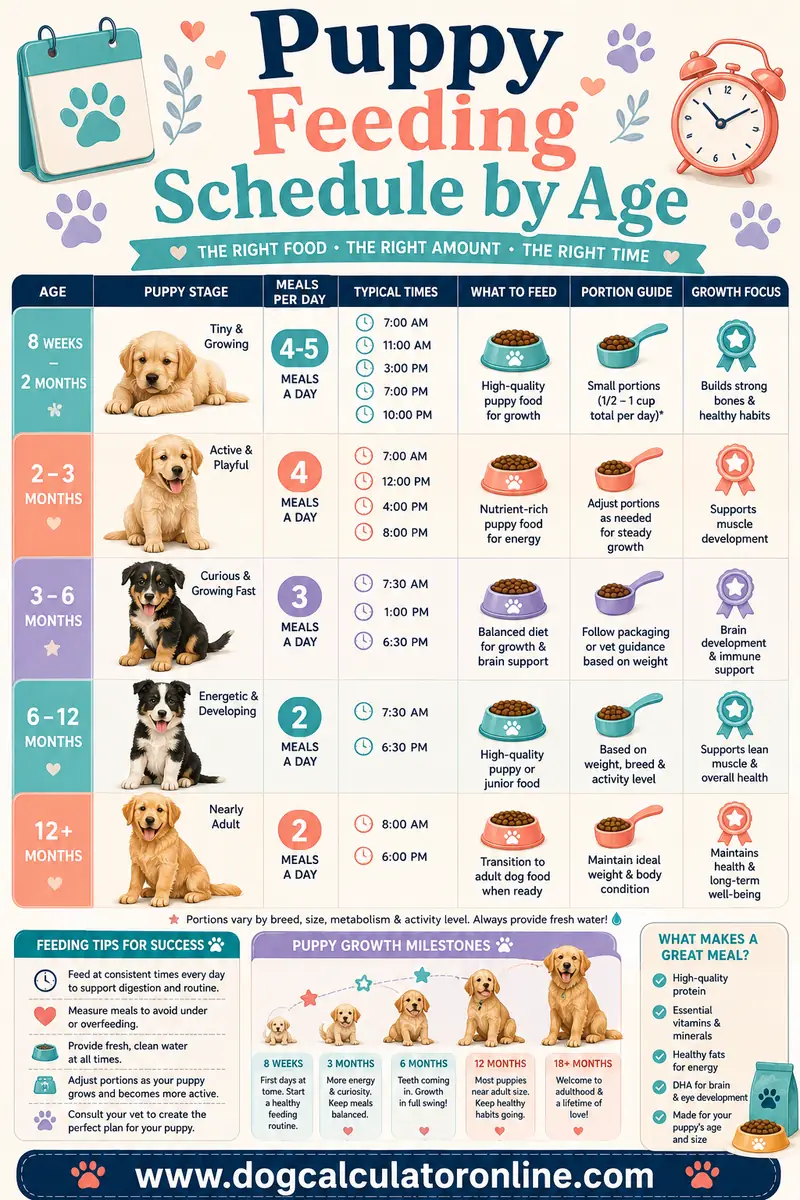
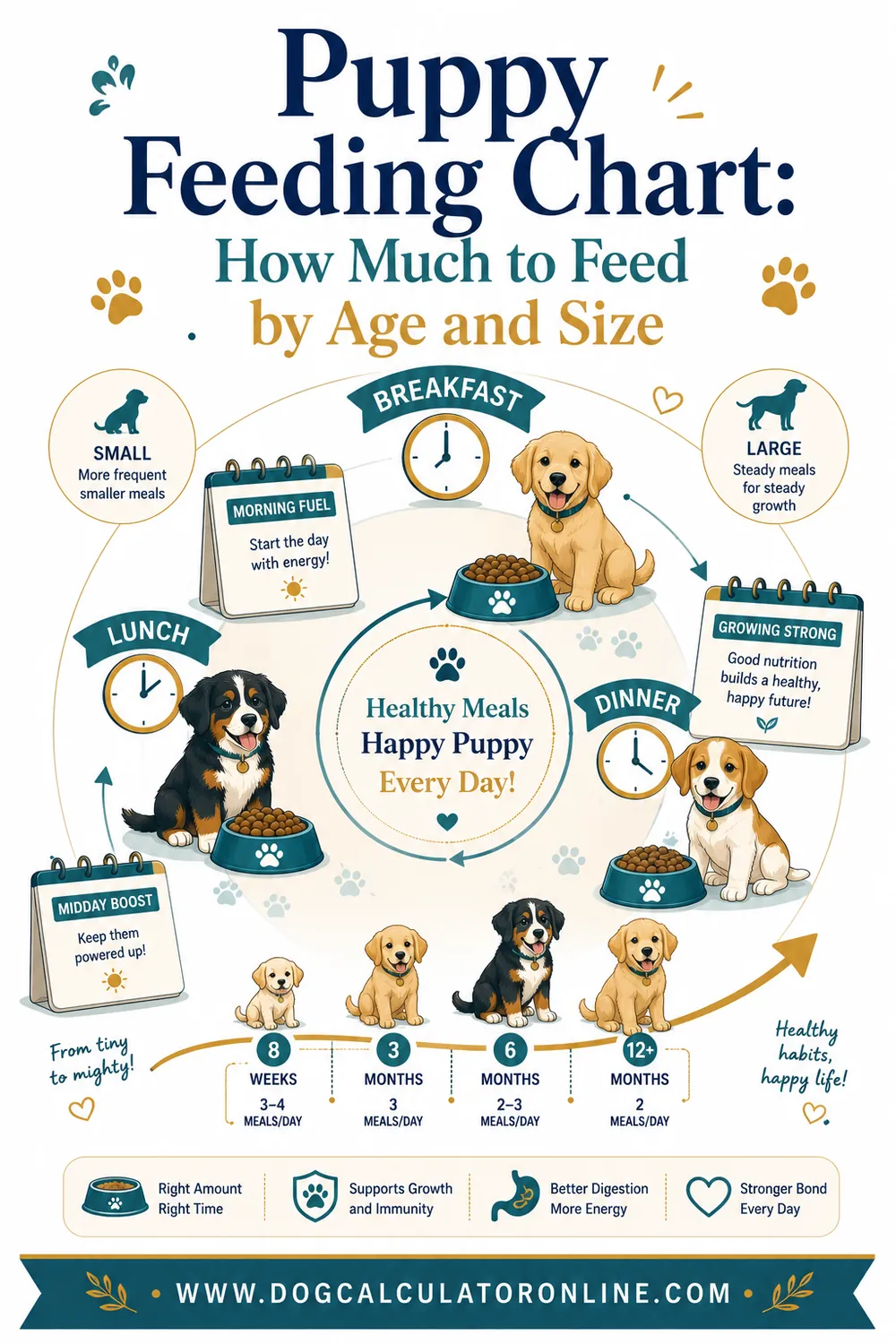
Meals per Day: Splitting the Total
The daily total gets divided across the day — puppies can't handle it in one or two big sittings when young:
- 6–12 weeks: 4 meals a day (3 can work for large breeds eating bigger volumes)
- 3–6 months: 3 meals a day
- 6–12 months: 2 meals a day
So a 3-month-old eating 2 cups a day gets roughly ⅔ cup per meal, three times daily. Toy-breed puppies deserve extra caution: their small bodies are prone to low blood sugar when meals are spaced too far apart, so frequent meals matter more, not less, for the tiniest puppies. The clock-time version of all this lives in our puppy feeding schedule by age.
How to Tell You've Got the Amount Right
Puppies should be lean — a fat puppy isn't extra healthy, it's carrying strain on developing joints, and in large breeds, growing too fast is a known orthopedic risk. Check these weekly:
- Ribs: easily felt with light pressure, lightly padded, not visible from across the room (except naturally lean sighthound-type breeds).
- Waist: a visible tuck behind the ribs from above.
- Energy and stools: a well-fed puppy is bright and produces firm stools. Chronic soft stool sometimes just means portions are too big per sitting.
- Steady gain: puppies should gain steadily week over week — not plateau, not balloon.
Signs of overfeeding: no waist, ribs hard to find, soft stools, and weight climbing faster than the growth-curve trend. Signs of underfeeding: prominent ribs and hips, low energy, obsessive food-seeking, stalled weight. Either pattern that persists for more than a week or two is worth a vet conversation — as is any puppy that refuses food for more than a day, which in a young puppy is always take-it-seriously territory.
Adjusting as Your Puppy Grows
The rhythm that works: weigh every 1–2 weeks, re-run the numbers, adjust the scoop. Bathroom-scale method is fine for small breeds (hold the puppy, subtract yourself); bigger pups can stand on the scale at the vet's office, usually free and always good socialization.
Expect the pattern to surprise you. Portions climb steadily through the first months, plateau somewhere in adolescence, and then — this is the step most owners miss — drop when growth finishes and again after spay/neuter, when calorie needs fall noticeably. Keep feeding the peak-growth amount to a 10-month-old whose growth has slowed, and you'll meet the classic "suddenly chubby adolescent."
When your puppy approaches adult size, the transition to adult food comes with its own timing rules by breed size — small breeds around 9–12 months, giants as late as 18–24 months.
Don't Forget the Training-Treat Budget
Puppyhood is peak training season — sit, stay, come, "please stop eating the rug" — and every rep usually costs a treat. That's dozens of extra calories a day sneaking in alongside carefully measured meals, and for a small puppy it can quietly push the total 20% over plan.
Three fixes that keep training generous without inflating the waistline:
- Pay wages from the paycheck. Set aside part of the day's measured kibble as training currency. Most puppies work enthusiastically for their own food, especially before meals.
- Go tiny. A treat only needs to be pea-sized to register as a win. One commercial treat torn into six pieces buys six reps for the price of one.
- Keep the 10% ceiling. Whatever treats you use beyond kibble, cap them at about a tenth of daily calories and subtract them from the next meal's scoop.
Your future adult dog — lean, well-trained, and unbothered — will be the receipt.
FAQ
How much should my puppy eat a day?
Roughly ⅔–1 cup at 5 lb, 1–1⅔ cups at 10 lb, 1¾–2¾ cups at 20 lb, and 2½–3¾ cups at 30 lb of typical puppy kibble — split into 3–4 meals. Your bag's feeding chart, calibrated to its exact calories, beats any generic estimate.
How do I know if I'm feeding my puppy enough?
Steady weekly weight gain, good energy, firm stools, and a lean-but-padded feel over the ribs. Prominent bones, low energy, or stalled gain suggest too little; ask your vet if you're unsure.
Should puppies eat as much as they want?
No. Free-choice feeding tends to overfeed, and in large breeds, overfeeding and too-rapid growth are linked to joint problems. Measured meals on a schedule are the safer approach — nursing mothers being the classic exception, per your vet.
How many times a day should my puppy eat?
Four meals from 6–12 weeks, three from 3–6 months, two from about 6 months on. Toy breeds often keep more frequent meals longer to protect blood sugar.
Why does my puppy always act hungry?
Most puppies are enthusiastic eaters — appetite alone doesn't mean underfed. Judge by body condition and weight trend, not begging. If a puppy is ravenous and thin despite proper portions, have your vet check for parasites and other causes.
Do puppies need puppy food, or can they eat adult food?
Puppies need a food formulated for growth (or all life stages) — it carries more protein, fat, and specific minerals than adult maintenance food. Large-breed puppies specifically need large-breed puppy formulas with controlled calcium.
The Bottom Line
Puppies eat roughly double an adult's calories per pound — real amounts run from about ⅔ cup a day for a tiny 5-pounder to 4+ cups for a fast-growing large breed — and the right portion changes every few weeks as they grow. Use your label's chart as the anchor, split the total across 3–4 meals, keep your puppy lean, and re-check the math after every weigh-in.
The free dog food calculator makes the re-check painless: weight and age in, daily portion out. For the bigger picture, see the full puppy feeding chart and how much to feed a puppy.