How Much to Feed a Puppy by Weight
By weight alone, a puppy under 4 months old needs roughly 390 kcal a day at 5 lb, 650 kcal at 10 lb, 1,100 kcal at 20 lb, and 1,500 kcal at 30 lb — about 1, 1⅔, 2¾, and 3¾ cups of typical 400-kcal/cup puppy food respectively. Older puppies (4 months to adult size) need about a third less at the same weight. Weight is the biggest input, but age decides the multiplier — which is why every good puppy chart uses both.
The free dog food calculator runs the weight-and-age math for your puppy in seconds. Below are the full charts in both calories and cups, the formula behind them, and worked examples so you can sanity-check any feeding chart you're handed.
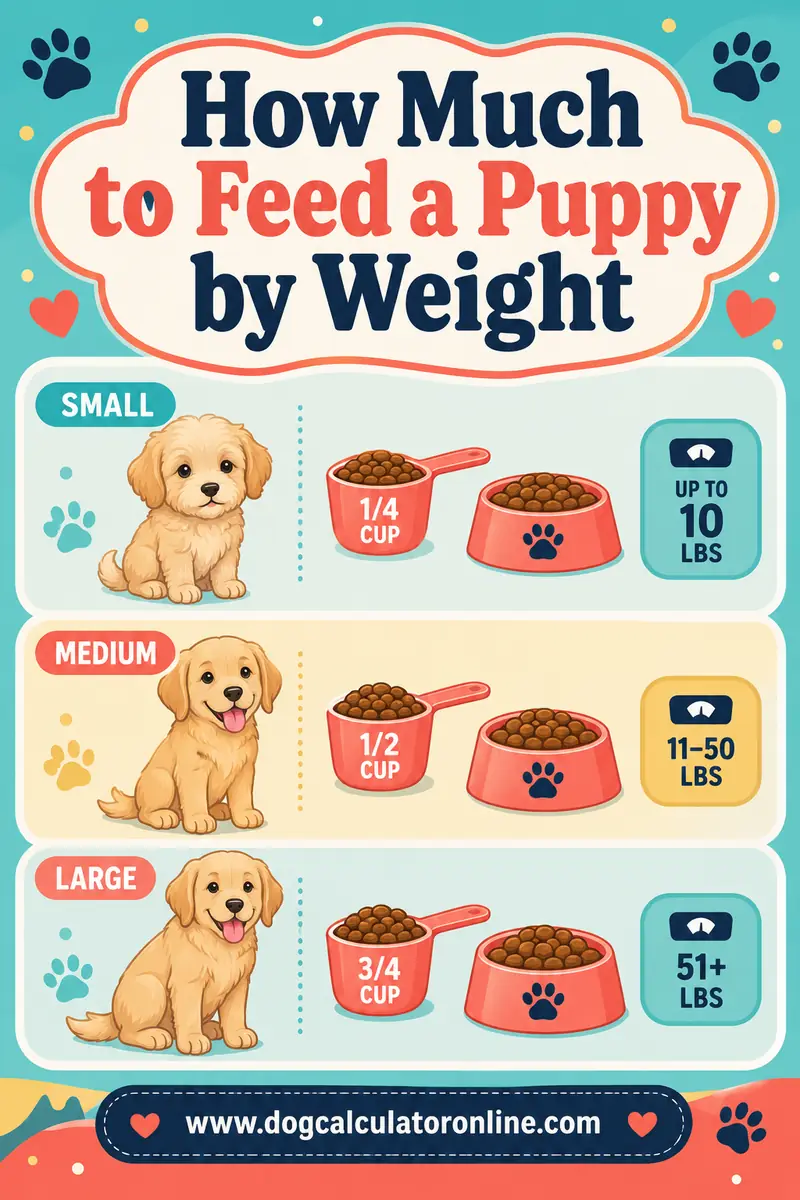
⚖️ Feed-by-weight lookup (puppy under 4 months)
Tap your puppy’s current weight:
Tap a weight above for the daily estimate. Puppies over 4 months need about a third less.
The Feed-by-Weight Chart (Calories and Cups)
Two versions of the same chart — pick your unit. Cup figures assume a typical dry puppy food at ~400 kcal per cup; check your bag's calorie statement and scale accordingly.
Puppies under 4 months (≈3 × RER):
| Current weight | kcal/day | Cups/day (~400 kcal/cup) | Meals |
|---|---|---|---|
| 3 lb | ~265 | ~⅔ | 4 |
| 5 lb | ~390 | ~1 | 4 |
| 8 lb | ~550 | ~1⅓ | 4 |
| 10 lb | ~650 | ~1⅔ | 3–4 |
| 15 lb | ~890 | ~2¼ | 3–4 |
| 20 lb | ~1,100 | ~2¾ | 3 |
| 30 lb | ~1,500 | ~3¾ | 3 |
| 40 lb | ~1,850 | ~4⅔ | 3 |
Puppies 4 months to adult size (≈2 × RER):
| Current weight | kcal/day | Cups/day (~400 kcal/cup) | Meals |
|---|---|---|---|
| 5 lb | ~260 | ~⅔ | 3 |
| 10 lb | ~435 | ~1 | 3 |
| 20 lb | ~730 | ~1¾ | 3 |
| 30 lb | ~990 | ~2½ | 2–3 |
| 40 lb | ~1,230 | ~3 | 2–3 |
| 50 lb | ~1,450 | ~3½ | 2 |
| 60 lb | ~1,670 | ~4 | 2 |
| 70 lb | ~1,880 | ~4¾ | 2 |
Individual puppies can run 20% above or below these figures and be perfectly healthy — treat every row as the middle of a range, then let body condition steer.
The Formula Behind the Chart
If you like seeing the gears, here's the whole machine:
- Convert weight to kilograms (pounds ÷ 2.2).
- Resting Energy Requirement: RER = 70 × kg^0.75.
- Multiply by growth stage: about 3 × RER for puppies under 4 months, about 2 × RER from 4 months until adult size. (Adults run 1.4–1.8 depending on lifestyle.)
- Convert to cups: daily kcal ÷ your food's kcal per cup.
Worked example — a 16-week-old puppy weighing 18 lb (8.2 kg): RER = 70 × 8.2^0.75 ≈ 340 kcal. At the 2× growth factor, that's ~680 kcal a day. On a 380-kcal/cup food: about 1¾ cups daily, split across three meals — call it a generous ½ cup per meal.
Notice how sensitive the answer is to the age multiplier: the same 18-lb puppy at 3 months would get ~1,020 kcal, half again as much. Weight sets the base; age sets the multiplier. Any chart that asks only for weight is making an assumption about age — find out which one before you trust it.
Why Weight-Only Charts Can Mislead
Three puppies can all weigh 20 lb and need three different portions:
- A nearly-grown Cavalier mix at 20 lb is at adult size — feed close to adult levels (~2 × RER falling toward 1.6).
- A 5-month-old Border Collie at 20 lb is mid-growth — the 2 × RER chart fits.
- A 10-week-old Bernese Mountain Dog at 20 lb is a baby with 80 lb to go — the 3 × RER chart fits, and it needs a large-breed puppy formula.
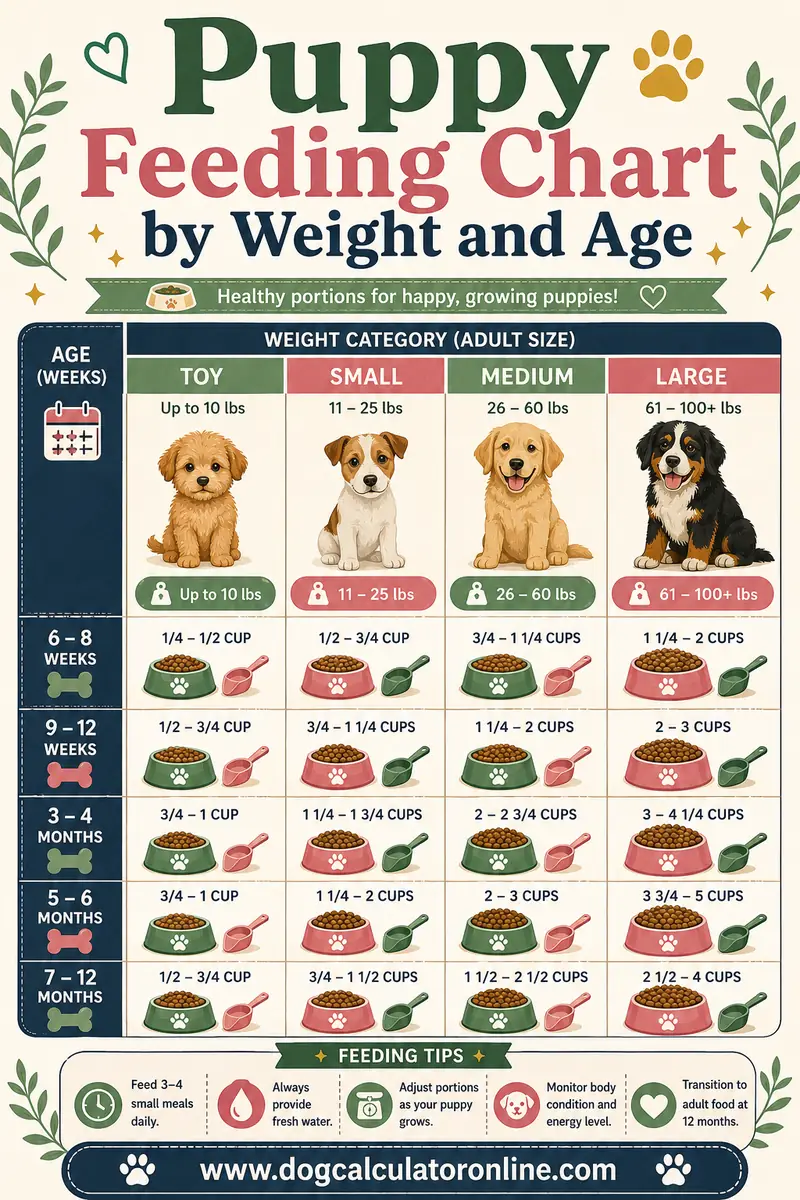
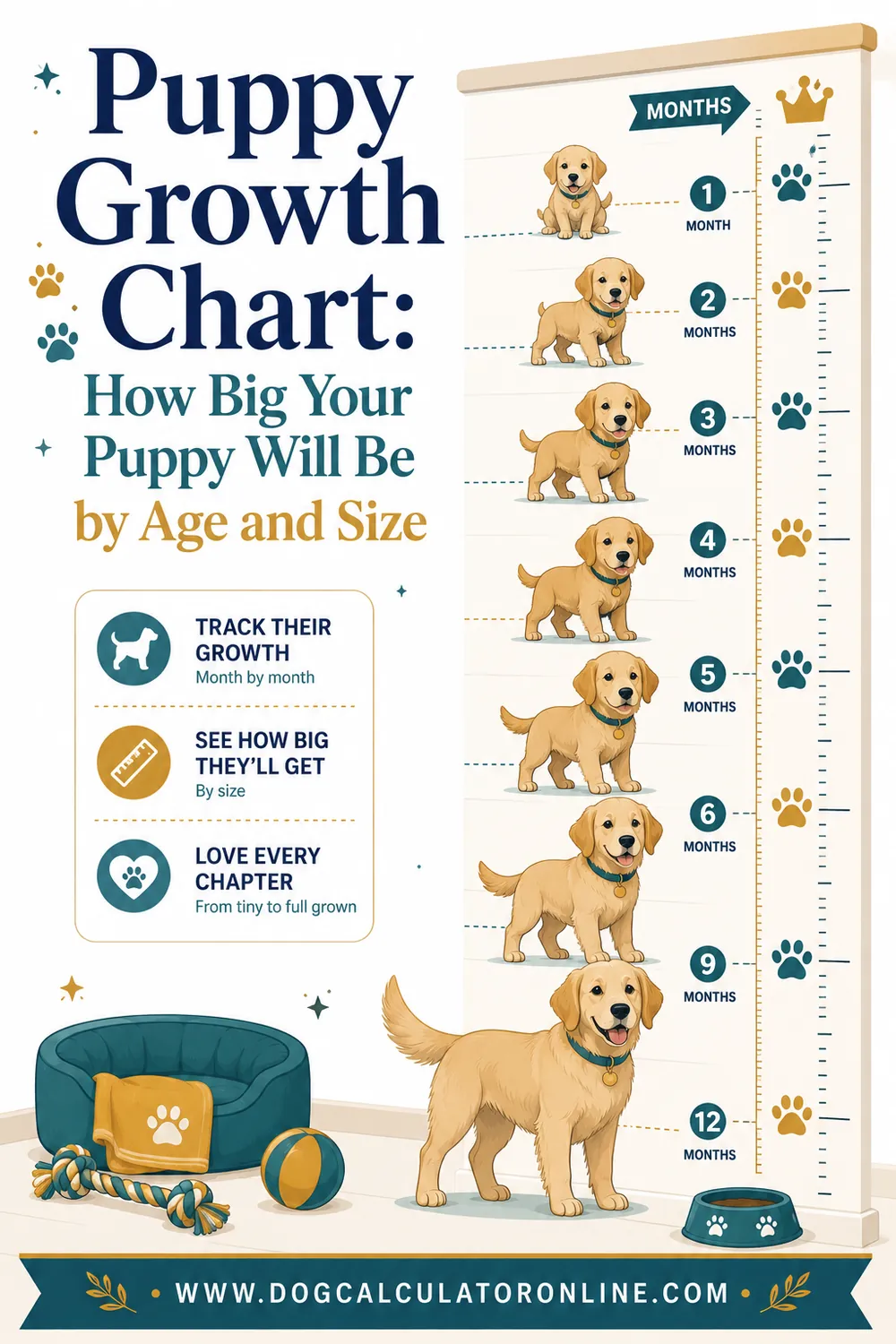
Same scale reading, different math. This is also why the "expected adult weight" question matters on better charts and calculators: it distinguishes a puppy that's nearly done from one that's just getting started. Our puppy feeding chart by weight and age crosses both variables in one table, and the puppy growth chart helps you place your puppy on its curve.
Weigh-In Rhythm: The Habit That Keeps Portions Right
A by-weight chart is only as current as the weight you feed into it, and puppies change fast — some breeds gain multiple pounds a week during peak growth.
- Weigh every 1–2 weeks during the first six months. Small puppies: bathroom-scale method (hold puppy, subtract yourself). Bigger pups: most vet clinics happily let you use the lobby scale free.
- Re-run the numbers after every weigh-in. A 25% weight jump — three weeks of growth for many puppies — means a 25%-ish portion jump at the same life stage.
- Log it. A note on the fridge or your phone turns feeding into a trend you can see. A weight that stalls two weeks running, or leaps beyond the breed's usual curve, is worth a vet chat.
- Mind the multiplier changes. Around 4 months the growth factor steps down; near adult size it steps down again. If your puppy's weight went up but the calculated portion barely moved, that's the multiplier doing its job — not an error.
Cups Are Only as Accurate as the Scoop
By-weight feeding fails at the bowl more often than in the math:
- Use a real measuring cup, leveled — not a mug, not the giant scoop that came in the bin. Studies of owner scooping consistently find generous "cups."
- Better: a kitchen scale. The bag lists kcal per kilogram; weighing food in grams removes scoop error entirely. For a small puppy whose whole day is 150 grams of kibble, a 20-gram over-scoop per meal is a 40–50% overfeed.
- Recheck when you change bags. Kcal per cup varies between brands and even between formulas of one brand — 340 vs 430 kcal/cup means the "same cup" is a 25% swing.
- Count the extras. Training treats are constant at this age. Keep them under ~10% of daily calories, or use part of the measured daily kibble as training rewards.
Lean is the goal: ribs easy to feel under light padding, a visible waist from above. In large breeds especially, overfeeding and too-fast growth are linked to joint problems — a lean puppy isn't a deprived puppy, it's a protected one.
Feeding by Kilograms Instead
If your scale, vet, or food bag speaks metric, the formula gets simpler — RER already runs on kilograms, so skip the conversion step entirely. The same milestones in metric:
| Current weight | kcal/day (under 4 months) | kcal/day (4 months+) |
|---|---|---|
| 2 kg | ~355 | ~235 |
| 5 kg | ~700 | ~470 |
| 10 kg | ~1,180 | ~790 |
| 15 kg | ~1,600 | ~1,070 |
| 20 kg | ~1,985 | ~1,325 |
Metric has one genuine advantage at the bowl: most bags list kcal per kilogram of food alongside kcal per cup, and weighing kibble in grams on a kitchen scale beats any scoop for accuracy. Daily kcal ÷ (kcal per kg ÷ 1,000) = grams per day — divide by meals and you're done, no cup-fraction squinting required.
When the By-Weight Chart Doesn't Apply
A few puppies need a different starting point than the chart gives:
- Underweight rescues. A puppy arriving thin shouldn't jump straight to full portions — sudden large meals on an empty system backfire. Feed modest amounts on the frequent-meal schedule and let your vet set the ramp-up pace.
- Recently spayed or neutered. Energy needs drop after the surgery, often by a noticeable margin. If your puppy is altered during the growth phase, watch body condition closely and expect to trim the calculated portion.
- Recovering from illness. Appetite and needs swing during and after sickness; follow your vet's feeding instructions over any chart until things normalize.
- Extremely active pups. A farm puppy running all day can genuinely need more than the table row — feed to body condition, not to the printed number.
The chart is built for the healthy, average-activity puppy. Everyone else starts there and adjusts.
FAQ
How much should I feed my puppy per pound of body weight?
Young puppies (under 4 months) need roughly 75–90 kcal per pound per day at small sizes, tapering toward 50 kcal per pound as they get heavier; older puppies need about a third less. The curve isn't linear, which is why per-pound rules are rougher than the chart or the dog food calculator.
How many cups of food should a 10-lb puppy eat?
Around 1⅔ cups a day of typical 400-kcal/cup puppy food if under 4 months, or about 1 cup if older — split into 3–4 meals. Check your own bag's kcal per cup; it changes the answer directly.
Do I feed based on current weight or expected adult weight?
Most charts and the formula here use current weight plus age. Expected adult weight matters for choosing the food type (large-breed puppy formula for dogs maturing over ~70 lb) and for reading label charts that are built that way — always check which input a chart wants.
How often should I reweigh my puppy and adjust food?
Every one to two weeks during the first six months, then monthly until grown. Adjust the portion after each weigh-in — puppy portions have a shelf life of weeks.
My puppy food chart says something different — which do I trust?
The bag, generally: it's calibrated to that exact food's calorie density. Use this article's math to sanity-check it and to interpolate between the chart's rows. If bag and body condition disagree, trust body condition and ask your vet.
Does the by-weight chart work for wet food too?
Yes — the daily calorie target is the same regardless of format. Check the label for kcal per can or pouch and divide the day's calories by that figure instead of kcal per cup. Mixing wet and dry? Count both toward one daily total, not each toward its own.
Can I overfeed a growing puppy?
Easily — and it matters. Overfed puppies aren't just chubby; in large breeds, excess calories and too-rapid growth are associated with developmental joint problems. Feed measured amounts and keep your puppy lean.
The Bottom Line
Feeding a puppy by weight works when you remember the second input: weight sets the base calories, age sets the multiplier (about 3 × RER under 4 months, 2 × after), and your food's kcal-per-cup turns it into a scoop. Reweigh every week or two, because the right answer keeps moving.
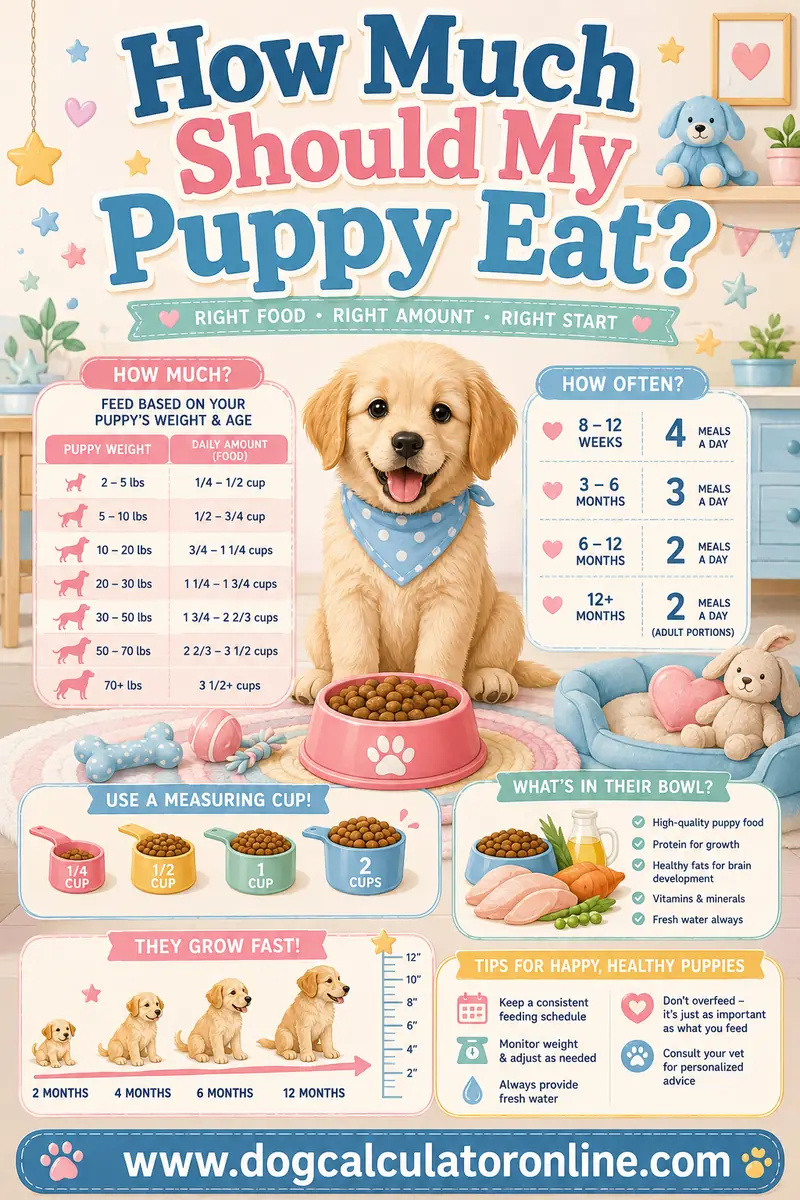
Skip the exponents — the free dog food calculator takes weight and age and hands back the daily portion. For the broader feeding picture, see how much to feed a puppy and how much your puppy should eat.