Puppy Feeding Chart by Weight and Age
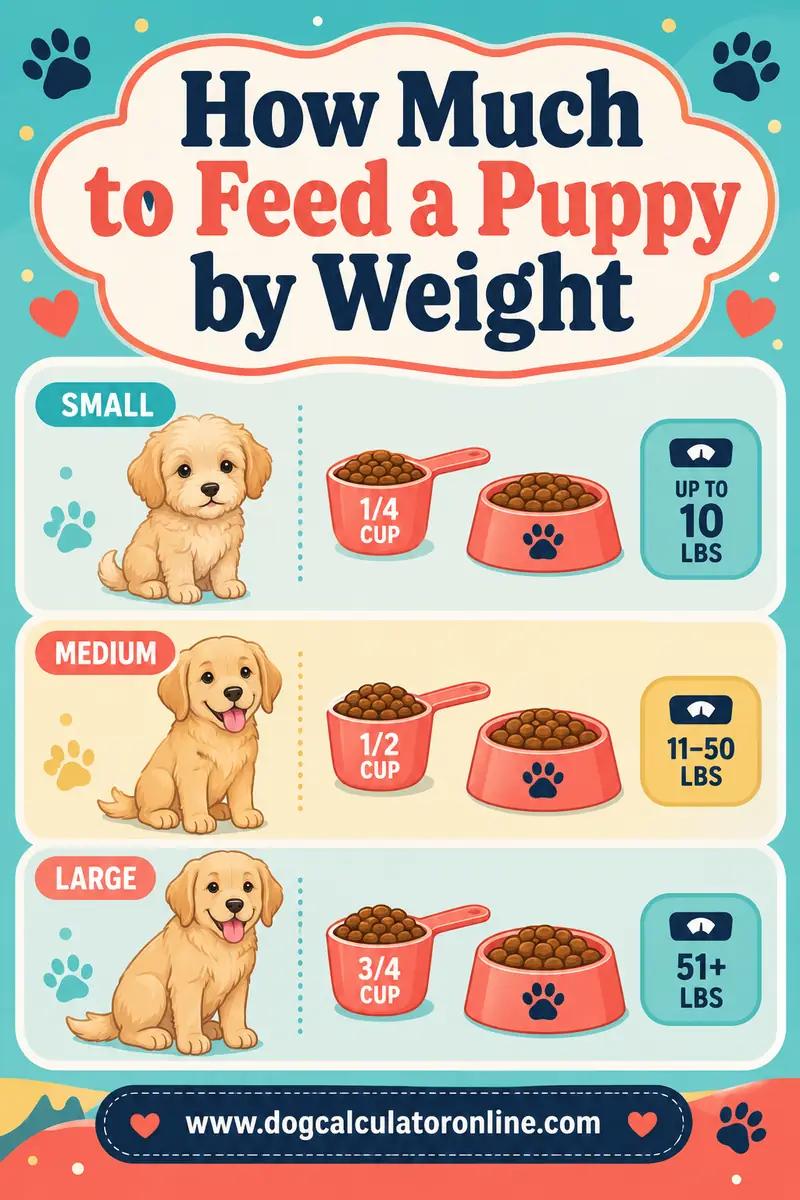
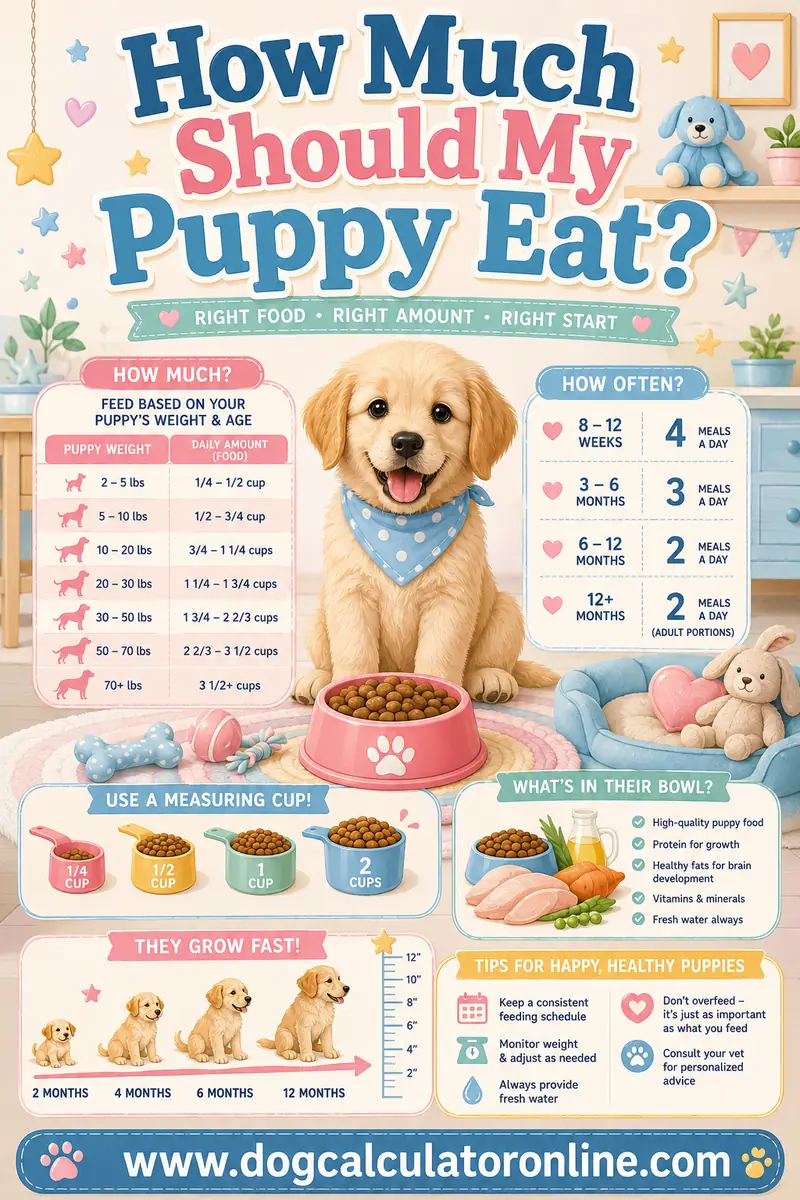
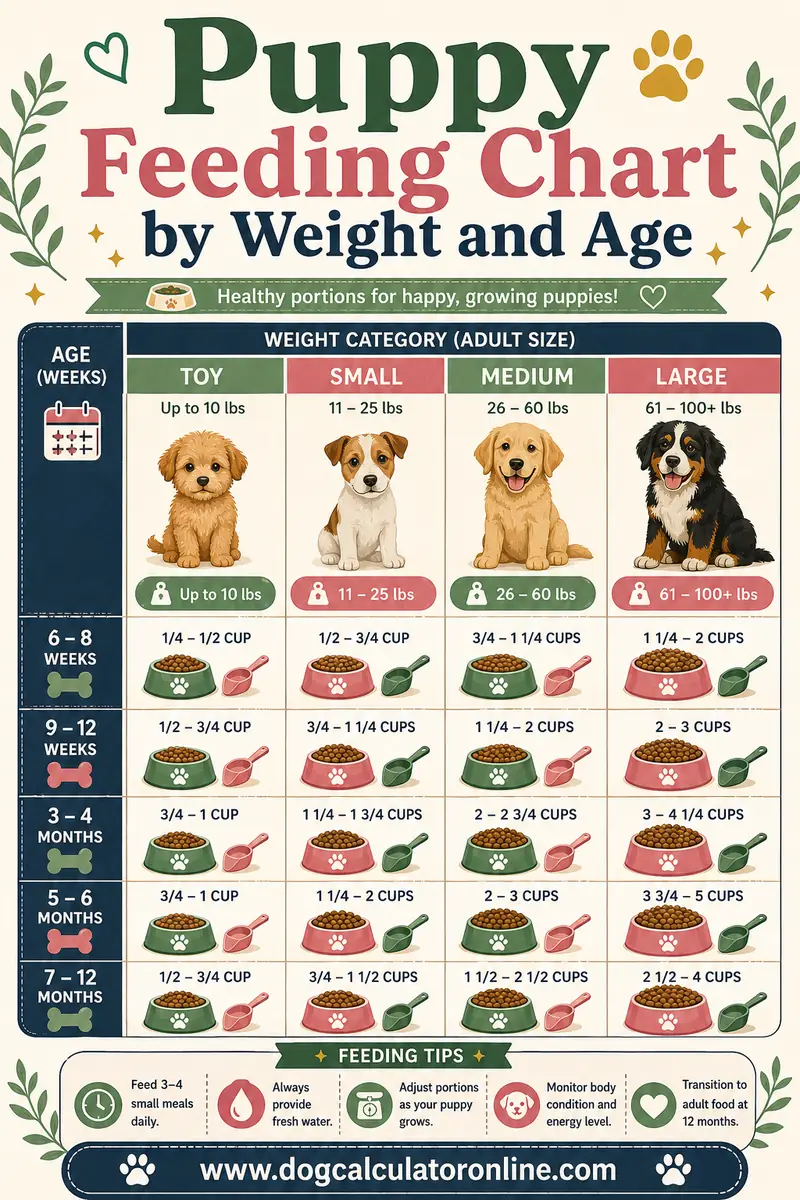
A puppy needs roughly twice as many calories per pound as an adult dog of the same weight — a 10-lb, three-month-old pup may need as much food as a 20-lb adult. As a working range on typical puppy kibble: about ½–1 cup a day for a 5-lb puppy, 1–1¾ cups at 10 lb, 2–3 cups at 20 lb, and 3–4½ cups at 40 lb, split into 3–4 meals for young pups — with the amount re-checked every two weeks, because a growing puppy's "right portion" is a moving target.
Both variables matter: weight sets the scale of the portion, and age sets how hard the growth engine is running. The free dog food calculator turns your puppy's current weight and age into a daily estimate in seconds. Below: the chart by weight and age, the meals-per-day schedule, the large-breed exception, and how to tell when the chart is wrong for your particular puppy.
🐶 Puppy portion check
Tap your puppy’s current weight for a typical daily amount (standard puppy kibble):
Tap a weight above. Age and your bag’s kcal-per-cup shift the number.
The Puppy Feeding Chart
Approximate daily amounts of typical puppy kibble (~400–450 kcal per cup), by current weight and age band. Always cross-check against your own bag's puppy table — formulas vary.
| Current weight | 2–4 months | 4–8 months | 8–12 months |
|---|---|---|---|
| 5 lb | ~¾–1 cup | ~½–¾ cup | ~½ cup |
| 10 lb | ~1¼–1¾ cups | ~1–1½ cups | ~¾–1 cup |
| 20 lb | ~2½–3 cups | ~2–2½ cups | ~1½–2 cups |
| 30 lb | ~3–3¾ cups | ~2½–3¼ cups | ~2–2½ cups |
| 40 lb | — | ~3–4 cups | ~2½–3¼ cups |
| 60 lb | — | ~4–5 cups | ~3½–4½ cups |
| 80 lb | — | — | ~4½–5½ cups |
Read it by finding your puppy's current weight in the left column, then the column for age. Notice the counterintuitive pattern: for the same weight, a younger puppy eats more — a 10-lb three-month-old outeats a 10-lb ten-month-old, because early growth burns hotter. The dashes mark combinations that barely exist (an 8-week-old rarely weighs 40 lb).
Two rules that trump the chart every time: follow your specific bag's feeding table when it disagrees (it's calibrated to that food's calories), and re-check the portion every two weeks, because your puppy will have changed rows.
Why Puppies Eat So Much More Per Pound
An adult dog eats to maintain a finished body. A puppy eats to maintain and build one — bone, muscle, organs, brain, immune system, all under construction simultaneously. In calorie terms, veterinary guidelines put a young puppy (weaning to about four months) at roughly three times resting energy requirement, dropping to about twice from four months to adolescence, then tapering to adult levels (~1.6×) as growth finishes.
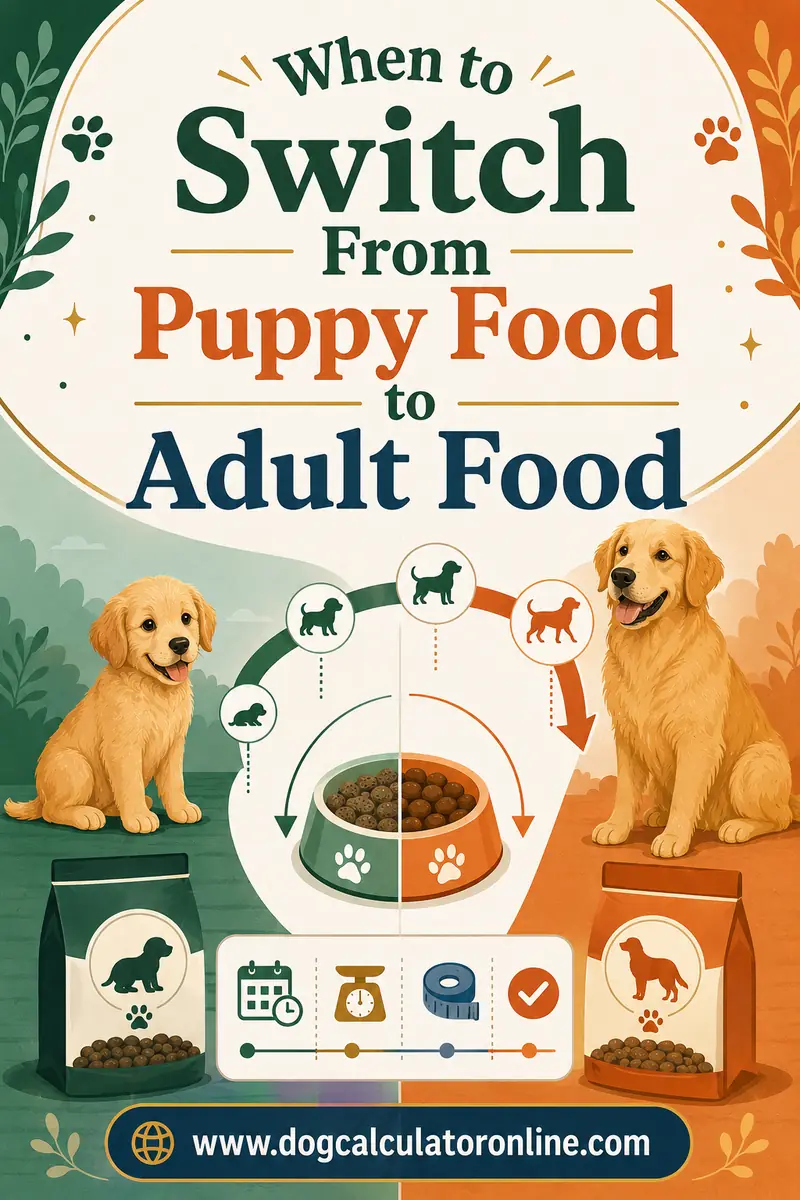
That's why "just feed him a bit less than an adult portion" is exactly backwards for a young pup, and why puppy food exists at all: it packs more calories, protein, and growth minerals per cup, so small stomachs can carry big construction budgets. It's also why the transition off puppy food matters — keep feeding that dense formula after growth ends and the same portions quietly become a weight problem. (Timing details in when to switch puppy food to adult food.)
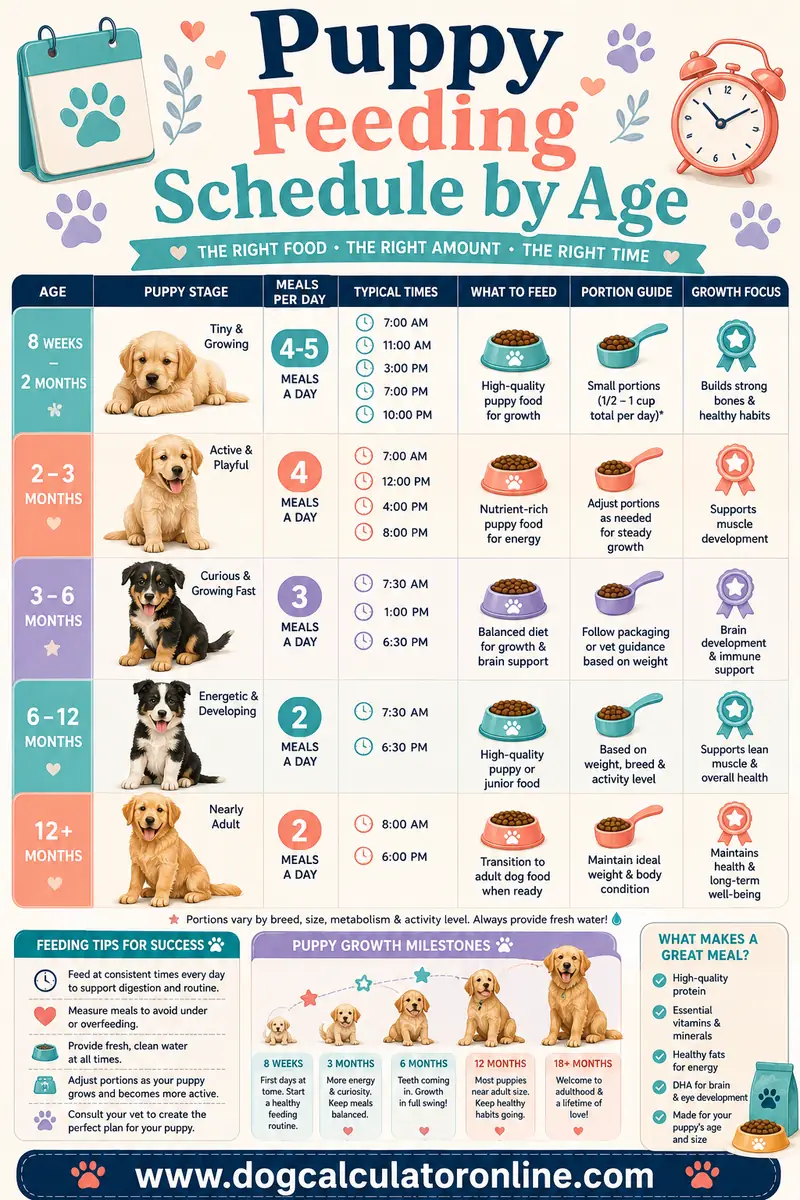
Meals Per Day by Age
The daily total gets split differently as your puppy grows — small stomachs and fast metabolisms need frequent refueling:
| Age | Meals per day |
|---|---|
| 6–12 weeks | 4 meals |
| 3–6 months | 3 meals |
| 6–12 months | 2–3 meals |
| 12+ months | 2 meals |
A morning / midday / evening rhythm works well for the three-meal phase, with the last meal a couple of hours before bed to help nighttime house-training. Toy breeds are the exception worth flagging: very small puppies (Chihuahuas, Yorkies, and friends) can be prone to low blood sugar and often stay on 4 small meals longer than the table suggests — a good question for your vet at the first visit. The full day-by-day routine, including water and potty timing, is in the puppy feeding schedule by age.
The Large-Breed Exception
If your puppy's adult weight will be 50–70 lb or more, the chart's food choice matters as much as the amounts. Large and giant-breed puppies (Labs, Shepherds, Danes, and company) grow for longer and are vulnerable to developmental joint problems if they grow too fast or get too much calcium while their skeletons are forming.
The veterinary consensus points:
- Feed a large-breed puppy formula — these control calcium and calorie density specifically for slow, steady skeletal growth.
- Lean is the goal, not chunky. A roly-poly large-breed puppy isn't thriving; extra weight during growth loads developing joints. You should feel ribs easily throughout puppyhood.
- Don't supplement calcium on top of a complete puppy food — more is not better for bones and can actively cause harm. If someone recommends a supplement, run it past your vet first.
- Expect a long adolescence. Giant breeds may keep growing to 18–24 months and stay on puppy formula longer — your vet can time the switch to your pup's actual growth curve.
Small-breed puppies have the mirror-image quirk: tiny jaws and hot metabolisms do best on small-breed puppy formulas with small kibble and dense calories.
How to Adjust When the Chart Isn't Fitting
Charts and bags describe average puppies; yours is a specific one. The feedback loop:
- Body condition beats the table. Ribs easy to feel under a thin cover, a visible waist from above, a belly tuck from the side — even in a puppy. If ribs are disappearing, trim portions ~10%; if they're sharp and prominent, add ~10% and mention it at the next vet visit.
- Track the growth trend. Weigh your puppy every week or two (bathroom scale: hold the pup, subtract yourself). Steady gains along a curve are the goal — a puppy who plateaus or loses weight needs a vet call, not just a bigger scoop.
- Leftovers are information. A young puppy who consistently walks away from food may simply be over-portioned — or teething, or unwell. Persistent poor appetite in a puppy is a same-week vet question.
- Stool grades the ration too. Consistently soft stool can mean too much food at once; smaller, more frequent meals often fix it. Sudden diarrhea in a young puppy, especially with lethargy, is urgent — puppies dehydrate fast.
And a scheduling note: growth isn't linear. Puppies eat like furnaces during growth spurts and turn picky in the lulls. A hungry week followed by an indifferent week is normal adolescence, not a broken chart.
Treats, Toppers, and the 10% Rule
Training season and puppyhood arrive together, which means treats flow freely exactly when the calorie budget is smallest. Keep the arithmetic honest:
- Treats stay under ~10% of daily calories, and they come out of the daily total, not on top of it.
- Use the smallest treat that works. Training treats can be pea-sized; puppies care about frequency, not volume. A portion of the day's kibble ration makes excellent training currency.
- Watch the "helpers." Half the household slipping the puppy extras is the classic invisible calorie leak. One feeder, or one written tally, keeps the chart meaningful.
- Skip the risky extras entirely: no cooked bones, no fatty table scraps, and none of the toxic list (grapes, raisins, chocolate, onions, anything sweetened with xylitol). A puppy's small body means small amounts of the wrong thing hit harder.
Reading Your Bag's Puppy Table (Without Getting Fooled)
Every puppy food bag carries its own feeding table, and it's worth two minutes to learn its dialect. Most are organized by expected adult weight down one side and current age across the top — which trips up owners who look up the puppy's current weight instead and end up feeding a 60-lb-adult ration to a 20-lb pup months early. Check the row label carefully.
Other fine print worth noticing: the amounts are usually per day, not per meal (dividing is your job); the ranges assume the food is fed alone, so toppers and training treats come out of the printed amount; and the kcal-per-cup line elsewhere on the bag lets you cross-check the table against a calculated estimate. When the bag and the calculator disagree by a little, start between them and let body condition break the tie. When they disagree wildly, re-read the row — it's almost always the adult-weight-vs-current-weight mix-up.
FAQ
How much should I feed my puppy by weight and age?
On typical puppy kibble: roughly ½–1 cup daily at 5 lb, 1–1¾ cups at 10 lb, 2–3 cups at 20 lb, 3–4½ cups at 40 lb — with younger puppies at the higher end for their weight. Split into 3–4 meals when young, and follow your bag's table for your exact food.
How many times a day should a puppy eat?
Four meals from 6–12 weeks, three from 3–6 months, two to three from 6–12 months, then two as an adult. Toy breeds often stay on more frequent meals longer — ask your vet.
Why does my 10-lb puppy eat as much as my neighbor's 20-lb dog?
Growth roughly doubles calorie needs per pound. A young puppy runs at about 2–3 times resting energy requirement, while a neutered adult sits near 1.6 times — so small puppies legitimately eat like much bigger dogs.
Do I feed by current weight or expected adult weight?
Current weight and age, updated every couple of weeks as your puppy grows. (Expected adult size matters for choosing the food — large-breed pups need large-breed formula — more than for the daily amount.)
When do puppies stop needing puppy food?
Around 12 months for most small and medium breeds, later — up to 18–24 months — for large and giant breeds. Your vet can time it to your pup's growth. See our guide on switching to adult food.
My puppy always acts starving — should I feed more?
Judge by ribs and waist, not appetite; most puppies perform hunger convincingly. If body condition is lean-and-right, the portion is right. Genuine failure to gain weight is a vet conversation.
The Bottom Line
Feed by current weight and age, split the day into 3–4 meals while your puppy is young, choose a formula matched to expected adult size, and re-run the numbers every two weeks — the only constant in puppy feeding is that the right amount keeps changing. Get today's number for your actual puppy from the free dog food calculator, and see how much to feed a puppy by weight for the weight-side deep dive.