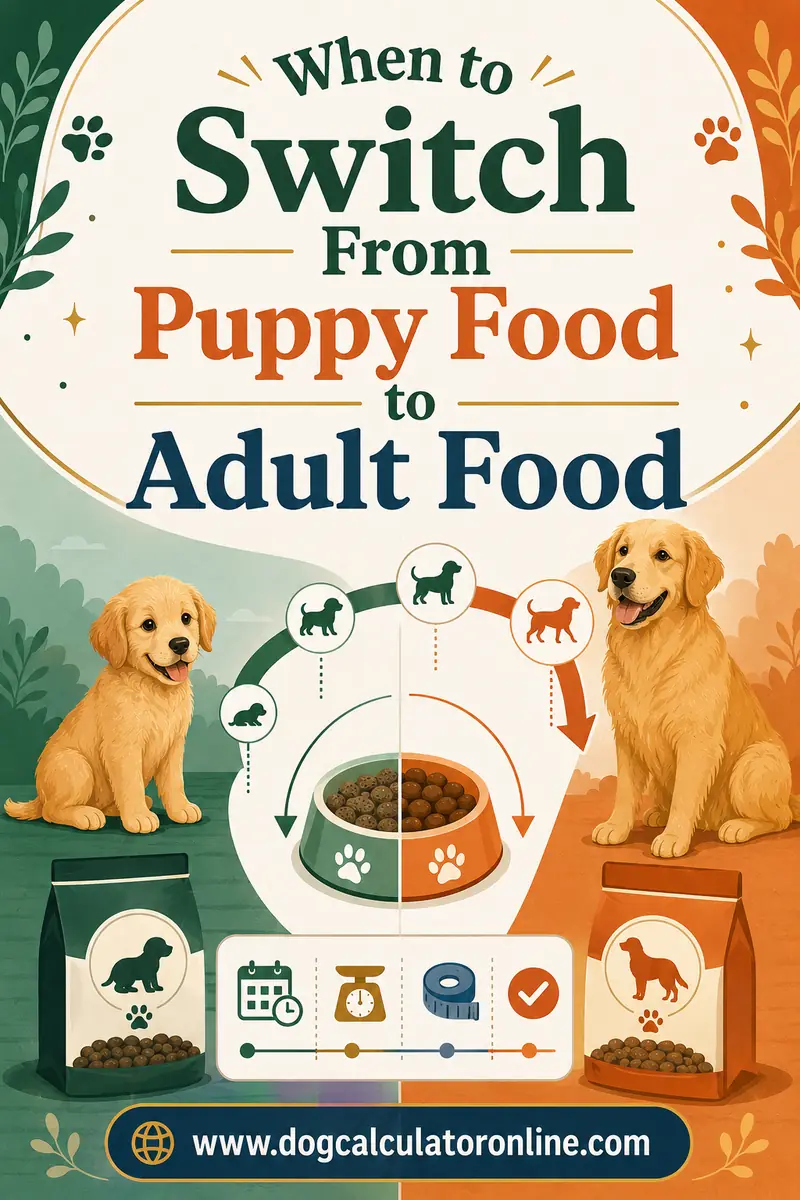
When to Switch From Puppy Food to Adult Food
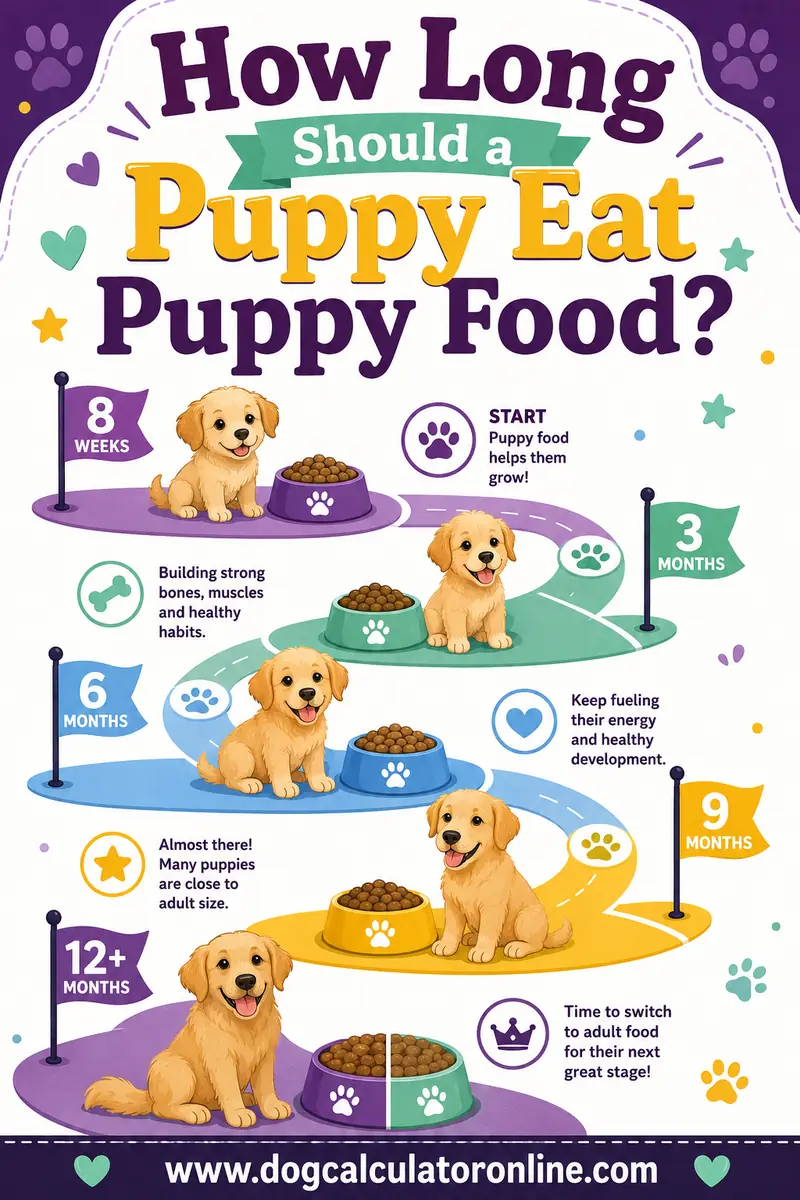
Switch your puppy to adult food when they reach adult size — around 9–12 months for small breeds, about 12 months for medium breeds, 12–18 months for large breeds, and as late as 18–24 months for giant breeds. The trigger is skeletal maturity, not a birthday: puppy food supports growth, and the switch happens when growth is essentially done.
Timing is half the job; the other half is switching gradually and re-sizing portions, because adult food and adult metabolism both mean fewer calories. The free dog food calculator gives you the new adult portion in seconds. Here's how to know your dog is ready, how to run the 7–10 day transition, and the mistakes that cause most food-switch disasters.
🔄 When should my dog switch?
Tap your dog’s expected adult size:
Tap a size above for the typical switch window.
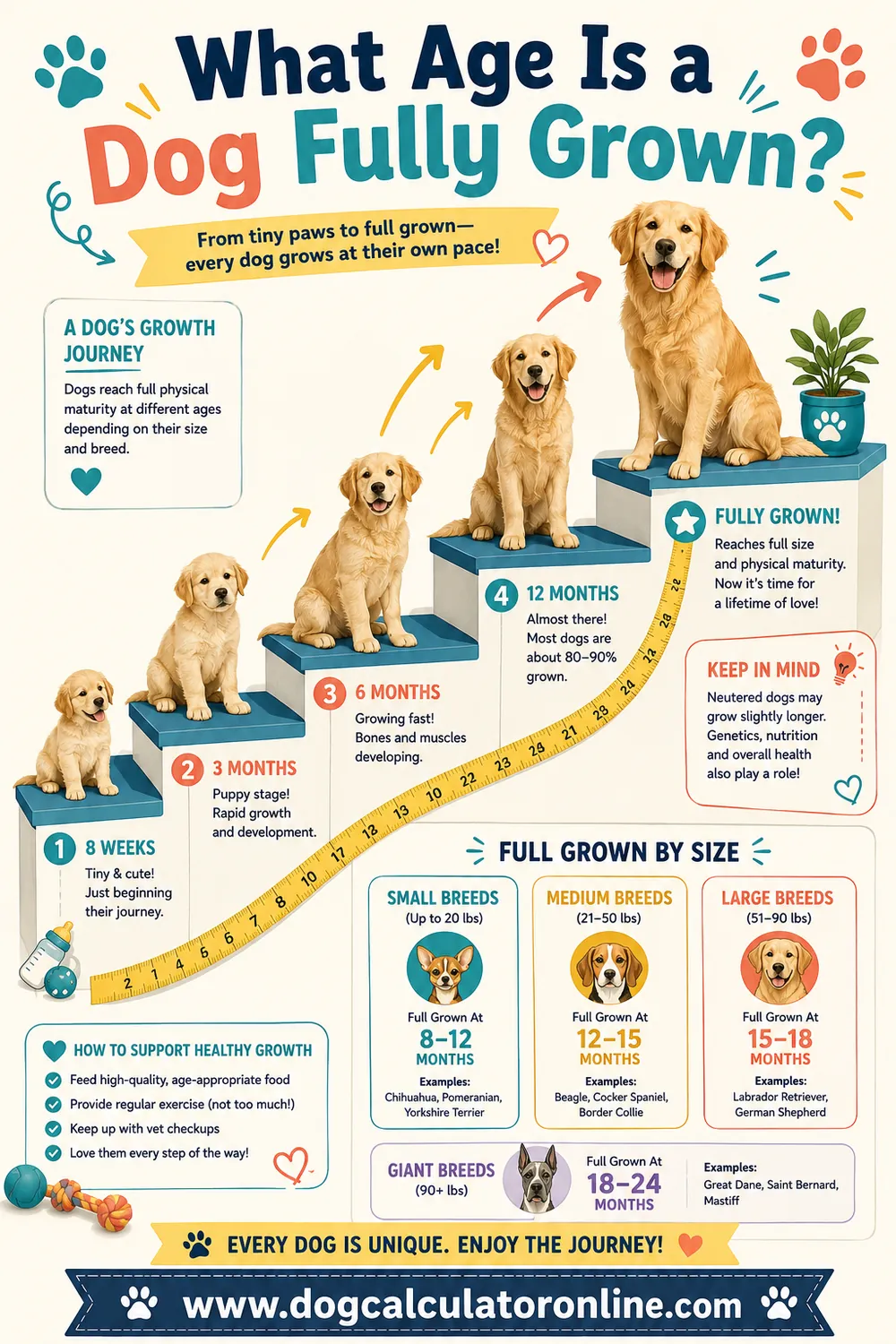
The Switch Timeline by Breed Size
| Adult size | Typical adult weight | Switch to adult food | Why it varies |
|---|---|---|---|
| Toy / Small | Under 20 lb | ~9–12 months | Small dogs finish growing fastest |
| Medium | 20–50 lb | ~12 months | Standard timeline |
| Large | 50–100 lb | ~12–18 months | Skeleton keeps building past the first year |
| Giant | 100+ lb | ~18–24 months | Slowest growers of all |
The pattern is counterintuitive at first: tiny dogs mature fastest, giants slowest. A Chihuahua can be effectively full-grown at 9 months while a Great Dane is still visibly growing at 18. That's why "switch at one year," the advice printed on the back of many minds, is right for medium dogs, early for a Mastiff, and slightly late for a Yorkie. If you're unsure where your mixed-breed lands, expected adult weight is the deciding number — and what age a dog is fully grown walks through the growth timelines in detail.
When in doubt, ask at the 12-month vet visit. Vets make this call constantly, and staying on puppy food a few extra weeks is a smaller error than switching a still-growing large breed early.
Why Puppy Food Exists (and Why It Eventually Doesn't Fit)
Puppy food isn't marketing — it's a different nutritional spec. Foods formulated for growth carry more protein, more fat and calories per cup, and carefully balanced calcium and phosphorus for bone construction. Look for the AAFCO statement on any bag: "growth" or "all life stages" versus "adult maintenance."
The same richness becomes the problem once growth stops. An adult dog eating calorie-dense growth food, at portions that no longer have a skeleton to build, gains fat — reliably. Meanwhile the extra minerals have no job to do. So the switch isn't about puppy food becoming harmful overnight; it's about matching the food to what the body is doing. Growth done, maintenance begins.
Large-breed note: for puppies maturing over ~70 lb, the puppy-food phase itself has a special rule — they should eat large-breed puppy formula, which moderates calcium and energy so fast-growing joints develop at a safe rate. Those same dogs also stay on puppy food longest. Both facts come from the same underlying truth: big skeletons are under construction for a long time.
Signs Your Dog Is Ready
The calendar gives you the window; these confirm it:
- Height has plateaued. No visible gain at the shoulder for a couple of months. (Weight can still creep from filling out — height is the better growth signal.)
- They've reached expected adult size for their breed or mix.
- Appetite has cooled. Many adolescent dogs naturally lose the ravenous-puppy edge as growth ends — leaving food, eating with less urgency.
- Body condition is trending soft on unchanged puppy-food portions — the classic sign that growth calories no longer have anywhere to go.
- Your vet agrees. Especially worth asking for large/giant breeds and any dog that had growth or orthopedic concerns.
One event that does not trigger the switch on its own: spay/neuter. It lowers calorie needs — often noticeably — but a 7-month-old large-breed dog who was just neutered is still a growing puppy who needs growth food, likely in a slightly smaller portion. Adjust the amount, not the life stage.
How to Make the Switch: The 7–10 Day Transition
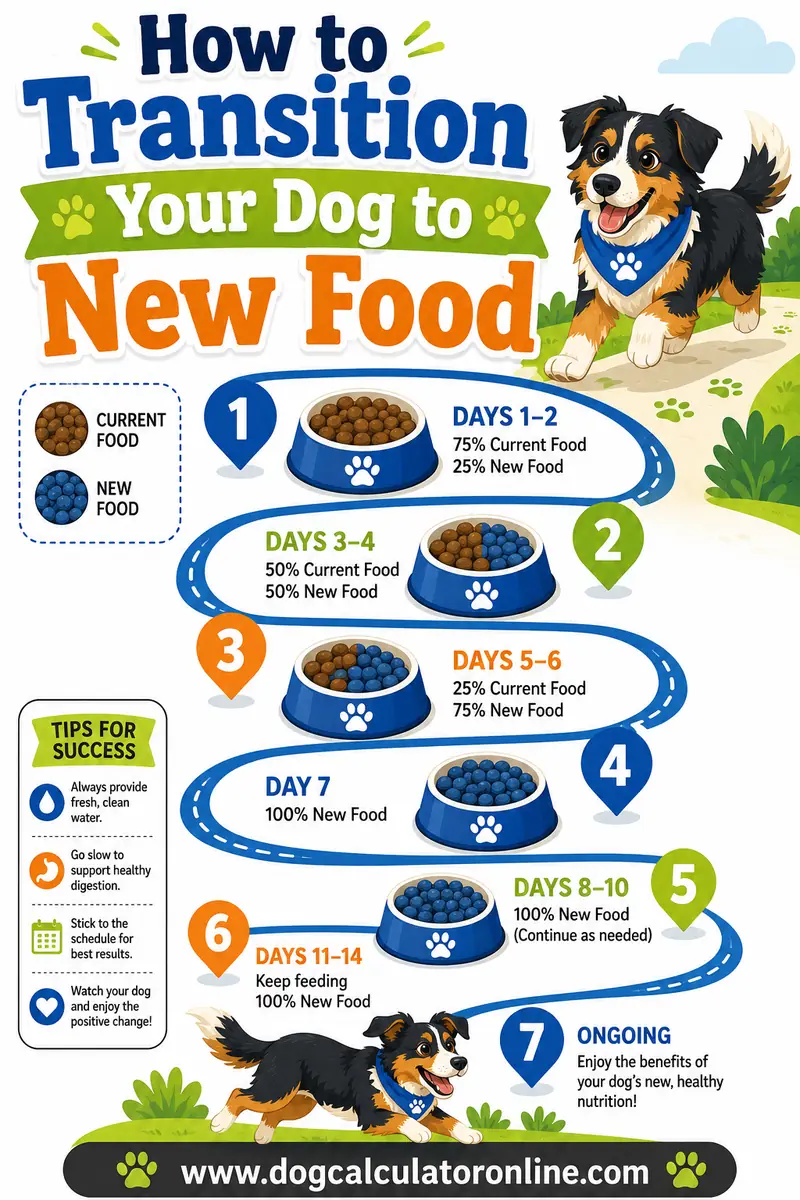
Dog digestion hates surprises. The gut's bacteria adapt to a specific food, and an overnight swap is the most reliable diarrhea generator in dog ownership. The standard gradual mix:
| Days | Old (puppy) food | New (adult) food |
|---|---|---|
| 1–2 | 75% | 25% |
| 3–4 | 50% | 50% |
| 5–7 | 25% | 75% |
| 8–10 | 0% | 100% |
Run it slower — two weeks or more — for dogs with sensitive stomachs, and pause at the current ratio for a day or two if stools soften. Loose stool that persists past a couple of days, vomiting, or refusal to eat means stop and call your vet.
Two practical notes: measure the combined portion during the mix (75/25 of the right total, not a full scoop of each), and this same protocol applies to any food change, not just the puppy-to-adult one — the full playbook is in how to transition your dog to new food.
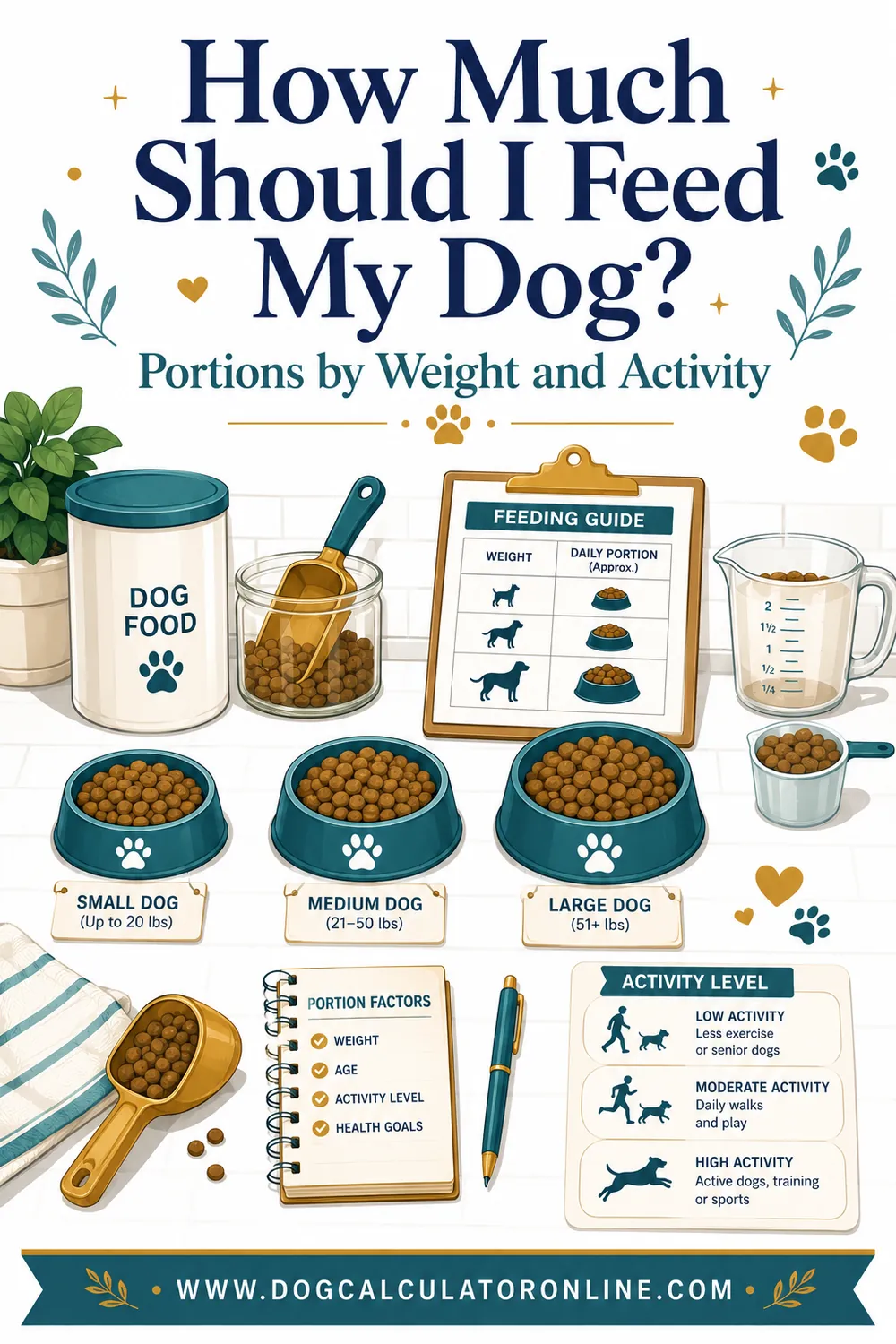
Recalculate the Portion — the Step Everyone Skips
The switch changes two numbers at once, and both point down:
- Adult food is usually less calorie-dense than puppy food — but not always, so compare the kcal-per-cup on both bags rather than assuming.
- Adult metabolism needs less. A typical neutered adult runs at roughly 1.4–1.6 × resting energy requirement, versus about 2 × for a growing adolescent. The end of growth is a real calorie cliff.
Concretely: a 60-lb dog that needed ~1,650 kcal a day while finishing growth needs roughly 1,150–1,250 as a settled adult — about a quarter to a third less. Keep feeding the adolescent portion of a denser food and you've engineered the classic "he just turned two and got fat" outcome.
So when the transition finishes: run your dog's adult weight through the dog food calculator, read the new bag's kcal per cup, and set the adult portion from scratch. Our adult feeding guide has the full charts. Then let body condition fine-tune — ribs easy to feel, waist visible from above.
Common Switch Mistakes
- Switching a large breed at 12 months flat. A Lab, Shepherd, or Dane at one year is often still growing — large breeds switch at 12–18 months, giants later still.
- Cold-turkey swaps. Even "premium to premium" needs the mix schedule. The gut doesn't care about price point.
- Keeping puppy portions on adult food (or vice versa). New food, new math — every time.
- Switching during chaos. A move, boarding stay, or vaccination week stacks stressors. Pick a boring two weeks.
- Judging the new food in 48 hours. Mild stool changes during transition are normal adaptation. Judge coat, energy, stool, and weight after several weeks at 100%.
- "All life stages" confusion. Foods with an all-life-stages AAFCO statement technically feed both puppies and adults — fine, but they're typically calorie-rich, so the portion recalculation matters even when the bag doesn't change.
Picking the Adult Food Before You Switch
The transition plan assumes you've already chosen the destination food, and that choice deserves five minutes of label reading before the first mixed bowl:
- Check the AAFCO statement. You want "adult maintenance" (or "all life stages," with the portion caveat above). That line, not the front-of-bag artwork, tells you what the food is actually formulated for.
- Stay in familiar territory. A new food built around the same main protein and a similar ingredient style as the puppy food tends to transition more smoothly than a hard left turn. Many owners simply move up the same product line, which keeps the change gentle — but any complete adult food that suits your dog works.
- Read the kcal per cup now, not later. Knowing both foods' calorie density before you start is what makes the portion recalculation painless instead of a surprise.
- Consider size-specific adult formulas. Small-breed adult foods use tiny kibble that little jaws handle comfortably; large-breed adult foods tend to be moderately lower in calories with joint-conscious formulation. Neither is mandatory the way large-breed puppy food is, but both are sensible fits.
- Dogs with a sensitive history get a vet consult first. If puppyhood featured food reactions, itching, or chronic soft stool, the switch is a good moment to ask about it rather than guess.
A Worked Example: One Lab's Switch, Start to Finish
Here's how the whole milestone looks assembled, using a roughly 65-lb Labrador — numbers for illustration; your dog's label and the dog food calculator give the real ones.
At 14 months, height at the shoulder hasn't budged in two months and the vet confirms growth is done. The owner compares bags: the puppy food runs about 430 kcal per cup, the chosen adult food about 370. The adolescent portion had been around 4 cups a day; the calculator puts the settled-adult target closer to 3½ cups of the new food — a genuine calorie cut hiding inside a similar-looking bowl.
Days 1–10: the standard mix schedule, measured as a combined total, with stools staying normal throughout. Day 30: a weigh-in and a rib check — weight steady, waist visible — so the new portion stands. If the scale had crept up instead, the next move would be a modest trim and a recheck a month later. That's the entire project: confirm, compare, transition, recalculate, verify.
FAQ
When should I switch my puppy to adult dog food?
When growth is essentially complete: about 9–12 months for small breeds, 12 months for medium, 12–18 months for large, and 18–24 months for giant breeds. Your vet can confirm for your individual dog.
What happens if I switch to adult food too early?
A still-growing puppy misses the higher protein, fat, and balanced minerals that growth requires — a particular concern for large breeds mid-skeletal-development. If you switched early, just transition back to an appropriate growth food and mention it to your vet.
Is it bad to keep a dog on puppy food too long?
The main risk is weight gain — growth-formula calories with no growth to spend them on. A few extra weeks is harmless; a year of puppy food for a settled adult usually shows up on the scale.
How do I switch from puppy food to adult food?
Mix gradually over 7–10 days: 25% new for two days, then 50%, then 75%, then fully switched — slower if your dog has a sensitive stomach.
Do small breeds really switch earlier than large breeds?
Yes. Small breeds finish growing around 9–12 months, while giant breeds keep building skeleton until 18–24 months. Switch timing follows growth, so the little dogs graduate first.
What if my dog refuses the new adult food mid-transition?
Hold at the current mix ratio for a few days rather than pushing forward, and try a splash of warm water to boost aroma. Don't start rotating through new bags — buffet-hopping teaches pickiness. Refusal that persists, or comes with vomiting or lethargy, is a vet call rather than a flavor problem.
Should I change the amount when I switch?
Almost always — adult dogs need fewer calories per pound, and the new food's kcal per cup will differ. Recalculate from scratch with the dog food calculator rather than carrying the old scoop forward.
The Bottom Line
Switch to adult food when growth ends — 9–12 months for small dogs, about a year for medium, up to 18–24 months for the giants — make the change over 7–10 days, and re-run the portion math the day the transition completes, because adulthood comes with a calorie cut.
The free dog food calculator sets the new adult portion in seconds, and how long a puppy should eat puppy food covers the flip side of this milestone in more depth.