How Long Should a Puppy Eat Puppy Food?
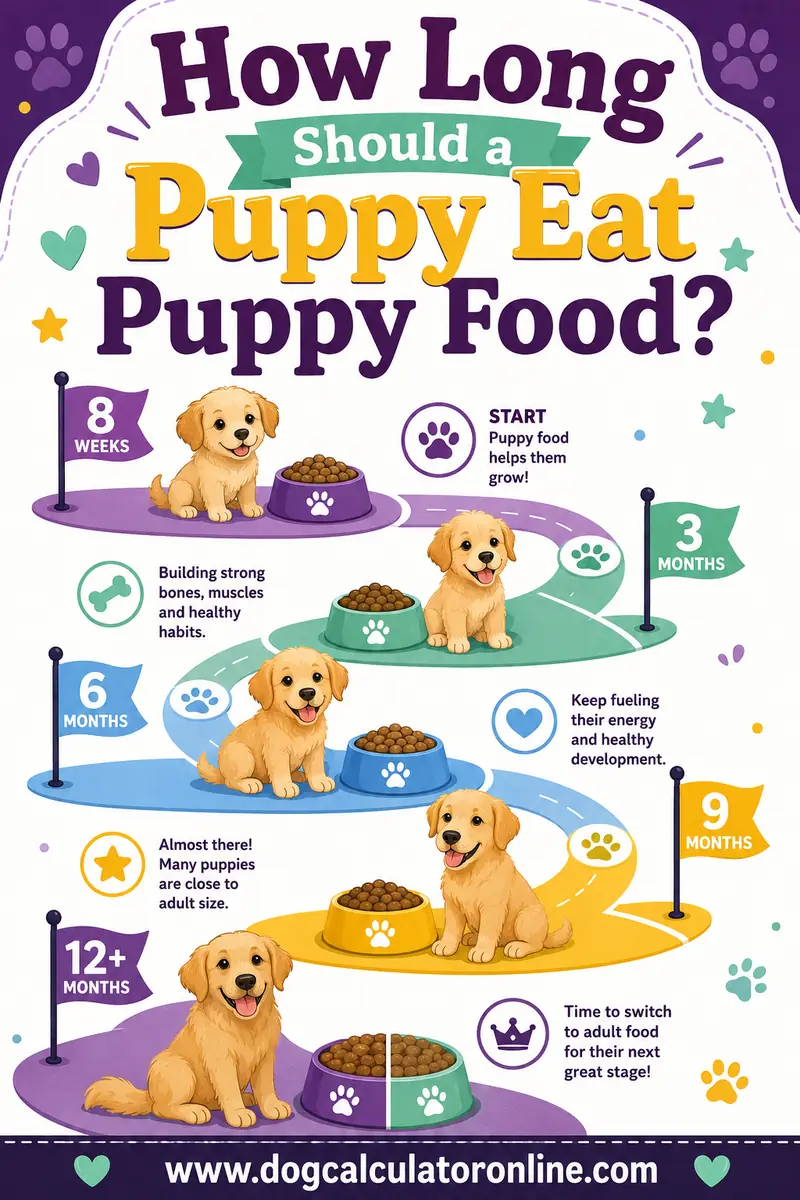
A puppy should eat puppy food until they finish growing — roughly 9–12 months for small breeds, 12 months for medium breeds, 12–18 months for large breeds, and 18–24 months for giant breeds. Puppy food is formulated for growth, so the duration tracks how long the skeleton is under construction, which varies enormously with adult size.
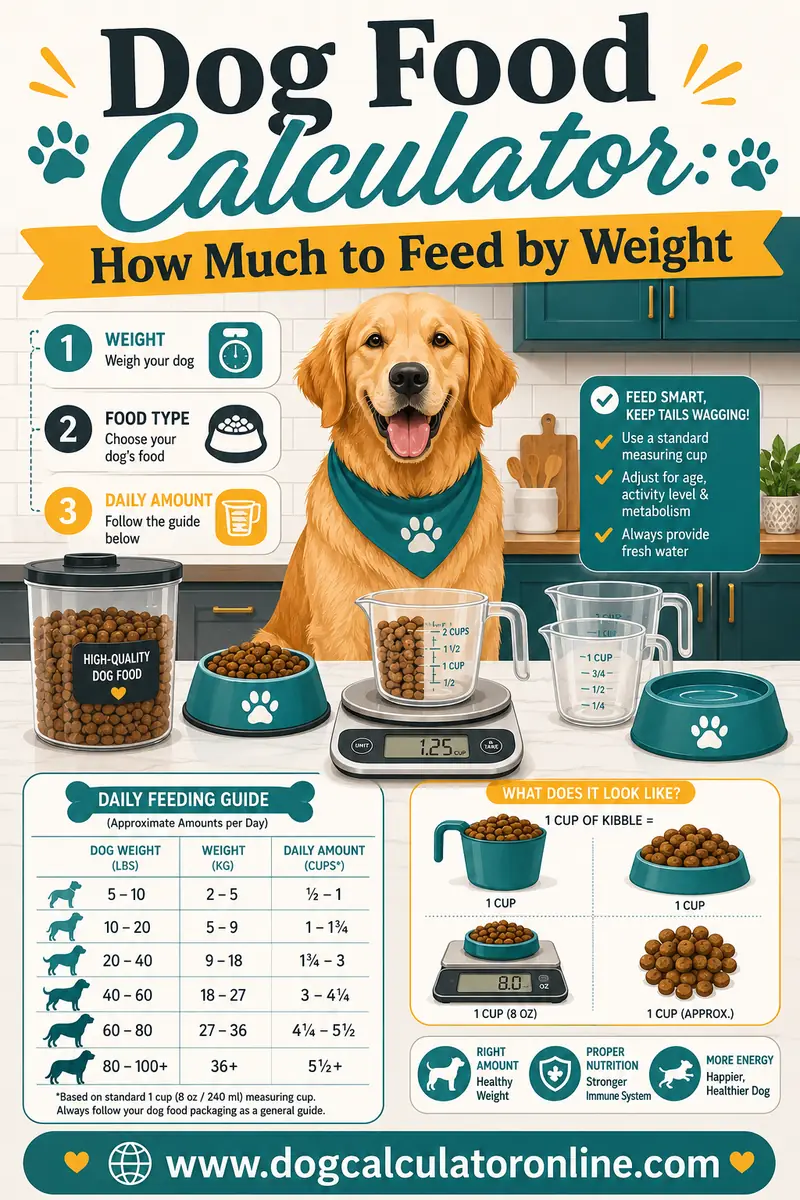
Through that whole stretch, the amount changes constantly even though the food doesn't — portions climb through peak growth, then ease off as growth slows. The free dog food calculator keeps the portion matched to your puppy's current weight and age. Here's how long each size class stays on growth food, what the food is actually doing, and how to spot the finish line.
⏳ Puppy food duration checker
Tap your dog’s expected adult size:
Tap a size above to see how long puppy food should last.
Duration by Breed Size
| Adult size | Examples | Time on puppy food | Formula note |
|---|---|---|---|
| Toy (under 10 lb) | Chihuahua, Yorkie | ~9–10 months | Small-bite growth formula |
| Small (10–20 lb) | Shih Tzu, Mini Schnauzer | ~9–12 months | Growth formula |
| Medium (20–50 lb) | Beagle, Border Collie | ~12 months | Growth formula |
| Large (50–100 lb) | Labrador, German Shepherd | ~12–18 months | Large-breed puppy formula |
| Giant (100+ lb) | Great Dane, Mastiff | ~18–24 months | Large-breed puppy formula |
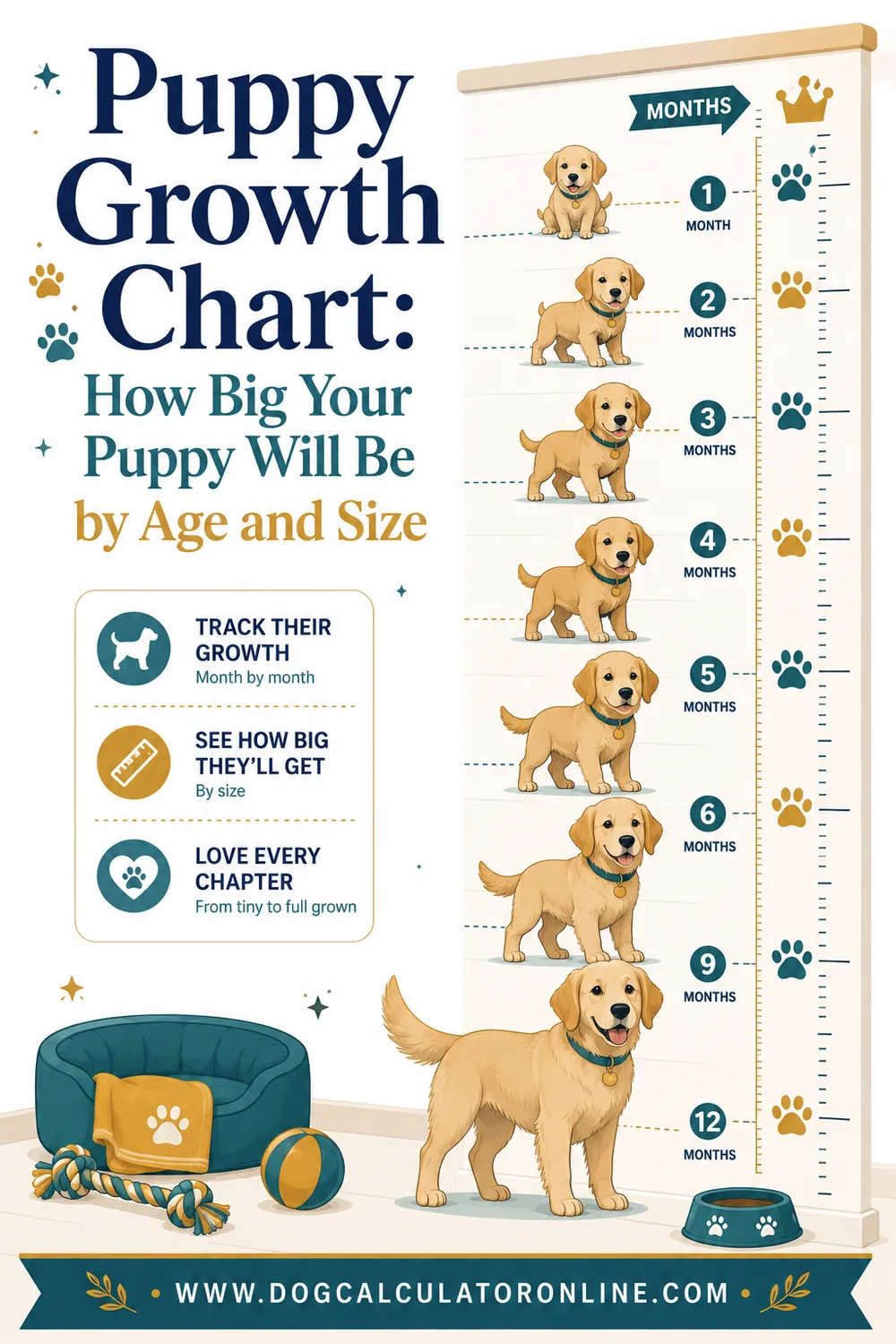
The inverse rule surprises people: the smaller the dog, the shorter the puppy-food phase. A Yorkie is done growing before its first birthday; a Great Dane is still adding frame at a year and a half. Duration follows the skeleton — our guide to when puppies stop growing maps those timelines, and the puppy growth chart shows the curves by size class.
For mixed breeds, estimate from expected adult weight (parents' sizes, paw-size trajectory, or your vet's guess) and use the matching row. When genuinely unsure, err toward staying on growth food a little longer and confirm at a vet visit.
What Puppy Food Actually Does All Those Months
"Puppy food" is a regulated nutritional category, not a marketing flavor. A food labeled for growth (check the AAFCO statement on the bag) differs from adult maintenance food in ways that matter every single week of the timeline above:
- More protein and fat — muscle, organs, brain, and coat are all being built from scratch, and early brain development also relies on specific fatty acids (DHA is commonly added for this reason).
- More calories per cup — a growing puppy needs roughly double an adult's calories per pound; energy-dense food makes that physically fit inside a small stomach.
- Balanced calcium and phosphorus — bone construction needs minerals in the right amounts and the right ratio, dosed for a skeleton that's actively lengthening.
An adult maintenance food fed during this window shortchanges all three. That's the real answer to "can't I just feed adult food a few months early?" — nothing dramatic happens on day one, but the entire remaining growth phase runs on a spec sheet written for a body that's finished.
The Large-Breed Exception Deserves Its Own Section
For dogs maturing over roughly 70 lb, which puppy food matters as much as how long. Large and giant breeds should eat a large-breed puppy formula for their entire growth phase — and it's the one label decision with orthopedic stakes.
The reason is growth rate. Big puppies gain skeleton at extraordinary speed, and both excess calcium and excess calories push that growth faster than developing joints handle well — a known risk factor for developmental orthopedic problems in large breeds. Large-breed growth formulas moderate calcium and energy density so the same adult size arrives on a slower, safer curve.
Three practical consequences:
- No calcium supplements on top of a complete large-breed puppy food — more is not better; it's the specific thing the formula is controlling. (Supplements in general: only if your vet says so.)
- Lean matters even more. A chubby large-breed puppy is carrying extra load on joints that are still forming. Feed measured portions and keep ribs easy to feel.
- Don't rush the finish line. These are exactly the dogs that stay on growth food 12–24 months — the long duration and the special formula solve the same problem.
The Amount Changes Even When the Food Doesn't
"Stay on puppy food for a year" can sound like "set the scoop for a year." It's the opposite — across the puppy-food months, the right portion rises, peaks, and falls:
- 8 weeks – ~4 months: needs run at roughly 3 × resting energy requirement. Portions climb almost every weigh-in.
- ~4 months – near adult size: the multiplier steps down to about 2 × RER, but the puppy keeps gaining weight, so the absolute portion often still creeps up. Peak absolute portion usually lands in this stretch.
- Final months: growth decelerates and the portion should start shrinking toward adult levels — this is where the "suddenly chubby adolescent" is made. Spay/neuter, often done in this window, cuts calorie needs further.
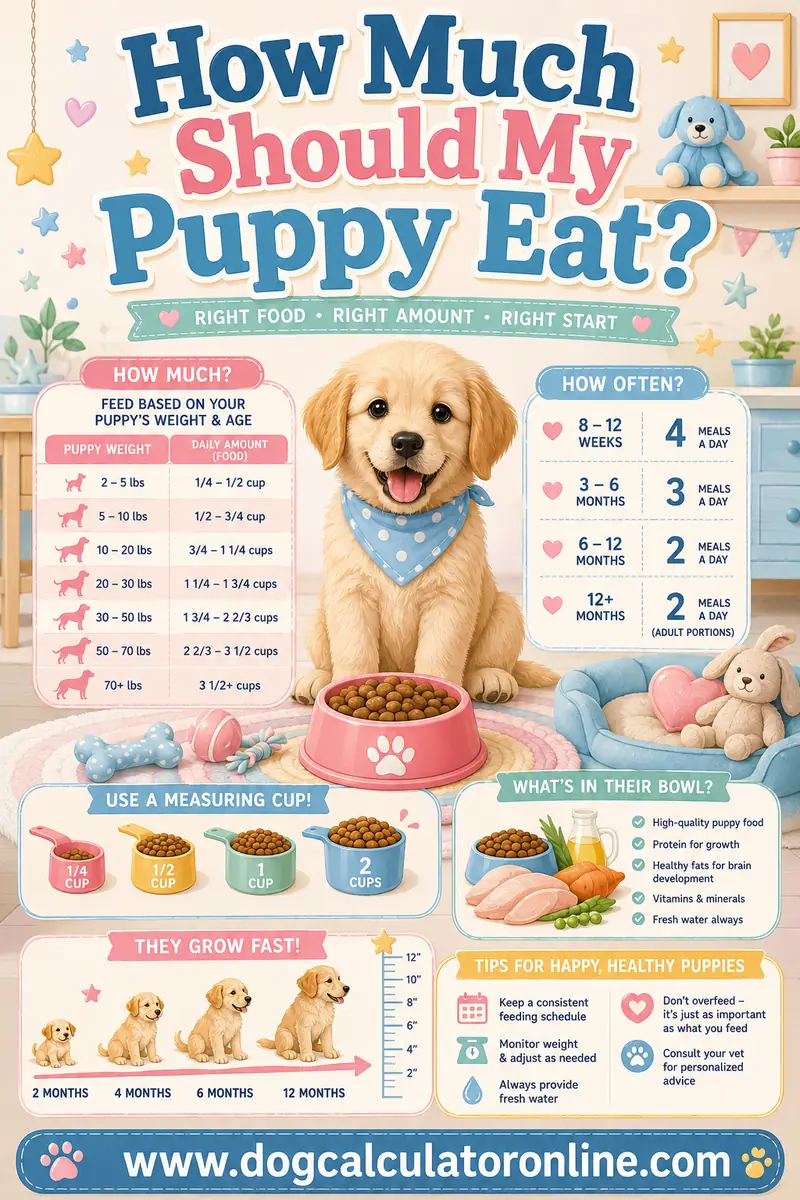
The rhythm that handles all three phases: weigh every couple of weeks, re-run the dog food calculator, adjust the scoop, and check body condition monthly. Full portion tables live in how much your puppy should eat.
Too Short vs Too Long: Which Mistake Is Worse?
Switching too early (adult food while still growing) is the more consequential error, and it's worst for large breeds mid-skeletal-development — wrong calorie density, wrong mineral dosing, less protein, during construction. If you realize you switched early, transition back to an appropriate growth formula and mention it at the next vet visit; puppies are resilient, and course-correcting promptly is usually all that's needed.
Switching too late (growth food into settled adulthood) is the gentler error with a predictable cost: weight gain. Growth-formula calories with no growth to fund become fat, quietly, at maybe a pound or two a month for a mid-sized dog. A few extra weeks is nothing; an extra year usually shows on the scale and the body-condition check.
The asymmetry explains the standard advice: when in doubt, stay on puppy food a bit longer — while keeping portions honest — and let your vet call the finish line.
How to Know the Puppy-Food Phase Is Over
Cross-check the calendar against the dog:
- Height at the shoulder hasn't changed in ~2 months
- They've reached the expected adult size for their breed or mix
- Mealtime urgency has cooled; food sometimes gets left
- Body condition trends soft on unchanged portions — growth calories with nowhere to go
- Your vet, looking at the actual dog, agrees
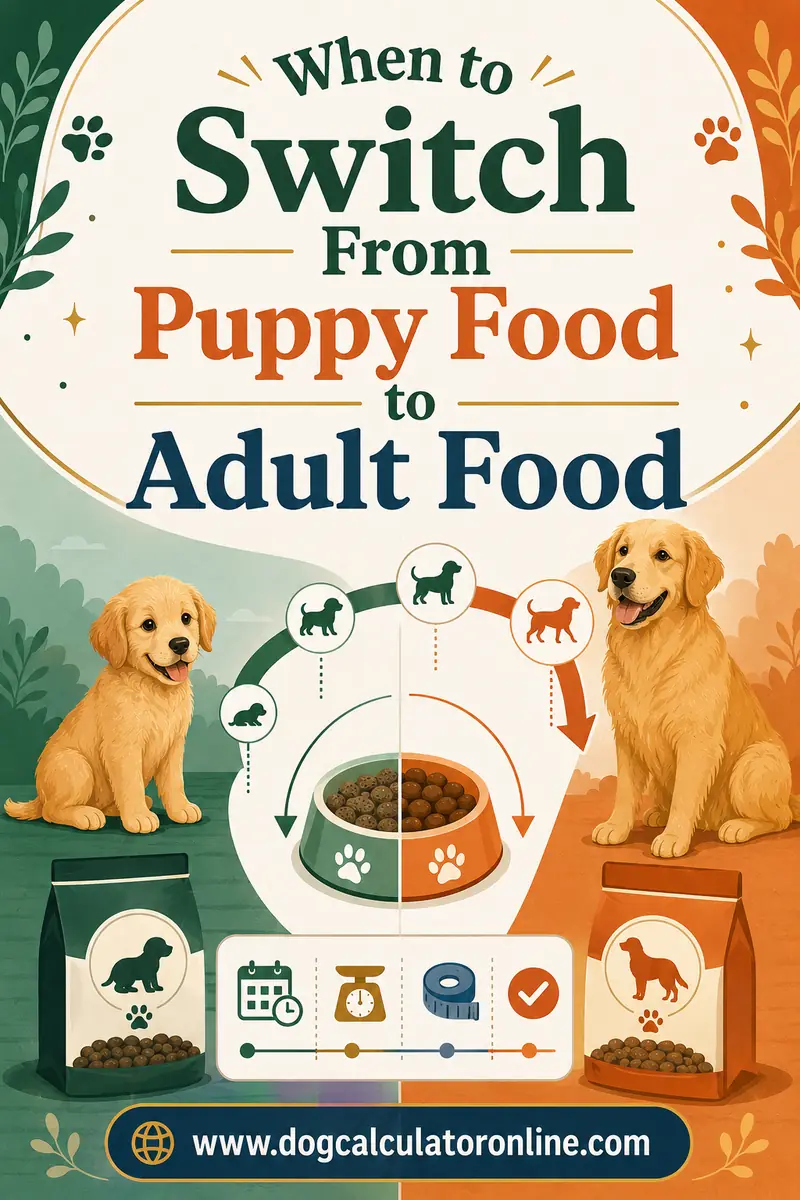
When those line up, run the switch as a gradual 7–10 day mix and recalculate the portion for adult needs — both steps are covered in when to switch from puppy food to adult food.
The Puppy-Food Months, Mapped
Here's the whole arc for a typical medium breed on a 12-month timeline — with notes on how the other size classes stretch or compress it:
| Stage | What's happening | Feeding note |
|---|---|---|
| 2–4 months | Fastest growth of the whole phase | Portions climb nearly every weigh-in; 3–4 meals a day |
| 4–6 months | Steady growth, teething | Multiplier steps down but portions still rise; 3 meals |
| 6–9 months | Growth visibly slowing | Peak portion usually passes; 2 meals; watch for creeping softness |
| 9–12 months | Filling out more than growing up | Portions drift down toward adult levels |
| ~12 months | Height plateaued | Confirm with the vet, run the 7–10 day switch |
Small breeds compress this map — a Yorkie can hit the "filling out" stage by 7 months and the finish line by 9. Large and giant breeds stretch it — a Dane's "growth visibly slowing" stage may not arrive until well past a year, and the plateau check lands somewhere between 18 and 24 months. The stages come in the same order for every dog; only the calendar changes. That's why watching the dog (height, appetite, body condition) beats watching the birthday.
Special Cases That Bend the Timeline
A few situations where the standard chart needs an asterisk:
- Rescue puppies of unknown age. Your vet can estimate age reasonably well from teeth — baby teeth, adult-tooth eruption, and wear each mark a window. Feed to the estimated age and adjust as the growth pattern reveals itself.
- Mixed breeds with a wide guess range. If the honest estimate is "somewhere between 40 and 80 lb," feed as if the higher number is true — that means a large-breed growth formula and the longer timeline. Overshooting duration is the cheap error; undershooting the calcium control isn't.
- Early spay or neuter. The surgery lowers calorie needs but does not shorten the growth phase — an altered 8-month-old large breed still needs growth food, just slightly less of it.
- Therapeutic diets. A puppy put on a vet-prescribed food for a medical issue follows the vet's timeline, full stop. The charts here are for the healthy default case.
FAQ
How long should a puppy stay on puppy food?
Until growth is done: about 9–12 months for small breeds, 12 months for medium, 12–18 months for large, and 18–24 months for giant breeds.
Can a 6-month-old puppy eat adult food?
Not ideally — at 6 months every size class is still growing, some barely halfway. Keep a 6-month-old on a growth (puppy) formula, and a future 70-lb-plus dog on a large-breed growth formula specifically.
Is it okay to feed puppy food to an adult dog?
Occasionally or briefly, it's harmless; long-term, its calorie density typically causes weight gain in a dog that's stopped growing. Vets do sometimes use growth or all-life-stages foods for underweight adults or nursing mothers — that's a case-by-case vet call.
Do small dogs really finish puppy food before big dogs?
Yes — small breeds complete growth around 9–12 months while giants continue to 18–24 months. Duration follows skeletal development, and small skeletons finish first.
What is special about large-breed puppy food?
Controlled calcium and calorie density, so fast-growing large-breed skeletons develop at a safer rate. It's the standard recommendation for puppies expected to mature over roughly 70 lb, for their whole growth phase.
Can I use up the last bag of puppy food after the switch date?
Yes — a few extra weeks of growth food in a just-matured dog is harmless. The tidy way is to make the tail end of the bag your transition mix, blending in the new adult food over 7–10 days as the puppy food runs out.
Do wet and dry puppy foods follow the same timeline?
Yes — the duration follows growth, not format. Wet, dry, or a mix all count as puppy food as long as the label carries a growth (or all-life-stages) AAFCO statement; only the portion math differs between them.
Does "all life stages" food change the timeline?
Foods with an all-life-stages AAFCO statement meet growth requirements, so a puppy can technically stay on one through adulthood. The timeline still matters for portions — adult needs drop — and large-breed puppies still do best on formulas meeting the large-breed growth standard.
The Bottom Line
Feed puppy food for as long as your dog is growing — under a year for the little ones, up to two years for the giants, with large breeds on a large-breed growth formula throughout — and remember that the portion is a moving target the entire time.
Keep it matched to your puppy's current weight with the free dog food calculator, and when the growth curve flattens, the switch-to-adult-food guide covers the handoff step by step.