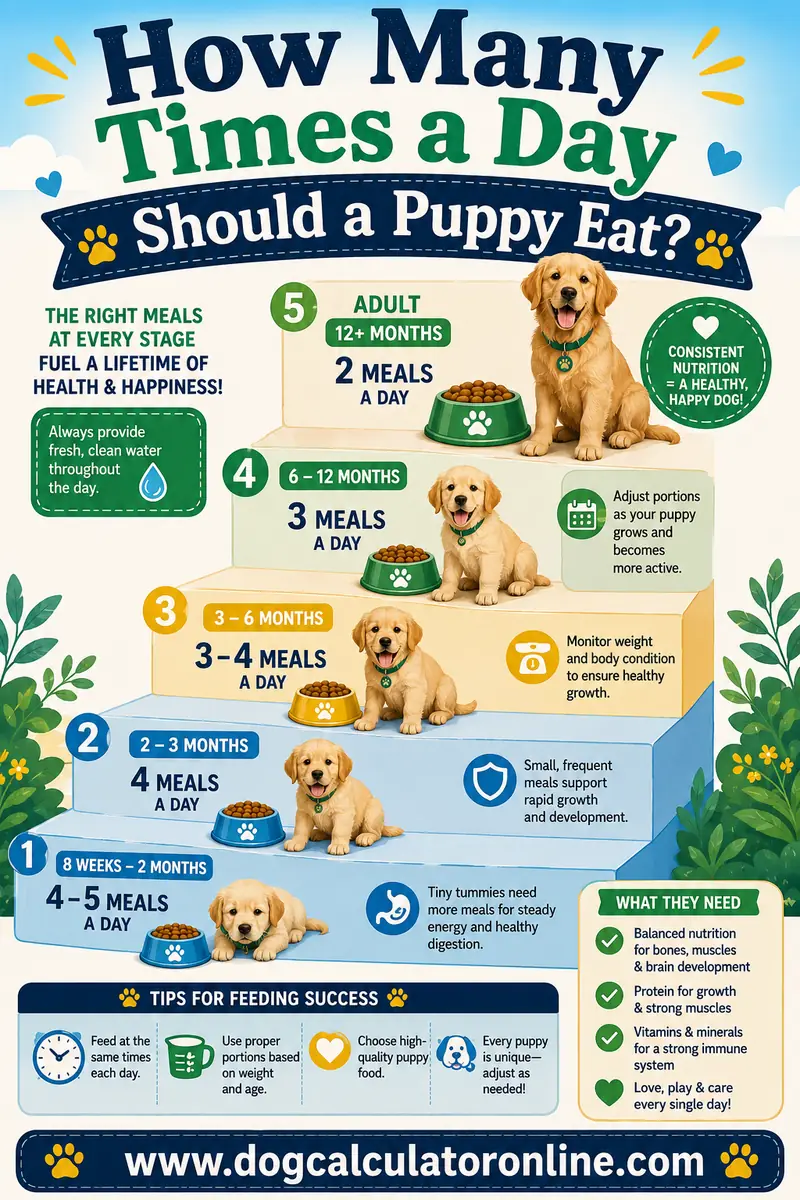
How Many Times a Day Should a Puppy Eat?
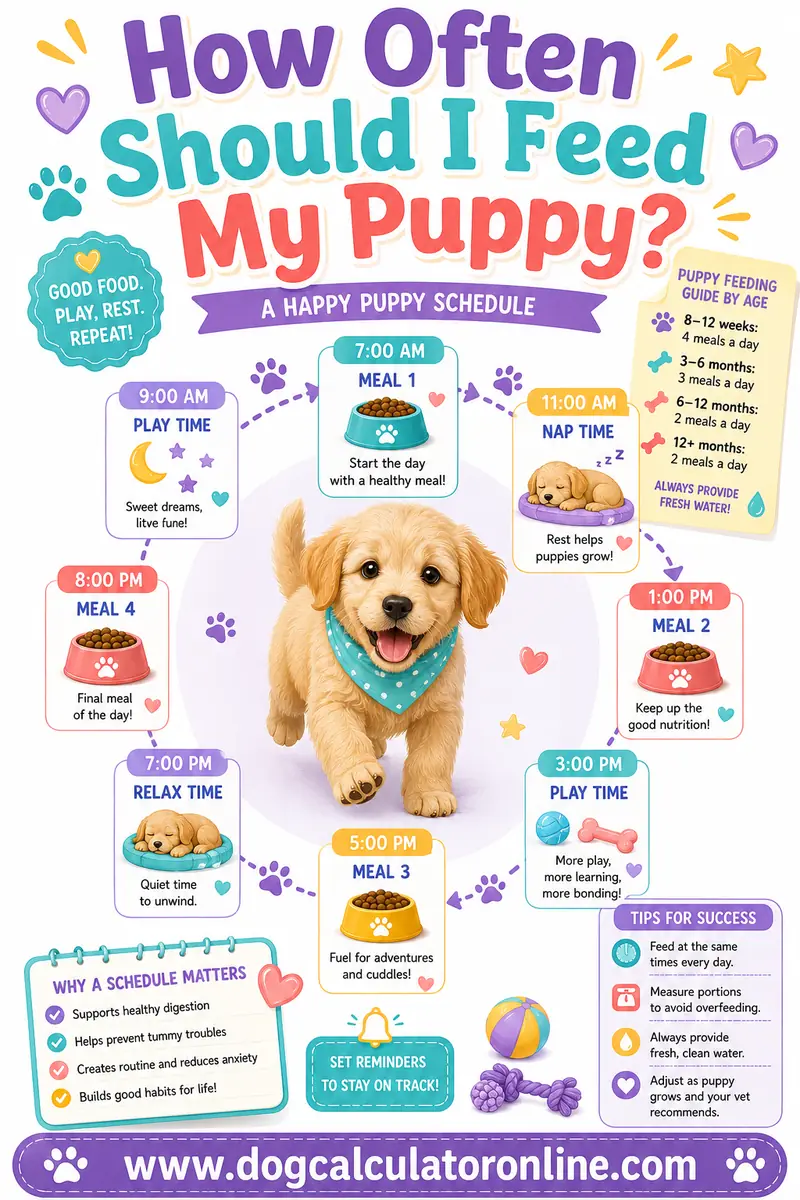
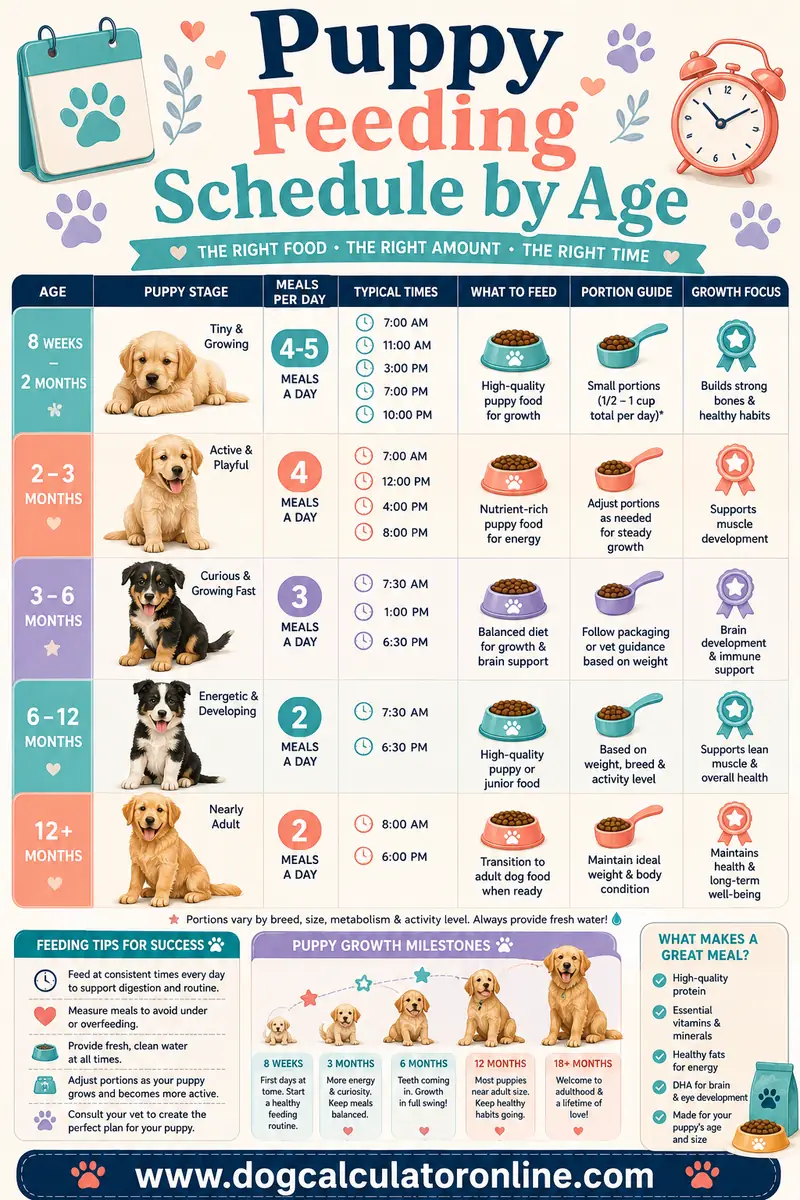
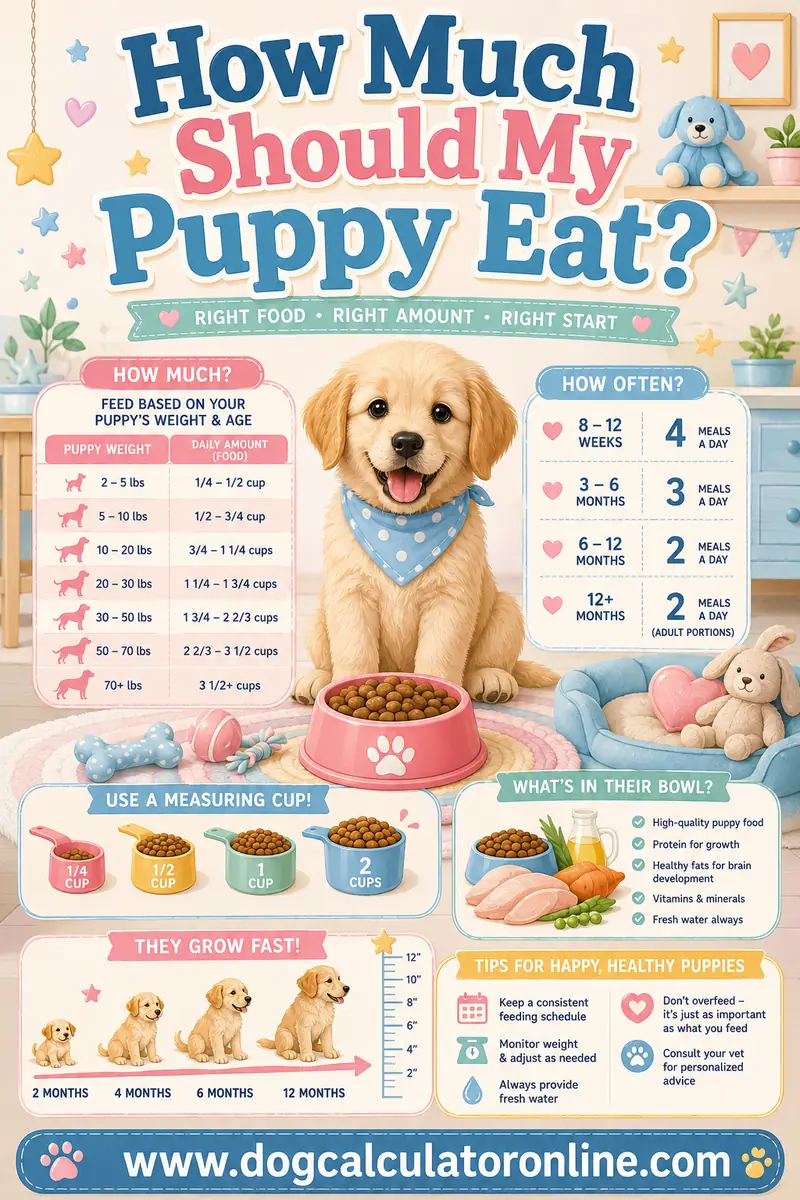
A puppy should eat four times a day from 6 to 12 weeks old, three times a day from 3 to 6 months, and twice a day from 6 months onward. Toy and small breeds often need the higher meal counts for longer — tiny puppies can develop low blood sugar between widely-spaced meals — while large-breed puppies sometimes manage on three meals slightly earlier.
The meal count divides a daily total, and that total is the number that really controls growth. The free dog food calculator estimates it from your puppy's weight and age. Below: the count by age, the per-meal portion math, breed-size differences, and what to do when your puppy skips or inhales a meal.
🍽️ Puppy meals-per-day counter
Tap your puppy’s age to see how many meals a day they need:
Tap an age above for the meal count.
The Answer at a Glance
| Puppy's age | Meals per day | Example times |
|---|---|---|
| 6–12 weeks | 4 | 7 am, 11 am, 3 pm, 7 pm |
| 3–6 months | 3 | 7 am, 12:30 pm, 6 pm |
| 6–12 months | 2 | 7 am, 6 pm |
| 12+ months | 2 | Adult schedule |
Adjust one notch by size: toy breeds (Chihuahuas, Yorkies, Maltese) tend to need four meals until about 4 months and three until at least 6 months. Large and giant breeds eating bigger volumes per sitting can often run three meals from 8–10 weeks without trouble.
The count exists to solve a physics problem: a young puppy needs roughly double an adult's calories per pound, but has a stomach the size of a walnut. More sittings is the only way the math fits.
From Meal Count to Meal Size
The meal count only means something once you know the daily total. The two-step:
- Get the daily amount from your food label's puppy chart or the dog food calculator.
- Divide by the meal count. That's it — the count is a divisor, not a multiplier.
Worked example: a 12-week-old, 10-lb puppy needs roughly 650 kcal a day. On a 400 kcal/cup puppy food, that's about 1⅔ cups daily. On four meals, each meal is a bit under ½ cup. The same puppy at 5 months on three meals eats slightly over ½ cup per meal — bigger meals, fewer of them, similar total.
The classic mistake is running this backwards: picking a "normal-looking" meal size and multiplying by four. Meal sizes that look sensible per-sitting routinely add up to 30–50% overfeeding across four sittings. Always start from the daily total; the amounts side of the equation is covered fully in how much to feed a puppy.
Why Not Just Two Big Meals From the Start?
Because three things go wrong, in escalating order of seriousness:
Soft stools and stomach upset. An immature digestive system fed half a day's food at once often can't keep up. Chronically soft stool in an otherwise healthy young puppy is frequently a per-meal-volume problem masquerading as a food-quality problem.
Hunger-gap misery. Long stretches between meals in a fast-metabolizing puppy produce frantic begging, scavenging, and sometimes empty-stomach bile vomiting — the yellow-foam special, usually before breakfast.
Hypoglycemia in small puppies. The serious one. Toy and small-breed puppies under about 12 weeks have minimal energy reserves; spacing meals too far apart can drop blood sugar to dangerous levels. Signs — weakness, wobbling, disorientation, collapse — mean an immediate vet call. Frequent meals are the everyday prevention, which is why four-a-day for young puppies is a safety rule, not a suggestion.
Stepping Down: 4 → 3 → 2
Each drop in meal count works the same way:
- Timing: around 12 weeks for 4→3, around 6 months for 3→2 — a soft range, not a birthday deadline.
- Method: shrink the disappearing meal gradually over 4–7 days, moving its food into the surviving meals. The daily total stays constant; only the split changes.
- Green lights: puppy sometimes leaves the midday meal unfinished, no urgency at mealtime, steady weight gain.
- Red lights: desperation before meals, vomiting bile in the gap, energy dips. Any of these = go back a stage for a week or two and try again.
There's no prize for consolidating early. A 7-month-old still eating three sensible meals is doing fine; a 3-month-old squeezed onto two big meals is the one to fix.
Meal Count Q&A for Real Life
The gulper. A puppy that inhales each meal in eight seconds isn't asking for fewer, bigger meals — quite the opposite. Slow-feeder bowls, food scattered on a tray, or part of the ration fed through training all stretch the experience without adding calories.
The grazer. A puppy that nibbles and walks away can tempt you into leaving the bowl down. Resist. Offer each meal for 15–20 minutes, then lift it; a healthy puppy learns the rhythm within days. Persistent disinterest in food is different — in a young puppy, refusing meals for a day warrants a same-day vet call.
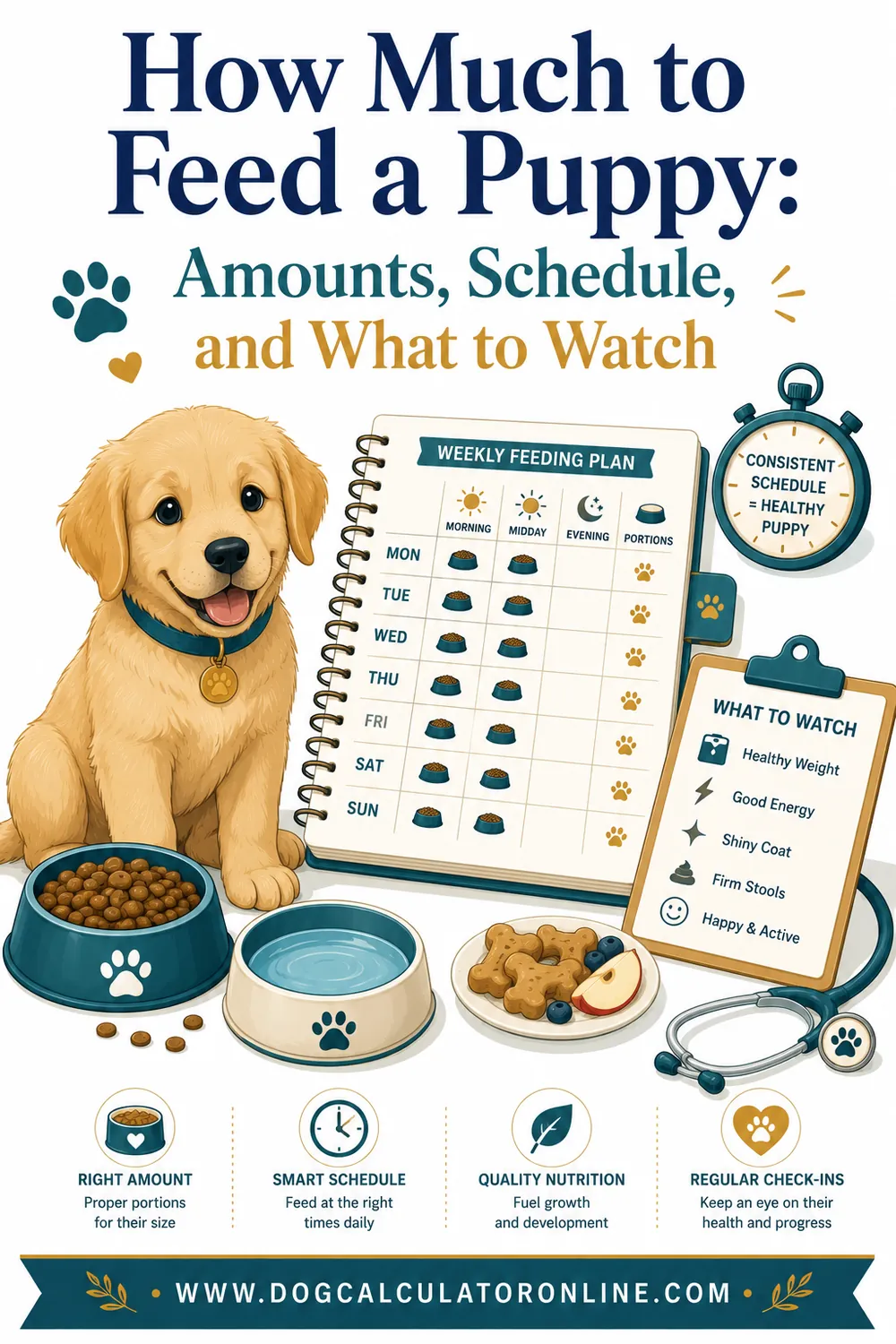
The workday gap. Three meals with a job is the hard stage. In order of preference: a midday visit (family, neighbor, walker), a timed automatic feeder with a measured portion, or — for larger-breed puppies handling volume well — an early/late three-meal spread. Full clock-time layouts are in the puppy feeding schedule by age.
Multiple puppies. Feed separately — different bowls, ideally different spots. Shared bowls hide who's eating what, and appetite is the single most useful health signal you have.
Treats between meals. Fine, and inevitable during training — but they count. Keep treats under about 10% of daily calories and subtract them mentally from the day's total, not add them on top.
When the Meal Count Isn't the Issue
Sometimes owners adjust frequency when the real problem is elsewhere. Signals that it's time to look past the schedule and call the vet:
- Refusing food for more than a meal or two (urgent in puppies under 12 weeks)
- Repeated vomiting or diarrhea regardless of meal size
- A pot-bellied look with prominent ribs — classic parasite presentation, common in puppies
- Weight stalling for two-plus weeks despite correct portions
- A toy breed showing weakness or wobbliness between meals — treat as an emergency
Meal frequency fixes distribution problems. It doesn't fix medical ones.
Meal Counts by Breed Size: The Full Timeline
The at-a-glance table works for the average puppy, but "average" hides a big spread. Here's how the stages tend to shift once adult size enters the picture:
| Adult size | 4 meals a day | 3 meals a day | 2 meals a day |
|---|---|---|---|
| Toy (under 10 lb) | 6 weeks – 4 months | 4 – 7 months | from ~7 months, gradually |
| Small (10–20 lb) | 6 – 12 weeks | 3 – 6 months | from ~6 months |
| Medium (20–50 lb) | 6 – 12 weeks | 3 – 6 months | from ~6 months |
| Large (50–100 lb) | 6 – 10 weeks | 10 weeks – 6 months | from 6 – 7 months |
| Giant (100+ lb) | 6 – 10 weeks | 10 weeks – 7 months | from ~7 months; some stay on 3 |
Two ends of the spectrum deserve a closer look. Toy breeds run out of fuel fastest — tiny bodies can't store much energy between meals — so hold each stage a little longer and only drop a meal once your puppy is clearly coasting. A Yorkie still on three meals at 8 months isn't behind; that's the schedule working.
Giant and deep-chested breeds have the opposite constraint. Their daily volume is enormous, and squeezing it into two sittings means genuinely huge meals — something many vets prefer to avoid in bloat-prone body types. Plenty of Great Dane owners keep three smaller meals a day for life, and that's a perfectly reasonable schedule as long as the daily total stays right; ask your vet if your breed is on the deep-chested list.
Does Wet, Raw, or Mixed Feeding Change the Count?
No — the meal count follows your puppy's age, not the food's format. A 10-week-old eats four times a day whether the bowl holds kibble, wet food, or a vet-approved fresh diet. A few format-specific wrinkles are worth knowing, though:
- Wet food can't wait. It spoils at room temperature, so the 15–20-minute bowl-down window matters even more. Refrigerate opened pouches and cans between meals, and expect a wet-fed puppy to finish faster — moisture and aroma do the selling for you.
- Raw and fresh diets use the same divisor. Work out the daily amount with your vet or the food maker's guidance, then split it by the age-appropriate meal count exactly as you would kibble.
- Mixed feeding needs one budget. Kibble plus a wet topper is two calorie sources in one bowl — check both labels and count everything toward the same daily figure. The topper isn't free; it's part of the meal.
FAQ
How many times a day should an 8-week-old puppy eat?
Four times a day, spaced across waking hours — for example 7 am, 11 am, 3 pm, and 7 pm. Large-breed puppies can usually do three.
How many times a day should a 4-month-old puppy eat?
Three times a day. Most puppies hold three meals from about 12 weeks until roughly 6 months, then step down to two.
When should a puppy go to 2 meals a day?
Around 6 months for most breeds — later for toy breeds. Make the change gradually over a week and keep the total daily amount unchanged.
Is 2 meals a day enough for a 3-month-old puppy?
Not ideal — at that age the standard is three to four meals. Two large meals per day at 12 weeks raises the odds of digestive upset and long hungry gaps, especially in smaller breeds.
Can a puppy eat 5 or more times a day?
Very young (6–8 weeks) or very tiny puppies sometimes do, and that's fine if the daily total is right. Past 12 weeks, more than four scheduled meals is usually unnecessary — just make sure extra sittings aren't quietly inflating the total.
Do puppy meals need to be evenly spaced?
Roughly, yes — the point of multiple meals is avoiding long empty stretches, so spread them across waking hours. Perfect symmetry isn't required; a 7 am / 11 am / 3 pm / 7 pm day beats a morning pile-up followed by a ten-hour gap. The overnight stretch is fine because your puppy sleeps through it.
Does the number of meals change how much a puppy eats overall?
It shouldn't. The daily amount is set by your puppy's weight, age, and food; the meal count just divides it. Get the daily figure from the dog food calculator first, then split.
The Bottom Line
Four meals a day at 6–12 weeks, three from 3–6 months, two from 6 months on — shift one stage later for toy breeds, and never change the count without keeping the daily total steady. The count is the divisor; the total is the answer.
Get that total in seconds with the free dog food calculator, and see how often to feed a puppy for the scheduling side — times, transitions, and workday workarounds.