How Often Should I Feed My Puppy?
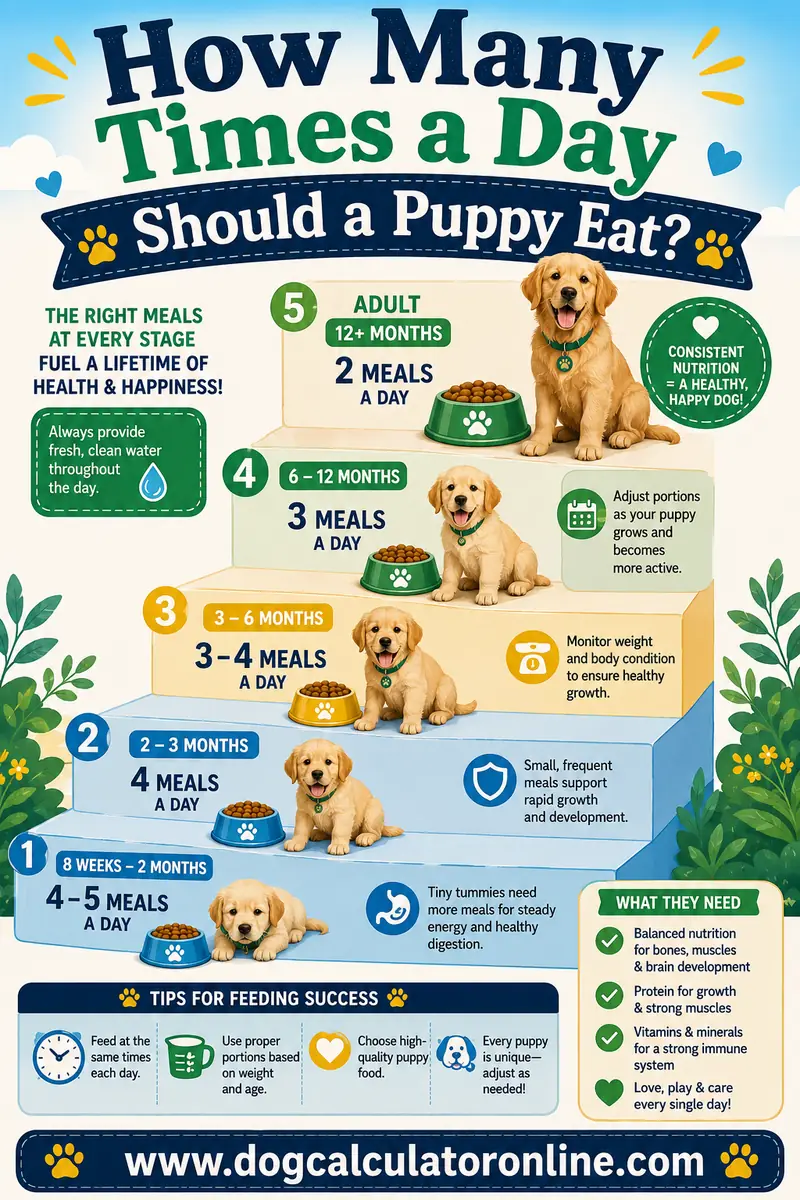
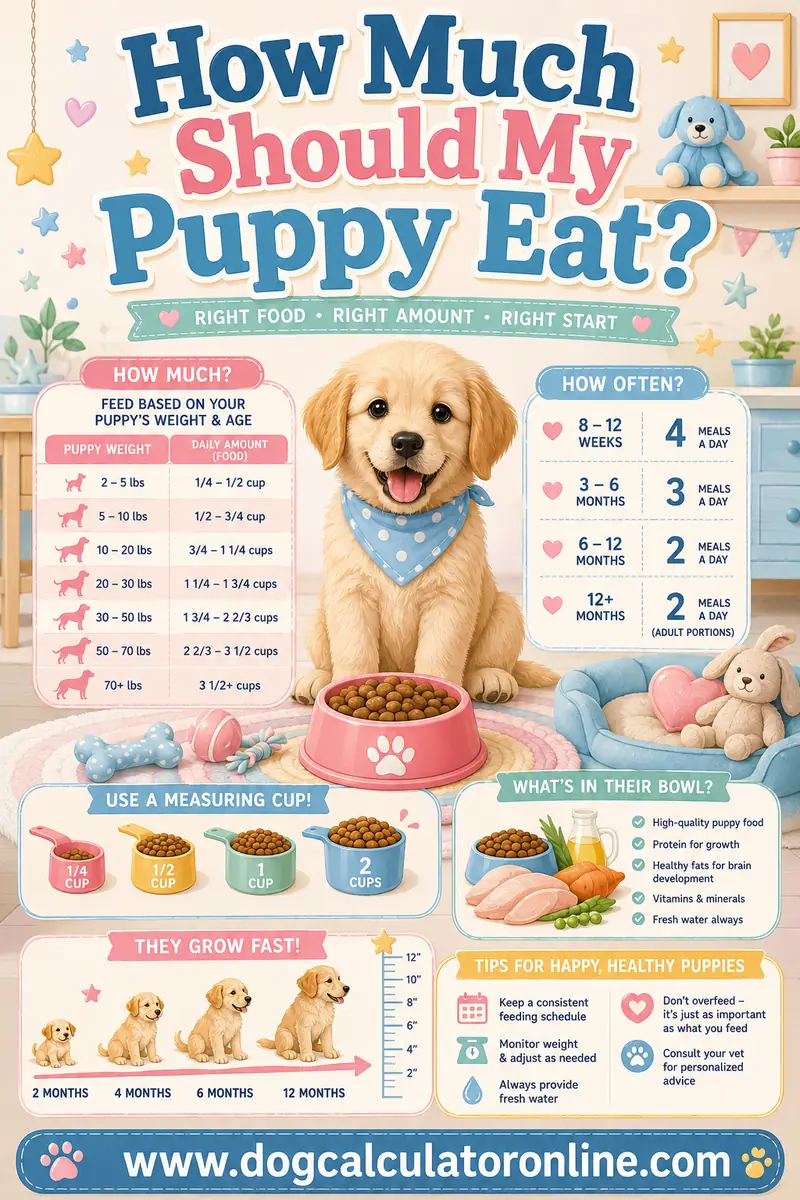
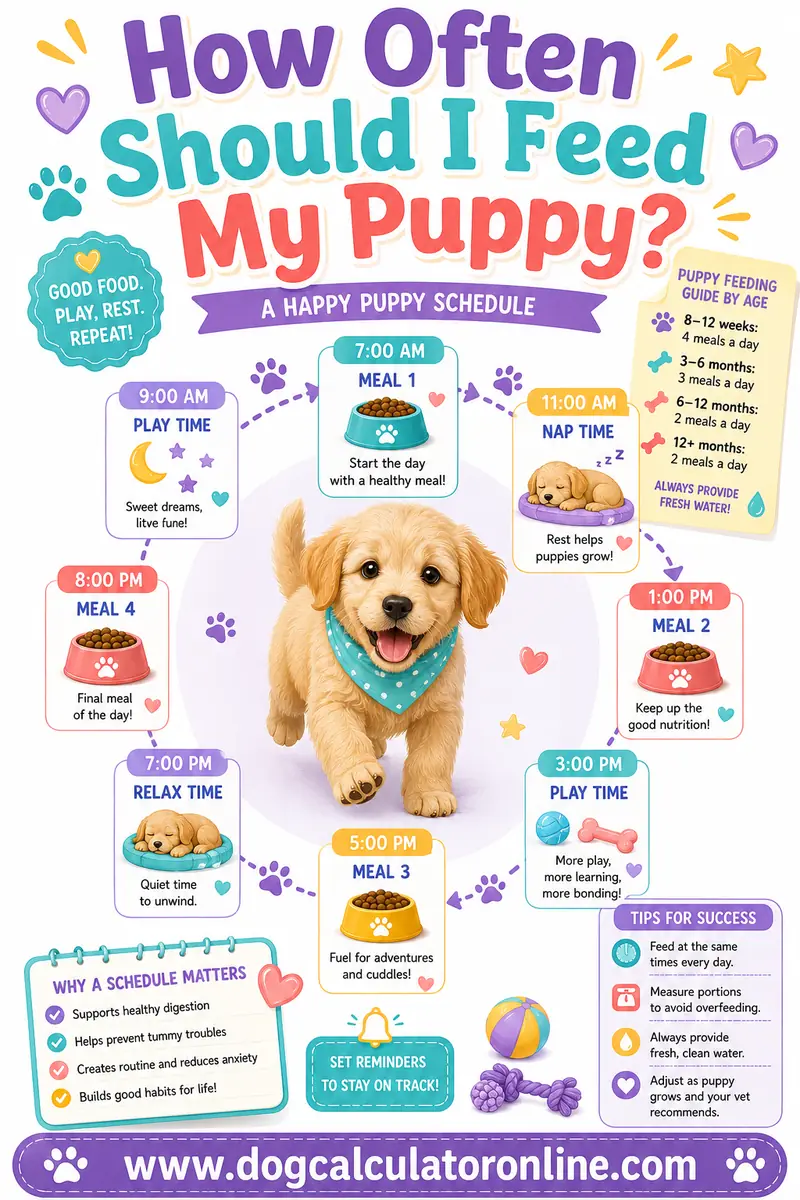
Feed a puppy four meals a day from 6 to 12 weeks, three meals a day from 3 to 6 months, and two meals a day from 6 months onward. Toy-breed puppies often need the more frequent end of that range for longer, because tiny puppies can develop low blood sugar if meals are spaced too far apart.
Frequency is one half of puppy feeding; the amount per meal is the other. The free dog food calculator gives you your puppy's daily total so you can split it cleanly across meals. Here's the full frequency timeline, example clock schedules, and how to handle the transitions between stages.
⏰ Puppy meal frequency by age
Tap your puppy’s age:
Tap an age above for the recommended frequency.
The Puppy Feeding Frequency Timeline
| Age | Meals per day | Notes |
|---|---|---|
| Under 6 weeks | Nursing / weaning | With mother; breeder or vet guides weaning |
| 6–12 weeks | 4 | Small stomach, huge needs; 3 acceptable for large breeds |
| 3–6 months | 3 | The classic breakfast–lunch–dinner stage |
| 6–12 months | 2 | Adult rhythm begins |
| 12+ months | 2 | Standard adult schedule |
The pattern behind the table: a puppy's calorie needs per pound are roughly double an adult's, but its stomach is proportionally tiny. Early on, the day's food physically can't fit in two sittings — so it goes in four. As the stomach grows and growth slows, meals consolidate.
These are guidelines with soft edges, not cliffs. A 13-week-old on four meals isn't a problem, and a large-breed 11-week-old doing fine on three isn't either. What you're managing is the direction of travel.
Why Young Puppies Can't Skip Meals
Three reasons frequency genuinely matters in the early weeks:
Blood sugar. Puppies — especially toy and small breeds under about 12 weeks — have limited glycogen reserves. Long gaps between meals can cause hypoglycemia: weakness, wobbly gait, glassy eyes, and in severe cases collapse or seizures. This is an emergency-vet situation, and frequent meals are the everyday prevention. It's the single strongest argument against stretching a young puppy's schedule for convenience.
Digestion. An immature GI tract handles small, regular volumes far better than big boluses. Puppies fed too much per sitting commonly produce soft stools — often misread as a food problem when it's a portion-per-meal problem.
House-training. Food in on a schedule means poop out on a schedule. Puppies typically need to eliminate shortly after eating, so predictable meals are the backbone of predictable potty breaks. Free-fed puppies are notoriously hard to house-train because there's no rhythm to anticipate.
Example Schedules by Stage
Anchor times to your own routine — the spacing matters more than the specific hours.
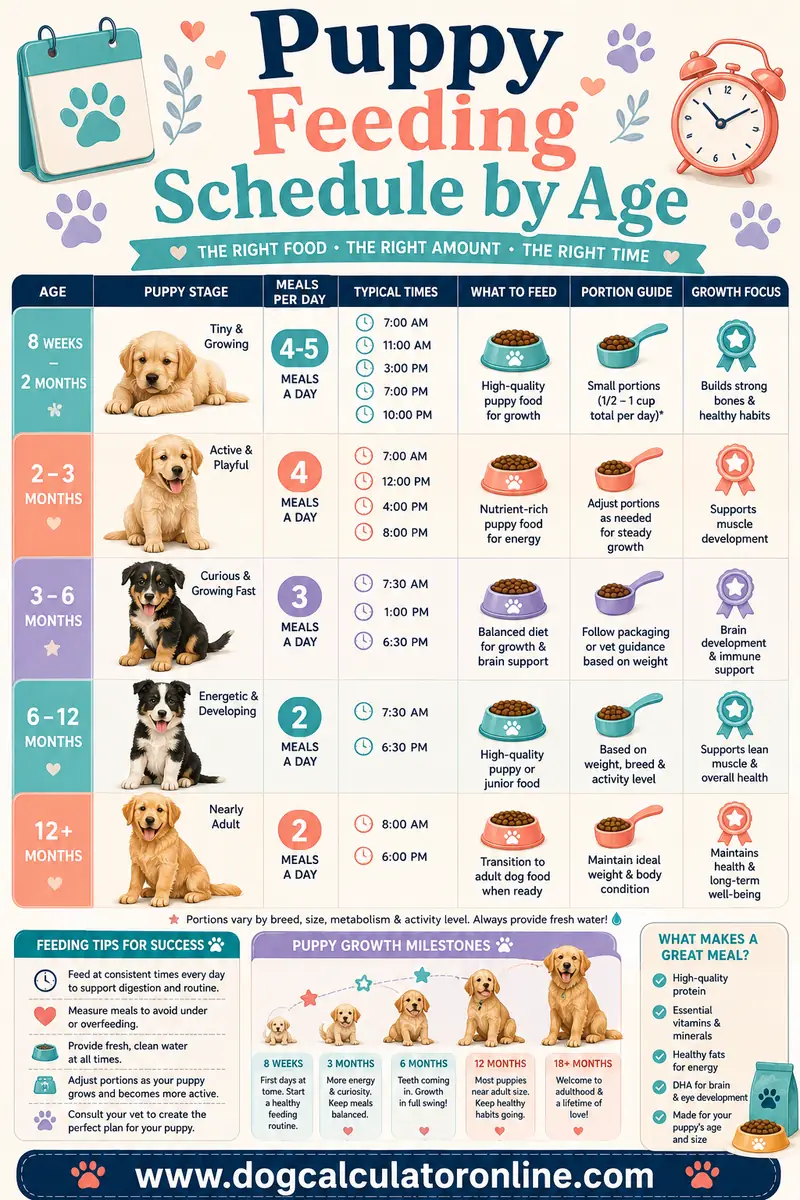
8–12 weeks (4 meals):
- 7:00 am — breakfast (then straight to potty spot)
- 11:00 am — lunch
- 3:00 pm — afternoon meal
- 7:00 pm — dinner
Keeping the last meal ~2–3 hours before bedtime, with a final potty trip after, buys you a quieter night. Don't feed later just to "fill them up" for sleeping — it mostly fills the 2 am potty break instead.
3–6 months (3 meals):
- 7:00 am — breakfast
- 12:30 pm — lunch
- 6:00 pm — dinner
If midday is impossible on workdays, options in rough order of preference: a lunch visit from a family member or dog walker, a timed automatic feeder with a measured portion, or shifting to an early-and-late 3-meal spread on a large-breed puppy who's handling volume well. What to avoid: leaving a full bowl out all day, which trades your schedule (and house-training rhythm) for grazing.
6+ months (2 meals):
- 7:00 am — breakfast
- 6:00 pm — dinner
This is the schedule most dogs keep for life. The full clock-time playbook, including potty timing, is in our puppy feeding schedule by age.
How to Transition Between Stages
Dropping a meal isn't a switch — it's a slide. When moving from four meals to three (or three to two):
- Shrink the outgoing meal over several days rather than deleting it cold. Take the meal you're cutting and reduce it by a third every couple of days, redistributing that food into the remaining meals.
- Keep the daily total right. Dropping a meal never means dropping the food — the same daily amount just gets divided into fewer, bigger portions. Re-run the dog food calculator at each stage change, since your puppy's weight has usually jumped since you last checked.
- Watch the signals. Ready to consolidate: puppy sometimes leaves food, eats the midday meal without urgency. Not ready: frantic hunger before the next meal, midday nausea (empty-stomach bile vomiting), energy dips. If dropping a meal produces those, add it back for another week or two.
Toy breeds get a slower version of everything above — many stay on three meals until 6 months or beyond, and some very small adults eat three small meals for life.
Frequency Mistakes Puppy Owners Make
- Free feeding for convenience. Grazing hides appetite changes (your earliest illness signal), wrecks potty predictability, and overfeeds most puppies. Measured meals, 15–20 minutes down, then the bowl comes up.
- Cutting to two meals too early. A 3-month-old on two meals is getting too much per sitting and too long between refuels. Hold three meals until around 6 months.
- Adding food when adding a meal is needed. If a young puppy seems hungry, the fix is usually distribution (or a genuine portion recheck) — not free extra scoops. Weigh, recalculate, then adjust.
- Skipping the midday meal on workdays only. Inconsistency is its own problem; a puppy fed three meals on weekends and two on weekdays lives in permanent schedule confusion. Pick a plan you can run seven days a week.
- Late-night feeding. The last meal 2–3 hours before bed, then a final potty trip. Your 3 am self will thank you.
When Frequency Is a Vet Question
Most frequency decisions are routine, but call your vet when:
- A toy-breed puppy shows weakness, wobbliness, or lethargy between meals — possible hypoglycemia, treat as urgent.
- A puppy refuses more than one meal. Adult dogs can shrug off a skipped meal; in a young puppy, refusing food for a day is a same-day vet call.
- Vomiting or diarrhea keeps recurring around meals — could be portion size, could be more.
- You have a large or giant breed and want a growth plan — feeding frequency, food choice, and growth rate all interact with joint development, and a vet can tailor the plan.
The First Week Home: Start With Their Schedule, Not Yours
If your puppy is newly arrived, there's a step before building your ideal schedule: find out what the breeder, shelter, or foster was doing and copy it for the first several days. Same food, same number of meals, times as close to theirs as you can manage. A puppy adjusting to a new home, new smells, and a first night without littermates doesn't need a new digestive routine on top of it — abrupt food or schedule changes in week one are the classic recipe for soft stools and a worried owner.
From about day four or five, start sliding meal times toward your own routine in 30–60 minute steps, and if you're changing foods, mix the new in gradually over a week or so. By the second week you're running your schedule with your food, and the puppy never noticed the handover. One more first-week tip: appetite dips slightly in some puppies during the initial adjustment, but a young puppy refusing food outright still gets the same-day vet call — homesickness is never the assumption you settle on.
Where Water Fits Into the Feeding Schedule
Meals are scheduled; water mostly shouldn't be. Fresh water stays available throughout the day, every day — puppies drink more per pound than adults, and even more on hot days, active days, and dry-kibble diets.
The one nuance owners ask about: during house-training, many trainers suggest picking up the water bowl an hour or so before bedtime (after the final potty trip) to help the overnight dry streak. It's a reasonable short-term tactic for healthy puppies, but it isn't for every dog — and any puppy who seems to drink constantly or is suddenly emptying the bowl should see a vet rather than have water restricted. When in doubt, leave the water down and ask at the next checkup.
FAQ
How often should I feed my 8-week-old puppy?
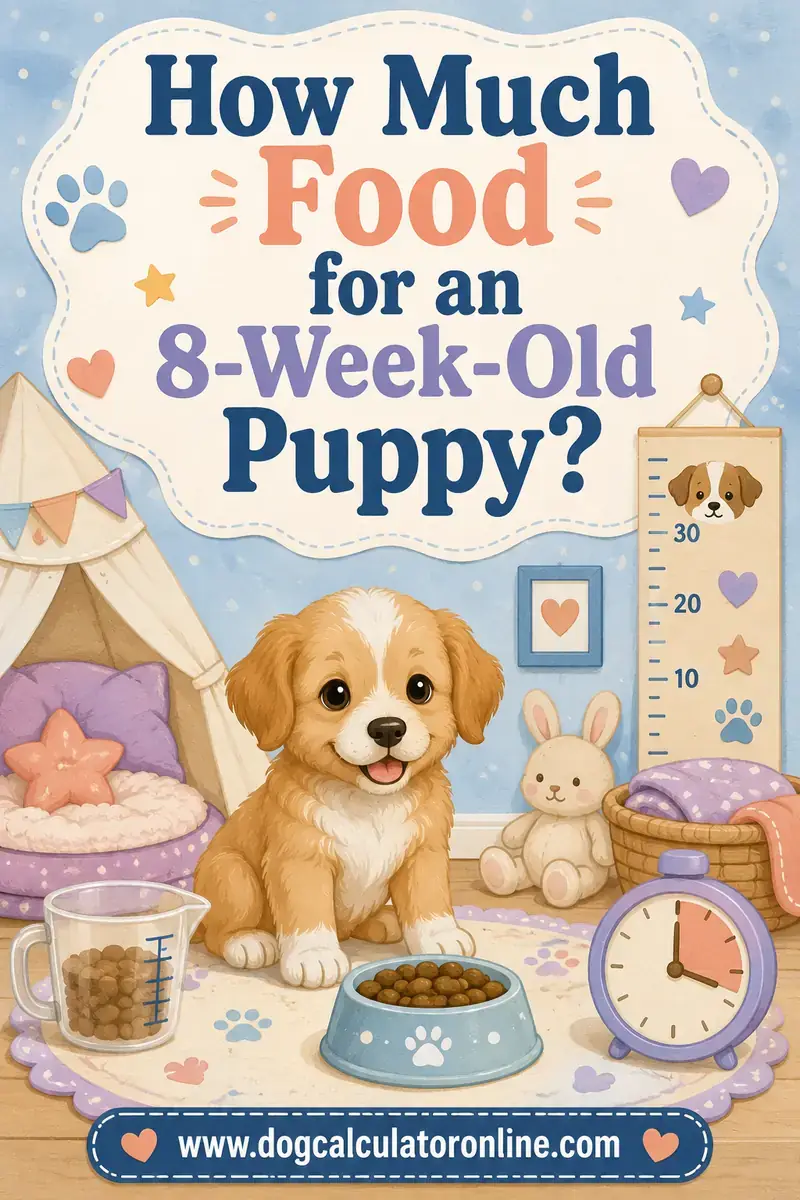
Four meals a day, evenly spaced across waking hours — for example 7 am, 11 am, 3 pm, and 7 pm. Large-breed puppies can do three. See how much food for an 8-week-old puppy for the amounts side.
When can my puppy go from 3 meals to 2?
Around 6 months for most puppies. Transition gradually over a week, keep the daily total the same, and delay if your puppy shows hunger-nausea or energy dips between meals.
Can I feed my puppy twice a day at 3 months?
It's earlier than ideal — at 3 months, three meals is the standard. If your schedule truly can't support midday, talk through options (auto-feeder, walker) rather than defaulting to two large meals.
Should I leave food out for my puppy all day?
No. Free feeding overfeeds most puppies, hides appetite loss, and makes house-training harder because potty times stop being predictable. Scheduled meals win on every count.
How long can a puppy go between meals?
During the day at 8–12 weeks, aim for no more than 4–5 waking hours between meals — shorter for toy breeds. Overnight is different: sleeping puppies handle the longer gap fine after about 8 weeks.
Why does meal frequency matter more for small puppies?
Small bodies store less fuel. Toy and small-breed puppies can develop dangerous low blood sugar between widely-spaced meals, so frequent small meals aren't a preference — they're a safety measure.
The Bottom Line
Four meals a day until about 12 weeks, three until about 6 months, then the adult two — with toy breeds running one stage more frequent, and every transition made gradually. Pair the right frequency with the right daily amount, and puppy feeding stops being guesswork.
Get that daily amount for your puppy's current weight with the free dog food calculator, then split it per the schedule above. For the amounts side of the equation, see how much your puppy should eat.