How Long Can a Puppy Hold Its Bladder?
The working rule is the puppy's age in months, plus one, in hours — so a two-month-old manages about three hours, a four-month-old about five. That's the maximum under good conditions, not a target, and during the day you'll be going out far more often than that. Puppies have small bladders and limited muscular control, and both develop with age rather than with training; no amount of consistency makes an eight-week-old physically capable of holding on all night. This page covers the timings, a realistic toilet schedule, what to expect overnight, and when accidents point to something medical. Growth and bladder capacity develop together, so the puppy weight calculator is a useful companion.
How Long Can They Hold It by Age?
| Age | Maximum hold | Daytime breaks while awake | Overnight |
|---|---|---|---|
| 8 weeks | 2–3 hrs | Every 30–60 min | 1–2 breaks |
| 10 weeks | 3 hrs | Every 45–60 min | 1–2 breaks |
| 12 weeks | 4 hrs | Every 1–2 hrs | Often 1 break |
| 16 weeks | 5 hrs | Every 2–3 hrs | Usually through |
| 5 months | 6 hrs | Every 3 hrs | Through |
| 6 months | 7 hrs | Every 3–4 hrs | Through |
| Adult | 6–8 hrs (working max) | Every 4–6 hrs | Through |
Two things to note. The maximum isn't the schedule — a twelve-week-old can hold on for four hours in a pinch, and should still be going out every hour or two while awake, because opportunities to succeed are what build the habit.
And the rule breaks down at both ends. Very young puppies often can't manage even the two hours the formula suggests, and by six or seven months you're already at adult capacity — an eight-month-old doesn't hold on for nine hours.
Small breeds need more frequent trips than the chart implies, simply because a smaller bladder holds less. A Chihuahua puppy needs more trips than a Labrador puppy of the same age.
What Does a Toilet Schedule Look Like?
Timing is far more important than the total number. There are moments when a puppy will almost certainly need to go, and catching those is most of house training.
Always go out:
- First thing in the morning, immediately — before anything else
- After every meal, within 10 to 30 minutes
- After every nap, straight away
- After play or excitement
- Before bed, as the last thing you do
- Every 30–60 minutes while awake for a young puppy
Watch for the signals: circling, sniffing the floor intently, sudden restlessness, whining, heading toward a door or a spot they've used before, or squatting. When you see any of those, go immediately rather than finishing what you were doing.
Make each trip work:
- Same spot every time — the scent is a strong prompt
- Go out with them rather than sending them out
- Stay boring until they've been; play afterwards, not before
- Praise and treat the instant they finish, outside. Rewarding indoors afterwards teaches nothing
- If nothing happens in five minutes, go back in and try again in ten
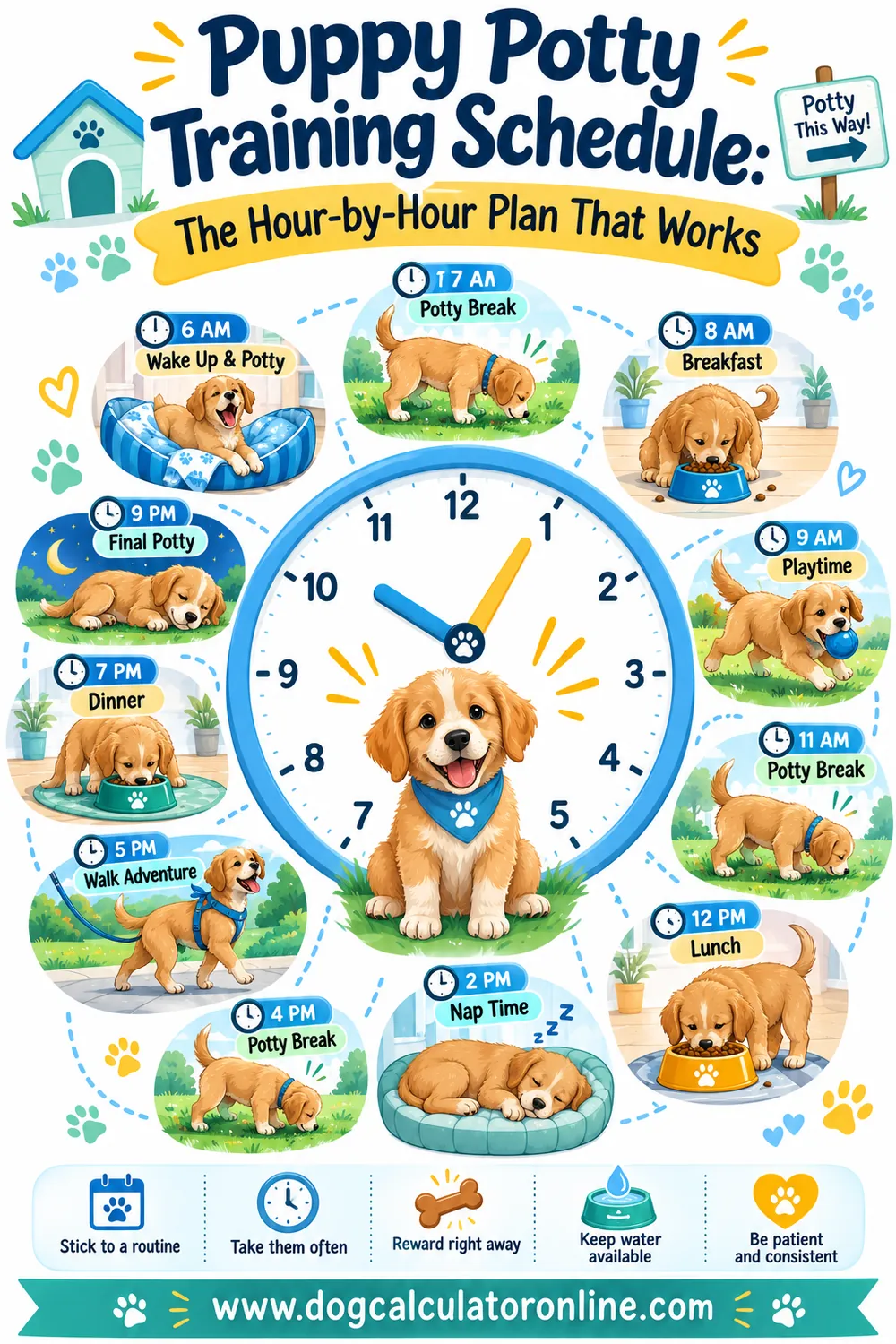
A fuller version of this, with the daily structure, is in the puppy potty training schedule.
What About Overnight?
Night-time is where owners struggle most, and where realistic expectations help enormously.
What to expect: one or two breaks a night at eight to ten weeks, usually one by twelve weeks, and most puppies sleeping through somewhere between twelve and sixteen weeks.
Why puppies last longer at night than the daytime figures suggest: they're asleep, still, and not drinking. A ten-week-old that needs a break every hour during the day may manage four or five hours overnight.
What helps:
- Final toilet trip immediately before bed, not an hour before
- Remove water an hour or two before bedtime — though not in hot weather, and not if your vet has advised otherwise
- Crate in your bedroom, so you hear the stirring before it becomes an accident, and so the puppy settles better
- Set an alarm for the first week or two rather than waiting to be woken. Pre-empting is easier than reacting
- Keep night trips silent and boring. Out, toilet, back in. No talking, no lights, no play — otherwise 3am becomes social hour
- Move the alarm later by 15 minutes every few nights as they improve
Don't punish a night accident. A puppy that can't hold on physically hasn't done anything wrong, and it will simply learn to hide where it goes. Crate sizing matters here too — a crate large enough to sleep at one end and toilet at the other undermines the whole thing, which is covered in how to crate train a puppy.
Why Do Accidents Happen?
Almost always one of these, and none of them is defiance.
Left too long. The most common cause, and the easiest to fix.
Missed signals. Puppies give very little warning, and it's easy to be looking the other way.
Excitement or submissive urination. Some puppies leak when thrilled or when greeting people. Keep greetings low-key and ignore it — telling a puppy off for this makes it considerably worse, since it's an anxiety response rather than a choice.
Scent. Any spot that hasn't been cleaned with an enzymatic cleaner still smells like a toilet to a puppy, even when it smells clean to you. Never use ammonia-based products — ammonia smells like urine and actively marks the spot.
Too much freedom too soon. A puppy with the run of the house will find a quiet corner. Restricting access to one or two rooms until house training is solid prevents most of it.
Regression around four to six months. Common during adolescence, and usually temporary. Go back to a stricter schedule for two weeks rather than assuming failure.
Changes in routine. A house move, a new person, a different schedule — stress affects house training more than most owners expect, and a settled puppy can wobble for a week after something unremarkable like a change in working hours.
What not to do: rubbing a puppy's nose in it, telling them off after the event, or punishing at all. Puppies can't connect a telling-off to something they did minutes ago; all they learn is that you're unpredictable, and that toileting near you is dangerous — which produces a dog that goes behind the sofa instead. Clean it up without comment, and adjust the schedule.
How Do You Manage a Working Day?
The practical problem behind this whole page: a puppy's bladder and a full-time job don't fit together, and it's better to plan for that than discover it in week two.
The honest arithmetic. A ten-week-old puppy can hold on for about three hours. A standard working day is eight or nine with commuting. There's no schedule or training method that closes that gap — the capacity simply isn't there yet.
What actually works:
- Take time off at the start. A week or two at home covers the hardest stretch, when trips are hourly
- A midday visitor — a neighbor, family member, or paid walker — breaking the day into manageable halves. For a young puppy you may need two visits, not one
- Puppy daycare, from around 12 to 16 weeks and once vaccinations allow. Expensive but effective, and it covers socialization too
- Staggered household hours, if two people can start and finish at different times
- Working from home on some days, even partially
Indoor toileting as a stopgap. Puppy pads or a grass patch in a pen mean accidents happen somewhere predictable rather than on the carpet. The trade-off is real: pads teach that indoors is an acceptable place to go, and most puppies then need a second transition to outdoors. Useful for flats, high floors, or unavoidable long days — not the default if you can go straight outside.
Set up a safe space rather than shutting a puppy in a crate for hours. A pen with a bed at one end, water, a chew and a toileting area at the other is far more humane than a crate that's either too small to move in or big enough to soil.
A realistic timeline for leaving them. One to two hours at eight to ten weeks, two to three at three months, three to four at four months, and up to four or five by six months — with a walk or company built into anything longer.
When Should You See a Vet?
Most accidents are training and timing. A few aren't.
Book an appointment for:
- A sudden regression in a previously reliable puppy
- Straining, or frequent small amounts — a classic urinary tract infection picture
- Blood in the urine
- Excessive drinking alongside excessive urinating
- Dribbling while asleep or lying down, which can indicate an anatomical problem
- Signs of pain when passing urine
- No urination at all for an extended period — this one is an emergency
Urinary tract infections are common in puppies, particularly females, and they respond quickly to treatment. It's a cheap consultation that saves weeks of frustrating and unnecessary "training".
Other possibilities your vet will consider include an ectopic ureter or other congenital abnormality, bladder stones, and in older dogs, diabetes or kidney disease.
The general principle is worth remembering beyond puppyhood: a housetrained animal that starts having accidents is telling you something, and the first stop is a vet rather than a trainer. Adult limits are covered in how long can a dog stay in a crate, and how sleep interacts with all of this is in puppy sleep schedule by age. Once your puppy is cleared for walks, outdoor trips become part of the routine too — timings for that are in when can puppies go outside.
Frequently Asked Questions
How long can a puppy hold its bladder?
Roughly their age in months plus one, in hours — about three hours at two months, five at four months. That's a maximum under good conditions, not a schedule. While awake, young puppies need a toilet trip every 30 to 60 minutes.
How long can a puppy hold it overnight?
Longer than the daytime figures suggest, because they're asleep and not drinking. Expect one or two breaks a night at eight to ten weeks, usually one at twelve weeks, and most sleeping through by twelve to sixteen weeks.
How often should I take my puppy out?
Every 30 to 60 minutes while awake for a young puppy, plus immediately after every meal, nap, play session, first thing in the morning and last thing at night. Frequent opportunities to get it right are what build the habit.
Why is my puppy suddenly having accidents again?
Common causes are adolescence around four to six months, a change in routine, spots not cleaned with enzymatic cleaner, or too much household freedom. A sudden regression in a previously reliable puppy also warrants a vet check for a urinary tract infection.
Should I punish my puppy for accidents?
No. Puppies can't connect a telling-off to something they did minutes earlier, and punishment teaches them to hide where they go rather than to hold on. Clean up with an enzymatic cleaner, adjust the schedule, and reward successes outside.
Can I leave my puppy alone all day?
No. A young puppy can't hold on for a working day, and beyond the bladder issue, long isolation causes real distress. Arrange a midday visit, a walker or daycare — this is one of the practical realities of getting a puppy rather than an adult dog.
One final reassurance, because house training feels endless while you're in it: most puppies are broadly reliable by four to six months, and the intensive phase — hourly trips, broken nights, accidents on the rug — lasts weeks rather than months. Progress is rarely smooth, and a bad week after two good ones is normal rather than a sign that anything has gone wrong.
The point worth holding onto is that bladder control is physical development, not obedience. Work to the age formula, go out far more often than the maximum, reward every success outside, and treat a sudden regression as a medical question first. Track how your puppy is developing overall with the puppy weight calculator.