How Long Can a Dog Stay in a Crate?
The working rule for puppies is one hour per month of age, up to a maximum of around four to five hours — so a three-month-old puppy can manage roughly three hours during the day. Healthy adult dogs can generally cope with four to six hours, and eight should be treated as an absolute ceiling rather than a routine. Overnight is different, because dogs sleep through it much as we do. If your working day is longer than these limits, that's a solvable problem rather than a reason to feel guilty — and the crate size calculator makes sure the crate itself isn't adding to the discomfort.

What Are the Limits by Age?
| Age | Daytime maximum | Overnight |
|---|---|---|
| 8–10 weeks | 30–60 minutes | 2–3 hrs, then a toilet break |
| 11–14 weeks | 1–3 hours | 3–4 hrs, then a break |
| 15–16 weeks | 3–4 hours | 4–6 hrs |
| 4–6 months | 3–4 hours | 6–7 hrs |
| 6–12 months | 4–5 hours | 7–8 hrs |
| Adult (1–7 yrs) | 4–6 hours, 8 absolute max | 8 hrs |
| Senior (8+ yrs) | 2–4 hours | 6–8 hrs, often needs a break |
Two things to read carefully in that table.
Daytime and overnight are genuinely different. A dog asleep for eight hours isn't enduring eight hours of confinement — it's sleeping, which it would do anyway. The same eight hours while awake and alone is a much bigger ask.
Seniors go backwards. Older dogs often need more frequent toilet breaks than a healthy adult, and stiff joints make long periods lying in one position uncomfortable. A twelve-year-old may need what a six-month-old needs.
What Is the One-Hour-Per-Month Rule?
The most useful shorthand in puppy raising: a puppy can hold its bladder for roughly one hour per month of age.
So a two-month-old manages about two hours, a four-month-old about four. It's a rule of thumb rather than a guarantee, and it caps out — no puppy should be crated more than four or five hours during the day regardless of what the arithmetic says.
Why it works: bladder control develops with physical maturity, and the muscles simply aren't developed enough in a young puppy to do more.
The important part is what happens when you exceed it. A puppy who cannot hold on will soil the crate — not from naughtiness but from necessity. And once that happens, two things go wrong at once. The natural instinct not to soil the sleeping area weakens, which sets house training back considerably. And the crate becomes associated with distress rather than safety.
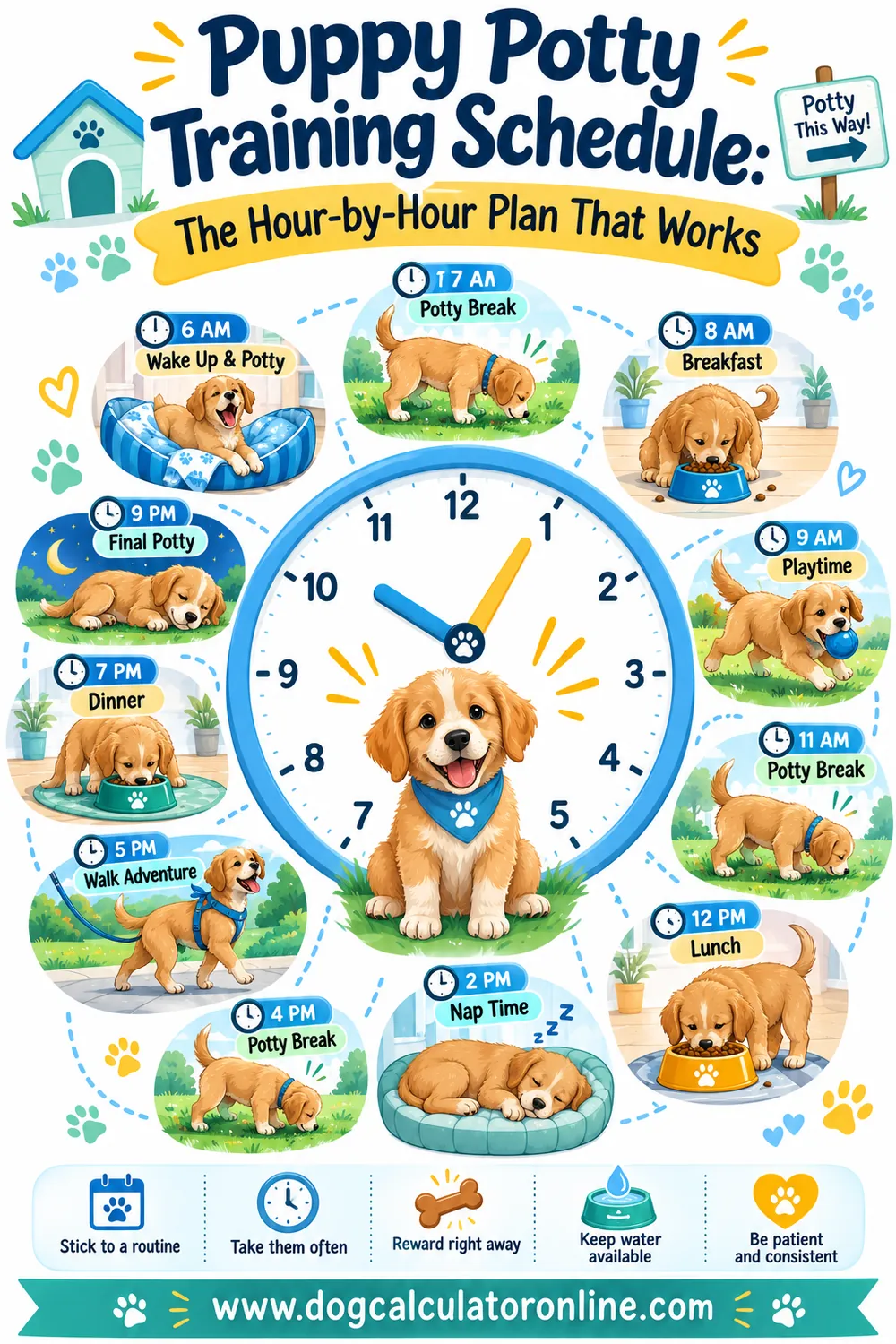
That's why the limit matters more than it might seem. It's not about strictness; it's about not asking your puppy to fail. Routine guidance is in the puppy potty training schedule.
What About Overnight?
More generous, because sleep changes the picture.
Most puppies can manage a longer stretch at night than during the day, because they're not awake and needing to move. But young puppies still need a toilet break in the small hours — expect one for the first few weeks, sometimes two for a very young puppy.
Practical points:
- Put the crate in your bedroom initially. It resolves most night crying and lets you hear when your puppy genuinely needs out.
- Keep night breaks boring. Outside, toilet, quiet praise, back in. No play, no chat, no lights on. Anything more interesting teaches them that waking you is worthwhile.
- Last toilet trip immediately before bed, and lift the water bowl an hour beforehand — though never restrict water during the day.
- Expect it to shorten quickly. Most puppies sleep through the night by around four months.
If your adult dog is suddenly needing overnight breaks when they didn't before, that's a vet conversation rather than a training one — increased frequency can signal a urinary or medical issue.
What Happens If a Dog Is Crated Too Long?
Real consequences, and worth being straightforward about.
Physical. Being unable to stretch, walk or change position properly causes stiffness and muscle weakness. Holding urine for too long is uncomfortable and can contribute to urinary problems. Puppies especially need movement for normal development.
Toilet training damage. Covered above, and it's the most common practical harm.
Behavioral. A dog with too little stimulation and too much confinement may develop repetitive behaviors, excessive barking, destructiveness when released, or difficulty settling generally. Crating doesn't cause these on its own, but prolonged confinement without enough exercise and company can.
The association breaks. The whole point of crate training is a dog who finds the crate safe. Overuse turns it into somewhere they endure, and once that shifts it takes real work to rebuild.
None of this happens from one long day when something ran over. It comes from a pattern. If crating for eight hours is your normal weekday, that's the thing worth changing rather than any individual day.
What If Your Workday Is Longer?
Very common, entirely solvable, and worth saying plainly: needing to work is not a reason you shouldn't have a dog.
A midday visit. A dog walker, neighbor, friend or family member coming once during the day breaks an eight-hour stretch into two manageable ones. This is the simplest fix and often cheaper than people expect.
Doggy daycare, once or twice a week if not daily. Useful for social dogs, less so for those who find other dogs stressful.
A puppy pen or dog-proofed room instead. More space, room to move, and a separate toilet area for a young puppy. Many owners use a crate with the door open inside a larger pen, which gives the den without the confinement.
Staggered household schedules. If two people work different hours, even a small overlap change can halve the alone time.
Working from home, where possible, even one or two days a week.
Adjusting your timing. A proper walk before you leave and immediately when you return makes the middle stretch far easier for a dog to sleep through.
The honest position: most adult dogs cope with four to six hours alone, and many sleep through most of it. The problem is specifically the longer stretches, and specifically puppies — who need company and toilet breaks far more often than a working day allows.
How Do You Make Crate Time Easier?
The same duration can feel very different depending on what's around it. A few things help more than people expect.
Exercise before, not after. A dog who has had a proper walk and a chance to sniff and empty out will sleep through most of a crated stretch. A dog crated straight from a nap will be awake, bored and restless for the whole thing. This single change does more than anything else on the list.
Leave something to do. A stuffed rubber toy or a long-lasting chew occupies the first twenty minutes and usually sends a dog to sleep afterward. Rotating between two or three keeps it interesting.
Make departures boring. Prolonged goodbyes raise the emotional stakes. Put your dog in, give the chew, leave without ceremony. The same on return — greet calmly once they've settled rather than the moment you walk in.
Background sound. Radio or television at low volume masks street noise that would otherwise startle a dog who can't investigate it.
Get the placement right. Somewhere out of direct sun, away from draughts and radiators, and not in a high-traffic corridor. Many dogs settle better where they can still see a doorway.
Keep a routine. Dogs cope far better with predictable patterns than with irregular ones. Crating at roughly the same times, for roughly the same lengths, makes each session less unsettling.
Practice while you're home. If the crate only ever means being left alone, your dog will learn to dread the sight of it. Short sessions with you in the next room keep the association neutral.
None of these extend the safe limits — a three-month-old still needs a toilet break after three hours regardless of how good the chew was. What they do is make the time within those limits genuinely restful rather than merely tolerated.
Does Crate Size Change How Long They Can Cope?
Yes, more than most owners expect.
A crate that's too small makes any duration harder. If a dog can't stand without ducking, turn around comfortably, or lie fully stretched on its side, then even two hours becomes genuinely uncomfortable. Getting the dimensions right is the cheapest way to improve your dog's experience of the crate, and it's what the crate size calculator and what size crate for my dog are for.
There's a tension with puppies, though. Too big is also a problem during house training, because a puppy can sleep at one end and toilet at the other, which defeats the instinct you're relying on. The answer is a divider panel in an adult-sized crate, moved back as your puppy grows.
Comfort matters too. Suitable bedding, a spot out of direct sun and away from draughts, water for longer sessions, and something safe to chew all extend how contentedly a dog will settle. Whether to cover the crate is worth its own consideration, in should you cover a dog crate.
How Do You Know It's Too Long for Your Dog?
Watch what happens rather than only counting hours. Every dog is different, and yours will tell you.
Signs the duration is fine:
- Settles and sleeps within a few minutes
- Relaxed body when you return — stretching, a normal greeting
- Dry, clean crate
- Goes in willingly, sometimes chooses it when the door is open
Signs it's too long:
- Soiling the crate, in a dog who is otherwise house trained
- Frantic or over-the-top greeting on release, taking a long time to settle
- Barking or whining that continues rather than fading
- Damage to the crate, or worn paws and teeth from trying to get out
- Reluctance to go in, or having to be persuaded
- Stiffness, or seeming uncomfortable on release
That last group deserves attention rather than firmer training. If your dog shows real distress — persistent panic, drooling, self-injury, or soiling in a clean dog — that can indicate separation anxiety rather than a crate problem, and it needs your vet or a qualified behaviourist. Pushing on alone usually makes it worse. Training foundations are in how to crate train a puppy, and the stage-by-stage build-up in the crate training schedule by age.
Frequently Asked Questions
How long can a puppy stay in a crate?
Roughly one hour per month of age during the day — so about three hours for a three-month-old — capped at four to five hours regardless of age. A puppy crated beyond its bladder capacity will soil the crate, which sets house training back and damages the association.
How long can an adult dog be left in a crate?
Four to six hours is reasonable for a healthy adult, with eight as an absolute ceiling rather than a routine. Overnight is different, since dogs sleep much as we do, and most adults manage a full night comfortably.
Is it cruel to crate a dog for 8 hours?
Eight hours occasionally, when something has run over, isn't cruel. Eight hours every weekday is too much — it risks stiffness, toilet accidents and a breakdown in the crate association. A midday visit that splits it into two stretches solves most of it.
Can a dog be crated overnight?
Yes, and most adult dogs cope well because they're asleep. Young puppies still need a toilet break in the night for the first few weeks. Putting the crate in your bedroom initially helps enormously with settling.
Should I crate my senior dog for the same length of time?
Usually less. Older dogs often need more frequent toilet breaks and find lying in one position uncomfortable if their joints are stiff. Two to four hours during the day is more realistic, and many seniors need an overnight break too.
What can I do if I work full time?
A midday visit from a walker, neighbor or family member is the simplest fix and breaks a long day into two manageable stretches. Daycare, a puppy pen with more space, staggered household schedules, or working from home part of the week all help too.
The numbers matter, but the principle behind them matters more: a crate is somewhere a dog rests, not somewhere a dog waits. One hour per month of age for puppies, four to six hours for healthy adults, less for seniors, and eight as a ceiling you only touch when something has gone wrong. If your schedule doesn't fit that, the fix is usually one midday visit rather than anything dramatic. Start by checking the crate itself is the right size with the crate size calculator.