Crate Training Schedule by Age
Crate training isn't one process — it's a moving target, because what a puppy can manage at eight weeks and at six months are completely different things. At 8–10 weeks you're working in minutes and taking night-time toilet breaks. By 3–4 months most puppies handle a few hours and sleep through the night. By 6 months you're close to adult capacity, and the work shifts from building tolerance to maintaining a good habit. This page lays out what to expect at each stage, a realistic daily routine, and what to do when progress stalls. Sizing the crate correctly at the start makes all of it easier — that's what the crate size calculator is for.
What Does the Schedule Look Like at a Glance?
| Age | Crate goal | Max daytime stretch | Nights |
|---|---|---|---|
| 8–10 weeks | Introduction; door open, meals inside | 30–60 min | 1–2 toilet breaks |
| 10–12 weeks | Door closed, brief absences | 1–2 hrs | Usually 1 break |
| 3–4 months | Settling with a chew, real duration | 2–3 hrs | Often sleeping through |
| 4–6 months | Maintaining through adolescence | 3–4 hrs | Sleeping through |
| 6–12 months | Near-adult capacity | 4–5 hrs | Sleeping through |
| Adult | Voluntary use; maintenance only | 4–6 hrs | Full night |
Two notes before the detail. These are ceilings, not targets — there's no benefit in crating a puppy for the maximum simply because you can. And progress isn't linear; almost every puppy has a week where things go backwards, usually around adolescence.
What Should You Do at 8–10 Weeks?
Your puppy has just left its mother and littermates, and this is the first time in its life it has been alone. Everything here is about making the crate feel safe.
What to do:
- Crate open, or door removed entirely, for the first day or two
- Feed every meal inside, bowl just inside at first then further back
- Scatter treats in at random moments so good things appear there unpredictably
- Close the door for two seconds, then five, then ten — always opening before your puppy finishes eating
- Put the crate in your bedroom. This resolves most night crying
What to expect: 30–60 minutes maximum during the day. One or two toilet breaks a night — a puppy this age genuinely cannot hold on longer. Some grumbling that settles within a few minutes is normal.
What not to do: leave for long stretches, use the crate as somewhere to put the puppy when it's being annoying, or push past distress. The full method is in how to crate train a puppy.
What Changes at 10–12 Weeks?
The stage where the crate starts doing real work.
What to do:
- Door closed while you sit beside it, then a few feet away, then out of the room briefly
- Build from 30 seconds out of sight to five minutes to twenty
- Introduce a stuffed chew — this is the single most useful crate tool there is
- Practice at times you're staying home, so the crate doesn't only ever predict being left
What to expect: one to two hours during the day. Usually down to a single night break. Toilet training should be visibly progressing, since the crate is doing its job.
Common wobble: puppies who were fine at week nine sometimes protest at week eleven as they become more aware of being separated. Back up a stage for a few days rather than pushing through.
What Can a Puppy Manage at 3–4 Months?
Usually when crate training starts feeling normal rather than like a project.
What to do:
- Build to two or three hours during the day
- Keep a proper walk or play session before crating, not after
- Start moving the crate toward its permanent spot if it's been in your bedroom — a little further every few nights
- Keep sessions varied: some short, some longer, some with you home
What to expect: most puppies sleep through the night by around four months. Daytime settling is usually quick — a few minutes with a chew, then sleep.
Adjust the divider. Your puppy is growing fast. Move the divider panel back so they can stand, turn and stretch fully, but not so far that they can toilet at one end.
Why Does It Go Backwards at 4–6 Months?
The stage most owners aren't warned about, and the one where people conclude crate training has failed.
Adolescence brings testing behavior, and teething brings genuine discomfort. A puppy who settled beautifully at fourteen weeks may start protesting again at five months, chewing at the crate, or refusing to go in.
What to do:
- Hold the routine. Consistency is what carries you through this, not escalation
- Increase exercise and mental stimulation — most adolescent crate protest is under-stimulation
- Provide appropriate chews, since teething discomfort is real and needs an outlet
- Go back a stage if needed. Shorter sessions for two weeks costs nothing
- Don't punish the protest. It's a phase, not defiance
What to expect: three to four hours during the day, sleeping through the night. The wobble usually passes within a few weeks. Context on the wider adolescent phase is in when do puppies calm down.
What Happens Between 6 and 12 Months?
Growing confidence and near-adult capacity.
What to do:
- Build to four or five hours during the day, but no further
- Start leaving the door open for some sessions, so the crate becomes a choice rather than a confinement
- Remove the divider entirely once your dog has reached full size
- Keep occasional short sessions even when you don't need them, so the habit stays intact
What to expect: most dogs settle immediately and sleep. Many start going in voluntarily to nap, which is the sign the training has genuinely worked.
A note on timing: large breeds mature more slowly than small ones. A twelve-month Labrador may still be behaviourally adolescent, while a twelve-month terrier is fully grown up.
What About an Adult Dog?
At this point crate training is either done or not needed, and both are fine outcomes.
Options for an adult dog:
- Keep using it for travel, vet recovery, visitors or when you're out
- Leave the door open permanently, so it's simply a den
- Stop entirely, if your dog is reliable loose and doesn't use it
What's worth preserving is the comfort, even if you stop the confinement. A dog who is relaxed in a crate copes far better with an overnight vet stay, a car journey, or crate rest after an injury. Occasional short sessions keep that alive.
Adult limits stay the same: four to six hours as a working maximum, eight only when something has gone wrong. Full detail is in how long can a dog stay in a crate.
What Does a Daily Routine Look Like?
For a twelve-week-old puppy, as an illustration rather than a prescription:
| Time | What happens |
|---|---|
| 7:00 | Out of crate, straight outside to toilet |
| 7:15 | Breakfast, fed in the crate with the door open |
| 7:45 | Play and short training session |
| 8:15 | Toilet, then crate with a chew — 1–2 hrs |
| 10:00 | Out, toilet, play, some free time supervised |
| 11:30 | Toilet, then crate nap — 1–2 hrs |
| 13:30 | Out, toilet, lunch, walk or sniffing session |
| 15:00 | Crate rest — 1–2 hrs |
| 17:00 | Out, toilet, play, evening free time |
| 18:30 | Dinner in the crate |
| 20:00 | Calm evening; short crate settle |
| 22:30 | Final toilet trip, then bed in the crate |
| ~02:30 | One night toilet break, kept boring |
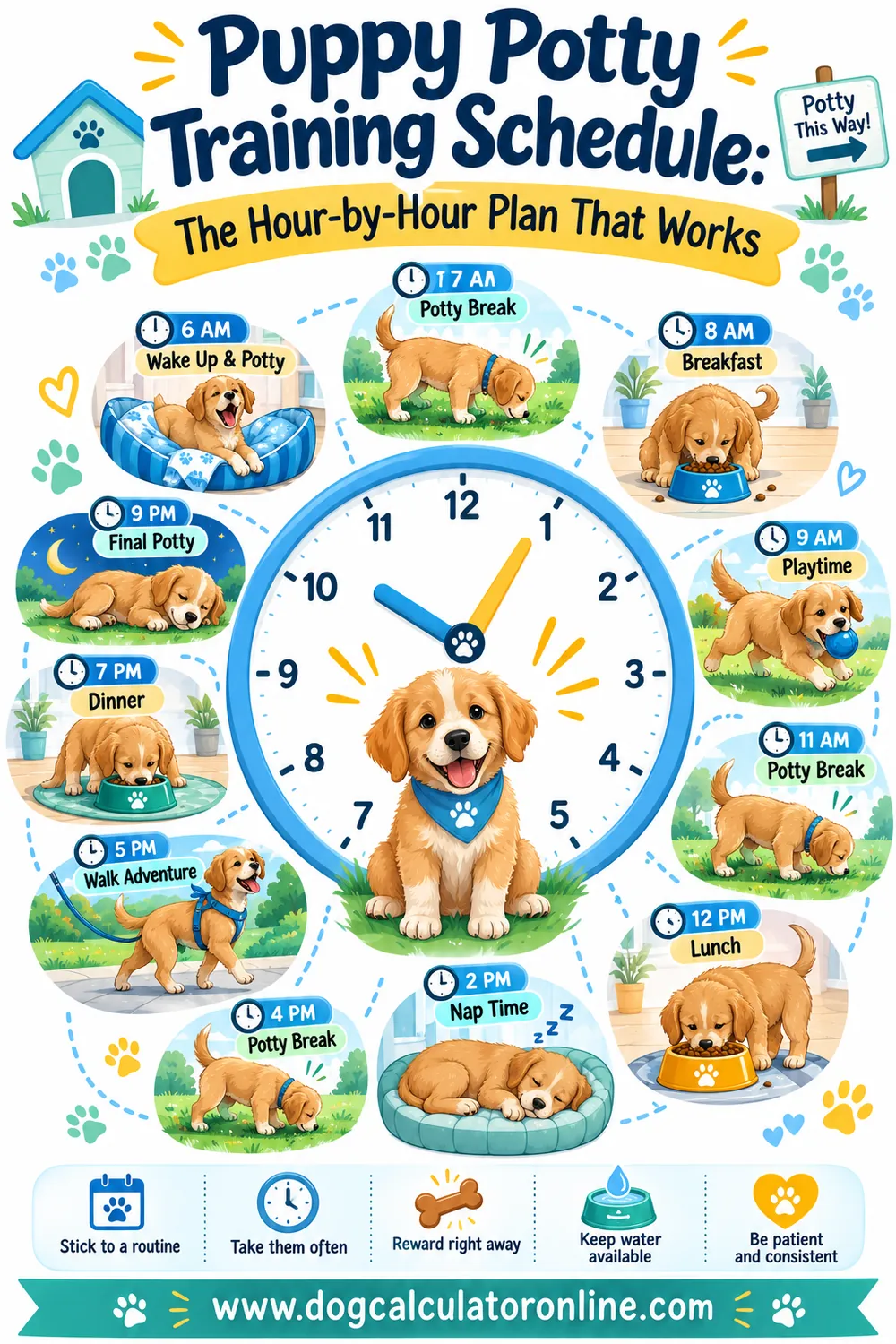
The pattern that matters isn't the exact clock times — it's the rhythm: out, toilet, activity, crate rest, repeat. Puppies genuinely need a great deal of sleep, and the crate is often what makes that happen rather than an overtired puppy careering around. Toilet timing is covered in the puppy potty training schedule.
What If Progress Stalls?
Very common, and usually fixable without starting over.
Go back one stage, not to the beginning. If twenty minutes causes distress, work at five for a few days. Success at a shorter duration rebuilds confidence faster than persisting at a failing one.
Check the obvious first. Does your puppy need the toilet? Have they had enough exercise today? Is the crate too small, too hot, in direct sun, or somewhere isolated? A surprising amount of crate protest is one of these.
Raise the value. Better treats, a chew reserved exclusively for crate time, meals only inside.
Check the size. Puppies grow fast, and a crate that fitted last month may be tight now. Equally, if house training has regressed, the space may now be too big — see what to look for on covering and setup.
Rule out pain. A puppy reluctant to lie down or settle may be uncomfortable rather than untrained, particularly during teething or after a growth spurt.
Know when it's more than training. Frantic escape attempts, drooling, damaged paws or teeth, or soiling in a previously clean dog can indicate separation anxiety. That needs your vet or a qualified behaviourist — continuing to push crate training alone usually makes it worse.
What Should Be Inside the Crate at Each Stage?
The contents change as your puppy does, and getting this wrong causes more problems than most owners realize.
8–12 weeks: keep it sparse. A flat, washable blanket or vet bed rather than a thick plush bed — young puppies have accidents, and something absorbent that hides the mess teaches them the crate is an acceptable place to toilet. A soft toy is fine. Water isn't necessary for short daytime sessions, and a bowl in a small crate usually ends up tipped over and soaked into the bedding.
3–6 months: this is peak chewing age, so anything destructible goes. Plenty of puppies shred a fabric bed at four months and swallow enough of it to need a vet. Switch to a chew-resistant mat, and give a stuffed frozen chew every time the door closes — it turns being crated into something worth doing and buys you twenty settled minutes while it lasts.
6 months and up: once destructive chewing has passed you can add a proper bed, and most dogs sleep far better for it. If your dog is crated for more than a couple of hours, clip a spill-proof water bowl to the door at this point rather than standing one on the floor.
Every stage: nothing with a cord, strap or collar tag that could catch on the bars. Remove collars entirely for long sessions — a tag hooked through a wire panel is one of the few genuinely dangerous things that can happen in a crate.
Frequently Asked Questions
How long does crate training take?
Most puppies settle comfortably within one to three weeks, with full confidence taking a month or two. Puppies aged eight to twelve weeks generally adapt fastest. Expect a wobble around four to six months when adolescence and teething arrive.
When can a puppy sleep through the night in a crate?
Most manage it by around four months. Before that, expect one or two toilet breaks a night at eight to ten weeks, reducing to one by about twelve weeks. Keep night breaks boring so waking you doesn't become rewarding.
Should I crate my puppy during the day?
Yes, in short stretches — it helps house training and gives an overtired puppy somewhere to actually rest. Keep to roughly one hour per month of age, and break the day into several shorter sessions rather than one long one.
My puppy was fine and now hates the crate — what happened?
Almost certainly adolescence, usually between four and six months, often combined with teething discomfort. Hold the routine, increase exercise and mental stimulation, provide chews, and shorten sessions for two weeks. It typically passes within a few weeks.
When can I stop crating my dog?
Once your dog is reliably house trained and trustworthy loose — usually somewhere between one and two years. Many owners leave the crate available with the door open, since dogs who stay comfortable in one cope far better with vet stays and travel.
Should the crate move out of my bedroom?
Eventually, if you want it elsewhere, but not straight away. Start in your bedroom to help your puppy settle, then move it gradually — a little further every few nights — once nights are going well. Moving it too soon often restarts the crying.
The most useful thing to hold onto is that crate training changes shape as your puppy grows. Minutes at eight weeks, hours at four months, a voluntary den by adulthood. Match what you're asking to what your puppy can actually manage, expect a wobble in adolescence, and go back a stage rather than pushing when things stall. Check the crate is the right size for the stage you're at with the crate size calculator.