Puppy Weaning Schedule Explained
Most weaning guides describe only half the job. Weaning is two schedules running at once — the puppies moving from milk to solid food between about three and a half and eight weeks, and the mother's food being wound back down in step so her milk production falls as demand does. Skip the second half and you get a dog whose glands keep filling with nowhere to send the milk, which is a direct route to mastitis. The other thing worth knowing before you start: weaning is puppy-led and gradual, and the mother does most of the work herself if you let her. Keep the growth curve honest throughout with the free puppy weight calculator.
🐾 Where are you in the schedule?
Tap a week:
Tap a week above. Two schedules at once: the puppies up, the mother down.
What Weaning Actually Means
It is a transfer of calories, not a single event.
Weaning is the process of shifting a puppy from 100% milk to 100% solid food, and it normally takes four to five weeks rather than happening in a day.
It is driven by biology on both sides. The puppies grow teeth and an appetite bigger than the supply; the mother finds nursing uncomfortable and starts limiting it.
Nature does this without help. In a free-living dog the mother would simply reduce access and the puppies would follow her to food. The human contribution is offering something suitable at the right time and keeping the arithmetic honest.
The end point is nutritional independence at seven to eight weeks, which is not the same as being ready to leave home.
Nothing about weaning should be abrupt. Removing a mother from a litter in one step is stressful, risks mastitis, and skips the behavioral side of the process.
Every litter runs slightly differently. Big litters and large breeds tend to wean earlier; small litters and toy breeds later.
The Full Schedule at a Glance
Both sides of the process, in one table.
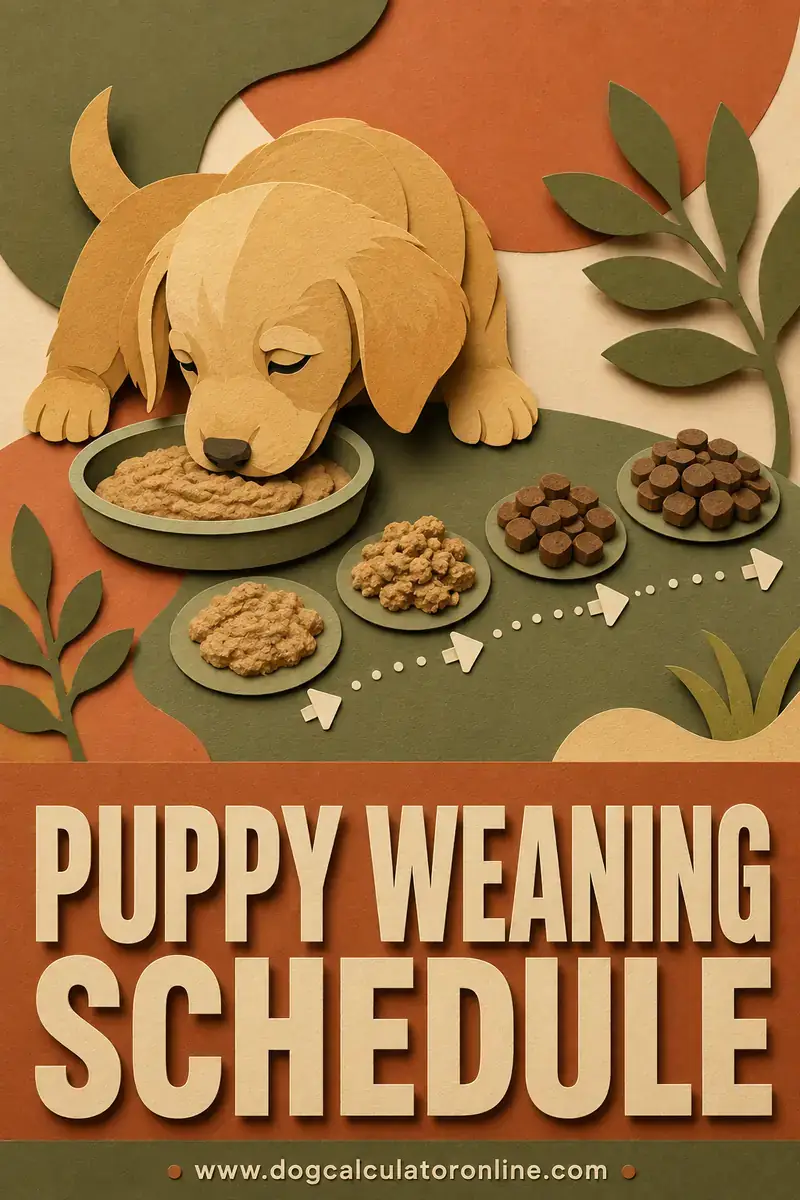
| Puppy age | Puppy food | Meals a day | Mother's food |
|---|---|---|---|
| Week 3 | Milk only; water available | Nursing on demand | Peak: 2.5–3× maintenance |
| Week 4 | Thin gruel introduced | 1–2 + nursing | Still at or near peak |
| Week 5 | Thicker gruel | 3–4 + nursing | Step down to ~2× |
| Week 6 | Lumpy, lightly mashed | 4 + short nursing | ~1.5× maintenance |
| Week 7 | Softened kibble | 4 + brief nursing | Approaching maintenance |
| Week 8 | Dry puppy food | 4, no milk | Normal adult food and portions |
The mother's column is the one usually missing from weaning charts, and it is the one that prevents problems.
Her multipliers depend on litter size, and the full working is in how much should a nursing dog eat.
Treat the table as a plan rather than a rule. If puppies are eating enthusiastically at four and a half weeks, move on; if they are not touching the dish, hold at the current step for a few more days.
Worming runs alongside, usually fortnightly from about two weeks on the vet's schedule, and the first vaccination lands at six to eight weeks.
Weeks Three to Four: Preparation
The groundwork happens before anything goes in a dish.
The first milk teeth erupt at around three weeks, and this is the biological starting gun. Sharp teeth make nursing uncomfortable and the mother begins to shorten feeds.
Puppies stand and walk in this week, which they need to do before they can reach a dish. The milestone sequence is set out in when do puppies open their eyes.
Put a shallow dish of fresh water down from about three and a half weeks and change it several times a day.
The mother starts nursing standing up, then leaving the box between feeds. Do not interpret this as rejection — it is exactly what should happen.
First gruel goes in at about three and a half to four weeks, thin and warm, once or twice a day, in a wide flat dish. The method and the expected chaos are described in when do puppies start eating solid food.
Her food stays at peak this week. She is still supplying almost everything.
Weeks Four to Five: The Handover Begins
The first real transfer of calories.
Increase to three or four gruel meals a day by the end of week four, spaced through the day.
Thicken the mixture gradually from pourable to thick porridge over the week.
Move from milk replacer towards plain warm water as the soaking liquid, so that by five weeks the gruel is puppy food and water.
Take the dish up after 15–20 minutes. Gruel left down sours quickly and lets confident puppies gorge while shy ones miss out.
Begin stepping the mother's food down as soon as the puppies are eating a meaningful amount, roughly to twice maintenance by the end of week five.
Keep weighing the puppies. A puppy that stalls now is usually one being outcompeted at the dish rather than one that is ill — feed the litter in two shifts if you need to, using the routine in newborn puppy care week by week.
Weeks Five to Six: Solids Take Over
Solid food becomes the main event.
Four meals a day of increasingly lumpy food. Stop blending and mash lightly instead, then soak kibble and leave it partly whole.
Nursing sessions become short and infrequent, and the mother controls when they happen. She may jump out of the pen when she has had enough, which is why the pen needs a place she can retreat to.
Puppies drink water properly from this point, so keep it available and clean.
Stools change as the diet does. Firm, formed stools mean the transition is going at the right pace. Persistently loose stools mean back off the texture or the volume for a couple of days, and watery or bloody stools mean a vet the same day.
Reduce her food further, towards about one and a half times maintenance.
This is peak socialization time. Handling, household noise, different surfaces and short separations from littermates all pay off later.
Weeks Six to Eight: Finishing
The last steps, and the ones people rush.
By six to seven weeks most puppies are on softened kibble that holds its shape, four meals a day.
By seven to eight weeks they should be on dry puppy food with no soaking, taking no meaningful nutrition from the mother.
Some nursing may continue for comfort. That is fine and self-limiting; the mother will end it herself.
Portion by expected adult weight, not by current weight, following the food's own chart, and the daily figures can be worked out with the dog food calculator. Four meals a day continues to about three or four months.
Send food home with each puppy. A change of diet on the same day as a change of home reliably causes loose stools.
Weaned is not the same as ready to go. Weeks six to eight are when bite inhibition and dog-to-dog manners are learned, which is the whole argument in when can puppies leave their mother.
Drying the Mother Off Safely
Her schedule matters as much as theirs.
Milk production responds to demand. As long as glands are emptied and she is eating at peak levels, she keeps producing.
Step her food down in parallel with the puppies eating more, not afterwards. This is the single most effective way to avoid engorgement.
Switch her back from puppy food to her normal adult diet once the puppies are fully weaned, or she will gain weight quickly.
Some breeders reduce food for 24 hours at final separation to help drying off. Only do this on veterinary advice, never with a dog who is unwell, and never restrict water severely.
Check her mammary glands daily during weeks five to eight. They should soften gradually. A gland that is hot, hard, red or painful, or a dog who is feverish and off her food, is mastitis and needs a vet the same day.
Watch her weight. She should return to roughly her pre-pregnancy condition around the time weaning finishes.
When Weaning Goes Wrong
The situations that come up most, and what to do.
Puppies refusing the dish. Usually the food is too cold, too thick, or offered when they are full. Warm it, thin it, and try when the mother has been out for an hour.
Diarrhea during weaning. Very common when the texture or volume moves too fast; step back one stage. In a puppy under six weeks, watery diarrhea causes dehydration quickly and warrants a vet call rather than a wait.
One puppy falling behind. Feed the litter in two groups so smaller puppies get a clear run at the dish, and keep weighing.
Early weaning by circumstance — an ill mother, a very large litter, or orphaned puppies. Solids can be started at three and a half weeks, with the gap filled by milk replacer rather than cow milk, as set out in how much milk should a newborn puppy drink.
Weaning before six weeks by choice is the one to avoid. Puppies removed from the litter before six weeks show measurably more behavioral problems later, and nothing about early independence is a benefit.
A mother who will not stop nursing at seven or eight weeks. Increase her time away from the pen gradually rather than separating abruptly, and check her food has actually come down.
A mother growling at her puppies during weaning is normal communication, not aggression, provided it stops when they back off.
FAQ
When should you start weaning puppies?
At about three and a half to four weeks, once the first milk teeth have erupted and puppies can stand and walk to a dish. Starting before three weeks is too early — the gut is not ready and diarrhea is the usual result.
How long does weaning take?
Four to five weeks in total. Puppies go from a first thin gruel at around three and a half weeks to dry puppy food in four measured meals a day by seven to eight weeks, with the change happening one texture step at a time.
Do you need to separate the mother to wean puppies?
No, and abrupt separation is counterproductive. She reduces feeds herself once teeth arrive, and weeks six to eight of contact with her and the littermates are where important social learning happens.
How do you reduce a mother dog's food after whelping?
Step it down as the puppies eat more solids, from peak levels at four weeks to about twice maintenance by five weeks, one and a half by six, and normal adult portions by eight. Keeping her on peak rations risks mastitis.
Can puppies be weaned at five weeks?
They can be eating mostly solid food by five to six weeks, especially in a large litter, but they should stay with the litter until eight weeks. Nutritional independence and behavioral readiness are different milestones.
What should you feed weaning puppies?
A complete puppy food, soaked and blended at first and thickened over several weeks. Large breeds need a large-breed puppy formula. Avoid cow milk, adult food and human leftovers throughout the process.
Two Schedules, One Timetable
Weaning works when both halves move together. On the puppies' side it is a texture ladder — thin gruel at three and a half to four weeks, thicker at five, lumpy at six, softened kibble at seven, dry puppy food in four meals by eight — advanced one step at a time and only when the previous step is being eaten cleanly. On the mother's side it is the same ladder in reverse, stepping her from peak lactation rations down to normal adult portions across the same four weeks so her milk supply falls as demand does and her glands empty safely. Weigh the puppies throughout, treat diarrhea under six weeks as a same-day veterinary matter, and do not confuse a weaned puppy with a puppy ready to leave. Keep the record with the free puppy weight calculator.