How Much Milk Should a Newborn Puppy Drink?
There is a real number behind this, and it is worth memorising: a newborn puppy needs roughly 13 mL of prepared puppy milk replacer per 100 g of body weight, per day, for the first week of life. A 300 g (about 10.5 oz) puppy therefore needs about 40 mL, or 1.4 fl oz, across the day, which at two-hourly feeds works out at around 3–4 mL a time. The figure rises each week as the puppy grows, and it is calculated from current weight rather than birth weight, which is why daily weighing is not optional. The other half of the answer matters just as much: cow milk is not a substitute and will make a puppy ill. Track the gains as they come with the free puppy weight calculator.

🐾 Daily milk volume by puppy weight
Tap a week-one weight:
Tap a weight above. Recalculate from the weight you measured this morning, not from birth weight.
The Rule of Thumb That Actually Works
Most guidance gives vague answers. The volume rule gives you an actual figure.
Week one: about 13 mL of prepared milk replacer per 100 g of body weight per day. Prepared means mixed to the label instructions, not powder.
The rate rises each week as the puppy becomes more active and its stomach grows: roughly 16 mL per 100 g in week two, 20 mL in week three, and 22 mL in week four.
Always recalculate from today's weight. A puppy that doubles its weight in ten days needs double the milk in ten days, and feeding week-one volumes in week two is a common reason a hand-reared puppy stalls.
Check the tin first. Different milk replacers vary in concentration and most print a per-kilogram feeding chart. Where the tin and this rule disagree, follow the tin.
Energy is the underlying measure. Puppies need roughly 15 kcal per 100 g per day in week one, rising towards 20–25 kcal by weeks three and four; the millilitre figures are simply that energy converted into a typical replacer.
Grams and millilitres are the working units on this page, because puppy feeding syringes, bottles and milk-replacer tins are all marked that way, and rounding a newborn to the nearest ounce hides exactly the gains you are watching for. If you prefer imperial, 100 g is about 3.5 oz, 30 mL is about 1 fl oz, and 1 lb is 454 g.
These volumes are for hand-rearing. A puppy nursing normally from its mother regulates its own intake, and the useful check there is the scales rather than a measuring jug.
From Daily Volume to Individual Feeds
Divide the daily total by the number of feeds. That is the whole calculation.
| Puppy weight | Week 1 (13 mL/100 g) | Feeds per day | Per feed |
|---|---|---|---|
| 150 g (5.3 oz) | 20 mL (0.7 fl oz) | 12 | ~1.6 mL |
| 250 g (8.8 oz) | 33 mL (1.1 fl oz) | 12 | ~2.7 mL |
| 350 g (12.3 oz) | 45 mL (1.5 fl oz) | 12 | ~3.8 mL |
| 500 g (1.1 lb) | 65 mL (2.2 fl oz) | 12 | ~5.4 mL |
| 750 g (1.7 lb) | 98 mL (3.3 fl oz) | 12 | ~8 mL |
| 1,000 g (2.2 lb) | 130 mL (4.4 fl oz) | 12 | ~11 mL |
A newborn stomach holds very little, which is why the answer is many tiny feeds rather than a few large ones. Forcing a bigger volume in causes regurgitation, and regurgitated milk can be inhaled.
A rough ceiling per feed is about 4 mL per 100 g of body weight. If the arithmetic pushes past that, add a feed rather than a bigger bottle.
Warm the milk to about 99°F (37°C), roughly blood heat. Cold milk is poorly digested; hot milk scalds. Test on your wrist as you would for a baby.
Mix fresh, or refrigerate for no more than 24 hours and warm each feed. Never microwave — it heats unevenly and produces hot spots.
Let the puppy stop when it stops. A satisfied puppy turns its head away, and a slightly rounded but soft belly is the target, not a tight drum.
How Often to Feed, Week by Week
Frequency drops much more slowly than people expect.
Week one: every two hours, day and night. That is twelve feeds in 24 hours and there is no way around it — puppies this small have almost no glycogen reserve and drop into low blood sugar quickly.
Week two: every three hours, about eight feeds.
Week three: every four hours, about six feeds, and you can usually stretch the overnight gap slightly.
Week four: four or five feeds, alongside the first gruel as weaning begins.
Missing the overnight feeds in week one is the single most common hand-rearing failure. A weak, cold, floppy puppy at 6 a.m. is often just a puppy that has gone eight hours without milk.
By five to six weeks milk should be a supplement rather than the diet, with solid food doing the work — the handover is mapped out in when do puppies start eating solid food.
Why Cow Milk Is Not a Substitute
This is the mistake that sends most hand-reared puppies to the vet.
The composition is wrong in every direction. Dog milk is far richer — roughly twice the protein and considerably more fat than cow milk — and much lower in lactose relative to its energy content.
Puppies digest lactose poorly, so the excess lactose in cow milk ferments in the gut and causes osmotic diarrhea. In a newborn, diarrhea means dehydration, and dehydration is fast and dangerous.
Even if the puppy tolerates it, it does not contain enough. A puppy fed cow milk is being fed dilute food and will fail to gain weight while apparently eating.
Goat milk is a little closer but still not right, and the same applies to lactose-free cow milk, evaporated milk and the various home recipes with egg yolk and cream. They are emergency stopgaps for a few hours at most, not a plan.
Human infant formula is not suitable either. It is built for a species whose milk is weaker still than a cow's.
Use a commercial puppy milk replacer, sold by vets and pet shops as powder or ready-mixed. It is the only thing formulated to the right protein, fat and lactose profile.
Colostrum cannot be replaced at all. Milk replacer supplies calories, not the antibodies in the mother's first milk, which is why a puppy that misses colostrum needs the vet to know about it.
Bottle, Syringe or Tube
Three delivery methods with very different risk profiles.
A proper puppy feeding bottle is the default. The teat is small and the hole should let milk drip slowly when inverted, not run. A hole that is too big is the classic cause of aspiration.
Never use a human infant bottle. The teat is far too large for a newborn puppy's mouth and the flow rate is dangerous.
A syringe suits very small or weak puppies, but only if you push extremely slowly, a drop at a time, allowing the puppy to swallow between each. Fast syringe feeding forces milk into the airway.
Tube feeding is fast, reliable and unforgiving. It bypasses the swallow entirely, so a tube placed in the trachea rather than the oesophagus delivers milk straight into the lungs. Do not attempt it until a vet or experienced breeder has shown you how and watched you do it.
Sterilize everything between feeds, as you would for a baby. Newborn immune systems are close to defenceless.
Whatever you use, feeds take time. Rushing is where the harm happens.
Position and Technique
The single most important physical rule in hand-rearing.
Feed a puppy belly-down, lying flat on a towel or resting on your hand, head level and slightly forward — the position it would be in nursing from its mother.
Never feed a puppy on its back. That is the human-baby position, and in a puppy it lines the airway up with the flow of milk. Aspiration pneumonia is a common and frequently fatal consequence.
Let the puppy suck rather than squeezing the bottle. Squeezing overwhelms the swallow reflex.
Stop immediately if milk appears at the nostrils. Hold the puppy head-down, wipe the nose, let it cough and settle, then call the vet — milk in the lungs is not something that resolves on its own.
Burp gently afterwards, holding the puppy upright against your shoulder and stroking its back.
Stimulate toileting after every feed with damp cotton wool over the genital and anal area until about three weeks, because a puppy this young cannot do it alone. The rest of the daily routine is set out in newborn puppy care week by week.
Keep the puppy warm throughout. A puppy that has gone cold should be warmed for one to two hours before any milk is offered at all — a chilled gut cannot digest.
Is the Puppy Getting Enough?
The scales answer this better than the bottle does.
Weigh daily at the same time. Steady daily gain, roughly doubling birth weight by seven to ten days, means the volume is right whatever the numbers on your feeding chart say.
No gain for 24 hours means increase the feeds and call the vet, in that order and on the same day.
A well-fed puppy is quiet, warm, sleeps in a pile and twitches in its sleep. Restless crying between feeds usually means hunger, cold, or both.
Urine should be pale yellow and almost clear. Dark or scanty urine means the puppy is not taking enough fluid.
Stools should be firm, yellowish and paste-like. Green, watery or foamy stools usually mean overfeeding or an over-concentrated mix; dilute slightly and reduce the volume per feed for a day.
A tight, drum-hard belly straight after a feed means too much, too fast. Smaller, more frequent feeds fix it.
Puppies nursing from their mother need the same weight checks, and if several are failing to gain, the question shifts to her milk supply and her intake, covered in how much should a nursing dog eat.
Tapering Off, and When to call the vet
Milk feeding has an end date, and a few situations that need help before then.
Introduce gruel at three and a half to four weeks — replacer mixed with softened puppy food to a porridge consistency, in a shallow dish.
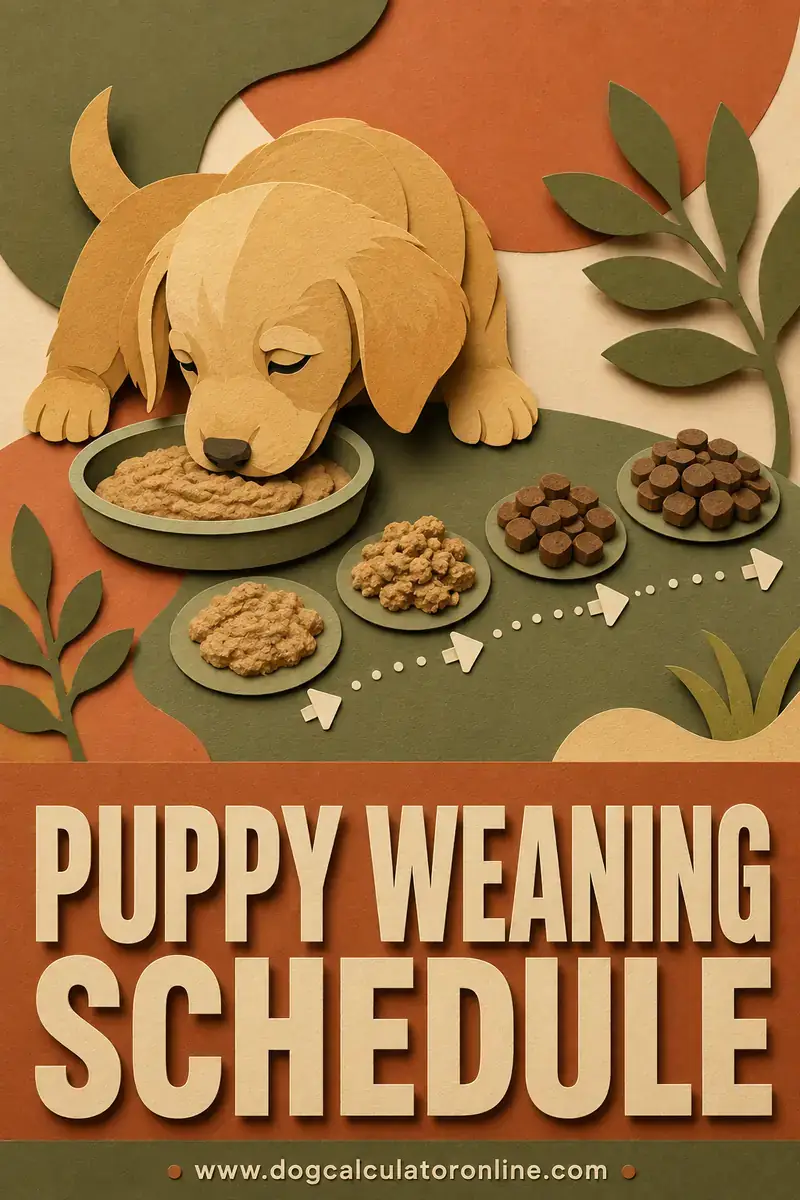
Reduce bottle feeds as gruel intake rises, dropping roughly one milk feed every few days across weeks four to six. The full staging is in the puppy weaning schedule.
Most puppies are off milk entirely by seven to eight weeks and eating four measured meals of solid puppy food a day; portions from that point can be worked out with the dog food calculator.
call the vet the same day if you see any of the following: no weight gain over 24 hours or any weight loss; a puppy that is cool, limp or refusing to suck; diarrhea or vomiting at any age under four weeks; milk coming from the nose during or after a feed; labored or rattly breathing; or a puppy that cannot latch at all, which can indicate a cleft palate needing tube feeding. Hand-rearing goes wrong quickly, and none of these improve with waiting. If you are preparing before the litter arrives, the kit list is in how to prepare a whelping box.
FAQ
How much milk does a newborn puppy need per day?
Roughly 13 mL of prepared puppy milk replacer per 100 g of body weight per day in the first week, so about 33 mL, or 1.1 fl oz, for a 250 g (8.8 oz) puppy. The rate rises to around 16 mL per 100 g in week two and 20 mL in week three.
How often should you bottle feed a newborn puppy?
Every two hours around the clock in week one, every three hours in week two, and every four hours in week three. Missing overnight feeds in the first week is a common cause of collapse from low blood sugar.
Can newborn puppies drink cow milk?
No. Cow milk has too little protein and fat and too much lactose for a puppy, which causes diarrhea and dehydration while failing to supply enough calories. Use a commercial puppy milk replacer instead.
How much should a puppy drink in one feed?
Divide the daily volume by the number of feeds, and keep any single feed under roughly 4 mL per 100 g of body weight. For most week-one puppies that is between 2 and 6 mL. Add a feed rather than a larger one.
Why should a puppy never be fed on its back?
Lying on its back lines a puppy's airway up with the flow of milk, so milk can be inhaled and cause aspiration pneumonia. Feed belly-down with the head level and slightly forward, as the puppy would nurse naturally.
When do puppies stop drinking milk?
Gruel starts at about three and a half to four weeks, milk feeds taper across weeks four to six, and most puppies are fully on solid puppy food by seven to eight weeks. The mother reduces feeds on her own timetable too.
Get the Volume Right, Then Let the Scales Confirm It
Hand-rearing comes down to two numbers and one position. Feed roughly 13 mL of prepared puppy milk replacer per 100 g of body weight per day in week one, rising to about 16 mL in week two and 20 mL in week three, split across two-hourly feeds to start with and recalculated from the weight you took that morning. Use a proper puppy replacer rather than milk from a cow, warm it to blood heat, and feed the puppy belly-down through a small teat that drips rather than runs. Then let the scales tell you whether it is working: daily gain means yes, a flat day means call the vet. Keep a record of every weight with the free puppy weight calculator.