Monthly Cost of Owning a Dog
Most dog budgets fail for a reason that has nothing to do with the monthly figure being too low. Roughly a third of what you spend on a dog in a year arrives in two or three lumps — a dental, a lameness workup, two weeks of boarding — that no monthly average predicts. In an ordinary month, a typical US owner spends somewhere between $70 and $200. In the month the lump lands, that becomes $600 or $2,000. Both numbers are true, and only planning for both keeps a dog affordable. Here is what genuinely leaves your account each month, what does not, and how to price your own dog rather than an average one. Start with the free dog cost calculator.

🐾 What does your month look like?
Tap the closest match:
Tap an option above. The ordinary month and the spike month need budgeting separately.
What a Dog Costs in an Ordinary Month
An ordinary month is one with no vet emergency, no boarding and no replacement purchases. That month is the base of the budget.
| Line | Small (under 25 lb / 11 kg) | Medium (25–60 lb / 11–27 kg) | Large (60–100 lb / 27–45 kg) |
|---|---|---|---|
| Food | $15–$35 | $30–$60 | $50–$100 |
| Flea, tick and worm cover | $15–$30 | $20–$40 | $25–$50 |
| Routine vet care, spread monthly | $25–$50 | $30–$60 | $35–$70 |
| Insurance or savings transfer | $20–$45 | $25–$55 | $35–$80 |
| Treats, poo bags, replacements | $10–$25 | $12–$30 | $15–$35 |
| Ordinary-month total | $85–$185 | $117–$245 | $160–$335 |
Read these as planning ranges, not quotes. Every figure here moves with your city, your dog's health and the brand of food in your cupboard, and the spread within a size band is wider than the gap between bands.
The single largest driver is body weight, not breed. Food is sold by weight, parasite preventatives are dosed by weight, anaesthesia and most medication are dosed by weight, and boarding kennels price by run size. The full arithmetic is set out in cost of owning a dog by size.
Services are the line that turns a modest budget into a large one. A dog walker at $20–$30 a visit or daycare at $25–$45 a day can double the total on its own, and neither appears in most published averages.
Nothing in that table covers a surprise. The ordinary-month total is what you need to have coming in every month; the spike is what you need to have saved.
Why the Monthly Average Is a Fiction
Averages are built by dividing a year by twelve, which describes a year no owner actually lives.
Real spending is lumpy and the lumps are large. A dental with extractions runs $600–$1,500. A limp that needs sedation, radiographs and a specialist opinion runs $800–$2,500. A single overnight in an emergency hospital starts around $1,500. None of these is rare across a dog's life.
The lumps cluster at both ends of life. Year one carries vaccinations, neutering and kit; the last three years carry chronic medication, more frequent bloodwork and mobility support. The quiet middle years are the ones that make the average look reassuring.
Two of the biggest lines are optional until suddenly they are not. Boarding is discretionary — until a family funeral or a work trip forces it. Behavioral help is discretionary — until the dog bites a visitor.
A budget that only holds the ordinary month is a budget that puts treatment on a credit card. Roughly a quarter of owners report having declined or delayed a recommended treatment on cost grounds at least once, and the delay usually makes the eventual bill larger.
The fix is two numbers, not one. A standing monthly figure that covers the ordinary month, and a separate pot that absorbs the spikes. The rest of this guide splits the budget that way.
Food: The Only Genuinely Monthly Line
Food is the one cost that behaves the way a monthly budget assumes it does, and the one most people misprice.
Price the bag by kilogram, not by bag. A $60 bag that lasts a 70 lb (32 kg) dog five weeks costs more per month than an $80 bag that lasts eight. The number that matters is the cost per day, and the only way to get it is to divide the bag price by the days it genuinely lasts.
Wet food multiplies the bill. Feeding a medium dog entirely on tins or trays typically costs three to five times the equivalent dry ration, because you are largely paying to ship water.
Portion drift is the commonest reason a food budget overruns. A scoop measured by eye rather than by weight is routinely 20–30% over the label, which both raises the bill and creates a weight problem that costs more later.
Treats are a real line, not a rounding error. Training treats, dental chews and table scraps often account for 15–25% of a dog's daily calories and a similar share of the food budget.
Raw and fresh-cooked diets sit at the top. Subscription fresh food for a medium dog commonly runs $150–$300 a month. There is a fuller breakdown in how much does it cost to feed a dog.
Vet Care Spread Across Twelve Months
Routine care is annual but predictable, so it belongs in the monthly figure rather than the buffer.
A healthy adult dog needs one visit a year. A wellness consultation, core vaccinations and a parasite check together usually run $250–$500, which is roughly $20–$45 a month once spread.
Puppies and seniors need more. A puppy needs three or four visits in the first six months; a dog over eight is usually recommended twice-yearly checks with bloodwork, which lifts the annual figure to $500–$900.
Parasite prevention is monthly and non-negotiable. Combined flea, tick and worm products cost $15–$50 a month depending on weight, and lapsing is a false economy — treating an established flea infestation in a house costs several times a year of prevention.
Dental care is the routine cost people leave out. A scale and polish under anaesthetic runs $400–$800 with no extractions, and most dogs need one every two to three years. Brushing at home genuinely delays it; see signs of dental disease in dogs for what to watch.
Get a real local number rather than trusting a national average. Ring three practices near you and ask the price of an annual health check, a booster and a routine dental. Ten minutes on the phone beats any published figure, and average vet costs for a dog explains what should be included in each quote.
Insurance Or the Savings Pot That Replaces It
Every owner pays for emergencies. The only choice is whether the payment is smooth or sudden.
Accident-and-illness cover for a dog typically runs $25–$70 a month. Premiums rise sharply with age, and certain breeds — brachycephalics, giant breeds, and lines predisposed to hip or spinal disease — sit well above the average. There is a per-month breakdown in how much is pet insurance per month.
Insurance is worst value exactly when it looks cheapest. Premiums on a healthy two-year-old are low because claims are unlikely. The same policy at ten is expensive precisely because it is likely to pay out — and by then a condition diagnosed in the interim may be excluded.
A savings pot works, but only with real discipline. Standing $50 a month into a separate account from the day a puppy arrives gives roughly $6,000 by age ten. That is enough for most single emergencies and not enough for a bad orthopedic year.
The hybrid suits most households. A higher-deductible accident-and-illness policy for the catastrophic tail, plus a modest monthly transfer for the routine spikes, keeps the monthly figure low without leaving a five-figure exposure.
Decide before you need to. Pre-existing conditions are excluded by every insurer, so the choice is made the moment a symptom is first recorded — not the moment you apply.
Grooming, Walking and Daycare
These are the lines that vary most between two otherwise identical dogs, and they are where a household budget is genuinely under your control.
Coat type sets the grooming bill, not size. A smooth-coated dog of any size may never need a professional groom. A poodle cross, a bichon or an old english sheepdog needs a full groom every six to eight weeks at $50–$120, which is $35–$80 a month on average.
Grooming is not cosmetic for those coats. Skipping appointments produces matting, and a matted dog needs a clip-off — which costs more, takes longer and sometimes needs sedation.
Dog walkers are priced per visit. $18–$30 for a group walk, $30–$50 for a solo walk. Three walks a week sits around $250–$400 a month, which is more than most owners spend on food and vet care combined.
Daycare is the biggest single discretionary line. At $25–$45 a day, two days a week is $200–$350 a month. Many facilities discount packages by 10–20%, and some cap monthly spend.
Working from home changes the arithmetic completely. The same dog can cost $110 or $450 a month purely on whether somebody is home at lunchtime, which is why household averages are so much less useful than your own numbers.
Three Real Monthly Budgets
The gap between a lean and a full budget is far wider than the gap between breeds.
| Household | Dog | Ordinary month | What drives it |
|---|---|---|---|
| Lean | 18 lb (8 kg) terrier, owner home most days | $85–$120 | Dry food, self-groomed, savings pot instead of insurance |
| Typical | 45 lb (20 kg) crossbreed, one walk a week | $180–$260 | Mid-range food, insured, groomed every eight weeks |
| Full service | 75 lb (34 kg) retriever, two daycare days | $420–$620 | Large-breed food, daycare, insurance, professional grooming |
All three are reasonable ways to keep a dog. The lean budget is not neglect and the full-service one is not indulgence; they are different working patterns.
The variable you can actually change is services, not care. Cutting food quality or skipping preventatives saves $20 a month and risks a $900 bill. Halving daycare saves $150 with no clinical consequence.
Multi-dog households do not double. Food, preventatives and insurance double, but boarding often discounts a second dog by 25–50%, and walkers usually charge only a small supplement.
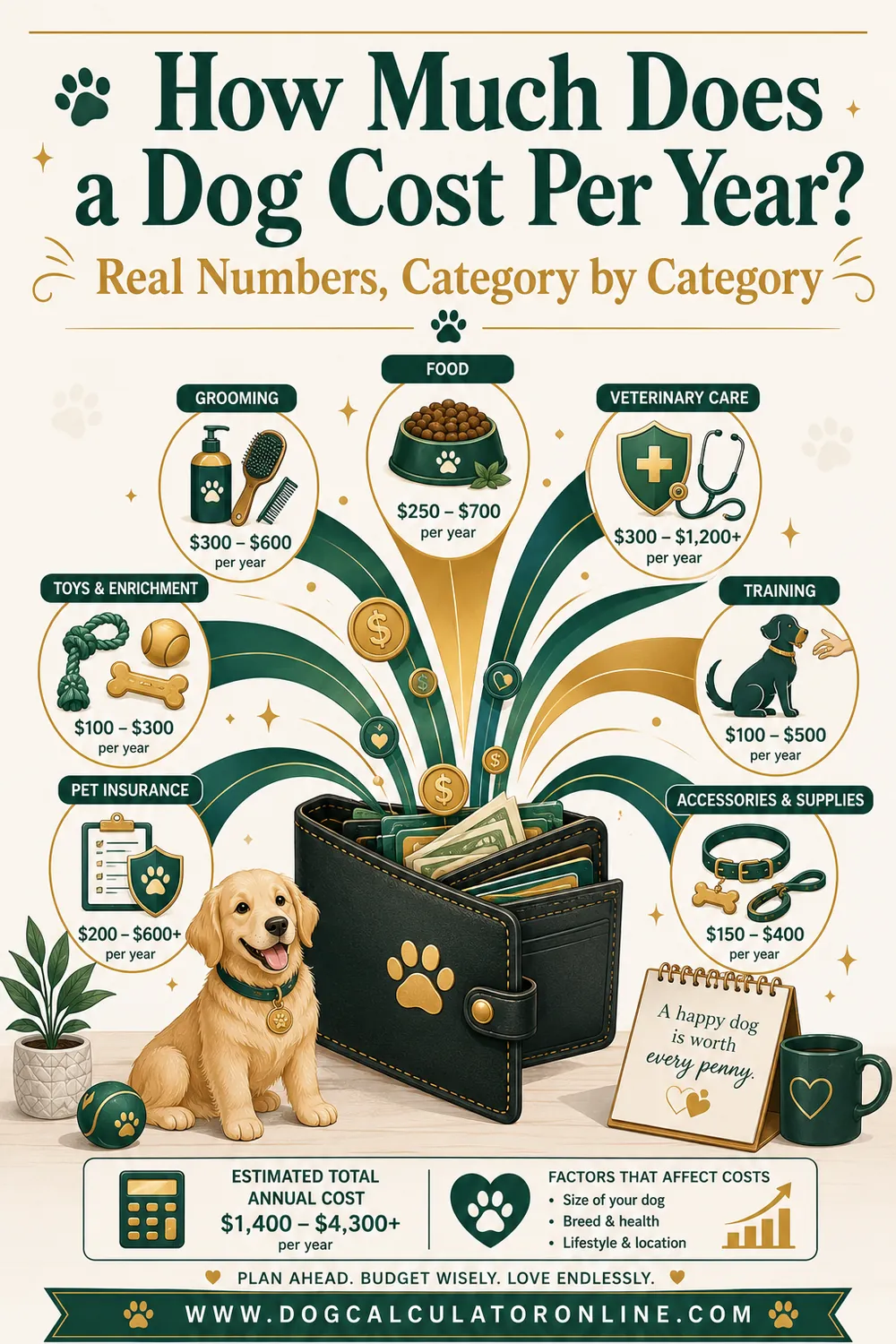
The annual view is the honest one. Multiply your ordinary month by twelve, then add the one-offs; how much does a dog cost per year sets out the full-year picture the monthly figure sits inside.
How to Smooth the Spikes
Turning a lumpy year into a predictable month is a mechanical exercise, and it takes about an hour.
List the one-offs before they happen. Boarding weeks, the next dental, the annual booster, the replacement bed. Total them, divide by twelve, and add that to the standing monthly figure.
Hold the buffer somewhere separate and slightly inconvenient. A named savings account that is not your current account survives contact with a normal month; a mental allowance does not.
Target a floor of $1,500 first, then $3,000. $1,500 covers most single emergency consultations with diagnostics. $3,000 covers the great majority of non-orthopedic emergencies outright.
Ask about payment plans before you need one. Many practices offer instalments or work with third-party medical credit, but arranging it at the desk during a crisis is far harder than asking during a routine visit.
Watch the costs that never appear on a budget sheet. Replaced skirting boards, a canceled holiday deposit, a behaviorist after a bite incident; these are covered in the hidden costs of owning a dog, and they are the ones that most often break an otherwise sound plan.
FAQ
What is the average monthly cost of a dog?
For most US owners, $70–$200 a month covers food, preventatives, a share of routine vet care and consumables. Adding insurance, professional grooming or daycare commonly pushes the figure to $250–$500. Size, coat type and whether anyone is home during the day move it more than breed does.
Is a small dog really cheaper each month?
Usually yes, but less than people expect. Food and medication doses are genuinely smaller, so the ordinary month is lower. Small breeds often live 14–16 years and need more frequent dental work, so the lifetime total can end up close to a large dog's shorter, more expensive one.
How much should I save each month for vet emergencies?
$40–$60 a month from the start is a workable target if you are self-insuring, aiming for a floor of $1,500 and a working buffer of $3,000. If you carry accident-and-illness insurance, $20–$30 a month still covers deductibles, co-pays and the exclusions every policy has.
Why is my first year so much more expensive?
Vaccination courses, neutering, microchipping, crate, bed, harness and training classes all land in the same twelve months. A puppy's first year typically costs two to three times any later year, which is why it should be budgeted as a one-off project rather than a monthly rate.
Can I cut the monthly cost without harming my dog?
Yes, in specific places. Buying larger food bags, learning to bath and brush at home, using group walks instead of solo ones, and comparing insurance at renewal all cut real money. Skipping parasite prevention, dental care or annual checks reliably costs more within two years.
Does insurance actually reduce the monthly total?
No — it raises the ordinary month and lowers the worst one. Insurance is a way of converting an unpredictable $3,000 into a predictable $40. If you already hold enough savings to absorb a five-figure bill without borrowing, self-insuring is defensible; most households do not.
Budget Two Numbers, Not One
The useful monthly figure for a dog is not a single average but a pair: what leaves your account in a quiet month, and what you have set aside for the month that is not quiet. For most owners the quiet month is $70–$200, rising to $250–$500 once insurance, grooming or daycare are in the mix, and the spike month is anywhere from $600 to several thousand. Price your own dog rather than an average one — weigh the food, ring three practices for real local quotes, and count the services honestly. Then set a standing transfer for both numbers. Run yours through the free dog cost calculator.