Cost of Owning a Dog by Size
If you want to predict what a dog will cost, the most useful thing you can know about it is not its breed or its pedigree but its adult body weight — because food, parasite preventatives, anaesthetic, most medication, boarding, kit and even the car you need all scale with it. A 90 lb (41 kg) dog does not cost slightly more than a 15 lb (7 kg) one; in the lines that scale, it costs two to four times as much. The exception is worth knowing too: small dogs live longer and go to the dentist more, so the lifetime totals converge more than the annual ones suggest. Price yours with the free dog cost calculator.
🐾 Which size are you pricing?
Tap a size band:
Tap an option above. Adult body weight predicts cost better than breed does.
What Each Size Band Costs Per Year
These are ordinary-year figures: no emergency surgery, no extended boarding, no behavioral referral.
| Line | Small (under 25 lb / 11 kg) | Medium (25–60 lb / 11–27 kg) | Large (60–100 lb / 27–45 kg) | Giant (100 lb+ / 45 kg+) |
|---|---|---|---|---|
| Food | $200–$420 | $360–$720 | $600–$1,200 | $900–$1,800 |
| Parasite prevention | $180–$360 | $240–$480 | $300–$600 | $360–$700 |
| Routine vet care | $300–$600 | $320–$650 | $360–$750 | $420–$900 |
| Insurance | $240–$540 | $300–$660 | $420–$960 | $600–$1,400 |
| Grooming | $0–$700 | $0–$900 | $0–$1,100 | $0–$1,300 |
| Kit and replacements | $80–$200 | $120–$300 | $180–$420 | $250–$550 |
| Ordinary year | $1,000–$2,200 | $1,400–$3,000 | $2,000–$4,000 | $2,800–$5,500 |
Treat these as planning ranges. Local prices, coat type and whether you use daycare move the total more than a band boundary does, and the overlap between adjacent bands is deliberate.
The bands themselves are conventions, not biology. Different sources put the small/medium line anywhere from 20 to 30 lb; average dog weight by size category sets out the definitions used here.
Weigh before you budget. Guessing a dog's weight by eye is unreliable by 20% or more, and 20% is the difference between two food-cost brackets.
Why Weight Drives Almost Every Line
The reason size predicts cost so well is that most of what you buy for a dog is sold or dosed by mass.
Food is priced by weight and eaten by weight. No other consumable in a dog budget is bought in kilograms every month.
Preventatives are banded by weight. Flea, tick and heartworm products come in weight-specific packs, and each step up the ladder costs more for identical protection.
Prescription medication is dosed per kilogram. A course of antibiotics, a painkiller, a thyroid tablet or a long-term arthritis drug costs roughly in proportion to the dog. A giant-breed dog on daily medication can cost four to six times what a terrier on the same drug costs.
Anaesthesia scales too. The agent, the monitoring time and the recovery all rise with body mass, which is why the same routine procedure is quoted differently for a chihuahua and a mastiff at the same practice.
Even the fixed costs are not fixed. Microchipping is the same price for any dog; almost nothing else is.
Food Scales, But Not in a Straight Line
This is the most commonly misunderstood part of size-based budgeting, and it works in your favor.
Energy needs scale to roughly body weight to the power of 0.75, not to weight itself. A dog four times heavier does not eat four times as much — it eats around 2.8 times as much.
In practice that means a 60 lb (27 kg) dog eats about twice what a 15 lb (7 kg) dog eats, not four times. The gap in the food line is real but smaller than raw weight suggests.
Large-breed formulations cost more per kilogram than the volume discount saves. Controlled-calcium large-breed puppy food and joint-supplemented adult ranges carry a premium of 10–25%.
Wet food is where size punishes you hardest. Feeding a 90 lb (41 kg) dog entirely on trays is one of the most expensive things an ordinary owner can do — commonly $250–$450 a month.
Activity moves the food line as much as a size band does. A working or sport dog of any size can need 30–60% more calories than a sedentary one of identical weight.
Where Small Dogs Cost More
Small does not mean cheap, and three lines run the other way.
Dental disease is the big one. Crowded teeth in a short jaw mean small breeds need scaling and extractions earlier and more often — commonly every 18 months to 3 years from middle age, at $400–$1,200 a time. Over a long life that is a five-figure line.
Small breeds carry their own expensive conditions. Luxating patella repair runs $1,500–$4,000 per knee, tracheal collapse and mitral valve disease both mean long-term medication, and none of these is unusual.
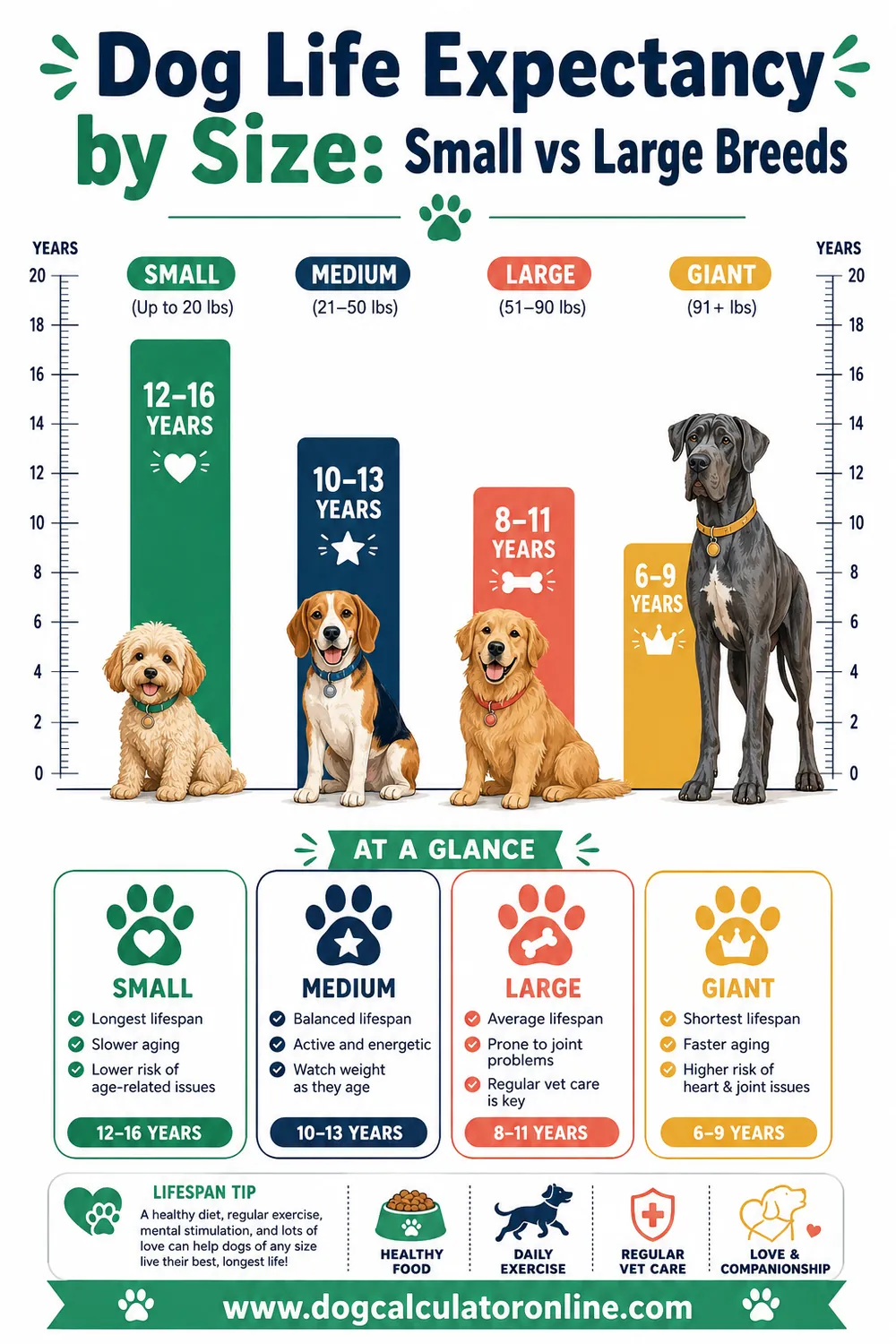
They live longer, so you pay for more years. A small dog commonly reaches 14–16 years against 8–10 for a giant breed; that is six to eight extra years of food, insurance and vet care. The lifespan pattern is set out in dog life expectancy by size.
Insurance premiums rise steeply with age regardless of size. The years 12 to 16 are the expensive ones, and small dogs are the dogs that reach them.
Grooming is coat-driven, not size-driven. A 12 lb (5 kg) shih tzu needs a full groom every six weeks; a 100 lb (45 kg) labrador may never need one.
Services That Price by Size
Once you buy care rather than provide it, the price list is explicitly banded by size.
Boarding kennels price by run size. The gap between a small and a large run is typically $10–$20 a night, which over a two-week holiday is $140–$280. Dog boarding cost guide explains what else moves the quote.
Groomers price by size and coat together. A small dog full groom is commonly $50–$75, a large one $80–$140, and a giant double-coated dog $120–$200 with a de-shed treatment. The dog grooming cost guide breaks this down by coat.
Daycare sometimes bands by size, sometimes not. Facilities that separate by size often charge the same; those that price by space charge more for large dogs.
Air travel is brutally size-banded. A dog small enough for an in-cabin carrier flies for $95–$150; anything larger goes as cargo at $400–$1,200 per leg, with breed and temperature embargoes on top.
Some services refuse large dogs entirely. Rental agreements, some home boarders and many hotels cap by weight, which converts a price difference into an availability problem.
Kit, Replacements and the Things Around the Dog
The one-off purchases scale too, and the replacement cycle is faster at the top end.
Crates, beds and harnesses roughly double from small to large. A crate that suits a 15 lb (7 kg) dog costs $40–$70; the equivalent for a 90 lb (41 kg) dog is $110–$200, and a giant-breed crate more again.
Large dogs destroy things faster. Beds, toys and leads all have shorter lives, and the replacement rate is the part owners forget.
Household damage is a real size-linked cost. A big dog with separation anxiety can take out a door frame; a small one takes out a cushion.
Transport sometimes has to change. A car boot that will not take a crate for a great dane is a genuine cost of the decision, even if it never appears on a pet budget.
Fencing and gates get more serious. Containing a determined 80 lb (36 kg) dog costs more than containing a 15 lb (7 kg) one, though small dogs escape through smaller gaps.
Coats, harnesses and beds are priced in bands too. The same model of orthopedic bed can cost $55 in small and $160 in extra-large, and a large dog goes through them faster.
Waste bags and consumables scale with output. It sounds trivial, but a giant breed gets through three to four times the bags, wipes and cleaning products of a toy breed over a year.
Lifetime Cost: The Size Paradox
Comparing per-year costs makes large dogs look expensive. Comparing lifetimes narrows the gap sharply.
| Size | Ordinary year | Typical lifespan | Rough lifetime total |
|---|---|---|---|
| Small | $1,000–$2,200 | 14–16 years | $16,000–$33,000 |
| Medium | $1,400–$3,000 | 11–13 years | $17,000–$37,000 |
| Large | $2,000–$4,000 | 9–12 years | $20,000–$46,000 |
| Giant | $2,800–$5,500 | 7–10 years | $22,000–$52,000 |
The lifetime ranges overlap heavily. A well-managed giant breed and an indulged small one can land within a few thousand dollars of each other across their lives.
Higher annual cost with fewer years is not automatically better value. The final year of a giant breed is often the most expensive year of any dog's life, and it arrives sooner.
What genuinely separates the totals is health, not size. One cruciate repair ($3,000–$6,000 per knee) or one lifetime of allergy management ($800–$2,000 a year) outweighs the whole size effect.
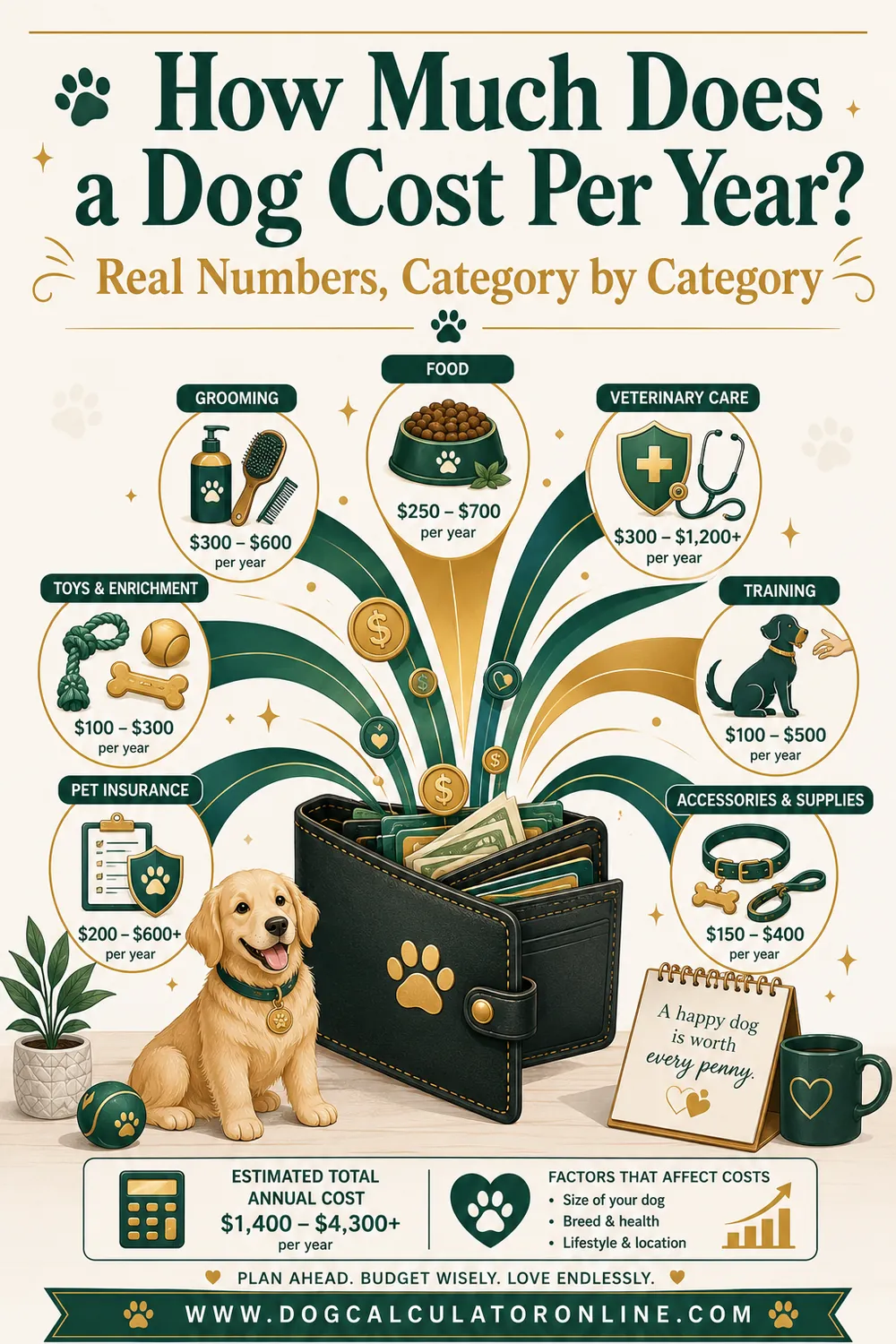
Use the annual figure for planning and the lifetime one for the decision. How much does a dog cost per year covers the yearly view, and monthly cost of owning a dog covers the cashflow.
Getting a Real Number for Your Own Dog
National ranges are a starting point. Twenty minutes of local research gets you something you can actually budget against.
Weigh the dog, then price the food properly. Take the manufacturer's daily ration for that weight, divide the bag price by the days it lasts, and multiply by 365.
Ring three local practices. Ask for the price of an annual health check with boosters, a routine dental, and a neuter for a dog of your dog's weight. Practices quote these readily and the spread within one city is often 40%.
Get two boarding quotes for your dog's size, in a peak week. That single number is often the largest discretionary line in the year.
Run one insurance quote for the exact breed, age and ZIP code. Generic averages hide breed loading, which is where large and brachycephalic dogs get expensive.
For a puppy, price the adult, not the puppy. A crossbreed that finishes at 70 lb (32 kg) rather than 30 lb (14 kg) costs roughly $800–$1,200 more every year for a decade.
FAQ
Does a big dog really cost twice as much as a small one?
In the scaling lines, roughly yes — food, weight-banded preventatives, medication doses and boarding are commonly 1.5 to 3 times higher. Across a whole ordinary year the difference is typically $1,000–$2,000. Across a lifetime it narrows, because small dogs live several years longer.
Which size is cheapest to own overall?
Small-to-medium dogs with short coats and no breed-specific health loading are usually the cheapest, at roughly $1,000–$2,000 a year. But coat type, local service prices and individual health history move the total far more than the size band, so no size guarantees a low bill.
Why is my small dog's vet bill as high as a friend's labrador?
Dentistry and small-breed orthopedic and cardiac conditions are the usual reason. Scaling and extractions, patella surgery and long-term heart medication are all common in small breeds and none of them is cheap. Drug doses are smaller; the number of procedures often is not.
Do giant breeds cost more to insure?
Yes, and usually by a wide margin. Insurers load for shorter lifespans, higher anaesthetic and surgical costs, and elevated rates of bloat, cruciate injury and joint disease. Premiums for giant breeds commonly run 50–150% above a medium crossbreed of the same age.
How do I budget for a puppy whose adult size is unknown?
Budget for the top of the plausible range. Ask the rescue or breeder for the parents' weights, and use a growth projection to narrow it. Being $600 a year over-provisioned is a manageable error; being under-provisioned on a dog that reaches 80 lb (36 kg) is not.
Is it cheaper to have two small dogs than one large one?
Rarely. Food and preventatives for two 20 lb (9 kg) dogs cost about the same as for one 60 lb (27 kg) dog, but you pay two sets of routine vet fees, two insurance premiums, two dentals and two sets of one-off procedures. Two dogs of any size cost roughly 1.7 to 1.9 times one.
Weigh the Dog Before You Set the Budget
Size is the single most reliable predictor of what a dog will cost, because most of what you buy is sold or dosed by mass. Expect roughly $1,000–$2,200 a year for a small dog, $1,400–$3,000 for a medium, $2,000–$4,000 for a large and $2,800–$5,500 for a giant, and expect the lifetime totals to converge as small dogs collect extra years and extra dentals. The number that actually matters is your dog's adult weight in your city, so weigh, ring three practices and price the real bag of food. Then run it through the free dog cost calculator.