Average Dog Weight by Size Category
Dogs are usually sorted into five size categories — toy, small, medium, large and giant — and the boundaries are conventions rather than science, so different sources draw them in slightly different places. The version below is the one most widely used: toy under 5 kg, small 5–10 kg, medium 10–25 kg, large 25–45 kg, giant over 45 kg. What makes the categories worth knowing is not the labels but what they predict: how long a dog takes to stop growing, how long it is likely to live, when joint problems start appearing, and how its food should be portioned. This page covers the ranges, the breeds in each, and where the categories mislead.
📊 The five size categories
Tap a category:
Tap a category above. The label predicts growth, lifespan and joint risk.
The Five Categories
| Category | Weight range | Height (approx) | Typical breeds |
|---|---|---|---|
| Toy | Under 5 kg (11 lb) | Under 30 cm | Chihuahua, Pomeranian, Yorkshire Terrier, Maltese |
| Small | 5–10 kg (11–22 lb) | 30–40 cm | Pug, Dachshund, Miniature Schnauzer, West Highland Terrier |
| Medium | 10–25 kg (22–55 lb) | 40–55 cm | Beagle, Border Collie, Cocker Spaniel, Bulldog, Staffie |
| Large | 25–45 kg (55–99 lb) | 55–70 cm | Labrador, German Shepherd, Golden Retriever, Boxer |
| Giant | Over 45 kg (99 lb) | Over 70 cm | Great Dane, Mastiff, Newfoundland, St Bernard, Leonberger |
The boundaries are conventions. Some sources put the small/medium line at 11 kg, some at 12; some treat "large" as starting at 23 kg. Nothing biological happens at 25 kg — the categories are useful groupings, not thresholds.
Height matters as much as weight for categorising. A Greyhound at 30 kg is a large dog; a Bulldog at 25 kg is a compact medium one. The two are shaped nothing alike.
And breeds straddle the lines. Cocker Spaniels, Bulldogs and Staffies sit near the small/medium boundary depending on the individual; Labradors and German Shepherds can cross into giant territory at the top of their range.
Why the Category Matters
Four practical consequences, and they are the reason the labels are worth knowing at all.
When the dog stops growing. Toy breeds are essentially finished by about nine months. Giant breeds are still maturing at two years and sometimes beyond. That difference changes when you switch off puppy food, when it is safe to start real exercise, and how long joints stay vulnerable.
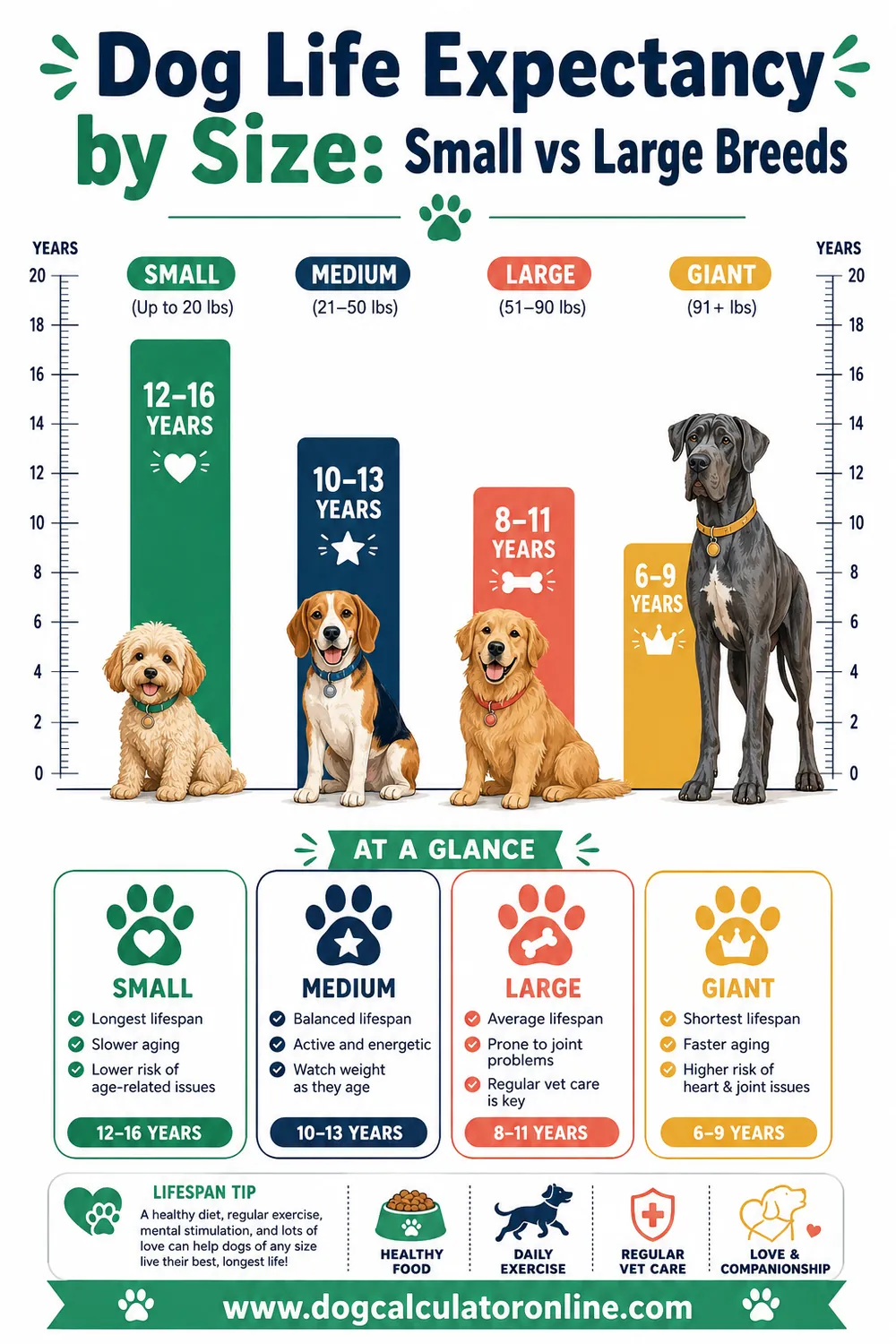
How long the dog is likely to live. Larger dogs live shorter lives, and the gap is substantial — a Chihuahua commonly reaches 15 or 16, a Great Dane often 7 to 10. Uniquely among mammals, size within a species runs inverse to lifespan in dogs. The detail is in dog life expectancy by size.
When old age starts. A giant breed is "senior" at around 5 or 6; a toy breed not until 10 or 11. Screening bloodwork and twice-yearly checks should follow the dog's own timetable rather than a fixed age.
How much a few extra kilos cost. On a 4 kg toy breed, 1 kg of excess weight is 25% of body weight — the equivalent of a 70 kg person carrying an extra 17 kg. Small dogs are the most likely to be overweight and the least likely to be noticed, because the numbers are small.
Where the Categories Mislead
Worth being clear about, because size labels get over-applied.
They describe populations, not individuals. Within any breed there is a legitimate range of several kilos. A well-conditioned Labrador can be 27 kg or 36 kg depending on frame, sex and line, and both are healthy.
Sex makes a real difference. Males typically run 10–20% heavier than females in most breeds, and breed standards usually quote separate ranges.
Working and show lines differ. A working cocker and a show cocker are different dogs on the scales, and the same is true of springers, labradors and many gundog breeds.
Mixed breeds do not read the table. A crossbreed can land anywhere between its parents' categories, and often at the larger end.
Shape is not captured at all. Weight tells you nothing about whether a dog is muscular or carrying fat. Two 25 kg dogs can be very differently conditioned, and the one that matters is body condition rather than the reading — the reference ranges are in healthy weight range for dogs by size.
Which is why the table is a starting point. Your dog's own healthy weight is what your vet identifies by feel, not what a category says it should be.
How Long Does Each Category Take to Grow?
The most practically useful thing the categories predict.
| Category | Adult height by | Fully filled out by | Puppy food until |
|---|---|---|---|
| Toy | 6–8 months | ~9 months | ~9 months |
| Small | 8–10 months | ~12 months | ~10 months |
| Medium | 10–12 months | ~14 months | ~12 months |
| Large | 12–16 months | ~18 months | ~14 months |
| Giant | 18–24 months | 2–3 years | ~18–24 months |
Height finishes before width. Dogs reach close to their adult height well before they finish filling out through the chest and shoulders, which is why an adolescent large-breed dog looks lanky for months.
Large and giant breeds need large-breed puppy food specifically. It is formulated with controlled calcium and energy density to slow growth deliberately, because growing too fast is a recognized risk factor for developmental joint problems in big dogs. This is one of the few cases where a "breed size" food is doing something real rather than marketing.
Exercise loading matters most in this group too. Repeated high-impact exercise on immature joints is a genuine concern in large and giant breeds, and the growth-plate timetable above is the reason. Your vet is the right person to ask about your specific dog and breed.
The growth pattern is not smooth in any category — it comes in bursts with plateaus between, covered in puppy growth spurts explained.
Feeding by Category
Portion size does not scale linearly with weight, which surprises people.
Small dogs need more calories per kilogram than large ones. A 5 kg dog might need around 350 kcal a day; a 30 kg dog does not need six times that, but closer to three times.
Which is why food charts are given per weight band rather than as a simple multiplier, and why halving a large dog's portion is not the right answer for a medium one.
Toy breeds need small kibble and often more frequent meals, because small stomachs and fast metabolisms make one large daily meal a poor fit. Very small puppies can develop low blood sugar if meals are too far apart.
Giant breeds need meals split across the day rather than fed as one large portion — a deep-chested dog fed a single large meal is exposed to a greater risk of bloat, which is a genuine emergency in this group.
And every guideline on every bag is a starting point. Adjust by what the scales and the ribs tell you over the following month, not by what the packet says. The weighing method is in how to weigh your dog at home.
Predicting Which Category a Puppy Will Land In
Useful when the breed is unknown.
Breed is the best predictor where you know it. Breed standards give adult ranges, and a puppy from known parents usually lands near their average.
Current weight and age gives a rough projection. A common working rule is that a medium-breed puppy at four months is around half its adult weight, though this varies by category and is less reliable at the extremes.
Paw size is a folk method and a weak one — it gives a broad hint about frame, not a number. The detail is in can paw size predict adult dog size.
Growth plate closure is the definitive answer and is visible on an x-ray, though that is not something to do purely out of curiosity.
For rescues with no history, a vet's estimate from teeth, frame and paws will bracket the likely adult category, and that bracket is usually enough for practical decisions about food and equipment.
And plan equipment for the top of the range. A crate, a dog door or a car crate bought for the projected adult should assume the larger end of the estimate — the cost of being wrong upward is small, and downward is a second purchase.
What Changes as a Dog Ages?
Weight is not static across a life, and the expected direction differs by category.
Young adults settle. Most dogs reach a stable adult weight some months after they stop growing in height, once muscle has filled in. That figure is the baseline worth recording.
Middle age is where gain creeps in. Activity drops, metabolism slows slightly, and portions rarely change to match. This is the stage where most dogs become overweight, and it happens slowly enough that nobody notices — which is why the monthly number matters more than how the dog looks.
Neutering lowers energy requirements, commonly by a meaningful margin, and portions should be reviewed a few weeks afterwards rather than left as they were.
Old age usually brings loss. Muscle mass declines with age in every category, and older dogs often become bonier over the spine and hips while their weight holds steady. That is normal. A falling number on the scales in an older dog is not, and it warrants a vet conversation rather than more food.
Giant breeds reach each of these stages earlier, because their whole timetable is compressed — a Great Dane is middle-aged at four and old at seven, where a Chihuahua is middle-aged at eight.
The practical upshot: record the adult baseline once the dog stops growing, then watch for drift in either direction against that number rather than against a breed average.
Common Misunderstandings
Treating the boundaries as meaningful. Nothing changes at exactly 25 kg.
Using the category as a target weight. It is a description of a group, not a goal for your dog.
Assuming heavier means bigger. A fat Beagle is not a medium dog that became large.
Ignoring sex differences. Males typically run 10–20% heavier.
Applying large-breed puppy food to a medium dog. It is formulated for a specific growth problem that medium breeds do not have.
Expecting a mixed breed to match a parent. Crossbreeds land anywhere in between, often at the larger end.
Feeding by weight alone. Calorie needs per kilogram fall as dogs get bigger.
Forgetting that small dogs hide weight gain. A kilo on a toy breed is a quarter of its body weight — the target figures are in ideal weight for small-breed dogs.
FAQ
What are the dog size categories by weight?
Toy is under 5 kg, small 5–10 kg, medium 10–25 kg, large 25–45 kg and giant over 45 kg. The boundaries are conventions rather than biological thresholds, and different sources place them slightly differently.
What is the average weight of a medium dog?
Medium dogs run roughly 10–25 kg, with breeds like Beagles, Border Collies, Cocker Spaniels and Staffies sitting in that band. Individual dogs vary by several kilos within any breed.
Why does dog size category matter?
It predicts when a dog stops growing, how long it is likely to live, when it should be treated as senior, and how its food should be portioned. Giant breeds mature at two years and are senior at five or six; toy breeds mature at nine months and are senior at ten or eleven.
Do bigger dogs really live shorter lives?
Yes. Toy breeds commonly reach 15 or 16 years while giant breeds often live 7 to 10. Dogs are unusual in that larger individuals within the species live shorter lives.
Is my dog overweight if it is above its breed's average?
Not necessarily. Averages describe populations and healthy dogs vary by several kilos within a breed. Body condition — feeling the ribs, seeing a waist from above and a belly tuck from the side — is the better test.
When do large-breed dogs stop growing?
Large breeds reach adult height around 12 to 16 months and finish filling out by about 18 months. Giant breeds take 18 to 24 months for height and can keep developing to two or three years.
Categories Predict Timing, Not Targets
The five size categories are conventions, and their value is not in the labels but in what they forecast: when your dog finishes growing, when it counts as senior, how its joints should be treated while it matures, and how its food should be portioned. Use the table to work out which timetable your dog is on, then set its actual target weight from its own frame and body condition rather than from a breed average. The free dog ideal weight calculator will give you that figure in a few seconds.