Ideal Weight for Small-Breed Dogs
Small dogs carry excess weight worse than any other size category, and it is the hardest to notice. One extra kilogram on a 4 kg Chihuahua is 25% of its body weight — proportionally the same as a 70 kg adult carrying an extra 17 kg. Yet a kilo sounds like nothing, coats hide it, and the numbers are small enough that a bathroom scale cannot reliably see it. Small breeds are consistently among the most overweight dogs in veterinary surveys, and their owners are consistently the most surprised to hear it. This page gives breed-by-breed target ranges, explains why the ranges are wide, and covers how to assess a small dog properly. For a target figure, use the free dog ideal weight calculator.
🐕🦺 Small-dog weight essentials
Tap each one:
Tap an item above. On a small dog, a small number is a big change.
Why a Kilo Matters So Much
The arithmetic is the whole argument.
On a 4 kg dog, one extra kilogram is 25% over target. In human terms that is an adult of 70 kg carrying an extra 17 kg.
On a 30 kg Labrador, the same kilogram is 3% — barely detectable and of little consequence.
Which means the tolerance is completely different. A large dog can drift a kilo or two before anyone needs to act. A small dog cannot drift at all.
And the consequences land on small joints. Toy and small breeds are already predisposed to patellar luxation — kneecaps slipping out of position — and to spinal problems in the long-backed breeds. Extra weight loads exactly those structures.
Dachshunds are the clearest case. A long back with short legs is mechanically vulnerable to intervertebral disc disease, and excess weight is one of the few risk factors an owner can directly control.
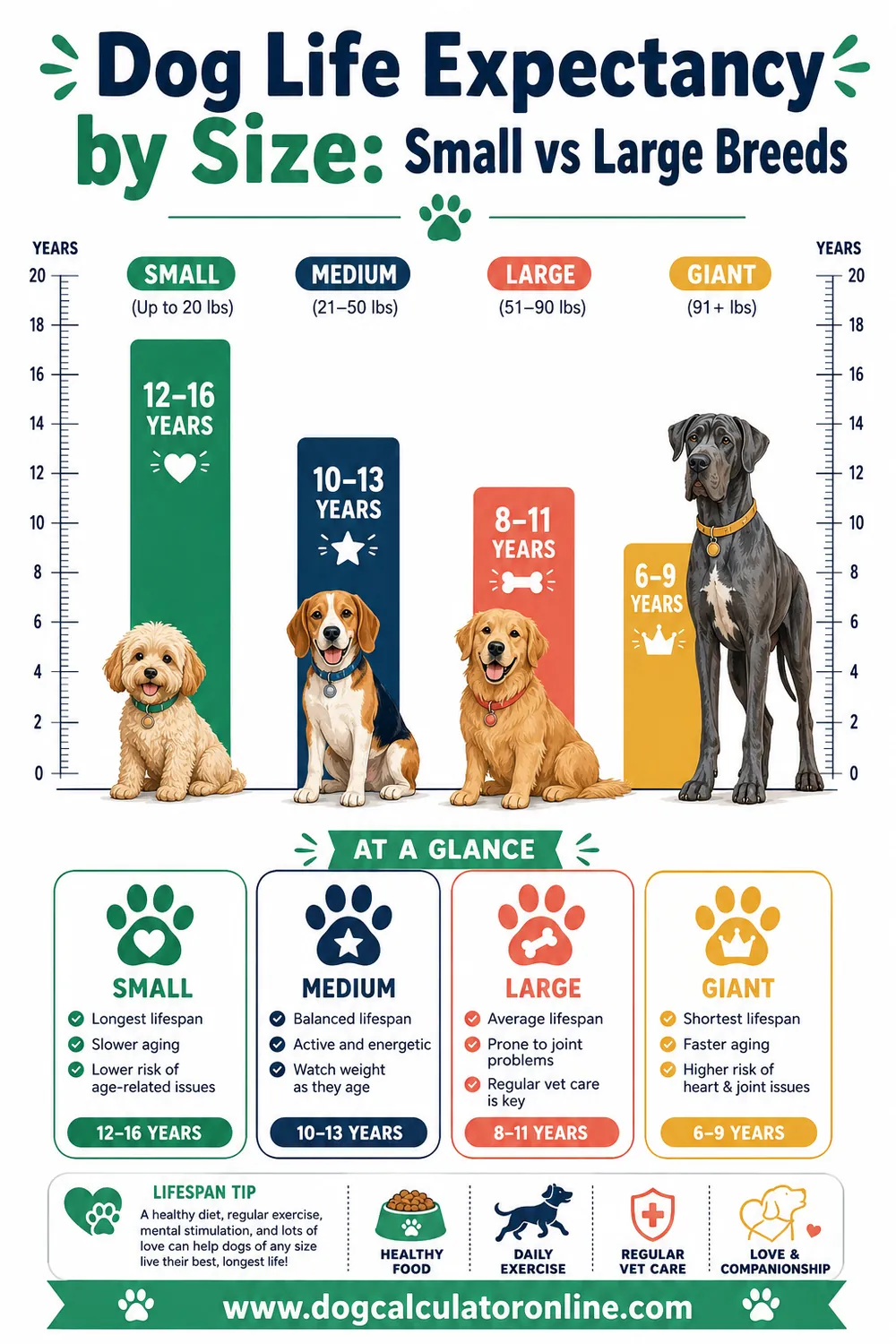
Add to that the general costs of excess weight in any dog: reduced mobility, heat intolerance, higher anaesthetic risk, and a shorter life. Small dogs otherwise have the longest lifespans of any category, which makes weight one of the easiest ways to spend that advantage — the size-lifespan relationship is in dog life expectancy by size.
Target Weights by Breed
| Breed | Typical healthy range | Notes |
|---|---|---|
| Chihuahua | 1.8–2.7 kg (4–6 lb) | Frame varies; some healthy dogs sit above this |
| Yorkshire Terrier | 2–3.2 kg (4.5–7 lb) | Breed standard caps at about 3.2 kg |
| Pomeranian | 1.8–3.2 kg (4–7 lb) | Coat hides body shape almost entirely |
| Maltese | 1.8–3.2 kg (4–7 lb) | Same coat problem |
| Toy Poodle | 2–3.5 kg (4.5–8 lb) | Miniature Poodle is 5–7 kg |
| Shih Tzu | 4–7.5 kg (9–16 lb) | Wide legitimate range |
| Miniature Dachshund | 4–5 kg (9–11 lb) | Standard Dachshund is 7–14 kg |
| Pug | 6.3–8.1 kg (14–18 lb) | Very prone to gain; flat face worsens heat risk |
| French Bulldog | 8–12.5 kg (18–28 lb) | Breed standard caps around 12.7 kg |
| Miniature Schnauzer | 5.4–9 kg (12–20 lb) | Prone to weight-linked pancreatitis |
| West Highland Terrier | 6.8–9.5 kg (15–21 lb) | Dense coat hides gain |
| Jack Russell Terrier | 6–8 kg (13–17 lb) | Working lines run leaner |
| Cavalier King Charles | 5.9–8.2 kg (13–18 lb) | Weight matters for known heart issues |
| Boston Terrier | 4.5–11.3 kg (10–25 lb) | Sold in three weight classes |
The ranges are wide on purpose. Frame size varies within every breed, sex makes a difference of 10–20%, and a dog at the bottom of a range is not necessarily healthier than one at the top. Your dog's own target is set by its frame and condition, not by a chart.
Where the chart is most useful is as a sanity check. A Pug at 12 kg is well outside any legitimate reading of the range and does not need a second opinion to confirm it.
Feel, Do Not Look
The assessment that matters, and the one coats defeat.
Long and dense coats hide body shape completely. A Pomeranian, a Maltese, a Shih Tzu or a Westie can gain 20% of its body weight with no visible change whatsoever. Judging these breeds by eye is close to useless.
So use your hands. Three checks, each taking a few seconds:
Ribs. Run your fingertips along the side of the chest. You should feel each rib easily under a thin layer of covering, without pressing in. If you have to push to find them, there is too much fat. If they feel sharp and prominent, there is too little.
Waist from above. Look down at the dog from directly overhead. There should be a visible narrowing behind the ribcage. A straight line, or bulging outwards, means excess weight. On a heavily coated dog you may need to feel for this rather than see it.
Belly tuck from the side. Viewed side-on, the underline should rise from the ribcage towards the hind legs. A belly that runs level, or sags, indicates excess.
All three together give you a body condition score, which is what vets use, and it is a better measure than any number on a chart.
Do this monthly while grooming, and it becomes automatic.
Weighing a Small Dog Properly
The equipment matters more here than for any other size of dog.
Bathroom scales are not accurate enough. They read to roughly ±0.5 kg, which on a 3 kg dog is 17% — larger than the change you are trying to detect.
Use kitchen scales or baby scales. Put a box or a folded towel on kitchen scales, zero them, then put the dog in. Baby scales are ideal because they are built for something that moves.
Weigh monthly, before a meal, on the same scales.
Write it down. On a small dog the meaningful changes are 100–200 g, and nobody remembers those.
Watch for 5% shifts. On a 4 kg dog that is 200 g — a change worth investigating rather than ignoring. The general method for larger dogs is in how to weigh your dog at home.
Where the Weight Comes From
Almost always the same three sources, and treats lead by a distance.
Treats. A single small dog biscuit can be 30–40 kcal. A toy breed's entire daily requirement may be around 200–350 kcal. Three biscuits and a chew can be a third of the day's calories before the actual meals are counted.
The fix is not to stop treating but to take treats out of the daily food allowance rather than adding them on top. Weigh the day's food in the morning and use part of it as training rewards.
Table scraps. A cube of cheese to a Chihuahua is proportionally an enormous portion. Small dogs live at the same table as everyone else and are fed by more people than their owner realises — this is the source that most often surprises households when they actually count it.
Portion drift. Food scoops are wildly inconsistent, and a "heaped" scoop can be 40% more than a level one. Weigh food on kitchen scales rather than measuring by volume; on a small dog the difference between a level and a heaped scoop is a substantial share of the daily requirement.
And check who else is feeding. In multi-person households, the commonest cause of a small dog gaining is two people each giving a meal.
Once the source is identified, reduction should be gradual and vet-guided rather than abrupt — the practical approach is in how to help a dog lose weight.
Small-Breed Puppies
A different problem, and one with a genuine risk attached.
Toy-breed puppies can develop low blood sugar if meals are spaced too far apart, because they have very small energy reserves. Frequent small meals — often four a day in the early months — matter more in this group than in any other. Your vet or breeder will give a schedule for the specific breed.
They finish growing early. Most toy and small breeds reach adult size by around nine to ten months, considerably before medium and large breeds.
Which means the adult baseline arrives early too. Record the weight once growth stops, and use it as the reference point from then on.
Weigh weekly while growing, using kitchen or baby scales — the changes are small and bathroom scales cannot see them.
Growth is not smooth in any breed; plateaus and spurts are normal, and the pattern is covered in puppy growth spurts explained.
And do not free-feed a small-breed puppy past the point where it is growing. Free feeding is the most common route into adult obesity in this group, because a bowl left down all day is a bowl that gets finished.
Common Mistakes With Small Dogs
Judging by eye on a coated breed. Use your hands.
Using bathroom scales. The error is bigger than the signal.
Treating "small" as "does not need exercise". Small dogs need daily activity as much as any other, scaled to their size.
Adding treats on top of meals rather than taking them out of the allowance.
Measuring food by scoop. Weigh it.
Assuming the breed chart is the target. Frame varies; body condition decides.
Letting several people feed the same dog. Agree who feeds and when.
Ignoring 200 g. On a 4 kg dog that is 5% of its body weight.
Waiting for the annual check to find out. A year is long enough for a small dog to gain a quarter of its body weight.
Comparing against large-breed advice. The proportional math is entirely different — the category-by-category picture is in average dog weight by size category and the ranges in healthy weight range for dogs by size.
FAQ
What is the ideal weight for a small dog?
It depends on the breed and the individual frame — a Chihuahua is typically 1.8–2.7 kg, a Pug 6.3–8.1 kg, a French Bulldog 8–12.5 kg. Body condition is a better test than any chart: you should feel the ribs easily, see a waist from above and a belly tuck from the side.
Why does a kilo matter more on a small dog?
Because it is a much larger proportion of body weight. One kilogram on a 4 kg dog is 25% — equivalent to a 70 kg adult carrying an extra 17 kg. The same kilo on a Labrador is about 3%.
How can I tell if my fluffy small dog is overweight?
By feel, not by sight. Dense coats hide body shape entirely. Run your fingertips along the ribs — you should feel each one easily under a thin covering without pressing — and feel for a waist behind the ribcage.
What scales should I use for a small dog?
Kitchen or baby scales. Bathroom scales are accurate to roughly half a kilogram, which on a 3 kg dog is around 17% and larger than the change you are trying to detect.
Why are small dogs so often overweight?
Mostly treats and portion drift. A single biscuit can be a tenth of a toy breed's daily calories, food scoops vary hugely between level and heaped, and in busy households more than one person often feeds the dog.
How often should I weigh a small dog?
Monthly, before a meal, on the same kitchen or baby scales, and write it down. On a small dog a 200 g change is 5% of body weight and worth noticing.
Small Numbers, Large Changes
Small-breed weight management comes down to accepting that the tolerances are tighter than for any other size of dog. Two hundred grams is a real change on a 4 kg animal, coats hide it entirely, and bathroom scales cannot see it. Weigh monthly on kitchen scales, assess by hand rather than by eye, take treats out of the daily allowance instead of adding them, and weigh food rather than scooping it. Get your dog's specific target with the free dog ideal weight calculator.