How Much Is Pet Insurance per Month? Real Ranges for Dogs
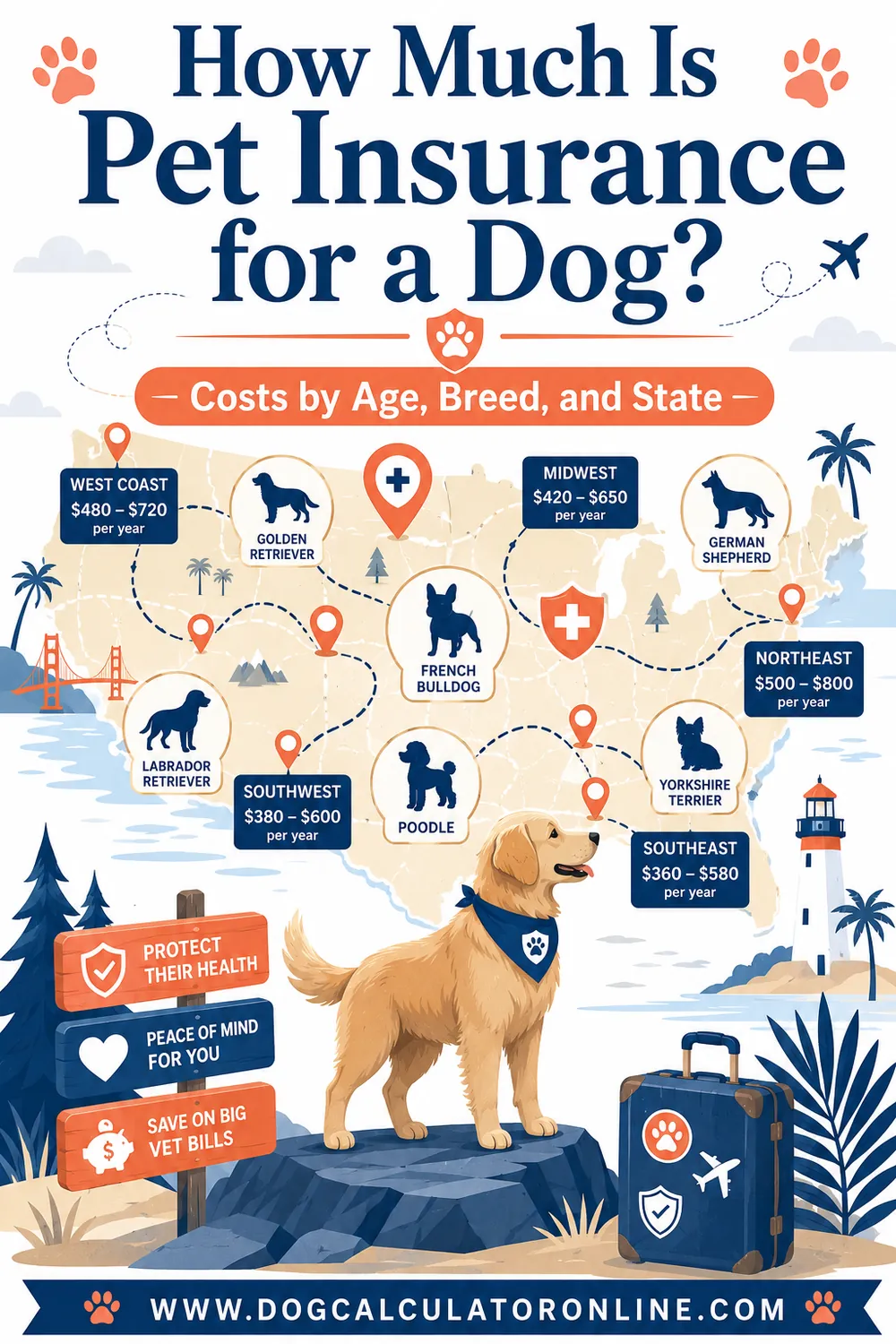
Most US dog owners pay somewhere between $40 and $70 per month for an accident-and-illness pet insurance plan, though real quotes stretch from roughly $25 for a young small-breed dog in a low-cost state to well over $100 for a senior or a high-risk breed. The monthly number is not random — it's built from five factors you can see coming, and three plan dials you control. This guide breaks the whole thing down, and the free dog cost calculator helps you see where a premium fits inside your total dog budget.

The Typical Monthly Cost at a Glance
Here's the honest picture of what dog owners actually pay per month in the US, framed as typical ranges rather than a single misleading average:
| Plan type | Typical monthly range | What it covers |
|---|---|---|
| Accident and illness | $40–$70 | Injuries, illnesses, diagnostics, surgery, hospitalization |
| Accident-only | $15–$25 | Injuries only (broken bones, swallowed objects, wounds) |
| Accident and illness + wellness add-on | $60–$95 | Everything above plus a routine-care allowance |
Two things to keep in mind about these numbers. First, they describe a middle-of-the-road dog — an adult, medium-sized, mixed or moderate-risk breed with standard plan settings. Second, your quote is personal: the same plan can cost twice as much for a French Bulldog in a big city as for a similar-sized mixed breed in a rural area.
The 5 Factors That Set Your Monthly Premium
Insurers price risk, and dog risk is surprisingly predictable. Five inputs do most of the work.
1. Your dog's age
Age is the biggest driver over time. A puppy might be quoted $35 a month; the same dog at age ten could be quoted triple that. Premiums usually rise at renewal each year even if you never file a claim, because an older dog is statistically more likely to need care next year than last year.
2. Breed (or breed mix)
Breeds with well-documented health predispositions — flat-faced breeds with breathing issues, large breeds prone to joint problems, breeds with common skin or eye conditions — get higher quotes. Mixed-breed dogs often land at the cheaper end because their risk is more diluted. If you have a high-risk breed, the gap can be dramatic; our guide to pet insurance costs for a dog walks through breed pricing in more depth.
3. Size
Bigger dogs generally cost more to insure. They need larger medication doses, bigger anesthesia protocols, and more of everything during a hospital stay — and several expensive orthopedic conditions cluster in large breeds.
4. Your location
Vet prices vary a lot by region, and premiums follow local vet prices. Urban areas with high costs of living — and high emergency-clinic fees — produce noticeably higher quotes than lower-cost states and rural areas.
5. The insurer's pricing model
Different companies weigh these factors differently, which is why two quotes for the same dog can differ by $20 a month or more. That spread is exactly why getting multiple quotes matters more than finding a "cheap" brand name.
The 3 Plan Dials You Control
Beyond the factors you can't change, every quote comes with three settings that move the monthly price up or down:
| Dial | Common choices | Effect on monthly cost |
|---|---|---|
| Annual deductible | $250 / $500 / $1,000 | Higher deductible = lower premium |
| Reimbursement rate | 70% / 80% / 90% | Lower rate = lower premium |
| Annual coverage limit | $5,000 / $10,000 / unlimited | Lower limit = lower premium |
Moving from a $250 deductible with 90% reimbursement to a $500 deductible with 80% reimbursement can cut a monthly premium meaningfully — often by a quarter or more — while still protecting you from catastrophic bills. The trade is simple: you accept more of the small-bill pain in exchange for a cheaper month-to-month cost. If those dials feel abstract, our plain-English explainer on pet insurance deductibles shows the math on real bill sizes.
Example Monthly Costs by Dog Profile
To make the ranges concrete, here's how typical quotes tend to shake out for a few common dog profiles with a mid-range plan ($500 deductible, 80% reimbursement, $10,000 annual limit):
| Dog profile | Typical monthly quote |
|---|---|
| 1-year-old small mixed breed, low-cost state | $25–$40 |
| 3-year-old Labrador, average-cost state | $45–$70 |
| 2-year-old French Bulldog, major city | $70–$110 |
| 8-year-old Golden Retriever, average-cost state | $80–$130 |
| 5-year-old medium mixed breed, average-cost state | $40–$60 |
These aren't quotes — they're the shape of the market. Your actual number depends on the exact breed, ZIP code, and insurer. The useful takeaway is the pattern: young + mixed + small + rural sits at the bottom; older + purebred + large or flat-faced + urban sits at the top.
What the Monthly Premium Does NOT Include
A common surprise for new policyholders: the premium isn't the whole cost of using insurance. Budget for these too:
- The deductible. You pay the first $250–$1,000 of covered costs each year (on most plans) before reimbursement starts.
- Your co-insurance share. At 80% reimbursement, you still pay 20% of every covered bill after the deductible.
- Exam fees, on some plans. Some policies don't reimburse the vet's consultation fee, which is typically $50–$150 per visit.
- Everything excluded. Pre-existing conditions, routine care (without a wellness add-on), dental cleanings on many plans, and anything that appears during a waiting period.
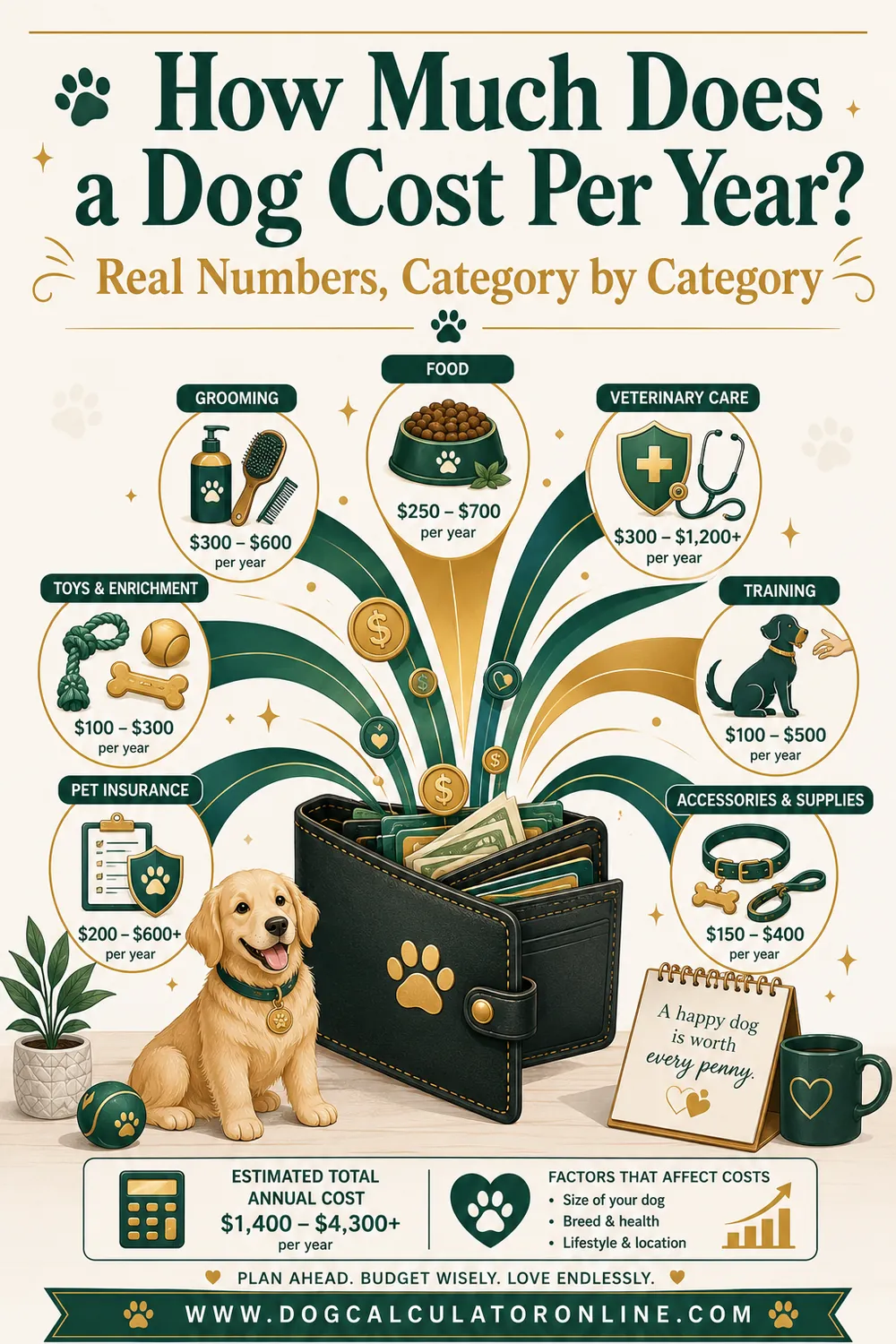
So a $55-per-month plan is really "$660 a year, plus the first $500 of covered bills, plus 20% of the rest." That's still excellent protection against a $6,000 surgery — but it's important to see the whole picture. For the full annual budget including food, routine vet care, and gear, see how much a dog costs per year or run your numbers through the free dog cost calculator.
Why Your Premium Goes Up Every Year
Almost every policyholder notices the same thing at renewal: the price went up. Two forces drive it:
- Your dog got older. Insurers re-rate age at renewal, and age is the strongest predictor of claims.
- Vet care got more expensive. Premiums track local veterinary inflation, which has run hot in recent years.
What generally does not raise your individual premium is filing a claim — most US pet insurers don't penalize individual claims the way car insurers do. But breed-wide and area-wide claim trends absolutely feed into everyone's renewal price.
A practical tip: when the renewal notice stings, adjusting your dials (raising the deductible, dropping from 90% to 80% reimbursement) is usually smarter than canceling outright — because a new policy elsewhere would treat everything your dog has developed so far as pre-existing.
How to Lower Your Monthly Cost Without Gutting Coverage
- Raise the deductible to the highest number you could comfortably pay in a bad month.
- Choose 80% reimbursement instead of 90% — a modest difference on most bills, a real monthly saving.
- Skip the wellness add-on unless the math clearly works; it mostly pre-pays predictable costs with a fee on top.
- Insure early. Locking in coverage while your dog is young and healthy keeps conditions from becoming pre-existing and starts you at the bottom of the age curve.
- Ask about discounts. Multi-pet, annual-pay, and employer or military discounts of 5–10% are common.
- Compare 2–3 quotes with identical settings. Same deductible, same reimbursement, same limit — otherwise you're comparing apples to oranges.
How Location Moves the Monthly Number
Because premiums track local veterinary prices, where you live can matter as much as what dog you have. The pattern across the US is consistent:
| Area type | Effect on premium | Why |
|---|---|---|
| Major coastal metros (NYC, SF, LA, Seattle, Boston) | Highest — often 30–60% above national typical | High clinic overhead, expensive emergency and specialty hospitals |
| Mid-size cities and suburbs | Near the typical $40–$70 band | Moderate vet pricing, good clinic competition |
| Rural areas and low-cost states | Lowest — sometimes 20–30% below typical | Lower clinic costs, fewer specialty facilities |
Two wrinkles worth knowing. First, moving can change your premium at the next renewal — insurers re-rate when your ZIP changes, in either direction. Second, high-cost areas are also where uninsured emergencies hurt most, so the places with the priciest premiums are often the places where coverage does the most work. There's no arbitrage here; the premium and the risk rise together.
What a Decade of Premiums Looks Like
A single month's quote understates the real commitment, so here's the honest long view. Take a dog insured at age one for $45/month with typical annual increases from age and vet inflation:
- Years 1–3: roughly $45–$55/month — the cheap years
- Years 4–6: roughly $55–$75/month — gradual climb
- Years 7–9: roughly $75–$110/month — the steeper senior ramp begins
- Years 10+: often $110–$160+/month — the expensive years, which are also the high-claim years
Summed up, a typical dog insured for life represents roughly $8,000–$15,000 in total premiums over 10–13 years. That's not an argument against insurance — one cancer year or two orthopedic surgeries can match it — but it is the number to weigh honestly against a disciplined savings alternative. Planning for the ramp (rather than being surprised by it) is what keeps owners from canceling at age nine, right before the coverage matters most.
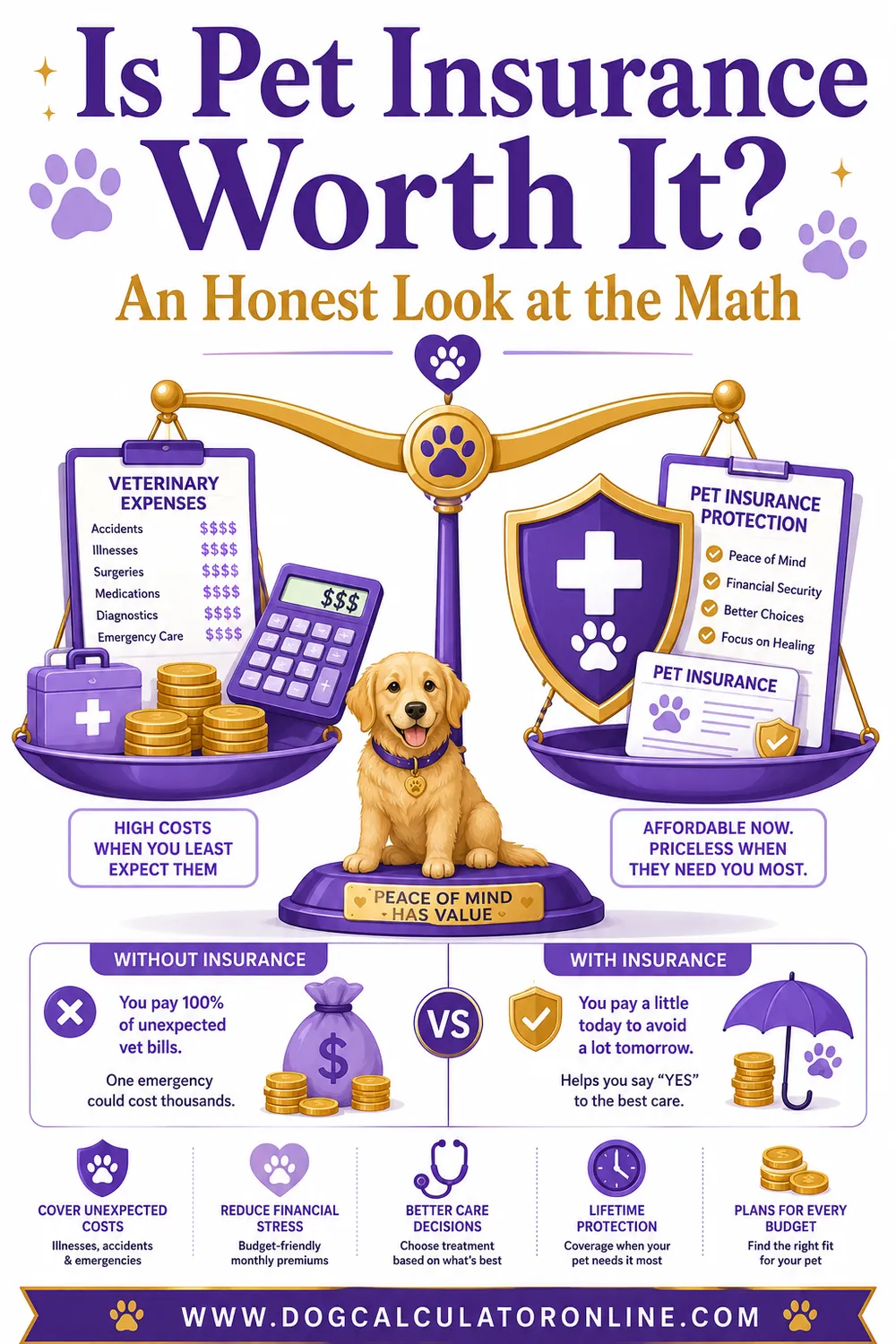
One thing we'd gently steer you away from: picking accident-only coverage just for the price without thinking it through. It's genuinely useful for some owners, but illness claims (skin problems, ear infections, cancer, digestive issues) are among the most common reasons dogs see a vet. If you're weighing that trade, start with whether insurance fits your finances at all — our honest look at whether pet insurance is worth it walks through the decision without a sales agenda.
FAQ
How much is dog insurance per month on average?
Typical accident-and-illness plans for dogs run about $40–$70 per month in the US. Small young dogs in low-cost areas can come in around $25–$35, while seniors and high-risk breeds in expensive cities can exceed $100–$150.
Why is my pet insurance quote so much higher than average?
Usually one of four reasons: an older dog, a breed with documented health risks, an expensive ZIP code, or generous plan settings (low deductible, 90% reimbursement, unlimited annual coverage). Adjusting the plan dials is the fastest way to bring a quote down.
Is it cheaper to pay pet insurance monthly or annually?
Many insurers offer a small discount — or waive transaction fees — if you pay annually instead of monthly. The coverage is identical; it's purely a billing choice. If the annual lump sum doesn't strain your budget, it's usually the slightly cheaper route.
Does the monthly price stay the same as my dog ages?
No. Expect the premium to rise at renewal most years, both because your dog is older and because vet costs rise. Budgeting for gradual increases — especially from age seven onward — keeps the renewal letter from being a shock.
Is accident-only insurance worth the lower monthly price?
It can be, if your main fear is a catastrophic injury and you can self-fund illness care. But illness is the more common claim category over a dog's life, so treat accident-only as a deliberate budget choice, not a bargain version of full coverage.
How do I know what pet insurance should cost for my specific dog?
Get two or three real quotes using your dog's exact breed, age, and ZIP code with identical plan settings. Then put that premium alongside food, routine care, and the rest of your budget in the free dog cost calculator to see the complete monthly picture.
The Bottom Line
Pet insurance for a dog typically costs $40–$70 a month, but your number is set by age, breed, size, location, and the three plan dials you choose. Know the ranges, compare identical quotes, and make the premium a deliberate line in your dog budget rather than a mystery. Total up everything your dog costs — insurance included — with the free dog cost calculator, and you'll know exactly what the monthly bill should be before any salesperson tells you.