Is Pet Insurance Worth It for a Healthy Dog?
Here's the paradox: a healthy dog is exactly when insurance feels most pointless — and exactly when it's cheapest and most complete. Premiums for a healthy adult run a typical $40–$70 per month, nothing is excluded as pre-existing, and every condition that ever develops will be covered for life if the policy stays active. Whether that's worth paying for a dog who never seems to need a vet comes down to your savings, your breed, and your honesty about both. This guide gives you the decision straight, with no carrier pitches — and the free dog cost calculator shows how a premium fits your dog's full budget.
The Short Answer
For a healthy dog, insurance is worth it if a sudden $3,000–$6,000 bill would hurt — because "healthy" describes your dog's past, and insurance covers the future. It's not worth it if you hold (and will maintain) an emergency fund that could absorb that bill, and you'd rather keep the premium surplus in the lucky years. The healthy-dog discount isn't a discount on the decision — it's better terms on whichever side you pick: cheapest premiums and zero exclusions if you insure, or maximum time to build savings if you don't.
"Healthy" Is a Rearview Mirror
The core error in "my dog is healthy, why pay?" is that insurance doesn't price yesterday — it prices tomorrow. Three uncomfortable truths:
- Accidents ignore health entirely. The fittest dog at the park is one squirrel-chase away from a $4,000 cruciate tear or a swallowed tennis-ball half. Injury risk correlates with energy, not illness.
- Most conditions announce themselves once. Allergies, thyroid disease, diabetes, cancer — each has a first day, and before that day every dog looks healthy. After that day, the condition is pre-existing on any new policy, forever. The exclusion mechanics in our pre-existing conditions guide are the reason timing dominates this decision.
- The healthy years are the buy-in window. Insurance is like a club that only admits people who don't currently need it. That's not a scam — it's the only way risk-pooling works — but it means the "waste" of premiums during healthy years is precisely what purchases coverage for the unhealthy ones.
The Case for Insuring While Healthy
- Lowest premiums you'll ever see. Quotes rise with every birthday. Locking in as a healthy young adult starts you at the bottom of the curve; typical ranges by age are in our monthly cost guide.
- A completely clean policy. No exclusions, no gray areas, no records-review surprises. Every future condition — including breed-typical ones like hip dysplasia or heart disease — is coverable because none has appeared yet.
- Lifetime lock-in. Develop a chronic condition in year two, and it's covered in year ten — as long as the policy never lapses. Owners who wait until "something seems off" discover that the something is excluded and everything related to it too.
- Predictability. A fixed monthly cost replaces an unknowable disaster. For many households that certainty is worth money on its own.
The Case for Skipping It (Honestly Stated)
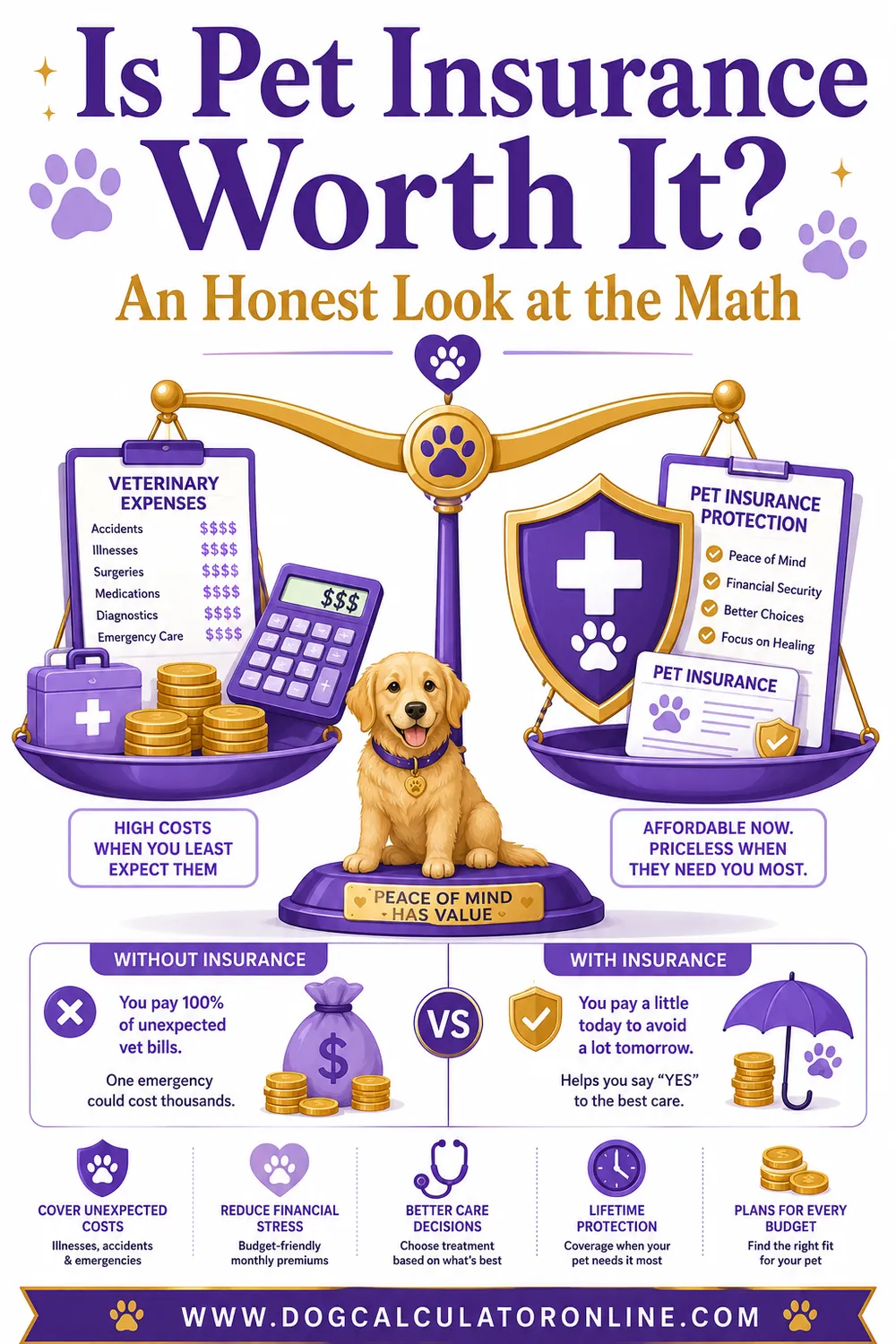
- Expected value favors the insurer. Premiums fund payouts and overhead; the average policyholder gets back less than they pay in. Insurance is a bad bet on average — you buy it for the unaffordable tail, not the average.
- A funded account keeps the surplus. $50/month autotransferred is $600/year, $3,000 in five years — yours forever if the luck holds, and spendable on excluded things (dental cleanings, routine care) that insurance never touches. The full head-to-head, including the failure modes of each, is in pet insurance vs a savings account.
- You might genuinely be able to self-insure. With $5,000+ liquid and the discipline to replenish it, a healthy dog is the best possible candidate for self-insurance — you have time to compound before the risky senior years.
- The catch: the savings plan is only real if the transfers are automatic and the fund is untouchable. A "mental" emergency fund that also buys vacations is just being uninsured with extra steps.
The Deciding Questions
Run through these in order; the first "no" usually settles it:
- Could you pay a $5,000 vet bill tomorrow without debt or delay? No → insure while the terms are this good.
- Is your breed on the expensive-risk list (flat-faced breeds, giants, breeds with known joint/heart/skin issues)? Yes → the odds of using coverage rise, and so does the value of enrolling pre-symptoms.
- Will you truly automate the savings — seeded now, funded monthly, ring-fenced? No → the premium is the more honest version of the same money.
- Does the unknown-bill anxiety cost you sleep? Insurance converts anxiety into arithmetic; that's a legitimate purchase.
If you sailed through all four with confident yeses — solid fund, low-risk mixed breed, iron discipline, calm nerves — self-insuring a healthy dog is a rational, defensible choice. Most people don't sail through all four.
One more honesty check before you decide: ask what you'd actually do at the emergency vet's counter when the estimate reads $5,800. Owners who would pay anything, instantly, are the ones insurance serves best — it converts an inevitable "yes" into a manageable cost. Owners who would genuinely weigh euthanasia or decline treatment over money face a harder, more personal question that no policy answers. Know which owner you are while your dog is healthy; the counter is a terrible place to find out.
The Ten-Year Ledger, Both Routes
Here's what a healthy 2-year-old's next decade looks like under each strategy, assuming a $55/month premium (rising with age) versus a $55/month savings transfer:
| Outcome over 10 years | Insured owner | Savings owner |
|---|---|---|
| Total set aside | ~$8,000–$10,000 in premiums | ~$6,600 saved + interest |
| Lucky decade (minor claims only) | Money spent; peace of mind received | Keeps ~$6,000+ |
| One $6,000 emergency in year 4 | Reimbursed ~$4,400; barely notices | Fund covers it, but drops to ~$500 and must rebuild from zero |
| Chronic illness from year 5 ($2,500/yr) | Covered at 80% for life; comes out far ahead | Fund exhausted by year 7; pays cash thereafter |
| Two big events back-to-back | Covered both times | The strategy's failure mode: the second event hits an empty fund |
The table exposes the real difference: savings handle one bad event gracefully; insurance handles repeated or sustained bad luck. A healthy dog makes the lucky-decade row more likely — but "more likely" is doing all the work in that sentence, and nobody gets to pick their row.
The hybrid strategy nobody markets
There's a defensible middle path: a high-deductible ($1,000), 80–90% policy — the cheapest real coverage — plus a smaller automatic savings transfer to cover the deductible and routine care. You cap the catastrophe with insurance and self-fund the predictable layer. For healthy dogs especially, this usually beats both pure strategies on total protection per dollar, at the cost of requiring slightly more setup. If you like the idea, price the high-deductible tier first; it's often surprisingly close to accident-only money.
If You Insure a Healthy Dog: Set It Up Smart
- Choose accident-and-illness, not accident-only; illness coverage is the part that becomes irreplaceable once symptoms ever appear.
- Take a higher deductible ($500–$1,000) with a strong reimbursement rate (80–90%). A healthy dog's rare claims skew catastrophic, which is exactly the profile a high-deductible, high-rate plan handles best.
- Skip the wellness add-on unless its arithmetic clearly beats paying routine care directly. Vaccines and annual exams are predictable; a healthy dog's budget handles them fine without an insurer in the middle taking a fee.
- Never lapse. The entire value you're accumulating — the clean, exclusion-free history — evaporates with a missed renewal.
- Re-shop only while still healthy. Switching insurers is nearly free for a condition-free dog and costly after the first diagnosis. Set a calendar reminder to compare quotes annually until anything appears in the chart — then stop shopping and hold the policy you have, because from that day forward, continuity is the asset.
And whichever route you take, give the money a job in your written budget. Premium or savings transfer, it's a permanent line item — the free dog cost calculator will show you how it stacks against food, routine vet care, and the rest, and the dog age calculator tells you how many low-premium years your dog likely has left.
FAQ
Is pet insurance a waste of money for a healthy dog?
It's only a "waste" in the years nothing happens — which is true of every insurance product you own. The honest framing: you're paying today's lowest possible price for coverage of conditions that haven't announced themselves yet. Whether that beats self-funding depends on your savings and discipline.
What does pet insurance cost for a healthy adult dog?
Typically $40–$70 per month for accident-and-illness coverage in the US, with small young mixed breeds in low-cost areas sometimes under $35. Health history barely moves the quote — age, breed, and location do.
If my dog never gets sick, do I get anything back?
No — standard pet insurance has no refund or no-claims bonus. The product you received was risk transfer: every insured month, a catastrophic bill couldn't ruin you. If you want the surplus back in lucky years, the savings-account strategy is the alternative.
When does it stop making sense to start a policy?
The value of a new policy declines with each diagnosis added to the chart, since each becomes an exclusion. Practically, the tipping point is the first chronic condition — after that, compare what's still coverable against the premium before buying.
Should a healthy dog get accident-only insurance to save money?
It's cheaper (~$15–$25/month) but skips illness — the category most likely to generate lifetime claims. For a healthy young dog, the small premium gap buys the half of coverage you can't add back later once symptoms appear. Accident-only fits best as a budget floor or senior fallback.
Is it better to insure young and healthy or wait until my dog is older?
Insure young, if you're going to insure at all. Waiting raises the premium, shrinks coverage through accumulated exclusions, and risks the one diagnosis that makes the whole question moot. The worst-value policy is the one bought right after the first big vet visit.
The Bottom Line
A healthy dog doesn't make insurance unnecessary — it makes it cheap and complete, which is the only time it's truly worth buying. Insure now and never lapse, or self-insure with a seeded, automated, untouchable fund. The indefensible middle path is drifting uncovered with good intentions until the first diagnosis closes the window. Decide this week, put the number in your budget, and let the free dog cost calculator show you the whole financial picture in one place.