Pet Insurance vs a Savings Account
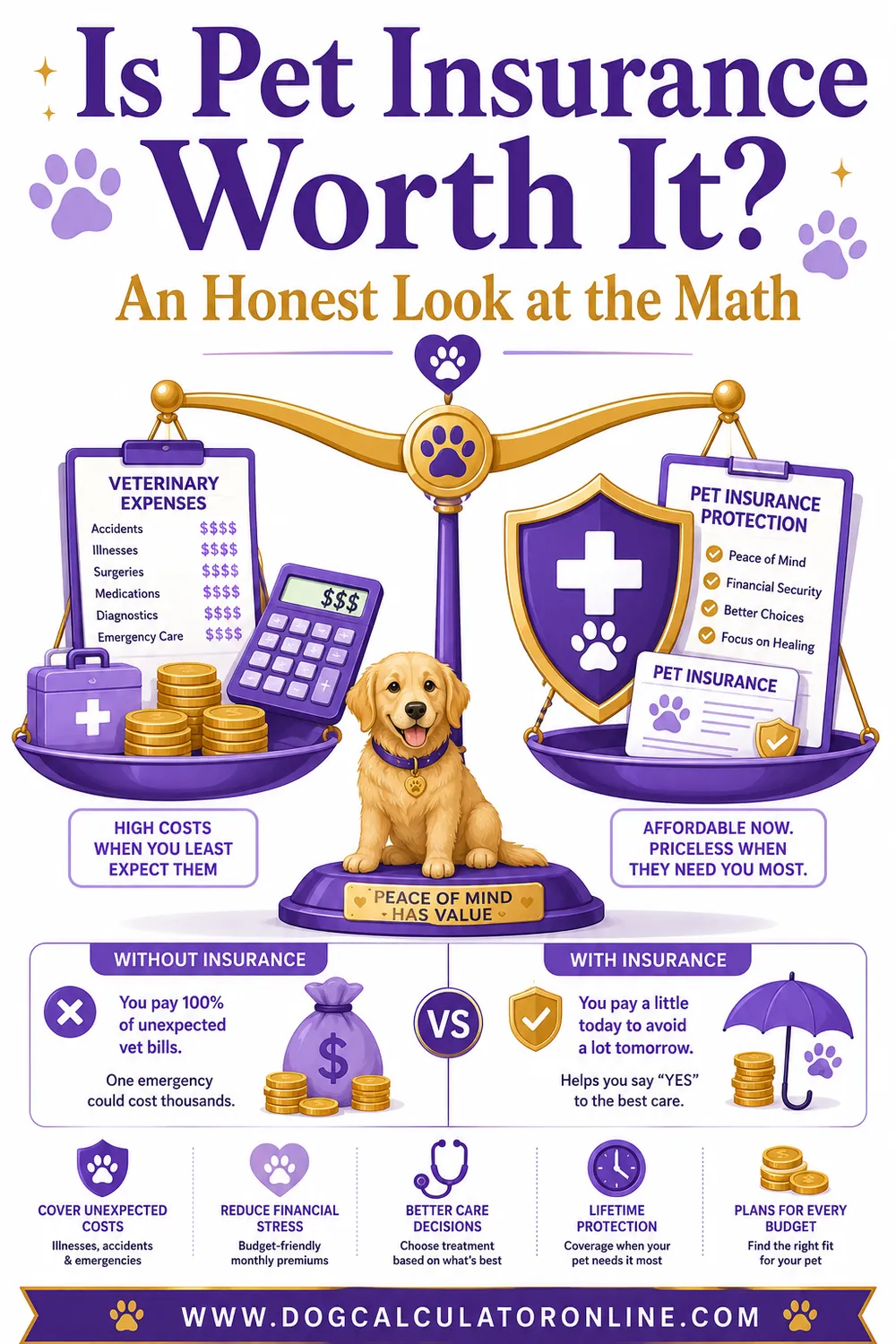
Both strategies can work, and neither is free money. A dedicated savings account beats pet insurance if you seed it early, fund it every month, and never raid it — because in the lucky scenario where your dog stays healthy, you keep every dollar. Insurance beats savings when a catastrophic bill lands early, before a fund could possibly have grown large enough, and that early-timing risk is exactly what a premium buys off. The honest comparison isn't "which is cheaper" but "which failure can you live with" — and the numbers below walk through both. Before you pick a side, it helps to know what your dog actually costs in a normal year; the free dog cost calculator gives you that baseline in about a minute.
What Are You Actually Comparing?
Strip away the marketing and the two strategies are answers to the same question: where will the money come from when the vet hands you a four-figure estimate?
Pet insurance converts an unknown, unlimited risk into a known monthly cost. You pay a premium — typically $40–$70 per month for an adult dog on an accident-and-illness plan — and in exchange the insurer reimburses a percentage of covered vet bills after a deductible, up to an annual cap. Our monthly cost guide breaks down the typical ranges by dog and plan.
Self-insuring with a savings account means paying yourself that same premium. You open a separate account, automate a monthly transfer, and treat the balance as untouchable except for vet bills. There's no deductible, no claim forms, no exclusions, and no company deciding what counts — but there's also no backstop beyond whatever the account holds on the day you need it.
Both are legitimate. Vets see both work and both fail every week. The failures just look different: the insurance failure is decades of premiums for a dog who never needed them, while the savings failure is a $5,000 surgery quote against an $800 balance — and that second failure sometimes ends with a treatable dog being euthanized for money reasons. Keeping the size of each downside in view is what makes the comparison honest.
When Does a Savings Account Beat Insurance?
The savings route wins on flexibility and on the lucky path, and the advantages are real:
- You keep the surplus. Deposit $60 a month for ten years and you've set aside $7,200. If your dog's worst incident was a $900 gastro episode, roughly $6,000 of that is still your money. Ten years of premiums at the same rate are simply spent.
- Everything is "covered." A fund doesn't care about pre-existing conditions, waiting periods, exam fees, food, dental cleanings, or breed exclusions. It's cash. The fine print that fills our pre-existing conditions guide doesn't apply to your own account.
- No claim risk. There's no scenario where your own savings account denies reimbursement, disputes whether a limp was "bilateral," or raises your rate after a claim.
- One fund can back multiple pets. A household emergency fund scales across two or three animals in a way per-pet premiums don't — with the obvious caveat that two emergencies in one year drain it twice as fast.
- It earns instead of costing. Parked in a high-yield savings account, the balance grows a little each year instead of disappearing.
But notice what every advantage assumes: the fund exists and is funded. Self-insurance is a discipline product. It works beautifully for people who automate the transfer, seed it with a starting lump sum, and genuinely treat it as spoken-for money. It fails quietly for everyone who means to start next month, or who borrows $400 from it for a car repair and never tops it back up. If you're honest with yourself about which person you are, you already know half the answer.
When Does Insurance Beat the Savings Account?
Insurance wins in three specific situations, and they're worth spelling out because none of them are rare.
1. The emergency comes early. This is the decisive one. A swallowed toy at eight months costs $2,000–$5,000 to remove surgically. A savings plan started at adoption holds maybe $300–$600 by then. Insurance coverage, once past its waiting periods, pays the same in month six as in year six. Savings needs years to mature; risk doesn't wait for it. This is the core argument in the broader is pet insurance worth it question, and it's strongest for puppies and newly adopted dogs.
2. The problem is chronic, not one-time. A fund can absorb one bad event. Chronic conditions — allergies, diabetes, arthritis, heart disease — bill every year for the rest of the dog's life. Lifetime costs for a chronic condition can run well into five figures, and a policy that renews the full annual limit every year is built for exactly that shape of cost. A savings account hit by a chronic diagnosis in year three never gets a chance to recover.
3. The worst case exceeds anything you'd realistically save. Emergency surgery plus ICU time, or cancer treatment with a veterinary oncologist, can run $10,000–$15,000+. Very few owners ever accumulate that in a pet-specific fund. Insurance is the only version of this comparison with a genuinely high ceiling — you're renting access to sums you haven't saved yet.
There's also a quieter, human advantage: at the emergency clinic, insured owners make medical decisions and self-insured owners make financial ones. Deciding "yes, do the surgery" is easier when you know 80% comes back. That's not math, but anyone who's stood at that counter at 2 a.m. will tell you it's not nothing.
What Does the Honest Math Look Like?
Here's a ten-year comparison for a medium-sized dog, using realistic mid-range numbers: a $55/month premium (rising with age), versus $55/month into savings. The insurance column assumes a typical plan — $500 deductible, 80% reimbursement — mechanics explained in our deductible guide.
| Scenario over 10 years | Savings account result | Insurance result |
|---|---|---|
| Lucky dog — nothing over $500 ever | ~$6,600 saved, nearly all still yours | ~$8,000–$10,000 in premiums spent, little reimbursed |
| One big event, year 7 — $5,000 surgery | Fund holds ~$4,600; covers most of it, then rebuilds | You pay ~$1,400 of the bill; premiums still total more overall |
| One big event, year 1 — $5,000 surgery | Fund holds ~$600; you're ~$4,400 short, likely into debt | You pay ~$1,400; insurance clearly wins |
| Chronic illness from year 3 — $2,500/year for life | Fund drains by year 5, then it’s out-of-pocket forever | Policy reimburses ~$1,600/year of it, every year |
| Catastrophe — $12,000 cancer treatment, year 6 | Fund holds ~$3,900; you’re ~$8,000 short | You pay ~$2,900 (deductible + 20% share) |
Read the table honestly and the pattern is clear. Savings wins the top row — the most common single outcome — and wins it by thousands. Insurance wins every row where the bill is early, repeated, or huge, and wins those by more. That asymmetry is the entire decision: self-insuring is a bet that your dog lands in row one or two, made with money you can see; insurance is a hedge against rows three through five, paid for with money you'll probably never get back.
Two footnotes keep the math honest. First, premiums rise as your dog ages — the factors are covered in what affects your premium — so the ten-year premium total is higher than a flat $55/month suggests. Second, savings balances above assume you never skip a month and never borrow from the fund. Real accounts leak; real premiums don't get to.
What Is the Early-Gap Problem, and How Do You Fix It?
The single biggest flaw in the savings strategy deserves its own section, because it's fixable.
Every savings plan has a window — usually the first two to three years — where the balance is too small to survive a real emergency. That window happens to overlap with the accident-heavy phase of a dog's life: puppies and adolescent dogs swallow things, jump off things, and eat things at rates adult dogs don't. The strategy is weakest exactly when the risk is highest.
If you choose the savings route, close the gap deliberately:
- Seed the account with a lump sum on day one. $1,000–$2,000 up front changes the fund from a promise into an actual buffer. If you can't seed it, that's a strong signal insurance fits your situation better right now.
- Automate the transfer. Same day as payday, no manual step. Funds that rely on remembering don't survive year two.
- Set a floor you never cross. The fund pays for emergencies, not grooming, not food, not the boarding bill for your vacation.
- Consider bridge insurance. Some owners carry an accident-and-illness policy for the first two or three years — the cheap, high-risk years — then drop it once the fund clears $5,000. It's a reasonable hybrid, with one important caveat covered next.
Can You Do Both?
Yes, and the combination is arguably stronger than either strategy alone — because they fail in opposite directions.
A common pairing: a high-deductible insurance policy (a $750–$1,000 deductible cuts the premium meaningfully) plus a modest savings fund whose job is to cover that deductible and your reimbursement share. The policy handles the catastrophic ceiling; the fund handles the out-of-pocket floor and everything insurance doesn't touch — exam fees, food, dental cleanings, the uncovered 20%. You get the fund's flexibility and the policy's ceiling, at a total monthly cost usually below a rich policy plus nothing saved.
One warning if you plan to "insure now, cancel later": cancellation has a hidden cost. Every condition noted in your dog's chart while insured becomes pre-existing on any future policy. Dropping coverage at age six means you can't cleanly buy it back at age nine when the risk curve steepens. Treat canceling as a one-way door, and reread the pre-existing conditions guide before walking through it.
How Do You Actually Choose?
Four questions settle it for most people:
- Could you pay a $5,000 vet bill tomorrow without debt? If no, insure — you're the person the early-gap problem hurts most. If yes, keep going.
- Will you honestly seed and automate a dedicated fund, starting this week? Not "plan to" — will you? If no, insure. Good intentions are not a strategy.
- Is your dog young, or a breed with known expensive risks? Early accidents and hereditary conditions both tilt the math toward insurance, especially since enrolling before symptoms is the only way those conditions ever get covered.
- Which regret is worse for you: paying years of premiums for a healthy dog, or facing a huge bill with a half-built fund? There's no wrong answer — but there is an answer that's true for you, and it matters more than any table.
Temperament counts too. Insurance is partly a peace-of-mind product; some owners sleep better with a capped downside and consider the premium money well spent even in the lucky scenario. Others resent every unreimbursed dollar. Neither instinct is wrong. The only genuinely wrong choice is the default one — no policy and no fund — which is where a surprising number of owners quietly sit.
Frequently Asked Questions
Is it better to get pet insurance or save the money?
It depends on timing and discipline. Savings wins if your dog stays mostly healthy and you genuinely fund the account from day one — you keep the surplus. Insurance wins if a big bill arrives early, becomes chronic, or exceeds what you'd realistically save. Owners who can't absorb a $5,000 surprise today are usually better off insured.
How much should I save monthly instead of buying pet insurance?
Match or beat the premium you'd have paid — typically $40–$70 per month for an adult dog — and seed the account with $1,000–$2,000 up front. The seed money matters more than the monthly rate, because it covers the early years when the fund would otherwise be too small to help.
What is the biggest risk of self-insuring a pet?
An early catastrophe. A fund started at adoption holds only a few hundred dollars in year one, while a swallowed object or broken leg can cost $2,000–$5,000 immediately. The second risk is discipline: funds that get borrowed from for non-vet expenses rarely recover.
Can I cancel pet insurance once my savings are big enough?
You can, but everything diagnosed while you were insured becomes a pre-existing condition on any future policy, so buying coverage back later gets harder and less useful. If you plan to cancel at a savings milestone, pick that number in advance and understand you're likely leaving insurance permanently.
Does a savings account cover things pet insurance won't?
Yes — that's one of its real advantages. Cash pays for pre-existing conditions, exam fees, routine and dental care, food, boarding, and anything else, with no waiting periods or exclusions. Insurance only reimburses covered accidents and illnesses under the plan's terms.
Is a combination of insurance and savings a good idea?
Often, yes. A high-deductible policy keeps the premium low while capping catastrophic risk, and a modest fund covers the deductible, your reimbursement share, and everything outside the policy. The two strategies fail in opposite directions, so pairing them covers both failure modes.
The Bottom Line
Self-insuring is a real strategy, not a cop-out — but only the funded, automated, never-borrowed-from version of it. Insurance is a real hedge, not a scam — but it's a hedge, and in the most common outcome you'll pay more in than you get back. Choose based on which failure you can survive: a thin fund meeting an early emergency, or years of premiums for a dog who never needed them. Whatever you pick, put real numbers behind it — the free dog cost calculator shows what your dog costs in a normal year, which is the baseline every good decision starts from.